
Leviticus 1:7

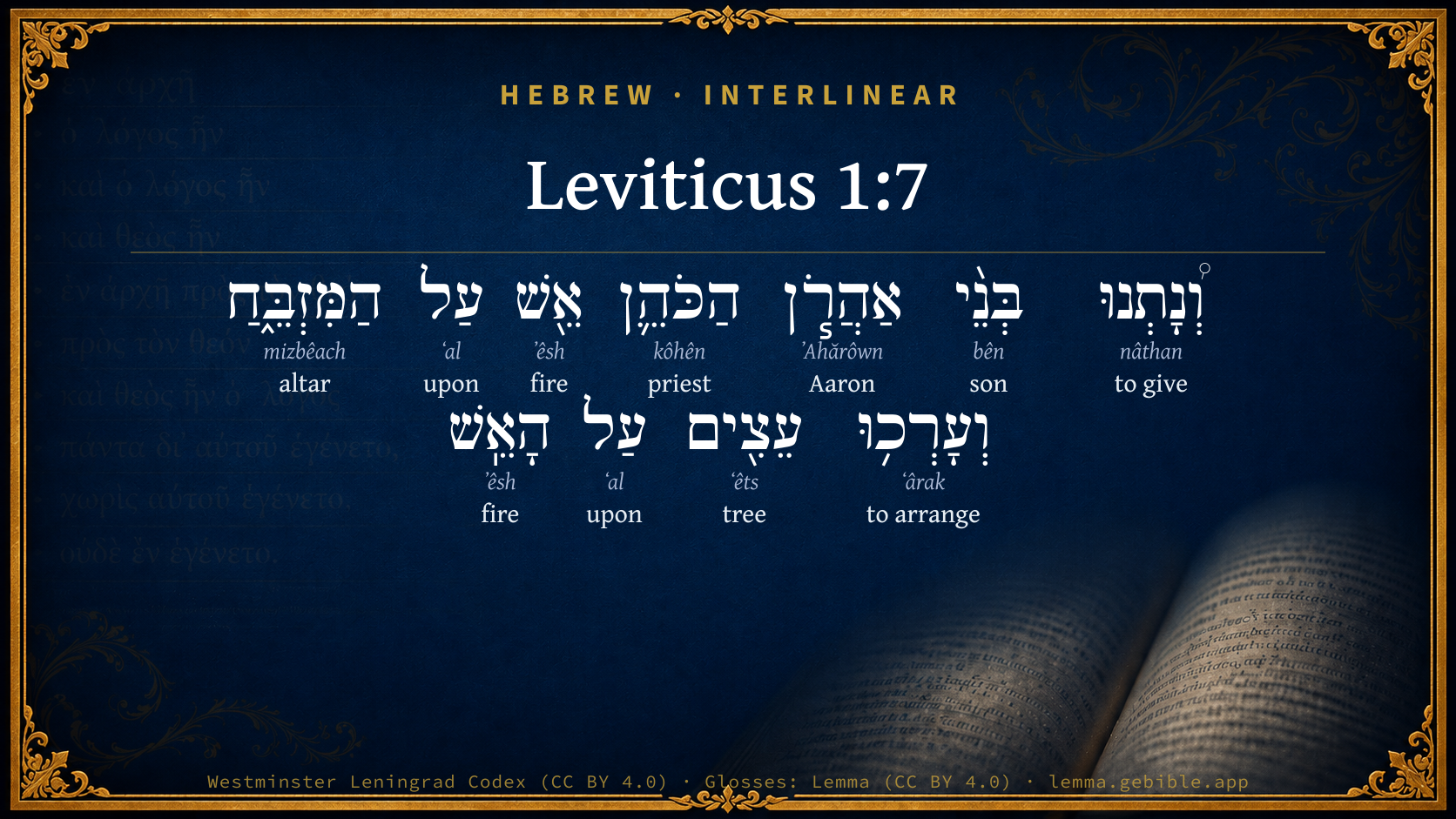
Hebrew (Westminster Leningrad Codex) Leviticus 1:7 appears in the Hebrew Old Testament. The text above is from the Westminster Leningrad Codex. Each word links to its Strong’s number, a concise gloss, and parsing drawn from the Open Scriptures Hebrew Bible morphology. Click any word for its full Brown-Driver-Briggs (BDB) entry.
Download image
Cite this verse

Leviticus 1:7 (World English Bible). Public Domain. Lemma interlinear Bible study tool, https://lemma.gebible.app/v/leviticus/1/7.

Show BibTeX & RIS
BibTeX
RIS
English Translation
The sons of Aaron the priest shall put fire on the altar, and lay wood in order on the fire;
World English Bible · Public Domain
Download a study sheet

One document with this verse’s original text, its word-by-word gloss line, the meaning frame, cross-references with their text, attributed commentary, and full source and license credits — printable, and it pastes into notes with its structure intact.

This verse Autodidact and up

Study sheet (.html) Plain text (.txt)

A passage Seminary Student

Up to 50 verses in one chapter. A passage sheet keeps up to 6 commentary sources and 12 cross-references per verse, in the order this page ranks them, and says so on the sheet whenever that leaves anything out. Ask for a single verse and you get the Autodidact verse sheet above.

Everything on this page stays free to read, with no account — the sheet is a download of what is already on screen, not access to it.

Want to remove ads? Support Godless Engineer
Compare translations 3

The same verse in 3 English versions, stacked beneath the original-language interlinear above. Click any original word for its lexicon entry.

Each is an independent rendering of the whole verse — the interlinear is not word-aligned to these translations.

Highlighted words mark where these versions differ — a whole-verse word diff, not a word-by-word alignment.

  • World English Bible Public Domain
    The sons of Aaron the priest shall put fire on the altar, and lay wood in order on the fire;
  • King James Version Public Domain
    And the sons of Aaron the priest shall put fire upon the altar, and lay the wood in order upon the fire:
  • unfoldingWord Literal Text CC BY-SA 4.0
    And the sons of Aaron the priest shall put fire on the altar, and they shall arrange wood on the fire.

unfoldingWord Literal Text — © unfoldingWord, licensed CC BY-SA 4.0. Word-aligned USFM3 via Door43 (git.door43.org/unfoldingWord/en_ult).

Versions to compare (up to 4)

3 of 4 selected

Show all 18 translations

Every available English version of this verse, each an independent rendering of the whole verse.

  • World English Bible Public Domain
    The sons of Aaron the priest shall put fire on the altar, and lay wood in order on the fire;
  • Berean Standard Bible Public Domain
    The sons of Aaron the priest shall put a fire on the altar and arrange wood on the fire.
  • Majority Standard Bible Public Domain
    The sons of Aaron the priest shall put a fire on the altar and arrange wood on the fire.
  • King James Version Public Domain
    And the sons of Aaron the priest shall put fire upon the altar, and lay the wood in order upon the fire:
  • American Standard Version (1901) Public Domain
    And the sons of Aaron the priest shall put fire upon the altar, and lay wood in order upon the fire;
  • Revised Version (1885) Public Domain
    And the sons of Aaron the priest shall put fire upon the altar, and lay wood in order upon the fire:
  • Geneva Bible (1599) Public Domain
    So the sonnes of Aaron the Priest shall put fire vpon the altar, and lay the wood in order vpon the fire.
  • Douay-Rheims (1899) Public Domain
    And shall put fire on the altar, having before laid in order a pile of wood:
  • Young's Literal Translation Public Domain
    and the sons of Aaron the priest have put fire on the altar, and arranged wood on the fire;
  • Literal Standard Version CC BY-SA 4.0
    and the sons of Aaron the priest have put fire on the altar, and arranged wood on the fire;
  • Unlocked Literal Bible CC BY-SA 4.0
    Then the sons of Aaron the priest will put fire on the altar and place wood to feed the fire.
  • unfoldingWord Literal Text CC BY-SA 4.0
    And the sons of Aaron the priest shall put fire on the altar, and they shall arrange wood on the fire.
  • Darby Bible Public Domain
    And the sons of Aaron the priest shall put fire on the altar, and lay wood in order on the fire;
  • World Messianic Bible Public Domain
    The sons of Aaron the priest shall put fire on the altar, and lay wood in order on the fire;
  • Webster's Bible Public Domain
    And the sons of Aaron the priest shall put fire upon the altar, and lay the wood in order upon the fire.
  • Free Bible Version CC BY-SA 4.0
    The sons of Aaron the priest shall start a fire on the altar and put wood on it.
  • Bible in Basic English Public Domain
    And Aaron's sons, the priests, are to put fire on the altar and put the wood in order on the fire:
  • JPS Tanakh (1917) Public Domain
    And the sons of Aaron the priest shall put fire upon the altar, and lay wood in order upon the fire.

Literal Standard Version (2020), Covenant Press — licensed CC BY-SA 4.0. Text via the HelloAO Bible API (eBible.org). Unlocked Literal Bible (unfoldingWord) — licensed CC BY-SA 4.0. Text via the HelloAO Bible API (eBible.org). unfoldingWord Literal Text — © unfoldingWord, licensed CC BY-SA 4.0. Word-aligned USFM3 via Door43 (git.door43.org/unfoldingWord/en_ult). Free Bible Version, Dr. Jonathan Gallagher — licensed CC BY-SA 4.0. Text via the HelloAO Bible API (eBible.org).

Word by word

More ways to search: Search by grammar → Find every occurrence → Compare this word →

Practice this passage: Drill this verse → Learn its vocabulary →

וְעָרְכ֥וּ
ʻârak
H6186
“and · to arrange”
Conjunction + Verb, Qal, Sequential Perfect, 3rd Person, Common, Plural
Part of Speech
Conjunction + Verb
Stem
Qal
Form
Sequential Perfect
Person
3rd Person
Gender
Common
Number
Plural
Full BDB Definition

Origin: a primitive root

TWOT: 1694

to arrange, set or put or lay in order, set in array, prepare, order, ordain, handle, furnish, esteem, equal, direct, compare - (Qal) - to arrange or set or lay in order, arrange, state in order, set forth (a legal case), set in place - to compare, be comparable - (Hiphil) to value, tax
  1. וְ֠נָתְנוּ nâthan H5414 “and · to give” Conjunction + Verb, Qal, Sequential Perfect, 3rd Person, Common, Plural
  2. בְּנֵ֨י bên H1121 “sons of” Noun, Common, Masculine, Plural, Construct
  3. אַהֲרֹ֧ן ʼAhărôwn H175 “Aaron” Noun, Proper
  4. הַכֹּהֵ֛ן kôhên H3548 “the · priest” Particle, Definite Article + Noun, Common, Masculine, Singular, Absolute
  5. אֵ֖שׁ ʼêsh H784 “fire” Noun, Common, Both, Singular, Absolute
  6. עַל ʻal H5921 “upon” Preposition
  7. הַמִּזְבֵּ֑חַ mizbêach H4196 “the · altar” Particle, Definite Article + Noun, Common, Masculine, Singular, Absolute
  8. עֵצִ֖ים ʻêts H6086 “trees” Noun, Common, Masculine, Plural, Absolute
  9. עַל ʻal H5921 “upon” Preposition
  10. הָאֵֽשׁ ʼêsh H784 “the · fire” Particle, Definite Article + Noun, Common, Both, Singular, Absolute

About this verse

These counts appear in no published source. They are computed here, from the morphology-tagged text and Lemma’s own curated glosses. What Lemma adds →

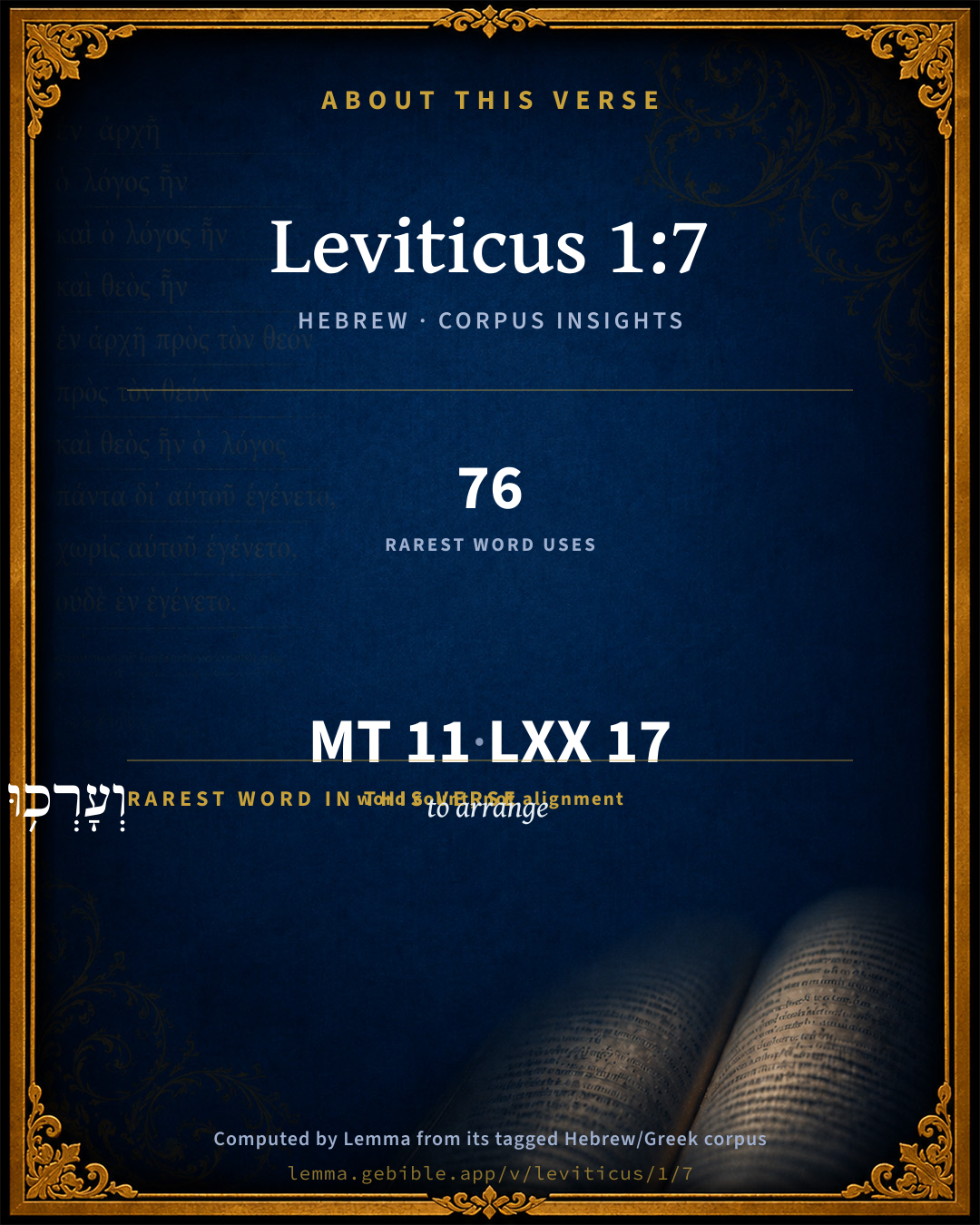
11
words
9
distinct lemmas
Pentateuch
section

Grammatical profile

  • 2 verbs
  • 7 nouns
  • 2 prepositions

Verb forms

  • וְ֠נָתְנוּ Qal · Sequential Perfect
  • וְעָרְכ֥וּ Qal · Sequential Perfect

Repetition

Words recur within this verse — often emphatic in Hebrew:

  • אֵ֖שׁ fire H784 ×2
  • עַל upon H5921 ×2

Hebrew & Septuagint length

In English translation the verse runs 20 words from the Hebrew and 20 from the Septuagint (LXX English) — the same length.

A rough comparison of the two English renderings, which tokenize alike — not a word-level alignment.

Word counts can differ between the Hebrew and the Greek without any difference in meaning — e.g. the Hebrew direct-object marker אֵת has no separate Greek word, and Greek often adds the article ὁ.

In the original languages it is 11 Hebrew tokens and 17 Greek tokens — but the two are counted differently (Hebrew bundles its prefixes and suffixes into one token; the Greek is in lemma form), so that isn’t a like-for-like length.

Cross-references

7

Topical passages linked to Leviticus 1:7 in the Treasury of Scripture Knowledge — connected by theme and wording, ordered by reader-vote popularity; previews shown in the World English Bible.

  • Genesis 22:9 They came to the place which God had told him of. Abraham built the altar there, and laid the wood in order, bound Isaac his son, and laid him on the altar, on the wood.
  • Leviticus 6:12–13 The fire on the altar shall be kept burning on it, it shall not go out; and the priest shall burn wood on it every morning: and he shall lay the burnt offering in order upon it, and shall burn on it the fat of the peace offerings.
  • Leviticus 9:24–10:1 There came forth fire from before Yahweh, and consumed the burnt offering and the fat upon the altar: and when all the people saw it, they shouted, and fell on their faces.
  • 1 Chronicles 21:26 David built there an altar to Yahweh, and offered burnt offerings and peace-offerings, and called on Yahweh; and he answered him from the sky by fire on the altar of burnt offering.
  • 2 Chronicles 7:1 Now when Solomon had made an end of praying, the fire came down from heaven, and consumed the burnt offering and the sacrifices; and the glory of Yahweh filled the house.
  • Nehemiah 13:31 and for the wood-offering, at times appointed, and for the first fruits. Remember me, my God, for good.
  • Malachi 1:10 "Oh that there were one among you who would shut the doors, that you might not kindle fire on my altar in vain! I have no pleasure in you," says Yahweh of hosts, "neither will I accept an offering at your hand.

Cross-references courtesy of OpenBible.info (CC BY 4.0).

Hebrew and Greek witnesses Masoretic Hebrew ↔ Greek Septuagint

The same verse in the two great witnesses to the Old Testament, shown verse-for-verse.

These are two independent witnesses, not word-aligned to each other, and the Septuagint is shown in lemma (dictionary) form.

Hebrew Leviticus 1:7 Masoretic · Westminster Leningrad Codex

וְ֠נָתְנוּ בְּנֵ֨י אַהֲרֹ֧ן הַכֹּהֵ֛ן אֵ֖שׁ עַל הַמִּזְבֵּ֑חַ וְעָרְכ֥וּ עֵצִ֖ים עַל הָאֵֽשׁ

The sons of Aaron the priest shall put fire on the altar, and lay wood in order on the fire;

World English Bible · Public Domain

Greek LXX Leviticus 1:7 Septuagint · lemma form

καί ἐπιτίθημι ὁ υἱός ἀαρών ὁ ἱερεύς πῦρ ἐπί ὁ θυσιαστήριον καί ἐπιστοιβάζω ξύλον ἐπί ὁ πῦρ

And the sons of Aaron the priests shall put fire on the altar, and shall pile wood on the fire.

LXX2012 (modern English Septuagint) · Public Domain

On this verse, Haydock's Catholic Bible Commentary discusses the Septuagint’s reading. Read the note in Commentary ↓

Hebrew: Westminster Leningrad Codex (CC BY 4.0). Greek: Septuagint (public domain); English from LXX2012 (modern English Septuagint) (Public Domain). How the Septuagint differs from the Hebrew →

Targum (Aramaic paraphrase)

2

The Targum is the ancient Jewish Aramaic paraphrase of the Hebrew Scriptures — an interpretive translation, not the Hebrew text itself. Onkelos (literal) and Pseudo-Jonathan (expansive) render the Torah, and Jonathan the Prophets. Coverage is partial: where no permissively-licensed English translation exists for a verse, only the Aramaic is shown. This is verse-level text, not a word-by-word alignment to the Hebrew. Some Onkelos verses here show an unreviewed machine translation (clearly flagged), not a published edition.

  1. Targum Onkelos Torah (Genesis–Deuteronomy)
    וְיִתְּנוּן בְּנֵי אַהֲרֹן כַּהֲנָא אֶשָׁתָא עַל מַדְבְּחָא וִיסַדְרוּן אָעַיָא עַל אֶשָׁתָא

    Unreviewed machine translation (Claude Sonnet 5) — not public domain confidence: high

    And the sons of Aaron the priest shall put fire on the altar, and shall arrange wood upon the fire.

    Generated by an AI translate-then-audit pipeline and checked against an independent public-domain English translation of the underlying Hebrew for drift only. Not a published edition; pending human review.

    Aramaic base: public-domain Targum Onkelos (via Sefaria). The English above is the unreviewed machine translation, not public domain.

  2. Targum Pseudo-Jonathan Torah (Genesis–Deuteronomy)
    וִינָתְנוּן בְּנֵי אַהֲרן אֵשָׁתָא עַל מַדְבְּחָא וִיסַדְרוּן קֵיסִין עַל אֵישָׁתָא

    And the sons of Aharon the priest shall put fire upon the altar, and lay wood in order upon the fire;

    Targum Pseudo-Jonathan — Aramaic: “Targum Jonathan on Genesis” (public domain); “Targum Jonathan on Exodus” (public domain); “Targum Jonathan on Leviticus” (public domain); “Targum Jonathan on Numbers” (public domain); “Targum Jonathan on Deuteronomy” (public domain). English: “The Targum of Jonathan ben Uzziel, trans. J. W. Etheridge, London, 1862” (public domain). Text via Sefaria.

Commentary

Notes on Leviticus 1:7 from classic Christian and Jewish commentators (each source and its license shown beneath its notes). The classic Christian expositions comment on the surrounding passage and are grouped to its opening verse, so a note may address several verses; the Jewish commentaries on the Tanakh (Rashi and others) are per-verse, so they appear only where the commentator wrote on this verse.

Lemma curates 59 commentaries, every one of them public domain or Creative Commons licensed, each selected and text-cleaned for this edition rather than reprinted as found. About our sources →

Trapp's Complete Commentary

John Trapp

Lev 1:7 And the sons of Aaron the priest shall put fire upon the altar, and lay the wood in order upon the fire:

Ver. 7. Fire upon the altar.] That fire from heaven {Lev 9:24} - which the heathens apishly imitated in their vestal fire - typing either the scorching wrath of God seizing upon Christ, or the ardent love of Christ to his, and their zeal for him.

John Trapp, A Commentary or Exposition upon All the Books of the Old and New Testament (1647–1656) — public domain. Text from a community e-Sword module.

Joseph Benson's Commentary

Lev 1:7. The sons of Aaron shall put fire — The fire was originally kindled from heaven, when the first sacrifices were offered, (Lev 9:24,) and was to be carefully preserved and kept burning, (Lev 6:13,) and therefore the expression of putting fire upon the altar is to be understood, not of kindling, but of feeding the fire with fresh fuel, or disposing and putting it in order.

Joseph Benson's Commentary on the Old and New Testaments (1811–1818) — public domain. Text from a community e-Sword module.

Adam Clarke's Commentary

Verse 7. Put fire] The fire that came out of the tabernacle from before the Lord, and which was kept perpetually burning; see Le 9:24. Nor was it lawful to use any other fire in the service of God. See the case of Nadab and Abihu, Lev 10:1; Lev 10:2.

Adam Clarke's Commentary on the Bible (1810–1826) — public domain. Text from a community e-Sword/MySword module.

Ellicott's Commentary for English Readers

(7) And the sons of Aaron.—The priests are to put the fire upon the altar, because they offered the sacrifice upon the altar. This applies to the first burnt offering which was offered upon the newly-erected altar, since afterwards the fire was always burning, and was never allowed to go out (Lev_6:13).

And lay the wood.—No other fuel but wood was allowed for the altar, and no one was allowed to bring it from his own house, but it had to be the wood of the congregation. (Comp. Neh_10:34; Neh_13:31.) It had to be of the best kind; worm-eaten wood or timber from pulled-down buildings was not allowed.

A Bible Commentary for English Readers, edited by Charles John Ellicott (1878–1897) — public domain. Text from a community e-Sword module.

The Cambridge Bible for Schools and Colleges

gen. ed. J. J. S. Perowne

7. shall put fire upon the altar] According to Lev_6:9-13 the fire is kept burning upon the altar.

lay wood in order] The verb ‘lay in order’ here and in Lev_1:8 is different from ‘lay’ in Lev_1:4. The wood was collected and brought by the people (Neh_10:34).

The Cambridge Bible for Schools and Colleges (gen. ed. J. J. S. Perowne; Cambridge University Press, 1878–1918) — public domain. Text from a community e-Sword module.

John Gill's Exposition

And the sons of Aaron the priest shall put fire upon the altar,.... The fire of the altar originally came down from heaven, and consumed the sacrifice, and which was a token of God's acceptance of it, see Lev 9:24 and this fire was kept burning continually upon the altar, Lev 6:12 and yet the Jewish writers say, it was the command of God, according to this passage, that fire should be brought from another place and put here; Jarchi's note on the text is,"though fire came down from heaven, it was commanded to bring it from a common or private place:''and Maimonides (r) says the same thing, and so it is often said in the Talmud (s); and this, as Gersom observes, was not done by any but a priest in the time of his priesthood, or when clothed with his priestly garments; and so in the Talmud it is said, that the putting fire upon the altar belonged to the priesthood, but not flaying or cutting in pieces (t): this fire denoted the wrath of God, revealed from heaven against all unrighteousness and ungodliness of men, and which is the everlasting fire prepared for the devil and his angels, and all the workers of iniquity; and which Christ endured for his people in human nature, when he bore their sins, and became a whole burnt offering for them:

and lay the wood in order upon the fire; the wood for the sacrifice was an offering of the people, brought to the temple at the times appointed, Neh 10:34 where was a place called , "the wood room", or "wood chamber", and which was in the northeast part of the court of the women; and here such priests as had blemishes wormed the wood, or searched the wood for worms; for whatsoever wood had a worm found in it, it was not fit to be laid upon the altar; and it was from hence the priests fetched the wood and laid it on the altar (u); for a private person might not bring it from his own house for his offering (w), though it was provided by the congregation (x), and brought thither by private persons; and it might be any sort of wood but that of the vine and olive (y), which were not used, because they did not burn well, and were soon reduced to ashes; and because such a consumption would be made of such useful trees hereby, that there would be no wine or oil in the land of Israel, so necessary for private and religious uses. The Vulgate Latin version renders it, "the pile of wood being laid before": that is, before the fire was put upon the altar; but this is contrary to the text, for the wood was laid upon the fire, and therefore the fire must be first; the case seems to be this, the fire was first kindled, and then the wood laid in order upon it.

(r) Hilchot. Tamidin, c. 2. sect. 1. (s) T. Bab. Erubin, fol. 63. 1. Yoma, fol. 21. 2. & 53. 1. (t) T. Bab. Yoma, fol. 26. 2. Vid. T. Bab. Zebachim, fol. 18. 1. (u) Misn. Middot, c. 2. sect. 5. (w) Issure Mizbeach, c. 5. sect. 13. T. Bab. Cholin, fol. 27. 1. (x) T. Bab. Menachot, fol. 22. 1. (y) Misn. Tamid, c. 2. sect. 3. & T. Bab. Tamid, fol. 29. 2.

John Gill's Exposition of the Whole Bible (1746–1763) — public domain (CC PDM 1.0). Text via the HelloAO Bible API.

Albert Barnes' Notes on the Bible

Put fire upon the altar - This must specifically refer to the first burnt-offering on the newly-constructed altar. The rule was afterward to be, “it shall never go out,” Lev 6:13.

Albert Barnes' Notes on the Bible (1834–1885) — public domain. Text from a community e-Sword/MySword module.

Haydock's Catholic Bible Commentary

Fire. Hebrew and Septuagint place the fire first, then the wood. It was the sacred fire which was never extinguished, but removed from the altar in marches, (chap. iv. 13,) perhaps in a censer or pan. (Haydock)

George Leo Haydock (1774–1849), Haydock's Catholic Family Bible and Commentary, 1859 edition — public domain. Excludes Psalms (Douay-Rheims chapter numbering differs from Protestant) and Deuterocanonical books (Catholic canon only).

Matthew Poole's English Annotations

Or,

dispose the fire, i.e. blow it up, and put it together, so as it might be fit for the present work. For the fire there used and allowed came down from heaven, Lev 9:24, and was to be carefully preserved there, and all other fire was forbidden, Lev 10:1, &c.

Matthew Poole's English Annotations on the Holy Bible (1683–1685) — public domain. Text from a community e-Sword/MySword module.

Whedon's Commentary on the Bible

Daniel D. Whedon

7. Put fire upon the altar — So long as the altar was stationary the fire was never to go out. See note on Lev_6:13. When the altar was transported, the fire was probably carried in a censer and put on the altar in its new location. See note on Num_4:16.

Lay the wood — Such a ritual could not be executed in the dessert of Sahara. Wood still abounds in the Sinaitic Peninsula, and charcoal has for centuries been the chief article of export.

In order — The sacrifice was to be made with decency and deliberation.

Daniel D. Whedon (gen. ed.), Commentary on the Old and New Testaments (1874–1909) — public domain. Text from a community e-Sword module.

The Pulpit Commentary

The priest shall put fire upon the altar. The fire once kindled was never to be allowed to go out. (Lev_6:13) Unless, therefore, these words refer to the first occasion only on which a burnt sacrifice was offered, they must mean "make up the fire on the altar" or it might possibly have been the practice, as Bishop Wordsworth (after Maimonides) supposes, that fresh fire was added to the altar fire before each sacrifice.

The Pulpit Commentary (1880–1919), ed. H.D.M. Spence-Jones & Joseph S. Exell — public domain. Text from a community e-Sword module.

unfoldingWord translationNotes

Door43 World Missions Community

General Information:

Yahweh continues telling Moses what the people must do so their offerings will be acceptable to him.

will put fire on the altar and place wood to feed the fire

This may mean that the priests placed hot coals on the altar, then placed the wood on the coals. Or you may need to reorder this as in the UDB. AT: "will put wood on the altar and light a fire" (See: Order of Events)

to feed the fire

This is an idiom that means to keep putting wood in the fire. Translate this idiom so it is understood that the fire on the altar must be kept burning. AT: "to keep the fire burning" (See: Idiom)

But its inner parts and its legs he must wash with water

The person would do this before giving the pieces to the priests to place on the altar. You can state this at the end of Leviticus 1:6.

inner parts

This is the stomach and intestines.

he must wash

Here "he" refers to the one making the offering.

It will produce a sweet aroma for me

Yahweh being pleased with the sincere worshiper offering the sacrifice is spoken of as if Yahweh were pleased by the aroma of the burning sacrifice. (See: Metaphor)

an offering made to me by fire

Yahweh is telling Moses that the offerings are to be burnt with fire. This can be stated in active form. AT: "a burnt offering to me" (See: Active or Passive)

translationWords

Aaron

priest

fire

altar

burnt offering

unfoldingWord translationNotes — © Distant Shores Media and the Door43 World Missions Community, licensed CC BY-SA 4.0. Source: git.door43.org/Door43/en_tn.

Rashi

Rabbi Shlomo Yitzchaki (Rashi)

אש … ‎ונתנו AND [THE SONS OF AARON …] SHALL PUT FIRE [ON THE ALTAR] — Although the fire descended from heaven, it was nevertheless a religious duty to bring also some fire of profane origin (Sifra, Vayikra Dibbura d'Nedavah, Chapter 5 10; Yoma 21b; cf. Rashi on Leviticus 10:2 and Note thereon).

בני אהרן הכהן THE SONS OF AARON THE PRIEST — They shall place the fire on the altar as sons of Aaron the priest: implying that Aaron should always minister in his priestly dignity (i. e. when attired in his priestly garments), consequently if he officiated in the garments of an ordinary priest his service is invalid (Sifra, Vayikra Dibbura d'Nedavah, Chapter 5 9; Zevachim 18a).

Rashi on the Tanakh — English translations: “The Judaica Press complete Tanach with Rashi, translated by A. J. Rosenberg” (CC BY 4.0); “Pentateuch with Rashi's commentary by M. Rosenbaum and A.M. Silbermann, 1929-1934” (public domain); “The Metsudah Tanach series, Lakewood, N.J” (CC BY 4.0); and “The Book of Joshua, Metsudah Publications, 1997” (CC BY 4.0). Text via Sefaria.

Lesson kit

Teaching starters — assembled from the data on this page, not authored interpretation. Every prompt links to the verse data it draws on. Edit before teaching.

Leviticus, in the Pentateuch, opens this verse with 11 words (9 distinct Hebrew lemmas). Its most distinctive word is ʻârak (“to arrange”). A historical commentator’s framing appears above. Read the whole chapter for the surrounding context.

Discussion questions

  1. How does “to arrange” (ʻârak) shape what this verse is saying?
  2. Genesis 22:9 shares this passage’s theme. How do the two illuminate each other?
  3. “fire” occurs 2× in this one verse. What is the effect of the repetition?
  4. These translations render this verse differently. What is at stake in choosing one wording over another?
  5. The verb «וְ֠נָתְנוּ» is Qal Sequential Perfect. How does its form color the action?
  6. Reading how Trapp's Complete Commentary and Joseph Benson's Commentary read this verse, where do the two commentators agree and where do they part?

Things to notice

Reading settings

Reading text

Shown beneath each verse's original-language words.

Old Testament
Old Testament edition

Read the OT as the Masoretic Hebrew (MT) or the Greek Septuagint (LXX).

English shown for the Greek Septuagint (in the Hebrew ↔ Greek comparison).

Comparing translations? Open the Compare panel on any verse page to stack up to four side by side.