
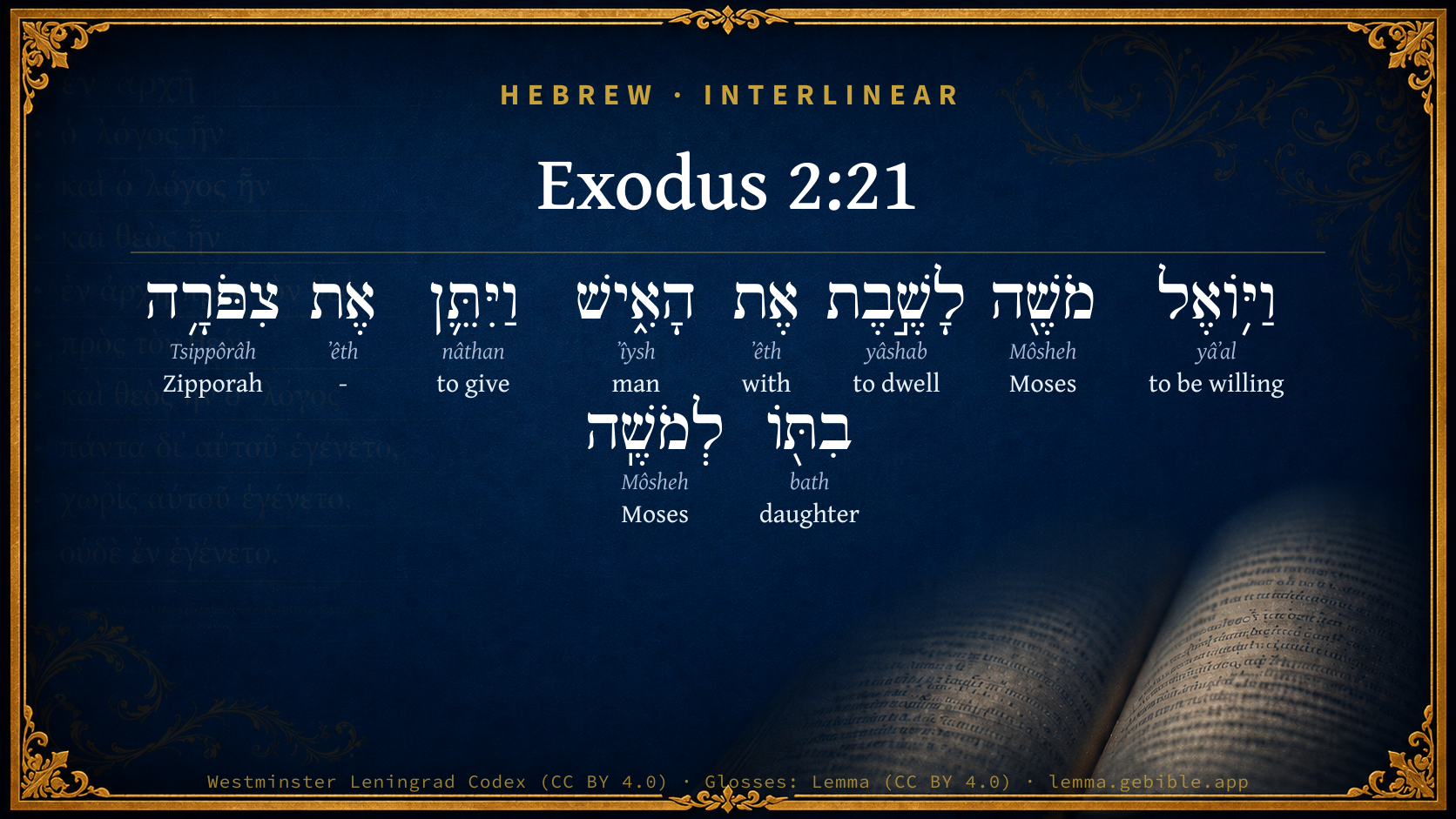
Exodus 2:21

Hebrew (Westminster Leningrad Codex) Exodus 2:21 appears in the Hebrew Old Testament. The text above is from the Westminster Leningrad Codex. Each word links to its Strong’s number, a concise gloss, and parsing drawn from the Open Scriptures Hebrew Bible morphology. Click any word for its full Brown-Driver-Briggs (BDB) entry.
Download image
Cite this verse

Exodus 2:21 (World English Bible). Public Domain. Lemma interlinear Bible study tool, https://lemma.gebible.app/v/exodus/2/21.

Show BibTeX & RIS
BibTeX
RIS
English Translation
Moses was content to dwell with the man. He gave Moses Zipporah, his daughter.
World English Bible · Public Domain
Highlights
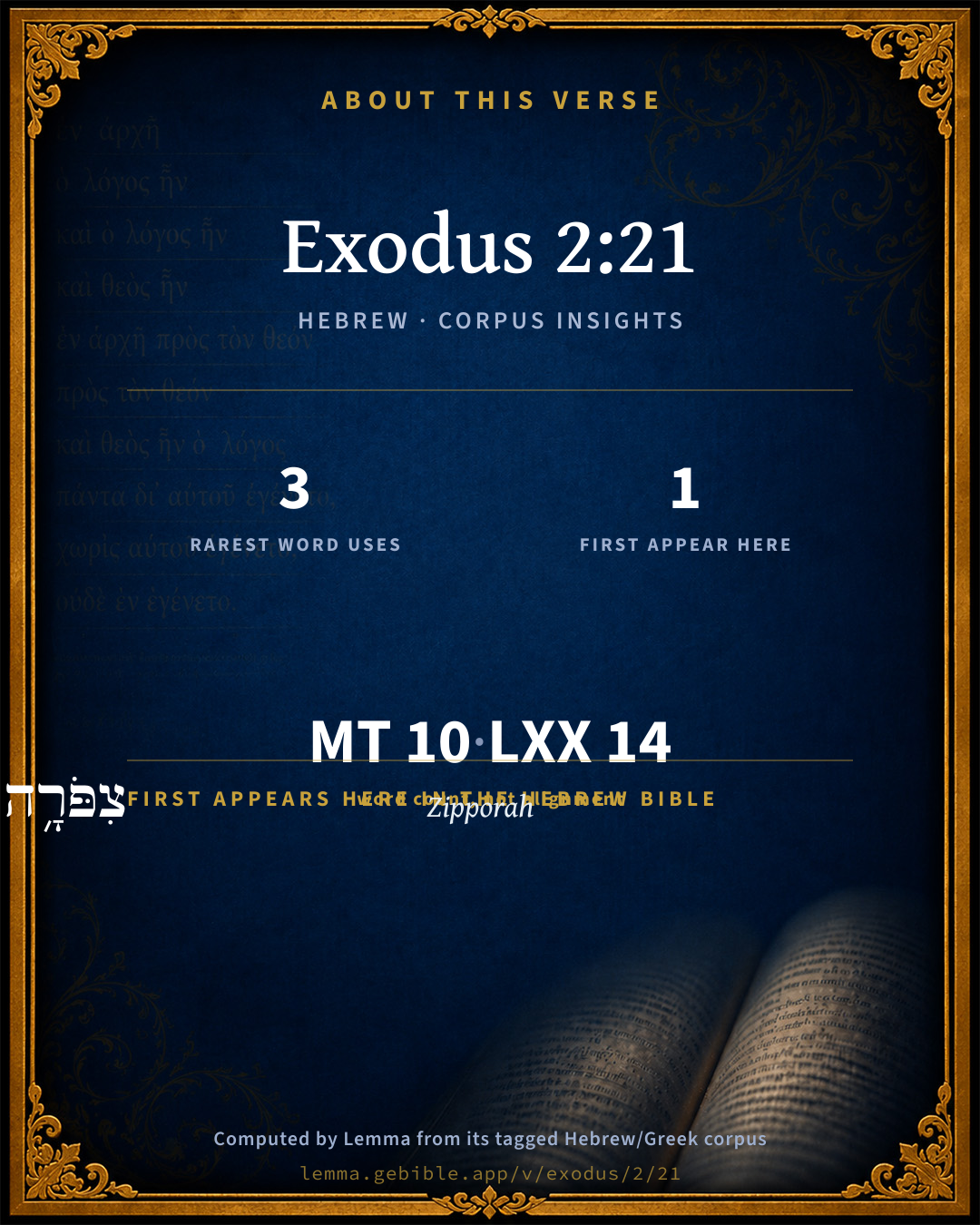
  • 1 first appearance in the Hebrew Bible
Full analysis ↓
Download a study sheet

One document with this verse’s original text, its word-by-word gloss line, the meaning frame, cross-references with their text, attributed commentary, and full source and license credits — printable, and it pastes into notes with its structure intact.

This verse Autodidact and up

Study sheet (.html) Plain text (.txt)

A passage Seminary Student

Up to 50 verses in one chapter. A passage sheet keeps up to 6 commentary sources and 12 cross-references per verse, in the order this page ranks them, and says so on the sheet whenever that leaves anything out. Ask for a single verse and you get the Autodidact verse sheet above.

Everything on this page stays free to read, with no account — the sheet is a download of what is already on screen, not access to it.

Want to remove ads? Support Godless Engineer
Compare translations 3

The same verse in 3 English versions, stacked beneath the original-language interlinear above. Click any original word for its lexicon entry.

Each is an independent rendering of the whole verse — the interlinear is not word-aligned to these translations.

Highlighted words mark where these versions differ — a whole-verse word diff, not a word-by-word alignment.

  • World English Bible Public Domain
    Moses was content to dwell with the man. He gave Moses Zipporah, his daughter.
  • King James Version Public Domain
    And Moses was content to dwell with the man: and he gave Moses Zipporah his daughter.
  • unfoldingWord Literal Text CC BY-SA 4.0
    And Moses was willing to dwell with the man, and he gave Zipporah his daughter to Moses.

unfoldingWord Literal Text — © unfoldingWord, licensed CC BY-SA 4.0. Word-aligned USFM3 via Door43 (git.door43.org/unfoldingWord/en_ult).

Versions to compare (up to 4)

3 of 4 selected

Show all 18 translations

Every available English version of this verse, each an independent rendering of the whole verse.

  • World English Bible Public Domain
    Moses was content to dwell with the man. He gave Moses Zipporah, his daughter.
  • Berean Standard Bible Public Domain
    Moses agreed to stay with the man, and he gave his daughter Zipporah to Moses in marriage.
  • Majority Standard Bible Public Domain
    Moses agreed to stay with the man, and he gave his daughter Zipporah to Moses in marriage.
  • King James Version Public Domain
    And Moses was content to dwell with the man: and he gave Moses Zipporah his daughter.
  • American Standard Version (1901) Public Domain
    And Moses was content to dwell with the man: and he gave Moses Zipporah his daughter.
  • Revised Version (1885) Public Domain
    And Moses was content to dwell with the man: and he gave Moses Zipporah his daughter.
  • Geneva Bible (1599) Public Domain
    And Moses agreed to dwell with the man: who gaue vnto Moses Zipporah his daughter:
  • Douay-Rheims (1899) Public Domain
    And Moses swore that he would dwell with him. And he took Sephora his daughter to wife:
  • Young's Literal Translation Public Domain
    And Moses is willing to dwell with the man, and he giveth Zipporah his daughter to Moses,
  • Literal Standard Version CC BY-SA 4.0
    And Moses is willing to dwell with the man, and he gives his daughter Zipporah to Moses,
  • Unlocked Literal Bible CC BY-SA 4.0
    Moses agreed to stay with the man, who also gave him his daughter Zipporah in marriage.
  • unfoldingWord Literal Text CC BY-SA 4.0
    And Moses was willing to dwell with the man, and he gave Zipporah his daughter to Moses.
  • Darby Bible Public Domain
    And Moses consented to remain with the man; and he gave Moses Zipporah his daughter.
  • World Messianic Bible Public Domain
    Moses was content to dwell with the man. He gave Moses Zipporah, his daughter.
  • Webster's Bible Public Domain
    And Moses was content to dwell with the man: and he gave Moses Zipporah his daughter.
  • Free Bible Version CC BY-SA 4.0
    Moses agreed to stay with the man, who arranged for his daughter Zipporah to marry Moses.
  • Bible in Basic English Public Domain
    And Moses was happy to go on living with the man; and he gave his daughter Zipporah to Moses.
  • JPS Tanakh (1917) Public Domain
    And Moses was content to dwell with the man; and he gave Moses Zipporah his daughter.

Literal Standard Version (2020), Covenant Press — licensed CC BY-SA 4.0. Text via the HelloAO Bible API (eBible.org). Unlocked Literal Bible (unfoldingWord) — licensed CC BY-SA 4.0. Text via the HelloAO Bible API (eBible.org). unfoldingWord Literal Text — © unfoldingWord, licensed CC BY-SA 4.0. Word-aligned USFM3 via Door43 (git.door43.org/unfoldingWord/en_ult). Free Bible Version, Dr. Jonathan Gallagher — licensed CC BY-SA 4.0. Text via the HelloAO Bible API (eBible.org).

Word by word

More ways to search: Search by grammar → Find every occurrence → Compare this word →

Practice this passage: Drill this verse → Learn its vocabulary →

About this verse

These counts appear in no published source. They are computed here, from the morphology-tagged text and Lemma’s own curated glosses. What Lemma adds →

10
words
9
distinct lemmas
Pentateuch
section

Notable vocabulary

The rarest word here is צִפֹּרָ֥ה Zipporah H6855 — appearing just 3 times in the whole Hebrew Bible.

First appearance in Scripture

This word makes its first canonical appearance in the Hebrew Bible here:

  • צִפֹּרָ֥ה Zipporah H6855

Shared distinctive vocabulary

צִפֹּרָ֥ה Zipporah H6855 occurs in 3 verses of the Hebrew Bible. Also found in:

Grammatical profile

  • 3 verbs
  • 5 nouns
  • 1 preposition
  • 1 particle

Verb forms

  • וַיּ֥וֹאֶל Hiphil · Sequential Imperfect
  • לָשֶׁ֣בֶת Qal · Infinitive Construct
  • וַיִּתֵּ֛ן Qal · Sequential Imperfect

Repetition

A word recurs within this verse — often emphatic in Hebrew:

  • מֹשֶׁ֖ה Moses H4872 ×2

Hebrew & Septuagint length

In English translation the verse runs 14 words from the Hebrew and 17 from the Septuagint (LXX English) — closely comparable.

A rough comparison of the two English renderings, which tokenize alike — not a word-level alignment.

Word counts can differ between the Hebrew and the Greek without any difference in meaning — e.g. the Hebrew direct-object marker אֵת has no separate Greek word, and Greek often adds the article ὁ.

In the original languages it is 10 Hebrew tokens and 14 Greek tokens — but the two are counted differently (Hebrew bundles its prefixes and suffixes into one token; the Greek is in lemma form), so that isn’t a like-for-like length.

Cross-references

10

Topical passages linked to Exodus 2:21 in the Treasury of Scripture Knowledge — connected by theme and wording, ordered by reader-vote popularity; previews shown in the World English Bible.

  • Genesis 31:38–40 These twenty years have I been with you. Your ewes and your female goats have not cast their young, and I haven't eaten the rams of your flocks.
  • Hebrews 13:5 Be free from the love of money, content with such things as you have, for he has said, "I will in no way leave you, neither will I in any way forsake you."
  • Exodus 2:10 The child grew, and she brought him to Pharaoh's daughter, and he became her son. She named him Moses, and said, "Because I drew him out of the water."
  • Exodus 4:20–25 Moses took his wife and his sons, and set them on a donkey, and he returned to the land of Egypt. Moses took God's rod in his hand.
  • Exodus 18:2–6 Jethro, Moses' father-in-law, received Zipporah, Moses' wife, after he had sent her away,
  • Philippians 4:11–12 Not that I speak in respect to lack, for I have learned in whatever state I am, to be content in it.
  • 1 Timothy 6:6 But godliness with contentment is great gain.
  • Hebrews 11:25 choosing rather to share ill treatment with God's people, than to enjoy the pleasures of sin for a time;
  • James 1:10 and the rich, in that he is made humble, because like the flower in the grass, he will pass away.
  • Numbers 12:1 Miriam and Aaron spoke against Moses because of the Cushite woman whom he had married; for he had married a Cushite woman.

Cross-references courtesy of OpenBible.info (CC BY 4.0).

Hebrew and Greek witnesses Masoretic Hebrew ↔ Greek Septuagint

The same verse in the two great witnesses to the Old Testament, shown verse-for-verse.

These are two independent witnesses, not word-aligned to each other, and the Septuagint is shown in lemma (dictionary) form.

Hebrew Exodus 2:21 Masoretic · Westminster Leningrad Codex

וַיּ֥וֹאֶל מֹשֶׁ֖ה לָשֶׁ֣בֶת אֶת הָאִ֑ישׁ וַיִּתֵּ֛ן אֶת צִפֹּרָ֥ה בִתּ֖וֹ לְמֹשֶֽׁה

Moses was content to dwell with the man. He gave Moses Zipporah, his daughter.

World English Bible · Public Domain

Greek LXX Exodus 2:21 Septuagint · lemma form

καταοἰκίζω δέ μωυσῆς παρά ὁ ἄνθρωπος καί ἐκδίδωμι σεπφωρα ὁ θυγάτηρ αὐτός μωυσῆς γυνή

And Moses was established with the man, and he gave Sepphora his daughter to Moses to wife.

LXX2012 (modern English Septuagint) · Public Domain

On this verse, Haydock's Catholic Bible Commentary discusses the Septuagint’s reading. Read the note in Commentary ↓

Hebrew: Westminster Leningrad Codex (CC BY 4.0). Greek: Septuagint (public domain); English from LXX2012 (modern English Septuagint) (Public Domain). How the Septuagint differs from the Hebrew →

Targum (Aramaic paraphrase)

2

The Targum is the ancient Jewish Aramaic paraphrase of the Hebrew Scriptures — an interpretive translation, not the Hebrew text itself. Onkelos (literal) and Pseudo-Jonathan (expansive) render the Torah, and Jonathan the Prophets. Coverage is partial: where no permissively-licensed English translation exists for a verse, only the Aramaic is shown. This is verse-level text, not a word-by-word alignment to the Hebrew.

  1. Targum Onkelos Torah (Genesis–Deuteronomy)
    וּצְבִי משֶׁה לְמִיתַב עִם גַבְרָא וִיהַב יָת צִפּוֹרָה בְרַתֵּהּ לְמשֶׁה:

    (no public-domain English translation for this verse)

    Targum Onkelos — Aramaic: “Onkelos Genesis” (public domain); “Onkelos Exodus” (public domain); “Onkelos Leviticus” (public domain); “Onkelos Numbers” (public domain); “Onkelos Deuteronomy” (public domain). English: “Sefaria Community Translation” (CC0 1.0 (public-domain dedication)); “J.W. Etheridge. The Targums of Onkelos and Jonathan Ben Uzziel on the Pentateuch. London: Longmans, Green, 1862” (public domain). Text via Sefaria.

  2. Targum Pseudo-Jonathan Torah (Genesis–Deuteronomy)
    וְכַד חַכִּים רְעוּאֵל דְעָרַק משֶׁה מִן קֳדָם פַרְעה טָלַק יָתֵיהּ לְגוּבָא וַהֲוַת צִפּוֹרָה בְּרַתֵּיהּ דִבְרֵיהּ מְפַרְנָסָא יָתֵיהּ בְּסִיתְרָא בִּזְמַן עִשַרְתִּי שְׁנִין וּלְסוֹף עִשַרְתִּי שְׁנִין אַפְקֵיהּ מִן גוּבָא וְעַל משֶׁה בְּגוֹי גִינוּנִיתָא דִרְעוּאֵל וַהֲוָה מוֹדֵי וּמַצְלֵי קֳדָם יְיָ דַעֲבֵד עִמֵיהּ נִיסִין וּגְבוּרַן וְאִיסְתְּכִיַית חוּטְרָא דְאִיתְבְּרִאַת בֵּינֵי שִׁמְשְׁתָא וְחַקְיָין וּמְפָרַשׁ עֲלָהּ שְׁמָא רַבָּא וְיַקִירָא דְבֵיהּ עָתִיד לְמֶעֱבַד יַת תִּמְהַיָא בְּמִצְרַיִם וּבֵיהּ עָתִיד לְמִבְזַע יַת יַמָא דְסוּף וּלְהַנְפָקָא מוֹי מִן כֵּיפָא וַהֲוָה דָעִיץ בְּגוֹ גִינוּנִיתָא וּמִן יַד אוֹשִׁיט יְדֵיהּ וְנַסְבֵיהּ הָא בְּכֵין צָבֵי משֶׁה לְמִתַּב עִם גַבְרָא וִיהַב יַת צִפּוֹרָה בְּרַת בְּרַתֵּיהּ לְמשֶׁה

    But when Reuel knew that Mosheh had fled from before Pharoh he cast him into a pit; but Zipporah, the daughter of his son, maintained him with food, secretly, for the time of ten years; and at the end of ten years brought him out of the pit. And Mosheh went into the bedchamber of Reuel, and gave thanks and prayed before the Lord, who by him would work miracles and mighty acts. And there was shown to him the Rod which was created between the evenings, and on which was engraven and set forth the Great and Glorious Name, with which he was to do the wonders in Mizraim, and to divide the sea of Suph, and to bring, forth water from the rock. And it was infixed in the midst of the chamber, and he stretched forth his hand at once and took it. Then, behold, Mosheh was willing to dwell with the man, and he gave Zipporah, the daughter of his son, to Mosheh.

    Targum Pseudo-Jonathan — Aramaic: “Targum Jonathan on Genesis” (public domain); “Targum Jonathan on Exodus” (public domain); “Targum Jonathan on Leviticus” (public domain); “Targum Jonathan on Numbers” (public domain); “Targum Jonathan on Deuteronomy” (public domain). English: “The Targum of Jonathan ben Uzziel, trans. J. W. Etheridge, London, 1862” (public domain). Text via Sefaria.

Commentary

Notes on Exodus 2:21 from classic Christian and Jewish commentators (each source and its license shown beneath its notes). The classic Christian expositions comment on the surrounding passage and are grouped to its opening verse, so a note may address several verses; the Jewish commentaries on the Tanakh (Rashi and others) are per-verse, so they appear only where the commentator wrote on this verse.

Lemma curates 59 commentaries, every one of them public domain or Creative Commons licensed, each selected and text-cleaned for this edition rather than reprinted as found. About our sources →

Trapp's Complete Commentary

John Trapp

Exo 2:21 And Moses was content to dwell with the man: and he gave Moses Zipporah his daughter.

Ver. 21. Zipporah his daughter.] A peevish piece; a cold armful. {a} He had better, haply, have been married to a quartan ague. Sulla felix si non hobuisset uxorem, &c. It is not ill to marry, but good to be wary, lest we make shipwreck in the haven.

{a} ψυχρον παρατκαλισμα. - Lycophron.

John Trapp, A Commentary or Exposition upon All the Books of the Old and New Testament (1647–1656) — public domain. Text from a community e-Sword module.

Joseph Benson's Commentary

Exo 2:21. He gave Moses Zipporah, his daughter — Whom he married, not immediately, but after some years of acquaintance with the family, as may be gathered from the youth of one of his sons, and his being uncircumcised forty years after this, Exo 4:25.

Joseph Benson's Commentary on the Old and New Testaments (1811–1818) — public domain. Text from a community e-Sword module.

Adam Clarke's Commentary

Verse 21. Zipporah his daughter.] Abul Farajius calls her "Saphura the black, daughter of Rewel the Midianite, the son of Dedan, the son of Abraham by his wife Keturah." The Targum calls her the granddaughter of Reuel. It appears that Moses obtained Zipporah something in the same way that Jacob obtained Rachel; namely, for the performance of certain services, probably keeping of sheep: see Ex 3:1.

Adam Clarke's Commentary on the Bible (1810–1826) — public domain. Text from a community e-Sword/MySword module.

Ellicott's Commentary for English Readers

(21) Moses was content to dwell with the man.—Reuel must have been so pleased with the manner and appearance of Moses that he invited him to take service with him—perhaps to share his tent. Moses consented, and in course of time took to wife Zipporah, one of Reuel’s daughters. Marriage with the Midianites was allowed, even under the Law. It has been conjectured that Reuel might have communicated to Moses traditions, or even documents concerning their common ancestor, Abraham, and his family. But there is nothing to indicate the use of letters at this early date by the Midianites.

A Bible Commentary for English Readers, edited by Charles John Ellicott (1878–1897) — public domain. Text from a community e-Sword module.

The Cambridge Bible for Schools and Colleges

gen. ed. J. J. S. Perowne

21. was content] or agreed; cf. Jdg_17:11; Jdg_19:6.

The Cambridge Bible for Schools and Colleges (gen. ed. J. J. S. Perowne; Cambridge University Press, 1878–1918) — public domain. Text from a community e-Sword module.

John Gill's Exposition

And Moses was content to dwell with the man,.... After he had been called and brought into the house, and had had some refreshment, and after some conversation had passed between them, and perhaps after some days' stay in Reuel's house; Reuel having observed his disposition and behaviour, and being delighted therewith, proposed to him to take up his residence with him, with which motion Moses was well pleased, and accepted of it:

and he gave Moses Zipporah his daughter; to be his wife. It is not to be supposed that this was done directly; though both Philo (u) and Josephus (w) intimate as if it was done at first meeting together; but it is not likely that Reuel would dispose of his daughter so suddenly to a stranger, though he might at once entertain an high opinion of him; nor would Moses marry a woman directly he had so slender an acquaintance with, so little knowledge of her disposition, endowments of mind and religion. The Targum of Jonathan says it was at the end of ten years; and indeed forty years after this a son of his seems to have been young, having not till then been circumcised, Exo 4:22. The author of the Life of Moses says (x), that he was seventy seven years of age when he married Zipporah, which was but three years before he returned to Egypt. This circumstance of Moses's marrying Reuel's daughter is confirmed by Artapanus (y) an Heathen historian; and also by Demetrius (z), and expressly calls her Sapphora, who he says was a daughter of Jother or Jethro; and likewise by Ezekiel the tragedian (a).

(u) De Vita Mosis, l. 1. p. 611. (w) Antiqu. l. 2. c. 11. sect. 2. (x) Chronicon Mosis, fol. 9. 1. (y) Apud Euseb. Evangel. Praepar. l. 9. c. 27. p. 434. (z) Ib. c. 29. p. 439. (a) lb. c. 28.

John Gill's Exposition of the Whole Bible (1746–1763) — public domain (CC PDM 1.0). Text via the HelloAO Bible API.

Albert Barnes' Notes on the Bible

Moses tells us nothing of what he may have learned from his father-in-law, but he must have found in him a man conversant with the traditions of the family of Abraham; nor is there any improbability in the supposition that, as hereditary priest, Reuel may have possessed written documents concerning their common ancestors.

Albert Barnes' Notes on the Bible (1834–1885) — public domain. Text from a community e-Sword/MySword module.

Haydock's Catholic Bible Commentary

Swore. Hebrew Goel is rendered "was willing." --- Symmachus has, "He conjured Moses;" and Theodotion, "Moses began to dwell." The Septuagint neglect the word entirely, "But Moses took up his abode."

George Leo Haydock (1774–1849), Haydock's Catholic Family Bible and Commentary, 1859 edition — public domain. Excludes Psalms (Douay-Rheims chapter numbering differs from Protestant) and Deuterocanonical books (Catholic canon only).

Matthew Poole's English Annotations

Moses was content; or, consented to this desire or offer. And so his present and temporary repose there is turned into a settled habitation. Moses married Zipporah not instantly, but after some years of acquaintance with the family, as may probably be gathered from the youngness and uncircumcisedness of one of his sons forty years after this, Exo 4:25. In which time, as Moses would not fail to instruct them in the knowledge of the true God, which he was able excellently to do, so it is likely he had succeeded therein in some measure, and therefore married Zipporah.

Matthew Poole's English Annotations on the Holy Bible (1683–1685) — public domain. Text from a community e-Sword/MySword module.

Whedon's Commentary on the Bible

Daniel D. Whedon

21, 22. The Egyptian prince is content to become the shepherd of an humble Arab priest, whose daughter, a child of the desert, becomes the Zipporah (little bird) of his wilderness home. The sceptre that had been almost within his grasp is exchanged for a shepherd’s crook. The learning, luxury, and power of Egypt are exchanged for the barbarism, sand, and stones of Midian. It was the way of duty, but a wonderfully mysterious way! The deliverer is in the glory of his strength and eager for his work, and his people are dying — yet God does not speak! The name of his first-born,

Gershom — a stranger there — tells us that he feels his exile, that his heart is with his far-off people, but we hear no murmur; and the name of his second born,

Eliezer — my God (is my) help — shows that his faith was firm. He vanishes into the awful solitudes of Sinai, and we neither see nor hear of him any more for forty years.

Daniel D. Whedon (gen. ed.), Commentary on the Old and New Testaments (1874–1909) — public domain. Text from a community e-Sword module.

The Pulpit Commentary

Moses was content to dwell with the man. Moses had fled from Egypt without any definite plan, simply to save his life, and had now to determine how he would obtain a subsistence. Received into Reuel"s house, or tent, pleased with the man and with his family, he consented to stay with him, probably entered into his service, as Jacob into Laban"s, (Gen_29:15-20) kept his sheep, or otherwise made himself useful; (Exo_3:1) and in course of time Reuel gave Moses his daughter, accepted him for his son-in-law, so that he became not merely a member of his household, but of his family, was adopted probably into the tribe, so that he could not quit it without permission, (Exo_4:18) and, so far as his own intention went, cast in his lot with the Midianites, with whom he meant henceforth to live and die. Such vague ideas as he may previously have entertained of his "mission" had passed away; he had been "disillusioned" by his ill-success, and now looked forward to nothing but a life of peaceful obscurity.

Vers. 21, 22Moses as husband and father.

The Midianites were descendants of Abraham; (Gen_25:2) and marriage with them was permitted, even under the Law. (Num_31:18) Moses, in wedding Zipporah, obeyed the primeval command, "Be fruitful and multiply", (Gen_1:28) while at the same time he gave himself the solace so much needed by an exile, of tender and loving lifelong companionship. That Reuel was willing to give him one of his daughters indicates that he had approved himself as a faithful servant in the good priest"s household, and was felt to deserve a reward. That Zipporah accepted him was perhaps mere filial obedience, for which she was rewarded when the fugitive and exile became the first man in a considerable nation. God blessed the marriage with male issue, a blessing fondly desired by each true Israelite, and certainly not least by Moses, who knew so well that in some descendant of Abraham "all the families of the earth should be blessed." A shade of sadness shows itself, however, in the name which he gave his firstborn Gershom, "a stranger there." He himself had been for years, and, for aught that he could tell. his son might always be "a stranger in a strange land" far from his true home, far from his own people, a refugee among foreigners, who could not be expected to love him as one of themselves, or treat him otherwise than with coldness. Depression like this often assails us at moments of great joy, the good obtained making us feel all the more sensibly that other goods have been lost. Such depression, however, after a time, passes away, and the desponding cry of "Gershom" is followed (Exo_18:3, Exo_18:4) by that of" Eliezer," or "my God helps."

The Pulpit Commentary (1880–1919), ed. H.D.M. Spence-Jones & Joseph S. Exell — public domain. Text from a community e-Sword module.

Keil & Delitzsch

C. F. Keil & F. Delitzsch

Moses' Life in Midian. - As Reguel gave a hospitable welcome to Moses, in consequence of his daughters' report of the assistance that he had given them in watering their sheep; it pleased Moses (ויּואל) to dwell with him. The primary meaning of הואיל is voluit (vid., Ges. thes.). קראן for קראנה: like שׁמען in Gen 4:23. - Although Moses received Reguel's daughter Zipporah as his wife, probably after a lengthened stay, his life in Midian was still a banishment and a school of bitter humiliation. He gave expression to this feeling at the birth of his first son in the name which he gave it, viz., Gershom (גּרשׁם, i.e., banishment, from גּרשׁ to drive or thrust away); "for," he said, interpreting the name according to the sound, "I have been a stranger (גּר) in a strange land." In a strange land he was obliged to live, far away from his brethren in Egypt, and far from his fathers' land of promise; and in this strange land the longing for home seems to have been still further increased by his wife Zipporah, who, to judge from Exo 4:24., neither understood nor cared for the feelings of his heart. By this he was urged on to perfect and unconditional submission to the will of his God. To this feeling of submission and confidence he gave expression at the birth of his second son, by calling him Eliezer (אליעזר God is help); for he said, "The God of my father (Abraham or the three patriarchs, cf. Exo 3:6) is my help, and has delivered me from the sword of Pharaoh" (Exo 18:4). The birth of this son is not mentioned in the Hebrew text, but his name is given in Exo 18:4, with this explanation.

(Note: In the Vulgate the account of his birth and name is interpolated here, and so also in some of the later codices of the lxx. But in the oldest and best of the Greek codices it is wanting here, so that there is no ground for the supposition that it has fallen out of the Hebrew text.)

In the names of his two sons, Moses expressed all that had affected his mind in the land of Midian. The pride and self-will with which he had offered himself in Egypt as the deliverer and judge of his oppressed brethren, had been broken down by the feeling of exile. This feeling, however, had not passed into despair, but had been purified and raised into firm confidence in the God of his fathers, who had shown himself as his helper by delivering him from the sword of Pharaoh. In this state of mind, not only did "his attachment to his people, and his longing to rejoin them, instead of cooling, grow stronger and stronger" (Kurtz), but the hope of the fulfilment of the promise given to the fathers was revived within him, and ripened into the firm confidence of faith.

Keil & Delitzsch — Biblical Commentary on the Old Testament (1861–1891) — public domain (CC PDM 1.0). Text via the HelloAO Bible API. (Old Testament only.)

unfoldingWord translationNotes

Door43 World Missions Community

Moses agreed to stay with the man

"Moses agreed to live with Reuel"

Zipporah

This is Reuel's daughter. (See: How to Translate Names)

Gershom

This is Moses's son. (See: How to Translate Names)

resident in a foreign land

"stranger in a foreign land"

translationWords

Moses

alien

unfoldingWord translationNotes — © Distant Shores Media and the Door43 World Missions Community, licensed CC BY-SA 4.0. Source: git.door43.org/Door43/en_tn.

Rashi

Rabbi Shlomo Yitzchaki (Rashi)

ויואל — Translate this as the Targum does: AND HE WAS WILLING. Similar are: (Judges 19:6) “Be content (הואל), I pray thee, and tarry all night”; (Joshua 7:7) “would that we had been content (הואלנו)”; (Genesis 18:31) “I am content (הואלתי) to speak”. A Midrashic explanation is that it has the sense of taking an oath (אלה), so that it should be rendered, “And Moses pledged himself by an oath to remain with the man” — he swore to him that he would not stir from Midian save by his permission (cf. Exodus 4:18) (Nedarim 65a).

Rashi on the Tanakh — English translations: “The Judaica Press complete Tanach with Rashi, translated by A. J. Rosenberg” (CC BY 4.0); “Pentateuch with Rashi's commentary by M. Rosenbaum and A.M. Silbermann, 1929-1934” (public domain); “The Metsudah Tanach series, Lakewood, N.J” (CC BY 4.0); and “The Book of Joshua, Metsudah Publications, 1997” (CC BY 4.0). Text via Sefaria.

Lesson kit

Teaching starters — assembled from the data on this page, not authored interpretation. Every prompt links to the verse data it draws on. Edit before teaching.

Exodus, in the Pentateuch, opens this verse with 10 words (9 distinct Hebrew lemmas). Its most distinctive word is Tsippôrâh (“Zipporah”). A historical commentator’s framing appears above. Read the whole chapter for the surrounding context.

Discussion questions

  1. How does “Zipporah” (Tsippôrâh) shape what this verse is saying?
  2. This is the first place “Zipporah” appears in Scripture (first appears here). What does its debut here establish?
  3. How does Exodus 4:25, which shares the word «Zipporah», read alongside this verse?
  4. What does the repetition of “Moses” (2× in this one verse) do in this verse?
  5. The translations on this page render this verse differently — a whole-verse word diff, not a word-by-word alignment. What might account for the different wordings?
  6. «וַיּ֥וֹאֶל» is a Hiphil Sequential Imperfect verb. How does that grammatical form shape the action described?
  7. Compare how Trapp's Complete Commentary and Joseph Benson's Commentary read this verse. Where do they agree or differ?

Things to notice

Reading settings

Reading text

Shown beneath each verse's original-language words.

Old Testament
Old Testament edition

Read the OT as the Masoretic Hebrew (MT) or the Greek Septuagint (LXX).

English shown for the Greek Septuagint (in the Hebrew ↔ Greek comparison).

Comparing translations? Open the Compare panel on any verse page to stack up to four side by side.