
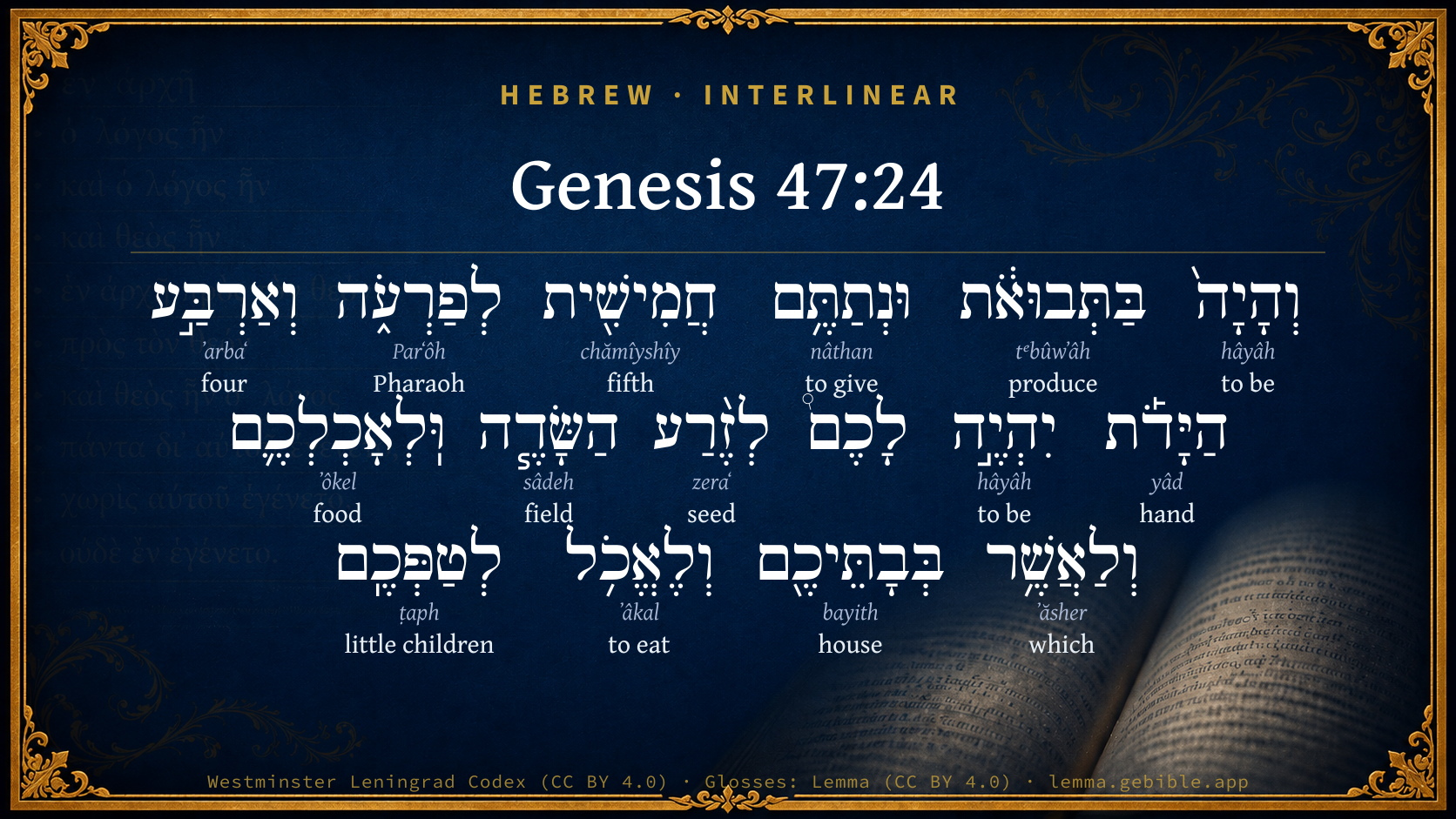
Genesis 47:24

Hebrew (Westminster Leningrad Codex) Genesis 47:24 appears in the Hebrew Old Testament. The text above is from the Westminster Leningrad Codex. Each word links to its Strong’s number, a concise gloss, and parsing drawn from the Open Scriptures Hebrew Bible morphology. Click any word for its full Brown-Driver-Briggs (BDB) entry.
Download image
Cite this verse

Genesis 47:24 (World English Bible). Public Domain. Lemma interlinear Bible study tool, https://lemma.gebible.app/v/genesis/47/24.

Show BibTeX & RIS
BibTeX
RIS
English Translation
It will happen at the harvests, that you shall give a fifth to Pharaoh, and four parts will be your own, for seed of the field, for your food, for them of your households, and for food for your little ones."
World English Bible · Public Domain
Highlights
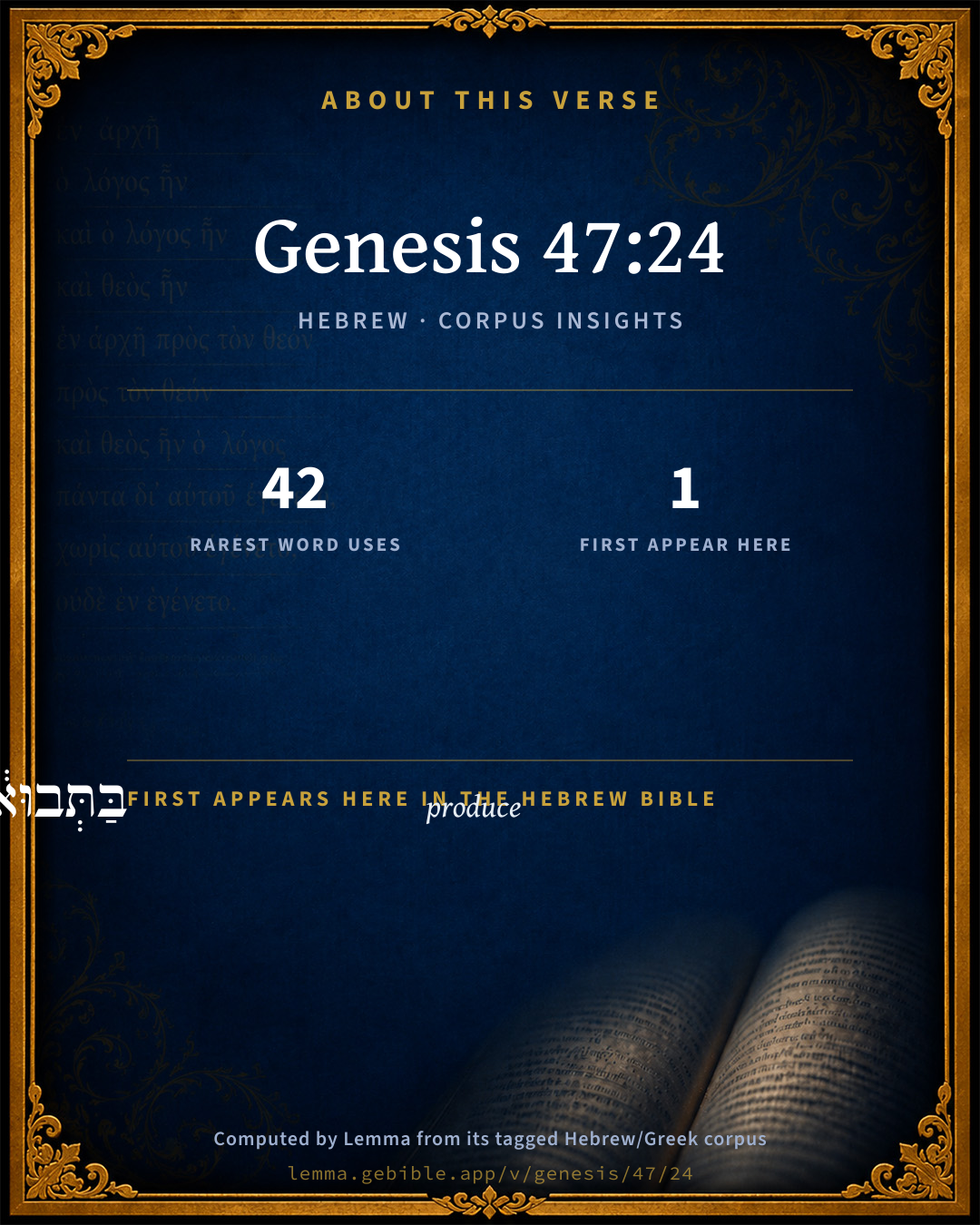
  • 1 first appearance in the Hebrew Bible
Full analysis ↓
Download a study sheet

One document with this verse’s original text, its word-by-word gloss line, the meaning frame, cross-references with their text, attributed commentary, and full source and license credits — printable, and it pastes into notes with its structure intact.

This verse Autodidact and up

Study sheet (.html) Plain text (.txt)

A passage Seminary Student

Up to 50 verses in one chapter. A passage sheet keeps up to 6 commentary sources and 12 cross-references per verse, in the order this page ranks them, and says so on the sheet whenever that leaves anything out. Ask for a single verse and you get the Autodidact verse sheet above.

Everything on this page stays free to read, with no account — the sheet is a download of what is already on screen, not access to it.

Want to remove ads? Support Godless Engineer
Compare translations 3

The same verse in 3 English versions, stacked beneath the original-language interlinear above. Click any original word for its lexicon entry.

Each is an independent rendering of the whole verse — the interlinear is not word-aligned to these translations.

Highlighted words mark where these versions differ — a whole-verse word diff, not a word-by-word alignment.

  • World English Bible Public Domain
    It will happen at the harvests, that you shall give a fifth to Pharaoh, and four parts will be your own, for seed of the field, for your food, for them of your households, and for food for your little ones."
  • King James Version Public Domain
    And it shall come to pass in the increase, that ye shall give the fifth part unto Pharaoh, and four parts shall be your own, for seed of the field, and for your food, and for them of your households, and for food for your little ones.
  • unfoldingWord Literal Text CC BY-SA 4.0
    And it will happen in the harvests that you must give a fifth to Pharaoh, and the four parts will be for you as seed of the field and as your food and for those in your houses and for your little ones to eat.”

unfoldingWord Literal Text — © unfoldingWord, licensed CC BY-SA 4.0. Word-aligned USFM3 via Door43 (git.door43.org/unfoldingWord/en_ult).

Versions to compare (up to 4)

3 of 4 selected

Show all 18 translations

Every available English version of this verse, each an independent rendering of the whole verse.

  • World English Bible Public Domain
    It will happen at the harvests, that you shall give a fifth to Pharaoh, and four parts will be your own, for seed of the field, for your food, for them of your households, and for food for your little ones."
  • Berean Standard Bible Public Domain
    At harvest time, you are to give a fifth of it to Pharaoh, and four-fifths will be yours as seed for the field and food for yourselves and your households and children.”
  • Majority Standard Bible Public Domain
    At harvest time, you are to give a fifth of it to Pharaoh, and four-fifths will be yours as seed for the field and food for yourselves and your households and children.”
  • King James Version Public Domain
    And it shall come to pass in the increase, that ye shall give the fifth part unto Pharaoh, and four parts shall be your own, for seed of the field, and for your food, and for them of your households, and for food for your little ones.
  • American Standard Version (1901) Public Domain
    And it shall come to pass at the ingatherings, that ye shall give a fifth unto Pharaoh, and four parts shall be your own, for seed of the field, and for your food, and for them of your households, and for food for your little ones.
  • Revised Version (1885) Public Domain
    And it shall come to pass at the ingatherings, that ye shall give a fifth unto Pharaoh, and four parts shall be your own, for seed of the field, and for your food, and for them of your households, and for food for your little ones.
  • Geneva Bible (1599) Public Domain
    And of the encrease ye shall giue the fifth part vnto Pharaoh, and foure partes shalbe yours for the seede of the fielde, and for your meate, and for them of your housholdes, and for your children to eate.
  • Douay-Rheims (1899) Public Domain
    That you may have corn. The fifth part you shall give to the king: the other four you shall have for seed, and for food for your families and children.
  • Young's Literal Translation Public Domain
    and it hath come to pass in the increases, that ye have given a fifth to Pharaoh, and four of the parts are for yourselves, for seed of the field, and for your food, and for those who `are' in your houses, and for food for your infants.'
  • Literal Standard Version CC BY-SA 4.0
    and it has come to pass in the increases, that you have given a fifth to Pharaoh, and four of the parts are for yourselves, for seed of the field, and for your food, and for those who [are] in your houses, and for food for your infants.”
  • Unlocked Literal Bible CC BY-SA 4.0
    At the harvest, you must give a fifth to Pharaoh, and four parts will be your own, for seed of the field and for food for your households and your children.”
  • unfoldingWord Literal Text CC BY-SA 4.0
    And it will happen in the harvests that you must give a fifth to Pharaoh, and the four parts will be for you as seed of the field and as your food and for those in your houses and for your little ones to eat.”
  • Darby Bible Public Domain
    And it shall come to pass in the increase that ye shall give the fifth to Pharaoh, and the four parts shall be your own, for seed of the field, and for your food, and for them of your households, and for food for your little ones.
  • World Messianic Bible Public Domain
    It will happen at the harvests, that you shall give a fifth to Pharaoh, and four parts will be your own, for seed of the field, for your food, for them of your households, and for food for your little ones.”
  • Webster's Bible Public Domain
    And it shall come to pass in the increase, that ye shall give the fifth part to Pharaoh, and four parts shall be your own, for seed of the field, and for your food, and for them of your households, and for food for your little ones.
  • Free Bible Version CC BY-SA 4.0
    However, when it's harvested, you have to give one-fifth of it to Pharaoh. The other four-fifths you can keep as seed for the fields and as food for you, your households, and your children.”
  • Bible in Basic English Public Domain
    And when the grain is cut, you are to give a fifth part to Pharaoh, and four parts will be yours for seed and food, and for your families and your little ones.
  • JPS Tanakh (1917) Public Domain
    And it shall come to pass at the ingatherings, that ye shall give a fifth unto Pharaoh, and four parts shall be your own, for seed of the field, and for your food, and for them of your households, and for food for your little ones.'

Literal Standard Version (2020), Covenant Press — licensed CC BY-SA 4.0. Text via the HelloAO Bible API (eBible.org). Unlocked Literal Bible (unfoldingWord) — licensed CC BY-SA 4.0. Text via the HelloAO Bible API (eBible.org). unfoldingWord Literal Text — © unfoldingWord, licensed CC BY-SA 4.0. Word-aligned USFM3 via Door43 (git.door43.org/unfoldingWord/en_ult). Free Bible Version, Dr. Jonathan Gallagher — licensed CC BY-SA 4.0. Text via the HelloAO Bible API (eBible.org).

Word by word

More ways to search: Search by grammar → Find every occurrence → Compare this word →

Practice this passage: Drill this verse → Learn its vocabulary →

לְטַפְּכֶֽם
ṭaph
H2945
“to/for · little children · your”
Preposition + Noun, Common, Masculine, Singular, Construct + Suffix, Personal, 2nd Person, Masculine, Plural
Part of Speech
Preposition + Noun
Type
Common
Gender
Masculine
Number
Singular
State
Construct
Full BDB Definition

Origin: from H2952 (perhaps referring to the tripping gait of children)

TWOT: 821a

children, little children, little ones
  1. וְהָיָה֙ hâyâh H1961 “and · to be” Conjunction + Verb, Qal, Sequential Perfect, 3rd Person, Masculine, Singular
  2. בַּתְּבוּאֹ֔ת tᵉbûwʼâh H8393 “in/at the · produce” Preposition, Determined + Noun, Common, Feminine, Plural, Absolute
  3. וּנְתַתֶּ֥ם nâthan H5414 “and · to give” Conjunction + Verb, Qal, Sequential Perfect, 2nd Person, Masculine, Plural
  4. חֲמִישִׁ֖ית chămîyshîy H2549 “fifth” Adjective, Ordinal number, Feminine, Singular, Absolute
  5. לְפַרְעֹ֑ה Parʻôh H6547 “to/for · Pharaoh” Preposition + Noun, Proper
  6. וְאַרְבַּ֣ע ʼarbaʻ H702 “and · four” Conjunction + Adjective, Cardinal number, Feminine, Singular, Absolute
  7. הַיָּדֹ֡ת yâd H3027 “the · hands” Particle, Definite Article + Noun, Common, Both, Plural, Absolute
  8. יִהְיֶ֣ה hâyâh H1961 “to be” Verb, Qal, Imperfect, 3rd Person, Masculine, Singular
  9. לְזֶ֨רַע zeraʻ H2233 “to/for · seed of” Preposition + Noun, Common, Masculine, Singular, Construct
  10. הַשָּׂדֶ֧ה sâdeh H7704 “the · field” Particle, Definite Article + Noun, Common, Masculine, Singular, Absolute
  11. וּֽלְאָכְלְכֶ֛ם ʼôkel H400 “and · to/for · food · your” Conjunction + Preposition + Noun, Common, Masculine, Singular, Construct + Suffix, Personal, 2nd Person, Masculine, Plural
  12. וְלַאֲשֶׁ֥ר ʼăsher H834 “and · to/for · which” Conjunction + Preposition + Particle, Relative
  13. בְּבָתֵּיכֶ֖ם bayith H1004 “in/at · houses · your” Preposition + Noun, Common, Masculine, Plural, Construct + Suffix, Personal, 2nd Person, Masculine, Plural
  14. וְלֶאֱכֹ֥ל ʼâkal H398 “and · to eat” Conjunction + Preposition + Verb, Qal, Infinitive Construct

About this verse

These counts appear in no published source. They are computed here, from the morphology-tagged text and Lemma’s own curated glosses. What Lemma adds →

16
words
14
distinct lemmas
Pentateuch
section

First appearance in Scripture

This word makes its first canonical appearance in the Hebrew Bible here:

  • בַּתְּבוּאֹ֔ת produce H8393

Shared distinctive vocabulary

לְטַפְּכֶֽם little children H2945 occurs in 42 verses of the Hebrew Bible. Also found in:

Grammatical profile

  • 4 verbs
  • 8 nouns
  • 2 adjectives
  • 1 preposition
  • 1 particle

Verb forms

  • וְהָיָה֙ Qal · Sequential Perfect
  • וּנְתַתֶּ֥ם Qal · Sequential Perfect
  • יִהְיֶ֣ה Qal · Imperfect
  • וְלֶאֱכֹ֥ל Qal · Infinitive Construct

Repetition

A word recurs within this verse — often emphatic in Hebrew:

  • וְהָיָה֙ to be H1961 ×2

Hebrew & Septuagint length

In English translation the verse runs 41 words from the Hebrew and 43 from the Septuagint (LXX English) — closely comparable.

A rough comparison of the two English renderings, which tokenize alike — not a word-level alignment.

Word counts can differ between the Hebrew and the Greek without any difference in meaning — e.g. the Hebrew direct-object marker אֵת has no separate Greek word, and Greek often adds the article ὁ.

Cross-references

6

Topical passages linked to Genesis 47:24 in the Treasury of Scripture Knowledge — connected by theme and wording, ordered by reader-vote popularity; previews shown in the World English Bible.

  • Genesis 41:34 Let Pharaoh do this, and let him appoint overseers over the land, and take up the fifth part of the land of Egypt's produce in the seven plenteous years.
  • Psalms 41:1 Blessed is he who considers the poor: Yahweh will deliver him in the day of evil.
  • Psalms 112:5 It is well with the man who deals graciously and lends. He will maintain his cause in judgment.
  • Genesis 47:25 They said, "You have saved our lives! Let us find favor in the sight of my lord, and we will be Pharaoh's servants."
  • Leviticus 27:32 All the tithe of the herds or the flocks, whatever passes under the rod, the tenth shall be holy to Yahweh.
  • 1 Samuel 8:15–17 He will take the tenth of your seed, and of your vineyards, and give to his officers, and to his servants.

Cross-references courtesy of OpenBible.info (CC BY 4.0).

Hebrew and Greek witnesses Masoretic Hebrew ↔ Greek Septuagint

The same verse in the two great witnesses to the Old Testament, shown verse-for-verse.

These are two independent witnesses, not word-aligned to each other, and the Septuagint is shown in lemma (dictionary) form.

Hebrew Genesis 47:24 Masoretic · Westminster Leningrad Codex

וְהָיָה֙ בַּתְּבוּאֹ֔ת וּנְתַתֶּ֥ם חֲמִישִׁ֖ית לְפַרְעֹ֑ה וְאַרְבַּ֣ע הַיָּדֹ֡ת יִהְיֶ֣ה לָכֶם֩ לְזֶ֨רַע הַשָּׂדֶ֧ה וּֽלְאָכְלְכֶ֛ם וְלַאֲשֶׁ֥ר בְּבָתֵּיכֶ֖ם וְלֶאֱכֹ֥ל לְטַפְּכֶֽם

It will happen at the harvests, that you shall give a fifth to Pharaoh, and four parts will be your own, for seed of the field, for your food, for them of your households, and for food for your little ones."

World English Bible · Public Domain

Greek LXX Genesis 47:24 Septuagint · lemma form

καί εἰμί ὁ γένημα αὐτός δίδωμι ὁ πέμπτος μέρος ὁ φαραώ ὁ δέ τέσσαρες μέρος εἰμί σύ αὐτός εἰς σπέρμα ὁ γῆ καί εἰς βρῶσις σύ καί πᾶς ὁ ἐν ὁ οἶκος σύ

And there shall be the fruits of it; and you⌃ shall give the fifth part to Pharao, and the four remaining parts shall be for yourselves, for seed for the earth, and for food for you, and all that are in your houses.

LXX2012 (modern English Septuagint) · Public Domain

Hebrew: Westminster Leningrad Codex (CC BY 4.0). Greek: Septuagint (public domain); English from LXX2012 (modern English Septuagint) (Public Domain). How the Septuagint differs from the Hebrew →

Targum (Aramaic paraphrase)

2

The Targum is the ancient Jewish Aramaic paraphrase of the Hebrew Scriptures — an interpretive translation, not the Hebrew text itself. Onkelos (literal) and Pseudo-Jonathan (expansive) render the Torah, and Jonathan the Prophets. Coverage is partial: where no permissively-licensed English translation exists for a verse, only the Aramaic is shown. This is verse-level text, not a word-by-word alignment to the Hebrew.

  1. Targum Onkelos Torah (Genesis–Deuteronomy)
    וִיהֵי בְּאָעוֹלֵי עֲלַלְתָּא וְתִתְּנוּן חַד מִן חַמְשָׁא לְפַרְעֹה וְאַרְבַּע חֳלָקִין יְהֵא לְכוֹן לְבַר זְרַע חַקְלָא וּלְמֵיכַלְכוֹן וְלֶאֱנַשׁ בָתֵּיכוֹן וּלְמֵיכַל לְטַפְלְכוֹן

    (no public-domain English translation for this verse)

    Targum Onkelos — Aramaic: “Onkelos Genesis” (public domain); “Onkelos Exodus” (public domain); “Onkelos Leviticus” (public domain); “Onkelos Numbers” (public domain); “Onkelos Deuteronomy” (public domain). English: “Sefaria Community Translation” (CC0 1.0 (public-domain dedication)); “J.W. Etheridge. The Targums of Onkelos and Jonathan Ben Uzziel on the Pentateuch. London: Longmans, Green, 1862” (public domain). Text via Sefaria.

  2. Targum Pseudo-Jonathan Torah (Genesis–Deuteronomy)
    וִיהֵי בְאִישׁוּנֵיהּ בְּמִכְנוֹש עֲלַלְתָּא וְתִתְּנוּן חוּמְשָׁא לְפַּרְעה וְאַרְבַּע חוּלְקִין יְהֵי לְכוֹן לְבַר זַרְעָא דְאַרְעָא וּלְמֵיכְלֵיכוֹן וּלְפַרְנוּס בָּתֵּיכוֹן וּלְמֵיכוּל לְטַפְלְכוֹן

    and at the time of the ingathering of your produce you shall give the fifth part to Pharoh, and four parts shall be yours, for the seeding of your land, and for food and for provision for your houses and little ones.

    Targum Pseudo-Jonathan — Aramaic: “Targum Jonathan on Genesis” (public domain); “Targum Jonathan on Exodus” (public domain); “Targum Jonathan on Leviticus” (public domain); “Targum Jonathan on Numbers” (public domain); “Targum Jonathan on Deuteronomy” (public domain). English: “The Targum of Jonathan ben Uzziel, trans. J. W. Etheridge, London, 1862” (public domain). Text via Sefaria.

Commentary

Notes on Genesis 47:24 from classic Christian and Jewish commentators (each source and its license shown beneath its notes). The classic Christian expositions comment on the surrounding passage and are grouped to its opening verse, so a note may address several verses; the Jewish commentaries on the Tanakh (Rashi and others) are per-verse, so they appear only where the commentator wrote on this verse.

Lemma curates 59 commentaries, every one of them public domain or Creative Commons licensed, each selected and text-cleaned for this edition rather than reprinted as found. About our sources →

Trapp's Complete Commentary

John Trapp

Gen 47:24 And it shall come to pass in the increase, that ye shall give the fifth [part] unto Pharaoh, and four parts shall be your own, for seed of the field, and for your food, and for them of your households, and for food for your little ones.

Ver. 24. Ye shall give the fifth part.] {See Trapp on "Gen 47:19"}

John Trapp, A Commentary or Exposition upon All the Books of the Old and New Testament (1647–1656) — public domain. Text from a community e-Sword module.

Adam Clarke's Commentary

Verse 24. Ye shall give the fifth part unto Pharaoh] This is precisely the case in Hindostan; the king has the fifth part of all the crops.

Adam Clarke's Commentary on the Bible (1810–1826) — public domain. Text from a community e-Sword/MySword module.

The Cambridge Bible for Schools and Colleges

gen. ed. J. J. S. Perowne

24. a fifth] Cf. Gen_41:34. This seems an immense impost. But it is said to compare favourably with the ruthless standard of taxation by Oriental governments, in which corruption was rife and liberty did not exist: cf. the letter of King Demetrius, 1Ma_10:30, “the third part of the seed,” “the half of the fruit of the trees which falleth to me to receive.”

The Cambridge Bible for Schools and Colleges (gen. ed. J. J. S. Perowne; Cambridge University Press, 1878–1918) — public domain. Text from a community e-Sword module.

John Gill's Exposition

And they said, thou hast saved our lives,.... Preserved them from death through famine, by laying up stores of corn, which he had sold out to them for their money, cattle, and land, or otherwise they must have perished, they and theirs, and this favour they thankfully acknowledge:

let us find grace in the sight of my lord, and we will be Pharaoh's servants; signifying, that they esteemed it a great favour to be so on the foot of the bargain made with them, and they desired a continuance in it.

John Gill's Exposition of the Whole Bible (1746–1763) — public domain (CC PDM 1.0). Text via the HelloAO Bible API.

Matthew Poole's English Annotations

Whereas he might have reserved four parts to Pharaoh, and have allowed them only the fifth. Herein he showed both his humanity and kindness, in mitigating that hard bargain which themselves had made, and were necessitated to make, and his prudence in composing, sweetening, and winning the hearts of the people to the king, and making them pay their tribute for the future with more cheerfulness.

Matthew Poole's English Annotations on the Holy Bible (1683–1685) — public domain. Text from a community e-Sword/MySword module.

Rashi

Rabbi Shlomo Yitzchaki (Rashi)

לזרע השדה FOR SEED OF THE FIELD — for sowing every year),

ולאשר בבתיכם AND FOR THEM OF YOUR HOUSEHOLDS — means and as food for the servants and maidservants that are in your houses,

טפכם means your young children.

Rashi on the Tanakh — English translations: “The Judaica Press complete Tanach with Rashi, translated by A. J. Rosenberg” (CC BY 4.0); “Pentateuch with Rashi's commentary by M. Rosenbaum and A.M. Silbermann, 1929-1934” (public domain); “The Metsudah Tanach series, Lakewood, N.J” (CC BY 4.0); and “The Book of Joshua, Metsudah Publications, 1997” (CC BY 4.0). Text via Sefaria.

Radak

Rabbi David Kimhi (Radak)

ולאשר בבתיכם, a reference to male and female servants as well as to horses and donkeys. [which had not been included in the מקנה, livestock, which Joseph had taken in payment for food on behalf of Pharaoh. Ed.]

ולאכול לטפכם, and for your children to eat. Joseph made sure that the people would have enough food from the 80% of harvests of their parents even though he was aware that the children would require more food than their elders, it being well known that they were being wasteful. The land of Egypt, normally, has a surplus of food due to the irrigation method based on the overflow of the Nile, so that by being allowed to keep four fifths of their crops the farmers would not suffer hardship.

Radak on the Tanakh — English translations: “Sefaria Community Translation” (CC0 1.0 (public-domain dedication)); “Eliyahu Munk, HaChut Hameshulash” (CC BY 4.0); “Rabbi Mike Feuer, Jerusalem Anthology” (CC BY 4.0); and “R. David Kimhi on the first book of Psalms, Translated by R.G. Finch, London, 1919” (public domain). Text via Sefaria.

Lesson kit

Teaching starters — assembled from the data on this page, not authored interpretation. Every prompt links to the verse data it draws on. Edit before teaching.

Genesis, in the Pentateuch, opens this verse with 16 words (14 distinct Hebrew lemmas). Its most distinctive word is ṭaph (“little children”). A historical commentator’s framing appears above. Read the whole chapter for the surrounding context.

Discussion questions

  1. The word ṭaph carries the sense “little children.” How does it shape the verse?
  2. This is the first place “produce” appears in Scripture (first appears here). What does its debut here establish?
  3. How does Genesis 34:29, which shares the word «little children», read alongside this verse?
  4. What does the repetition of “to be” (2× in this one verse) do in this verse?
  5. These translations render this verse differently. What is at stake in choosing one wording over another?
  6. «וְהָיָה֙» is a Qal Sequential Perfect verb. How does that grammatical form shape the action described?
  7. Compare how Trapp's Complete Commentary and Adam Clarke's Commentary read this verse. Where do they agree or differ?

Things to notice

  • 1 word makes its first canonical appearance in Scripture here.
  • These translations choose different wording for 14 words in this verse.
  • “to be” occurs 2× in this single verse.
  • 14 distinct Hebrew lemmas span 16 words in this verse.

Reading settings

Reading text

Shown beneath each verse's original-language words.

Old Testament
Old Testament edition

Read the OT as the Masoretic Hebrew (MT) or the Greek Septuagint (LXX).

English shown for the Greek Septuagint (in the Hebrew ↔ Greek comparison).

Comparing translations? Open the Compare panel on any verse page to stack up to four side by side.