
Deuteronomy 1:8

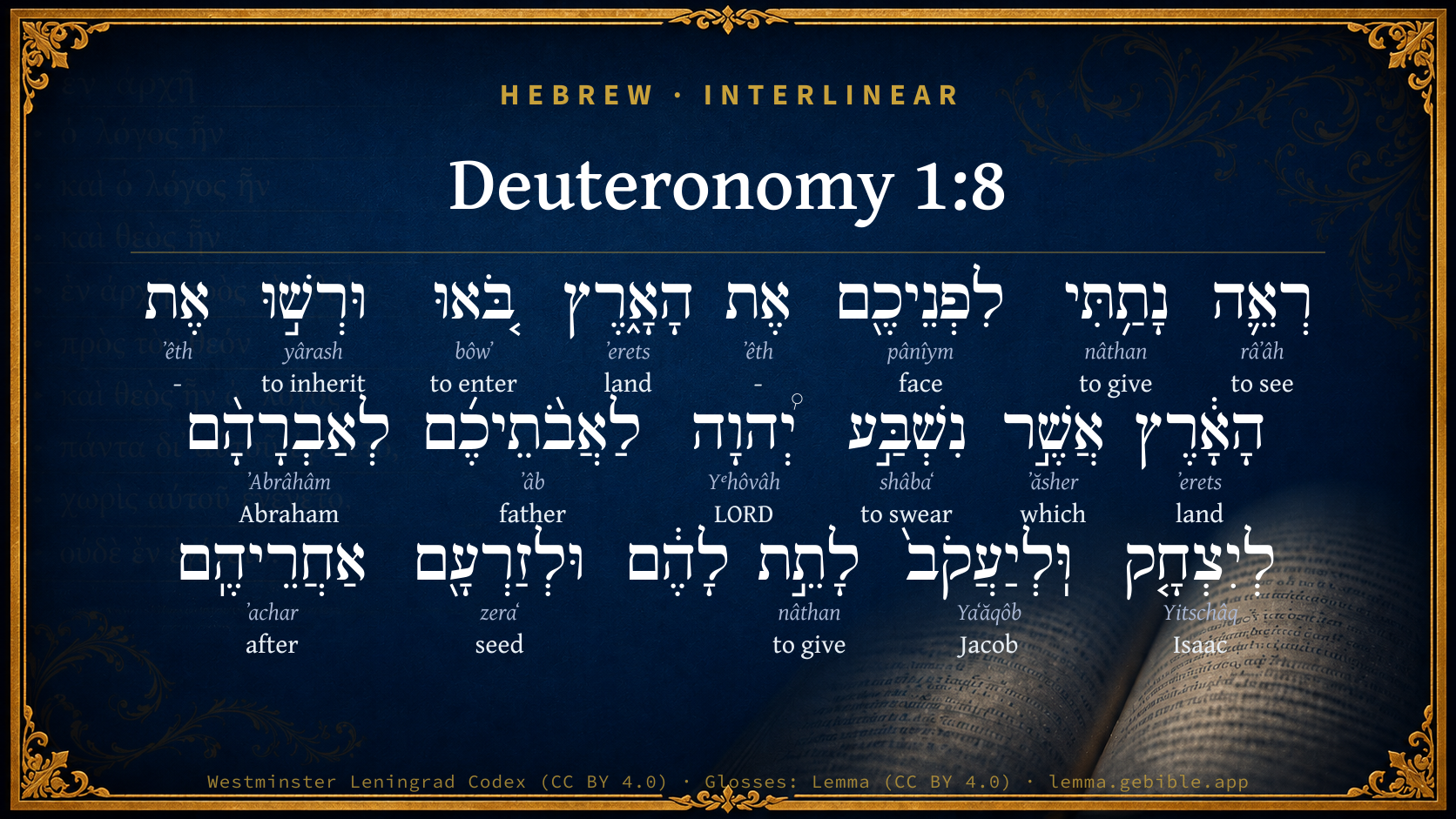
Hebrew (Westminster Leningrad Codex) Deuteronomy 1:8 appears in the Hebrew Old Testament. The text above is from the Westminster Leningrad Codex. Each word links to its Strong’s number, a concise gloss, and parsing drawn from the Open Scriptures Hebrew Bible morphology. Click any word for its full Brown-Driver-Briggs (BDB) entry.
Download image
Cite this verse

Deuteronomy 1:8 (World English Bible). Public Domain. Lemma interlinear Bible study tool, https://lemma.gebible.app/v/deuteronomy/1/8.

Show BibTeX & RIS
BibTeX
RIS
English Translation
Behold, I have set the land before you: go in and possess the land which Yahweh swore to your fathers, to Abraham, to Isaac, and to Jacob, to give to them and to their seed after them.
World English Bible · Public Domain
Download a study sheet

One document with this verse’s original text, its word-by-word gloss line, the meaning frame, cross-references with their text, attributed commentary, and full source and license credits — printable, and it pastes into notes with its structure intact.

This verse Autodidact and up

Study sheet (.html) Plain text (.txt)

A passage Seminary Student

Up to 50 verses in one chapter. A passage sheet keeps up to 6 commentary sources and 12 cross-references per verse, in the order this page ranks them, and says so on the sheet whenever that leaves anything out. Ask for a single verse and you get the Autodidact verse sheet above.

Everything on this page stays free to read, with no account — the sheet is a download of what is already on screen, not access to it.

Want to remove ads? Support Godless Engineer
Compare translations 3

The same verse in 3 English versions, stacked beneath the original-language interlinear above. Click any original word for its lexicon entry.

Each is an independent rendering of the whole verse — the interlinear is not word-aligned to these translations.

Highlighted words mark where these versions differ — a whole-verse word diff, not a word-by-word alignment.

  • World English Bible Public Domain
    Behold, I have set the land before you: go in and possess the land which Yahweh swore to your fathers, to Abraham, to Isaac, and to Jacob, to give to them and to their seed after them.
  • King James Version Public Domain
    Behold, I have set the land before you: go in and possess the land which the LORD sware unto your fathers, Abraham, Isaac, and Jacob, to give unto them and to their seed after them.
  • unfoldingWord Literal Text CC BY-SA 4.0
    Look, I have given the land to your faces. Go and possess the land that Yahweh swore to your fathers, to Abraham, to Isaac, and to Jacob, to give to them and to their seed after them.’

unfoldingWord Literal Text — © unfoldingWord, licensed CC BY-SA 4.0. Word-aligned USFM3 via Door43 (git.door43.org/unfoldingWord/en_ult).

Versions to compare (up to 4)

3 of 4 selected

Show all 18 translations

Every available English version of this verse, each an independent rendering of the whole verse.

  • World English Bible Public Domain
    Behold, I have set the land before you: go in and possess the land which Yahweh swore to your fathers, to Abraham, to Isaac, and to Jacob, to give to them and to their seed after them.
  • Berean Standard Bible Public Domain
    See, I have placed the land before you. Enter and possess the land that the LORD swore He would give to your fathers Abraham, Isaac, and Jacob, and to their descendants after them.”
  • Majority Standard Bible Public Domain
    See, I have placed the land before you. Enter and possess the land that the LORD swore He would give to your fathers Abraham, Isaac, and Jacob, and to their descendants after them.”
  • King James Version Public Domain
    Behold, I have set the land before you: go in and possess the land which the LORD sware unto your fathers, Abraham, Isaac, and Jacob, to give unto them and to their seed after them.
  • American Standard Version (1901) Public Domain
    Behold, I have set the land before you: go in and possess the land which Jehovah sware unto your fathers, to Abraham, to Isaac, and to Jacob, to give unto them and to their seed after them.
  • Revised Version (1885) Public Domain
    Behold, I have set the land before you: go in and possess the land which the LORD sware unto your fathers, to Abraham, to Isaac, and to Jacob, to give unto them and to their seed after them.
  • Geneva Bible (1599) Public Domain
    Beholde, I haue set the land before you: go in and possesse that land which the Lord sware vnto your fathers, Abraham, Izhak, and Iaakob, to giue vnto them and to their seede after them.
  • Douay-Rheims (1899) Public Domain
    The Lord our God spoke to us in Horeb, saying: You have stayed long enough in this mountain:
  • Young's Literal Translation Public Domain
    see, I have set before you the land; go in and possess the land which Jehovah hath sworn to your fathers, to Abraham, to Isaac, and to Jacob, to give to them, and to their seed after them.
  • Literal Standard Version CC BY-SA 4.0
    see, I have set the land before you; go in and possess the land which YHWH has sworn to your fathers, to Abraham, to Isaac, and to Jacob, to give to them and to their seed after them.
  • Unlocked Literal Bible CC BY-SA 4.0
    Look, I have set the land before you; go in and possess the land that Yahweh swore to your fathers—to Abraham, to Isaac, and to Jacob—to give to them and to their descendants after them.'
  • unfoldingWord Literal Text CC BY-SA 4.0
    Look, I have given the land to your faces. Go and possess the land that Yahweh swore to your fathers, to Abraham, to Isaac, and to Jacob, to give to them and to their seed after them.’
  • Darby Bible Public Domain
    Behold, I have set the land before you: go in and possess the land which Jehovah swore unto your fathers, to Abraham, to Isaac, and to Jacob, to give unto them and to their seed after them.
  • World Messianic Bible Public Domain
    Behold, I have set the land before you. Go in and possess the land which the LORD swore to your fathers—to Abraham, to Isaac, and to Jacob—to give to them and to their offspring after them.’”
  • Webster's Bible Public Domain
    Behold, I have set the land before you: go in and possess the land which the LORD swore to your fathers, Abraham, Isaac, and Jacob, to give to them and to their seed after them.
  • Free Bible Version CC BY-SA 4.0
    Look, I'm giving this land to you. Go and take ownership of the land that the Lord promised he would give to your fathers Abraham, Isaac, and Jacob, and to their descendants who would follow them.”
  • Bible in Basic English Public Domain
    See, all the land is before you: go in and take for yourselves the land which the Lord gave by an oath to your fathers, Abraham, Isaac, and Jacob, and to their seed after them.
  • JPS Tanakh (1917) Public Domain
    Behold, I have set the land before you: go in and possess the land which the LORD swore unto your fathers, to Abraham, to Isaac, and to Jacob, to give unto them and to their seed after them.'

Literal Standard Version (2020), Covenant Press — licensed CC BY-SA 4.0. Text via the HelloAO Bible API (eBible.org). Unlocked Literal Bible (unfoldingWord) — licensed CC BY-SA 4.0. Text via the HelloAO Bible API (eBible.org). unfoldingWord Literal Text — © unfoldingWord, licensed CC BY-SA 4.0. Word-aligned USFM3 via Door43 (git.door43.org/unfoldingWord/en_ult). Free Bible Version, Dr. Jonathan Gallagher — licensed CC BY-SA 4.0. Text via the HelloAO Bible API (eBible.org).

Word by word

More ways to search: Search by grammar → Find every occurrence → Compare this word →

Practice this passage: Drill this verse → Learn its vocabulary →

לְיִצְחָ֤ק
Yitschâq
H3327
“to/for · Isaac”
Preposition + Noun, Proper
Part of Speech
Preposition + Noun
Type
Proper
Full BDB Definition

Origin: from H6711

TWOT: 1905b

Isaac = "he laughs" - son of Abraham by Sarah his wife and father of Jacob and Esau
  1. רְאֵ֛ה râʼâh H7200 “see” Verb, Qal, Imperative, 2nd Person, Masculine, Singular
  2. נָתַ֥תִּי nâthan H5414 “to give” Verb, Qal, Perfect, 1st Person, Common, Singular
  3. לִפְנֵיכֶ֖ם pânîym H6440 “to/for · face(s) · your” Preposition + Noun, Common, Both, Plural, Construct + Suffix, Personal, 2nd Person, Masculine, Plural
  4. אֶת ʼêth H853 “-” Particle, Direct Object
  5. הָאָ֑רֶץ ʼerets H776 “the · land” Particle, Definite Article + Noun, Common, Both, Singular, Absolute
  6. בֹּ֚אוּ bôwʼ H935 “enter” Verb, Qal, Imperative, 2nd Person, Masculine, Plural
  7. וּרְשׁ֣וּ yârash H3423 “and · inherit” Conjunction + Verb, Qal, Imperative, 2nd Person, Masculine, Plural
  8. אֶת ʼêth H853 “-” Particle, Direct Object
  9. הָאָ֔רֶץ ʼerets H776 “the · land” Particle, Definite Article + Noun, Common, Both, Singular, Absolute
  10. אֲשֶׁ֣ר ʼăsher H834 “which” Particle, Relative
  11. נִשְׁבַּ֣ע shâbaʻ H7650 “to swear” Verb, Niphal, Perfect, 3rd Person, Masculine, Singular
  12. יְ֠הוָה Yᵉhôvâh H3068 “LORD” Noun, Proper
  13. לַאֲבֹ֨תֵיכֶ֜ם ʼâb H1 “to/for · fathers · your” Preposition + Noun, Common, Masculine, Plural, Construct + Suffix, Personal, 2nd Person, Masculine, Plural
  14. לְאַבְרָהָ֨ם ʼAbrâhâm H85 “to/for · Abraham” Preposition + Noun, Proper
  15. וּֽלְיַעֲקֹב֙ Yaʻăqôb H3290 “and · to/for · Jacob” Conjunction + Preposition + Noun, Proper
  16. לָתֵ֣ת nâthan H5414 “to give” Preposition + Verb, Qal, Infinitive Construct
  17. וּלְזַרְעָ֖ם zeraʻ H2233 “and · to/for · seed · their” Conjunction + Preposition + Noun, Common, Masculine, Singular, Construct + Suffix, Personal, 3rd Person, Masculine, Plural
  18. אַחֲרֵיהֶֽם ʼachar H310 “after · them” Preposition + Suffix, Personal, 3rd Person, Masculine, Plural

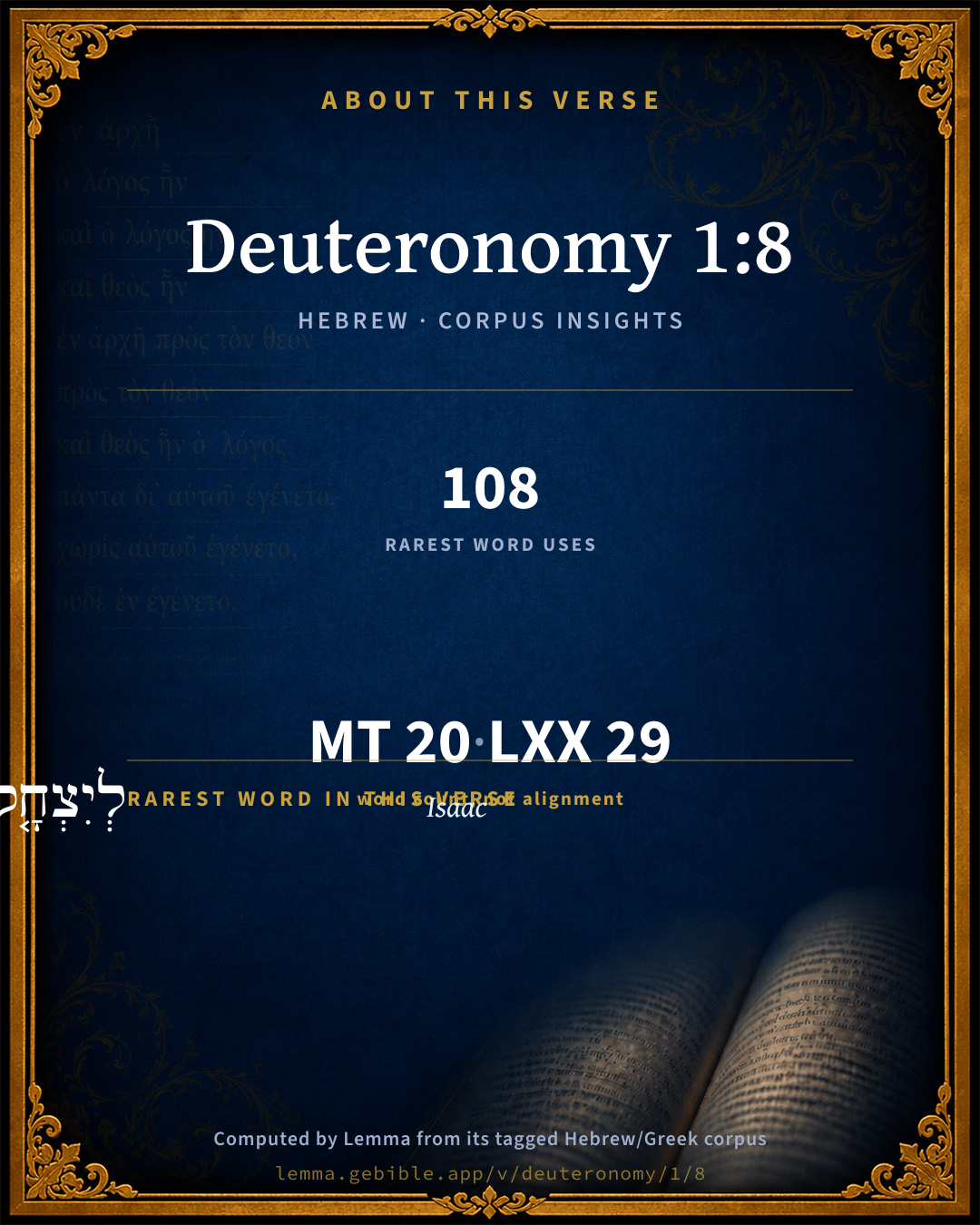
About this verse

These counts appear in no published source. They are computed here, from the morphology-tagged text and Lemma’s own curated glosses. What Lemma adds →

20
words
16
distinct lemmas
Pentateuch
section

Grammatical profile

  • 6 verbs
  • 9 nouns
  • 2 prepositions
  • 3 particles

Verb forms

  • רְאֵ֛ה Qal · Imperative
  • נָתַ֥תִּי Qal · Perfect
  • בֹּ֚אוּ Qal · Imperative
  • וּרְשׁ֣וּ Qal · Imperative
  • נִשְׁבַּ֣ע Niphal · Perfect
  • לָתֵ֣ת Qal · Infinitive Construct

Repetition

Words recur within this verse — often emphatic in Hebrew:

  • נָתַ֥תִּי to give H5414 ×2
  • הָאָ֑רֶץ land H776 ×2

Hebrew & Septuagint length

In English translation the verse runs 37 words from the Hebrew and 36 from the Septuagint (LXX English) — closely comparable.

A rough comparison of the two English renderings, which tokenize alike — not a word-level alignment.

Word counts can differ between the Hebrew and the Greek without any difference in meaning — e.g. the Hebrew direct-object marker אֵת has no separate Greek word, and Greek often adds the article ὁ.

In the original languages it is 20 Hebrew tokens and 29 Greek tokens — but the two are counted differently (Hebrew bundles its prefixes and suffixes into one token; the Greek is in lemma form), so that isn’t a like-for-like length.

Cross-references

8

Topical passages linked to Deuteronomy 1:8 in the Treasury of Scripture Knowledge — connected by theme and wording, ordered by reader-vote popularity; previews shown in the World English Bible.

  • Genesis 15:18 In that day Yahweh made a covenant with Abram, saying, "To your seed have I given this land, from the river of Egypt to the great river, the river Euphrates:
  • Genesis 12:7 Yahweh appeared to Abram, and said, "I will give this land to your seed." He built an altar there to Yahweh, who appeared to him.
  • Genesis 26:3–4 Sojourn in this land, and I will be with you, and will bless you. For to you, and to your seed, I will give all these lands, and I will establish the oath which I swore to Abraham your father.
  • Genesis 13:14–15 Yahweh said to Abram, after Lot was separated from him, "Now, lift up your eyes, and look from the place where you are, northward and southward and eastward and westward,
  • Genesis 17:7–8 I will establish my covenant between me and you and your seed after you throughout their generations for an everlasting covenant, to be a God to you and to your seed after you.
  • Genesis 28:13–14 Behold, Yahweh stood above it, and said, "I am Yahweh, the God of Abraham your father, and the God of Isaac. The land whereon you lie, to you will I give it, and to your seed.
  • Genesis 22:16–18 and said, "I have sworn by myself, says Yahweh, because you have done this thing, and have not withheld your son, your only son,
  • Genesis 15:16 In the fourth generation they will come here again, for the iniquity of the Amorite is not yet full."

Cross-references courtesy of OpenBible.info (CC BY 4.0).

Hebrew and Greek witnesses Masoretic Hebrew ↔ Greek Septuagint

The same verse in the two great witnesses to the Old Testament, shown verse-for-verse.

These are two independent witnesses, not word-aligned to each other, and the Septuagint is shown in lemma (dictionary) form.

Hebrew Deuteronomy 1:8 Masoretic · Westminster Leningrad Codex

רְאֵ֛ה נָתַ֥תִּי לִפְנֵיכֶ֖ם אֶת הָאָ֑רֶץ בֹּ֚אוּ וּרְשׁ֣וּ אֶת הָאָ֔רֶץ אֲשֶׁ֣ר נִשְׁבַּ֣ע יְ֠הוָה לַאֲבֹ֨תֵיכֶ֜ם לְאַבְרָהָ֨ם לְיִצְחָ֤ק וּֽלְיַעֲקֹב֙ לָתֵ֣ת לָהֶ֔ם וּלְזַרְעָ֖ם אַחֲרֵיהֶֽם

Behold, I have set the land before you: go in and possess the land which Yahweh swore to your fathers, to Abraham, to Isaac, and to Jacob, to give to them and to their seed after them.

World English Bible · Public Domain

Greek LXX Deuteronomy 1:8 Septuagint · lemma form

ὁράω παραδίδωμι ἐνώπιον σύ ὁ γῆ εἰςπορεύομαι κληρονομέω ὁ γῆ ὅς ὄμνυμι ὁ πατήρ σύ ὁ ἀβραάμ καί ισαακ καί ἰακώβ δίδωμι αὐτός καί ὁ σπέρμα αὐτός μετά αὐτός

Behold, God has delivered the land before you; go in and inherit the land, which I swore to your fathers, Abraam, and Isaac, and Jacob, to give it to them and to their seed after them.

LXX2012 (modern English Septuagint) · Public Domain

On this verse, The Cambridge Bible for Schools and Colleges discusses the Septuagint’s reading. Read the note in Commentary ↓

Hebrew: Westminster Leningrad Codex (CC BY 4.0). Greek: Septuagint (public domain); English from LXX2012 (modern English Septuagint) (Public Domain). How the Septuagint differs from the Hebrew →

Targum (Aramaic paraphrase)

2

The Targum is the ancient Jewish Aramaic paraphrase of the Hebrew Scriptures — an interpretive translation, not the Hebrew text itself. Onkelos (literal) and Pseudo-Jonathan (expansive) render the Torah, and Jonathan the Prophets. Coverage is partial: where no permissively-licensed English translation exists for a verse, only the Aramaic is shown. This is verse-level text, not a word-by-word alignment to the Hebrew.

  1. Targum Onkelos Torah (Genesis–Deuteronomy)
    חֲזֵי דִיהָבִית קֳדָמֵיכוֹן יָת אַרְעָא עוּלוּ וְאַחֲסִינוּ יָת אַרְעָא דִי קַיַם יְיָ לַאֲבָהָתְכוֹן לְאַבְרָהָם לְיִצְחָק וּלְיַעֲקֹב לְמִתַּן לְהוֹן וְלִבְנֵיהוֹן בַּתְרֵיהוֹן

    (no public-domain English translation for this verse)

    Targum Onkelos — Aramaic: “Onkelos Genesis” (public domain); “Onkelos Exodus” (public domain); “Onkelos Leviticus” (public domain); “Onkelos Numbers” (public domain); “Onkelos Deuteronomy” (public domain). English: “Sefaria Community Translation” (CC0 1.0 (public-domain dedication)); “J.W. Etheridge. The Targums of Onkelos and Jonathan Ben Uzziel on the Pentateuch. London: Longmans, Green, 1862” (public domain). Text via Sefaria.

  2. Targum Pseudo-Jonathan Torah (Genesis–Deuteronomy)
    חֲמוֹן דִּי מְסָרִית קֳדָמֵיכוֹן יַת דַּיְירֵי אַרְעָא וְלָא תִצְטַרְכוּן לְמֵיטוּל זַיְינָא עוּלוּ וְאַחֲסִינוּ יַת אַרְעָא וְקָבְעוּ בָּהּ דִּפְטַיָא וּפַלְגוּהָא הֵי כְמָא דְקַיֵים לְאַבְהַתְכוֹן לְאַבְרָהָם לְיִצְחָק וּלְיַעֲקב לְמִתַּן לְהוֹן וְלִבְנֵיהוֹן בַּתְרֵיהוֹן

    See, I have given up the inhabitants of the land before you; nor shall it be needful to carry arms; go in and possess the land, and appoint the allotters, and divide it, even as the Lord sware to your fathers, to Abraham, Izhak, and Jakob, that He would give it unto them and their sons after them.

    Targum Pseudo-Jonathan — Aramaic: “Targum Jonathan on Genesis” (public domain); “Targum Jonathan on Exodus” (public domain); “Targum Jonathan on Leviticus” (public domain); “Targum Jonathan on Numbers” (public domain); “Targum Jonathan on Deuteronomy” (public domain). English: “The Targum of Jonathan ben Uzziel, trans. J. W. Etheridge, London, 1862” (public domain). Text via Sefaria.

Commentary

Notes on Deuteronomy 1:8 from classic Christian and Jewish commentators (each source and its license shown beneath its notes). The classic Christian expositions comment on the surrounding passage and are grouped to its opening verse, so a note may address several verses; the Jewish commentaries on the Tanakh (Rashi and others) are per-verse, so they appear only where the commentator wrote on this verse.

Lemma curates 59 commentaries, every one of them public domain or Creative Commons licensed, each selected and text-cleaned for this edition rather than reprinted as found. About our sources →

Trapp's Complete Commentary

John Trapp

Deu 1:8 Behold, I have set the land before you: go in and possess the land which the LORD sware unto your fathers, Abraham, Isaac, and Jacob, to give unto them and to their seed after them.

Ver. 8. Go in and possess it.] God was ready, but they were not ripe for such a mercy. So {2Ch 20:33} the high places were not taken away; for the people had not yet prepared their hearts for such a reformation: the work was ensnarled and retarded by their unfitness. See Isa 59:2.

John Trapp, A Commentary or Exposition upon All the Books of the Old and New Testament (1647–1656) — public domain. Text from a community e-Sword module.

Tyndale Open Study Notes

Tyndale Open Resources

1:8 occupy it (literally acquire it as an inheritance): The land was already Israel’s because God had promised it to the nation’s ancestors centuries earlier (Gen 15:18-21; 26:3; Exod 23:31). Israel was not seizing new territory from its rightful owners but was taking possession of land occupied by squatters.

Tyndale Open Study Notes — © Tyndale Open Resources, licensed CC BY-SA 4.0. Text via the HelloAO Bible API.

Jamieson, Fausset & Brown

Robert Jamieson, A. R. Fausset & David Brown

I have set the land before you--literally, "before your faces"--it is accessible; there is no impediment to your occupation. The order of the journey as indicated by the places mentioned would have led to a course of invasion, the opposite of what was eventually followed; namely, from the seacoast eastward--instead of from the Jordan westward (see on Num 20:1).

Jamieson, Fausset & Brown — Commentary Critical and Explanatory on the Whole Bible (1871) — public domain (CC PDM 1.0). Text via the HelloAO Bible API.

Ellicott's Commentary for English Readers

(8) To give unto them.—Note that the land is promised to Abraham, and to Isaac, and to Jacob, not only to their seed. The promise is not forgotten, though the three patriarchs are in another world. (Comp. Act_7:5, and Heb_11:16. See also Note. on Deu_11:21.)

A Bible Commentary for English Readers, edited by Charles John Ellicott (1878–1897) — public domain. Text from a community e-Sword module.

The Cambridge Bible for Schools and Colleges

gen. ed. J. J. S. Perowne

8. Behold] Sg. but even if this reading be correct (Sam. and LXX read Pl.) it is meant as an interjection and is no proof of a change to the Sg. address, cp. Deu_4:5.

I have set … before you] Heb. given before you, given up to you; in this sense both of land and foe; eleven times in D, and not elsewhere in Heb.; in D nearly always with Sg.

which the Lord sware] As the Lord Himself is the speaker, we ought perhaps to read with LXX and Sam. which I sware. Yet their reading may be a correction of the original, which in that case would be a symptom of the carelessness of the writer in not sustaining the situation he assumed. The anthropomorphism, imputing an oath to the Deity, is found in JE (Gen_22:16), especially in the phrases, sware unto Abraham, Isaac, and Jacob (Gen_50:24; Exo_32:13; Exo_33:1); to Abraham thy father (Gen_26:3); to thy fathers or to them (Num_11:12; Num_14:16; Num_14:23); thee and thy fathers (Exo_13:11). Used in D of special oaths (Deu_1:34, Deu_2:14, Deu_4:21); of the covenant (Deu_4:31); or as here of the land which he sware unto thy, your, or our fathers, 22 or 23 times.

The Cambridge Bible for Schools and Colleges (gen. ed. J. J. S. Perowne; Cambridge University Press, 1878–1918) — public domain. Text from a community e-Sword module.

John Gill's Exposition

Behold, I have set the land before you,.... Described it to them, and set its bounds, as well as had given them a grant of it:

go in and possess the land, which the Lord sware unto your fathers, Abraham, Isaac, and Jacob, to give unto them and their seed after them: and which being thus made sure unto them, they had nothing more to do than to go and take possession of it.

John Gill's Exposition of the Whole Bible (1746–1763) — public domain (CC PDM 1.0). Text via the HelloAO Bible API.

Matthew Poole's English Annotations

Before you, Heb. before your faces; it is open to your view, and to your possession; there is no impediment in the way. See Poole "Gen 13:9"; See Poole "Gen 34:10".

Matthew Poole's English Annotations on the Holy Bible (1683–1685) — public domain. Text from a community e-Sword/MySword module.

Whedon's Commentary on the Bible

Daniel D. Whedon

8. I have set the land before you — It was, at the time of which Moses speaks, accessible. If obedient, under Jehovah’s guidance the Israelites could have marched from Horeb into the Land of Promise, entering it at the south, and conquering it in the order of the divisions given in the preceding verse.

Daniel D. Whedon (gen. ed.), Commentary on the Old and New Testaments (1874–1909) — public domain. Text from a community e-Sword module.

The Pulpit Commentary

Behold, I have set the land before you: literally, have given the land before you, i.e. have made it over to you, that you may go and take possession of it. The Lord had placed this land in the power of the Israelites, had given it up to them to possess and use it, according as he had sworn to their fathers, the patriarchs, to give it to them and their seed. (Gen_12:7 Gen_13:15 Gen_15:18, etc.; Gen_22:16) At Horeb, therefore, they received the charter of their inheritance, and might have gone on at once to take possession of the land. The delay that had occurred had arisen solely from their own waywardness and perversity, not from anything on the part of God.

The Pulpit Commentary (1880–1919), ed. H.D.M. Spence-Jones & Joseph S. Exell — public domain. Text from a community e-Sword module.

John Wesley's Explanatory Notes

Before you - Hebrew. Before your faces; it is open to your view, and to your possession; there is no impediment in the way.

John Wesley, Explanatory Notes Upon the Whole Bible (1754–1765) — public domain. Text via the GEBible commentary corpus.

Rashi

Rabbi Shlomo Yitzchaki (Rashi)

ראה נתתי SEE, I HAVE GIVEN [THE LAND BEFORE THEE] — With your own eyes do you see this: I do not tell you this by conjecture or hearsay (Sifrei Devarim 7).

באו ורשו GO IN AND POSSESS [THE LAND] — There is no one who will contest the matter, and you will not need to wage war. Indeed, had they not sent the spies, but had trusted in God's promise, they would not have needed weapons of war (cf. Sifrei Devarim 7).

לאבתיכם [THE LAND WHICH THE LORD SWARE] UNTO YOUR FATHERS … [TO GIVE TO THEM] — Why does he further mention their names: to Abraham, to Isaac, and to Jacob? But it is to suggest the following: The merit of Abraham would itself suffice, that of Isaac would itself suffice, that of Jacob would itself suffice, that I should give the land to you (cf. Sifrei Devarim 8:1; see also Rashi on Leviticus 26:42).

Rashi on the Tanakh — English translations: “The Judaica Press complete Tanach with Rashi, translated by A. J. Rosenberg” (CC BY 4.0); “Pentateuch with Rashi's commentary by M. Rosenbaum and A.M. Silbermann, 1929-1934” (public domain); “The Metsudah Tanach series, Lakewood, N.J” (CC BY 4.0); and “The Book of Joshua, Metsudah Publications, 1997” (CC BY 4.0). Text via Sefaria.

Ramban (Nachmanides)

Rabbi Moshe ben Nachman (Ramban / Nachmanides)

WHICH THE ETERNAL SWORE. The reason [for using the third person the Eternal swore rather than the first person “I swore” which would be more appropriate, since G-d is the speaker] is similar to that in the verse, And unto Moses He said, Come up to the Eternal, [rather than “Come up unto Me”]. There I have explained it., Vol. II, pp. 422-424.

Ramban (Nachmanides) on the Tanakh — English translation: “Commentary on the Torah by Ramban (Nachmanides). Translated and annotated by Charles B. Chavel. New York, Shilo Pub. House, 1971-1976” (CC BY 4.0). Text via Sefaria.

Lesson kit

Teaching starters — assembled from the data on this page, not authored interpretation. Every prompt links to the verse data it draws on. Edit before teaching.

Deuteronomy, in the Pentateuch, opens this verse with 20 words (16 distinct Hebrew lemmas). Its most distinctive word is Yitschâq (“Isaac”). A historical commentator’s framing appears above. Read the whole chapter for the surrounding context.

Discussion questions

  1. What does “Isaac” (Yitschâq) contribute to the verse as a whole?
  2. Genesis 15:18 shares this passage’s theme. How do the two illuminate each other?
  3. “to give” occurs 2× in this one verse. What is the effect of the repetition?
  4. These translations render this verse differently; the difference is in the English rendering, not the original. What questions does that raise?
  5. The verb «רְאֵ֛ה» is Qal Imperative. How does its form color the action?
  6. Reading how Trapp's Complete Commentary and Tyndale Open Study Notes read this verse, where do the two commentators agree and where do they part?

Things to notice

Reading settings

Reading text

Shown beneath each verse's original-language words.

Old Testament
Old Testament edition

Read the OT as the Masoretic Hebrew (MT) or the Greek Septuagint (LXX).

English shown for the Greek Septuagint (in the Hebrew ↔ Greek comparison).

Comparing translations? Open the Compare panel on any verse page to stack up to four side by side.