
Numbers 21:3

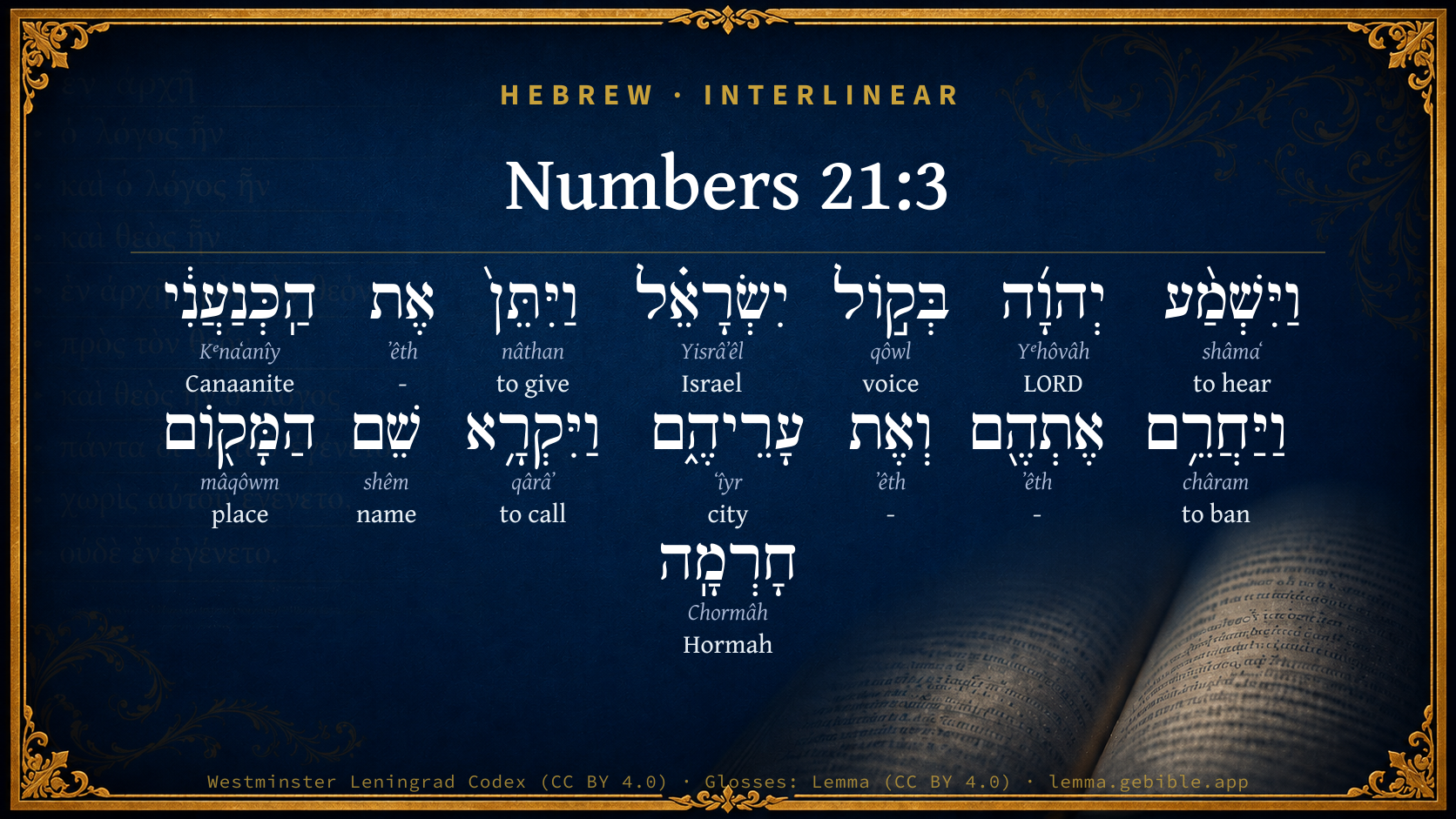
Hebrew (Westminster Leningrad Codex) Numbers 21:3 appears in the Hebrew Old Testament. The text above is from the Westminster Leningrad Codex. Each word links to its Strong’s number, a concise gloss, and parsing drawn from the Open Scriptures Hebrew Bible morphology. Click any word for its full Brown-Driver-Briggs (BDB) entry.
Download image
Cite this verse

Numbers 21:3 (World English Bible). Public Domain. Lemma interlinear Bible study tool, https://lemma.gebible.app/v/numbers/21/3.

Show BibTeX & RIS
BibTeX
RIS
English Translation
Yahweh listened to the voice of Israel, and delivered up the Canaanites; and they utterly destroyed them and their cities: and the name of the place was called Hormah.
World English Bible · Public Domain
Download a study sheet

One document with this verse’s original text, its word-by-word gloss line, the meaning frame, cross-references with their text, attributed commentary, and full source and license credits — printable, and it pastes into notes with its structure intact.

This verse Autodidact and up

Study sheet (.html) Plain text (.txt)

A passage Seminary Student

Up to 50 verses in one chapter. A passage sheet keeps up to 6 commentary sources and 12 cross-references per verse, in the order this page ranks them, and says so on the sheet whenever that leaves anything out. Ask for a single verse and you get the Autodidact verse sheet above.

Everything on this page stays free to read, with no account — the sheet is a download of what is already on screen, not access to it.

Want to remove ads? Support Godless Engineer
Compare translations 3

The same verse in 3 English versions, stacked beneath the original-language interlinear above. Click any original word for its lexicon entry.

Each is an independent rendering of the whole verse — the interlinear is not word-aligned to these translations.

Highlighted words mark where these versions differ — a whole-verse word diff, not a word-by-word alignment.

  • World English Bible Public Domain
    Yahweh listened to the voice of Israel, and delivered up the Canaanites; and they utterly destroyed them and their cities: and the name of the place was called Hormah.
  • King James Version Public Domain
    And the LORD hearkened to the voice of Israel, and delivered up the Canaanites; and they utterly destroyed them and their cities: and he called the name of the place Hormah.
  • unfoldingWord Literal Text CC BY-SA 4.0
    And Yahweh listened to the voice of Israel, and he gave the Canaanite, and he devoted them and their cities to destruction. And he called the name of the place Hormah.

unfoldingWord Literal Text — © unfoldingWord, licensed CC BY-SA 4.0. Word-aligned USFM3 via Door43 (git.door43.org/unfoldingWord/en_ult).

Versions to compare (up to 4)

3 of 4 selected

Show all 18 translations

Every available English version of this verse, each an independent rendering of the whole verse.

  • World English Bible Public Domain
    Yahweh listened to the voice of Israel, and delivered up the Canaanites; and they utterly destroyed them and their cities: and the name of the place was called Hormah.
  • Berean Standard Bible Public Domain
    And the LORD heard Israel’s plea and delivered up the Canaanites. Israel devoted them and their cities to destruction; so they named the place Hormah.
  • Majority Standard Bible Public Domain
    And the LORD heard Israel’s plea and delivered up the Canaanites. Israel devoted them and their cities to destruction; so they named the place Hormah.
  • King James Version Public Domain
    And the LORD hearkened to the voice of Israel, and delivered up the Canaanites; and they utterly destroyed them and their cities: and he called the name of the place Hormah.
  • American Standard Version (1901) Public Domain
    And Jehovah hearkened to the voice of Israel, and delivered up the Canaanites; and they utterly destroyed them and their cities: and the name of the place was called Hormah.
  • Revised Version (1885) Public Domain
    And the LORD hearkened to the voice of Israel, and delivered up the Canaanites; and they utterly destroyed them and their cities: and the name of the place was called Hormah.
  • Geneva Bible (1599) Public Domain
    And the Lord heard the voyce of Israel, and deliuered them the Canaanites: and they vtterly destroied them and their cities, and called ye name of the place Hormah.
  • Douay-Rheims (1899) Public Domain
    And the Lord heard the prayers of Israel, and delivered up the Chanaanite, and they cut them off and destroyed their cities: and they called the name of that place Horma, that is to say, Anathema.
  • Young's Literal Translation Public Domain
    and Jehovah hearkeneth to the voice of Israel, and giveth up the Canaanite, and he devoteth them and their cities, and calleth the name of the place Hormah.
  • Literal Standard Version CC BY-SA 4.0
    and YHWH listens to the voice of Israel and gives up the Canaanite, and he devotes them and their cities, and calls the name of the place Hormah.
  • Unlocked Literal Bible CC BY-SA 4.0
    Yahweh listened to Israel's voice and he gave them victory over the Canaanites. They completely destroyed them and their cities. That place was called Hormah.
  • unfoldingWord Literal Text CC BY-SA 4.0
    And Yahweh listened to the voice of Israel, and he gave the Canaanite, and he devoted them and their cities to destruction. And he called the name of the place Hormah.
  • Darby Bible Public Domain
    And Jehovah listened to the voice of Israel, and delivered up the Canaanites; and they utterly destroyed them, and their cities. And they called the name of the place Hormah.
  • World Messianic Bible Public Domain
    The LORD listened to the voice of Israel, and delivered up the Canaanites; and they utterly destroyed them and their cities. The name of the place was called Hormah.
  • Webster's Bible Public Domain
    And the LORD hearkened to the voice of Israel, and delivered up the Canaanites; and they utterly destroyed them and their cities: and he called the name of the place Hormah.
  • Free Bible Version CC BY-SA 4.0
    The Lord responded to their appeal and handed over the Canaanites to them. The Israelites completely destroyed them and their towns, and named the place Hormah.
  • Bible in Basic English Public Domain
    And the Lord, in answer to the voice of Israel, gave the Canaanites up to them; and they put them and their towns completely to destruction: and that place was named Hormah.
  • JPS Tanakh (1917) Public Domain
    And the LORD hearkened to the voice of Israel, and delivered up the Canaanites; and they utterly destroyed them and their cities; and the name of the place was called Hormah.

Literal Standard Version (2020), Covenant Press — licensed CC BY-SA 4.0. Text via the HelloAO Bible API (eBible.org). Unlocked Literal Bible (unfoldingWord) — licensed CC BY-SA 4.0. Text via the HelloAO Bible API (eBible.org). unfoldingWord Literal Text — © unfoldingWord, licensed CC BY-SA 4.0. Word-aligned USFM3 via Door43 (git.door43.org/unfoldingWord/en_ult). Free Bible Version, Dr. Jonathan Gallagher — licensed CC BY-SA 4.0. Text via the HelloAO Bible API (eBible.org).

Word by word

More ways to search: Search by grammar → Find every occurrence → Compare this word →

Practice this passage: Drill this verse → Learn its vocabulary →

חָרְמָֽה
Chormâh
H2767
“Hormah”
Noun, Proper
Part of Speech
Noun
Type
Proper
Full BDB Definition

Origin: from H2763

TWOT: None

Hormah = "devotion" - a town of the Canaanites, conquered by Joshua, allotted to Judah, and located in the south of Judah
  1. וַיִּשְׁמַ֨ע shâmaʻ H8085 “and · to hear” Conjunction + Verb, Qal, Sequential Imperfect, 3rd Person, Masculine, Singular
  2. יְהוָ֜ה Yᵉhôvâh H3068 “LORD” Noun, Proper
  3. בְּק֣וֹל qôwl H6963 “in/at · voice of” Preposition + Noun, Common, Masculine, Singular, Construct
  4. יִשְׂרָאֵ֗ל Yisrâʼêl H3478 “Israel” Noun, Proper
  5. וַיִּתֵּן֙ nâthan H5414 “and · to give” Conjunction + Verb, Qal, Sequential Imperfect, 3rd Person, Masculine, Singular
  6. אֶת ʼêth H853 “-” Particle, Direct Object
  7. הַֽכְּנַעֲנִ֔י Kᵉnaʻanîy H3669 “the · Canaanite” Particle, Definite Article + Noun, Gentilic, Masculine, Singular, Absolute
  8. וַיַּחֲרֵ֥ם châram H2763 “and · to ban” Conjunction + Verb, Hiphil, Sequential Imperfect, 3rd Person, Masculine, Singular
  9. אֶתְהֶ֖ם ʼêth H853 “- · them” Particle, Direct Object + Suffix, Personal, 3rd Person, Masculine, Plural
  10. וְאֶת ʼêth H853 “and · -” Conjunction + Particle, Direct Object
  11. עָרֵיהֶ֑ם ʻîyr H5892 “cities · their” Noun, Common, Feminine, Plural, Construct + Suffix, Personal, 3rd Person, Masculine, Plural
  12. וַיִּקְרָ֥א qârâʼ H7121 “and · to call” Conjunction + Verb, Qal, Sequential Imperfect, 3rd Person, Masculine, Singular
  13. שֵׁם shêm H8034 “name of” Noun, Common, Masculine, Singular, Construct
  14. הַמָּק֖וֹם mâqôwm H4725 “the · place” Particle, Definite Article + Noun, Common, Masculine, Singular, Absolute

About this verse

These counts appear in no published source. They are computed here, from the morphology-tagged text and Lemma’s own curated glosses. What Lemma adds →

15
words
13
distinct lemmas
Pentateuch
section

Notable vocabulary

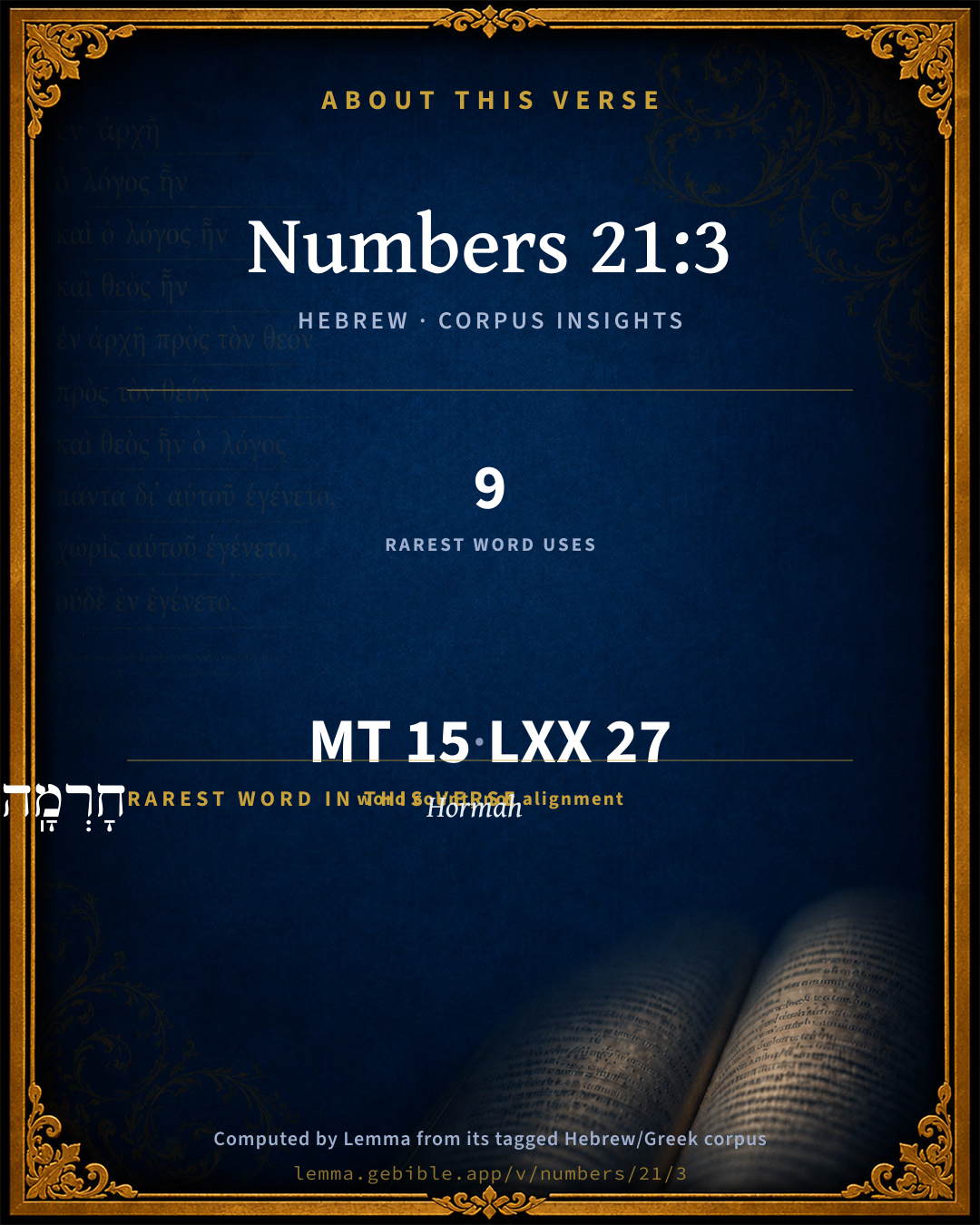
The rarest word here is חָרְמָֽה Hormah H2767 — appearing just 9 times in the whole Hebrew Bible.

Shared distinctive vocabulary

חָרְמָֽה Hormah H2767 occurs in 9 verses of the Hebrew Bible. Also found in:

Grammatical profile

  • 4 verbs
  • 8 nouns
  • 3 particles

Verb forms

  • וַיִּשְׁמַ֨ע Qal · Sequential Imperfect
  • וַיִּתֵּן֙ Qal · Sequential Imperfect
  • וַיַּחֲרֵ֥ם Hiphil · Sequential Imperfect
  • וַיִּקְרָ֥א Qal · Sequential Imperfect

Hebrew & Septuagint length

In English translation the verse runs 29 words from the Hebrew and 32 from the Septuagint (LXX English) — closely comparable.

A rough comparison of the two English renderings, which tokenize alike — not a word-level alignment.

Word counts can differ between the Hebrew and the Greek without any difference in meaning — e.g. the Hebrew direct-object marker אֵת has no separate Greek word, and Greek often adds the article ὁ.

In the original languages it is 15 Hebrew tokens and 27 Greek tokens — but the two are counted differently (Hebrew bundles its prefixes and suffixes into one token; the Greek is in lemma form), so that isn’t a like-for-like length.

Cross-references

6

Topical passages linked to Numbers 21:3 in the Treasury of Scripture Knowledge — connected by theme and wording, ordered by reader-vote popularity; previews shown in the World English Bible.

  • Numbers 14:45 Then the Amalekite came down, and the Canaanite who lived in that mountain, and struck them and beat them down, even to Hormah.
  • Deuteronomy 1:44 The Amorites, who lived in that hill-country, came out against you, and chased you, as bees do, and beat you down in Seir, even to Hormah.
  • 1 Samuel 30:30 and to those who were in Hormah, and to those who were in Borashan, and to those who were in Athach,
  • Psalms 10:17 Yahweh, you have heard the desire of the humble. You will prepare their heart. You will cause your ear to hear,
  • Psalms 91:15 He will call on me, and I will answer him. I will be with him in trouble. I will deliver him, and honor him.
  • Psalms 102:17 He has responded to the prayer of the destitute, And has not despised their prayer.

Cross-references courtesy of OpenBible.info (CC BY 4.0).

Hebrew and Greek witnesses Masoretic Hebrew ↔ Greek Septuagint

The same verse in the two great witnesses to the Old Testament, shown verse-for-verse.

These are two independent witnesses, not word-aligned to each other, and the Septuagint is shown in lemma (dictionary) form.

Hebrew Numbers 21:3 Masoretic · Westminster Leningrad Codex

וַיִּשְׁמַ֨ע יְהוָ֜ה בְּק֣וֹל יִשְׂרָאֵ֗ל וַיִּתֵּן֙ אֶת הַֽכְּנַעֲנִ֔י וַיַּחֲרֵ֥ם אֶתְהֶ֖ם וְאֶת עָרֵיהֶ֑ם וַיִּקְרָ֥א שֵׁם הַמָּק֖וֹם חָרְמָֽה

Yahweh listened to the voice of Israel, and delivered up the Canaanites; and they utterly destroyed them and their cities: and the name of the place was called Hormah.

World English Bible · Public Domain

Greek LXX Numbers 21:3 Septuagint · lemma form

καί εἰςἀκούω κύριος ὁ φωνή ἰσραήλ καί παραδίδωμι ὁ χανανίς ὑποχείριος αὐτός καί ἀναθεματίζω αὐτός καί ὁ πόλις αὐτός καί ἐπικαλέω ὁ ὄνομα ὁ τόπος ἐκεῖνος ἀνάθεμα

And the Lord listened to the voice of Israel, and delivered the Chananite into his power; and Israel devoted him and his cities, and they called the name of that place Anathema.

LXX2012 (modern English Septuagint) · Public Domain

On this verse, The Cambridge Bible for Schools and Colleges discusses the Septuagint’s reading. Read the note in Commentary ↓

Hebrew: Westminster Leningrad Codex (CC BY 4.0). Greek: Septuagint (public domain); English from LXX2012 (modern English Septuagint) (Public Domain). How the Septuagint differs from the Hebrew →

Targum (Aramaic paraphrase)

2

The Targum is the ancient Jewish Aramaic paraphrase of the Hebrew Scriptures — an interpretive translation, not the Hebrew text itself. Onkelos (literal) and Pseudo-Jonathan (expansive) render the Torah, and Jonathan the Prophets. Coverage is partial: where no permissively-licensed English translation exists for a verse, only the Aramaic is shown. This is verse-level text, not a word-by-word alignment to the Hebrew.

  1. Targum Onkelos Torah (Genesis–Deuteronomy)
    וְקַבֵּיל יְיָ צְלוֹתֵיהּ דְיִשְׂרָאֵל וּמְסַר יָת כְּנַעֲנָאָה וְגַמַר יָתְהוֹן וְיָת קִרְוֵיהוֹן וּקְרָא שְׁמָא דְאַתְרָא חָרְמָה

    (no public-domain English translation for this verse)

    Targum Onkelos — Aramaic: “Onkelos Genesis” (public domain); “Onkelos Exodus” (public domain); “Onkelos Leviticus” (public domain); “Onkelos Numbers” (public domain); “Onkelos Deuteronomy” (public domain). English: “Sefaria Community Translation” (CC0 1.0 (public-domain dedication)); “J.W. Etheridge. The Targums of Onkelos and Jonathan Ben Uzziel on the Pentateuch. London: Longmans, Green, 1862” (public domain). Text via Sefaria.

  2. Targum Pseudo-Jonathan Torah (Genesis–Deuteronomy)
    וְקַבֵּיל יְיָ צְלוֹתֵיהּ דְיִשְרָאֵל וּמְסַר יַת כְּנַעֲנָאָה וּגְמַר יַתְהוֹן וְיַת קִירְוֵויהוֹן וּקְרָא שְׁמָא דְאַתְרָא חָרְמָה

    And the Lord heard Israel's prayer, and delivered up the Kenaanites, and he destroyed them and their cities. And he called the name of the place Hormah.

    Targum Pseudo-Jonathan — Aramaic: “Targum Jonathan on Genesis” (public domain); “Targum Jonathan on Exodus” (public domain); “Targum Jonathan on Leviticus” (public domain); “Targum Jonathan on Numbers” (public domain); “Targum Jonathan on Deuteronomy” (public domain). English: “The Targum of Jonathan ben Uzziel, trans. J. W. Etheridge, London, 1862” (public domain). Text via Sefaria.

Commentary

Notes on Numbers 21:3 from classic Christian and Jewish commentators (each source and its license shown beneath its notes). The classic Christian expositions comment on the surrounding passage and are grouped to its opening verse, so a note may address several verses; the Jewish commentaries on the Tanakh (Rashi and others) are per-verse, so they appear only where the commentator wrote on this verse.

Lemma curates 59 commentaries, every one of them public domain or Creative Commons licensed, each selected and text-cleaned for this edition rather than reprinted as found. About our sources →

Trapp's Complete Commentary

John Trapp

Num 21:3 And the LORD hearkened to the voice of Israel, and delivered up the Canaanites; and they utterly destroyed them and their cities: and he called the name of the place Hormah.

Ver. 3. Delivered up the Canaanites.] This King Arad, heartened with his former success, might - as Guicciardini saith of Charles VIII of France, in his expedition against Naples - come into the field like thunder and lightning, but go out like a snuff; more than a man at first, less than a woman at last.

John Trapp, A Commentary or Exposition upon All the Books of the Old and New Testament (1647–1656) — public domain. Text from a community e-Sword module.

Joseph Benson's Commentary

Num 21:3. They utterly destroyed them — That is, as many of them as they took at that time; but it is plain that all these Canaanites were not destroyed at this time, for we find the king of Arad and the king of Hormah mentioned among the kings whom Joshua smote some time after this, Jos 12:14; and several of their cities were not taken and destroyed till after the death of Joshua, Jdg 1:16-17. Indeed, all that the Hebrew here (יחרם, jacharem) signifies is, that they now devoted them and their cities to destruction, and when their cities came into their possession they fulfilled their vow. He called the name of the place Hormah — That is, devoted to destruction, or, Anathema.

Joseph Benson's Commentary on the Old and New Testaments (1811–1818) — public domain. Text from a community e-Sword module.

Geneva Bible (1599)

Geneva Bible translators

Or, destruction.

Geneva Bible (1599) marginal notes — public domain. Text via Bolls.life.

Adam Clarke's Commentary

Verse 3. The Lord hearkened to the voice of Israel] The whole of this verse appears to me to have been added after the days of Joshua. It is certain the Canaanites were not utterly destroyed at the time here spoken of, for this did not take place till after the death of Moses. If, instead of utterly destroyed them, ויחרם vaiyacharem, we translate they devoted them to utter destruction, it will make a good sense, and not repugnant to the Hebrew; though some think it more probable that the verse was added afterwards by Joshua or Ezra, in testimony of the fulfilment of God's promise; for Arad, who is mentioned as being destroyed here, is mentioned among those destroyed by Joshua long after, (see Jos 12:14): but this is quite consistent with their being devoted to destruction, as this might be fulfilled any time after. See Clarke on Le 27:34.

Adam Clarke's Commentary on the Bible (1810–1826) — public domain. Text from a community e-Sword/MySword module.

Ellicott's Commentary for English Readers

(3) And they utterly destroyed them and their cities.—The meaning of the verb which is here employed is to devote to destruction, and hence to destroy utterly. It does not clearly appear whether this destruction was effected at once, or whether the fulfilment of the vow took place at a later period. (See Jos_12:14; Jdg_1:17.) If the attack of the Canaanites was made at the time of the final departure from Kadesh, the latter view must be maintained, as it can scarcely be supposed that the cities could have been rebuilt and again destroyed in so short an interval.

And he called the name of the place Hormah.—Better, And the name of the place was called Hormah. The word Hormah—i.e., a devoted thing—is cognate with the verb which occurs in this and the preceding verse, and which is rendered utterly destroy. The place is so called by anticipation in Num_14:45, and, as in regard to other names (e.g., Bethel and Jacob), the name was probably given anew to the place on a later occasion (Jdg_1:17).

A Bible Commentary for English Readers, edited by Charles John Ellicott (1878–1897) — public domain. Text from a community e-Sword module.

The Cambridge Bible for Schools and Colleges

gen. ed. J. J. S. Perowne

3. the name of the place was called Hormah] In view of the expression ‘destroyed them and their cities,’ Hormah would seem to be a district and not a town; and perhaps it is so in Num_14:45 (‘the Hormah’) and Dt. 1:441 [Note: This is the more probable if we read ‘from Seir’ with LXX., Syr., Vulg.] . But in other passages Hormah is a city; cf. Jos_12:14; Jos_15:30; Jos_19:4, 1Sa_30:30, 1Ch_4:30; and in Jdg_1:17 it is said that its former name was Ẓephath.

The Cambridge Bible for Schools and Colleges (gen. ed. J. J. S. Perowne; Cambridge University Press, 1878–1918) — public domain. Text from a community e-Sword module.

John Gill's Exposition

And the Lord hearkened to the voice of Israel,.... In their prayers and vows; with acceptance heard, and answered them according to their wish:

and delivered up the Canaanites: into their hands, gave them victory over them:

and they utterly destroyed them and their cities; that is, "anathematized" them, and devoted them to destruction; for as yet they did not actually destroy them, since we read of Arad afterwards, Jos 12:14, but this they did in Joshua's time, when the whole land of Canaan came into their hands; for had they entered the land now, and took and destroyed the cities belonging to Arad, they would doubtless have proceeded, and pursued their conquests, and not have returned into the wilderness again to go round about Edom, in order to enter another way; many think, as Aben Ezra observes on Num 21:1 that this section was written by Joshua, after the land was subdued:

and he called the name of the place Hormah; which before was called Zephath, and it seems to have its name from various disasters which happened at this place; as the defeat of the Israelites by the Amalekites, Num 14:45, and here of the Canaanites by the Israelites, and afterwards of the inhabitants of this place by Judah and Simeon, Jdg 1:17 it had its name from "Cherem", the anathema or destruction it was devoted to.

John Gill's Exposition of the Whole Bible (1746–1763) — public domain (CC PDM 1.0). Text via the HelloAO Bible API.

Albert Barnes' Notes on the Bible

He called the name of the place - Render it as: “the name of the place was called.” The transitive verb here is, by a common Hebrew idiom, equivalent to an impersonal one.

Hormah - i. e. “Ban.” See Num 14:45 and note. In Jdg 1:17, we read that the men of Judah and Simeon “slew the Canaanites that inhabited Zephath, and utterly destroyed it;” and further, that “the name of the city was called Hormah.” But it does not follow that the name “Hormah” was first bestowed in consequence of the destruction of the place in the time of the Judges, and that in Numbers its occurrence is a sign of a post-Mosaic date of composition. The text here informs us that this aggression of the king of Arad was repelled, and avenged by the capture and sack of his cities; and that the Israelites “banned” them (compare Lev 27:28-29). But it was not the plan of the Israelites in the time of Moses to remain in this district. They therefore marched away southeastward; and no doubt for the time the Canaanites resumed possession, and restored the ancient name (Zephath). But Joshua again conquered the king of this district, and finally in the time of the early Judges the ban of Moses and his contemporaries was fully executed. We have therefore in the passage before us the history of the actual origin of the name “Hormah.”

Albert Barnes' Notes on the Bible (1834–1885) — public domain. Text from a community e-Sword/MySword module.

Haydock's Catholic Bible Commentary

Anathema. That is, a thing devoted to utter destruction. (Challoner) --- The explanation of Horma is inserted by St. Jerome. (Haydock)

George Leo Haydock (1774–1849), Haydock's Catholic Family Bible and Commentary, 1859 edition — public domain. Excludes Psalms (Douay-Rheims chapter numbering differs from Protestant) and Deuterocanonical books (Catholic canon only).

Matthew Poole's English Annotations

They utterly destroyed them: when?

Answ. Either,

1. Some time after this, under Joshua, who subdued, among others, the king of Arad, Jos 12:14. And so this is mentioned here by anticipation, that the vow being now made and mentioned, the effect or performance of it might be recorded, though out of its place; and so this verse must be supposed to be added by some of the prophets, and inserted into Moses’s history, as some other passages seem to be. Or,

2. At this time; and so this is not the same Arad with that, Jos 12:14, nor this the same Hormah with that there mentioned, but another of the same name, which is most frequent in persons and places in Scripture. And this is the more probable, because that Arad and Hormah, Jos 12:14, are two distinct places, and had divers kings, whereas here the same place is called both Arad and Hormah; and because that Arad seems to be at some good distance from this, and more within the country, and more northward, as may be gathered from the other places joined with it, Jos 12. whereas this Arad was near Edom, Num 21:4, and in the south, Num 21:1.

Quest. 1. How could this be done in the land of Canaan, when Moses neither entered himself, nor led the people into that land?

Answ. Neither Moses nor the whole body of the people did this exploit, but a select number sent out for this purpose to punish that king and people, who were so fierce and malicious that they came out of their own country to fight with the Israelites in the wilderness; and these, when they had done this work, returned to their brethren into the wilderness.

Quest. 2. Why did they not all now go into Canaan, when some of them had once entered it, and pursue this victory?

Answ. Because God would not permit it, there being several works yet to be done, other people must be conquered, the Israelites must be further humbled and tried and purged, Moses must die, and then they shall enter, and that in a more glorious manner, even over Jordan, which shall be miraculously dried up, and give them passage.

Matthew Poole's English Annotations on the Holy Bible (1683–1685) — public domain. Text from a community e-Sword/MySword module.

Whedon's Commentary on the Bible

Daniel D. Whedon

3. They utterly destroyed them and their cities — It is supposed by some that the actual destruction of the cities did not take place then, for two reasons: 1.) It would have required an entrance into Canaan in order to destroy Arad and its allied cities; and, 2.) it was standing after Joshua led in the nation, and its king was destroyed by him. Jos_12:14. The difficulty all disappears when the word destroyed is rendered, as it should be, anathematized, or put under the ban. The identification of Hormah with Sebaita, (see below,) only twenty-five miles north of Kadesh, (Gadis,) leads others to interpret the ban as executed at that time. But when the Israelites retired the fugitive Canaanites returned and rebuilt the city, which was again taken and destroyed in the conquest of southern Canaan by Judah and Simeon after the death of Joshua.

Hormah — Derived from a Hebrew word signifying to anathema, or a devotement to destruction. Its earlier name was Zephath. Jdg_1:17. Robinson identifies it with the pass Es-Sufa, both on account of the name and the situation in the mountain, which, running southwest and northeast, completes the plateau of southern Palestine. But the true identification is Sebaita, twenty-five miles southwest of Beer-sheba. See notes on Jos_12:14, and Jdg_1:17. It is evident, if it was not destroyed now, that till its actual conquest by Judah and Simeon it was called Hormah proleptically. Keil suggests that it may have been captured in the time of Joshua and retaken again by the Canaanites, who restored its old name, Zephath, and that it was subsequently permanently conquered by Judah and Simeon, and received its new name once for all.

Daniel D. Whedon (gen. ed.), Commentary on the Old and New Testaments (1874–1909) — public domain. Text from a community e-Sword module.

The Pulpit Commentary

They utterly destroyed them and their cities. Rather, "they banned (anayematisen ) them and their cities." No doubt the banning implies here their utter destruction, because it is not the vow before the battle, but the carrying of it out after the victory, which is here spoken of. And he called the name of the place Hormah. Rather, "the name of the place was called (impersonal use of the transitive) Charmah." hmrj. Septuagint, Anayema . It is not very clear what place received this name at this time. It does not appear to have been Arid itself, as would have seemed most natural, because Arid and Hormah are mentioned side by side in Jos_12:14. It is identified with Zephath in Jud_1:17. It may have been the place where the victory was won which gave all the cities of Arid to destruction. Whether it was the Hormah mentioned in Num_14:45 is very doubtful (see note there). The nomenclature of the Jews, especially as to places, and most especially as to places with which their own connection was passing or broken, was vague and confused in the extreme, and nothing can be more unsatisfactory than arguments which turn upon the shifting names of places long ago perished and forgotten. It must be added that the three verses which narrate the chastisement of this Canaanite chieftain have caused immense embarrassment to commentators.

If the incident is narrated in its proper order of time, it must have happened during the stay of the Israelites under Mount Hor, when they had finally left the neighbourhood of the Negeb, and were separated from the king of Arid by many days" march, and by a most impracticable country. It is therefore generally supposed that the narrative is out of place, and that it really belongs to the time when Israel was gathered together for the second time at Kadesh, and When his reappearance there in force might well have given rise to the report that be was about to invade Canaan from that side. This is unsatisfactory, because no plausible reason can be assigned for the insertion of the notice where it stands, both here and in Num_33:40. To say that Moses wished to bring it into juxtaposition with the victories recorded in the latter part of the chapter, from which it is separated by the incident of the fiery serpents, and the brief record of many journeys, is to confess that no explanation can be invented which has the least show of reason. If the narrative be displaced, the displacement must simply be due to accident or interpolation. Again, it would seem quite inconsistent with the position and plans of Israel since the rebellion of Kadesh that any invasion and conquest, even temporary, of any part of Canaan should be made at this time, and that especially if the attack was not made until Israel was lying in the Arabah on his way round the land of Edom. It is therefore supposed by some that the vow only was made at this time, and the ban suspended over the place, and that it was only carried out as part of the general conquest under Joshua; that, in fact, the fulfillment of the vow is narrated in Jos_12:14 Jud_1:16, 17. This, however, throws the narrative as it stands into confusion and discredit, for the ban and the destruction become a mockery and an unreality if nothing more was done to the towns of the king of Arad than was done at the same time to the towns of all his neighbours. It would be more reverent to reject the story as an error or a falsehood than to empty it of the meaning which it was obviously intended to convey. We are certainly meant to understand that the vow was there and then accepted by God, and was there and then carried into effect by Israel; the towns of Arad were depopulated and destroyed as far as lay in their power, although they may have been immediately reoccupied. There are only two theories which are worth considering. 1. The narrative may really be displaced, for what cause we do not know. If so, it would he more satisfactory to refer it, not to the time of the second encampment at Kadesh, but to the time of the first, during the absence of the spies in Canaan. It is probable that their entry was known, as was the case with Joshua"s spies; (Jos_2:2) and nothing could be more likely than that the king of Arad, suspecting what would follow, should attempt to anticipate invasion by attack. If it were so it might help to account for the rash confidence shown by the people afterwards, (Num_14:40) for the mention of Hormah, (Num_14:45) and for the reappearance of kings of Hormah and of Arad in the days of Jos 2. The narrative may after all be in place. That the Israelites lay for thirty days under Mount Hor is certain, and they may have been longer. During this period they could not get pasture for their cattle on the side of Edom, and they may have wandered far and wide in search of it. It may have been but a comparatively small band which approached the Negeb near enough to be attacked, and which, by the help of God, was enabled to defeat the king of Arad, and to lay waste his towns. It had certainly been no great feat for all Israel to overthrow a border chieftain who could not possibly have brought 5000 men into the field.

The Pulpit Commentary (1880–1919), ed. H.D.M. Spence-Jones & Joseph S. Exell — public domain. Text from a community e-Sword module.

John Wesley's Explanatory Notes

They utterly destroyed them - Neither Moses nor the whole body of the people did this but a select number sent out to punish that king and people, who were so fierce and malicious that they came out of their own country to fight with the Israelites in the wilderness; and these, when they had done this work, returned to their brethren into the wilderness. But why did they not all now go into Canaan, and pursue this victory? Because God would not permit it, there being several works yet to be done, other people must be conquered, the Israelites must be farther humbled and tried and purged, Moses must die, and then they shall enter, and that in a more glorious manner, even over Jordan, which shall be miraculously dried up, to give them passage. Hormah - That is, utter destruction.

John Wesley, Explanatory Notes Upon the Whole Bible (1754–1765) — public domain. Text via the GEBible commentary corpus.

Scofield Reference Notes

C. I. Scofield

Hormah

i.e. utter destruction.

The Scofield Reference Bible (1917 edition), notes by C. I. Scofield — public domain. Text from a community e-Sword module.

Rashi

Rabbi Shlomo Yitzchaki (Rashi)

ויחרם אתהם AND HE DOOMED THEM by slaughter,

ואת עריהם AND THEIR CITIES as things dedicated to the Most High.

Rashi on the Tanakh — English translations: “The Judaica Press complete Tanach with Rashi, translated by A. J. Rosenberg” (CC BY 4.0); “Pentateuch with Rashi's commentary by M. Rosenbaum and A.M. Silbermann, 1929-1934” (public domain); “The Metsudah Tanach series, Lakewood, N.J” (CC BY 4.0); and “The Book of Joshua, Metsudah Publications, 1997” (CC BY 4.0). Text via Sefaria.

Lesson kit

Teaching starters — assembled from the data on this page, not authored interpretation. Every prompt links to the verse data it draws on. Edit before teaching.

Numbers, in the Pentateuch, opens this verse with 15 words (13 distinct Hebrew lemmas). Its most distinctive word is Chormâh (“Hormah”). A historical commentator’s framing appears above. Read the whole chapter for the surrounding context.

Discussion questions

  1. How does “Hormah” (Chormâh) shape what this verse is saying?
  2. Numbers 14:45 shares the word «Hormah» with this verse. How do the two illuminate each other?
  3. These translations render this verse differently; the difference is in the English rendering, not the original. What questions does that raise?
  4. The verb «וַיִּשְׁמַ֨ע» is Qal Sequential Imperfect. How does its form color the action?
  5. Reading how Trapp's Complete Commentary and Joseph Benson's Commentary read this verse, where do the two commentators agree and where do they part?

Things to notice

Reading settings

Reading text

Shown beneath each verse's original-language words.

Old Testament
Old Testament edition

Read the OT as the Masoretic Hebrew (MT) or the Greek Septuagint (LXX).

English shown for the Greek Septuagint (in the Hebrew ↔ Greek comparison).

Comparing translations? Open the Compare panel on any verse page to stack up to four side by side.