Deuteronomy 26:9

Hebrew (Westminster Leningrad Codex) Deuteronomy 26:9 appears in the Hebrew Old Testament. The text above is from the Westminster Leningrad Codex. Each word links to its Strong’s number, a concise gloss, and parsing drawn from the Open Scriptures Hebrew Bible morphology. Click any word for its full Brown-Driver-Briggs (BDB) entry.
Download image
Cite this verse

Deuteronomy 26:9 (World English Bible). Public Domain. Lemma interlinear Bible study tool, https://lemma.gebible.app/v/deuteronomy/26/9.

Show BibTeX & RIS
BibTeX
RIS
English Translation
and he has brought us into this place, and has given us this land, a land flowing with milk and honey.
World English Bible · Public Domain
Download a study sheet

One document with this verse’s original text, its word-by-word gloss line, the meaning frame, cross-references with their text, attributed commentary, and full source and license credits — printable, and it pastes into notes with its structure intact.

This verse Autodidact and up

Study sheet (.html) Plain text (.txt)

A passage Seminary Student

Up to 50 verses in one chapter. A passage sheet keeps up to 6 commentary sources and 12 cross-references per verse, in the order this page ranks them, and says so on the sheet whenever that leaves anything out. Ask for a single verse and you get the Autodidact verse sheet above.

Everything on this page stays free to read, with no account — the sheet is a download of what is already on screen, not access to it.

Want to remove ads? Support Godless Engineer
Compare translations 3

The same verse in 3 English versions, stacked beneath the original-language interlinear above. Click any original word for its lexicon entry.

Each is an independent rendering of the whole verse — the interlinear is not word-aligned to these translations.

Highlighted words mark where these versions differ — a whole-verse word diff, not a word-by-word alignment.

  • World English Bible Public Domain
    and he has brought us into this place, and has given us this land, a land flowing with milk and honey.
  • King James Version Public Domain
    And he hath brought us into this place, and hath given us this land, even a land that floweth with milk and honey.
  • unfoldingWord Literal Text CC BY-SA 4.0
    and he has brought us to this place and has given to us this land, a land flowing with milk and honey.

unfoldingWord Literal Text — © unfoldingWord, licensed CC BY-SA 4.0. Word-aligned USFM3 via Door43 (git.door43.org/unfoldingWord/en_ult).

Versions to compare (up to 4)

3 of 4 selected

Show all 17 translations

Every available English version of this verse, each an independent rendering of the whole verse.

  • World English Bible Public Domain
    and he has brought us into this place, and has given us this land, a land flowing with milk and honey.
  • Berean Standard Bible Public Domain
    And He brought us to this place and gave us this land, a land flowing with milk and honey.
  • Majority Standard Bible Public Domain
    And He brought us to this place and gave us this land, a land flowing with milk and honey.
  • King James Version Public Domain
    And he hath brought us into this place, and hath given us this land, even a land that floweth with milk and honey.
  • American Standard Version (1901) Public Domain
    and he hath brought us into this place, and hath given us this land, a land flowing with milk and honey.
  • Revised Version (1885) Public Domain
    and he hath brought us into this place, and hath given us this land, a land flowing with milk and honey.
  • Geneva Bible (1599) Public Domain
    And he hath brought vs into this place, and hath giuen vs this land, euen a lande that floweth with milke and hony.
  • Young's Literal Translation Public Domain
    and he bringeth us in unto this place, and giveth to us this land -- a land flowing with milk and honey.
  • Literal Standard Version CC BY-SA 4.0
    and He brings us to this place, and gives this land to us—a land flowing with milk and honey.
  • Unlocked Literal Bible CC BY-SA 4.0
    and he has brought us to this place and has given us this land, a land that flows with milk and honey.
  • unfoldingWord Literal Text CC BY-SA 4.0
    and he has brought us to this place and has given to us this land, a land flowing with milk and honey.
  • Darby Bible Public Domain
    and he hath brought us into this place, and hath given us this land, a land flowing with milk and honey!
  • World Messianic Bible Public Domain
    and he has brought us into this place, and has given us this land, a land flowing with milk and honey.
  • Webster's Bible Public Domain
    And he hath brought us into this place, and hath given us this land, even a land that floweth with milk and honey.
  • Free Bible Version CC BY-SA 4.0
    He brought us here and gave us this country, a land flowing with milk and honey.
  • Bible in Basic English Public Domain
    And he has been our guide to this place, and has given us this land, a land flowing with milk and honey.
  • JPS Tanakh (1917) Public Domain
    And He hath brought us into this place, and hath given us this land, a land flowing with milk and honey.

Literal Standard Version (2020), Covenant Press — licensed CC BY-SA 4.0. Text via the HelloAO Bible API (eBible.org). Unlocked Literal Bible (unfoldingWord) — licensed CC BY-SA 4.0. Text via the HelloAO Bible API (eBible.org). unfoldingWord Literal Text — © unfoldingWord, licensed CC BY-SA 4.0. Word-aligned USFM3 via Door43 (git.door43.org/unfoldingWord/en_ult). Free Bible Version, Dr. Jonathan Gallagher — licensed CC BY-SA 4.0. Text via the HelloAO Bible API (eBible.org).

Word by word

More ways to search: Search by grammar → Find every occurrence → Compare this word →

Practice this passage: Drill this verse → Learn its vocabulary →

זָבַ֥ת
zûwb
H2100
“flowing”
Verb, Qal, Participle Active, Feminine, Singular, Construct
Part of Speech
Verb
Stem
Qal
Form
Participle Active
Gender
Feminine
Number
Singular
State
Construct
Full BDB Definition

Origin: a primitive root

TWOT: 534

to flow, gush, issue, discharge - (Qal) - to flow, gush - to die, pine away (figuratively) - to flow (of issue from woman), have an issue, flux - flowing (participle)
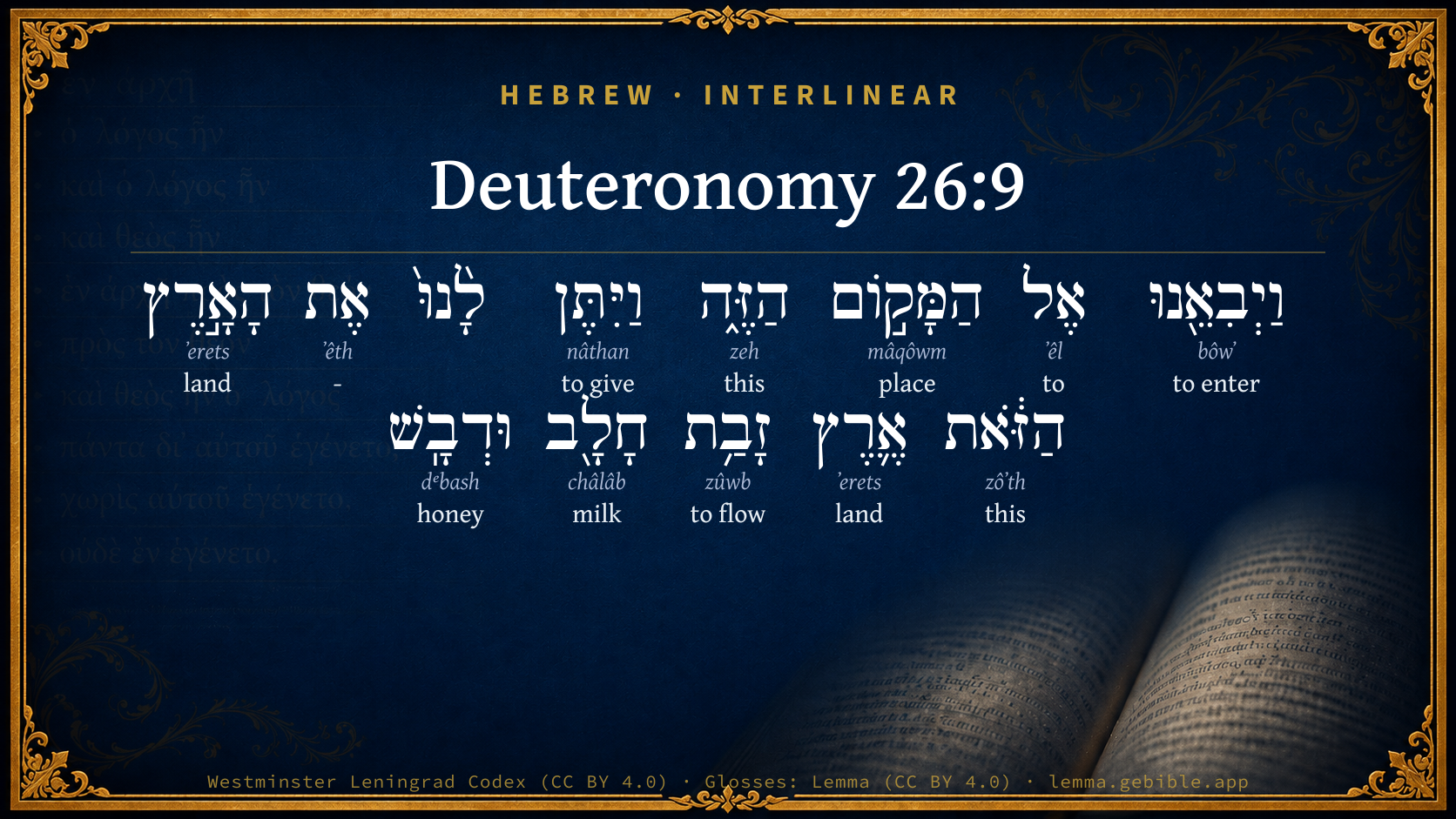
  1. וַיְבִאֵ֖נוּ bôwʼ H935 “and · to enter · us” Conjunction + Verb, Hiphil, Sequential Imperfect, 3rd Person, Masculine, Singular + Suffix, Personal, 1st Person, Common, Plural
  2. אֶל ʼêl H413 “to” Preposition
  3. הַמָּק֣וֹם mâqôwm H4725 “the · place” Particle, Definite Article + Noun, Common, Masculine, Singular, Absolute
  4. הַזֶּ֑ה zeh H2088 “the · this” Particle, Definite Article + Pronoun, Demonstrative, Masculine, Singular
  5. וַיִּתֶּן nâthan H5414 “and · to give” Conjunction + Verb, Qal, Sequential Imperfect, 3rd Person, Masculine, Singular
  6. אֶת ʼêth H853 “-” Particle, Direct Object
  7. הָאָ֣רֶץ ʼerets H776 “the · land” Particle, Definite Article + Noun, Common, Both, Singular, Absolute
  8. הַזֹּ֔את zôʼth H2063 “the · this” Particle, Definite Article + Pronoun, Demonstrative, Feminine, Singular
  9. אֶ֛רֶץ ʼerets H776 “land” Noun, Common, Both, Singular, Absolute
  10. חָלָ֖ב châlâb H2461 “milk” Noun, Common, Masculine, Singular, Absolute
  11. וּדְבָֽשׁ dᵉbash H1706 “and · honey” Conjunction + Noun, Common, Masculine, Singular, Absolute

About this verse

These counts appear in no published source. They are computed here, from the morphology-tagged text and Lemma’s own curated glosses. What Lemma adds →

13
words
11
distinct lemmas
Pentateuch
section

Shared distinctive vocabulary

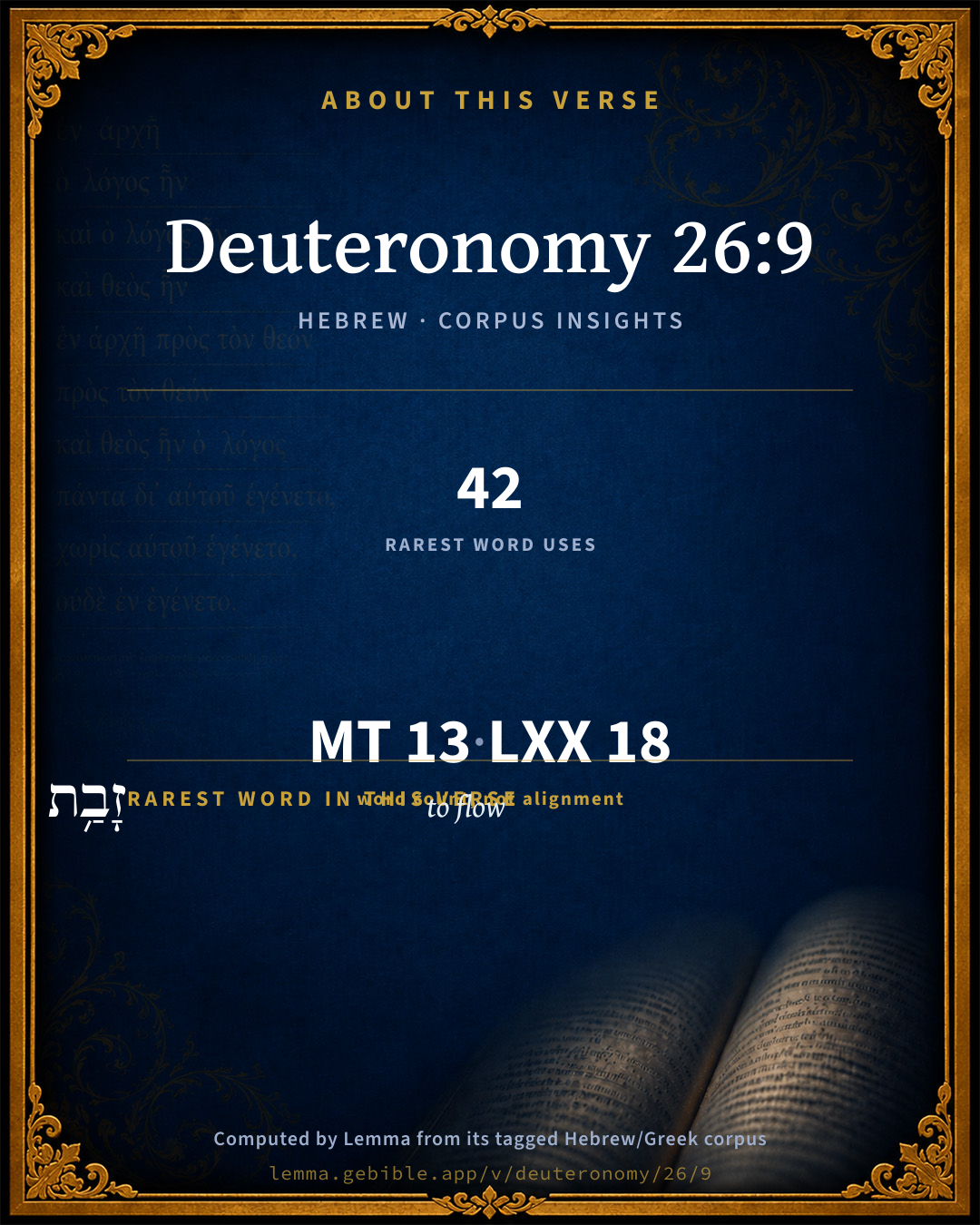
זָבַ֥ת to flow H2100 occurs in 41 verses of the Hebrew Bible. Also found in:

Grammatical profile

  • 3 verbs
  • 5 nouns
  • 2 pronouns
  • 2 prepositions
  • 1 particle

Verb forms

  • וַיְבִאֵ֖נוּ Hiphil · Sequential Imperfect
  • וַיִּתֶּן Qal · Sequential Imperfect
  • זָבַ֥ת Qal · Participle Active

Repetition

A word recurs within this verse — often emphatic in Hebrew:

  • הָאָ֣רֶץ land H776 ×2

Hebrew & Septuagint length

In English translation the verse runs 21 words from the Hebrew and 19 from the Septuagint (LXX English) — closely comparable.

A rough comparison of the two English renderings, which tokenize alike — not a word-level alignment.

Word counts can differ between the Hebrew and the Greek without any difference in meaning — e.g. the Hebrew direct-object marker אֵת has no separate Greek word, and Greek often adds the article ὁ.

In the original languages it is 13 Hebrew tokens and 18 Greek tokens — but the two are counted differently (Hebrew bundles its prefixes and suffixes into one token; the Greek is in lemma form), so that isn’t a like-for-like length.

Cross-references

8

Topical passages linked to Deuteronomy 26:9 in the Treasury of Scripture Knowledge — connected by theme and wording, ordered by reader-vote popularity; previews shown in the World English Bible.

  • Exodus 3:8 I have come down to deliver them out of the hand of the Egyptians, and to bring them up out of that land to a good and large land, to a land flowing with milk and honey; to the place of the Canaanite, the Hittite, the Amorite, the Perizzite, the Hivite, and the Jebusite.
  • Joshua 23:14 Behold, this day I am going the way of all the earth: and you know in all your hearts and in all your souls, that not one thing has failed of all the good things which Yahweh your God spoke concerning you; all are happen to you, not one thing has failed of it.
  • 1 Samuel 7:12 Then Samuel took a stone, and set it between Mizpah and Shen, and called the name of it Ebenezer, saying, Hitherto has Yahweh helped us.
  • Psalms 105:44 He gave them the lands of the nations. They took the labor of the peoples in possession,
  • Psalms 107:7–8 He led them also by a straight way, That they might go to a city to live in.
  • Ezekiel 20:6 in that day I swore to them, to bring them forth out of the land of Egypt into a land that I had searched out for them, flowing with milk and honey, which is the glory of all lands.
  • Ezekiel 20:15 Moreover also I swore to them in the wilderness, that I would not bring them into the land which I had given them, flowing with milk and honey, which is the glory of all lands;
  • Acts 26:22 Having therefore obtained the help that is from God, I stand to this day testifying both to small and great, saying nothing but what the prophets and Moses said would happen,

Cross-references courtesy of OpenBible.info (CC BY 4.0).

Hebrew and Greek witnesses Masoretic Hebrew ↔ Greek Septuagint

The same verse in the two great witnesses to the Old Testament, shown verse-for-verse.

These are two independent witnesses, not word-aligned to each other, and the Septuagint is shown in lemma (dictionary) form.

Hebrew Deuteronomy 26:9 Masoretic · Westminster Leningrad Codex

וַיְבִאֵ֖נוּ אֶל הַמָּק֣וֹם הַזֶּ֑ה וַיִּתֶּן לָ֨נוּ֙ אֶת הָאָ֣רֶץ הַזֹּ֔את אֶ֛רֶץ זָבַ֥ת חָלָ֖ב וּדְבָֽשׁ

and he has brought us into this place, and has given us this land, a land flowing with milk and honey.

World English Bible · Public Domain

Greek LXX Deuteronomy 26:9 Septuagint · lemma form

καί εἰςἄγω ἐγώ εἰς ὁ τόπος οὗτος καί δίδωμι ἐγώ ὁ γῆ οὗτος γῆ ῥέω γάλα καί μέλι

And he brought us into this place, and gave us this land, a land flowing with milk and honey.

LXX2012 (modern English Septuagint) · Public Domain

Hebrew: Westminster Leningrad Codex (CC BY 4.0). Greek: Septuagint (public domain); English from LXX2012 (modern English Septuagint) (Public Domain). How the Septuagint differs from the Hebrew →

Targum (Aramaic paraphrase)

2

The Targum is the ancient Jewish Aramaic paraphrase of the Hebrew Scriptures — an interpretive translation, not the Hebrew text itself. Onkelos (literal) and Pseudo-Jonathan (expansive) render the Torah, and Jonathan the Prophets. Coverage is partial: where no permissively-licensed English translation exists for a verse, only the Aramaic is shown. This is verse-level text, not a word-by-word alignment to the Hebrew.

  1. Targum Onkelos Torah (Genesis–Deuteronomy)
    וְאַיְתָנָא לְאַתְרָא הָדֵין וִיהַב לָנָא יָת אַרְעָא הָדָא אַרְעָא עָבְדָא חֲלַב וּדְבָש

    (no public-domain English translation for this verse)

    Targum Onkelos — Aramaic: “Onkelos Genesis” (public domain); “Onkelos Exodus” (public domain); “Onkelos Leviticus” (public domain); “Onkelos Numbers” (public domain); “Onkelos Deuteronomy” (public domain). English: “Sefaria Community Translation” (CC0 1.0 (public-domain dedication)); “J.W. Etheridge. The Targums of Onkelos and Jonathan Ben Uzziel on the Pentateuch. London: Longmans, Green, 1862” (public domain). Text via Sefaria.

  2. Targum Pseudo-Jonathan Torah (Genesis–Deuteronomy)
    וְאַנְטֵיל יָתָנָא לְאַתְרָא הָדֵין וִיהַב לָנָא יַת אַרְעָא הָדָא אֲרַע דְפֵירָהָא שְׁמֵינִין כַּחֲלָב וְחַלְיַין כִּדְבָשׁ

    and brought us into this place, and gave us this land, a land of fruits rich as milk and sweet as honey.

    Targum Pseudo-Jonathan — Aramaic: “Targum Jonathan on Genesis” (public domain); “Targum Jonathan on Exodus” (public domain); “Targum Jonathan on Leviticus” (public domain); “Targum Jonathan on Numbers” (public domain); “Targum Jonathan on Deuteronomy” (public domain). English: “The Targum of Jonathan ben Uzziel, trans. J. W. Etheridge, London, 1862” (public domain). Text via Sefaria.

Commentary

Notes on Deuteronomy 26:9 from classic Christian and Jewish commentators (each source and its license shown beneath its notes). The classic Christian expositions comment on the surrounding passage and are grouped to its opening verse, so a note may address several verses; the Jewish commentaries on the Tanakh (Rashi and others) are per-verse, so they appear only where the commentator wrote on this verse.

Lemma curates 59 commentaries, every one of them public domain or Creative Commons licensed, each selected and text-cleaned for this edition rather than reprinted as found. About our sources →

The Cambridge Bible for Schools and Colleges

gen. ed. J. J. S. Perowne

9. hath brought us into this place] Deu_1:31, Deu_9:7. As Cullen remarks, this phrase is not used for the Promised Land in 12–25, in which place means the One Sanctuary, see Deu_12:5.

flowing with milk and honey] Deu_6:3. Once nomads, they are now settled cultivators of a fertile land, in token of which guidance and the blessings it has brought them to, he continues—

The Cambridge Bible for Schools and Colleges (gen. ed. J. J. S. Perowne; Cambridge University Press, 1878–1918) — public domain. Text from a community e-Sword module.

John Gill's Exposition

And he hath brought us unto this place,.... After forty years travel through the wilderness:

and hath given us this land, even a land that floweth with milk and honey; an usual description of the land of Canaan, because of the great fertility of it, and the abundance of good things in it; see Exo 3:8.

John Gill's Exposition of the Whole Bible (1746–1763) — public domain (CC PDM 1.0). Text via the HelloAO Bible API.

Rashi

Rabbi Shlomo Yitzchaki (Rashi)

אל המקום הזה [AND HE HATH BROUGHT US] UNTO THIS PLACE — This refers to the Temple where the worshipper was standing when he made this declaration.

ויתן לנו את הארץ means what it literally implies: AND HATH GIVEN US THE LAND.

Rashi on the Tanakh — English translations: “The Judaica Press complete Tanach with Rashi, translated by A. J. Rosenberg” (CC BY 4.0); “Pentateuch with Rashi's commentary by M. Rosenbaum and A.M. Silbermann, 1929-1934” (public domain); “The Metsudah Tanach series, Lakewood, N.J” (CC BY 4.0); and “The Book of Joshua, Metsudah Publications, 1997” (CC BY 4.0). Text via Sefaria.

Lesson kit

Teaching starters — assembled from the data on this page, not authored interpretation. Every prompt links to the verse data it draws on. Edit before teaching.

Deuteronomy, in the Pentateuch, opens this verse with 13 words (11 distinct Hebrew lemmas). Its most distinctive word is zûwb (“to flow”). A historical commentator’s framing appears above. Read the whole chapter for the surrounding context.

Discussion questions

  1. The word zûwb carries the sense “to flow.” How does it shape the verse?
  2. Exodus 3:8 shares the word «to flow» with this verse. How do the two illuminate each other?
  3. “land” occurs 2× in this one verse. What is the effect of the repetition?
  4. The translations on this page render this verse differently — a whole-verse word diff, not a word-by-word alignment. What might account for the different wordings?
  5. The verb «וַיְבִאֵ֖נוּ» is Hiphil Sequential Imperfect. How does its form color the action?
  6. Reading how The Cambridge Bible for Schools and Colleges and John Gill's Exposition read this verse, where do the two commentators agree and where do they part?

Things to notice

Reading settings

Reading text

Shown beneath each verse's original-language words.

Old Testament
Old Testament edition

Read the OT as the Masoretic Hebrew (MT) or the Greek Septuagint (LXX).

English shown for the Greek Septuagint (in the Hebrew ↔ Greek comparison).

Comparing translations? Open the Compare panel on any verse page to stack up to four side by side.