
Deuteronomy 28:7

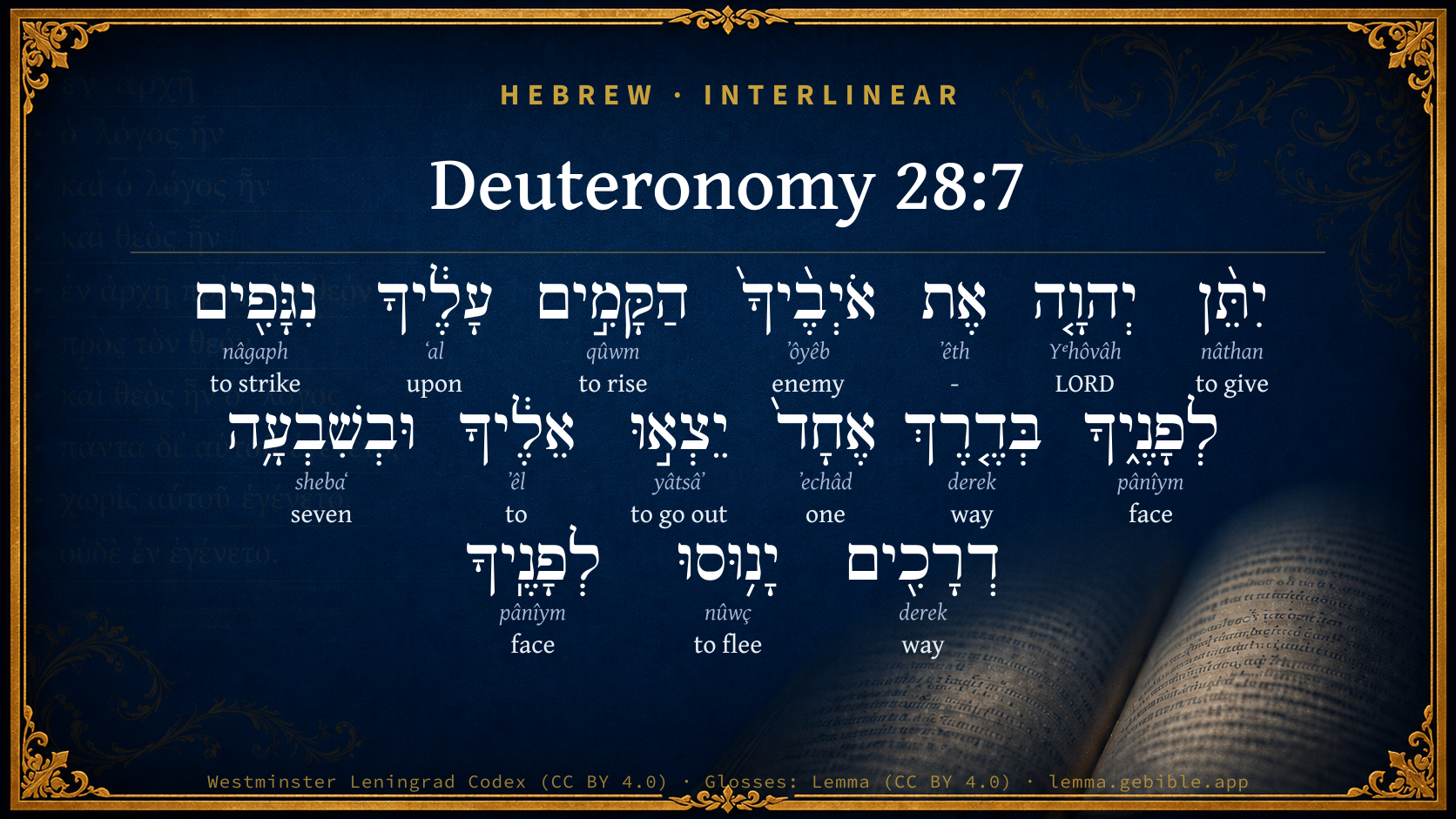
Hebrew (Westminster Leningrad Codex) Deuteronomy 28:7 appears in the Hebrew Old Testament. The text above is from the Westminster Leningrad Codex. Each word links to its Strong’s number, a concise gloss, and parsing drawn from the Open Scriptures Hebrew Bible morphology. Click any word for its full Brown-Driver-Briggs (BDB) entry.
Download image
Cite this verse

Deuteronomy 28:7 (World English Bible). Public Domain. Lemma interlinear Bible study tool, https://lemma.gebible.app/v/deuteronomy/28/7.

Show BibTeX & RIS
BibTeX
RIS
English Translation
Yahweh will cause your enemies who rise up against you to be struck before you: they shall come out against you one way, and shall flee before you seven ways.
World English Bible · Public Domain
Download a study sheet

One document with this verse’s original text, its word-by-word gloss line, the meaning frame, cross-references with their text, attributed commentary, and full source and license credits — printable, and it pastes into notes with its structure intact.

This verse Autodidact and up

Study sheet (.html) Plain text (.txt)

A passage Seminary Student

Up to 50 verses in one chapter. A passage sheet keeps up to 6 commentary sources and 12 cross-references per verse, in the order this page ranks them, and says so on the sheet whenever that leaves anything out. Ask for a single verse and you get the Autodidact verse sheet above.

Everything on this page stays free to read, with no account — the sheet is a download of what is already on screen, not access to it.

Want to remove ads? Support Godless Engineer
Compare translations 3

The same verse in 3 English versions, stacked beneath the original-language interlinear above. Click any original word for its lexicon entry.

Each is an independent rendering of the whole verse — the interlinear is not word-aligned to these translations.

Highlighted words mark where these versions differ — a whole-verse word diff, not a word-by-word alignment.

  • World English Bible Public Domain
    Yahweh will cause your enemies who rise up against you to be struck before you: they shall come out against you one way, and shall flee before you seven ways.
  • King James Version Public Domain
    The LORD shall cause thine enemies that rise up against thee to be smitten before thy face: they shall come out against thee one way, and flee before thee seven ways.
  • unfoldingWord Literal Text CC BY-SA 4.0
    Yahweh shall let your enemies who rise up against you be struck down to your faces; they will come out against you one way but will flee to your faces seven ways.

unfoldingWord Literal Text — © unfoldingWord, licensed CC BY-SA 4.0. Word-aligned USFM3 via Door43 (git.door43.org/unfoldingWord/en_ult).

Versions to compare (up to 4)

3 of 4 selected

Show all 18 translations

Every available English version of this verse, each an independent rendering of the whole verse.

  • World English Bible Public Domain
    Yahweh will cause your enemies who rise up against you to be struck before you: they shall come out against you one way, and shall flee before you seven ways.
  • Berean Standard Bible Public Domain
    The LORD will cause the enemies who rise up against you to be defeated before you. They will march out against you in one direction but flee from you in seven.
  • Majority Standard Bible Public Domain
    The LORD will cause the enemies who rise up against you to be defeated before you. They will march out against you in one direction but flee from you in seven.
  • King James Version Public Domain
    The LORD shall cause thine enemies that rise up against thee to be smitten before thy face: they shall come out against thee one way, and flee before thee seven ways.
  • American Standard Version (1901) Public Domain
    Jehovah will cause thine enemies that rise up against thee to be smitten before thee: they shall come out against thee one way, and shall flee before thee seven ways.
  • Revised Version (1885) Public Domain
    The LORD shall cause thine enemies that rise up against thee to be smitten before thee: they shall come out against thee one way, and shall flee before thee seven ways.
  • Geneva Bible (1599) Public Domain
    The Lord shall cause thine enemies that rise against thee, to fall before thy face: they shall come out against thee one way, and shall flee before thee leuen wayes.
  • Douay-Rheims (1899) Public Domain
    The Lord shall cause thy enemies, that rise up against thee, to fall down before thy face: one way shall they come out against thee, and seven ways shall they flee before thee.
  • Young's Literal Translation Public Domain
    `Jehovah giveth thine enemies, who are rising up against thee -- smitten before thy face; in one way they come out unto thee, and in seven ways they flee before thee.
  • Literal Standard Version CC BY-SA 4.0
    YHWH makes your enemies, who are rising up against you, to be struck before your face; in one way they come out to you, and in seven ways they flee before you.
  • Unlocked Literal Bible CC BY-SA 4.0
    Yahweh will cause your enemies who rise up against you to be struck down before you; they will come out against you one way but will flee before you seven ways.
  • unfoldingWord Literal Text CC BY-SA 4.0
    Yahweh shall let your enemies who rise up against you be struck down to your faces; they will come out against you one way but will flee to your faces seven ways.
  • Darby Bible Public Domain
    Jehovah will give up, smitten before thee, thine enemies that rise up against thee; they shall come out against thee one way, and by seven ways shall they flee before thee.
  • World Messianic Bible Public Domain
    The LORD will cause your enemies who rise up against you to be struck before you. They will come out against you one way, and will flee before you seven ways.
  • Webster's Bible Public Domain
    The LORD shall cause thy enemies that rise up against thee to be smitten before thy face: they shall come out against thee one way, and flee before thee seven ways.
  • Free Bible Version CC BY-SA 4.0
    The Lord will defeat the enemies who come to attack you. They will come at you from one direction, but they will scatter seven different ways.
  • Bible in Basic English Public Domain
    By the power of the Lord, those who take arms against you will be overcome before you: they will come out against you one way, and will go in flight from you seven ways.
  • JPS Tanakh (1917) Public Domain
    The LORD will cause thine enemies that rise up against thee to be smitten before thee; they shall come out against thee one way, and shall flee before thee seven ways.

Literal Standard Version (2020), Covenant Press — licensed CC BY-SA 4.0. Text via the HelloAO Bible API (eBible.org). Unlocked Literal Bible (unfoldingWord) — licensed CC BY-SA 4.0. Text via the HelloAO Bible API (eBible.org). unfoldingWord Literal Text — © unfoldingWord, licensed CC BY-SA 4.0. Word-aligned USFM3 via Door43 (git.door43.org/unfoldingWord/en_ult). Free Bible Version, Dr. Jonathan Gallagher — licensed CC BY-SA 4.0. Text via the HelloAO Bible API (eBible.org).

Word by word

More ways to search: Search by grammar → Find every occurrence → Compare this word →

Practice this passage: Drill this verse → Learn its vocabulary →

נִגָּפִ֖ים
nâgaph
H5062
“striking”
Verb, Niphal, Participle Active, Masculine, Plural, Absolute
Part of Speech
Verb
Stem
Niphal
Form
Participle Active
Gender
Masculine
Number
Plural
State
Absolute
Full BDB Definition

Origin: a primitive root

TWOT: 1294

to strike, smite - (Qal) to strike, smite - (Niphal) to be stricken, be smitten - (Hithpael) to stumble
  1. יִתֵּ֨ן nâthan H5414 “to give” Verb, Qal, Imperfect, 3rd Person, Masculine, Singular
  2. יְהוָ֤ה Yᵉhôvâh H3068 “LORD” Noun, Proper
  3. אֶת ʼêth H853 “-” Particle, Direct Object
  4. אֹיְבֶ֨יךָ֙ ʼôyêb H341 “enemy · you” Verb, Qal, Participle Active, Masculine, Plural, Construct + Suffix, Personal, 2nd Person, Masculine, Singular
  5. הַקָּמִ֣ים qûwm H6965 “the · rising” Particle, Definite Article + Verb, Qal, Participle Active, Masculine, Plural, Absolute
  6. עָלֶ֔יךָ ʻal H5921 “upon · you” Preposition + Suffix, Personal, 2nd Person, Masculine, Singular
  7. לְפָנֶ֑יךָ pânîym H6440 “to/for · face(s) · your” Preposition + Noun, Common, Both, Plural, Construct + Suffix, Personal, 2nd Person, Masculine, Singular
  8. בְּדֶ֤רֶךְ derek H1870 “in/at · way” Preposition + Noun, Common, Both, Singular, Absolute
  9. אֶחָד֙ ʼechâd H259 “one” Adjective, Cardinal number, Masculine, Singular, Absolute
  10. יֵצְא֣וּ yâtsâʼ H3318 “to go out” Verb, Qal, Imperfect, 3rd Person, Masculine, Plural
  11. אֵלֶ֔יךָ ʼêl H413 “to · you” Preposition + Suffix, Personal, 2nd Person, Masculine, Singular
  12. וּבְשִׁבְעָ֥ה shebaʻ H7651 “and · in/at · seven” Conjunction + Preposition + Adjective, Cardinal number, Masculine, Singular, Absolute
  13. דְרָכִ֖ים derek H1870 “ways” Noun, Common, Both, Plural, Absolute
  14. יָנ֥וּסוּ nûwç H5127 “to flee” Verb, Qal, Imperfect, 3rd Person, Masculine, Plural
  15. לְפָנֶֽיךָ pânîym H6440 “to/for · face(s) · your” Preposition + Noun, Common, Both, Plural, Construct + Suffix, Personal, 2nd Person, Masculine, Singular

About this verse

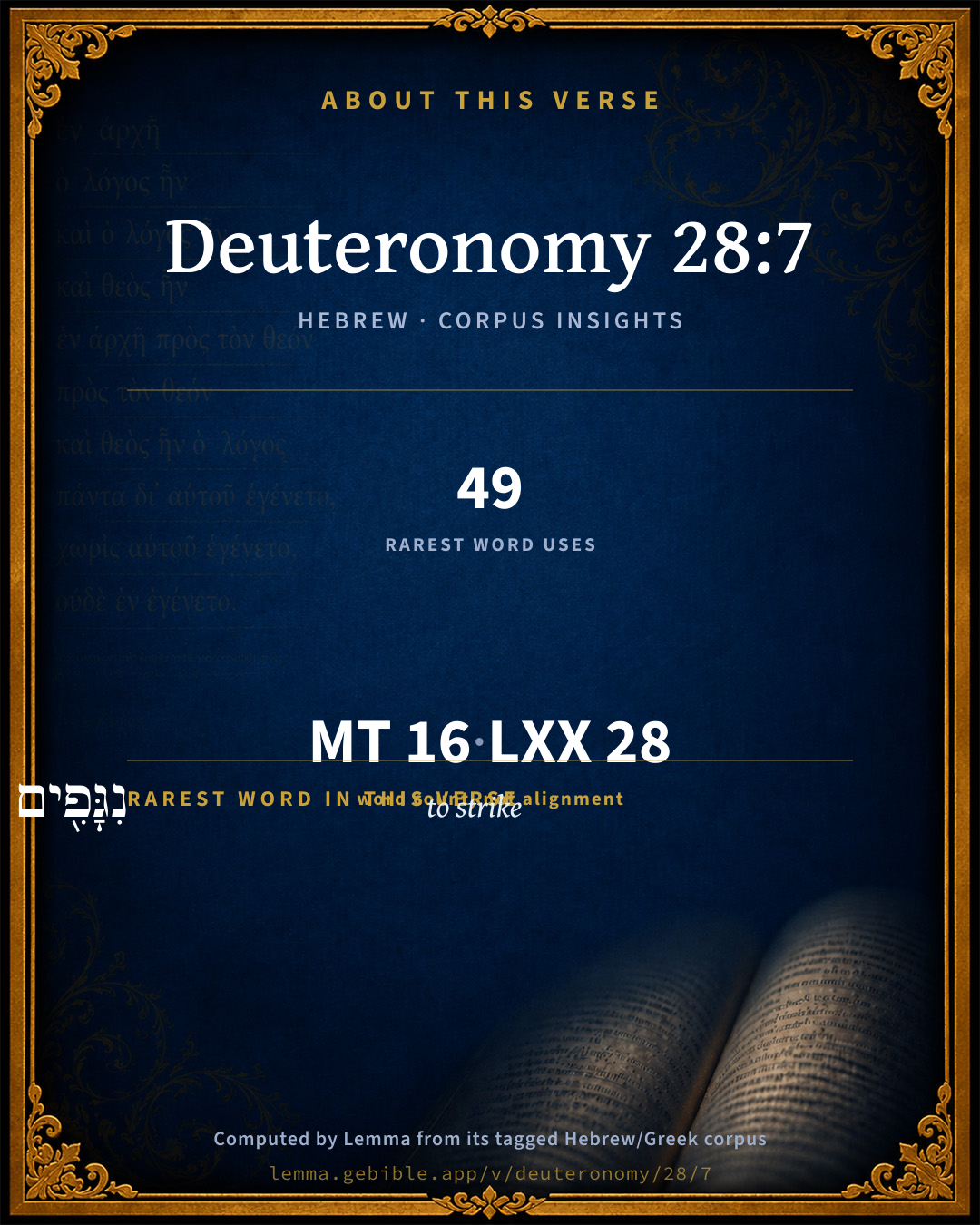
These counts appear in no published source. They are computed here, from the morphology-tagged text and Lemma’s own curated glosses. What Lemma adds →

16
words
14
distinct lemmas
Pentateuch
section

Shared distinctive vocabulary

נִגָּפִ֖ים to strike H5062 occurs in 46 verses of the Hebrew Bible. Also found in:

Grammatical profile

  • 6 verbs
  • 5 nouns
  • 2 adjectives
  • 2 prepositions
  • 1 particle

Verb forms

  • יִתֵּ֨ן Qal · Imperfect
  • אֹיְבֶ֨יךָ֙ Qal · Participle Active
  • הַקָּמִ֣ים Qal · Participle Active
  • נִגָּפִ֖ים Niphal · Participle Active
  • יֵצְא֣וּ Qal · Imperfect
  • יָנ֥וּסוּ Qal · Imperfect

Repetition

Words recur within this verse — often emphatic in Hebrew:

  • לְפָנֶ֑יךָ face H6440 ×2
  • בְּדֶ֤רֶךְ way H1870 ×2

Hebrew & Septuagint length

In English translation the verse runs 30 words from the Hebrew and 30 from the Septuagint (LXX English) — the same length.

A rough comparison of the two English renderings, which tokenize alike — not a word-level alignment.

Word counts can differ between the Hebrew and the Greek without any difference in meaning — e.g. the Hebrew direct-object marker אֵת has no separate Greek word, and Greek often adds the article ὁ.

In the original languages it is 16 Hebrew tokens and 28 Greek tokens — but the two are counted differently (Hebrew bundles its prefixes and suffixes into one token; the Greek is in lemma form), so that isn’t a like-for-like length.

Cross-references

16

Topical passages linked to Deuteronomy 28:7 in the Treasury of Scripture Knowledge — connected by theme and wording, ordered by reader-vote popularity; previews shown in the World English Bible.

  • 2 Samuel 22:38–41 I have pursued my enemies, and destroyed them; Neither did I turn again until they were consumed.
  • Leviticus 26:7–8 You shall chase your enemies, and they shall fall before you by the sword.
  • Psalms 89:23 I will beat down his adversaries before him, And strike those who hate him.
  • 2 Chronicles 32:21–22 Yahweh sent an angel, who cut off all the mighty men of valor, and the leaders and captains, in the camp of the king of Assyria. So he returned with shame of face to his own land. When he was come into the house of his god, those who came forth from his own bowels killed him there with the sword.
  • Joshua 8:22 The others came forth out of the city against them; so they were in the midst of Israel, some on this side, and some on that side: and they struck them, so that they let none of them remain or escape.
  • 2 Chronicles 19:4 Jehoshaphat lived at Jerusalem: and he went out again among the people from Beersheba to the hill-country of Ephraim, and brought them back to Yahweh, the God of their fathers.
  • Deuteronomy 28:25 Yahweh will cause you to be struck before your enemies; you shall go out one way against them, and shall flee seven ways before them: and you shall be tossed back and forth among all the kingdoms of the earth.
  • 2 Chronicles 31:20–21 Thus did Hezekiah throughout all Judah; and he worked that which was good and right and faithful before Yahweh his God.
  • 1 Samuel 7:3–4 Samuel spoke to all the house of Israel, saying, If you do return to Yahweh with all your heart, then put away the foreign gods and the Ashtaroth from among you, and direct your hearts to Yahweh, and serve him only; and he will deliver you out of the hand of the Philistines.
  • 1 Samuel 7:10–11 As Samuel was offering up the burnt offering, the Philistines drew near to battle against Israel; but Yahweh thundered with a great thunder on that day on the Philistines, and confused them; and they were struck down before Israel.
  • Deuteronomy 32:30 How should one chase a thousand, Two put ten thousand to flight, Except their Rock had sold them, Yahweh had delivered them up?
  • Joshua 10:10–11 Yahweh confused them before Israel, and he killed them with a great slaughter at Gibeon, and chased them by the way of the ascent of Beth Horon, and struck them to Azekah, and to Makkedah.
  • Joshua 10:42 All these kings and their land did Joshua take at one time, because Yahweh, the God of Israel, fought for Israel.
  • 2 Chronicles 14:2–6 Asa did that which was good and right in the eyes of Yahweh his God:
  • 2 Chronicles 14:9–15 There came out against them Zerah the Ethiopian with an army of a million troops, and three hundred chariots; and he came to Mareshah.
  • 2 Chronicles 20:22–25 When they began to sing and to praise, Yahweh set liers-in-wait against the children of Ammon, Moab, and Mount Seir, who had come against Judah; and they were struck.

Cross-references courtesy of OpenBible.info (CC BY 4.0).

Hebrew and Greek witnesses Masoretic Hebrew ↔ Greek Septuagint

The same verse in the two great witnesses to the Old Testament, shown verse-for-verse.

These are two independent witnesses, not word-aligned to each other, and the Septuagint is shown in lemma (dictionary) form.

Hebrew Deuteronomy 28:7 Masoretic · Westminster Leningrad Codex

יִתֵּ֨ן יְהוָ֤ה אֶת אֹיְבֶ֨יךָ֙ הַקָּמִ֣ים עָלֶ֔יךָ נִגָּפִ֖ים לְפָנֶ֑יךָ בְּדֶ֤רֶךְ אֶחָד֙ יֵצְא֣וּ אֵלֶ֔יךָ וּבְשִׁבְעָ֥ה דְרָכִ֖ים יָנ֥וּסוּ לְפָנֶֽיךָ

Yahweh will cause your enemies who rise up against you to be struck before you: they shall come out against you one way, and shall flee before you seven ways.

World English Bible · Public Domain

Greek LXX Deuteronomy 28:7 Septuagint · lemma form

παραδίδωμι κύριος ὁ θεός σύ ὁ ἐχθρός σύ ὁ ἀντιἵστημι σύ συντρίβω πρό πρόσωπον σύ ὁδός εἷς ἐκἔρχομαι πρός σύ καί ἐν ἑπτά ὁδός φεύγω ἀπό πρόσωπον σύ

The Lord deliver your enemies that withstand you utterly broken before your face: they shall come out against you one way, and they shall flee seven ways from before you.

LXX2012 (modern English Septuagint) · Public Domain

On this verse, Haydock's Catholic Bible Commentary discusses the Septuagint’s reading. Read the note in Commentary ↓

Hebrew: Westminster Leningrad Codex (CC BY 4.0). Greek: Septuagint (public domain); English from LXX2012 (modern English Septuagint) (Public Domain). How the Septuagint differs from the Hebrew →

Targum (Aramaic paraphrase)

2

The Targum is the ancient Jewish Aramaic paraphrase of the Hebrew Scriptures — an interpretive translation, not the Hebrew text itself. Onkelos (literal) and Pseudo-Jonathan (expansive) render the Torah, and Jonathan the Prophets. Coverage is partial: where no permissively-licensed English translation exists for a verse, only the Aramaic is shown. This is verse-level text, not a word-by-word alignment to the Hebrew.

  1. Targum Onkelos Torah (Genesis–Deuteronomy)
    יִתֵּן יְיָ יָת בַּעֲלֵי דְבָבָךְ דְקָיְמִין עֲלָךְ תְּבִירִין קֳדָמָךְ בְּאָרְחָא חַדָא יִפְּקוּן לְוָתָךְ וּבְשִׁבְעָא אָרְחָן יֵעִרְקוּן מִקֳדָמָךְ

    (no public-domain English translation for this verse)

    Targum Onkelos — Aramaic: “Onkelos Genesis” (public domain); “Onkelos Exodus” (public domain); “Onkelos Leviticus” (public domain); “Onkelos Numbers” (public domain); “Onkelos Deuteronomy” (public domain). English: “Sefaria Community Translation” (CC0 1.0 (public-domain dedication)); “J.W. Etheridge. The Targums of Onkelos and Jonathan Ben Uzziel on the Pentateuch. London: Longmans, Green, 1862” (public domain). Text via Sefaria.

  2. Targum Pseudo-Jonathan Torah (Genesis–Deuteronomy)
    יְשַׁוֵי מֵימְרָא דַיְיָ יַת בַּעֲלֵי דְבָבֵיכוֹן דְקַיְימִין לְקוּבְלֵיכוֹן לִמְבָאֲשָׁא תְּבִירִין קֳדָמֵיכוֹן בְּאוֹרְחָא חַד יְהוֹן נַפְקִין לְוַותְכוֹן לְסִדְרֵי קְרָבָא וּבְשִׁבְעָא אָרְחִין טַעֲיַין יֶהֱווּן עַרְקִין מִן קֳדָמֵיכוֹן

    The Word of the Lord will cause your enemies who rise up against you to hurt you, to be broken before you. By one way they will come out to fight against you, but seven ways they shall be dispersed, I fleeing before you.

    Targum Pseudo-Jonathan — Aramaic: “Targum Jonathan on Genesis” (public domain); “Targum Jonathan on Exodus” (public domain); “Targum Jonathan on Leviticus” (public domain); “Targum Jonathan on Numbers” (public domain); “Targum Jonathan on Deuteronomy” (public domain). English: “The Targum of Jonathan ben Uzziel, trans. J. W. Etheridge, London, 1862” (public domain). Text via Sefaria.

Commentary

Notes on Deuteronomy 28:7 from classic Christian and Jewish commentators (each source and its license shown beneath its notes). The classic Christian expositions comment on the surrounding passage and are grouped to its opening verse, so a note may address several verses; the Jewish commentaries on the Tanakh (Rashi and others) are per-verse, so they appear only where the commentator wrote on this verse.

Lemma curates 59 commentaries, every one of them public domain or Creative Commons licensed, each selected and text-cleaned for this edition rather than reprinted as found. About our sources →

Trapp's Complete Commentary

John Trapp

Deu 28:7 The LORD shall cause thine enemies that rise up against thee to be smitten before thy face: they shall come out against thee one way, and flee before thee seven ways.

Ver. 7. The Lord shall cause thine enemies.] Mr Fox observes, {a} that in King Edward VI’s time, the English put to flight their enemies in Musselburgh field, the selfsame day and hour wherein the reformation enjoined by parliament was put in execution at London, by burning of idolatrous images. Such a dependence hath our success upon our obedience.

And flee before thee seven ways.] In the forementioned fight many so strained themselves in their race that they fell down breathless and dead, whereby they seemed in running from their deaths to run to it: two thousand, lying all day as dead, got away in the night. The Irish were so galled or scared with the English ordinance, that they had neither good hearts to go forward, nor good liking to stand still, nor good assurance to run away, saith the historian. {b}

{a} Act. and Mon.

{b} Life of Ed. VI., by Sir J. Heywood.

John Trapp, A Commentary or Exposition upon All the Books of the Old and New Testament (1647–1656) — public domain. Text from a community e-Sword module.

Tyndale Open Study Notes

Tyndale Open Resources

28:7 In the Bible, the number seven generally conveys fullness or completion. Here, the number indicates that Israel’s enemies would be completely removed from the land (see study note on Deut 2:34).

Tyndale Open Study Notes — © Tyndale Open Resources, licensed CC BY-SA 4.0. Text via the HelloAO Bible API.

Geneva Bible (1599)

Geneva Bible translators

Meaning, many ways.

Geneva Bible (1599) marginal notes — public domain. Text via Bolls.life.

Jamieson, Fausset & Brown

Robert Jamieson, A. R. Fausset & David Brown

flee before thee seven ways--that is, in various directions, as always happens in a rout.

Jamieson, Fausset & Brown — Commentary Critical and Explanatory on the Whole Bible (1871) — public domain (CC PDM 1.0). Text via the HelloAO Bible API.

Adam Clarke's Commentary

Verse 7. The Lord shall cause thine enemies, &c.] This is a promise of security from foreign invasion, or total discomfiture of the invaders, should they enter the land. They shall come against thee one way - in the firmest and most united manner. And flee seven ways - shall be utterly broken, confounded, and finally routed.

Adam Clarke's Commentary on the Bible (1810–1826) — public domain. Text from a community e-Sword/MySword module.

Ellicott's Commentary for English Readers

(7) And flee before thee seven ways.—“So is the custom of them that are terrified, to flee, scattering in every direction” (Rashi). See the story of the flight of the Midianites (Jdg_7:21-22), and of the Syrians (2Ki_7:7).

A Bible Commentary for English Readers, edited by Charles John Ellicott (1878–1897) — public domain. Text from a community e-Sword module.

The Cambridge Bible for Schools and Colleges

gen. ed. J. J. S. Perowne

7. smitten before thee] See Deu_1:42.

The Cambridge Bible for Schools and Colleges (gen. ed. J. J. S. Perowne; Cambridge University Press, 1878–1918) — public domain. Text from a community e-Sword module.

John Gill's Exposition

The Lord shall command the blessing upon thee in thy storehouses,.... Barns, granaries, and cellar, where their corn, wine, and oil, were laid up; by preserving the corn from being devoured by vermin, and the casks of wine and oil from bursting and running out:

and in all thou settest thine hand unto; in all their manufactures, occupations, and trades, in which they were employed, and in the culture of their vines, olives, and other fruit trees:

and he shall bless thee in the land which the Lord thy God giveth thee; with health and long life in it, and with an abundance of all good things, it being a land flowing with milk and honey.

John Gill's Exposition of the Whole Bible (1746–1763) — public domain (CC PDM 1.0). Text via the HelloAO Bible API.

Haydock's Catholic Bible Commentary

Down. Hebrew, "dead." Septuagint, "bruised to pieces," ver. 25. (Calmet) --- Seven. This denotes the confusion and hurry with which the enemy shall endeavour to escape. (Menochius)

George Leo Haydock (1774–1849), Haydock's Catholic Family Bible and Commentary, 1859 edition — public domain. Excludes Psalms (Douay-Rheims chapter numbering differs from Protestant) and Deuterocanonical books (Catholic canon only).

Matthew Poole's English Annotations

i.e. Many ways, as is usual when an army is totally overthrown and dissipated.

Matthew Poole's English Annotations on the Holy Bible (1683–1685) — public domain. Text from a community e-Sword/MySword module.

Whedon's Commentary on the Bible

Daniel D. Whedon

7-14. The Lord shall cause thine enemies… to be smitten — In these verses the speaker describes the effect of the blessings upon the nation in all the various circumstances in which it may be placed.

Come out against thee one way, and flee… seven ways — That is, thy enemies will come against thee in solid, compact array, but will be discomfited and routed, so that they will flee in every direction.

The head, and not the tail — An expression implying excellence and superiority. Comp. Isa_9:15.

Daniel D. Whedon (gen. ed.), Commentary on the Old and New Testaments (1874–1909) — public domain. Text from a community e-Sword module.

unfoldingWord translationNotes

Door43 World Missions Community

General Information:

Moses speaks to the Israelites as if they were one man, so the words "you" and "your" here are singular. (See: Forms of You)

cause your enemies who rise up against you to be struck down before you

This can be stated in active form. AT: "cause you to defeat the armies that attack you" (See: Active or Passive)

but will flee before you seven ways

"but they will run away from you in seven directions"

seven ways

This is an idiom. The actual number could be more or less than seven. AT: "in many different directions" (See: Idiom)

Yahweh will command the blessing to come on you in your barns

Moses describes Yahweh blessing the Israelites as if Yahweh were commanding a person to attack them by surprise. AT: "When Yahweh blesses you, you will be surprised by how much grain you have in your barns" (See: Metaphor and Personification)

in all that you put your hand to

This is an idiom. AT: "in everything you do" (See: Idiom)

translationWords

adversary

raise

command

bless

hand

unfoldingWord translationNotes — © Distant Shores Media and the Door43 World Missions Community, licensed CC BY-SA 4.0. Source: git.door43.org/Door43/en_tn.

Rashi

Rabbi Shlomo Yitzchaki (Rashi)

ובשבעה דרכים ינוסו לפניך AND THEY SHALL RUN AWAY BEFORE THEE SEVEN WAYS — Such is the manner of all who flee out of fear: they scatter in every direction.

Rashi on the Tanakh — English translations: “The Judaica Press complete Tanach with Rashi, translated by A. J. Rosenberg” (CC BY 4.0); “Pentateuch with Rashi's commentary by M. Rosenbaum and A.M. Silbermann, 1929-1934” (public domain); “The Metsudah Tanach series, Lakewood, N.J” (CC BY 4.0); and “The Book of Joshua, Metsudah Publications, 1997” (CC BY 4.0). Text via Sefaria.

Lesson kit

Teaching starters — assembled from the data on this page, not authored interpretation. Every prompt links to the verse data it draws on. Edit before teaching.

Deuteronomy, in the Pentateuch, opens this verse with 16 words (14 distinct Hebrew lemmas). Its most distinctive word is nâgaph (“to strike”). A historical commentator’s framing appears above. Read the whole chapter for the surrounding context.

Discussion questions

  1. What does “to strike” (nâgaph) contribute to the verse as a whole?
  2. Exodus 8:2 shares the word «to strike» with this verse. How do the two illuminate each other?
  3. “face” occurs 2× in this one verse. What is the effect of the repetition?
  4. These translations render this verse differently. What is at stake in choosing one wording over another?
  5. The verb «יִתֵּ֨ן» is Qal Imperfect. How does its form color the action?
  6. Reading how Trapp's Complete Commentary and Tyndale Open Study Notes read this verse, where do the two commentators agree and where do they part?

Things to notice

Reading settings

Reading text

Shown beneath each verse's original-language words.

Old Testament
Old Testament edition

Read the OT as the Masoretic Hebrew (MT) or the Greek Septuagint (LXX).

English shown for the Greek Septuagint (in the Hebrew ↔ Greek comparison).

Comparing translations? Open the Compare panel on any verse page to stack up to four side by side.