
Exodus 28:30

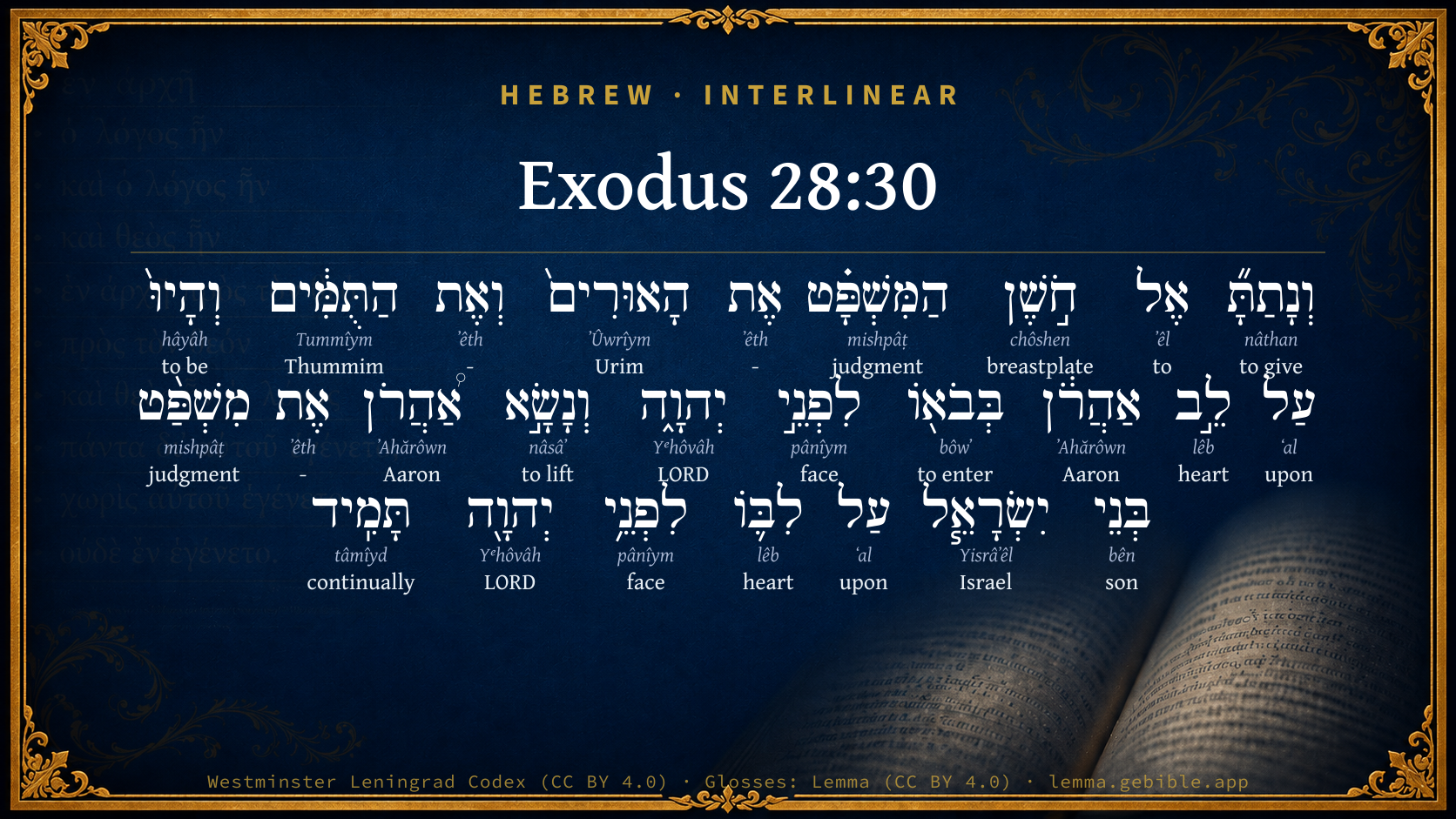
Hebrew (Westminster Leningrad Codex) Exodus 28:30 appears in the Hebrew Old Testament. The text above is from the Westminster Leningrad Codex. Each word links to its Strong’s number, a concise gloss, and parsing drawn from the Open Scriptures Hebrew Bible morphology. Click any word for its full Brown-Driver-Briggs (BDB) entry.
Download image
Cite this verse

Exodus 28:30 (World English Bible). Public Domain. Lemma interlinear Bible study tool, https://lemma.gebible.app/v/exodus/28/30.

Show BibTeX & RIS
BibTeX
RIS
English Translation
You shall put in the breastplate of judgment the Urim and the Thummim; and they shall be on Aaron's heart, when he goes in before Yahweh: and Aaron shall bear the judgment of the children of Israel on his heart before Yahweh continually.
World English Bible · Public Domain
Highlights Full analysis ↓
Download a study sheet

One document with this verse’s original text, its word-by-word gloss line, the meaning frame, cross-references with their text, attributed commentary, and full source and license credits — printable, and it pastes into notes with its structure intact.

This verse Autodidact and up

Study sheet (.html) Plain text (.txt)

A passage Seminary Student

Up to 50 verses in one chapter. A passage sheet keeps up to 6 commentary sources and 12 cross-references per verse, in the order this page ranks them, and says so on the sheet whenever that leaves anything out. Ask for a single verse and you get the Autodidact verse sheet above.

Everything on this page stays free to read, with no account — the sheet is a download of what is already on screen, not access to it.

Want to remove ads? Support Godless Engineer
Compare translations 3

The same verse in 3 English versions, stacked beneath the original-language interlinear above. Click any original word for its lexicon entry.

Each is an independent rendering of the whole verse — the interlinear is not word-aligned to these translations.

Highlighted words mark where these versions differ — a whole-verse word diff, not a word-by-word alignment.

  • World English Bible Public Domain
    You shall put in the breastplate of judgment the Urim and the Thummim; and they shall be on Aaron's heart, when he goes in before Yahweh: and Aaron shall bear the judgment of the children of Israel on his heart before Yahweh continually.
  • King James Version Public Domain
    And thou shalt put in the breastplate of judgment the Urim and the Thummim; and they shall be upon Aaron's heart, when he goeth in before the LORD: and Aaron shall bear the judgment of the children of Israel upon his heart before the LORD continually.
  • unfoldingWord Literal Text CC BY-SA 4.0
    And you shall put the Urim and the Thummim in the breastpiece of judgment, and they shall be over the heart of Aaron when he goes in before the face of Yahweh. And Aaron shall bear the judgment of the sons of Israel over his heart before the face of Yahweh continually.

unfoldingWord Literal Text — © unfoldingWord, licensed CC BY-SA 4.0. Word-aligned USFM3 via Door43 (git.door43.org/unfoldingWord/en_ult).

Versions to compare (up to 4)

3 of 4 selected

Show all 18 translations

Every available English version of this verse, each an independent rendering of the whole verse.

  • World English Bible Public Domain
    You shall put in the breastplate of judgment the Urim and the Thummim; and they shall be on Aaron's heart, when he goes in before Yahweh: and Aaron shall bear the judgment of the children of Israel on his heart before Yahweh continually.
  • Berean Standard Bible Public Domain
    And place the Urim and Thummim in the breastpiece of judgment, so that they will also be over Aaron’s heart whenever he comes before the LORD. Aaron will continually carry the judgment of the sons of Israel over his heart before the LORD.
  • Majority Standard Bible Public Domain
    And place the Urim and Thummim in the breastpiece of judgment, so that they will also be over Aaron’s heart whenever he comes before the LORD. Aaron will continually carry the judgment of the sons of Israel over his heart before the LORD.
  • King James Version Public Domain
    And thou shalt put in the breastplate of judgment the Urim and the Thummim; and they shall be upon Aaron's heart, when he goeth in before the LORD: and Aaron shall bear the judgment of the children of Israel upon his heart before the LORD continually.
  • American Standard Version (1901) Public Domain
    And thou shalt put in the breastplate of judgment the Urim and the Thummim; and they shall be upon Aaron's heart, when he goeth in before Jehovah: and Aaron shall bear the judgment of the children of Israel upon his heart before Jehovah continually.
  • Revised Version (1885) Public Domain
    And thou shalt put in the breastplate of judgment the Urim and the Thummim; and they shall be upon Aaron’s heart, when he goeth in before the LORD: and Aaron shall bear the judgment of the children of Israel upon his heart before the LORD continually.
  • Geneva Bible (1599) Public Domain
    Also thou shalt put in the brest plate of iudgement the Vrim and the Thummim, which shalbe vpon Aarons heart, when he goeth in before the Lord: and Aaron shall beare the iudgement of the children of Israel vpon his heart before the Lord continually.
  • Douay-Rheims (1899) Public Domain
    And thou shalt put in the rational of judgment doctrine and truth, which shall be on Aaron's breast, when he shall go in before the Lord: and he shall bear the judgment of the children of Israel on his breast, in the sight of the Lord always.
  • Young's Literal Translation Public Domain
    `And thou hast put unto the breastplate of judgment the Lights and the Perfections, and they have been on the heart of Aaron, in his going in before Jehovah, and Aaron hath borne the judgment of the sons of Israel on his heart before Jehovah continually.
  • Literal Standard Version CC BY-SA 4.0
    And you have put the Lights and the Perfections into the breastplate of judgment, and they have been on the heart of Aaron, in his going in before YHWH, and Aaron has borne the judgment of the sons of Israel on his heart before YHWH continually.
  • Unlocked Literal Bible CC BY-SA 4.0
    You are to put the Urim and the Thummim in the breastpiece for decision making, so they may be over Aaron's heart when he goes in before Yahweh. Thus Aaron will always carry the means for making decisions for the people of Israel over his heart before Yahweh.
  • unfoldingWord Literal Text CC BY-SA 4.0
    And you shall put the Urim and the Thummim in the breastpiece of judgment, and they shall be over the heart of Aaron when he goes in before the face of Yahweh. And Aaron shall bear the judgment of the sons of Israel over his heart before the face of Yahweh continually.
  • Darby Bible Public Domain
    And thou shalt put into the breastplate of judgment the Urim and the Thummim, that they may be upon Aaron's heart when he goeth in before Jehovah; and Aaron shall bear the judgment of the children of Israel upon his heart before Jehovah continually.
  • World Messianic Bible Public Domain
    You shall put in the breastplate of judgment the Urim and the Thummim; and they shall be on Aaron’s heart, when he goes in before the LORD. Aaron shall bear the judgment of the children of Israel on his heart before the LORD continually.
  • Webster's Bible Public Domain
    And thou shalt put in the breast-plate of judgment the Urim and the Thummim; and they shall be upon Aaron's heart, when he goeth in before the LORD: and Aaron shall bear the judgment of the children of Israel upon his heart before the LORD continually.
  • Free Bible Version CC BY-SA 4.0
    Place the Urim and Thummim in the breastpiece of decision, so that they too will be over Aaron's heart whenever he comes into the Lord's presence. Aaron will continually carry the means of gaining decisions over his heart before the Lord.
  • Bible in Basic English Public Domain
    And in the bag you are to put the Urim and Thummim, so that they may be on Aaron's heart whenever he goes in before the Lord; and Aaron may have the power of making decisions for the children of Israel before the Lord at all times.
  • JPS Tanakh (1917) Public Domain
    And thou shalt put in the breastplate of judgment the Urim and the Thummim; and they shall be upon Aaron's heart, when he goeth in before the LORD; and Aaron shall bear the judgment of the children of Israel upon his heart before the LORD continually.

Literal Standard Version (2020), Covenant Press — licensed CC BY-SA 4.0. Text via the HelloAO Bible API (eBible.org). Unlocked Literal Bible (unfoldingWord) — licensed CC BY-SA 4.0. Text via the HelloAO Bible API (eBible.org). unfoldingWord Literal Text — © unfoldingWord, licensed CC BY-SA 4.0. Word-aligned USFM3 via Door43 (git.door43.org/unfoldingWord/en_ult). Free Bible Version, Dr. Jonathan Gallagher — licensed CC BY-SA 4.0. Text via the HelloAO Bible API (eBible.org).

Word by word

More ways to search: Search by grammar → Find every occurrence → Compare this word →

Practice this passage: Drill this verse → Learn its vocabulary →

הַתֻּמִּ֔ים
Tummîym
H8550
“the · Thummim”
Particle, Definite Article + Noun, Common, Masculine, Plural, Absolute
Part of Speech
Particle + Noun
Type
Common
Gender
Masculine
Number
Plural
State
Absolute
Full BDB Definition

Origin: pl. of H8537

TWOT: None

Thummim = "perfection" - stones provided for the means of achieving a sacred lot - used with the Urim, the will of God was revealed
  1. וְנָתַתָּ֞ nâthan H5414 “and · to give” Conjunction + Verb, Qal, Sequential Perfect, 2nd Person, Masculine, Singular
  2. אֶל ʼêl H413 “to” Preposition
  3. חֹ֣שֶׁן chôshen H2833 “breastplate of” Noun, Common, Masculine, Singular, Construct
  4. הַמִּשְׁפָּ֗ט mishpâṭ H4941 “the · judgment” Particle, Definite Article + Noun, Common, Masculine, Singular, Absolute
  5. אֶת ʼêth H853 “-” Particle, Direct Object
  6. הָאוּרִים֙ ʼÛwrîym H224 “the · Urim” Particle, Definite Article + Noun, Common, Masculine, Plural, Absolute
  7. וְאֶת ʼêth H853 “and · -” Conjunction + Particle, Direct Object
  8. וְהָיוּ֙ hâyâh H1961 “and · to be” Conjunction + Verb, Qal, Sequential Perfect, 3rd Person, Common, Plural
  9. עַל ʻal H5921 “upon” Preposition
  10. לֵ֣ב lêb H3820 “heart of” Noun, Common, Masculine, Singular, Construct
  11. אַהֲרֹ֔ן ʼAhărôwn H175 “Aaron” Noun, Proper
  12. בְּבֹא֖וֹ bôwʼ H935 “in/at · to enter · him” Preposition + Verb, Qal, Infinitive Construct + Suffix, Personal, 3rd Person, Masculine, Singular
  13. לִפְנֵ֣י pânîym H6440 “to/for · face(s) of” Preposition + Noun, Common, Both, Plural, Construct
  14. יְהוָ֑ה Yᵉhôvâh H3068 “LORD” Noun, Proper
  15. וְנָשָׂ֣א nâsâʼ H5375 “and · to lift” Conjunction + Verb, Qal, Sequential Perfect, 3rd Person, Masculine, Singular
  16. אַ֠הֲרֹן ʼAhărôwn H175 “Aaron” Noun, Proper
  17. אֶת ʼêth H853 “-” Particle, Direct Object
  18. מִשְׁפַּ֨ט mishpâṭ H4941 “judgment of” Noun, Common, Masculine, Singular, Construct
  19. בְּנֵי bên H1121 “sons of” Noun, Common, Masculine, Plural, Construct
  20. יִשְׂרָאֵ֧ל Yisrâʼêl H3478 “Israel” Noun, Proper
  21. עַל ʻal H5921 “upon” Preposition
  22. לִבּ֛וֹ lêb H3820 “heart · his” Noun, Common, Masculine, Singular, Construct + Suffix, Personal, 3rd Person, Masculine, Singular
  23. לִפְנֵ֥י pânîym H6440 “to/for · face(s) of” Preposition + Noun, Common, Both, Plural, Construct
  24. יְהוָ֖ה Yᵉhôvâh H3068 “LORD” Noun, Proper
  25. תָּמִֽיד tâmîyd H8548 “continually” Noun, Common, Masculine, Singular, Absolute

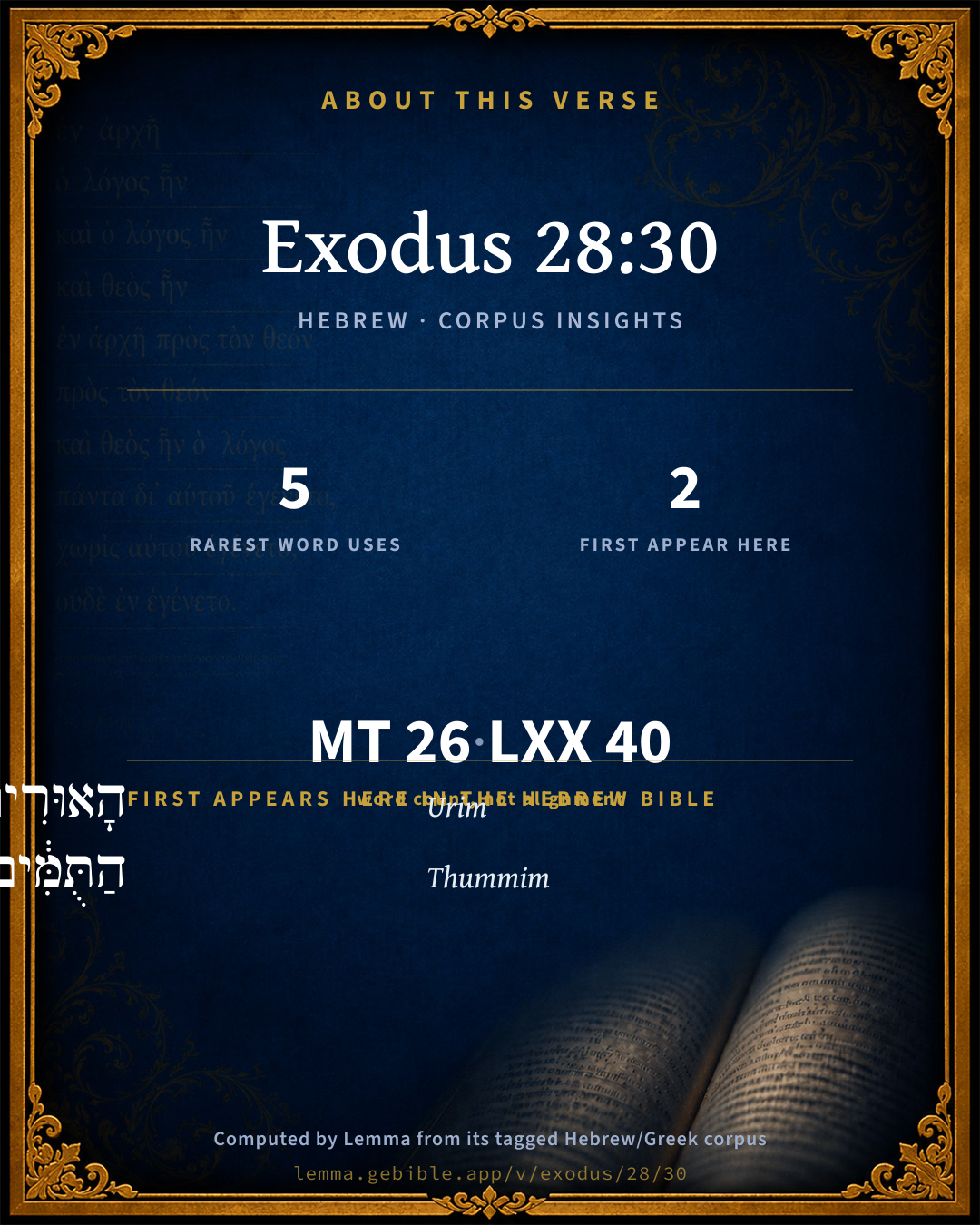
About this verse

These counts appear in no published source. They are computed here, from the morphology-tagged text and Lemma’s own curated glosses. What Lemma adds →

26
words
18
distinct lemmas
Pentateuch
section

Notable vocabulary

The rarest word here is הַתֻּמִּ֔ים Thummim H8550 — appearing just 5 times in the whole Hebrew Bible.

First appearance in Scripture

These words make their first canonical appearance in the Hebrew Bible here:

  • הָאוּרִים֙ Urim H224
  • הַתֻּמִּ֔ים Thummim H8550

Shared distinctive vocabulary

הַתֻּמִּ֔ים Thummim H8550 occurs in 5 verses of the Hebrew Bible. Also found in:

Grammatical profile

  • 4 verbs
  • 16 nouns
  • 3 prepositions
  • 3 particles

Verb forms

  • וְנָתַתָּ֞ Qal · Sequential Perfect
  • וְהָיוּ֙ Qal · Sequential Perfect
  • בְּבֹא֖וֹ Qal · Infinitive Construct
  • וְנָשָׂ֣א Qal · Sequential Perfect

Repetition

Words recur within this verse — often emphatic in Hebrew:

  • הַמִּשְׁפָּ֗ט judgment H4941 ×2
  • עַל upon H5921 ×2
  • לֵ֣ב heart H3820 ×2
  • אַהֲרֹ֔ן Aaron H175 ×2
  • לִפְנֵ֣י face H6440 ×2
  • יְהוָ֑ה LORD H3068 ×2

Hebrew & Septuagint length

In English translation the verse runs 43 words from the Hebrew and 19 from the Septuagint (LXX English) — the Septuagint runs noticeably shorter here. See the side-by-side →

A rough comparison of the two English renderings, which tokenize alike — not a word-level alignment.

Word counts can differ between the Hebrew and the Greek without any difference in meaning — e.g. the Hebrew direct-object marker אֵת has no separate Greek word, and Greek often adds the article ὁ.

In the original languages it is 26 Hebrew tokens and 40 Greek tokens — but the two are counted differently (Hebrew bundles its prefixes and suffixes into one token; the Greek is in lemma form), so that isn’t a like-for-like length.

Cross-references

21

Topical passages linked to Exodus 28:30 in the Treasury of Scripture Knowledge — connected by theme and wording, ordered by reader-vote popularity; previews shown in the World English Bible.

  • Ezra 2:63 The governor said to them, that they should not eat of the most holy things, until there stood up a priest with Urim and with Thummim.
  • Nehemiah 7:65 The governor said to them, that they should not eat of the most holy things, until there stood up a priest with Urim and Thummim.
  • Numbers 27:21 He shall stand before Eleazar the priest, who shall inquire for him by the judgment of the Urim before Yahweh: at his word shall they go out, and at his word they shall come in, both he, and all the children of Israel with him, even all the congregation.
  • Deuteronomy 33:8 Of Levi he said, Your Thummim and your Urim are with your godly one, Whom you did prove at Massah, With whom you did strive at the waters of Meribah;
  • Leviticus 8:8 He placed the breastplate on him; and in the breastplate he put the Urim and the Thummim.
  • 1 Samuel 28:6 When Saul inquired of Yahweh, Yahweh didn't answer him, neither by dreams, nor by Urim, nor by prophets.
  • 1 Samuel 30:7–8 David said to Abiathar the priest, the son of Ahimelech, Please bring me here the ephod. Abiathar brought there the ephod to David.
  • Hebrews 4:15 For we don't have a high priest who can't be touched with the feeling of our infirmities, but one who has been in all points tempted like we are, yet without sin.
  • Judges 1:1 It happened after the death of Joshua, the children of Israel asked of Yahweh, saying, Who shall go up for us first against the Canaanites, to fight against them?
  • 1 Samuel 23:9–12 David knew that Saul was devising mischief against him; and he said to Abiathar the priest, Bring here the ephod.
  • Zechariah 6:13 even he shall build the temple of Yahweh; and he shall bear the glory, and shall sit and rule on his throne; and he shall be a priest on his throne; and the counsel of peace shall be between them both.
  • 2 Corinthians 6:11–12 Our mouth is open to you, Corinthians. Our heart is enlarged.
  • Philippians 1:7–8 It is even right for me to think this way on behalf of all of you, because I have you in my heart, because, both in my bonds and in the defense and confirmation of the Gospel, you all are partakers with me of grace.
  • Hebrews 9:12 nor yet through the blood of goats and calves, but through his own blood, entered in once for all into the Holy Place, having obtained eternal redemption.
  • Hebrews 9:24 For Christ hasn't entered into holy places made with hands, which are representations of the true, but into heaven itself, now to appear in the presence of God for us;
  • Judges 20:23 The children of Israel went up and wept before Yahweh until even; and they asked of Yahweh, saying, Shall I again draw near to battle against the children of Benjamin my brother? Yahweh said, Go up against him.
  • Judges 20:27–28 The children of Israel asked of Yahweh (for the ark of the covenant of God was there in those days,
  • Judges 20:18 The children of Israel arose, and went up to Bethel, and asked counsel of God; and they said, Who shall go up for us first to battle against the children of Benjamin? Yahweh said, Judah [shall go up] first.
  • 2 Corinthians 7:3 I say this not to condemn you, for I have said before, that you are in our hearts to die together and live together.
  • 2 Corinthians 12:15 I will most gladly spend and be spent for your souls. If I love you more abundantly, am I loved the less?
  • Hebrews 2:17 Therefore he was obligated in all things to be made like his brothers, that he might become a merciful and faithful high priest in things pertaining to God, to make atonement for the sins of the people.

Cross-references courtesy of OpenBible.info (CC BY 4.0).

Hebrew and Greek witnesses Masoretic Hebrew ↔ Greek Septuagint

The same verse in the two great witnesses to the Old Testament, shown verse-for-verse.

Here the Septuagint runs noticeably shorter than the Hebrew — LXX2012 (modern English Septuagint) 19 words vs World English Bible 43. A rough length comparison of the two English translations, not a word-level alignment — read both below.

These are two independent witnesses, not word-aligned to each other, and the Septuagint is shown in lemma (dictionary) form.

Hebrew Exodus 28:30 Masoretic · Westminster Leningrad Codex

וְנָתַתָּ֞ אֶל חֹ֣שֶׁן הַמִּשְׁפָּ֗ט אֶת הָאוּרִים֙ וְאֶת הַתֻּמִּ֔ים וְהָיוּ֙ עַל לֵ֣ב אַהֲרֹ֔ן בְּבֹא֖וֹ לִפְנֵ֣י יְהוָ֑ה וְנָשָׂ֣א אַ֠הֲרֹן אֶת מִשְׁפַּ֨ט בְּנֵי יִשְׂרָאֵ֧ל עַל לִבּ֛וֹ לִפְנֵ֥י יְהוָ֖ה תָּמִֽיד

You shall put in the breastplate of judgment the Urim and the Thummim; and they shall be on Aaron's heart, when he goes in before Yahweh: and Aaron shall bear the judgment of the children of Israel on his heart before Yahweh continually.

World English Bible · Public Domain

Greek LXX Exodus 28:30 Septuagint · lemma form

καί ἐπιτίθημι ἐπί ὁ λογεῖον ὁ κρίσις ὁ δήλωσις καί ὁ ἀλήθεια καί εἰμί ἐπί ὁ στῆθος ααρων ὅταν εἰςπορεύομαι εἰς ὁ ἅγιος ἐναντίον κύριος καί φέρω ααρων ὁ κρίσις ὁ υἱός ἰσραήλ ἐπί ὁ στῆθος ἐναντίον κύριος διά πᾶς

A bell by the side of a golden pomegranate, and flower-work on the fringe of the robe round about.

LXX2012 (modern English Septuagint) · Public Domain

On this verse, Ellicott's Commentary for English Readers discusses the Septuagint’s reading. Read the note in Commentary ↓

Hebrew: Westminster Leningrad Codex (CC BY 4.0). Greek: Septuagint (public domain); English from LXX2012 (modern English Septuagint) (Public Domain). How the Septuagint differs from the Hebrew →

Targum (Aramaic paraphrase)

2

The Targum is the ancient Jewish Aramaic paraphrase of the Hebrew Scriptures — an interpretive translation, not the Hebrew text itself. Onkelos (literal) and Pseudo-Jonathan (expansive) render the Torah, and Jonathan the Prophets. Coverage is partial: where no permissively-licensed English translation exists for a verse, only the Aramaic is shown. This is verse-level text, not a word-by-word alignment to the Hebrew.

  1. Targum Onkelos Torah (Genesis–Deuteronomy)
    וְתִתֵּן בְּחשֶׁן דִינָא יָת אוּרַיָא וְיָת תֻּמַיָא וִיהוֹן עַל לִבָּא דְאַהֲרֹן בְּמֵעֲלֵהּ קֳדָם יְיָ וְיִטוֹל אַהֲרֹן יָת דִינָא דִבְנֵי יִשְׂרָאֵל עַל לִבֵּהּ קֳדָם יְיָ תְּדִירָא:

    (no public-domain English translation for this verse)

    Targum Onkelos — Aramaic: “Onkelos Genesis” (public domain); “Onkelos Exodus” (public domain); “Onkelos Leviticus” (public domain); “Onkelos Numbers” (public domain); “Onkelos Deuteronomy” (public domain). English: “Sefaria Community Translation” (CC0 1.0 (public-domain dedication)); “J.W. Etheridge. The Targums of Onkelos and Jonathan Ben Uzziel on the Pentateuch. London: Longmans, Green, 1862” (public domain). Text via Sefaria.

  2. Targum Pseudo-Jonathan Torah (Genesis–Deuteronomy)
    וְתִתֵּן בְּחֹשֶׁן דִּינָא יַת אוּרַיָא דִּמְנַהֲרִין מִלֵּיהוֹן וּמְפַרְסְמִין טְמִירָן דְּבֵית יִשְרָאֵל וְיַת תּוּמַיָא דְמַשְׁלִימִין בְּעוֹבָדֵיהוֹן לְכַהֲנָא רַבָּא דְתָבַע אוּלְפַן מִן קֳדָם יְיָ בְּהוֹן דִּבְהוֹן חָקִיק וּמְפָרַשׁ שְׁמָא רַבָּא וְקַדִּישָׁא דְבֵיהּ אִתְבַּרְיַין תְּלַת מְאָה וְעִישַרְתֵּי עַלְמַיָא וְחָקִיק וּמְפָרֵשׁ בְּאֶבֶן שְׁתִיָה דְבָהּ חָתַם מָארֵי עַלְמָא פּוּם תְּהוֹמָא רַבָּא מִן שֵׁירוּיָיא וְכָל מַאן דְּמַדְכַּר הַהוּא שְׁמָא קַדִּישָׁא בְּשַׁעַת אֲנִיקֵי מִשְׁתְּזֵיב וּטְמִירַן מְגַלְיַין וִיהוֹן עַל לִבָּא דְאַהֲרן בִּזְמַן מֵיעֲלֵיהּ קֳדָם יְיָ וְיִטוֹל אַהֲרן יַת דִּין בְּנֵי יִשְרָאֵל עַל לִבֵּיהּ קֳדָם יְיָ תְּדִירָא

    And thou shalt put upon the breastplate of judgment the Uraia, which illuminate their words, and manifest the hidden things of the house of Israel, and the Tumaia, which fulfil (or perfect) their work to the high priest, who seeketh instruction by them before the Lord; because in them is engraven and expressed the Great and Holy Name by which were created the three hundred and ten worlds, and which was engraven and expressed in the foundation stone wherewith the Lord of the world sealed up the mouth of the great deep at the beginning. Whosoever remembereth that holy name in the hour of necessity shall be delivered. And they shall be upon Aharon's heart in the time that he entereth before the Lord; and Aharon shall bear the judgment of the sons of Israel before the Lord continually.

    Targum Pseudo-Jonathan — Aramaic: “Targum Jonathan on Genesis” (public domain); “Targum Jonathan on Exodus” (public domain); “Targum Jonathan on Leviticus” (public domain); “Targum Jonathan on Numbers” (public domain); “Targum Jonathan on Deuteronomy” (public domain). English: “The Targum of Jonathan ben Uzziel, trans. J. W. Etheridge, London, 1862” (public domain). Text via Sefaria.

Commentary

Notes on Exodus 28:30 from classic Christian and Jewish commentators (each source and its license shown beneath its notes). The classic Christian expositions comment on the surrounding passage and are grouped to its opening verse, so a note may address several verses; the Jewish commentaries on the Tanakh (Rashi and others) are per-verse, so they appear only where the commentator wrote on this verse.

Lemma curates 59 commentaries, every one of them public domain or Creative Commons licensed, each selected and text-cleaned for this edition rather than reprinted as found. About our sources →

Ellicott's Commentary for English Readers

(30) Thou shalt put in the breastplate of judgment the Urim and the Thummim.—Comp. Lev_8:8. The expression used is identical with that employed in Exo_25:15; Exo_25:21 with respect to putting the Two Tables into the Ark of the Covenant, and can scarcely have any other meaning than the literal placing of one thing inside another. It has been already shown (see Note on Exo_28:16) that the breastplate was a bag, and so capable of being used as a receptacle. The words “Urim and Thummim” mean literally, “lights and perfections,” or, if the plural be one of dignity, “light and perfection” (Aquila and Symmachus translate by φωτισμοὶ καὶ τελειότητεϛ; the LXX., by ἡ δήλωσιϛ καὶ ἡ ἀλήθεια; the Vulg. by doctrina et veritas). The question arises, what do these two words, as here used, designate? Do they designate material objects; if so, what objects? In favour of their designating material objects are (1) the expressions, “thou shalt put in the breastplate the Urim and the Thummim,” “they shall be upon Aaron’s heart,” “he put in the breastplate the Urim and the Thummim” (Lev_8:8); (2) the fact that the words are accompanied by the article, on this, the first mention of them, as if they were familiar objects, well known at the time to the people generally; and (3) the explanations of Philo and Josephus, which, while they differ in all other respects, agree in this, that material objects are intended. But, if so, what objects? The two sides of the breastplate, says Philo (De Monarch., ii. 5). But these were not “put in” the breastplate after it was complete, as implied in Exo_28:30; Lev_8:8. The twelve jewels, says Josephus; but the present passage, taken in conjunction with Exo_28:17-21, distinguishes the Urim and Thummim from them. Some small objects which the bag of the breastplate could hold, and with which the people had long been familiar, can alone answer the requirements of the case. Most modern critics are thus far agreed; but when the further question is asked, what were these objects? The greatest difference appears. Diamonds, cut and uncut; slips of metal, marked with “yes” and “no”; lots, of some kind or other; and small images, like the teraphim (Gen_31:19), are among the suggestions. A very slight examination of the arguments by which these various views are supported is sufficient to show that certainty on the subject is unattainable. Probability, however, seems on the whole to be in favour of a connection between divination by teraphim and consultation of God by Urim and Thummim (Jdg_17:5; Jdg_18:14; Jdg_18:17; Jdg_18:20; Hos_3:4), whence it is reasonable to conclude that the Urim and Thummim were small images, by which God had been consulted in the past, and by which Moses was now authorised to state that He would be consulted in the future. How the consultation was made, and the decision given, is a question still more obscure than that which has been just considered, and one which seems to the present writer to admit of no solution. The reader who is curious upon the point may be referred to Dean Plumptre’s article on “Urim and Thummim,” in Dr. W. Smith’s Dictionary of the Bible, where the views propounded are ingenious, if not altogether satisfactory.

A Bible Commentary for English Readers, edited by Charles John Ellicott (1878–1897) — public domain. Text from a community e-Sword module.

The Cambridge Bible for Schools and Colleges

gen. ed. J. J. S. Perowne

30. The Urim and Thummim. These are to be put into the pouch of judgement: they are consequently something quite distinct from the jewels in front of it (v. 17), with which they have often been identified; and from the manner in which they are mentioned elsewhere (esp. 1Sa_14:41) there can be little doubt that they were two sacred lots, used for the purpose of ascertaining the Divine will on questions of national importance. We do not know their size or the material of which they were made: they are not described, but introduced as something well known. See further p. 313 f.

the judgement of &c.] The Urim and Thummim are so called as the means by which a Divine judgement, or decision, might be obtained on matters of national importance. Cf. Num_27:21 (P).

On the Urim and Thummim

In addition to Exo_28:30, the Urim and Thummim are mentioned in the ||, Lev_8:8, and (the Urim alone) in Num_27:21 (both P: here Eleazar is to determine for Joshua by their help when Israel is to ‘go out’ and ‘come in’); in the Blessing attributed to Moses, Deu_33:8 (as a privileged possession of the priestly tribe), in 1Sa_28:6 (the Urim alone,—Jehovah answered Saul ‘neither by dreams, nor by Urim, nor by prophets’), in Ezr_2:63 = Neh_7:65 (‘till a priest should rise up with Urim and Thummim,’ implying they were lost in the post-exilic age); and esp. in the original Heb. text of 1Sa_14:41, presupposed by the LXX. which throws the greatest light upon the manner in which they were used, ‘And Saul said, O Jehovah, the God of Israel, why hast thou not answered thy servant this day? If the iniquity be in me or in Jonathan my son, give Urim; and if it be in thy people Israel, give Thummim. And Jonathan and Saul were taken by lot, but the people escaped.’ (The Heb. words rendered in RVm. = A.V. ‘Give a perfect (lot)’ are a mutilated fragment of the longer text preserved in LXX., thâmim, ‘perfect,’ differing from ‘Thummim’ only in vocalization.) The priest who cast the lots on this occasion was evidently Ahijah, who just before (vv. 3, 18 RVm.) is mentioned as ‘bearing’ (above, p. 313) an ephod; and a comparison of the other passages in 1 Sam. in which the priest asks for a Divine decision with the help of the ephod, makes it probable that on these occasions also the Urim and Thummim, though not actually mentioned, were in fact employed: see 1Sa_14:18 (read as RVm.), 19, 37, Exo_23:10-12 (see v. 6), Exo_30:7-8. After David’s time the Urim and Thummim are not mentioned in the history; and though we are naturally not in a position to say that they were never resorted to, yet the increasing importance of the prophets as announcers of the Divine will, and the more spiritual conceptions of God which their teaching brought with it, make it probable that their use fell more and more into abeyance. But the possession of the sacred lots was an ancient and prized prerogative of the priestly caste (Deu_33:8); the right of using them was doubtless jealously maintained by the chief priest till—through whatever cause—they were lost (Ezr_2:63); and so they naturally found a place in P’s description of the high priest’s official dress, and their original institution was referred back to Moses.

The etymological meaning of ‘Urim and Thummim’ is uncertain. Regarded as two Heb. words, they would naturally signify Lights and Perfections; but as giving the original sense of the expression, this explanation is anything but satisfactory. It is possible that the words are the Hebraized forms of two originally Babylonian technical terms. The LXX. usually express Urim by either δῆλοι (sc. λίθοι), i.e. ‘visible, manifest (stones),’—and so in the Greek text of Sir_33:3 (codd. א A and RV.), Sir_45:10,—or δήλωσις, ‘manifestation, declaration’; and Thummim by ἀλήθεια, ‘truth’ (cf. Sir_45:10): the former rend is a paraphrase of ‘Lights’: the latter—as the translators lived in Egypt—may have been suggested to them by the fact that in Egypt the judge presiding at a trial wore, suspended from his neck, an image of Tme, the Egyptian goddess of truth (Wilk.-B. i. 296, iii. 183 f.; Diod. i. 48, 75). For further particulars on the whole subject, see Kennedy in DB., and Moore in EB., s.v.

31–35 (cf. Exo_39:22-26). The robe of the ephod. This was a long violet robe woven in one piece, put on by being drawn over the head, with arm-holes (but without sleeves), and with pomegranates worked in colours, and small golden bells, arranged alternately as a border, round the bottom of the skirt

The Cambridge Bible for Schools and Colleges (gen. ed. J. J. S. Perowne; Cambridge University Press, 1878–1918) — public domain. Text from a community e-Sword module.

Trapp's Complete Commentary

John Trapp

Exo 28:30 And thou shalt put in the breastplate of judgment the Urim and the Thummim; and they shall be upon Aaron’s heart, when he goeth in before the LORD: and Aaron shall bear the judgment of the children of Israel upon his heart before the LORD continually.

Ver. 30. The Urim and the Thummim.] A distinct thing from the stones and chains; made it was not by the artificers, but given by God to Moses, as were the two tables, and by him put into the breastplate. The very names of Urim and Thummim, - lights and perfections, - lead us to Christ, in whom is all fulness. In imitation of this Urim and Thummim, the high priest among the Egyptians is reported by Aelian to have worn about his neck a sapphire stone, which was called αληθεια, truth. {a}

When he goeth in before the Lord,] sc., To consult with God, who answered the priest by "voice." {Num 7:89}

{a} Var, Hist., lib. 14. s. 34.

John Trapp, A Commentary or Exposition upon All the Books of the Old and New Testament (1647–1656) — public domain. Text from a community e-Sword module.

The Biblical Illustrator

Joseph S. Exell

Exo_28:30

The Urim and the Thummim.

The Urim and Thummim

A very great mystery hangs over those two words--the Urim and the Thummim--commonly translated light and perfection--in the Septuagint version, manifestation and truth,--and in the Vulgate, doctrine and truth. But until there shall stand up a priest with Urim and Thummim, we are told, both in Ezra and Nehemiah, it will remain a mystery. And as a mystery we must view it.

I. The stones representing the Church, that were borne upon the high priests breast and the high priests shoulders, connect themselves with the Urim and the Thummim. In some way or other, it is quite clear that God was pleased to reveal His will in connection with these twelve stones. In what way it is very difficult to determine. There are these possible interpretations. It may be that it pleased God at certain times to throw a miraculous light upon these twelve different coloured stones, which did in some way write His mind; either by the initiatory letters, or by some signs which were familiar to the high priest, God did, by the means of these twelve precious stones, representing the twelve tribes, convey His will to the high priest--that he might again convey it to the people. But the closest investigation that has been given to the subject does not lead to that conclusion--and those who are the most competent to speak do not adopt that interpretation. It has been rather supposed that these stones were not made themselves the channels or the mediums by which God conveyed His will, but that they accredited, as it were, and empowered the high priest, when he was before God, authenticated the high priest, that then God seeing him in the fulness of his priesthood, was pleased to convey spiritually and not materially by these stones to his mind what God had in His own mind upon the subject that was transferred to him for consultation.

II. Consider now practically what is that which is to us the Urim and Thummim?--and how should we consult God, and obtain our answers?

1. And here let me speak to you of the very great importance of going to God very often consultingly. In prayer, pray consultingly--in reading, read consultingly. Always consult God first, before you ask any man--if possible, before you ask yourself. Before you go to a thought, if possible, ask God to take the initiative--ask God first to speak even before your own heart speaks.

2. You must be very careful, whenever you go to consult God, that there are two conditions.

(1) That your mind is not pre-occupied, that you be free, that you do not bring pre-conceived and settled ideas, and then ask God to fall in with your view. You will be surprised, if you examine your own hearts, how very generally you do that. You have settled what you wish, and then you go to God to persuade God, as it were, to follow your design. Try to go to God as the blank sheet, that God will write there, upon a mind quite free, His own entire will.

(2) And again, it is quite essential, if you will have answers to your consultings of God, that you should have thoroughly and honestly made up your mind to follow whatever you find to be, believe to be Gods guidance. If you do not go to God with that true determination, you will consult him in vain.

(3) If we are to attain Urim and Thummim in our consultations with God, we must do it through priest-hood--in the recognition of the priesthood of the Lord Jesus Christ.

III. There are many ways in which God may give us the Urim and Thummim to direct our steps.

1. By a light breaking on some passage of the Bible.

2. By the Spirit of God illuminating our own minds. (J. Vaughan, M. A.)

The Urim and Thummim

We lean to the opinion that the precious stones constituted the Urim and Thummim, but not by reason of any supernatural illumination of the letters, and that the stones rendered the breastplate the ornament or badge which qualified the high priest for making inquiries of Jehovah: They shall be upon Aarons heart when he goeth in before the Lord. The precious stones may have received the collective name of Urim and Thummim:

1. On their own account. Of all earthly objects, these precious stones are the most lustrous, and emit light of themselves. Like the stars they shine in the darkest night, and for that reason they have been called the stars of earth. Are they not, then, well called lights? Thummim signifies perfection. The stones, from their brilliancy, purity, and uncommon beauty, are perhaps the most striking emblems which earthly objects furnish of truth or perfection, and are therefore not inappropriately named Thummim.

2. On account of their being the badge or ornament which it was necessary for the high priest to wear when he consulted Jehovah. The object of the high priest was to get light on some dark subject, or to arrive at the truth on some matter he could not discover otherwise, or to give a righteous decision in cases in which his knowledge or wisdom was deficient, and such as would accord with innocence and justice. For these reasons the gems seem to be appropriately called Urim and Thummim.

3. On account of their representing the children of Israel. The names of all the tribes being on the stones--one name on each--the Israelites might see in these stones an emblem of what it was designed they should become, before they were meet for being worshippers in the heavenly temple; and the high priest might be reminded by them that his mission was to bring the pious Israelite into that state of perfection. Like these gems, man by nature is of the earth earthy. Both have their origin in mother earth. Yet both, when polished, may shine like the stars of the firmament, (W. Brown.)

The Urim and the Thummim

As to the Urim and the Thummim, whether they were precious stones bearing those significant names, or what they were, no one is able at present to decide. Urim means Lights; Thummim, Perfections. These mysterious contents of the breastplate seem to direct our thoughts to the heart of the Lord Jesus, as containing all lights and perfections, all grace and truth, all mercies and righteousness. In Him was light: and He manifested forth that light; He declared the Father. He is the light of the glory of God: all fulness of light dwells in Him. The Septuagint translation Manifestation, is not an inappropriate expression, though rather a paraphrase than a translation. We are told in Eph_5:13, Whatsoever doth make manifest is light. The high priest, with the Urim in his breastplate, became the channel by which God made manifest His counsels. The Lord Jesus, as the great High Priest, makes known the counsels and purposes of God. He is light; and in Him is no darkness at all; so that the mind and will of God can be perfectly revealed to Him, and can by Him be communicated to His saints. He is the brightness or shining forth of Gods glory, the irradiation of God. The Thummim also, or all perfections of truth and holiness, dwell in Him. Light and truth, love and holiness, grace and righteousness are inseparable. Sometimes we find the Urim mentioned, without the Thummim (Num_27:21; 1Sa_28:6). From these two passages it is clear that by means of the Urim, or lights, in the breastplate of the high priest, the counsel, judgment, and prophetic guidance of Jehovah were revealed. In three other passages (Deu_33:8; Ezr_2:63; Neh_7:65), the Urim and Thummim are mentioned together. Urim is also translated fire and fires (Isa_24:15; Isa_31:9; Isa_44:16; Isa_47:14; Isa_50:11; Eze_5:2). In the vision of the Son of Man (Rev_1:12-16), the eyes of the High Priest, in the midst of the seven golden candlesticks, were as a flame of fire. The lights and perfections of God searched into the ways of the seven Churches; and the Priest of the Most High could say, as He addressed each separately, I know thy works, and could give a word of encouragement or of rebuke, according as it was needed. (H. W. Soltau.)

The Biblical Illustrator, edited by Joseph S. Exell (c. 1880s–1900s) — public domain. Text from a community e-Sword module.

Joseph Benson's Commentary

Exo 28:30. The Urim and Thummim — By which the will of God was made known in doubtful cases, was put in this breast-plate, which is therefore called the breast-plate of judgment. Urim and Thummim signify light and integrity, or lights and perfections: many conjectures there are among the learned what they were: we have no reason to think they were any thing that Moses was to make, more than what was before ordered; so that either God made them himself, and gave them to Moses, for him to put into the breast-plate when other things were prepared; or, as is most probable, no more is meant but a declaration of the further use of what was already ordered to be made. The words may be read thus: And thou shalt give, or add, to the breast-plate of judgment, the illuminations and perfections, and they shall be upon the heart of Aaron — That is, he shall be endued with a power of knowing and making known the mind of God in all difficult cases, relative either to the civil or ecclesiastical state. Their government was a theocracy; God was their king, the high-priest was, under God, their ruler, this Urim and Thummim were his cabinet council: probably Moses wrote upon the breast-plate, or wove into it, these words, Urim and Thummim, to signify that the high-priest, having on him this breast-plate, and asking counsel of God in any emergency, should be directed to those measures which God would own. If he were standing before the ark, probably he received instructions from off the mercy-seat, as Moses did, Exo 25:22. If he were at a distance from the ark, as Abiathar was when he inquired of the Lord for David, (1Sa 23:6,) then the answer was given either by a voice from heaven, or by an impulse upon the mind of the high-priest, which last is perhaps intimated in that expression, He shall bear the judgment of the children of Israel upon his heart. This oracle was of great use to Israel. Joshua consulted it, (Num 27:21,) and it is likely, the judges after him. It was lost in the captivity, and never retrieved after. Indeed, according to the Jewish doctors, as Calmet observes, the custom of consulting God by Urim and Thummim continued no longer than under the tabernacle; for under the first temple, they say, (the temple of Solomon,) God spake by the prophets, and under the second temple, or after the captivity of Babylon, by bath koll, or the daughter of the voice, by which they mean a voice sent from heaven, as that which was heard at the baptism of Christ, at his transfiguration, and that mentioned Joh 12:28.

This Urim and Thummim, whatever they were, and in whatever way the will of God was made known by them, were no more than a shadow of good things to come, and the substance is Christ. He is our oracle; by him God in these last days makes known himself and his mind to us. Divine revelation centres in him, and comes to us through him; he is the light, the true light, the faithful witness; and from him we receive the Spirit of truth, who leads us into all truth. The joining of the breast-plate to the ephod signifies, that his prophetical office was founded on his priesthood; and it was by the merit of his death that he purchased this honour for himself, and this favour for us. It was the Lamb that had been slain that was worthy to take the book, and to open the seals, Rev 5:9.

Joseph Benson's Commentary on the Old and New Testaments (1811–1818) — public domain. Text from a community e-Sword module.

Tyndale Open Study Notes

Tyndale Open Resources

28:30 The Urim and Thummim (Hebrew terms that might translate as lights [or curses] and perfections) were apparently a pair of stones that were thrown down to get a yes or no answer from God. No physical description of these objects exists; their use is further explained in Num 27:21; Deut 33:8; 1 Sam 28:6; Ezra 2:63; and Neh 7:65.

Tyndale Open Study Notes — © Tyndale Open Resources, licensed CC BY-SA 4.0. Text via the HelloAO Bible API.

Geneva Bible (1599)

Geneva Bible translators

Urim signifieth light, and Thummim perfection: declaring that the stones of the breastplate were most clear, and of perfect beauty: by Urim also is meant knowledge, and Thummim holiness, showing what virtues are required in the Priests.

Geneva Bible (1599) marginal notes — public domain. Text via Bolls.life.

Jamieson, Fausset & Brown

Robert Jamieson, A. R. Fausset & David Brown

thou shalt put in the breastplate of judgment the Urim and Thummim--The words signify "lights" and "perfections"; and nothing more is meant than the precious stones of the breastplate already described (compare Exo 39:8-21; Lev 8:8). They received the name because the bearing of them qualified the high priest to consult the divine oracle on all public or national emergencies, by going into the holy place--standing close before the veil and putting his hand upon the Urim and Thummim, he conveyed a petition from the people and asked counsel of God, who, as the Sovereign of Israel, gave response from the midst of His glory. Little, however, is known about them. But it may be remarked that Egyptian judges wore on the breast of their official robes a representation of Justice, and the high priest in Israel long officiated also as a judge; so that some think the Urim and Thummim had a reference to his judicial functions.

Jamieson, Fausset & Brown — Commentary Critical and Explanatory on the Whole Bible (1871) — public domain (CC PDM 1.0). Text via the HelloAO Bible API.

Adam Clarke's Commentary

Verse 30. Thou shalt put in the breastplate - the Urim and the Thummim] What these were has, I believe, never yet been discovered.

1. They are nowhere described.

2. There is no direction given to Moses or any other how to make them.

3. Whatever they were, they do not appear to have been made on this occasion.

4. If they were the work of man at all, they must have been the articles in the ancient tabernacle, matters used by the patriarchs, and not here particularly described, because well known.

5. It is probable that nothing material is designed. This is the opinion of some of the Jewish doctors. Rabbi Menachem on this chapter says, "The Urim and Thummim were not the work of the artificer; neither had the artificers or the congregation of Israel in them any work or any voluntary offering; but they were a mystery delivered to Moses from the mouth of God, or they were the work of God himself, or a measure of the Holy Spirit."

6. That God was often consulted by Urim and Thummim, is sufficiently evident from several scriptures; but how or in what manner he was thus consulted appears in none.

7. This mode of consultation, whatever it was, does not appear to have been in use from the consecration of Solomon's temple to the time of its destruction; and after its destruction it is never once mentioned. Hence the Jews say that the five following things, which were in the first temple, were wanting in the second:

"1. The ark with the mercy-seat and cherubim;

2. The fire which came down from heaven;

3. The shechinah or Divine presence;

4. The Holy Spirit, i.e., the gift of prophecy; and

5. The Urim and Thummim."

8. As the word אורים urim signifies LIGHTS, and the word תמים tummim, PERFECTIONS, they were probably designed to point out the light-the abundant information, in spiritual things, afforded by the wonderful revelation which God made of himself by and under the LAW; and the perfection - entire holiness and strict conformity to himself, which this dispensation required, and which are introduced and accomplished by that dispensation of light and truth, the GOSPEL, which was prefigured and pointed out by the law and its sacrifices, c. and in this light the subject has been viewed by the Vulgate, where the words are translated doctrina et veritas, doctrine and truth - a system of teaching proceeding from truth itself. The Septuagint translate the original by δηλωσις και αληθεια, the manifestation and the truth; meaning probably the manifestation which God made of himself to Moses and the Israelites, and the truth which he had revealed to them, of which this breastplate should be a continual memorial.

All the other versions express nearly the same things, and all refer to intellectual and spiritual subjects, such as light, truth, manifestation, doctrine, perfection, c., c., not one of them supposing that any thing material is intended. The Samaritan text is however different it adds here a whole clause not found in the Hebrew: [Samaritan] veasitha eth haurim veeth hattummim, Thou shalt make the Urim and the Thummim. If this reading be admitted, the Urim and Thummim were manufactured on this occasion as well as the other articles. However it be, they are indescribable and unknown.

The manner in which the Jews suppose that the inquiry was made by Urim and Thummim is the following: "When they inquired the priest stood with his face before the ark, and he that inquired stood behind him with his face to the back of the priest and the inquirer said, Shall I go up? or, Shall I not go up? And forthwith the Holy Ghost came upon the priest, and he beheld the breastplate, and saw therein by the vision of prophecy, Go up, or Go not up, in the letters which showed forth themselves upon the breastplate before his face." See Nu 27:18, Nu 27:21; Jdg 1:1; Jdg 20:18, Jdg 20:28; 1Sa 23:9-12; 1Sa 28:6; and see Ainsworth.

It was the letters that formed the names of the twelve tribes upon the breastplate, which the Jews suppose were used in a miraculous way to give answers to the inquirers. Thus when David consulted the Lord whether he should go into a city of Judea, three letters which constituted the word עלה aloh, GO, rose up or became prominent in the names on the breastplate; ע ain, from the name of Simeon, ל lamed from the name of Levi, and ה he from the name of Judah. But this supposition is without proof.

Among the Egyptians, a breastplate something like that of the Jewish high-priest was worn by the president of the courts of justice. Diodorus Siculus has these words: Εφορει δ' οὑτος περι τον τραχηλον εκ χρυσης ἁλυσεως ηρτημενον ζωδιον των πολυτελων λιθων ὁ προσηγορευον ΑΛΗΘΕΙΑΝ. "He bore about his neck a golden chain, at which hung an image set about with or composed of precious stones, which was called TRUTH." - Bib. Hist., lib. i., chap. lxxv., p. 225. And he farther adds, "that as soon as the president put this gold chain about his neck, the legal proceedings commenced, but not before. And that when the case of the plaintiff and defendant had been fully and fairly heard, the president turned the image of truth, which was hung to the golden chain round his neck, toward the person whose cause was found to be just," by which he seemed to intimate that truth was on his side.

AElian, in his Hist. Var., lib. xxxiv., gives the same account. "The chief justice or president," he says, "was always a priest, of a venerable age and acknowledged probity. Ειχε δε και αγαλμα περι τον αυχενα εκ σαπφειρου λιθου, και εκαλειτο αγαλμα ΑΛΗΘΕΙΑ. And he had an image which was called TRUTH engraved on a sapphire, and hung about his neck with a gold chain."

Peter du Val mentions a mummy which he saw at Cairo, in Egypt, round the neck of which was a chain, having a golden plate suspended, which lay on the breast of the person, and on which was engraved the figure of a bird. This person was supposed to have been one of the supreme judges; and in all likelihood the bird, of what kind he does not mention, was the emblem of truth, justice, or innocence.

I have now before me paintings, taken on the spot by a native Chinese, of the different courts in China where criminal causes were tried. In these the judge always appears with a piece of embroidery on his breast, on which a white bird of the ardea or heron kind is represented, with expanded wings. All these seem to have been derived from the same source, both among the Hebrews, the Egyptians, and the Chinese. And it is certainly not impossible that the two latter might have borrowed the notion and use of the breastplate of judgment from the Hebrews, as it was in use among them long before we have any account of its use either among the Egyptians or Chinese. The different mandarins have a breast-piece of this kind.

Adam Clarke's Commentary on the Bible (1810–1826) — public domain. Text from a community e-Sword/MySword module.

John Gill's Exposition

And thou shall make the robe of the ephod all of blue. This was a different garment from the ephod, was longer than that, and was under it, and of different materials: that was made of gold, blue, purple, scarlet, and fine linen; this only of linen, and wholly of a blue colour, without any curious figures upon it, as were on that: in Exo 39:22, it is said to be of woven work; it was woven from top to bottom, and had no seam in it: so Josephus says (b),"the coat did not consist of two parts, nor was it sewed upon the shoulder, nor on the side, but was one long piece of woven work;''and such was the seamless coat our Lord Jesus Christ wore, literally understood, Joh 19:23 and both were an emblem of his perfect righteousness, which has nothing of the works of men joined to it, to justify them before God, and make them acceptable to him: for this robe signifies the robe of Christ's righteousness, the best robe; it has its name from a word which signifies prevarication or sin, because it covers the sins of God's people; the matter of it was linen, and so fitly points at the fine linen, that is the righteousness of the saints, and being blue or sky coloured may denote heaven and happiness, which that entitles to, see Mat 5:20, the Septuagint version calls it a garment down to the feet, using the same word as in Rev 1:13 and fitly agrees with that righteousness with which all Christ's members are covered and justified, Isa 45:24.

(b) Antiqu. l. 3. c. 7. sect. 4.

John Gill's Exposition of the Whole Bible (1746–1763) — public domain (CC PDM 1.0). Text via the HelloAO Bible API.

Haydock's Catholic Bible Commentary

Doctrine and truth. Hebrew Urim and Thummim: illuminations and perfections. These words, written on the rational, seem to signify the light of doctrine, and the integrity of life, with which the priests of God ought to approach to him. (Challoner) --- Aurim means things brilliant, "declarations," Septuagint, and thomim, "perfections," or "truths." Some imagine, that God required the stones of the rational to be of the utmost brilliancy and perfection; Oleaster and Josephus (Antiquities iii. 8,) say, it was by the appearance of those stones that the high priest was enlightened, when he consulted God. If God approved of what was in agitation, they assumed a surprising brightness, as well as those on the high priest’s shoulders. But this had not happened for 200 years before he began his history. The Urim and Thummim were not in the second temple, 1 Esdras ii. 63. Some think these words were engraven on the stones in the rational. Whether God explained his will by articulate sounds, as (Matthew iii. 17,) this is my beloved son, or internally instructed the high priest, when he was consulted, cannot be determined. (Calmet) --- St. Chrysostom is of the former opinion. "If any thing was to be known, a voice came from between the cherubim, from the propitiatory, to declare what would happen." As the Jews lost the propitiatory, when they were led captives to Babylon, it seems they never afterwards obtained this privilege of having an oracle. God sometimes instructed them by his prophets. But, for a long time, none had appeared; and all might attend more earnestly to the voice of the Messias. (Tirinus) --- Judgment. He shall be the supreme judge in religious matters, and must strive to pass sentence according to the dictates of my law, with truth. (Haydock) --- The chief judge in Egypt wore a golden chain, hanging from the neck on the breast, to which was attached the image of Truth, on a sapphire stone. Olian (Var. Hist. xxxiv. 14,) also observes, that this office was always held by a venerable and honest priest.

George Leo Haydock (1774–1849), Haydock's Catholic Family Bible and Commentary, 1859 edition — public domain. Excludes Psalms (Douay-Rheims chapter numbering differs from Protestant) and Deuterocanonical books (Catholic canon only).

Matthew Poole's English Annotations

The words Urim and Thummim confessedly signify light, or illuminations and perfections, which may be understood either of two differing things, the one noting the knowledge, the other the perfection, to wit, of virtues and graces, which were required in the high priest, and which were in Christ in an eminent degree, and from him alone communicated to his people; or of one and the same thing, noting perfect light or illumination, by a figure called hendyadis, oft used in Scripture, as Deu 16:18; Mat 4:16, compared with Job 10:21; Joh 3:5; Act 17:25, compared with Gen 2:7. Which may seem probable,

1. Because the great use of this instrument was to give light and direction in dubious and difficult cases, and not to confer any other perfection upon any person.

2. Because sometimes both these words and things are expressed only by one of them, and that is by Urim, Num 27:21; 1Sa 28:6, which signifies lights. And the name seems to be given from the effect, because hence the Israelites had clear light, and perfect or certain direction in dark and doubtful matters. But the great question is, what this Urim and Thummim was, and in what manner God answered by it; which God having on purpose concealed from us, and not set down the matter or form of it, as he hath done of all the other particulars, it may seem curiosity and presumption for men solicitously to inquire, and positively to determine. Many conceive it was nothing else but the twelve precious stones, wherein the names of the twelve tribes were engraven, and that the answer of God was composed out of those letters which either show more brightly, or thrust themselves further outward, than the rest did; which seems a frivolous and ungrounded conjecture, both because all the letters of the alphabet were not there, and so all answers could not be given by them; and because it was shut up within the duplicature of the breastplate, and therefore could not be seen by the high priest; and there is not a word to signify that he was to take it out thence, and look upon it, but rather the contrary is evident. And that this Urim and Thummim are not the same thing with those twelve stones may be easily proved:

1. Because the stones were set and engraven in the breastplate, Exo 28:17,21, this was only put into it, which is a word of quite different and more loose and large signification, and therefore probably doth not design the same thing.

2. It is not likely that in such a brief account of the sacred utensils the same command would be repeated again, especially in more dark and general words than it was mentioned before. And how could Moses now put it in, when the workmen had fastened it there before? or why should he be required to put it in the breastplate, when it was fastened to it already, and could not without violence be taken from it?

3. Because the stones were put in by the workmen, Exo 39:10, the Urim and Thummim by Moses himself, Lev 8:8. It is objected, that where the stones are mentioned there is no mention of Urim and Thummim, as Exo 29, and that where the Urim and Thummim are mentioned there is no mention of the stones, as Lev 8:8, which shows they were one and the same thing. But that is not necessary, and there is an evident reason of both those omissions; of the former, Exo 39, because he mentions only those things which were made by the workmen, whereas the Urium and Thummim seems to have been made immediately by God, or by Moses with God’s direction; of the latter, Le 8, because the stones are implied in the breastplate as a part of it, and being fastened to it, whereas there he only mentions what was put in by Moses himself. There are other conjectures, as that it; as the name Jehovah, or some visible representations, &c. But such conjectures are as easily denied as affirmed. It is therefore more modest and reasonable to be silent where God is silent, than to indulge ourselves in boundless and groundless fancies. It may suffice us to know that this was a singular piece of Divine workmanship, which the high priest was obliged to wear upon solemn occasions, as one of the conditions upon which God engaged to give him answers; which answers God might give to him either by inward suggestion to his mind, or by a vocal expression to his ear. But which of those ways, or whether by any other way, it is needless now to search, and impossible certainly to discover.

The judgment of the children of Israel. A short speech. As the testimony is oft put for the ark of the testimony, so is the judgment here for the breastplate of judgment, i.e. that breastplate which declared the judgment, or oracle, or mind of God to the Israelites in those cases which they brought to the Lord.

Before the Lord continually, i.e. at all times when he shall appear before the Lord in the holy place.

Matthew Poole's English Annotations on the Holy Bible (1683–1685) — public domain. Text from a community e-Sword/MySword module.

Whedon's Commentary on the Bible

Daniel D. Whedon

30. The Urim and the Thummim — Volumes have been written upon the significance of these mysterious words, but no one has succeeded in clearing the subject of its mystery. This verse shows that they should not be identified with the twelve stones mentioned above, (17-20,) but that they were something additional put in the breastplate; that is, according to the simplest import of the words, given or placed in the fold implied in the language of Exo_28:16. This seems to have been in the form of a case or bag fitted to receive these special treasures. That they were some material things, like small pieces of wood or stone, is the most probable inference, but not a word have we anywhere from which we may judge of their form or size. They were formally delivered to Aaron along with the breastplate when he was consecrated to the high priest’s office, (Lev_8:8,) and were employed in asking counsel or judgment from Jehovah in respect to the going out or coming in of the children of Israel. Num_27:21. That they thus served to determine important movements may be inferred from 1Sa_22:15; 1Sa_23:9-12; 1Sa_28:6; 1Sa_30:7-8; 2Sa_2:1; but in what form or manner answers from Jehovah were obtained no one is able now to explain. They no longer existed after the exile, except as traditions of the past, and as possible means for solving difficulties which might again be restored to Israel in the good providence of God. Ezr_2:63; Neh_7:65. Comp. Hos_3:4.

The Hebrew words are in the plural, and according to their simplest etymology mean lights and perfections. The Septuagint translates by words in the singular, meaning revelation and truth. They have been conjectured to have been small images, like the teraphim of patriarchal times, (see Gen_31:19,) and granted to the Israelites as a substitute for these, which they had persisted in retaining for purposes of divination. Thus it is supposed divine wisdom accommodated itself to the weakness and superstitions of the people, but after the word of prophecy arose in Israel these lower forms of communication gradually ceased. Josephus (Ant., 3:8, 9) evidently identified the Urim and Thummim with the twelve stones above described, and says that they indicated the divine will or favor by giving out a brilliancy and splendour that were not natural to them at other times. Later rabbinical writers held that letters were inscribed upon these stones, and the divine answer was given by means of the letters, which became luminous one after another, so as thus to spell out words. Others have maintained that the high priest, when inquiring by these stones, was wont to stand in the holy place before the vail, and fix his gaze intently on them until he was seized by the spirit of prophecy, and distinctly heard the divine revelation proceeding from the glory of the Lord. According to Michaelis, (Commentaries on Laws of Moses, vol. i, p. 261,) the Urim and Thummim were “three very ancient stones, which the Israelites before the time of Moses used as lots, one of them marked with an affirmative, a second with a negative, and the third blank or neutral.” Without adopting this particular view of the number and marking of the stones, many later writers have adopted the opinion that they were employed in some form of casting lots. Certainly, the casting of lots to ascertain some matter of uncertainty is often referred to, (comp. Lev_16:8; Num_26:55; Jos_18:8; 1Sa_14:41-42,) but in such a way as not to suggest that inquiry through Urim and Thummim was thus performed, but rather the contrary. For why should such casting of lots have been resorted to if the Urim and Thummim already existed, and were given for the same purpose and were employed in the same manner?

It is manifest that all these notions of the form and use of the mysterious stones are purely conjectural, and no degree of certainty or authority attaches to any one of them. All that the Scripture affirms is, that they were some objects put in the breastplate of judgment, and were upon Aaron’s heart when he officiated in the holy place before the Lord. As the prophet received the divine revelation in a vision or in a dream, and as Moses was honoured by receiving it in still more open ways, (Num_12:6-8,) it is not improbable that the high priest was granted special and extraordinary revelations through some visible media, and as the anointed minister of the holiest places bore these sacred signs and media as witnesses of the judgment of the children of Israel upon his heart before the Lord continually. They were a perpetual sign and symbol of his being a chosen medium of communication between God and the people.

Daniel D. Whedon (gen. ed.), Commentary on the Old and New Testaments (1874–1909) — public domain. Text from a community e-Sword module.

The Pulpit Commentary

Thou shalt put in the breast-plate of judgment the Urim and the Thummim. The words Urim and Thummim mean respectively "Lights "and" Perfections," or perhaps "Light" and "Perfection the plural form being merely a plural of honour. They were well translated by Aquila and Symmachus, fwtismoi kaithtev: less well by the LXX hJ dhlwsiv kaiqeia: still worse by the Vulgate, Doctrina et Veritas. What exactly the two words represented is doubtful in the extreme. It has been supposed by some that they were not material objects, but a method by which God communicated his will; e.g. , a miraculous light, or a miraculous voice. But such things as these could not have been put by Moses either "in," or "on the breastplate of judgment." Modern critics are generally agreed that the Urim and Thummim must have been material objects of one kind or another. The objects suggested are

1. The engraved stones of the breast-plate.

2. Two small images, like the teraphim.

3. A gold plate, engraved with the name of Jehovah.

4. Three plates or slips; one blank, one engraved with "yes," andone with "no.

5. Diamonds, cut and uncut, with marks engraved on them.

Against the first of these views it is urged with very great force that the present passage shows the Urim and Thummim to be something quite distinct from the breast-plate something which was to be added to the breast-plate after all the stones had been set in it; and which Aaron was to bear upon his breast in addition to the breast-plate and its jewels (compare ver. 29 with ver. 30). Against the fourth and fifth, it is sufficient to observe that they are pure conjectures, without any basis of authority, either in Scripture or tradition. The second and the third remain. The third has important Jewish names in its favour, but is open to the objection that it makes a single object correspond to both words. The second alone seems to have any basis in Scripture, which certainly connects the use of teraphim with the use of an ephod. (Jud_1:17:5 18:14, 17, 20; Hos_3:4) On the whole, while admitting that there is no sufficient evidence to determine the question, we incline to regard the Urim and Thummim as small images, kept in the bag of the "breast-plate" (ver. 16), by means of which the high priest gave a decision when he was consulted. How the decision was arrived at, is an even more difficult problem than the one which we have attempted to solve. Some suppose the two images to have been used as lots, one giving an affirmative and the other a negative answer. Others imagine, that by gazing attentively upon them, and fixing his thoughts on the qualities which they symbolised illumination and perfection the high priest was thrown into an ecstatic state which enabled him to prophesy aright. The notion has even been started, that an angel spoke by their lips, and answered any question that was put to them. The truth seems to be that no theory on the subject can be more than a theory quite arbitrary and conjectural neither Scripture nor tradition furnishing any hint on the matter. If we knew how men divined from teraphim (2Ki_23:24; Eze_21:21; Zec_10:2) we might thence obtain some inkling of the truth, since there is much probability in the view, that the teraphim were employed as an unauthorised substitute for the Urim and Thummim. (see Jud_1:17:5 18:5, 6, 14-20) But the method of this divination is wholly unknown. It is not however likely to have been a mere casting of lots, which is a very simple process, and requires no images; nor can this explanation of the decision by Urim and Thummim be regarded as having probability m its favour. Perhaps, of all the theories, that which supposes the Urim and Thummim to have been objects gazed at by the high priest until he entered the ecstatic state, is the least objectionable. It must not, however, be considered an essential part of this theory, that the material objects were derived from the religion of Egypt (Plumptre). The objects must have been well known to Moses and to those for whom he wrote; otherwise, they could not have been introduced, without any account of their nature, as," The Urim" and "The Thummim." They had probably been long possessed and consulted by the nation, which was accustomed to believe that it received enlightenment from them. Perhaps they were a sort of teraphim, but unconnected with any idolatrous worship. It is quite conceivable that an old usage, hitherto un-authorised, but not debased by any flagrant corruption, should have been adopted by Divine command into the Mosaic ritual, purified of any evil that attached to it, and consecrated to an important purpose.

The Pulpit Commentary (1880–1919), ed. H.D.M. Spence-Jones & Joseph S. Exell — public domain. Text from a community e-Sword module.

John Wesley's Explanatory Notes

The Urim and Thummim - By which the will of God was made known in doubtful cases, was put in this breast-plate, which is therefore called the breast-plate of judgment. Urim and Thummim signify light and integrity: many conjectures there are among the learned what they were: we have no reason to think they were any thing that Moses was to make, more than what was before ordered; so that either God made them himself, and gave them to Moses, for him to put into the breast-plate when other things were prepared; or, no more is meant but a declaration of the further use of what was already ordered to be made. The words may be read thus, And thou shalt give, or add, to the breast-plate of judgment, the illuminations and perfections, and they shall be upon the heart of Aaron - That is, he shall be endued with a power of knowing and making known the mind of God in all difficult cases relating either to the civil or ecclesiastical state. Their government was a theocracy; God was their king, the high priest was, under God, their ruler, this Urim and Thummim were his cabinet council: probably Moses wrote upon the breast-plate, or wove into it, these words, Urim and Thummim, to signify, that the high-priest, having on him this breast-plate, and asking council of God in any emergency, should be directed to those measures, which God would own. If he were standing before the ark, probably he received instructions from off the mercy-seat, as Moses did, chap. xxv, 22. If he were at a distance from the ark, as Abiathar was when he inquired of the Lord for David, 1 Sam. xxiii, 6, then the answer was given either by a voice from heaven, or by an impulse upon the mind of the high priest, which last is perhaps intimated in that expression, he shall bear the judgment of the children of Israel upon his heart. This oracle was of great use to Israel, Joshua consulted it. Num. xxvii, 21, and it is likely, the Judges after him. It was lost in the captivity, and never retrieved after. It was a shadow of good things to come, and the substance is Christ. He is our oracle; by him God in these last days, makes known himself and his mind to us. Divine Revelation centers in him, and comes to us through him; he is the light, the true light, the faithful witness; and from him we receive the Spirit of truth, who leads into all truth. The joining of the breast-plate to the ephod notes, that his prophetical office was founded on his priesthood; and it was by the merit of his death that he purchased this honour for himself, and this favour for us. It was the Lamb that had been slain that was worthy to take the book and to open the seals. Rev. v, 9. The judgment - The breast-plate of judgment: That breast-plate which declared the judgment or mind of God to the Israelites.

John Wesley, Explanatory Notes Upon the Whole Bible (1754–1765) — public domain. Text via the GEBible commentary corpus.

Keil & Delitzsch

C. F. Keil & F. Delitzsch

Into this choshen Moses was to put the Urim and Thummim, that they might be upon his heart when he came before Jehovah, and that he might thus constantly bear the right (mishpat) of the children of Israel upon his heart before Jehovah. It is evident at once from this, that the Urim and Thummim were to bring the right of the children of Israel before the Lord, and that the breastplate was called choshen mishpat because the Urim and Thummim were in it. Moreover it also follows from the expression אל נתתּ, both here and in Lev 8:8, that the Urim and Thummim were not only distinct from the choshen, but were placed in it, and not merely suspended upon it, as Knobel supposes. For although the lxx have adopted the rendering ἐπιτιθέναι ἐπί, the phrase is constantly used to denote putting or laying one thing into another, and never (not even in Sa1 6:8 and Sa2 11:16) merely placing one thing upon or against another. For this, על נתן is the expression invariably used in the account before us (cf. Exo 28:14 and Exo 28:23.).

What the Urim and Thummim really were, cannot be determined with certainty, either from the names themselves, or from any other circumstances connected with them.

(Note: The leading opinions and the most important writings upon the subject are given in my Bibl. Archaeol. 39, note 9.)

The lxx render the words δήλωσις (or δῆλος) καὶ ἀλήθεια, i.e., revelation and truth. This expresses with tolerable accuracy the meaning of Urim (אוּרים light, illumination), but Thummim (תּמּים) means integritas, inviolability, perfection, and not ἀλήθεια. The rendering given by Symm. and Theod., viz., φωτισμοὶ καὶ τελειώσεις, illumination and completion, is much better; and there is no good ground for giving up this rendering in favour of that of the lxx, since the analogy between the Urim and Thummim and the ἄγαλμα of sapphire-stones, or the ζώδιον of precious stones, which was worn by the Egyptian high priest suspended by a golden chain, and called ἀλήθεια (Aelian. var. hist. 14, 34; Diod. Sic. i. 48, 75), sufficiently explains the rendering ἀλήθεια, which the lxx have given to Thummim, but it by no means warrants Knobel's conclusion, that the Hebrews had adopted the Egyptian names along with the thing itself. The words are therefore to be explained from the Coptic. The Urim and Thummim are analogous, it is true, to the εἰκῶν τῆς ἀληθείας, which the Egyptian ἀρχιδικαστής hung round his neck, but they are by no means identical with it, or to be regarded as two figures which were a symbolical representation of revelation and truth. If Aaron was to bring the right of the children of Israel before Jehovah in the breastplate that was placed upon his breast with the Urim and Thummim, the latter, if they were intended to represent anything, could only be symbolical of the right or rightful condition of Israel. But the words do not warrant any such conclusion. If the Urim and Thummim had been intended to represent any really existing thing, their nature, or the mode of preparing them, would certainly have been described. Now, if we refer to Num 27:21, where Joshua as the commander of the nation is instructed to go to the high priest Eleazar, that the latter may inquire before Jehovah, through the right of Urim, how the whole congregation should walk and act, we can draw no other conclusion, than that the Urim and Thummim are to be regarded as a certain medium, given by the Lord to His people, through which, whenever the congregation required divine illumination to guide its actions, that illumination was guaranteed, and by means of which the rights of Israel, when called in question or endangered, were to be restored, and that this medium was bound up with the official dress of the high priest, though its precise character can no longer be determined. Consequently the Urim and Thummim did not represent the illumination and right of Israel, but were merely a promise of these, a pledge that the Lord would maintain the rights of His people, and give them through the high priest the illumination requisite for their protection. Aaron was to bear the children of Israel upon his heart, in the precious stones to be worn upon his breast with the names of the twelve tribes. The heart, according to the biblical view, is the centre of the spiritual life, - not merely of the willing, desiring, thinking life, but of the emotional life, as the seat of the feelings and affections (see Delitzsch bibl. Psychologie, pp. 203ff.). Hence to bear upon the heart does not merely mean to bear in mind, but denotes "that personal intertwining with the life of another, by virtue of which the high priest, as Philo expresses it, was τοῦ σύμπαντος ἔθνους συγγενὴς καὶ ἀγχιστεὺς κοινός (Spec. leg. ii. 321), and so stood in the deepest sympathy with those for whom he interceded" (Oehler in Herzog's Cycl.). As he entered the holy place with this feeling, and in this attitude, of which the choshen was the symbol, he brought Israel into remembrance before Jehovah that the Lord might accept His people; and when furnished with the Urim and Thummim, he appeared before Jehovah as the advocate of the people's rights, that he might receive for the congregation the illumination required to protect and uphold those rights.

Keil & Delitzsch — Biblical Commentary on the Old Testament (1861–1891) — public domain (CC PDM 1.0). Text via the HelloAO Bible API. (Old Testament only.)

Scofield Reference Notes

C. I. Scofield

Urim and Thummim

Urim and Thummim, meaning "lights and perfections." Some make these to be simply a collective name for the stones of the breastplate, so that the total effect of the twelve stones is to manifest the "lights and perfections" of Him who is the antitype of the Aaronic high priest. Per contra, Lev 8:8. This would seem to be conclusive that "the Urim and Thummim" are additional to the stones of the breastplate. In use the Urim and Thummim were connected, in some way not clearly expressed, with the ascertainment of the divine will in particular cases; Num 27:21; Deu 33:8; 1Sa 28:6; Ezr 2:63.

The Scofield Reference Bible (1917 edition), notes by C. I. Scofield — public domain. Text from a community e-Sword module.

Rashi

Rabbi Shlomo Yitzchaki (Rashi)

את האורים ואת התמים THE URIM AND THE THUMMIM — This was an inscription of the Proper Name of God which was placed between the folds (i. e. the two pieces forming the front and back) of the breast-plate through which it (the breast-plate) made its statements clear (lit., illuminated its words; מאיר from אור, light, this being an allusion to the אורים) and its promises true (מתמם from the root תמם, an allusion to תמים) (Yoma 73b). In the second Temple there was certainly the breast-plate (although other objects employed in the Temple Service were missing) for it was impossible that the High Priest should have lacked a garment, but that Divine Name was not within it. It was on account of the inscription which constituted the Urim and Thummim and which enabled it to give decisions that it was called “judgment”, as it is said, (Numbers 27:21) “And he shall enquire for him by the judgment of the Urim” (Numbers 27:21).

את משפט בני ישראל [AND AARON SHALL BEAR] THE JUDGMENT OF THE CHILDREN OF ISRAEL — the object by means of which they are judged and admonished whether they should do a particular thing or whether they should not do it. But according to the Midrashic statement (Zevachim 88b) that the breast-plate atoned for those who pervert judgment it was called “judgment” in allusion to the pardon thus given for perverse judgment.

Rashi on the Tanakh — English translations: “The Judaica Press complete Tanach with Rashi, translated by A. J. Rosenberg” (CC BY 4.0); “Pentateuch with Rashi's commentary by M. Rosenbaum and A.M. Silbermann, 1929-1934” (public domain); “The Metsudah Tanach series, Lakewood, N.J” (CC BY 4.0); and “The Book of Joshua, Metsudah Publications, 1997” (CC BY 4.0). Text via Sefaria.

Ramban (Nachmanides)

Rabbi Moshe ben Nachman (Ramban / Nachmanides)

AND THOU SHALT PUT IN THE BREASTPLATE OF JUDGMENT THE URIM AND THE THUMMIM. Rabbi Abraham ibn Ezra thought to display wisdom in the matter of the Urim and the Thummim, by saying that they were made by a craftsman from gold and silver, and he continued his discussion of them in this vein, for he thought that they were akin to the forms which the astrologers make in order to know the thoughts of the one who comes to ask of them [about the future]. But what [Ibn Ezra] said is of no import. Rather, the Urim and the Thummim are as Rashi has written: “This was an inscription of the Proper Name of G-d which was placed between the folds of the breastplate.” It was for this reason that the breastplate had to be double [i.e., made of a material that was folded in order to form a sort of bag, into which the Urim and the Thummim — the sacred Names of G-d, as explained further on, — were placed by Moses]. The proof for this is that in the work of the craftsmen the Urim and the Thummim are not mentioned at all, neither in the command nor in the [description of the] making thereof. Now concerning the garments He details: And he made the ephod, and he made the breastplate, Verse 8. but it does not say, “and he made the Urim and the Thummim.” And if it were the work of a skilled engraver He would have dealt with it in greater length than with all [the garments]. Even if perhaps He desired to shorten the discussion about them on account of their profundity, He would at least have said here, “and thou shalt make the Urim and the Thumim as it has been shown to you in the mount; of pure gold — or purified silver — you shall make them.” moreover, you will notice that He did not use the definite article in connection with any of the vessels [of the Tabernacle] which had not been previously mentioned. Instead, He said, and they shall make an ark; and thou shalt make a table;, Verse 23. and thou shalt make a candelabrum, Verse 31 and thus too in connection with all of them. In the case of the Tabernacle, however, He said, And thou shalt make ‘the’ Tabernacle, 26:1. because He had already mentioned it [in saying], And let them make Me a Sanctuary., 25:8. Now with reference to the Urim and the Thummim He said, And thou shalt put in the breastplate of judgment ‘the’ Urim and ‘the’ Thummim. He did not command him as to the making of them, and yet Scripture mentions them with the definite article! Moreover, Scripture mentions them with reference to Moses only, saying by way of command, and thou shalt put in the breastplate of judgment…; similarly, at the time of making them it says, and in the breastplate he put the Urim and the Thummim, since they were not the work of craftsmen. Neither craftsmen nor the congregation of Israel had any part whatsoever in their making or in their donation, for they were a secret transmitted by the Almighty to Moses, and he wrote them in holiness. They were thus of heavenly origin, and therefore they are referred to without any specification and with the definite article, in a similar usage to that which we have in the verse, and He placed at the east of the garden of Eden the cherubim. ] and yet nowhere previously do we read concerning them (Bachya). Now Moses took the inscription of the Urim and the Thummim, and placed them in the breastplate of judgment after he had clothed Aaron with the ephod and the breastplate, as it is said, And he put the ephod upon him, and he girded him with the skilfully-woven band of the ephod… And he placed the breastplate upon him; and in the breastplate he put the Urim and the Thummim. For only after [Aaron was already clothed with the ephod and the breastplate] did Moses place the Urim and the Thummim between the folds of the breastplate.Thus the Urim and the Thummim were the holy Names of G-d, and it was by virtue of the power residing in these Names that the letters inscribed upon the stones of the breastplate would light up before the eyes of the priest who inquired of their judgment. For example, when they inquired, Who shall go up for us first against the Canaanites, to fight against them, Eternal said: ‘Yehudah ya’aleh’ (Judah shall go up). the priest fixed his thoughts on those Divine Names which were the Urim [literally: “lights”], and the letters forming the name Yehudah lighted up before his eyes, and [for the word ya’aleh — “he shall go up”] the letter yod lighted up from the word Levi, amongst these names, the patriarchs’ names [Avraham, Yitzchak and Yaakov] were also inscribed upon the stones. Finally to include the letter tet the words shivtei Y-ah (“the tribes of G-d”) were also written upon them (Yoma 73 b). The answer given to the priest who inquired of the Urim and Thummim was through the gleaming forth of the letters written upon the stones. Thus when the tribes asked, Who shall go up for us first against the Canaanites? the name Yehudah gleamed forth, and as for the word ya’aleh, the yod of Levi lighted up etc. the ayin from Shimon, the lamed from Levi, and the hei from Avraham which was also written there, according to the opinion of our Rabbis, or perhaps the hei from Yehudah lighted up a second time. Now when the letters lighted up before the eyes of the priest, he did not yet know their arrangement [that is, how these letters were to be grouped together into words], for from the letters forming the words Yehudah ya’aleh (Judah shall go up), it is possible to form the words: hoy heid alehah, or hie al Yehudah, and very many other words. But then there were other sacred Divine Names [in the fold of the breastplate] called Thummim [literally: “perfection”], through whose power the priest’s heart was made perfect to understand the meaning of the letters which lighted up before his eyes. Thus, when he fixed his thoughts on the Divine Names in the Urim, and the letters lighted up, he would then immediately turn and fix his thoughts on the Divine Names in the Thummim, whilst the letters [of the Urim] were still lit up before him, and then it came to his mind that they combine to form the words Yehudah ya’aleh (Judah shall go up). This knowledge [of how to combine the letters that lit up in the breastplate into words], is one level of the degrees of Ruach Hakodesh. It is lower than prophecy, and higher than the Bath Kol which served [Israel] in the Second Sanctuary after prophecy had ceased, and after the Urim and Thummim had ceased, just as our Rabbis have mentioned. It is possible that after Moses placed the sacred Names of the Urim and Thummim in the breastplate, they became known to the great Sages of Israel, having been transmitted to them from Moses together with the secrets of the Torah. Hence we find that David possessed an ephod, which was similar to the ephod of Moses, and together with it was a breastplate similar to the holy breastplate [in the Tabernacle]. It appears, however, that [instead of being made of gold, blue-purple etc.] it was made of linen, just as it says of Samuel that he was a child, girden with a linen ephod, 2:18. and of Nob, the city of priests, it is said, fourscore and five persons that did wear a linen ephod., 22:18. They would clothe a priest who was of the sons of the prophets, and inquire of him [regarding certain events] and at times they were answered, just as Rabbi Abraham ibn Ezra thought on this point. However, as far as that which he [Ibn Ezra] said, that if [Rashi] had seen the responsum of Rabbeinu Hai, he would not have explained as he did, [that the Urim and Thummim were inscriptions of the Proper Name of G-d] — now we have already seen that responsum and have considered it, and we know [for a certainty] that it was Rabbi Abraham whose opinion [shows that he] did not grasp it.

Ramban (Nachmanides) on the Tanakh — English translation: “Commentary on the Torah by Ramban (Nachmanides). Translated and annotated by Charles B. Chavel. New York, Shilo Pub. House, 1971-1976” (CC BY 4.0). Text via Sefaria.

Lesson kit

Teaching starters — assembled from the data on this page, not authored interpretation. Every prompt links to the verse data it draws on. Edit before teaching.

Exodus, in the Pentateuch, opens this verse with 26 words (18 distinct Hebrew lemmas). Its most distinctive word is Tummîym (“Thummim”). The Greek Septuagint runs shorter here. A historical commentator’s framing appears above. Read the whole chapter for the surrounding context.

Discussion questions

  1. How does “Thummim” (Tummîym) shape what this verse is saying?
  2. 2 words make their first appearance in Scripture here. What does this debut establish?
  3. How does Leviticus 8:8, which shares the word «Thummim», read alongside this verse?
  4. What does the repetition of “judgment” (2× in this one verse) do in this verse?
  5. The Septuagint runs shorter here than the Hebrew. What might account for the difference?
  6. The translations on this page render this verse differently — a whole-verse word diff, not a word-by-word alignment. What might account for the different wordings?
  7. «וְנָתַתָּ֞» is a Qal Sequential Perfect verb. How does that grammatical form shape the action described?
  8. Compare how Ellicott's Commentary for English Readers and The Cambridge Bible for Schools and Colleges read this verse. Where do they agree or differ?

Things to notice

Reading settings

Reading text

Shown beneath each verse's original-language words.

Old Testament
Old Testament edition

Read the OT as the Masoretic Hebrew (MT) or the Greek Septuagint (LXX).

English shown for the Greek Septuagint (in the Hebrew ↔ Greek comparison).

Comparing translations? Open the Compare panel on any verse page to stack up to four side by side.