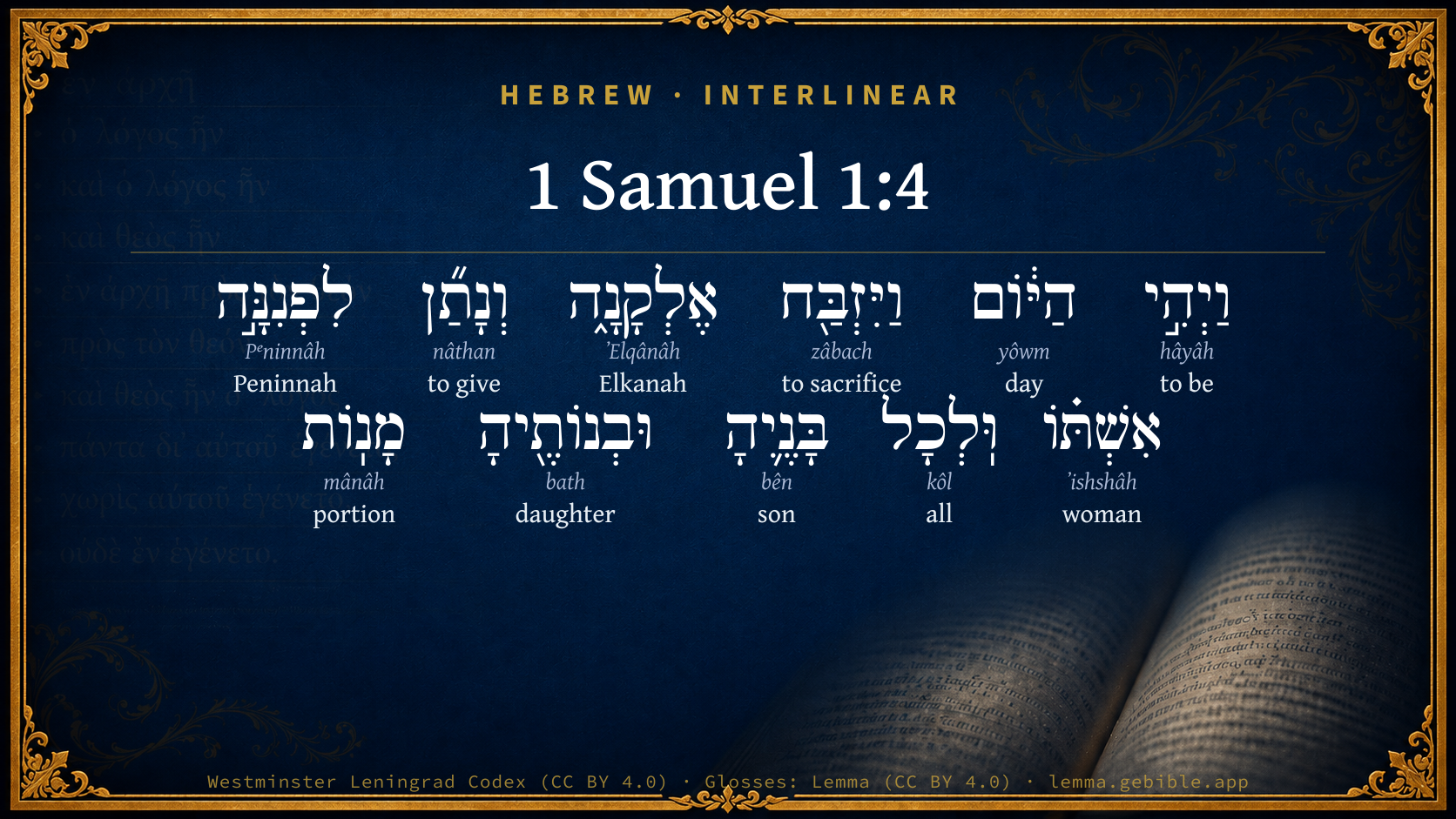
1 Samuel 1:4

Hebrew (Westminster Leningrad Codex) 1 Samuel 1:4 appears in the Hebrew Old Testament. The text above is from the Westminster Leningrad Codex. Each word links to its Strong’s number, a concise gloss, and parsing drawn from the Open Scriptures Hebrew Bible morphology. Click any word for its full Brown-Driver-Briggs (BDB) entry.
Download image
Cite this verse

1 Samuel 1:4 (World English Bible). Public Domain. Lemma interlinear Bible study tool, https://lemma.gebible.app/v/1-samuel/1/4.

Show BibTeX & RIS
BibTeX
RIS
English Translation
When the day came that Elkanah sacrificed, he gave to Peninnah his wife, and to all her sons and her daughters, portions:
World English Bible · Public Domain
Download a study sheet

One document with this verse’s original text, its word-by-word gloss line, the meaning frame, cross-references with their text, attributed commentary, and full source and license credits — printable, and it pastes into notes with its structure intact.

This verse Autodidact and up

Study sheet (.html) Plain text (.txt)

A passage Seminary Student

Up to 50 verses in one chapter. A passage sheet keeps up to 6 commentary sources and 12 cross-references per verse, in the order this page ranks them, and says so on the sheet whenever that leaves anything out. Ask for a single verse and you get the Autodidact verse sheet above.

Everything on this page stays free to read, with no account — the sheet is a download of what is already on screen, not access to it.

Want to remove ads? Support Godless Engineer
Compare translations 3

The same verse in 3 English versions, stacked beneath the original-language interlinear above. Click any original word for its lexicon entry.

Each is an independent rendering of the whole verse — the interlinear is not word-aligned to these translations.

Highlighted words mark where these versions differ — a whole-verse word diff, not a word-by-word alignment.

  • World English Bible Public Domain
    When the day came that Elkanah sacrificed, he gave to Peninnah his wife, and to all her sons and her daughters, portions:
  • King James Version Public Domain
    And when the time was that Elkanah offered, he gave to Peninnah his wife, and to all her sons and her daughters, portions:
  • unfoldingWord Literal Text CC BY-SA 4.0
    And it was the day, and Elkanah sacrificed, and he gave portions to Peninnah his wife and to all of her sons and her daughters.

unfoldingWord Literal Text — © unfoldingWord, licensed CC BY-SA 4.0. Word-aligned USFM3 via Door43 (git.door43.org/unfoldingWord/en_ult).

Versions to compare (up to 4)

3 of 4 selected

Show all 18 translations

Every available English version of this verse, each an independent rendering of the whole verse.

  • World English Bible Public Domain
    When the day came that Elkanah sacrificed, he gave to Peninnah his wife, and to all her sons and her daughters, portions:
  • Berean Standard Bible Public Domain
    And whenever the day came for Elkanah to present his sacrifice, he would give portions to his wife Peninnah and to all her sons and daughters.
  • Majority Standard Bible Public Domain
    And whenever the day came for Elkanah to present his sacrifice, he would give portions to his wife Peninnah and to all her sons and daughters.
  • King James Version Public Domain
    And when the time was that Elkanah offered, he gave to Peninnah his wife, and to all her sons and her daughters, portions:
  • American Standard Version (1901) Public Domain
    And when the day came that Elkanah sacrificed, he gave to Peninnah his wife, and to all her sons and her daughters, portions:
  • Revised Version (1885) Public Domain
    And when the day came that Elkanah sacrificed, he gave to Peninnah his wife, and to all her sons and her daughters portions:
  • Geneva Bible (1599) Public Domain
    And on a day, when Elkanah sacrificed, he gaue to Peninnah his wife and to all her sonnes and daughters portions,
  • Douay-Rheims (1899) Public Domain
    Now the day came, and Elcana offered sacrifice, and gave to Phenenna his wife, and to all her sons and daughters, portions:
  • Young's Literal Translation Public Domain
    And the day cometh, and Elkanah sacrificeth, and he hath given to Peninnah his wife, and to all her sons and her daughters, portions,
  • Literal Standard Version CC BY-SA 4.0
    And the day comes, and Elkanah sacrifices, and he has given portions to his wife Peninnah, and to all her sons and her daughters,
  • Unlocked Literal Bible CC BY-SA 4.0
    When the day came for Elkanah to sacrifice each year, he always gave portions of the meat to Peninnah his wife, and to all her sons and her daughters.
  • unfoldingWord Literal Text CC BY-SA 4.0
    And it was the day, and Elkanah sacrificed, and he gave portions to Peninnah his wife and to all of her sons and her daughters.
  • Darby Bible Public Domain
    And it came to pass on the day that Elkanah sacrificed, he gave to Peninnah his wife and to all her sons and her daughters portions;
  • World Messianic Bible Public Domain
    When the day came that Elkanah sacrificed, he gave portions to Peninnah his wife and to all her sons and her daughters;
  • Webster's Bible Public Domain
    And when the time was that Elkanah offered, he gave to Peninnah his wife, and to all her sons and her daughters, portions:
  • Free Bible Version CC BY-SA 4.0
    Whenever Elkanah offered a sacrifice, he would give portions of it to Peninnah his wife and to all her sons and daughters.
  • Bible in Basic English Public Domain
    And when the day came for Elkanah to make his offering, he gave to Peninnah his wife, and to all her sons and daughters, their part of the feast:
  • JPS Tanakh (1917) Public Domain
    And it came to pass upon a day, when Elkanah sacrificed, that he gave to Peninnah his wife, and to all her sons and her daughters, portions;

Literal Standard Version (2020), Covenant Press — licensed CC BY-SA 4.0. Text via the HelloAO Bible API (eBible.org). Unlocked Literal Bible (unfoldingWord) — licensed CC BY-SA 4.0. Text via the HelloAO Bible API (eBible.org). unfoldingWord Literal Text — © unfoldingWord, licensed CC BY-SA 4.0. Word-aligned USFM3 via Door43 (git.door43.org/unfoldingWord/en_ult). Free Bible Version, Dr. Jonathan Gallagher — licensed CC BY-SA 4.0. Text via the HelloAO Bible API (eBible.org).

Word by word

More ways to search: Search by grammar → Find every occurrence → Compare this word →

Practice this passage: Drill this verse → Learn its vocabulary →

לִפְנִנָּ֣ה
Pᵉninnâh
H6444
“to/for · Peninnah”
Preposition + Noun, Proper
Part of Speech
Preposition + Noun
Type
Proper
Full BDB Definition

Origin: probably from H6443 contr

TWOT: None

Peninnah = "jewel" - the other wife of Elkanah besides Hannah
  1. וַיְהִ֣י hâyâh H1961 “and · to be” Conjunction + Verb, Qal, Sequential Imperfect, 3rd Person, Masculine, Singular
  2. הַיּ֔וֹם yôwm H3117 “the · day” Particle, Definite Article + Noun, Common, Masculine, Singular, Absolute
  3. וַיִּזְבַּ֖ח zâbach H2076 “and · to sacrifice” Conjunction + Verb, Qal, Sequential Imperfect, 3rd Person, Masculine, Singular
  4. אֶלְקָנָ֑ה ʼElqânâh H511 “Elkanah” Noun, Proper
  5. וְנָתַ֞ן nâthan H5414 “and · to give” Conjunction + Verb, Qal, Perfect, 3rd Person, Masculine, Singular
  6. אִשְׁתּ֗וֹ ʼishshâh H802 “woman · his” Noun, Common, Feminine, Singular, Construct + Suffix, Personal, 3rd Person, Masculine, Singular
  7. וּֽלְכָל kôl H3605 “and · to/for · all of” Conjunction + Preposition + Noun, Common, Masculine, Singular, Construct
  8. בָּנֶ֛יהָ bên H1121 “sons · her” Noun, Common, Masculine, Plural, Construct + Suffix, Personal, 3rd Person, Feminine, Singular
  9. וּבְנוֹתֶ֖יהָ bath H1323 “and · daughters · her” Conjunction + Noun, Common, Feminine, Plural, Construct + Suffix, Personal, 3rd Person, Feminine, Singular
  10. מָנֽוֹת mânâh H4490 “portions” Noun, Common, Feminine, Plural, Absolute

About this verse

These counts appear in no published source. They are computed here, from the morphology-tagged text and Lemma’s own curated glosses. What Lemma adds →

11
words
11
distinct lemmas
Historical
section

Notable vocabulary

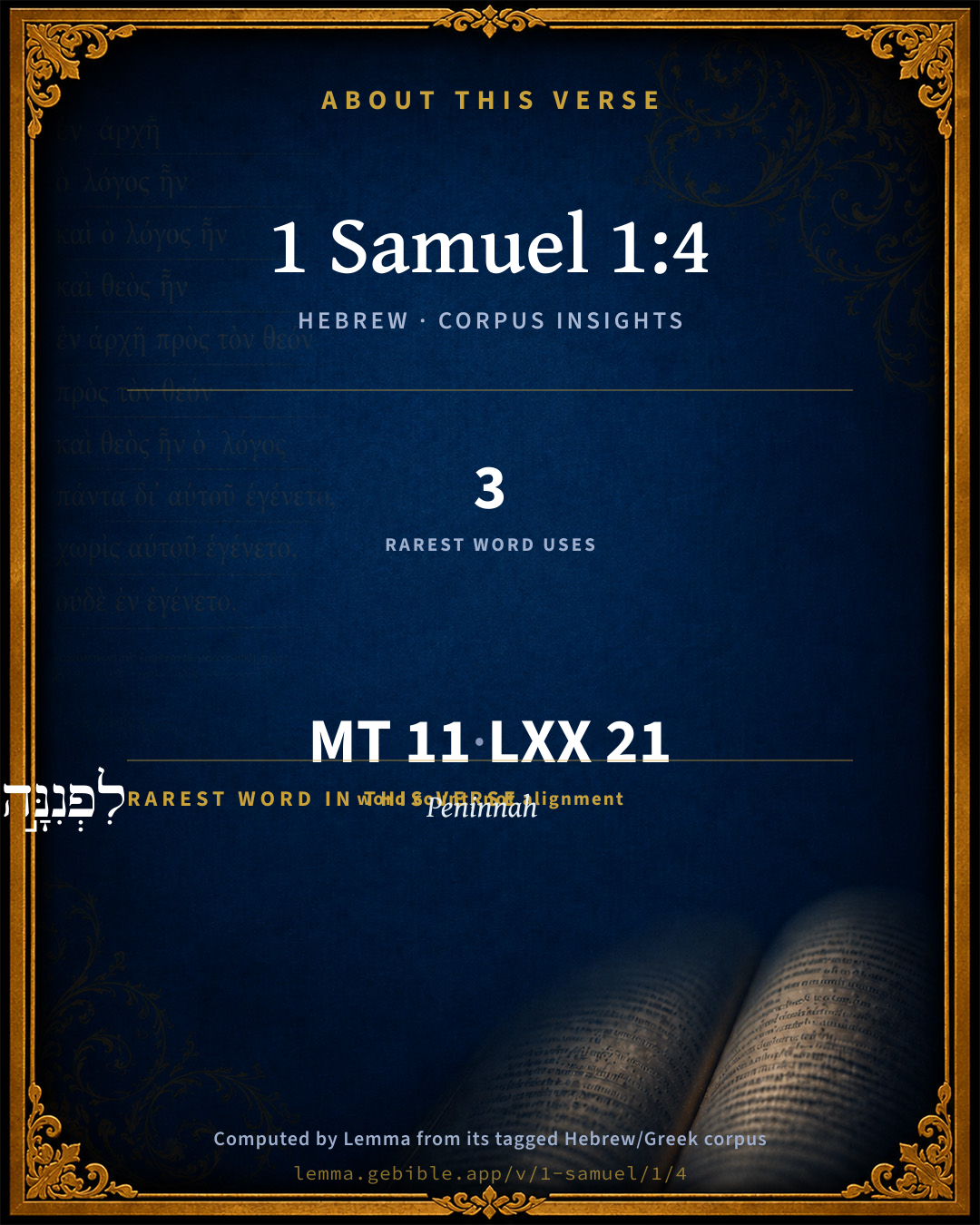
The rarest word here is לִפְנִנָּ֣ה Peninnah H6444 — appearing just 3 times in the whole Hebrew Bible.

Shared distinctive vocabulary

לִפְנִנָּ֣ה Peninnah H6444 occurs in 2 verses of the Hebrew Bible. Also found in:

Grammatical profile

  • 3 verbs
  • 8 nouns

Verb forms

  • וַיְהִ֣י Qal · Sequential Imperfect
  • וַיִּזְבַּ֖ח Qal · Sequential Imperfect
  • וְנָתַ֞ן Qal · Perfect

Hebrew & Septuagint length

In English translation the verse runs 22 words from the Hebrew and 17 from the Septuagint (LXX English) — closely comparable.

A rough comparison of the two English renderings, which tokenize alike — not a word-level alignment.

Word counts can differ between the Hebrew and the Greek without any difference in meaning — e.g. the Hebrew direct-object marker אֵת has no separate Greek word, and Greek often adds the article ὁ.

In the original languages it is 11 Hebrew tokens and 21 Greek tokens — but the two are counted differently (Hebrew bundles its prefixes and suffixes into one token; the Greek is in lemma form), so that isn’t a like-for-like length.

Cross-references

5

Topical passages linked to 1 Samuel 1:4 in the Treasury of Scripture Knowledge — connected by theme and wording, ordered by reader-vote popularity; previews shown in the World English Bible.

  • Deuteronomy 12:17–18 You may not eat within your gates the tithe of your grain, or of your new wine, or of your oil, or the firstborn of your herd or of your flock, nor any of your vows which you vow, nor your freewill-offerings, nor the heave-offering of your hand;
  • Deuteronomy 16:11 and you shall rejoice before Yahweh your God, you, and your son, and your daughter, and your man-servant, and your maid-servant, and the Levite who is within your gates, and the foreigner, and the fatherless, and the widow, who are in the midst of you, in the place which Yahweh your God shall choose, to cause his name to dwell there.
  • Leviticus 3:4 and the two kidneys, and the fat that is on them, which is by the loins, and the cover on the liver, with the kidneys, he shall take away.
  • Leviticus 7:15 The flesh of the sacrifice of his peace offerings for thanksgiving shall be eaten on the day of his offering. He shall not leave any of it until the morning.
  • Deuteronomy 12:5–7 But to the place which Yahweh your God shall choose out of all your tribes, to put his name there, even to his habitation shall you seek, and there you shall come;

Cross-references courtesy of OpenBible.info (CC BY 4.0).

Hebrew and Greek witnesses Masoretic Hebrew ↔ Greek Septuagint

The same verse in the two great witnesses to the Old Testament, shown verse-for-verse.

These are two independent witnesses, not word-aligned to each other, and the Septuagint is shown in lemma (dictionary) form.

Hebrew 1 Samuel 1:4 Masoretic · Westminster Leningrad Codex

וַיְהִ֣י הַיּ֔וֹם וַיִּזְבַּ֖ח אֶלְקָנָ֑ה וְנָתַ֞ן לִפְנִנָּ֣ה אִשְׁתּ֗וֹ וּֽלְכָל בָּנֶ֛יהָ וּבְנוֹתֶ֖יהָ מָנֽוֹת

When the day came that Elkanah sacrificed, he gave to Peninnah his wife, and to all her sons and her daughters, portions:

World English Bible · Public Domain

Greek LXX 1 Samuel 1:4 Septuagint · lemma form

καί γίγνομαι ἡμέρα καί θύω ελκανα καί δίδωμι ὁ φεννανα γυνή αὐτός καί ὁ υἱός αὐτός καί ὁ θυγάτηρ αὐτός μερίς

And the day came, and Helkana sacrificed, and gave portions to his wife Phennana and her children.

LXX2012 (modern English Septuagint) · Public Domain

Hebrew: Westminster Leningrad Codex (CC BY 4.0). Greek: Septuagint (public domain); English from LXX2012 (modern English Septuagint) (Public Domain). How the Septuagint differs from the Hebrew →

Targum (Aramaic paraphrase)

1

The Targum is the ancient Jewish Aramaic paraphrase of the Hebrew Scriptures — an interpretive translation, not the Hebrew text itself. Onkelos (literal) and Pseudo-Jonathan (expansive) render the Torah, and Jonathan the Prophets. Coverage is partial: where no permissively-licensed English translation exists for a verse, only the Aramaic is shown. This is verse-level text, not a word-by-word alignment to the Hebrew.

  1. Targum Jonathan Prophets (Joshua–Malachi)
    וַהֲוָה יוֹם מוֹעֲדָא וְדַבַּח אֶלְקָנָה וִיהַב לִפְנִנָה אִתְּתֵיהּ וּלְכָל בְּנָהָא וּבְנָתָהָא חוּלָקִין:

    (no public-domain English translation for this verse)

    Targum Jonathan — Aramaic: “Mikraot Gedolot” (public domain). English: “Sefaria Community Translation” (CC0 1.0 (public-domain dedication)); “London "Chaldee Paraphrase," 1871” (public domain). Text via Sefaria.

Commentary

Notes on 1 Samuel 1:4 from classic Christian and Jewish commentators (each source and its license shown beneath its notes). The classic Christian expositions comment on the surrounding passage and are grouped to its opening verse, so a note may address several verses; the Jewish commentaries on the Tanakh (Rashi and others) are per-verse, so they appear only where the commentator wrote on this verse.

Lemma curates 59 commentaries, every one of them public domain or Creative Commons licensed, each selected and text-cleaned for this edition rather than reprinted as found. About our sources →

The Cambridge Bible for Schools and Colleges

gen. ed. J. J. S. Perowne

4. offered] sacrificed, as in 1Sa_1:3. His sacrifice was a thank-offering, for it was only of the thank-offerings that the worshippers partook (Lev_7:11-18).

he gave] The tenses in 1Sa_1:4-7 express repeated action: “he used to give: her adversary used to provoke her.”

portions] Of the victims sacrificed. Cp. 1Sa_9:23.

The Cambridge Bible for Schools and Colleges (gen. ed. J. J. S. Perowne; Cambridge University Press, 1878–1918) — public domain. Text from a community e-Sword module.

Trapp's Complete Commentary

John Trapp

1Sa 1:4 And when the time was that Elkanah offered, he gave to Peninnah his wife, and to all her sons and her daughters, portions:

Ver. 4. And when the time was that Elkanah offered.] He did not forbear to offer, because the priests were wicked and slubbering, as some weak ones did, {1Sa 2:17} abhorring God’s sacrifice for their sakes: wherein they are said to have transgressed, even to a cry.

John Trapp, A Commentary or Exposition upon All the Books of the Old and New Testament (1647–1656) — public domain. Text from a community e-Sword module.

Joseph Benson's Commentary

1Sa 1:4. Portions — Of those parts of the peace-offerings which belonged to the offerer. These were the whole, except the fat, which belonged to the Lord, and the breast and right shoulder, which were due to the priest, Lev 7:34; with the rest the sacrificer made a feast for himself, his family, and friends, giving to every one a portion of the sacrifice, as the master of the feast used to do to the guests. And they ate all before the Lord, and hereby were supposed to have communion with him, by partaking with him of his sacrifices, which had been offered to him at his altar.

Joseph Benson's Commentary on the Old and New Testaments (1811–1818) — public domain. Text from a community e-Sword module.

Tyndale Open Study Notes

Tyndale Open Resources

1:4 sacrifice . . . portions of the meat: Certain sacrifices involved sharing part of the sacrificial animal in a communal meal (see Lev 7:11-34).

Tyndale Open Study Notes — © Tyndale Open Resources, licensed CC BY-SA 4.0. Text via the HelloAO Bible API.

Jamieson, Fausset & Brown

Robert Jamieson, A. R. Fausset & David Brown

when . . . Elkanah offered, he gave to Peninnah . . . portions--The offerer received back the greater part of the peace offerings, which he and his family or friends were accustomed to eat at a social feast before the Lord. (See on Lev 3:3; Deu 12:12). It was out of these consecrated viands Elkanah gave portions to all the members of his family; but "unto Hannah he gave a worthy portion"; that is, a larger choice, according to the Eastern fashion of showing regard to beloved or distinguished guests. (See on Sa1 9:24; also see on Gen 43:34).

Jamieson, Fausset & Brown — Commentary Critical and Explanatory on the Whole Bible (1871) — public domain (CC PDM 1.0). Text via the HelloAO Bible API.

Adam Clarke's Commentary

Verse 4. He gave - portions] The sacrifices which were made were probably peace-offerings, of which the blood was poured out at the foot of the altar; the fat was burnt on the fire; the breast and right shoulder were the portion of the priest, and the rest belonged to him who made the offering; on it he and his family feasted, each receiving his portion; and to these feasts God commands them to invite the Levite, the poor, the widow, and the orphan, De 16:11.

Adam Clarke's Commentary on the Bible (1810–1826) — public domain. Text from a community e-Sword/MySword module.

John Gill's Exposition

And when the time was that Elkanah offered,.... That is, brought his offering to the priest, to offer it for him, which was at one of the three festivals. According to R. Joshua Ben Levi (f), this was at the time of Pentecost; but Abarbinel thinks it was at the time of the ingathering of the fruits of the earth, which was a time of rejoicing, even the feast of tabernacles, and which is most likely:

he gave to Peninnah his wife, and to all her sons and her daughters, portions; parts of the offering, everyone a part, or portion; by which it appears, that this was a peace offering he offered, the greater part of which belonged to the owner, and which he made a feast of for his family and friends; see Deu 12:5. Jerom (g) interprets these portions of garments.

(f) Apud Kimchium in loc. (g) Trad. Heb. in lib. Reg. fol. 74. H.

John Gill's Exposition of the Whole Bible (1746–1763) — public domain (CC PDM 1.0). Text via the HelloAO Bible API.

Haydock's Catholic Bible Commentary

Sacrificed, by the hand of the priests, (Menochius) who had the breast and right shoulder; the rest was given back to the person who had presented the fattened victim, that he might feast with his friends. (Calmet)

George Leo Haydock (1774–1849), Haydock's Catholic Family Bible and Commentary, 1859 edition — public domain. Excludes Psalms (Douay-Rheims chapter numbering differs from Protestant) and Deuterocanonical books (Catholic canon only).

Matthew Poole's English Annotations

To wit, out of the sacrifice of his peace-offerings, the greatest part whereof fell to the offerer, and was eaten by him and his friends or guests before the Lord, Le 3; Le 7; Deu 12:12; 16:11; and out of this he gave them all parts or portions, as the master of the feast used to do to guests.

Matthew Poole's English Annotations on the Holy Bible (1683–1685) — public domain. Text from a community e-Sword/MySword module.

Whedon's Commentary on the Bible

Daniel D. Whedon

4. Portions — Parts of the flesh of the victims offered in sacrifice to the Lord. See Lev_7:15; Deu_12:7; Deu_12:18. The law of the peace-offerings gave the breast and shoulder to the priest, and the fat to be burned, (Lev_7:31-32;) but the rest was returned to him that offered it, and served for a feast of thanksgiving.

Daniel D. Whedon (gen. ed.), Commentary on the Old and New Testaments (1874–1909) — public domain. Text from a community e-Sword module.

The Pulpit Commentary

Vers. 4-8.

Domestic troubles.

The facts given in this section are

1. Hannah"s grief and disappointment.

2. Peninnah"s cruel jealousy.

3. Elkanah"s efforts to console.

I PROVIDENCE sometimes seems to RUN COUNTER TO WHAT IS MOST DESIRABLE, in withholding gifts where they would be devoutly valued and wisely used. Humanly speaking, Hannah was the most fit person to be blessed with offspring to be nurtured. The course of nature which finds expression in family life is of God. Though the free element of human action plays a part, yet God is supreme. Providence is over the home of the pious. Poverty and riches, new life and bereavement, are of the Lord. Looked at in its early stages, and tested by our range of vision, the course of Providence is often the reverse of what makes for the joy of the home and the good of the world. Often the illiberal spirit holds wealth, while the loving heart has only good wishes. Many a good, Christlike heart laments that it has not the means of clothing the poor, and sending forth messengers of the cross. Men of very slender abilities and lowly position, but of intense enthusiasm for Christ, may wonder why they have not been endowed with the intellectual and social qualities which would enable them to stem the tide of scepticism, and gain over to Christianity persons now inaccessible to them.

II PROVIDENCE, for reasons net obvious, sometimes SEEMS TO FAVOUR INFERIOR CHARACTERS, bestowing gifts where there is not the purest spirit to improve them. Peninnah was immensely inferior to Hannah in all that makes character to be admired. If judged by the benefits conferred on some persons, and the disposition to use them, Providence would be said to have erred. The writer of Psalms 37. and 73, had once bitter reflections on this subject. The causes of the Divine conduct lie deep in hidden counsels. The inequalities and disproportions of life clearly show that we see only the beginning of things, and that there is a future where every man shall receive according to his work. It is enough to know, that in the abundant blessings which often fall to the lot of the inferior and the bad, they have experienced goodness and mercy, so as to be without excuse for ingratitude, and that the Judge of all the earth cannot but do right.

III INTENSE GRIEF IS NATURAL ON THE BLIGHTING OF A SUPREME HOPE. Every one must see the naturalness of Hannah"s grief. The ordinary course of nature fosters hope; it is the basis of reasonable expectations. A well balanced mind lives in strong sympathy with nature"s ways, for they are of God, and always beneficent in final issue. God is not displeased with grief, not discontent, when it comes in the order of Providence, even though the grief rise from a wish that he had ordered otherwise. Tears have been consecrated by Christ. The wail over Jerusalem was not unconnected with blighted hope. But so far as men are concerned, the roots of their sorrow frequently lie in their ignorance of God"s times and methods. He doth not willingly afflict or grieve the children of men. There is some undeveloped purpose for their good which will yet vindicate his goodness.

IV To have a deep and SACRED GRIEF INTENSIFIED BY UNMERITED AND CONTINUOUS REPROACH is the climax of domestic suffering. The griefs of private life are sacred. The wounded spirit shuns the inquisitive eye. Sorrow often seeks sad comfort in self-isolation. The cruel jibes of her rival were agony to Hannah"s gentle spirit. So the Man of sorrows felt the bitter reproach of his own people as a most painful addition to that secret sorrow he ever carried in his heart. In many an unhappy home there is yet to be found a meek, loving soul grieving over deferred hope of a husband or children saved, and compelled also to bear scorn, and perhaps ill treatment, from those most dear. A patient, Christlike spirit is the Divine counterpoise of such suffering.

V LONG YEARS OF MEEKLY ENDURED TRIAL MAY BE THE DIVINE TRAINING for subordinating natural gratification to high spiritual ends. Completed history gives the clue to the enigmas of its early stages. Posterity has seen that the long trial of Hannah was not without its blessed uses in sublimating her hopes, and deepening her piety. It is a first principle that trial to the devout is essentially a good. The spirit of the sufferer has to grow up to the Divine intent by meek submission. Like many mothers, Hannah might have rested in the simple joy of bearing offspring had not a merciful God prepared means for directing her desires to a higher good. When sympathy with the holy purposes of Christ is developed in the soul, natural desires will fall into harmony with his will, and be laid at his feet. And the deepened piety of a mother tells most powerfully on the subsequent nurture of her child.

VI It is possible for HIGH RELIGIOUS FESTIVALS TO BE

(1) embittered by the presence of wicked jealousies,

(2) marred by an outburst of pent up grief.

The holy sanctuary is frequented by the devout and the profane, and the longing heart of a Hannah is fretted by the unkind expressions of a Peninnah. Side by side before the holy throne may be found men and women embittered by the very presence of each other. Divine worship and hallowed festivities should be the occasion when all animosities and vexations of spirit are lost in the calm, holy joy of God"s favour. But when the wounded heart is pierced afresh in the house of God, or amidst Zion"s rejoicings, the very joyousness of the occasion makes sorrow more sorrowful. Many are the tears shed in the sanctuary! The heart speaks its woes the more that joy becomes the place.

VII INDISCREET FAVOURS IN A HOME ONLY ADD TO TROUBLE. Monogamy is the dictate of religion and of philosophy. Trouble must arise in society by departure from the prime law. Elkanah"s troubles were his own seeking, and no amount of affection ostentatiously bestowed availed to cover the original error, or to lessen the inconveniences of it. Persons committed to conflicting domestic obligations, and beset with difficulty, need to exercise more than ordinary discretion in the expression of their feelings. Even in properly constituted homes, unwise preferences lay the foundation for alienation and strife.

VIII MEN OF TENDEREST AFFECTION AND ORDINARY GOODNESS MAY BE INCAPABLE OF FULLY APPRECIATING THE GREAT SORROW OF THEIR HOME. With all his kindness, Elkanah was unable to enter fully into the grief of his wife. Natures move in diverse spheres. Some lack responsiveness to the deepest experiences of their kindred and friends, or they have not the spiritual insight to recognise more than secular elements in trouble. The full bliss of one is not a standard for another. There are incommensurable joys, and joys inconceivable. A husband"s love is a perfect, beautiful thing. A wife"s joy in holy offspring is also perfect and beautiful. The presence of the one blessing may console, but cannot compensate for the absence of the other. The "woman of sorrowful spirit" yearned to be the means of advancing Messiah"s kingdom, and mourned that the joy was not hers; no assurance of affection could satisfy such an unrealised yearning. And so, good as the love of friends may be, it can never give full rest to the souls that peer into the future, and long to have the bliss of contributing their best to the Redeemer"s glory.

Hence the Practical suggestions:

1. Be not hasty in forming a judgment on the course of Providence.

2. Cherish sympathy with those whose hopes are deferred.

3. Be careful and sow not in the home, by some irrevocable action, theseeds of permanent discord.

4. Avoid partiality where vows and relationships demand equal treatment.

5. Adore the wisdom that can out of our failings and errors elicit a futureblessing.

The Pulpit Commentary (1880–1919), ed. H.D.M. Spence-Jones & Joseph S. Exell — public domain. Text from a community e-Sword module.

John Wesley's Explanatory Notes

Portions - Out of the sacrifice of his peace-offerings, the greatest part whereof fell to the offerer, and was eaten by him, and his friends or guests, before the Lord. And out of this he gave them all portions, as the master of the feast used to do to the guests.

John Wesley, Explanatory Notes Upon the Whole Bible (1754–1765) — public domain. Text via the GEBible commentary corpus.

Rashi

Rabbi Shlomo Yitzchaki (Rashi)

It happened on the day. It happened on the festive day.

Rashi on the Tanakh — English translations: “The Judaica Press complete Tanach with Rashi, translated by A. J. Rosenberg” (CC BY 4.0); “Pentateuch with Rashi's commentary by M. Rosenbaum and A.M. Silbermann, 1929-1934” (public domain); “The Metsudah Tanach series, Lakewood, N.J” (CC BY 4.0); and “The Book of Joshua, Metsudah Publications, 1997” (CC BY 4.0). Text via Sefaria.

Radak

Rabbi David Kimhi (Radak)

And it was on that day: The day of the set time; and likewise did Yonatan translate it [in the Targum] as, "the day of the set time." And in the homiletical teachings: Rabbi Yehoshua be Levi said, "This was the day of Shavuot."

And he would give to Peninah from the peace-offerings that he would sacrifice.

Radak on the Tanakh — English translations: “Sefaria Community Translation” (CC0 1.0 (public-domain dedication)); “Eliyahu Munk, HaChut Hameshulash” (CC BY 4.0); “Rabbi Mike Feuer, Jerusalem Anthology” (CC BY 4.0); and “R. David Kimhi on the first book of Psalms, Translated by R.G. Finch, London, 1919” (public domain). Text via Sefaria.

Lesson kit

Teaching starters — assembled from the data on this page, not authored interpretation. Every prompt links to the verse data it draws on. Edit before teaching.

1 Samuel, in the Historical, opens this verse with 11 words (11 distinct Hebrew lemmas). Its most distinctive word is Pᵉninnâh (“Peninnah”). A historical commentator’s framing appears above. Read the whole chapter for the surrounding context.

Discussion questions

  1. How does “Peninnah” (Pᵉninnâh) shape what this verse is saying?
  2. How does 1 Samuel 1:2, which shares the word «Peninnah», read alongside this verse?
  3. These translations render this verse differently. What is at stake in choosing one wording over another?
  4. «וַיְהִ֣י» is a Qal Sequential Imperfect verb. How does that grammatical form shape the action described?
  5. Compare how The Cambridge Bible for Schools and Colleges and Trapp's Complete Commentary read this verse. Where do they agree or differ?

Things to notice

Reading settings

Reading text

Shown beneath each verse's original-language words.

Old Testament
Old Testament edition

Read the OT as the Masoretic Hebrew (MT) or the Greek Septuagint (LXX).

English shown for the Greek Septuagint (in the Hebrew ↔ Greek comparison).

Comparing translations? Open the Compare panel on any verse page to stack up to four side by side.