
Genesis 17:20

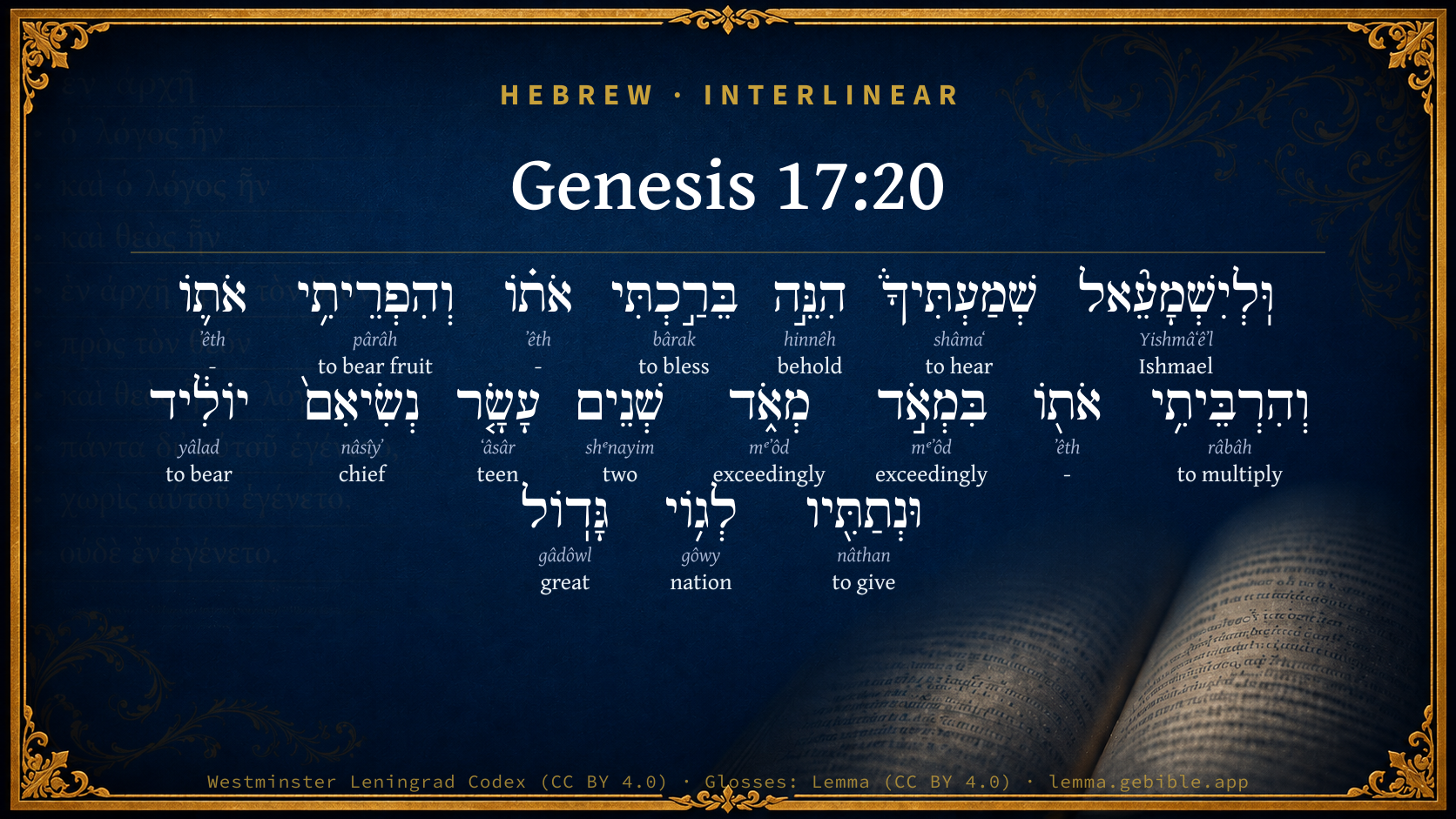
Hebrew (Westminster Leningrad Codex) Genesis 17:20 appears in the Hebrew Old Testament. The text above is from the Westminster Leningrad Codex. Each word links to its Strong’s number, a concise gloss, and parsing drawn from the Open Scriptures Hebrew Bible morphology. Click any word for its full Brown-Driver-Briggs (BDB) entry.
Download image
Cite this verse

Genesis 17:20 (World English Bible). Public Domain. Lemma interlinear Bible study tool, https://lemma.gebible.app/v/genesis/17/20.

Show BibTeX & RIS
BibTeX
RIS
English Translation
As for Ishmael, I have heard you. Behold, I have blessed him, and will make him fruitful, and will multiply him exceedingly. He will become the father of twelve princes, and I will make him a great nation.
World English Bible · Public Domain
Highlights
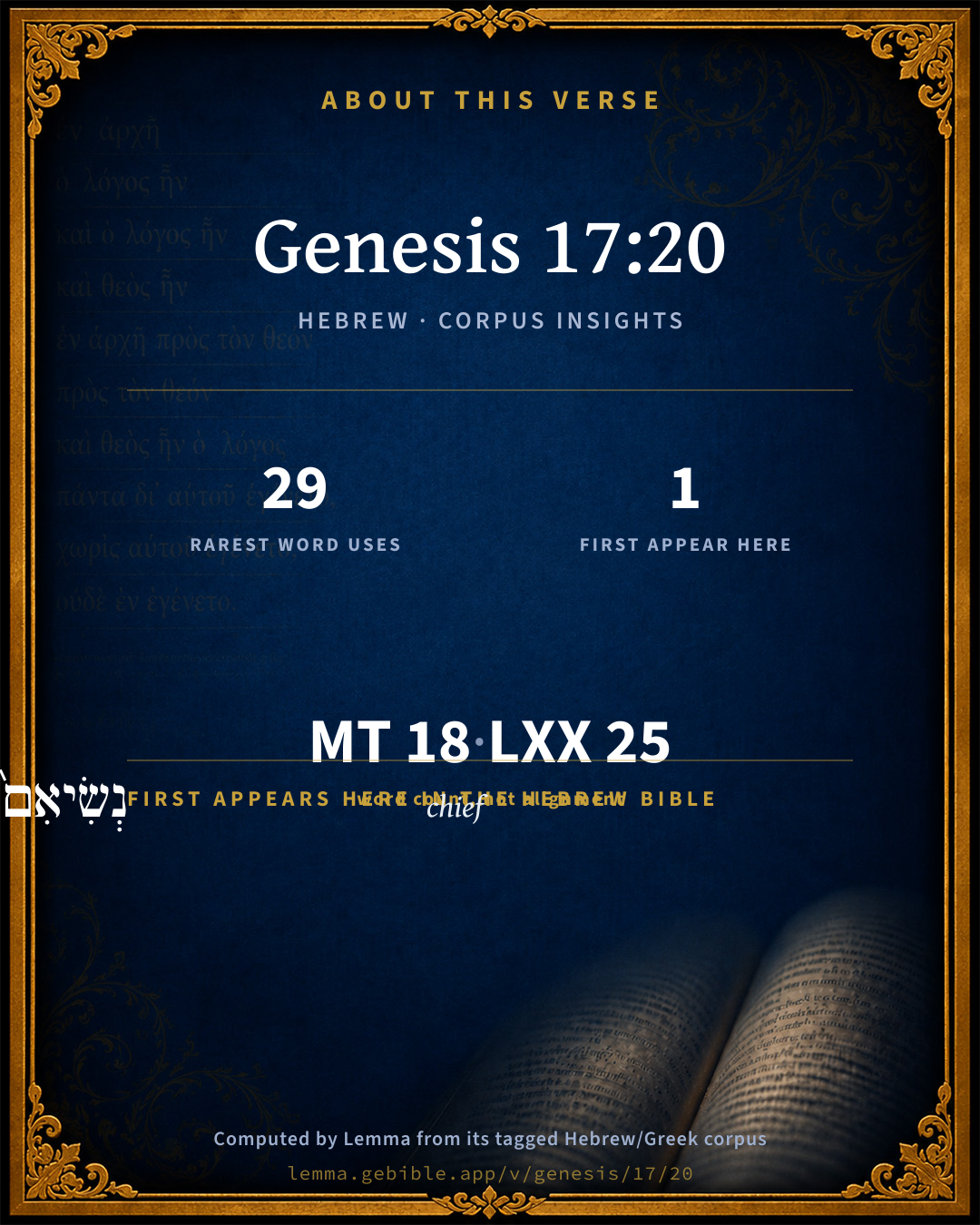
  • 1 first appearance in the Hebrew Bible
Full analysis ↓
Download a study sheet

One document with this verse’s original text, its word-by-word gloss line, the meaning frame, cross-references with their text, attributed commentary, and full source and license credits — printable, and it pastes into notes with its structure intact.

This verse Autodidact and up

Study sheet (.html) Plain text (.txt)

A passage Seminary Student

Up to 50 verses in one chapter. A passage sheet keeps up to 6 commentary sources and 12 cross-references per verse, in the order this page ranks them, and says so on the sheet whenever that leaves anything out. Ask for a single verse and you get the Autodidact verse sheet above.

Everything on this page stays free to read, with no account — the sheet is a download of what is already on screen, not access to it.

Want to remove ads? Support Godless Engineer
Compare translations 3

The same verse in 3 English versions, stacked beneath the original-language interlinear above. Click any original word for its lexicon entry.

Each is an independent rendering of the whole verse — the interlinear is not word-aligned to these translations.

Highlighted words mark where these versions differ — a whole-verse word diff, not a word-by-word alignment.

  • World English Bible Public Domain
    As for Ishmael, I have heard you. Behold, I have blessed him, and will make him fruitful, and will multiply him exceedingly. He will become the father of twelve princes, and I will make him a great nation.
  • King James Version Public Domain
    And as for Ishmael, I have heard thee: Behold, I have blessed him, and will make him fruitful, and will multiply him exceedingly; twelve princes shall he beget, and I will make him a great nation.
  • unfoldingWord Literal Text CC BY-SA 4.0
    And as for Ishmael, I have heard you. Behold, I will bless him, and I will make him fruitful and multiply him very greatly. He will father twelve rulers, and I will make him into a great nation.

unfoldingWord Literal Text — © unfoldingWord, licensed CC BY-SA 4.0. Word-aligned USFM3 via Door43 (git.door43.org/unfoldingWord/en_ult).

Versions to compare (up to 4)

3 of 4 selected

Show all 18 translations

Every available English version of this verse, each an independent rendering of the whole verse.

  • World English Bible Public Domain
    As for Ishmael, I have heard you. Behold, I have blessed him, and will make him fruitful, and will multiply him exceedingly. He will become the father of twelve princes, and I will make him a great nation.
  • Berean Standard Bible Public Domain
    As for Ishmael, I have heard you, and I will surely bless him; I will make him fruitful and multiply him greatly. He will become the father of twelve rulers, and I will make him into a great nation.
  • Majority Standard Bible Public Domain
    As for Ishmael, I have heard you, and I will surely bless him; I will make him fruitful and multiply him greatly. He will become the father of twelve rulers, and I will make him into a great nation.
  • King James Version Public Domain
    And as for Ishmael, I have heard thee: Behold, I have blessed him, and will make him fruitful, and will multiply him exceedingly; twelve princes shall he beget, and I will make him a great nation.
  • American Standard Version (1901) Public Domain
    And as for Ishmael, I have heard thee: behold, I have blessed him, and will make him fruitful, and will multiply him exceedingly; twelve princes shall he beget, and I will make him a great nation.
  • Revised Version (1885) Public Domain
    And as for Ishmael, I have heard thee: behold, I have blessed him, and will make him fruitful, and will multiply him exceedingly; twelve princes shall he beget, and I will make him a great nation.
  • Geneva Bible (1599) Public Domain
    And as concerning Ishmael, I haue heard thee: loe, I haue blessed him, and will make him fruitfull, and will multiplie him exceedingly: twelue princes shall he beget, and I will make a great nation of him.
  • Douay-Rheims (1899) Public Domain
    And as for Ismael I have also heard thee. Behold, I will bless him, and increase, and multiply him exceedingly: he shall beget twelve chiefs, and I will make him a great nation.
  • Young's Literal Translation Public Domain
    As to Ishmael, I have heard thee; lo, I have blessed him, and made him fruitful, and multiplied him, very exceedingly; twelve princes doth he beget, and I have made him become a great nation;
  • Literal Standard Version CC BY-SA 4.0
    As for Ishmael, I have heard you; behold, I have blessed him, and made him fruitful, and multiplied him, very exceedingly; twelve princes does he beget, and I have made him become a great nation;
  • Unlocked Literal Bible CC BY-SA 4.0
    As for Ishmael, I have heard you. Behold, I hereby bless him, and will make him fruitful, and will multiply him abundantly. He will be the father of twelve leaders of tribes, and I will make him become a great nation.
  • unfoldingWord Literal Text CC BY-SA 4.0
    And as for Ishmael, I have heard you. Behold, I will bless him, and I will make him fruitful and multiply him very greatly. He will father twelve rulers, and I will make him into a great nation.
  • Darby Bible Public Domain
    And for Ishmael I have heard thee: behold, I will bless him, and will make him fruitful, and will very greatly multiply him; twelve princes shall he beget, and I will make him a great nation.
  • World Messianic Bible Public Domain
    As for Ishmael, I have heard you. Behold, I have blessed him, and will make him fruitful, and will multiply him exceedingly. He will become the father of twelve princes, and I will make him a great nation.
  • Webster's Bible Public Domain
    And as for Ishmael, I have heard thee: Behold, I have blessed him, and will make him fruitful, and will multiply him exceedingly; twelve princes shall he beget, and I will make him a great nation.
  • Free Bible Version CC BY-SA 4.0
    Now about Ishmael. I heard what you said, and I will also bless him. I will make sure he has a great many descendants. He will be the father of twelve princes, and I will make him into a great nation.
  • Bible in Basic English Public Domain
    As for Ishmael, I have given ear to your prayer: truly I have given him my blessing and I will make him fertile and give him great increase; he will be the father of twelve chiefs, and I will make him a great nation.
  • JPS Tanakh (1917) Public Domain
    And as for Ishmael, I have heard thee; behold, I have blessed him, and will make him fruitful, and will multiply him exceedingly; twelve princes shall he beget, and I will make him a great nation.

Literal Standard Version (2020), Covenant Press — licensed CC BY-SA 4.0. Text via the HelloAO Bible API (eBible.org). Unlocked Literal Bible (unfoldingWord) — licensed CC BY-SA 4.0. Text via the HelloAO Bible API (eBible.org). unfoldingWord Literal Text — © unfoldingWord, licensed CC BY-SA 4.0. Word-aligned USFM3 via Door43 (git.door43.org/unfoldingWord/en_ult). Free Bible Version, Dr. Jonathan Gallagher — licensed CC BY-SA 4.0. Text via the HelloAO Bible API (eBible.org).

Word by word

More ways to search: Search by grammar → Find every occurrence → Compare this word →

Practice this passage: Drill this verse → Learn its vocabulary →

וְהִפְרֵיתִ֥י
pârâh
H6509
“and · to bear fruit”
Conjunction + Verb, Hiphil, Sequential Perfect, 1st Person, Common, Singular
Part of Speech
Conjunction + Verb
Stem
Hiphil
Form
Sequential Perfect
Person
1st Person
Gender
Common
Number
Singular
Full BDB Definition

Origin: a primitive root

TWOT: 1809

to bear fruit, be fruitful, branch off - (Qal) to bear fruit, be fruitful - (Hiphil) - to cause to bear fruit - to make fruitful - to show fruitfulness, bear fruit
  1. וּֽלְיִשְׁמָעֵ֘אל Yishmâʻêʼl H3458 “and · to/for · Ishmael” Conjunction + Preposition + Noun, Proper
  2. שְׁמַעְתִּיךָ֒ shâmaʻ H8085 “to hear · you” Verb, Qal, Perfect, 1st Person, Common, Singular + Suffix, Personal, 2nd Person, Masculine, Singular
  3. הִנֵּ֣ה hinnêh H2009 “behold” Particle, Demonstrative
  4. בֵּרַ֣כְתִּי bârak H1288 “to bless” Verb, Piel, Perfect, 1st Person, Common, Singular
  5. אֹת֗וֹ ʼêth H853 “- · him” Particle, Direct Object + Suffix, Personal, 3rd Person, Masculine, Singular
  6. אֹת֛וֹ ʼêth H853 “- · him” Particle, Direct Object + Suffix, Personal, 3rd Person, Masculine, Singular
  7. וְהִרְבֵּיתִ֥י râbâh H7235 “and · to multiply” Conjunction + Verb, Hiphil, Sequential Perfect, 1st Person, Common, Singular
  8. אֹת֖וֹ ʼêth H853 “- · him” Particle, Direct Object + Suffix, Personal, 3rd Person, Masculine, Singular
  9. בִּמְאֹ֣ד mᵉʼôd H3966 “in/at · exceedingly” Preposition + Adverb
  10. מְאֹ֑ד mᵉʼôd H3966 “exceedingly” Adverb
  11. שְׁנֵים shᵉnayim H8147 “two” Adjective, Cardinal number, Masculine, Dual, Absolute
  12. עָשָׂ֤ר ʻâsâr H6240 “teen” Adjective, Cardinal number, Masculine, Singular, Absolute
  13. נְשִׂיאִם֙ nâsîyʼ H5387 “chiefs” Noun, Common, Masculine, Plural, Absolute
  14. יוֹלִ֔יד yâlad H3205 “to bear” Verb, Hiphil, Imperfect, 3rd Person, Masculine, Singular
  15. וּנְתַתִּ֖יו nâthan H5414 “and · to give · him” Conjunction + Verb, Qal, Sequential Perfect, 1st Person, Common, Singular + Suffix, Personal, 3rd Person, Masculine, Singular
  16. לְג֥וֹי gôwy H1471 “to/for · nation” Preposition + Noun, Common, Masculine, Singular, Absolute
  17. גָּדֽוֹל gâdôwl H1419 “great” Adjective, Adjective, Masculine, Singular, Absolute

About this verse

These counts appear in no published source. They are computed here, from the morphology-tagged text and Lemma’s own curated glosses. What Lemma adds →

18
words
15
distinct lemmas
Pentateuch
section

First appearance in Scripture

This word makes its first canonical appearance in the Hebrew Bible here:

  • נְשִׂיאִם֙ chief H5387

Shared distinctive vocabulary

וְהִפְרֵיתִ֥י to bear fruit H6509 occurs in 28 verses of the Hebrew Bible. Also found in:

Grammatical profile

  • 6 verbs
  • 3 nouns
  • 3 adjectives
  • 2 adverbs
  • 4 particles

Verb forms

  • שְׁמַעְתִּיךָ֒ Qal · Perfect
  • בֵּרַ֣כְתִּי Piel · Perfect
  • וְהִפְרֵיתִ֥י Hiphil · Sequential Perfect
  • וְהִרְבֵּיתִ֥י Hiphil · Sequential Perfect
  • יוֹלִ֔יד Hiphil · Imperfect
  • וּנְתַתִּ֖יו Qal · Sequential Perfect

Repetition

A word recurs within this verse — often emphatic in Hebrew:

  • בִּמְאֹ֣ד exceedingly H3966 ×2

Hebrew & Septuagint length

In English translation the verse runs 38 words from the Hebrew and 35 from the Septuagint (LXX English) — closely comparable.

A rough comparison of the two English renderings, which tokenize alike — not a word-level alignment.

Word counts can differ between the Hebrew and the Greek without any difference in meaning — e.g. the Hebrew direct-object marker אֵת has no separate Greek word, and Greek often adds the article ὁ.

In the original languages it is 18 Hebrew tokens and 25 Greek tokens — but the two are counted differently (Hebrew bundles its prefixes and suffixes into one token; the Greek is in lemma form), so that isn’t a like-for-like length.

Cross-references

4

Topical passages linked to Genesis 17:20 in the Treasury of Scripture Knowledge — connected by theme and wording, ordered by reader-vote popularity; previews shown in the World English Bible.

  • Genesis 21:18 Get up, lift up the boy, and hold him in your hand. For I will make him a great nation."
  • Genesis 21:13 Also of the son of the handmaid will I make a nation, because he is your seed."
  • Genesis 25:12–18 Now this is the history of the generations of Ishmael, Abraham's son, whom Hagar the Egyptian, Sarah's handmaid, bore to Abraham.
  • Genesis 16:10–12 The angel of Yahweh said to her, "I will greatly multiply your seed, that they will not be numbered for multitude."

Cross-references courtesy of OpenBible.info (CC BY 4.0).

Hebrew and Greek witnesses Masoretic Hebrew ↔ Greek Septuagint

The same verse in the two great witnesses to the Old Testament, shown verse-for-verse.

These are two independent witnesses, not word-aligned to each other, and the Septuagint is shown in lemma (dictionary) form.

Hebrew Genesis 17:20 Masoretic · Westminster Leningrad Codex

וּֽלְיִשְׁמָעֵ֘אל שְׁמַעְתִּיךָ֒ הִנֵּ֣ה בֵּרַ֣כְתִּי אֹת֗וֹ וְהִפְרֵיתִ֥י אֹת֛וֹ וְהִרְבֵּיתִ֥י אֹת֖וֹ בִּמְאֹ֣ד מְאֹ֑ד שְׁנֵים עָשָׂ֤ר נְשִׂיאִם֙ יוֹלִ֔יד וּנְתַתִּ֖יו לְג֥וֹי גָּדֽוֹל

As for Ishmael, I have heard you. Behold, I have blessed him, and will make him fruitful, and will multiply him exceedingly. He will become the father of twelve princes, and I will make him a great nation.

World English Bible · Public Domain

Greek LXX Genesis 17:20 Septuagint · lemma form

περί δέ ισμαηλ ἰδού ἐπιἀκούω σύ ἰδού εὐλογέω αὐτός καί αὐξάνω αὐτός καί πληθύνω αὐτός σφόδρα δώδεκα ἔθνος γεννάω καί δίδωμι αὐτός εἰς ἔθνος μέγας

And concerning Ismael, behold, I have heard you, and, behold, I have blessed him, and will increase him and multiply him exceedingly; twelve nations shall he beget, and I will make him a great nation.

LXX2012 (modern English Septuagint) · Public Domain

Hebrew: Westminster Leningrad Codex (CC BY 4.0). Greek: Septuagint (public domain); English from LXX2012 (modern English Septuagint) (Public Domain). How the Septuagint differs from the Hebrew →

Targum (Aramaic paraphrase)

2

The Targum is the ancient Jewish Aramaic paraphrase of the Hebrew Scriptures — an interpretive translation, not the Hebrew text itself. Onkelos (literal) and Pseudo-Jonathan (expansive) render the Torah, and Jonathan the Prophets. Coverage is partial: where no permissively-licensed English translation exists for a verse, only the Aramaic is shown. This is verse-level text, not a word-by-word alignment to the Hebrew.

  1. Targum Onkelos Torah (Genesis–Deuteronomy)
    וְעַל יִשְׁמָעֵאל קַבֵּלִית צְלוֹתָךְ הָא בָּרֵכִית יָתֵהּ וְאַפֵּישּׁ יָתֵהּ וְאַסְגֵּי יָתֵהּ לַחֲדָא לַחֲדָא תְּרֵין עֲשַׂר רַבְרְבַיָּא יְלִיד וְאֶתְּנִנֵּיהּ לְעַם סַגִּי

    (no public-domain English translation for this verse)

    Targum Onkelos — Aramaic: “Onkelos Genesis” (public domain); “Onkelos Exodus” (public domain); “Onkelos Leviticus” (public domain); “Onkelos Numbers” (public domain); “Onkelos Deuteronomy” (public domain). English: “Sefaria Community Translation” (CC0 1.0 (public-domain dedication)); “J.W. Etheridge. The Targums of Onkelos and Jonathan Ben Uzziel on the Pentateuch. London: Longmans, Green, 1862” (public domain). Text via Sefaria.

  2. Targum Pseudo-Jonathan Torah (Genesis–Deuteronomy)
    וְעַל יִשְׁמָעֵאל קַבִּילִית צְלוֹתִיךְ הָא בְרָכִית יָתֵיהּ וְאַפֵּישׁ יָתֵיהּ לַחֲדָה וְאַסְגֵי יָתֵיהּ לַחֲדָא לַחֲדָא תְּרֵיסַר רַבְרְבִין יוֹלִיד וְאִתְּנִינֵיהּ לְעַם סַגִי

    And concerning Ishmael I have heard thy prayer. Behold, I have blessed him; and I will spread him abroad, and multiply him very greatly. Twelve princes shall he beget, and I will give him to be a great people.

    Targum Pseudo-Jonathan — Aramaic: “Targum Jonathan on Genesis” (public domain); “Targum Jonathan on Exodus” (public domain); “Targum Jonathan on Leviticus” (public domain); “Targum Jonathan on Numbers” (public domain); “Targum Jonathan on Deuteronomy” (public domain). English: “The Targum of Jonathan ben Uzziel, trans. J. W. Etheridge, London, 1862” (public domain). Text via Sefaria.

Commentary

Notes on Genesis 17:20 from classic Christian and Jewish commentators (each source and its license shown beneath its notes). The classic Christian expositions comment on the surrounding passage and are grouped to its opening verse, so a note may address several verses; the Jewish commentaries on the Tanakh (Rashi and others) are per-verse, so they appear only where the commentator wrote on this verse.

Lemma curates 59 commentaries, every one of them public domain or Creative Commons licensed, each selected and text-cleaned for this edition rather than reprinted as found. About our sources →

Trapp's Complete Commentary

John Trapp

Gen 17:20 And as for Ishmael, I have heard thee: Behold, I have blessed him, and will make him fruitful, and will multiply him exceedingly; twelve princes shall he beget, and I will make him a great nation.

Ver. 20. And us for Ishmael, I have heard thee.] Faithful prayer may have anything at God’s hands. It is but ask and have, with Abraham. As Zedekiah said to his courtiers glossingly, God saith to his servants seriously, The King can deny you nothing. Let this encourage us to pray for ourselves and children; for by prayer we may take out of God’s treasury, plentiful mercy for ourselves and ours.

John Trapp, A Commentary or Exposition upon All the Books of the Old and New Testament (1647–1656) — public domain. Text from a community e-Sword module.

Joseph Benson's Commentary

Gen 17:20. As for Ishmael, I have heard thee; I have blessed him — That is, I have many blessings in store for him. 1st, His posterity shall be numerous: I will multiply him exceedingly. 2d, They shall be considerable: twelve princes shall he beget. We may charitably hope that spiritual blessings also were bestowed upon him, though the visible church was not brought out of his loins.

Joseph Benson's Commentary on the Old and New Testaments (1811–1818) — public domain. Text from a community e-Sword module.

Tyndale Open Study Notes

Tyndale Open Resources

17:20-21 Ishmael would not be abandoned; his family would prosper (see 25:13-16), but the covenant promises were for Isaac.

Tyndale Open Study Notes — © Tyndale Open Resources, licensed CC BY-SA 4.0. Text via the HelloAO Bible API.

Geneva Bible (1599)

Geneva Bible translators

Hebrew, greatly, greatly.

Geneva Bible (1599) marginal notes — public domain. Text via Bolls.life.

Adam Clarke's Commentary

Verse 20. Twelve princes shall he beget, &c.] See the names of these twelve princes, Ge 25:12-16. From Ishmael proceeded the various tribes of the Arabs, called also Saracens by Christian writers. They were anciently, and still continue to be, a very numerous and powerful people. "It was somewhat wonderful, and not to be foreseen by human sagacity," says Bishop Newton, "that a man's whole posterity should so nearly resemble him, and retain the same inclinations, the same habits, and the same customs, throughout all ages! These are the only people besides the Jews who have subsisted as a distinct people from the beginning, and in some respects they very much resemble each other

1. The Arabs, as well as the Jews, are descended from Abraham, and both boast of their descent from the father of the faithful.

2. The Arabs, as well as the Jews, are circumcised, and both profess to have derived this ceremony from Abraham.

3. The Arabs, as well as the Jews, had originally twelve patriarchs, who were their princes or governors.

4. The Arabs, as well as the Jews, marry among themselves, and in their own tribes.

5. The Arabs, as well as the Jews, are singular in several of their customs, and are standing monuments to all ages of the exactness of the Divine predictions, and of the veracity of Scripture history.

We may with more confidence believe the particulars related of Abraham and Ishmael when we see them verified in their posterity at this day. This is having, as it were, ocular demonstration for our faith." See Bp. Newton's Second Dissertation on the Prophecies, and See Clarke on Ge 16:12.

Adam Clarke's Commentary on the Bible (1810–1826) — public domain. Text from a community e-Sword/MySword module.

John Calvin's Commentaries

20. And as for Ishmael. He here more clearly discriminates between the two sons of Abraham. For in promising to the one wealth, dignity, and other things pertaining to the present life, he proves him to be a son according to the flesh. But he makes a special covenant with Isaac, which rises above the world and this frail life: not for the sake of cutting Ishmael off from the hope of eternal life, but in order to teach him that salvation is to be sought from the race of Isaac, where it really dwells. We infers however, from this passage, that the holy fathers were by no means kept down to earth, by the promises of God, but rather were borne upwards to heaven. For God liberally and profusely promises to Ishmael whatever is desirable with respect to this earthly life: and yet He accounts as nothing all the gifts He confers on him, in comparison with the covenant which was to be established in Isaac. It therefore follow, that neither wealth, nor power, nor any other temporal gift, is promised to the sons of the Spirit, but an eternal blessing, which is possessed only by hope, in this world. Therefore, however we may now abound in delights, and in all good things, our happiness is still transient, unless by faith we penetrate into the celestial kingdom of God, where a greater and higher blessing is laid up for us.

It is however asked, whether Abraham had respect only to this earthly life when he prayed for his son? For this the Lord seems to intimate, when he declares that he had granted what Abraham asked, and yet only mentions the things we have recorded. But it was not God’s design to fulfill the whole wish of Abraham on this point; only he makes it plain that he would have some respect to Ishmael, for whom Abraham had entreated; so as to show that the fathers prayer had not been in vain. For he meant to testify that he embraced Abraham with such love, that, for his sake, he had respect to his whole race, and dignified it with peculiar benefits.

John Calvin's Commentaries (1540-1563) — public domain. Text from the Calvin Translation Society English edition (1840s-50s) via the Christian Classics Ethereal Library (ccel.org). Calvin's coverage is partial (roughly two-thirds of the Bible); uncommented books and verses are honest gaps, never fabricated. The 19th-century editor's footnotes and remarks are omitted so the notes are faithfully Calvin's own voice.

The Cambridge Bible for Schools and Colleges

gen. ed. J. J. S. Perowne

20. as for Ishmael, I have heard thee] This verse contains the reply to Abraham’s spoken words in Gen_17:18. “I have heard thee” contains a reference to the meaning of the name “Ishmael” = “God hears.” See note on Gen_16:11.

twelve princes] Recorded in Gen_25:13-16. As in the family of Israel, so also in that of Ishmael, the number “twelve” symbolizes the distribution and organization of a people under responsible leaders, and represents ancient usage.

The Cambridge Bible for Schools and Colleges (gen. ed. J. J. S. Perowne; Cambridge University Press, 1878–1918) — public domain. Text from a community e-Sword module.

John Gill's Exposition

And as for Ishmael, I have heard thee, &c. Took notice of his prayer for him, and accepted of and would answer him, and did, as follows:

behold, I have blessed him; determined in his mind to bless him, promised to bless him, Gen 16:10; had blessings laid up and in reserve for him:

and will make him fruitful, and will multiply him exceedingly; as he did, many of the Arabian nations, the Hagarenes, Saracens, and Turks, all springing from him:

twelve princes shall he beget; whose names are given, Gen 25:13; and their number there exactly agrees with this prophecy. Melo (s), the Heathen writer above mentioned, says, that Abraham, of his other wife, the Egyptian servant (that is, Hagar), begat twelve sons, which he mistakes for twelve sons of Ishmael, his son by Hagar; and, adds he, these going into Arabia, divided the country among them, and were the first that reigned over the inhabitants of it; hence down to our times the kings of the Arabians have twelve names like to those. So the Saracens were divided into twelve tribes, of which there were so many "phylarchi", or governors; and the Turks also are divided into the same number of tribes (t). And

I will make him a great nation; as the nation of the Turks especially is; and the Turkish empire is frequently called in Jewish writings the kingdom of Ishmael, as the Arabic language is called the Ishmaelitish language.

(s) Apud. Euseb. ut supra. (Evangel. Praepar. l. 9. c. 19. p. 421.) (t) Vid. Vales. Not. in Ammian. Marcellin. l. 24. p. 283.

John Gill's Exposition of the Whole Bible (1746–1763) — public domain (CC PDM 1.0). Text via the HelloAO Bible API.

Haydock's Catholic Bible Commentary

Nation of Arabs, who are still divided into twelve tribes. See chap. xxv. 13. (Calmet)

George Leo Haydock (1774–1849), Haydock's Catholic Family Bible and Commentary, 1859 edition — public domain. Excludes Psalms (Douay-Rheims chapter numbering differs from Protestant) and Deuterocanonical books (Catholic canon only).

Matthew Poole's English Annotations

Have heard thee, to wit, in part, or so far as is here expressed; and probably, as to the chief blessing of the covenant, to wit, the forgiveness of his sins, and eternal life, as the Hebrew doctors and some others collect from Gen 25:17, and from other considerations.

Matthew Poole's English Annotations on the Holy Bible (1683–1685) — public domain. Text from a community e-Sword/MySword module.

Whedon's Commentary on the Bible

Daniel D. Whedon

20. Ishmael, I have heard — Allusion to the meaning of the name, God will hear. See Gen_16:11, note.

Twelve princes — See Gen_25:12-16.

Daniel D. Whedon (gen. ed.), Commentary on the Old and New Testaments (1874–1909) — public domain. Text from a community e-Sword module.

The Pulpit Commentary

And as for Ishmael, I have heard thee (meaning, also, "and will grant thy prayer; an allusion to the significance of the name Ishmael, "God hears"): Behold, I have blessed him, and will make him fruitful, and will multiply him exceedingly; twelve princes shall he begot (vide, Gen_25:12-16) and I will make him a great nation.

The Pulpit Commentary (1880–1919), ed. H.D.M. Spence-Jones & Joseph S. Exell — public domain. Text from a community e-Sword module.

John Wesley's Explanatory Notes

As for Ishmael, I have heard thee; I have blessed him - That is, I have many blessings in store for him.

1. His posterity shall be numerous; I will multiply him exceedingly;

2. They shall be considerable; twelve princes shall he beget. We may charitably hope that spiritual blessings also were bestowed upon him, though the visible church was not brought out of his loins.

John Wesley, Explanatory Notes Upon the Whole Bible (1754–1765) — public domain. Text via the GEBible commentary corpus.

Rashi

Rabbi Shlomo Yitzchaki (Rashi)

שנים עשר נשיאים TWELVE PRINCES — like clouds shall they vanish, the word נשיאים being explained here as the same word in (Proverbs 25:14) נשיאים ורוח “Clouds and wind”

Rashi on the Tanakh — English translations: “The Judaica Press complete Tanach with Rashi, translated by A. J. Rosenberg” (CC BY 4.0); “Pentateuch with Rashi's commentary by M. Rosenbaum and A.M. Silbermann, 1929-1934” (public domain); “The Metsudah Tanach series, Lakewood, N.J” (CC BY 4.0); and “The Book of Joshua, Metsudah Publications, 1997” (CC BY 4.0). Text via Sefaria.

Radak

Rabbi David Kimhi (Radak)

ולישמעאל שמעתיך, to bless him, to make him fruitful so that he will multiply and to grant him international prominence. שנים עשר נשיאים, "will be descended from Ishmael, just as from Yitzchok. In fact I have already ברכתי אותו, blessed him by means of the angel who appeared to Hagar, and I took personally, will bless Ishmael. But this covenant which I have entered into with you I will maintain with Yitzchok.

Radak on the Tanakh — English translations: “Sefaria Community Translation” (CC0 1.0 (public-domain dedication)); “Eliyahu Munk, HaChut Hameshulash” (CC BY 4.0); “Rabbi Mike Feuer, Jerusalem Anthology” (CC BY 4.0); and “R. David Kimhi on the first book of Psalms, Translated by R.G. Finch, London, 1919” (public domain). Text via Sefaria.

Lesson kit

Teaching starters — assembled from the data on this page, not authored interpretation. Every prompt links to the verse data it draws on. Edit before teaching.

Genesis, in the Pentateuch, opens this verse with 18 words (15 distinct Hebrew lemmas). Its most distinctive word is pârâh (“to bear fruit”). A historical commentator’s framing appears above. Read the whole chapter for the surrounding context.

Discussion questions

  1. How does “to bear fruit” (pârâh) shape what this verse is saying?
  2. The word “chief” first appears here in Scripture. What is being introduced at this debut?
  3. Genesis 1:22 shares the word «to bear fruit» with this verse. How do the two illuminate each other?
  4. “exceedingly” occurs 2× in this one verse. What is the effect of the repetition?
  5. These translations render this verse differently. What is at stake in choosing one wording over another?
  6. The verb «שְׁמַעְתִּיךָ֒» is Qal Perfect. How does its form color the action?
  7. Reading how Trapp's Complete Commentary and Joseph Benson's Commentary read this verse, where do the two commentators agree and where do they part?

Things to notice

Reading settings

Reading text

Shown beneath each verse's original-language words.

Old Testament
Old Testament edition

Read the OT as the Masoretic Hebrew (MT) or the Greek Septuagint (LXX).

English shown for the Greek Septuagint (in the Hebrew ↔ Greek comparison).

Comparing translations? Open the Compare panel on any verse page to stack up to four side by side.