Genesis 48:9

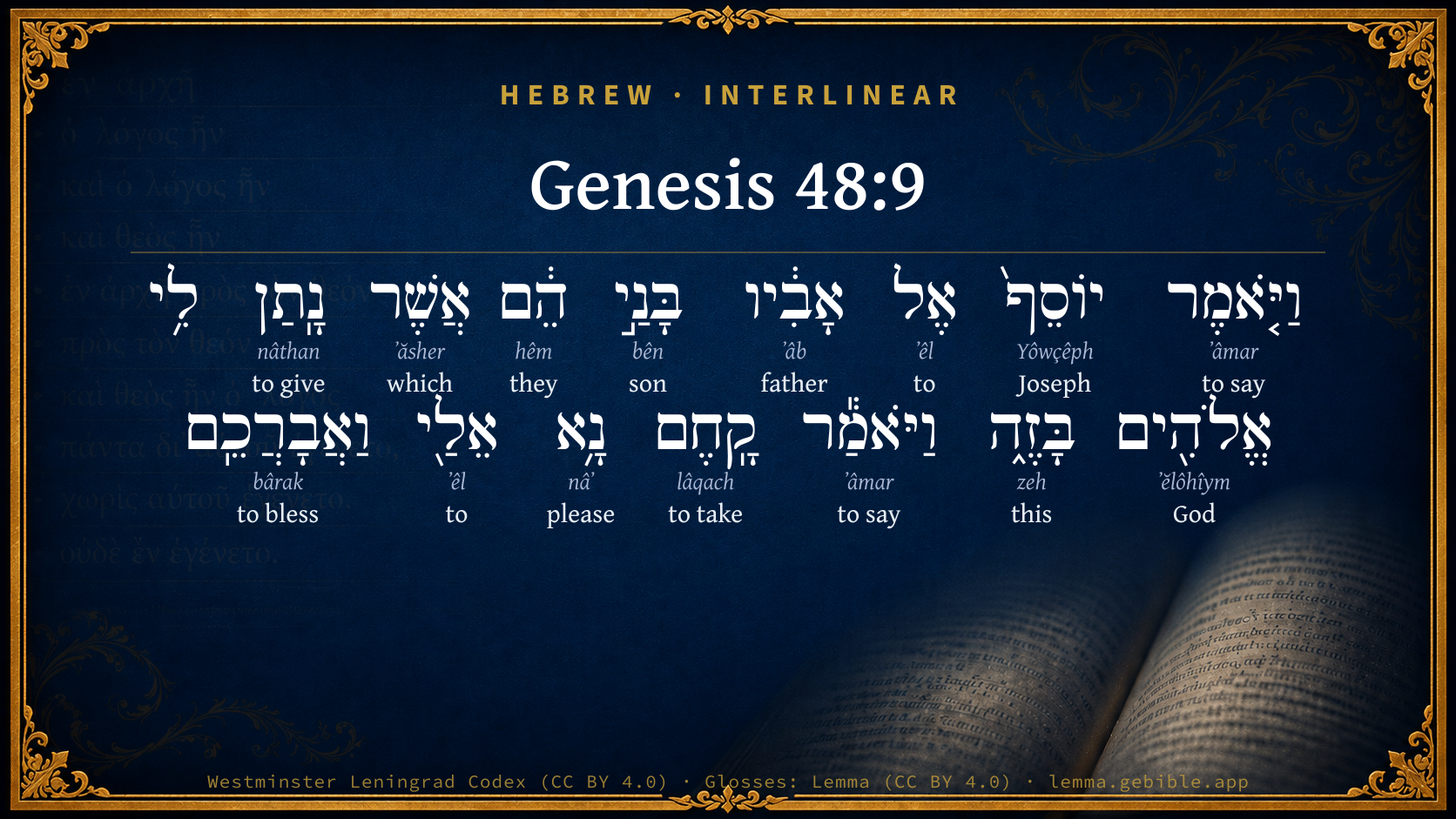
Hebrew (Westminster Leningrad Codex) Genesis 48:9 appears in the Hebrew Old Testament. The text above is from the Westminster Leningrad Codex. Each word links to its Strong’s number, a concise gloss, and parsing drawn from the Open Scriptures Hebrew Bible morphology. Click any word for its full Brown-Driver-Briggs (BDB) entry.
Download image
Cite this verse

Genesis 48:9 (World English Bible). Public Domain. Lemma interlinear Bible study tool, https://lemma.gebible.app/v/genesis/48/9.

Show BibTeX & RIS
BibTeX
RIS
English Translation
Joseph said to his father, "They are my sons, whom God has given me here." He said, "Please bring them to me, and I will bless them."
World English Bible · Public Domain
Download a study sheet

One document with this verse’s original text, its word-by-word gloss line, the meaning frame, cross-references with their text, attributed commentary, and full source and license credits — printable, and it pastes into notes with its structure intact.

This verse Autodidact and up

Study sheet (.html) Plain text (.txt)

A passage Seminary Student

Up to 50 verses in one chapter. A passage sheet keeps up to 6 commentary sources and 12 cross-references per verse, in the order this page ranks them, and says so on the sheet whenever that leaves anything out. Ask for a single verse and you get the Autodidact verse sheet above.

Everything on this page stays free to read, with no account — the sheet is a download of what is already on screen, not access to it.

Want to remove ads? Support Godless Engineer
Compare translations 3

The same verse in 3 English versions, stacked beneath the original-language interlinear above. Click any original word for its lexicon entry.

Each is an independent rendering of the whole verse — the interlinear is not word-aligned to these translations.

Highlighted words mark where these versions differ — a whole-verse word diff, not a word-by-word alignment.

  • World English Bible Public Domain
    Joseph said to his father, "They are my sons, whom God has given me here." He said, "Please bring them to me, and I will bless them."
  • King James Version Public Domain
    And Joseph said unto his father, They are my sons, whom God hath given me in this place. And he said, Bring them, I pray thee, unto me, and I will bless them.
  • unfoldingWord Literal Text CC BY-SA 4.0
    And Joseph said to his father, “They my sons whom God has given to me in this.” Then he said, “Please bring them to me, and I will bless them.”

unfoldingWord Literal Text — © unfoldingWord, licensed CC BY-SA 4.0. Word-aligned USFM3 via Door43 (git.door43.org/unfoldingWord/en_ult).

Versions to compare (up to 4)

3 of 4 selected

Show all 18 translations

Every available English version of this verse, each an independent rendering of the whole verse.

  • World English Bible Public Domain
    Joseph said to his father, "They are my sons, whom God has given me here." He said, "Please bring them to me, and I will bless them."
  • Berean Standard Bible Public Domain
    Joseph said to his father, “They are the sons God has given me in this place.” So Jacob said, “Please bring them to me, that I may bless them.”
  • Majority Standard Bible Public Domain
    Joseph said to his father, “They are the sons God has given me in this place.” So Jacob said, “Please bring them to me, that I may bless them.”
  • King James Version Public Domain
    And Joseph said unto his father, They are my sons, whom God hath given me in this place. And he said, Bring them, I pray thee, unto me, and I will bless them.
  • American Standard Version (1901) Public Domain
    And Joseph said unto his father, They are my sons, whom God hath given me here. And he said, Bring them, I pray thee, unto me, and I will bless them.
  • Revised Version (1885) Public Domain
    And Joseph said unto his father, They are my sons, whom God hath given me here. And he said, Bring them, I pray thee, unto me, and I will bless them.
  • Geneva Bible (1599) Public Domain
    And Ioseph sayd vnto his father, They are my sonnes, which God hath giuen mee here. Then he sayd, I pray thee, bring them to me, that I may blesse them:
  • Douay-Rheims (1899) Public Domain
    He answered: They are my sons, whom God hath given me in this place. And he said: Bring them to me that I may bless them.
  • Young's Literal Translation Public Domain
    and Joseph saith unto his father, `They `are' my sons, whom God hath given to me in this `place';' and he saith, `Bring them, I pray thee, unto me, and I bless them.'
  • Literal Standard Version CC BY-SA 4.0
    And Joseph says to his father, “They [are] my sons, whom God has given to me in this [place]”; and he says, “Please bring them to me, and I bless them.”
  • Unlocked Literal Bible CC BY-SA 4.0
    Joseph said to his father, “They are my sons, whom God has given me here.” Israel said, “Bring them to me, that I may bless them.”
  • unfoldingWord Literal Text CC BY-SA 4.0
    And Joseph said to his father, “They my sons whom God has given to me in this.” Then he said, “Please bring them to me, and I will bless them.”
  • Darby Bible Public Domain
    And Joseph said to his father, They are my sons, whom God has given me here. And he said, Bring them, I pray thee, to me, that I may bless them.
  • World Messianic Bible Public Domain
    Joseph said to his father, “They are my sons, whom God has given me here.” He said, “Please bring them to me, and I will bless them.”
  • Webster's Bible Public Domain
    And Joseph said to his father, They are my sons, whom God hath given me in this place. And he said, Bring them, I pray thee, to me, and I will bless them.
  • Free Bible Version CC BY-SA 4.0
    “Yes, these are the sons God gave me here,” Joseph told his father. “Bring them over here so I can bless them,” he said.
  • Bible in Basic English Public Domain
    And Joseph said to his father, They are my sons, whom God has given me in this land. And he said, Let them come near me, and I will give them a blessing.
  • JPS Tanakh (1917) Public Domain
    And Joseph said unto his father: 'They are my sons, whom God hath given me here.' And he said: 'Bring them, I pray thee, unto me, and I will bless them.'

Literal Standard Version (2020), Covenant Press — licensed CC BY-SA 4.0. Text via the HelloAO Bible API (eBible.org). Unlocked Literal Bible (unfoldingWord) — licensed CC BY-SA 4.0. Text via the HelloAO Bible API (eBible.org). unfoldingWord Literal Text — © unfoldingWord, licensed CC BY-SA 4.0. Word-aligned USFM3 via Door43 (git.door43.org/unfoldingWord/en_ult). Free Bible Version, Dr. Jonathan Gallagher — licensed CC BY-SA 4.0. Text via the HelloAO Bible API (eBible.org).

Word by word

More ways to search: Search by grammar → Find every occurrence → Compare this word →

Practice this passage: Drill this verse → Learn its vocabulary →

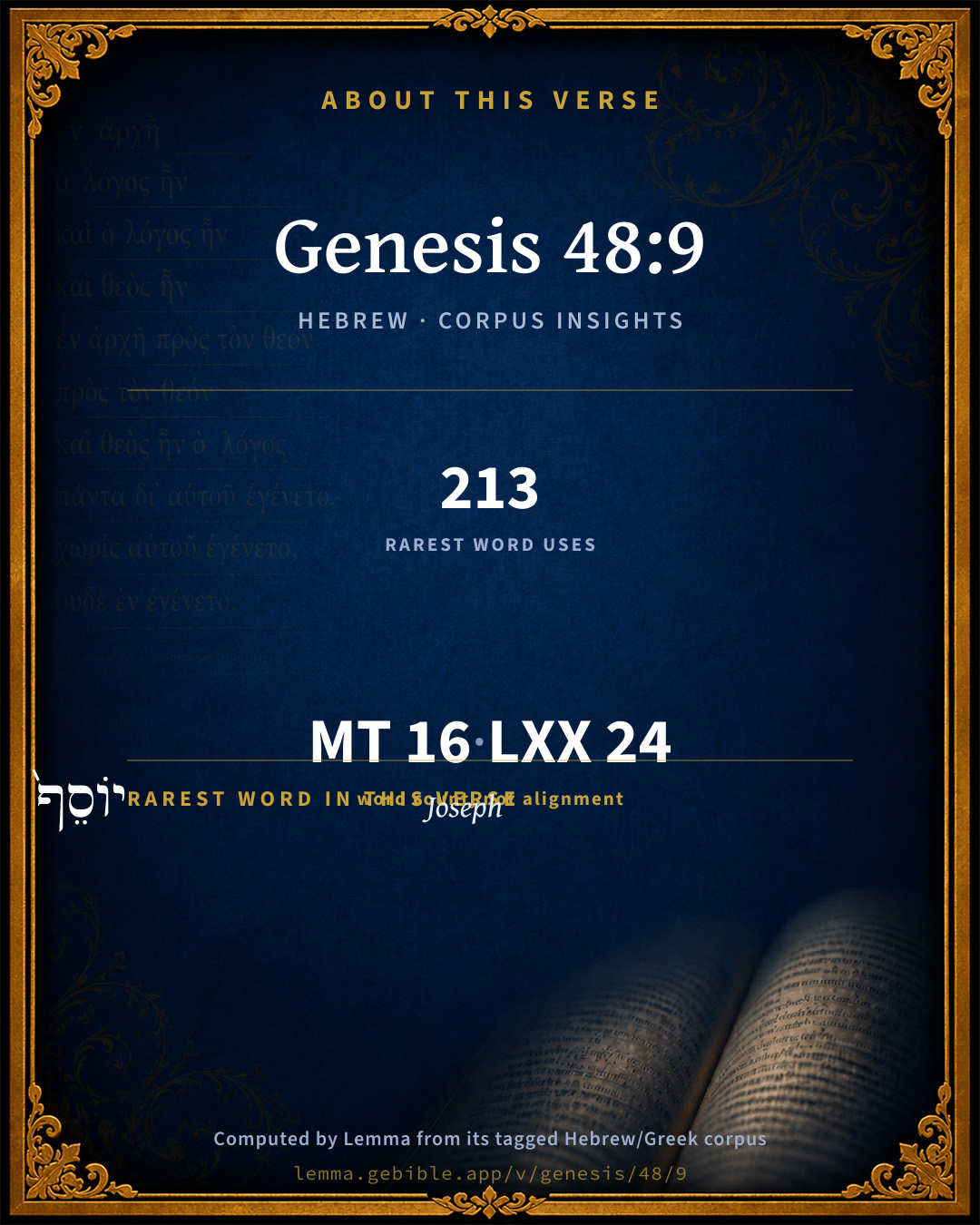
יוֹסֵף֙
Yôwçêph
H3130
“Joseph”
Noun, Proper
Part of Speech
Noun
Type
Proper
Full BDB Definition

Origin: future of H3254

TWOT: None

Joseph = "Jehovah has added" - the eldest son of Jacob by Rachel - father of Igal, who represented the tribe of Issachar among the spies - a son of Asaph - a man who took a foreign wife in the time of Ezra - a priest of the family of Shebaniah in the time of Nehemiah
  1. וַיֹּ֤אמֶר ʼâmar H559 “and · to say” Conjunction + Verb, Qal, Sequential Imperfect, 3rd Person, Masculine, Singular
  2. אֶל ʼêl H413 “to” Preposition
  3. אָבִ֔יו ʼâb H1 “father · his” Noun, Common, Masculine, Singular, Construct + Suffix, Personal, 3rd Person, Masculine, Singular
  4. בָּנַ֣י bên H1121 “sons · my” Noun, Common, Masculine, Plural, Construct + Suffix, Personal, 1st Person, Common, Singular
  5. הֵ֔ם hêm H1992 “they” Pronoun, Personal, 3rd Person, Masculine, Plural
  6. אֲשֶׁר ʼăsher H834 “which” Particle, Relative
  7. נָֽתַן nâthan H5414 “to give” Verb, Qal, Perfect, 3rd Person, Masculine, Singular
  8. אֱלֹהִ֖ים ʼĕlôhîym H430 “God(s)” Noun, Common, Masculine, Plural, Absolute
  9. בָּזֶ֑ה zeh H2088 “in/at · this” Preposition + Pronoun, Demonstrative, Masculine, Singular
  10. וַיֹּאמַ֕ר ʼâmar H559 “and · to say” Conjunction + Verb, Qal, Sequential Imperfect, 3rd Person, Masculine, Singular
  11. קָֽחֶם lâqach H3947 “take · them” Verb, Qal, Imperative, 2nd Person, Masculine, Singular + Suffix, Personal, 3rd Person, Masculine, Plural
  12. נָ֥א nâʼ H4994 “please” Particle, Exhortation
  13. אֵלַ֖י ʼêl H413 “to · me” Preposition + Suffix, Personal, 1st Person, Common, Singular
  14. וַאֲבָרֲכֵֽם bârak H1288 “and · to bless · them” Conjunction + Verb, Piel, Imperfect, 1st Person, Common, Singular + Suffix, Personal, 3rd Person, Masculine, Plural

About this verse

These counts appear in no published source. They are computed here, from the morphology-tagged text and Lemma’s own curated glosses. What Lemma adds →

16
words
13
distinct lemmas
Pentateuch
section

Grammatical profile

  • 5 verbs
  • 4 nouns
  • 2 pronouns
  • 3 prepositions
  • 2 particles

Verb forms

  • וַיֹּ֤אמֶר Qal · Sequential Imperfect
  • נָֽתַן Qal · Perfect
  • וַיֹּאמַ֕ר Qal · Sequential Imperfect
  • קָֽחֶם Qal · Imperative
  • וַאֲבָרֲכֵֽם Piel · Imperfect

Repetition

Words recur within this verse — often emphatic in Hebrew:

  • וַיֹּ֤אמֶר to say H559 ×2
  • אֶל to H413 ×2

Hebrew & Septuagint length

In English translation the verse runs 27 words from the Hebrew and 26 from the Septuagint (LXX English) — closely comparable.

A rough comparison of the two English renderings, which tokenize alike — not a word-level alignment.

Word counts can differ between the Hebrew and the Greek without any difference in meaning — e.g. the Hebrew direct-object marker אֵת has no separate Greek word, and Greek often adds the article ὁ.

In the original languages it is 16 Hebrew tokens and 24 Greek tokens — but the two are counted differently (Hebrew bundles its prefixes and suffixes into one token; the Greek is in lemma form), so that isn’t a like-for-like length.

Cross-references

18

Topical passages linked to Genesis 48:9 in the Treasury of Scripture Knowledge — connected by theme and wording, ordered by reader-vote popularity; previews shown in the World English Bible.

  • Genesis 27:4 Make me savory food, such as I love, and bring it to me, that I may eat, and that my soul may bless you before I die."
  • Genesis 33:5 He lifted up his eyes, and saw the women and the children; and said, "Who are these with you?" He said, "The children whom God has graciously given your servant."
  • Hebrews 11:21 By faith, Jacob, when he was dying, blessed each of the sons of Joseph, and worshiped, leaning on the top of his staff.
  • Genesis 27:28–29 God give you of the dew of the sky, of the fatness of the earth, and plenty of grain and new wine.
  • Genesis 27:34–40 When Esau heard the words of his father, he cried with an exceeding great and bitter cry, and said to his father, "Bless me, even me also, my father."
  • Genesis 28:3–4 May God Almighty bless you, and make you fruitful, and multiply you, that you may be a company of peoples,
  • Genesis 30:2 Jacob's anger was kindled against Rachel, and he said, "Am I in God's place, who has withheld from you the fruit of the womb?"
  • Genesis 49:28 All these are the twelve tribes of Israel, and this is what their father spoke to them and blessed them. He blessed everyone according to his blessing.
  • Deuteronomy 33:1 This is the blessing, with which Moses the man of God blessed the children of Israel before his death.
  • Ruth 4:11–14 All the people who were in the gate, and the elders, said, We are witnesses. Yahweh make the woman who has come into your house like Rachel and like Leah, which two built the house of Israel: and do you worthily in Ephrathah, and be famous in Bethlehem:
  • 1 Samuel 1:20 It happened, when the time was come about, that Hannah conceived, and bore a son; and she named him Samuel, [saying], Because I have asked him of Yahweh.
  • 1 Samuel 1:27 For this child I prayed; and Yahweh has given me my petition which I asked of him:
  • 1 Samuel 2:20–21 Eli blessed Elkanah and his wife, and said, Yahweh give you seed of this woman for the petition which was asked of Yahweh. They went to their own home.
  • 1 Chronicles 25:5 All these were the sons of Heman the king's seer in the words of God, to lift up the horn. God gave to Heman fourteen sons and three daughters.
  • 1 Chronicles 26:4–5 Obed-edom had sons: Shemaiah the firstborn, Jehozabad the second, Joah the third, and Sacar the fourth, and Nethanel the fifth,
  • Psalms 127:3 Behold, children are a heritage of Yahweh. The fruit of the womb is his reward.
  • Isaiah 8:18 Behold, I and the children whom Yahweh has given me are for signs and for wonders in Israel from Yahweh of Hosts, who dwells in Mount Zion.
  • Isaiah 56:3–5 Neither let the foreigner, who has joined himself to Yahweh, speak, saying, Yahweh will surely separate me from his people; neither let the eunuch say, Behold, I am a dry tree.

Cross-references courtesy of OpenBible.info (CC BY 4.0).

Hebrew and Greek witnesses Masoretic Hebrew ↔ Greek Septuagint

The same verse in the two great witnesses to the Old Testament, shown verse-for-verse.

These are two independent witnesses, not word-aligned to each other, and the Septuagint is shown in lemma (dictionary) form.

Hebrew Genesis 48:9 Masoretic · Westminster Leningrad Codex

וַיֹּ֤אמֶר יוֹסֵף֙ אֶל אָבִ֔יו בָּנַ֣י הֵ֔ם אֲשֶׁר נָֽתַן לִ֥י אֱלֹהִ֖ים בָּזֶ֑ה וַיֹּאמַ֕ר קָֽחֶם נָ֥א אֵלַ֖י וַאֲבָרֲכֵֽם

Joseph said to his father, "They are my sons, whom God has given me here." He said, "Please bring them to me, and I will bless them."

World English Bible · Public Domain

Greek LXX Genesis 48:9 Septuagint · lemma form

εἶπον δέ ιωσηφ ὁ πατήρ αὐτός υἱός ἐγώ εἰμί ὅς δίδωμι ἐγώ ὁ θεός ἐνταῦθα καί εἶπον ἰακώβ προςἄγω ἐγώ αὐτός ἵνα εὐλογέω αὐτός

And Joseph said to his father, They are my sons, whom God gave me here; and Jacob said, Bring me them, that I may bless them.

LXX2012 (modern English Septuagint) · Public Domain

Hebrew: Westminster Leningrad Codex (CC BY 4.0). Greek: Septuagint (public domain); English from LXX2012 (modern English Septuagint) (Public Domain). How the Septuagint differs from the Hebrew →

Targum (Aramaic paraphrase)

2

The Targum is the ancient Jewish Aramaic paraphrase of the Hebrew Scriptures — an interpretive translation, not the Hebrew text itself. Onkelos (literal) and Pseudo-Jonathan (expansive) render the Torah, and Jonathan the Prophets. Coverage is partial: where no permissively-licensed English translation exists for a verse, only the Aramaic is shown. This is verse-level text, not a word-by-word alignment to the Hebrew.

  1. Targum Onkelos Torah (Genesis–Deuteronomy)
    וַאֲמַר יוֹסֵף לַאֲבוּהִי בְּנַי אִנּוּן דִּי יְהַב לִי יְיָ הָכָא וַאֲמַר קָרֵבִנּוּן כְּעַן לְוָתִי וְאֵבָרֵכִנּוּן

    (no public-domain English translation for this verse)

    Targum Onkelos — Aramaic: “Onkelos Genesis” (public domain); “Onkelos Exodus” (public domain); “Onkelos Leviticus” (public domain); “Onkelos Numbers” (public domain); “Onkelos Deuteronomy” (public domain). English: “Sefaria Community Translation” (CC0 1.0 (public-domain dedication)); “J.W. Etheridge. The Targums of Onkelos and Jonathan Ben Uzziel on the Pentateuch. London: Longmans, Green, 1862” (public domain). Text via Sefaria.

  2. Targum Pseudo-Jonathan Torah (Genesis–Deuteronomy)
    וַאֲמַר יוֹסֵף לְאָבוּי בְּנַיי הִינוּן דִיהַב לִי מֵימְרָא דַיְיָ כְּדֵין כְּתָבָא דְעָלֵיהּ נְסֵיבִית יַת אָסְנַת בְּרַת דִינָה בְּרַתָּךְ לְאִינְתּוּ וַאֲמַר קָרֵבִינוֹן כְּדוֹן לְוָתִי וְאֵיבָרִיכִינוּן

    And Joseph answered his father, They are my sons which the Word of the Lord gave me according to this writing, according to which I took Asenath the daughter of Dinah thy daughter to be my wife. And he said, Bring them now near to me, and I will bless them.

    Targum Pseudo-Jonathan — Aramaic: “Targum Jonathan on Genesis” (public domain); “Targum Jonathan on Exodus” (public domain); “Targum Jonathan on Leviticus” (public domain); “Targum Jonathan on Numbers” (public domain); “Targum Jonathan on Deuteronomy” (public domain). English: “The Targum of Jonathan ben Uzziel, trans. J. W. Etheridge, London, 1862” (public domain). Text via Sefaria.

Commentary

Notes on Genesis 48:9 from classic Christian and Jewish commentators (each source and its license shown beneath its notes). The classic Christian expositions comment on the surrounding passage and are grouped to its opening verse, so a note may address several verses; the Jewish commentaries on the Tanakh (Rashi and others) are per-verse, so they appear only where the commentator wrote on this verse.

Lemma curates 59 commentaries, every one of them public domain or Creative Commons licensed, each selected and text-cleaned for this edition rather than reprinted as found. About our sources →

Trapp's Complete Commentary

John Trapp

Gen 48:9 And Joseph said unto his father, They [are] my sons, whom God hath given me in this [place]. And he said, Bring them, I pray thee, unto me, and I will bless them.

Ver. 9. They are my sons, whom God, &c.] The Lord Christ in like sort presents us to his heavenly Father with, "Here am I, and the children whom thou hast given me." {Heb 2:13} Whereunto the Father replies, as Jacob here, Bring them now unto me, and I will bless them.

John Trapp, A Commentary or Exposition upon All the Books of the Old and New Testament (1647–1656) — public domain. Text from a community e-Sword module.

Geneva Bible (1599)

Geneva Bible translators

The faithful acknowledge all benefits come of God’s free mercies.

Geneva Bible (1599) marginal notes — public domain. Text via Bolls.life.

Jamieson, Fausset & Brown

Robert Jamieson, A. R. Fausset & David Brown

Bring them, I pray thee, unto me, and I will bless them--The apostle (Heb 11:21) selected the blessing of Joseph's son as the chief, because the most comprehensive, instance of the patriarch's faith which his whole history furnishes.

Jamieson, Fausset & Brown — Commentary Critical and Explanatory on the Whole Bible (1871) — public domain (CC PDM 1.0). Text via the HelloAO Bible API.

John Gill's Exposition

And Joseph said unto his father, they are my sons, whom God hath given me in this place,.... In the land of Egypt; he accounts his sons as the gifts of God, as children are, Psa 127:3; and it was not only a sentiment of the Jews, that children are the gift of God; hence the names of Mattaniah, Nathaniel, &c. but of Heathens, as the Greeks and Romans, among whom are frequent the names of men which show it, as Theodorus, Deodatus, Apollodorus, Artemidorus, &c.

and he said, bring them, I pray thee, unto me, and I will bless them; not in a common way, barely wishing them prosperity and happiness, but as a patriarch and prophet, under the influence and inspiration of the Spirit of God, declaring what would befall them, and what blessings they should be partakers of, in time to come.

John Gill's Exposition of the Whole Bible (1746–1763) — public domain (CC PDM 1.0). Text via the HelloAO Bible API.

Matthew Poole's English Annotations

Or,

that I may bless them, not with a common, but with a paternal, and patriarchal, and prophetical blessing, in the name and by the Spirit of God, praying for and foretelling those blessings which God will confer upon them.

Matthew Poole's English Annotations on the Holy Bible (1683–1685) — public domain. Text from a community e-Sword/MySword module.

The Pulpit Commentary

And Joseph said unto his father, They are my sons (of whom you have just spoken), whom God hath given me in this place. It speaks highly in Joseph"s favor that, after listening to Jacob s promise regarding Ephraim and Manasseh, he did not seek to draw his aged father"s attention to the young men before him, but quietly waited for Jacob to take the initiative in any further communications of a personal nature that he might wish to address to them. And he ( i.e. Jacob) said Bring them, I pray thee, unto me, and I will bless them.

The Pulpit Commentary (1880–1919), ed. H.D.M. Spence-Jones & Joseph S. Exell — public domain. Text from a community e-Sword module.

Rashi

Rabbi Shlomo Yitzchaki (Rashi)

בָּזֶה IN THIS PLACE (literally, by this, or by means of this) — He showed him the contract of betrothal and the contract of marriage (evidence that their mother had adopted the faith of Israel, and that his and her offspring were of their faith) and Joseph prayed to God about the matter and the Holy Spirit again rested upon him (Jacob) (Midrash Tanchuma, Vayechi 6).

ויאמר קחם נא אלי ואברכם AND HE SAID, BRING THEM, I PRAY THEE, UNTO ME, AND I WILL BLESS THEM — It is to this that the text alludes, (Hosea 11:3) “And I, תרגלתי לאפרים taking them (קחם) upon his arms”, meaning, I made My Spirit once again a familiar thing (תרגלתי) in Jacob for Ephraim’s sake until he took them (him and Manasseh) upon his arms (cf. Midrash Tanchuma, Vayechi 6).

Rashi on the Tanakh — English translations: “The Judaica Press complete Tanach with Rashi, translated by A. J. Rosenberg” (CC BY 4.0); “Pentateuch with Rashi's commentary by M. Rosenbaum and A.M. Silbermann, 1929-1934” (public domain); “The Metsudah Tanach series, Lakewood, N.J” (CC BY 4.0); and “The Book of Joshua, Metsudah Publications, 1997” (CC BY 4.0). Text via Sefaria.

Ramban (Nachmanides)

Rabbi Moshe ben Nachman (Ramban / Nachmanides)

WHOM G-D HATH GIVEN ME HERE. It was really not necessary for Joseph to inform his father that his two sons were born to him in Egypt since when Joseph left him he had no wife and children, and Jacob himself had previously said to him, Thy two sons, who were born unto thee in the land of Egypt. It appears to me that the meaning of the word bazeh (here) is “in this matter concerning which you have spoken,” i.e., “G-d gave them to me before you came to Egypt to me, and they are the ones concerning whom you have said that they are yours.” A similar use of the word bazeh is found in the verse, In this way (‘u’bazeh’) the maiden came to the king., Verse 12). Now Joseph said, G-d hath given me, meaning that “G-d had performed miracles for me until the king gave me this wife, and I have these children from her.”

Ramban (Nachmanides) on the Tanakh — English translation: “Commentary on the Torah by Ramban (Nachmanides). Translated and annotated by Charles B. Chavel. New York, Shilo Pub. House, 1971-1976” (CC BY 4.0). Text via Sefaria.

Radak

Rabbi David Kimhi (Radak)

בזה. As if the Torah had written במקום הזה, “in this place.” The brief בזה, also appears in the same sense already in 38,21 לא היתה בזה קדשה, “no harlot has been in this place, the word for “place,” מקום, being omitted.

Radak on the Tanakh — English translations: “Sefaria Community Translation” (CC0 1.0 (public-domain dedication)); “Eliyahu Munk, HaChut Hameshulash” (CC BY 4.0); “Rabbi Mike Feuer, Jerusalem Anthology” (CC BY 4.0); and “R. David Kimhi on the first book of Psalms, Translated by R.G. Finch, London, 1919” (public domain). Text via Sefaria.

Lesson kit

Teaching starters — assembled from the data on this page, not authored interpretation. Every prompt links to the verse data it draws on. Edit before teaching.

Genesis, in the Pentateuch, opens this verse with 16 words (13 distinct Hebrew lemmas). Its most distinctive word is Yôwçêph (“Joseph”). A historical commentator’s framing appears above. Read the whole chapter for the surrounding context.

Discussion questions

  1. The word Yôwçêph carries the sense “Joseph.” How does it shape the verse?
  2. How does Genesis 27:4, which shares this passage’s theme, read alongside this verse?
  3. What does the repetition of “to say” (2× in this one verse) do in this verse?
  4. These translations render this verse differently. What is at stake in choosing one wording over another?
  5. «וַיֹּ֤אמֶר» is a Qal Sequential Imperfect verb. How does that grammatical form shape the action described?
  6. Compare how Trapp's Complete Commentary and Geneva Bible (1599) read this verse. Where do they agree or differ?

Things to notice

Reading settings

Reading text

Shown beneath each verse's original-language words.

Old Testament
Old Testament edition

Read the OT as the Masoretic Hebrew (MT) or the Greek Septuagint (LXX).

English shown for the Greek Septuagint (in the Hebrew ↔ Greek comparison).

Comparing translations? Open the Compare panel on any verse page to stack up to four side by side.