
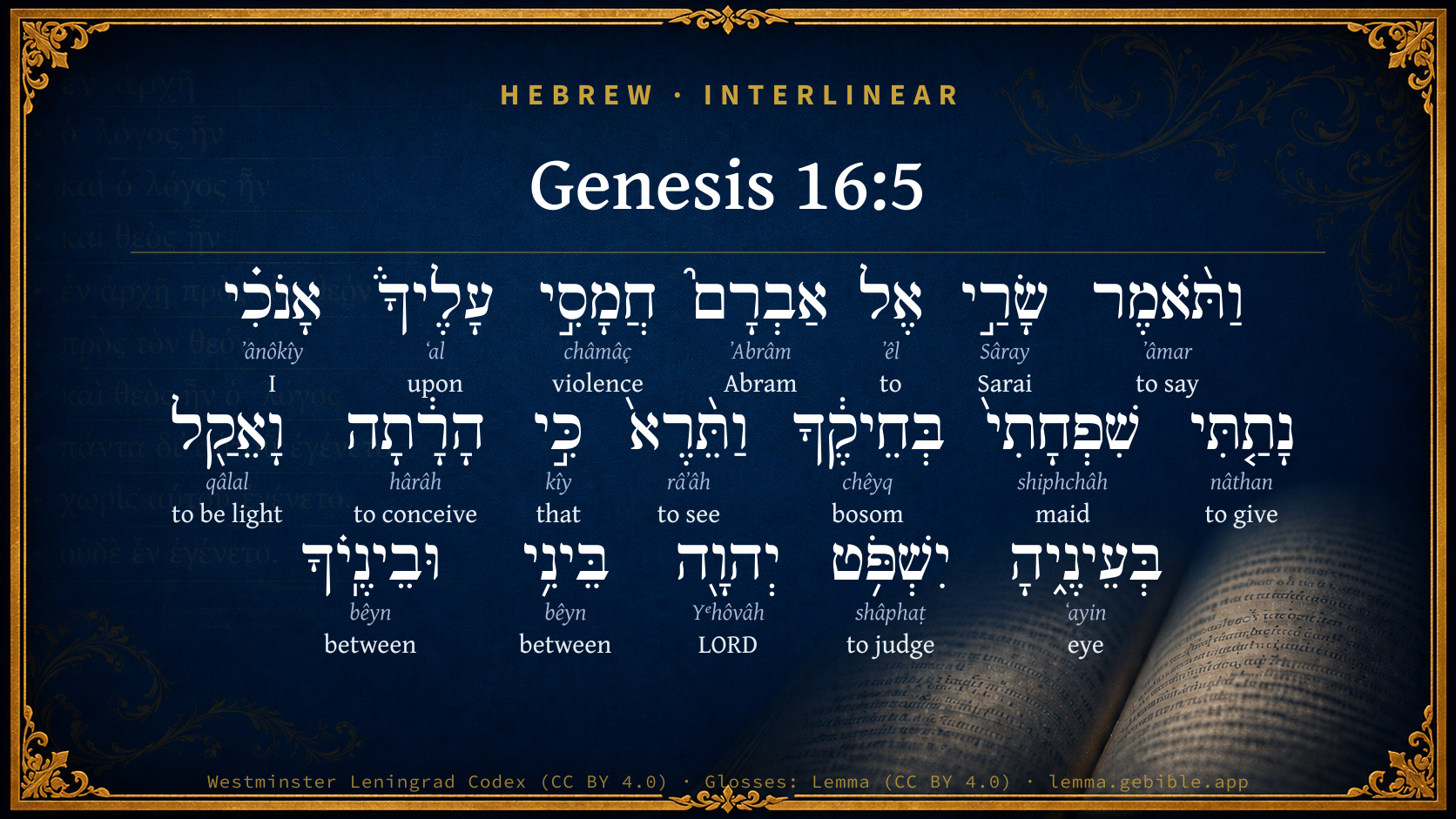
Genesis 16:5

Hebrew (Westminster Leningrad Codex) Genesis 16:5 appears in the Hebrew Old Testament. The text above is from the Westminster Leningrad Codex. Each word links to its Strong’s number, a concise gloss, and parsing drawn from the Open Scriptures Hebrew Bible morphology. Click any word for its full Brown-Driver-Briggs (BDB) entry.
Download image
Cite this verse

Genesis 16:5 (World English Bible). Public Domain. Lemma interlinear Bible study tool, https://lemma.gebible.app/v/genesis/16/5.

Show BibTeX & RIS
BibTeX
RIS
English Translation
Sarai said to Abram, "This wrong is your fault. I gave my handmaid into your bosom, and when she saw that she had conceived, I was despised in her eyes. Yahweh judge between me and you."
World English Bible · Public Domain
Highlights
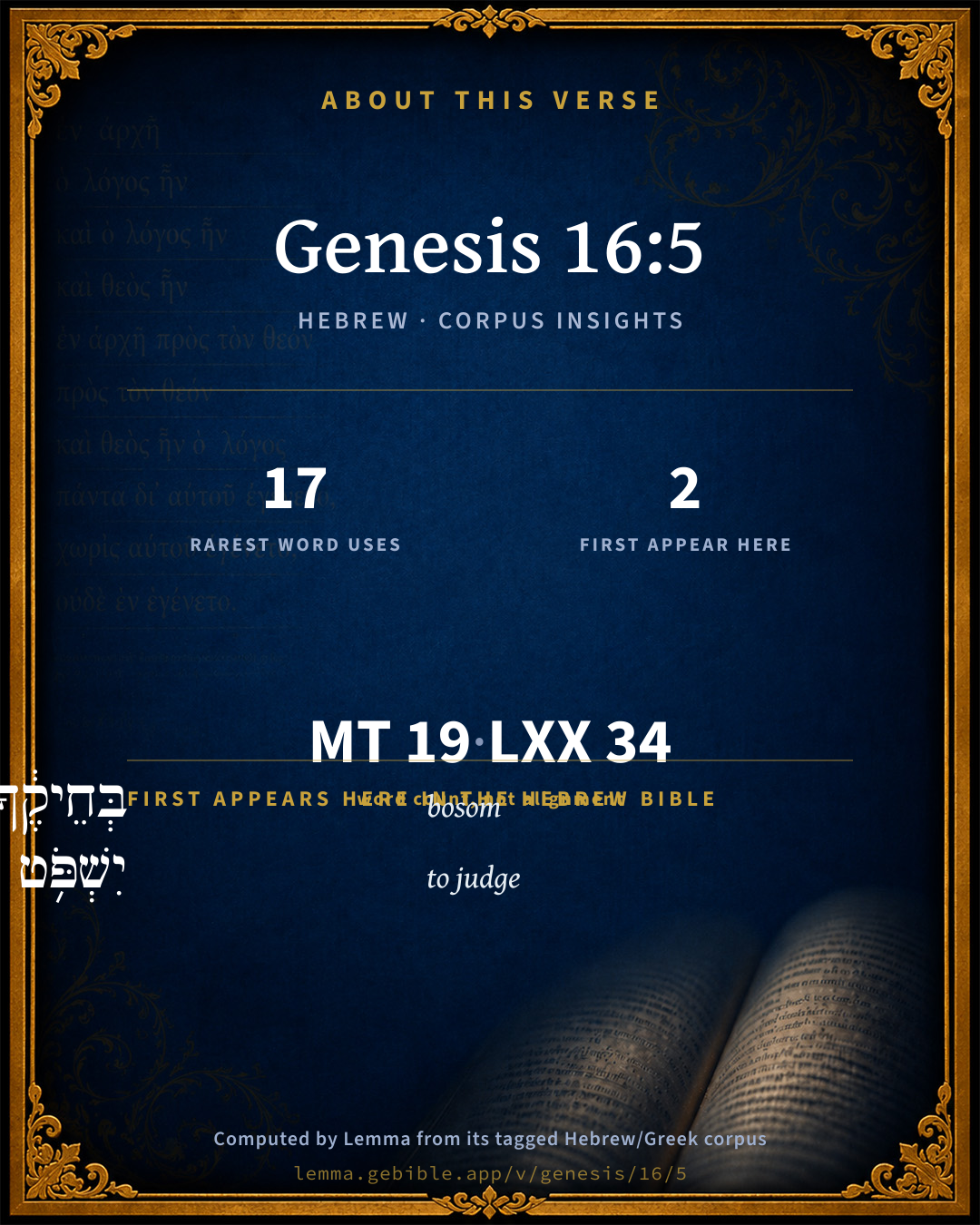
  • 2 first appearances in the Hebrew Bible
Full analysis ↓
Download a study sheet

One document with this verse’s original text, its word-by-word gloss line, the meaning frame, cross-references with their text, attributed commentary, and full source and license credits — printable, and it pastes into notes with its structure intact.

This verse Autodidact and up

Study sheet (.html) Plain text (.txt)

A passage Seminary Student

Up to 50 verses in one chapter. A passage sheet keeps up to 6 commentary sources and 12 cross-references per verse, in the order this page ranks them, and says so on the sheet whenever that leaves anything out. Ask for a single verse and you get the Autodidact verse sheet above.

Everything on this page stays free to read, with no account — the sheet is a download of what is already on screen, not access to it.

Want to remove ads? Support Godless Engineer
Compare translations 3

The same verse in 3 English versions, stacked beneath the original-language interlinear above. Click any original word for its lexicon entry.

Each is an independent rendering of the whole verse — the interlinear is not word-aligned to these translations.

Highlighted words mark where these versions differ — a whole-verse word diff, not a word-by-word alignment.

  • World English Bible Public Domain
    Sarai said to Abram, "This wrong is your fault. I gave my handmaid into your bosom, and when she saw that she had conceived, I was despised in her eyes. Yahweh judge between me and you."
  • King James Version Public Domain
    And Sarai said unto Abram, My wrong be upon thee: I have given my maid into thy bosom; and when she saw that she had conceived, I was despised in her eyes: the LORD judge between me and thee.
  • unfoldingWord Literal Text CC BY-SA 4.0
    Then Sarai said to Abram, “My wrong on you! I myself put my maidservant into your arms, but she sees that she has conceived, and I am despised in her eyes! May Yahweh judge between me and you!”

unfoldingWord Literal Text — © unfoldingWord, licensed CC BY-SA 4.0. Word-aligned USFM3 via Door43 (git.door43.org/unfoldingWord/en_ult).

Versions to compare (up to 4)

3 of 4 selected

Show all 18 translations

Every available English version of this verse, each an independent rendering of the whole verse.

  • World English Bible Public Domain
    Sarai said to Abram, "This wrong is your fault. I gave my handmaid into your bosom, and when she saw that she had conceived, I was despised in her eyes. Yahweh judge between me and you."
  • Berean Standard Bible Public Domain
    Then Sarai said to Abram, “May the wrong done to me be upon you! I delivered my servant into your arms, and ever since she saw that she was pregnant, she has treated me with contempt. May the LORD judge between you and me.”
  • Majority Standard Bible Public Domain
    Then Sarai said to Abram, “May the wrong done to me be upon you! I delivered my servant into your arms, and ever since she saw that she was pregnant, she has treated me with contempt. May the LORD judge between you and me.”
  • King James Version Public Domain
    And Sarai said unto Abram, My wrong be upon thee: I have given my maid into thy bosom; and when she saw that she had conceived, I was despised in her eyes: the LORD judge between me and thee.
  • American Standard Version (1901) Public Domain
    And Sarai said unto Abram, My wrong be upon thee: I gave my handmaid into they bosom; and when she saw that she had conceived, I was despised in her eyes: Jehovah judge between me and thee.
  • Revised Version (1885) Public Domain
    And Sarai said unto Abram, My wrong be upon thee: I gave my handmaid into thy bosom; and when she saw that she had conceived, I was despised in her eyes: the LORD judge between me and thee.
  • Geneva Bible (1599) Public Domain
    Then Sarai saide to Abram, Thou doest me wrong. I haue giuen my maide into thy bosome, and she seeth that she hath conceiued, and I am despised in her eyes: the Lord iudge betweene me and thee.
  • Douay-Rheims (1899) Public Domain
    And Sarai said to Abram: Thou dost unjustly with me: I gave my handmaid into thy bosom, and she perceiving herself to be with child, despiseth me. The Lord judge between me and thee.
  • Young's Literal Translation Public Domain
    And Sarai saith unto Abram, `My violence `is' for thee; I -- I have given mine handmaid into thy bosom, and she seeth that she hath conceived, and I am lightly esteemed in her eyes; Jehovah doth judge between me and thee.'
  • Literal Standard Version CC BY-SA 4.0
    And Sarai says to Abram, “My violence [is] for you; I have given my handmaid into your bosom, and she sees that she has conceived, and I am lightly esteemed in her eyes; YHWH judges between me and you.”
  • Unlocked Literal Bible CC BY-SA 4.0
    Then Sarai said to Abram, “This wrong on me is because of you. I gave my servant woman into your embrace, and when she saw that she had conceived, I was despised in her eyes. Let Yahweh judge between me and you.”
  • unfoldingWord Literal Text CC BY-SA 4.0
    Then Sarai said to Abram, “My wrong on you! I myself put my maidservant into your arms, but she sees that she has conceived, and I am despised in her eyes! May Yahweh judge between me and you!”
  • Darby Bible Public Domain
    And Sarai said to Abram, My wrong be on thee! I have given my maidservant into thy bosom; and now she sees that she has conceived, I am lightly esteemed in her eyes. Jehovah judge between me and thee!
  • World Messianic Bible Public Domain
    Sarai said to Abram, “This wrong is your fault. I gave my servant into your bosom, and when she saw that she had conceived, she despised me. May the LORD judge between me and you.”
  • Webster's Bible Public Domain
    And Sarai said to Abram, my wrong be upon thee: I have given my maid into thy bosom; and when she saw that she had conceived, I was despised in her eyes: the LORD judge between me and thee.
  • Free Bible Version CC BY-SA 4.0
    Then Sarai complained to Abram, “What I'm suffering is all your doing! I gave you my servant to sleep with, and now that she knows she's pregnant, she treats me with contempt. May the Lord decide who's at fault—you or me!”
  • Bible in Basic English Public Domain
    And Sarai said to Abram, May my wrong be on you: I gave you my servant for your wife and when she saw that she was with child, she no longer had any respect for me: may the Lord be judge between you and me.
  • JPS Tanakh (1917) Public Domain
    And Sarai said unto Abram: 'My wrong be upon thee: I gave my handmaid into thy bosom; and when she saw that she had conceived, I was despised in her eyes: the LORD judge between me and thee.'

Literal Standard Version (2020), Covenant Press — licensed CC BY-SA 4.0. Text via the HelloAO Bible API (eBible.org). Unlocked Literal Bible (unfoldingWord) — licensed CC BY-SA 4.0. Text via the HelloAO Bible API (eBible.org). unfoldingWord Literal Text — © unfoldingWord, licensed CC BY-SA 4.0. Word-aligned USFM3 via Door43 (git.door43.org/unfoldingWord/en_ult). Free Bible Version, Dr. Jonathan Gallagher — licensed CC BY-SA 4.0. Text via the HelloAO Bible API (eBible.org).

Word by word

More ways to search: Search by grammar → Find every occurrence → Compare this word →

Practice this passage: Drill this verse → Learn its vocabulary →

שָׂרַ֣י
Sâray
H8297
“Sarai”
Noun, Proper
Part of Speech
Noun
Type
Proper
Full BDB Definition

Origin: from H8269

TWOT: None

Sarai = "princess" - original name of Sarah the wife of Abram or Abraham
  1. וַתֹּ֨אמֶר ʼâmar H559 “and · to say” Conjunction + Verb, Qal, Sequential Imperfect, 3rd Person, Feminine, Singular
  2. אֶל ʼêl H413 “to” Preposition
  3. אַבְרָם֮ ʼAbrâm H87 “Abram” Noun, Proper
  4. חֲמָסִ֣י châmâç H2555 “violence · my” Noun, Common, Masculine, Singular, Construct + Suffix, Personal, 1st Person, Common, Singular
  5. עָלֶיךָ֒ ʻal H5921 “upon · you” Preposition + Suffix, Personal, 2nd Person, Masculine, Singular
  6. אָנֹכִ֗י ʼânôkîy H595 “I” Pronoun, Personal, 1st Person, Common, Singular
  7. נָתַ֤תִּי nâthan H5414 “to give” Verb, Qal, Perfect, 1st Person, Common, Singular
  8. שִׁפְחָתִי֙ shiphchâh H8198 “maid · my” Noun, Common, Feminine, Singular, Construct + Suffix, Personal, 1st Person, Common, Singular
  9. בְּחֵיקֶ֔ךָ chêyq H2436 “in/at · bosom · your” Preposition + Noun, Common, Masculine, Singular, Construct + Suffix, Personal, 2nd Person, Masculine, Singular
  10. וַתֵּ֨רֶא֙ râʼâh H7200 “and · to see” Conjunction + Verb, Qal, Sequential Imperfect, 3rd Person, Feminine, Singular
  11. כִּ֣י kîy H3588 “that” Conjunction
  12. הָרָ֔תָה hârâh H2029 “to conceive” Verb, Qal, Perfect, 3rd Person, Feminine, Singular
  13. וָאֵקַ֖ל qâlal H7043 “and · to be light” Conjunction + Verb, Qal, Sequential Imperfect, 1st Person, Common, Singular
  14. בְּעֵינֶ֑יהָ ʻayin H5869 “in/at · eyes · her” Preposition + Noun, Common, Both, Dual, Construct + Suffix, Personal, 3rd Person, Feminine, Singular
  15. יִשְׁפֹּ֥ט shâphaṭ H8199 “to judge” Verb, Qal, Jussive, 3rd Person, Masculine, Singular
  16. יְהוָ֖ה Yᵉhôvâh H3068 “LORD” Noun, Proper
  17. בֵּינִ֥י bêyn H996 “between · me” Preposition + Suffix, Personal, 1st Person, Common, Singular
  18. וּבֵינֶֽיׄךָ bêyn H996 “and · between · you” Conjunction + Preposition + Suffix, Personal, 2nd Person, Masculine, Singular

About this verse

These counts appear in no published source. They are computed here, from the morphology-tagged text and Lemma’s own curated glosses. What Lemma adds →

19
words
18
distinct lemmas
Pentateuch
section

Notable vocabulary

The rarest word here is שָׂרַ֣י Sarai H8297 — appearing just 17 times in the whole Hebrew Bible.

First appearance in Scripture

These words make their first canonical appearance in the Hebrew Bible here:

  • בְּחֵיקֶ֔ךָ bosom H2436
  • יִשְׁפֹּ֥ט to judge H8199

Shared distinctive vocabulary

שָׂרַ֣י Sarai H8297 occurs in 13 verses of the Hebrew Bible. Also found in:

Grammatical profile

  • 6 verbs
  • 7 nouns
  • 1 pronoun
  • 4 prepositions
  • 1 conjunction

Verb forms

  • וַתֹּ֨אמֶר Qal · Sequential Imperfect
  • נָתַ֤תִּי Qal · Perfect
  • וַתֵּ֨רֶא֙ Qal · Sequential Imperfect
  • הָרָ֔תָה Qal · Perfect
  • וָאֵקַ֖ל Qal · Sequential Imperfect
  • יִשְׁפֹּ֥ט Qal · Jussive

Repetition

A word recurs within this verse — often emphatic in Hebrew:

  • בֵּינִ֥י between H996 ×2

Hebrew & Septuagint length

In English translation the verse runs 36 words from the Hebrew and 38 from the Septuagint (LXX English) — closely comparable.

A rough comparison of the two English renderings, which tokenize alike — not a word-level alignment.

Word counts can differ between the Hebrew and the Greek without any difference in meaning — e.g. the Hebrew direct-object marker אֵת has no separate Greek word, and Greek often adds the article ὁ.

In the original languages it is 19 Hebrew tokens and 34 Greek tokens — but the two are counted differently (Hebrew bundles its prefixes and suffixes into one token; the Greek is in lemma form), so that isn’t a like-for-like length.

Cross-references

8

Topical passages linked to Genesis 16:5 in the Treasury of Scripture Knowledge — connected by theme and wording, ordered by reader-vote popularity; previews shown in the World English Bible.

  • Genesis 31:53 The God of Abraham, and the God of Nahor, the God of their father, judge between us." Then Jacob swore by the fear of his father, Isaac.
  • Exodus 5:21 and they said to them, "May Yahweh look at you, and judge, because you have made us a stench to be abhorred in the eyes of Pharaoh, and in the eyes of his servants, to put a sword in their hand to kill us."
  • 1 Samuel 24:12–15 Yahweh judge between me and you, and Yahweh avenge me of you; but my hand shall not be on you.
  • 2 Chronicles 24:22 Thus Joash the king didn't remember the kindness which Jehoiada his father had done to him, but killed his son. When he died, he said, Yahweh look on it, and require it.
  • Psalms 7:8 Yahweh administers judgment to the peoples. Judge me, Yahweh, according to my righteousness, And to my integrity that is in me.
  • Psalms 35:23 Wake up! Rise up to defend me, my God! My Lord, contend for me!
  • Luke 10:40–41 But Martha was distracted with much serving, and she came up to him, and said, "Lord, don't you care that my sister left me to serve alone? Ask her therefore to help me."
  • Psalms 43:1 Vindicate me, God, and plead my cause against an ungodly nation. Oh, deliver me from deceitful and wicked men.

Cross-references courtesy of OpenBible.info (CC BY 4.0).

Hebrew and Greek witnesses Masoretic Hebrew ↔ Greek Septuagint

The same verse in the two great witnesses to the Old Testament, shown verse-for-verse.

These are two independent witnesses, not word-aligned to each other, and the Septuagint is shown in lemma (dictionary) form.

Hebrew Genesis 16:5 Masoretic · Westminster Leningrad Codex

וַתֹּ֨אמֶר שָׂרַ֣י אֶל אַבְרָם֮ חֲמָסִ֣י עָלֶיךָ֒ אָנֹכִ֗י נָתַ֤תִּי שִׁפְחָתִי֙ בְּחֵיקֶ֔ךָ וַתֵּ֨רֶא֙ כִּ֣י הָרָ֔תָה וָאֵקַ֖ל בְּעֵינֶ֑יהָ יִשְׁפֹּ֥ט יְהוָ֖ה בֵּינִ֥י וּבֵינֶֽיׄךָ

Sarai said to Abram, "This wrong is your fault. I gave my handmaid into your bosom, and when she saw that she had conceived, I was despised in her eyes. Yahweh judge between me and you."

World English Bible · Public Domain

Greek LXX Genesis 16:5 Septuagint · lemma form

εἶπον δέ σαρα πρός αβραμ ἀδικέω ἐκ σύ ἐγώ δίδωμι ὁ παιδίσκη ἐγώ εἰς ὁ κόλπος σύ ὁράω δέ ὅτι ἐν γαστήρ ἔχω ἀτιμάζω ἐναντίον αὐτός κρίνω ὁ θεός ἀνά μέσος ἐγώ καί σύ

And Sara said to Abram, I am injured by you; I gave my handmaid into your bosom, and when I saw that she was with child, I was dishonored before her. The Lord judge between me and you.

LXX2012 (modern English Septuagint) · Public Domain

On this verse, The Cambridge Bible for Schools and Colleges discusses the Septuagint’s reading. Read the note in Commentary ↓

Hebrew: Westminster Leningrad Codex (CC BY 4.0). Greek: Septuagint (public domain); English from LXX2012 (modern English Septuagint) (Public Domain). How the Septuagint differs from the Hebrew →

Targum (Aramaic paraphrase)

2

The Targum is the ancient Jewish Aramaic paraphrase of the Hebrew Scriptures — an interpretive translation, not the Hebrew text itself. Onkelos (literal) and Pseudo-Jonathan (expansive) render the Torah, and Jonathan the Prophets. Coverage is partial: where no permissively-licensed English translation exists for a verse, only the Aramaic is shown. This is verse-level text, not a word-by-word alignment to the Hebrew.

  1. Targum Onkelos Torah (Genesis–Deuteronomy)
    וַאֲמַרַת שָׂרַי לְאַבְרָם דִין לִי עֲלָךְ אֲנָא יְהָבִית אַמְתִי לָךְ וַחֲזַת אֲרֵי עֲדִיאַת וּקְלֵית בְּעֵינָהַהּ יְדִין יְיָ בֵּינִי וּבֵינָךְ

    (no public-domain English translation for this verse)

    Targum Onkelos — Aramaic: “Onkelos Genesis” (public domain); “Onkelos Exodus” (public domain); “Onkelos Leviticus” (public domain); “Onkelos Numbers” (public domain); “Onkelos Deuteronomy” (public domain). English: “Sefaria Community Translation” (CC0 1.0 (public-domain dedication)); “J.W. Etheridge. The Targums of Onkelos and Jonathan Ben Uzziel on the Pentateuch. London: Longmans, Green, 1862” (public domain). Text via Sefaria.

  2. Targum Pseudo-Jonathan Torah (Genesis–Deuteronomy)
    וַאֲמַרַת שָרַי לְאַבְרָם כָּל עוּלְבָּנִי מִינָךְ דַהֲוִינָא רְחִיצָא דְתֶעֱבַּד דִינִי דַאֲנָא שַׁבְקִית אֲרַע וּבֵית אַבָּא וְעָלִית עִמָךְ לְאַרַע נוּכְרֵיתָא וּכְדוֹן בְּגִין דְלָא הֲוֵינָא יַלְדָא חֲרָרִית אַמְתִי וִיהַבְתָּהּ לְמִשְׁכּוֹב בְּעִיטְפָךְ וַחֲמַת אֲרוּם עַבְרִית וְיִתְבַּז אִיקְרִי בְּאַנְפָּהָא וּכְדוּן יִתְגְלֵי קֳדָם יְיָ עוּלְבָּנִי וְיִפְרוֹס שְׁלָמֵיהּ בֵּינִי וּבֵינָךְ וְתִתְמְלֵי אַרְעָא מִינָן וְלָא נִצְטַרָךְ לִבְנָהָא דְהָגָר בְּרַת פַּרְעה בַּר נִמְרוֹד דְטַלְקָךְ לְאַתּוּנָא דְנוּרָא

    And Sara said to Abram, All my affliction is from thee. Being secure that thou wouldst do me justice, I left the land and house of my father, and came up with thee to a foreign land; and forasmuch as I was not able to become a mother, I set free my handmaid, and gave her to lie in thy bosom; and she seeth that she had conceived, and mine honour is despised before her. But now is my affliction manifest before the Lord, who will spread peace between me and thee, and the land shall be replenished from us, nor shall we need the help of the progeny of Hagar the daughter of Pharoh bar Nimrod, who threw thee into the furnace of fire.

    Targum Pseudo-Jonathan — Aramaic: “Targum Jonathan on Genesis” (public domain); “Targum Jonathan on Exodus” (public domain); “Targum Jonathan on Leviticus” (public domain); “Targum Jonathan on Numbers” (public domain); “Targum Jonathan on Deuteronomy” (public domain). English: “The Targum of Jonathan ben Uzziel, trans. J. W. Etheridge, London, 1862” (public domain). Text via Sefaria.

Commentary

Notes on Genesis 16:5 from classic Christian and Jewish commentators (each source and its license shown beneath its notes). The classic Christian expositions comment on the surrounding passage and are grouped to its opening verse, so a note may address several verses; the Jewish commentaries on the Tanakh (Rashi and others) are per-verse, so they appear only where the commentator wrote on this verse.

Lemma curates 59 commentaries, every one of them public domain or Creative Commons licensed, each selected and text-cleaned for this edition rather than reprinted as found. About our sources →

Trapp's Complete Commentary

John Trapp

Gen 16:5 And Sarai said unto Abram, My wrong [be] upon thee: I have given my maid into thy bosom; and when she saw that she had conceived, I was despised in her eyes: the LORD judge between me and thee.

Ver. 5. My wrong be upon thee.] The greatest wrong doers are the greatest complainers commonly; {as Exo 2:13-14} guiltiness is ever exceptious and clamorous. Here be verba stomachantis atque imprecantis . Or, as some think rather, verba implorantis vindictam divinam seque consolantis spe defensionis divinae . Take it which way you will, as a passionate person, she "pours out foolishness," {Pro 15:2} and (besides the false charge she lays upon her husband) takes God’s name in vain. "Fret not thyself to do evil". {Psa 37:8}

The Lord judge.] He must not be sent for all in haste, to decide the controversy; who, if he had come, you may soon see which of them would have had the worst of it. The best, we see, have their domestic contentions; some household words will now and then pass between them: we match not with angels, but men and women. Two flints may as soon smite together, and not fire come forth, as two persons meet in marriage and not offences fall out. Publius Rubius Celer was held a happy man among the Romans, that commanded it to be engraven upon his gravestone, that he had lived three and forty years and eight months with C. Eunia, his wife, sine querela , without the least quarrel. Another I have read of, that complained that his coniugium marriage was a continual coniurgium quarrel; and when he died, gave order it should be written upon his tomb, Heus, Viator, miraculum! hic vir et uxor non litigant ,& c. {a} This to prevent, Alphonsus, king of Arragon, was wont to say, that to procure a quiet life, the husband must be deaf and the wife blind. But they say better that advise to a mutual forbearance, that no offence be given on either side, or, if given, yet not taken. The second blow makes the fray, we say. Be not both incensed together. If Abram were to blame in conniving at Hagar’s contempt of her mistress (as it may be he was somewhat), yet it was his wisdom to bear with Sarai when she was in her passion. Let two fires meet, and it will be hard quenching them. A choleric couple being asked how they agreed so well, the husband made this answer, "When my wife’s fit is on her, I bear with her, as Abram did with Sarai, and when my fit is on me, she bears with me, and so we never chide together, but asunder." {b} Those unkind husbands had much to answer for that caused their wives to "cover the Lord’s altar with tears, with weeping and with crying out, so that he regarded not the offering any more". {Mal 2:13} And those wives can never answer it to God that live customarily in the sin of frowardness or rebellion against their husbands. Among all the infirmities noted in any godly woman in the Scriptures, there is no example of any that did so. This of Sarai is but of one only fact: and for that of Zipporah, {Exo 4:26} the error seems to be as much in her judgment as in her affections. Those couples that are ever warbling can neither be at peace within themselves, {1Co 7:15} nor pray as they should do to God, {1Pe 3:7} which, if they did often, as Isaac and Rebecca did, they could not disagree. For either praying together would make them leave jarring, or jarring will make them leave praying, which the apostle accounts no small hindrance.

{a} Legitur id Romae citante Phil. Camerar., cent. i. cap. 51

{b} Greenham.

John Trapp, A Commentary or Exposition upon All the Books of the Old and New Testament (1647–1656) — public domain. Text from a community e-Sword module.

Geneva Bible (1599)

Geneva Bible translators

Hebrew, mine injury is upon thee.

Geneva Bible (1599) marginal notes — public domain. Text via Bolls.life.

Jamieson, Fausset & Brown

Robert Jamieson, A. R. Fausset & David Brown

And Sarai said . . . My wrong be upon thee--Bursts of temper, or blows, as the original may bear, took place till at length Hagar, perceiving the hopelessness of maintaining the unequal strife, resolved to escape from what had become to her in reality, as well as in name, a house of bondage.

Jamieson, Fausset & Brown — Commentary Critical and Explanatory on the Whole Bible (1871) — public domain (CC PDM 1.0). Text via the HelloAO Bible API.

Adam Clarke's Commentary

Verse 5. My wrong be upon thee] This appears to be intended as a reproof to Abram, containing an insinuation that it was his fault that she herself had not been a mother, and that now he carried himself more affectionately towards Hagar than he did to her, in consequence of which conduct the slave became petulant. To remove all suspicion of this kind, Abram delivers up Hagar into her hand, who was certainly under his protection while his concubine or secondary wife; but this right given to him by Sarai he restores, to prevent her jealousy and uneasiness.

Adam Clarke's Commentary on the Bible (1810–1826) — public domain. Text from a community e-Sword/MySword module.

John Calvin's Commentaries

5. My wrong be upon thee. This also was a part of her punishment, that Sarai was brought so low as to forget herself for a while; and being vehemently excited, conducted herself with so much weakness. Certainly, to the utmost of her power, she had impelled her husband to act rashly; and now she petulantly insults him, although innocent. For she adduces nothing for which Abram was to be blamed. She reproaches him with the fact, that she had given her maid into his bosom; and complains that she is condemned by this maid, without having first ascertained, whether he intended to assist the bad cause, by his countenance, or not. Thus blind is the assault of anger; it rushes impetuously hither and thither; and condemns, without inquiry, those who are entirely free from blame. If ever any woman was of a meek and gentle spirit, Sarai excelled in that virtue. Whereas, therefore, we see that her patience was violently shaken by a single offense, let every one of us he so much the more resolved to govern his own passions.

The Lord judge between me and thee. She makes improper use of the name of God, and almost forgets that due reverence, which is so strongly enforced on those who are godly. She makes her appeal to the judgment of God. What else is this, than to call down destruction on her own head? For if God had interposed as judge, he must of necessity have executed punishment upon one or other of them. But Abram had done no injury. It remains, therefore, that she must have felt the vengeance of God, whose anger she had so rashly imprecated upon herself, or her husband. Had Moses spoken this of any heathen woman, it might have been passed over as a common thing. But now, the Lord shows us, in the person of the mother of the faithful; first, how vehement is the flame of anger, and to what lengths it will hurry men; then, how greatly they are blinded who, in their own affairs, are too indulgent to themselves; whence we should learn to suspect ourselves, whenever our own concerns are treated of. Another thing also is here chiefly worthy of remark; namely, that the best ordered families are sometimes not free from contentions; nay, that this evil reaches even to the Church of God; for we know that the family of Abram, which was disturbed with strifes, was the living representation of the Church. As to domestic broils, we know that the principal part of social life, which God hallowed among men, is spent in marriage; and yet various inconveniences intervene, which defile that good state, as with spots. It behoves the faithful to prepare themselves to cut off these occasions of trouble. For this end, it is of great importance to reflect on the origin of the evil; for all the troubles men find in marriage, they ought to impute to sin.

John Calvin's Commentaries (1540-1563) — public domain. Text from the Calvin Translation Society English edition (1840s-50s) via the Christian Classics Ethereal Library (ccel.org). Calvin's coverage is partial (roughly two-thirds of the Bible); uncommented books and verses are honest gaps, never fabricated. The 19th-century editor's footnotes and remarks are omitted so the notes are faithfully Calvin's own voice.

Ellicott's Commentary for English Readers

(5) My wrong be upon thee.—That is, May the wrong done to me be avenged upon thee. Sarai’s act had been one of self-denial for Abram’s sake, and now that it has led to her being treated insolently she makes Abram answerable for it.

A Bible Commentary for English Readers, edited by Charles John Ellicott (1878–1897) — public domain. Text from a community e-Sword module.

The Cambridge Bible for Schools and Colleges

gen. ed. J. J. S. Perowne

5. My wrong] i.e. may the wrong done to me be visited on thee! Sarai’s passionate and unjust complaint is the utterance of jealousy. Abram is not to blame for the step which she herself had recommended in accordance with the custom of the age. The possibility, that in these cases the position of the mistress might be compromised by the insolence of the handmaid, formed the subject of special provision in the Code of Hammurabi. “Branding was the punishment inflicted upon the owner’s handmaid who arrogantly set herself on an equality with her mistress” (§ 146: see S. A. Cook, p. 160).

LXX ἀδικοῦμαι ἐκ σοῦ, Lat. inique agis contra me.

judge between me and thee] Cf. Gen_31:53; 1Sa_24:12. The latter passage adds “and the Lord avenge me of thee.” The “judgement” of the Lord may be the source of punishment: see note on Gen_15:14.

The Cambridge Bible for Schools and Colleges (gen. ed. J. J. S. Perowne; Cambridge University Press, 1878–1918) — public domain. Text from a community e-Sword module.

John Gill's Exposition

And Sarai said to Abram,.... Being affronted with the behaviour of her maid to her, she applies to Abram for the redress of her grievance, judging it, perhaps, below her dignity to enter into an altercation with her maid:

my wrong be upon thee; in her passion imprecating evil on him, as a just punishment upon him for suffering wrong to be done her by her maid; or, "is upon thee" (i); pointing at his duty, and suggesting to him what he ought to do; that it was incumbent on him as her husband to right her wrongs, and do her justice, and vindicate her from the calumnies and reproaches of her servant; and tacitly complaining of him, and accusing him with indolence and unconcern at the injury done her, being silent when it became him to check her insolence and chide her for it: or, "is for thee" (k); for thy sake; it was for the sake of Abram chiefly, that he might have a son and heir, which he was very solicitous, that she gave him her maid to wife; the consequence of which was, that she was now insulted and abused by her, and so suffered wrong for his sake; and the rather she might be tempted to say it was on his account, as she might be jealous of a growing affection in him to Hagar, and that he showed greater respect to her, being likely to have a child by her, and so connived at her haughtiness and arrogance:

I have given my maid into thy bosom; to be his wife, Mic 7:5; Sarai had no reason to upbraid Abram with this, since it was not at his solicitations she gave her to him, but it was her own motion:

and when she saw that she had conceived, I was despised in her eyes; when she found herself with child, and hoped to bring forth a son, that should be heir to Abram's large possessions, and inherit the land of Canaan, given to his seed, she began to think highly of herself, and looked with disdain upon her mistress, set lightly by her, made no account of her, showed her no respect, carried it haughtily to her, as if she was beneath her, and as if she had more authority in the house, and a better claim to the affection of Abram, and deserving of more honour and respect, as she was favoured of God with conception, a blessing Sarai never enjoyed:

the Lord judge between me and thee: which was very rashly and hastily said, as if Abram was not inclined and was unwilling to do her justice, and therefore she appeals to God against him, as an unrighteous man, and desires that he would interpose, and by his providence show who was in the right and who in the wrong: or "the Lord will judge" (l); expressing her confidence not only in the justness of her cause, but in the appearance of divine Providence in her favour; believing that the Lord would arise and help her, and defend her against the insults made upon her, and resent the injury done her.

(i) "injuria mea super te est", Cocceius; so Ainsworth. (k) "Vel injuria mea est propter te", Cocceius; "quid si legamus propter te?" Drusius. (l) "judicabit", Junius & Tremellius.

John Gill's Exposition of the Whole Bible (1746–1763) — public domain (CC PDM 1.0). Text via the HelloAO Bible API.

Haydock's Catholic Bible Commentary

Despiseth. Few bear prosperity in a proper manner! --- And thee. Sarai things it is the duty of her husband to restrain the insolence of Agar. She commits her cause to God, and does not seek revenge. (Menochius)

George Leo Haydock (1774–1849), Haydock's Catholic Family Bible and Commentary, 1859 edition — public domain. Excludes Psalms (Douay-Rheims chapter numbering differs from Protestant) and Deuterocanonical books (Catholic canon only).

Matthew Poole's English Annotations

i.e. The injury done to me by Hagar, who thus wickedly requites my kindness to her, be upon thee. i.e. is to be imputed to thee; thou art the cause of it, because thou dost not maintain my reputation, and repress her arrogancy.

The Lord give forth a righteous sentence between us, and deal with each of us according to our guilt or innocency in this matter. Compare 1Sa 24:12,15.

Matthew Poole's English Annotations on the Holy Bible (1683–1685) — public domain. Text from a community e-Sword/MySword module.

Whedon's Commentary on the Bible

Daniel D. Whedon

5. My wrong be upon thee — Sarai, stung by feelings of jealousy, and suspecting that Abram’s affections were turned from herself to her handmaid, complains to him of the wrong she suffers. She assumes that it is his place to redress the wrong, and in passionate haste implies that he has failed to do so because of his devotion to Hagar.

The Lord judge — “She would leave his conduct to the judgment of Jehovah, more as an appeal to his conscience than as a decided condemnation.” — Lange.

Daniel D. Whedon (gen. ed.), Commentary on the Old and New Testaments (1874–1909) — public domain. Text from a community e-Sword module.

The Pulpit Commentary

And Sarai said unto Abram, My wrong be upon thee. jAdikoumai ejk sou (LXX.); indue agis contra me (Vulgate); My injury is upon thee, i.e. thou art the cause of it (Jonathan, Rosenm Ainsworth, Clarke, "Speaker s Commentary"); or, it belongs to thee as well as to me (Clericus, Bush, Alford); or, perhaps better, May the injury done to me return upon thee! cf. 27:13 (Keil, Kalisch, Lange, Wordsworth) the language of passionate irritation, indicating repentance of her previous action and a desire to both impute its guilt to, and lay its bitter consequences on, her husband, who in the entire transaction was more innocent than she. I have given my maid into thy bosom (very imprudent, even had it not been sinful; the result was only what might have been expected); and when she saw that she had conceived, I was despised in her eyes: the Lord judge between me and thee (cf. 1Sa_24:15; Jud_1:11:27) An irreverent use of the Divine name on the part of Sarai (Calvin), and a speech arguing great passion (Ainsworth).

The Pulpit Commentary (1880–1919), ed. H.D.M. Spence-Jones & Joseph S. Exell — public domain. Text from a community e-Sword module.

unfoldingWord translationNotes

Door43 World Missions Community

This wrong on me

"This injustice against me"

is because of you

"is your responsibility" or "is your fault"

I gave my servant woman into your embrace

Sarai used the word "embrace" here to refer to him sleeping with her. AT: "I gave you my servant so that you would sleep with her" (See: Euphemism)

I was despised in her eyes

This can be active. AT: "she hated me" or "she began to hate me" or "she thought she was better than me" (See: Active or Passive)

Let Yahweh judge between me and you

"I want Yahweh to say whether this is my fault or your fault" or "I want Yahweh to decide which one of us is right." The phrase "to judge between" means to decide which person is right in a dispute between them.

See here

"Listen to me" or "Pay attention"

in your power

"under your authority"

Sarai dealt harshly with her

"Sarai treated Hagar very badly"

she fled from her

"Hagar fled from Sarai"

translationWords

Sarah

Abraham

wrong

servant

Yahweh

judge

unfoldingWord translationNotes — © Distant Shores Media and the Door43 World Missions Community, licensed CC BY-SA 4.0. Source: git.door43.org/Door43/en_tn.

Rashi

Rabbi Shlomo Yitzchaki (Rashi)

חמסי עליך MY WRONG BE UPON THEE — The wrong done to me (חמסי)— the punishment for it I call down on you (עליך). “When you prayed to the Holy One, blessed be He, (15:2) ‘what wilt Thou give me, seeing that I go childless’, you prayed only on behalf of yourself whereas you should have prayed on behalf of both of us — then would I have been borne in mind (by God) together with you” (i.e. when you had the gift of a child it would have been “my” child also — not that of a strange woman). Besides this, you deprive me (חומס) of your protecting words since you hear how I am despised and yet you keep silent (Genesis Rabbah 45:5).

'אנכי נתתי שפחתי וגו ביני וביניך I HAVE GIVEN MY HANDMAID etc… [MAY THE LORD JUDGE] BETWEEN ME AND THEE — Wherever this word “between thee” (masc.) occurs in Scripture it is written defective (i.e. without the second yod) whilst here it is written plene, therefore read it as וּבֵינָיִךְ (the fem form that corresponds to ביניך in our text — as though Sarah turned to Hagar saying “May God judge between me and thee”). Thus she cast the evil eye on Hagar so that she miscarried on this occasion. This explains what the angel said to Hagar, (16:11) הנך הרה “behold, thou wilt conceive”; but had she not already conceived and yet he announces to her that she would conceive? This therefore informs us that she miscarried in this, her first conception (cf. verse 11) (Genesis Rabbah 45:5).

Rashi on the Tanakh — English translations: “The Judaica Press complete Tanach with Rashi, translated by A. J. Rosenberg” (CC BY 4.0); “Pentateuch with Rashi's commentary by M. Rosenbaum and A.M. Silbermann, 1929-1934” (public domain); “The Metsudah Tanach series, Lakewood, N.J” (CC BY 4.0); and “The Book of Joshua, Metsudah Publications, 1997” (CC BY 4.0). Text via Sefaria.

Radak

Rabbi David Kimhi (Radak)

ותאמר חמסי עליך, Sarai referred to the insolent behavior she was being subjected to by Hagar as being due to her having had Avram's interest at heart instead of her own. She accused her husband of not disciplining Hagar for her insolent behavior toward her. She herself had been unwilling to treat Hagar harshly out of respect for Avram's dignity.

'ישפוט ה, our sages in Rosh Hashanah 16 say that if someone invokes Divine judgment on a fellow Jew, he or she will become subject to such judgment first. They derive this from Genesis 23,2 where Avraham mourned Sarah's death, i.e. she who was 10 years junior to him died first. The Talmud assumes that this rule applies in examples such as ours, when Sarai had no evidence that Avram had been aware of Hagar's insolence toward her. Had he become aware of this firsthand, there is no question that he would not have tolerated such behavior from Hagar against her. It is quite inconceivable that Avram should have remained silent when his wife was being insulted. This was so in spite of the fact that Hagar had been raised in status to be his wife instead of being merely Sarai's slave.

וביניך, the word is written plene, i.e. with the letter י between the נ and the ך, something that occurs almost only here in connection with the word בין. For instance, we have such spellings of the word בינכם וביניו, in Joshua 3,4 where in the very same verse it occurs both spelled defectively בינכם and plene וביניו, "between you (pl) and between him." There is an allegorical explanation quoted by Rashi for the spelling which suggests that in her jealousy Sarai looked at Hagar's swollen belly with the evil eye, something which would have resulted in Hagar losing her fetus. This is why the angel told her that she was pregnant, a fact that Hagar had been well aware of; however the idea was that Hagar would give birth to a son, etc., i.e. that she need not fear to abort her fetus on account of Sarai having given her the "evil eye."

Radak on the Tanakh — English translations: “Sefaria Community Translation” (CC0 1.0 (public-domain dedication)); “Eliyahu Munk, HaChut Hameshulash” (CC BY 4.0); “Rabbi Mike Feuer, Jerusalem Anthology” (CC BY 4.0); and “R. David Kimhi on the first book of Psalms, Translated by R.G. Finch, London, 1919” (public domain). Text via Sefaria.

Lesson kit

Teaching starters — assembled from the data on this page, not authored interpretation. Every prompt links to the verse data it draws on. Edit before teaching.

Genesis, in the Pentateuch, opens this verse with 19 words (18 distinct Hebrew lemmas). Its most distinctive word is Sâray (“Sarai”). A historical commentator’s framing appears above. Read the whole chapter for the surrounding context.

Discussion questions

  1. The word Sâray carries the sense “Sarai.” How does it shape the verse?
  2. 2 words here appear for the first time in Scripture. What is being introduced at this debut?
  3. Genesis 11:29 shares the word «Sarai» with this verse. How do the two illuminate each other?
  4. “between” occurs 2× in this one verse. What is the effect of the repetition?
  5. These translations render this verse differently; the difference is in the English rendering, not the original. What questions does that raise?
  6. The verb «וַתֹּ֨אמֶר» is Qal Sequential Imperfect. How does its form color the action?
  7. Reading how Trapp's Complete Commentary and Geneva Bible (1599) read this verse, where do the two commentators agree and where do they part?

Things to notice

Reading settings

Reading text

Shown beneath each verse's original-language words.

Old Testament
Old Testament edition

Read the OT as the Masoretic Hebrew (MT) or the Greek Septuagint (LXX).

English shown for the Greek Septuagint (in the Hebrew ↔ Greek comparison).

Comparing translations? Open the Compare panel on any verse page to stack up to four side by side.