Genesis 34:8

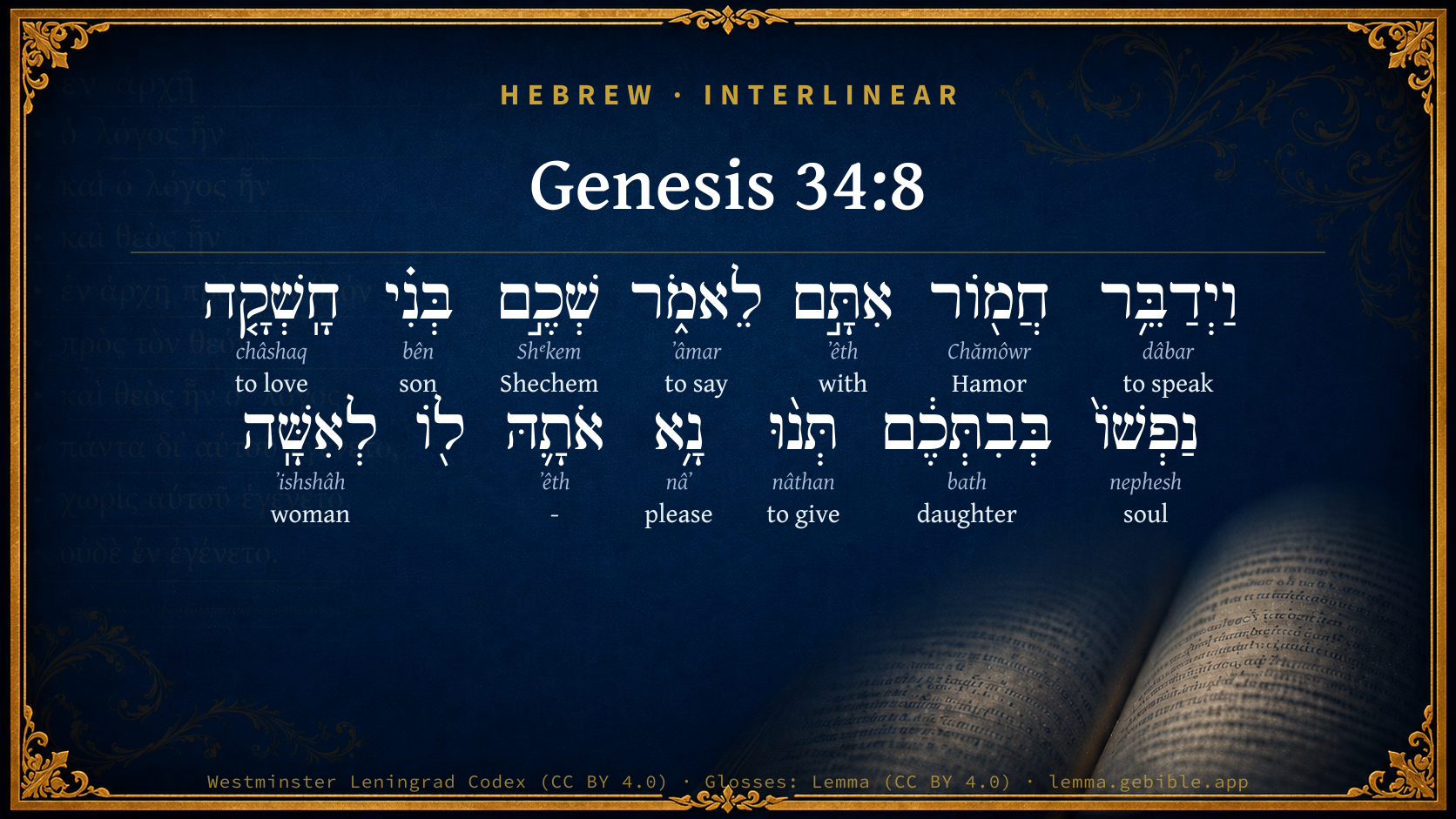
Hebrew (Westminster Leningrad Codex) Genesis 34:8 appears in the Hebrew Old Testament. The text above is from the Westminster Leningrad Codex. Each word links to its Strong’s number, a concise gloss, and parsing drawn from the Open Scriptures Hebrew Bible morphology. Click any word for its full Brown-Driver-Briggs (BDB) entry.
Download image
Cite this verse

Genesis 34:8 (World English Bible). Public Domain. Lemma interlinear Bible study tool, https://lemma.gebible.app/v/genesis/34/8.

Show BibTeX & RIS
BibTeX
RIS
English Translation
Hamor talked with them, saying, "The soul of my son, Shechem, longs for your daughter. Please give her to him as a wife.
World English Bible · Public Domain
Highlights
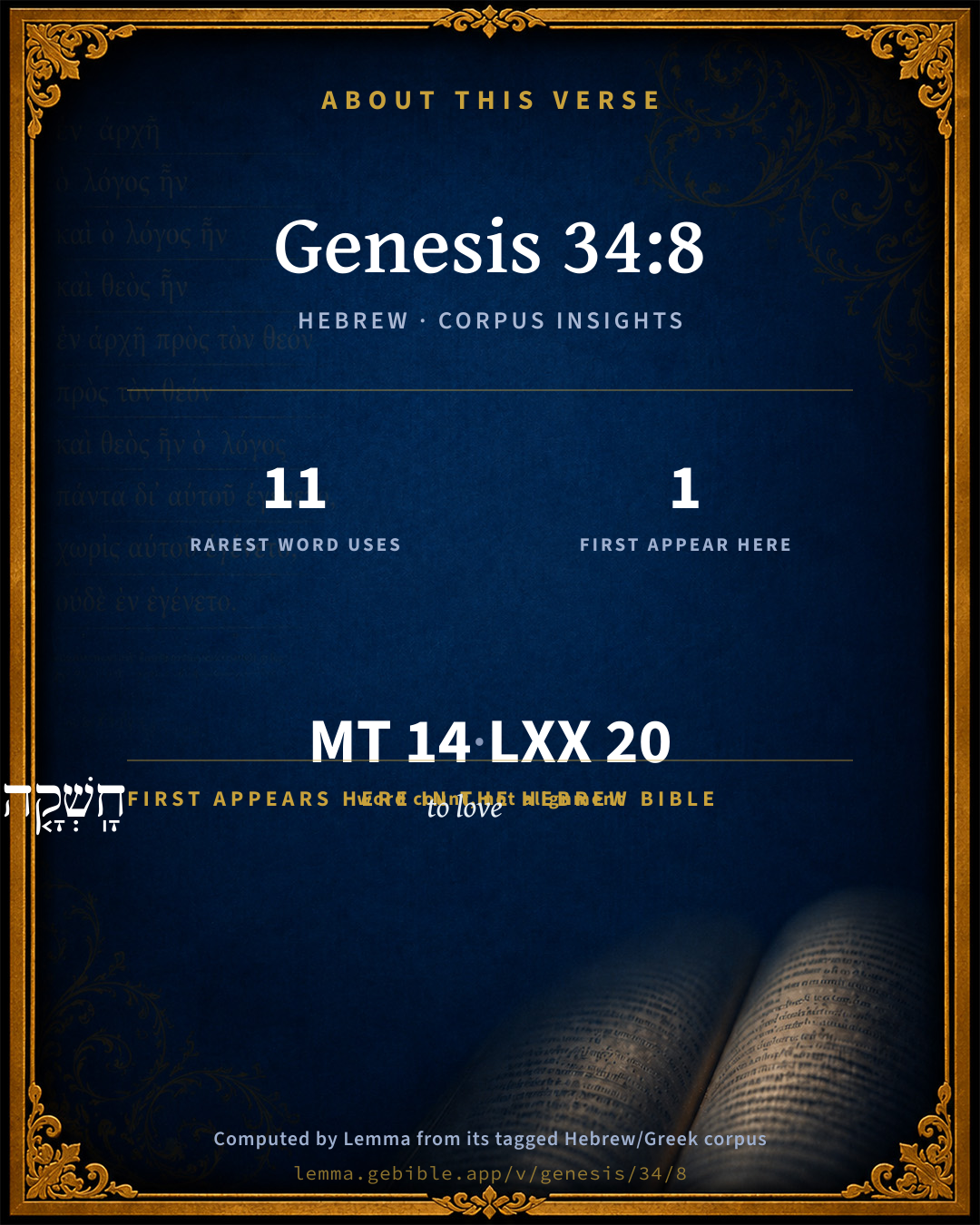
  • 1 first appearance in the Hebrew Bible
Full analysis ↓
Download a study sheet

One document with this verse’s original text, its word-by-word gloss line, the meaning frame, cross-references with their text, attributed commentary, and full source and license credits — printable, and it pastes into notes with its structure intact.

This verse Autodidact and up

Study sheet (.html) Plain text (.txt)

A passage Seminary Student

Up to 50 verses in one chapter. A passage sheet keeps up to 6 commentary sources and 12 cross-references per verse, in the order this page ranks them, and says so on the sheet whenever that leaves anything out. Ask for a single verse and you get the Autodidact verse sheet above.

Everything on this page stays free to read, with no account — the sheet is a download of what is already on screen, not access to it.

Want to remove ads? Support Godless Engineer
Compare translations 3

The same verse in 3 English versions, stacked beneath the original-language interlinear above. Click any original word for its lexicon entry.

Each is an independent rendering of the whole verse — the interlinear is not word-aligned to these translations.

Highlighted words mark where these versions differ — a whole-verse word diff, not a word-by-word alignment.

  • World English Bible Public Domain
    Hamor talked with them, saying, "The soul of my son, Shechem, longs for your daughter. Please give her to him as a wife.
  • King James Version Public Domain
    And Hamor communed with them, saying, The soul of my son Shechem longeth for your daughter: I pray you give her him to wife.
  • unfoldingWord Literal Text CC BY-SA 4.0
    But Hamor spoke with them, saying, “Shechem my son, his soul is attached to your daughter. Please give her to him as a wife.

unfoldingWord Literal Text — © unfoldingWord, licensed CC BY-SA 4.0. Word-aligned USFM3 via Door43 (git.door43.org/unfoldingWord/en_ult).

Versions to compare (up to 4)

3 of 4 selected

Show all 18 translations

Every available English version of this verse, each an independent rendering of the whole verse.

  • World English Bible Public Domain
    Hamor talked with them, saying, "The soul of my son, Shechem, longs for your daughter. Please give her to him as a wife.
  • Berean Standard Bible Public Domain
    But Hamor said to them, “My son Shechem longs for your daughter. Please give her to him as his wife.
  • Majority Standard Bible Public Domain
    But Hamor said to them, “My son Shechem longs for your daughter. Please give her to him as his wife.
  • King James Version Public Domain
    And Hamor communed with them, saying, The soul of my son Shechem longeth for your daughter: I pray you give her him to wife.
  • American Standard Version (1901) Public Domain
    And Hamor communed with them, saying, The soul of my son Shechem longeth for your daughter: I pray you, give her unto him to wife.
  • Revised Version (1885) Public Domain
    And Hamor communed with them, saying, The soul of my son Shechem longeth for your daughter: I pray you give her unto him to wife.
  • Geneva Bible (1599) Public Domain
    And Hamor communed with them, saying, the soule of my sonne Shechem longeth for your daughter: giue her him to wife, I pray you.
  • Douay-Rheims (1899) Public Domain
    And Hemor spoke to them: The soul of my son Sichem has a longing for your daughter: give her him to wife:
  • Young's Literal Translation Public Domain
    And Hamor speaketh with them, saying, `Shechem, my son, his soul hath cleaved to your daughter; give her, I pray you, to him for a wife,
  • Literal Standard Version CC BY-SA 4.0
    And Hamor speaks with them, saying, “Shechem, my son, his soul has cleaved to your daughter; please give her to him for a wife,
  • Unlocked Literal Bible CC BY-SA 4.0
    Hamor spoke with them, saying, “My son Shechem loves your daughter. Please give her to him as a wife.
  • unfoldingWord Literal Text CC BY-SA 4.0
    But Hamor spoke with them, saying, “Shechem my son, his soul is attached to your daughter. Please give her to him as a wife.
  • Darby Bible Public Domain
    And Hamor spoke to them, saying, My son Shechem's soul cleaves to your daughter: I pray you, give her to him as wife.
  • World Messianic Bible Public Domain
    Hamor talked with them, saying, “The soul of my son, Shechem, longs for your daughter. Please give her to him as a wife.
  • Webster's Bible Public Domain
    And Hamor communed with them, saying, The soul of my son Shechem longeth for your daughter: I pray you give her to him for a wife.
  • Free Bible Version CC BY-SA 4.0
    Hamor told them, “My son Shechem is very much in love with your daughter and your sister Dinah. Please allow him to marry her.
  • Bible in Basic English Public Domain
    But Hamor said to them, Shechem, my son, is full of desire for your daughter: will you then give her to him for a wife?
  • JPS Tanakh (1917) Public Domain
    And Hamor spoke with them, saying 'The soul of my son Shechem longeth for your daughter. I pray you give her unto him to wife.

Literal Standard Version (2020), Covenant Press — licensed CC BY-SA 4.0. Text via the HelloAO Bible API (eBible.org). Unlocked Literal Bible (unfoldingWord) — licensed CC BY-SA 4.0. Text via the HelloAO Bible API (eBible.org). unfoldingWord Literal Text — © unfoldingWord, licensed CC BY-SA 4.0. Word-aligned USFM3 via Door43 (git.door43.org/unfoldingWord/en_ult). Free Bible Version, Dr. Jonathan Gallagher — licensed CC BY-SA 4.0. Text via the HelloAO Bible API (eBible.org).

Word by word

More ways to search: Search by grammar → Find every occurrence → Compare this word →

Practice this passage: Drill this verse → Learn its vocabulary →

חָֽשְׁקָ֤ה
châshaq
H2836
“to love”
Verb, Qal, Perfect, 3rd Person, Feminine, Singular
Part of Speech
Verb
Stem
Qal
Form
Perfect
Person
3rd Person
Gender
Feminine
Number
Singular
Full BDB Definition

Origin: a primitive root

TWOT: 773

(Qal) to love, be attached to, long for - (Piel) fillet - (Pual) fillet
  1. וַיְדַבֵּ֥ר dâbar H1696 “and · to speak” Conjunction + Verb, Piel, Sequential Imperfect, 3rd Person, Masculine, Singular
  2. חֲמ֖וֹר Chămôwr H2544 “Hamor” Noun, Proper
  3. אִתָּ֣ם ʼêth H854 “with · them” Preposition + Suffix, Personal, 3rd Person, Masculine, Plural
  4. לֵאמֹ֑ר ʼâmar H559 “to say” Preposition + Verb, Qal, Infinitive Construct
  5. שְׁכֶ֣ם Shᵉkem H7927 “Shechem” Noun, Proper
  6. בְּנִ֗י bên H1121 “son · my” Noun, Common, Masculine, Singular, Construct + Suffix, Personal, 1st Person, Common, Singular
  7. נַפְשׁוֹ֙ nephesh H5315 “soul · his” Noun, Common, Both, Singular, Construct + Suffix, Personal, 3rd Person, Masculine, Singular
  8. בְּבִתְּכֶ֔ם bath H1323 “in/at · daughter · your” Preposition + Noun, Common, Feminine, Singular, Construct + Suffix, Personal, 2nd Person, Masculine, Plural
  9. תְּנ֨וּ nâthan H5414 “give” Verb, Qal, Imperative, 2nd Person, Masculine, Plural
  10. נָ֥א nâʼ H4994 “please” Particle, Exhortation
  11. אֹתָ֛הּ ʼêth H853 “- · her” Particle, Direct Object + Suffix, Personal, 3rd Person, Feminine, Singular
  12. לְאִשָּֽׁה ʼishshâh H802 “to/for · woman” Preposition + Noun, Common, Feminine, Singular, Absolute

About this verse

These counts appear in no published source. They are computed here, from the morphology-tagged text and Lemma’s own curated glosses. What Lemma adds →

14
words
13
distinct lemmas
Pentateuch
section

Notable vocabulary

The rarest word here is חָֽשְׁקָ֤ה to love H2836 — appearing just 11 times in the whole Hebrew Bible.

First appearance in Scripture

This word makes its first canonical appearance in the Hebrew Bible here:

  • חָֽשְׁקָ֤ה to love H2836

Shared distinctive vocabulary

חָֽשְׁקָ֤ה to love H2836 occurs in 11 verses of the Hebrew Bible. Also found in:

Grammatical profile

  • 4 verbs
  • 6 nouns
  • 2 prepositions
  • 2 particles

Verb forms

  • וַיְדַבֵּ֥ר Piel · Sequential Imperfect
  • לֵאמֹ֑ר Qal · Infinitive Construct
  • חָֽשְׁקָ֤ה Qal · Perfect
  • תְּנ֨וּ Qal · Imperative

Hebrew & Septuagint length

In English translation the verse runs 23 words from the Hebrew and 24 from the Septuagint (LXX English) — closely comparable.

A rough comparison of the two English renderings, which tokenize alike — not a word-level alignment.

Word counts can differ between the Hebrew and the Greek without any difference in meaning — e.g. the Hebrew direct-object marker אֵת has no separate Greek word, and Greek often adds the article ὁ.

In the original languages it is 14 Hebrew tokens and 20 Greek tokens — but the two are counted differently (Hebrew bundles its prefixes and suffixes into one token; the Greek is in lemma form), so that isn’t a like-for-like length.

Cross-references

5

Topical passages linked to Genesis 34:8 in the Treasury of Scripture Knowledge — connected by theme and wording, ordered by reader-vote popularity; previews shown in the World English Bible.

  • 1 Kings 11:2 of the nations concerning which Yahweh said to the children of Israel, You shall not go among them, neither shall they come among you; for surely they will turn away your heart after their gods: Solomon joined to these in love.
  • Psalms 119:20 My soul is consumed with longing for your ordinances at all times.
  • Genesis 34:3 His soul joined to Dinah, the daughter of Jacob, and he loved the young lady, and spoke kindly to the young lady.
  • Psalms 63:1 God, you are my God. I will earnestly seek you. My soul thirsts for you, My flesh longs for you, In a dry and weary land, where there is no water.
  • Psalms 84:2 My soul longs, and even faints for the courts of Yahweh. My heart and my flesh cry out for the living God.

Cross-references courtesy of OpenBible.info (CC BY 4.0).

Hebrew and Greek witnesses Masoretic Hebrew ↔ Greek Septuagint

The same verse in the two great witnesses to the Old Testament, shown verse-for-verse.

These are two independent witnesses, not word-aligned to each other, and the Septuagint is shown in lemma (dictionary) form.

Hebrew Genesis 34:8 Masoretic · Westminster Leningrad Codex

וַיְדַבֵּ֥ר חֲמ֖וֹר אִתָּ֣ם לֵאמֹ֑ר שְׁכֶ֣ם בְּנִ֗י חָֽשְׁקָ֤ה נַפְשׁוֹ֙ בְּבִתְּכֶ֔ם תְּנ֨וּ נָ֥א אֹתָ֛הּ ל֖וֹ לְאִשָּֽׁה

Hamor talked with them, saying, "The soul of my son, Shechem, longs for your daughter. Please give her to him as a wife.

World English Bible · Public Domain

Greek LXX Genesis 34:8 Septuagint · lemma form

καί λαλέω εμμωρ αὐτός λέγω συχεμ ὁ υἱός ἐγώ προαἱρέω ὁ ψυχή ὁ θυγάτηρ σύ δίδωμι οὖν αὐτός αὐτός γυνή

And Emmor spoke to them, saying, Sychem my son has chosen in his heart your daughter; give her therefore to him for a wife,

LXX2012 (modern English Septuagint) · Public Domain

Hebrew: Westminster Leningrad Codex (CC BY 4.0). Greek: Septuagint (public domain); English from LXX2012 (modern English Septuagint) (Public Domain). How the Septuagint differs from the Hebrew →

Targum (Aramaic paraphrase)

2

The Targum is the ancient Jewish Aramaic paraphrase of the Hebrew Scriptures — an interpretive translation, not the Hebrew text itself. Onkelos (literal) and Pseudo-Jonathan (expansive) render the Torah, and Jonathan the Prophets. Coverage is partial: where no permissively-licensed English translation exists for a verse, only the Aramaic is shown. This is verse-level text, not a word-by-word alignment to the Hebrew.

  1. Targum Onkelos Torah (Genesis–Deuteronomy)
    וּמַלִּיל חֲמוֹר עִמְּהוֹן לְמֵימָר שְׁכֶם בְּרִי אִתְרְעִיאַת נַפְשֵׁהּ בִּבְרַתְּכוֹן הָבוּ כְעַן יָתַהּ לֵהּ לְאִנְתּוּ

    (no public-domain English translation for this verse)

    Targum Onkelos — Aramaic: “Onkelos Genesis” (public domain); “Onkelos Exodus” (public domain); “Onkelos Leviticus” (public domain); “Onkelos Numbers” (public domain); “Onkelos Deuteronomy” (public domain). English: “Sefaria Community Translation” (CC0 1.0 (public-domain dedication)); “J.W. Etheridge. The Targums of Onkelos and Jonathan Ben Uzziel on the Pentateuch. London: Longmans, Green, 1862” (public domain). Text via Sefaria.

  2. Targum Pseudo-Jonathan Torah (Genesis–Deuteronomy)
    וּמַלֵיל עִמְהוֹן חֲמוֹר לְמֵימָר שְׁכֶם בְּרִי רְעִיַית נַפְשֵׁיהּ בִּבְרַתֵּיכוֹן הָבוּ בְּבָעוּ יָתָהּ לֵיהּ לְאִנְתּוּ

    And Hamor spake with them, saying, The soul of Shekem my son delighteth in your daughter: give her, I pray, to him to wife;

    Targum Pseudo-Jonathan — Aramaic: “Targum Jonathan on Genesis” (public domain); “Targum Jonathan on Exodus” (public domain); “Targum Jonathan on Leviticus” (public domain); “Targum Jonathan on Numbers” (public domain); “Targum Jonathan on Deuteronomy” (public domain). English: “The Targum of Jonathan ben Uzziel, trans. J. W. Etheridge, London, 1862” (public domain). Text via Sefaria.

Commentary

Notes on Genesis 34:8 from classic Christian and Jewish commentators (each source and its license shown beneath its notes). The classic Christian expositions comment on the surrounding passage and are grouped to its opening verse, so a note may address several verses; the Jewish commentaries on the Tanakh (Rashi and others) are per-verse, so they appear only where the commentator wrote on this verse.

Lemma curates 59 commentaries, every one of them public domain or Creative Commons licensed, each selected and text-cleaned for this edition rather than reprinted as found. About our sources →

Trapp's Complete Commentary

John Trapp

Gen 34:8 And Hamor communed with them, saying, The soul of my son Shechem longeth for your daughter: I pray you give her him to wife.

Ver. 8. And Hamor communed with them.] A fond father seeks to satisfy the lust of a loose son, whom he should severely have punished; such parents are peremptores potius quam parentes, saith Bernard; like apes, that kill their young with culling them. They show their love as little, as if, by clapping their hands on their children’s mouths, to keep the cold wind from them, they should strangle them to death. A fair hand, here, maketh a foul wound; when correction would be a kind of cure. Severitas tamen non sit tetra, sed tetrica, saith Sidonius. {a} For, as a cur by trying waxeth fiercer, and as new wine breaketh weak vessels; so too much severity overthroweth, and quite spilleth a tender mind.

{a} Sidonius, lib, iv. epist. 9.

John Trapp, A Commentary or Exposition upon All the Books of the Old and New Testament (1647–1656) — public domain. Text from a community e-Sword module.

Joseph Benson's Commentary

Gen 34:8. Hamor communed with them — Not only with Jacob, but with his sons, to whom Jacob had imprudently referred him. And here we have a particular account of the treaty, in which, it is a shame to say, the Canaanites were more honest than the Israelites.

Joseph Benson's Commentary on the Old and New Testaments (1811–1818) — public domain. Text from a community e-Sword module.

Tyndale Open Study Notes

Tyndale Open Resources

34:8-10 Hamor proposed an alliance of intermarriage with the prospect of mutual economic benefit, but God had already promised Jacob everything, including the land (34:10; see 14:21-24). Hamor wanted to gain control of Israel’s wealth (34:23); no good could come of trusting the defiling Canaanites. For some of these reasons, intermarriage with Canaanites was not allowed under the law (see Exod 23:27-33; Deut 7:1-5)—unless, of course, they came to faith (see Josh 2:1-15; 6:23-25; Matt 1:5).

Tyndale Open Study Notes — © Tyndale Open Resources, licensed CC BY-SA 4.0. Text via the HelloAO Bible API.

Geneva Bible (1599)

Geneva Bible translators

Or, marriage.

Geneva Bible (1599) marginal notes — public domain. Text via Bolls.life.

Jamieson, Fausset & Brown

Robert Jamieson, A. R. Fausset & David Brown

Hamor communed with them--The prince and his son seem at first sight to have acted honestly, and our feelings are enlisted on their side. They betray no jealousy of the powerful shepherds; on the contrary, they show every desire to establish friendly intercourse. But their conduct was unjustifiable in neither expressing regret nor restoring Dinah to her family; and this great error was the true cause of the negotiations ending in so unhappy a manner.

Jamieson, Fausset & Brown — Commentary Critical and Explanatory on the Whole Bible (1871) — public domain (CC PDM 1.0). Text via the HelloAO Bible API.

John Calvin's Commentaries

8. And Hamor communed with them. Though the sons of Jacob were justly incensed, yet their indignation ought to have been appeased, or at least somewhat mitigated, by the great courteousness of Hamor. And if the humanity of Hamor could not reconcile the sons of Jacob to Shechem, the old man himself was indeed worthy of a benignant reception. We see what equitable conditions he offers; he himself was the prince of the city, the sons of Jacob were strangers. Therefore their minds must have been savage beyond measure, not to be inclined to levity. Besides, the suppliant entreaty of Shechem himself deserved this, that they should have granted forgiveness to his fervent love. Therefore, that they remained implacable, is a sign of most cruel pride. What would they have done to enemies who had purposely injured them, when they are not moved by the prayers of him, who, being deceived by blind love, and by the error of incontinence, has injured them without any malicious intention?

John Calvin's Commentaries (1540-1563) — public domain. Text from the Calvin Translation Society English edition (1840s-50s) via the Christian Classics Ethereal Library (ccel.org). Calvin's coverage is partial (roughly two-thirds of the Bible); uncommented books and verses are honest gaps, never fabricated. The 19th-century editor's footnotes and remarks are omitted so the notes are faithfully Calvin's own voice.

John Gill's Exposition

And Hamor communed with them,.... With Jacob and his sons, who came in just at that time:

saying, the soul of my son Shechem longeth for your daughter: the daughter of the family, and the only daughter in it; for her Shechem had a vehement affection, a strong desire to marry her, and could not be satisfied without her:

I pray you, give her him to wife; he not only requests the consent of the parents of the damsel, but of her brothers also, which in those times and countries seems to have been usual to ask and have, see Gen 24:50.

John Gill's Exposition of the Whole Bible (1746–1763) — public domain (CC PDM 1.0). Text via the HelloAO Bible API.

Matthew Poole's English Annotations

Hamor communed with them; with Jacob’s sons, to whom Jacob committed the business, being himself oppressed with shame and grief, and fear for his daughter.

Your daughter, the daughter of your family; or he thus speaketh to her brothers, because they transacted all in their father’s name.

Matthew Poole's English Annotations on the Holy Bible (1683–1685) — public domain. Text from a community e-Sword/MySword module.

The Pulpit Commentary

Vers. 8-10. And Hamor communed (literally, spake) with them (i.e. the whole family, or Jacob and his sons), saying, The soul of my son Shechem longeth for the root (qvj;) signifies to join together, intrans., to be joined together, hence to cleave to another in love; (cf. Deu_7:7, Deu_7:10, 15 21:11) of similar import to the word (qbD;) employed in ver. 3, which means to be devotedly attached to any one, as, e.g., to God, (Deu_10:20) to a king, (2Sa_20:2) to a (1Ki_11:2) your daughter. The words are addressed to Jacob"s sons as well as Jacob himself, the brothers equally with the father being regarded as the natural guardians of a sister. I pray yon give her him to wife. The absence of any apology for Shechem"s atrocious outrage against Dinah need not be regarded as indicating some measure of consent on the part of Dinah, but may be explained on the supposition that Hamor"s proposal was considered by himself as a practical admission of his son"s guilt. And make ye marriages with us, literally, contract affinity with us by marriage, the verb chathan being spoken of the father-in-law (chothen), who makes the alliance (vide Furst, "Lex.," sub voce)and give your daughters unto us, from this it has been inferred that Jacob had other daughters besides Dinah, which is not improbable, (Gen_46:7) but the words may not imply more than that Humor thought he had and take our daughters unto you. And (as an inducement to form this alliance) ye shall dwell with us: and the land shall be before you; dwell and trade ye therein, and get you possessions thereini.e. he offers them the privilege of unrestricted movement throughout his dominions, with the right of establishing settlements, carrying on trade, and acquiring property.

The Pulpit Commentary (1880–1919), ed. H.D.M. Spence-Jones & Joseph S. Exell — public domain. Text from a community e-Sword module.

John Wesley's Explanatory Notes

Hamor communed - That is, talked. He came to treat with Jacob himself, but he turns them over to his sons. And here we have a particular account of the treaty, in which it is a shame to say the Canaanites were more honest than the Israelites.

John Wesley, Explanatory Notes Upon the Whole Bible (1754–1765) — public domain. Text via the GEBible commentary corpus.

unfoldingWord translationNotes

Door43 World Missions Community

Hamor spoke with them

"Hamor spoke with Jacob and his sons"

loves your daughter

Here the word "love" refers to romantic love between a man and a woman. AT: "loves her and wants to marry her"

give her to him as a wife

In some cultures, the parents decide whom their children will marry.

Intermarry with us

To intermarry is to marry a member of a different racial, social, religious or tribal group. AT: "Allow marriages between your people and ours"

the land will be open to you

"the land will be available to you"

translationWords

Hamor

Shechem

love

unfoldingWord translationNotes — © Distant Shores Media and the Door43 World Missions Community, licensed CC BY-SA 4.0. Source: git.door43.org/Door43/en_tn.

Rashi

Rabbi Shlomo Yitzchaki (Rashi)

חשקה means desires.

Rashi on the Tanakh — English translations: “The Judaica Press complete Tanach with Rashi, translated by A. J. Rosenberg” (CC BY 4.0); “Pentateuch with Rashi's commentary by M. Rosenbaum and A.M. Silbermann, 1929-1934” (public domain); “The Metsudah Tanach series, Lakewood, N.J” (CC BY 4.0); and “The Book of Joshua, Metsudah Publications, 1997” (CC BY 4.0). Text via Sefaria.

Radak

Rabbi David Kimhi (Radak)

וידבר חמור אתם, with Yaakov and his sons.

בבתכם, not “your sister,” although she was the sister to 11 brothers, but “your daughter,” seeing her status as the daughter of Yaakov was the foremost consideration. Besides, each of Dinah’s brothers was concerned for her well being as if she had been his daughter, not just his sister.

Radak on the Tanakh — English translations: “Sefaria Community Translation” (CC0 1.0 (public-domain dedication)); “Eliyahu Munk, HaChut Hameshulash” (CC BY 4.0); “Rabbi Mike Feuer, Jerusalem Anthology” (CC BY 4.0); and “R. David Kimhi on the first book of Psalms, Translated by R.G. Finch, London, 1919” (public domain). Text via Sefaria.

Lesson kit

Teaching starters — assembled from the data on this page, not authored interpretation. Every prompt links to the verse data it draws on. Edit before teaching.

Genesis, in the Pentateuch, opens this verse with 14 words (13 distinct Hebrew lemmas). Its most distinctive word is châshaq (“to love”). A historical commentator’s framing appears above. Read the whole chapter for the surrounding context.

Discussion questions

  1. How does “to love” (châshaq) shape what this verse is saying?
  2. This is the first place “to love” appears in Scripture (first appears here). What does its debut here establish?
  3. How does Exodus 27:17, which shares the word «to love», read alongside this verse?
  4. These translations render this verse differently. What is at stake in choosing one wording over another?
  5. «וַיְדַבֵּ֥ר» is a Piel Sequential Imperfect verb. How does that grammatical form shape the action described?
  6. Compare how Trapp's Complete Commentary and Joseph Benson's Commentary read this verse. Where do they agree or differ?

Things to notice

Reading settings

Reading text

Shown beneath each verse's original-language words.

Old Testament
Old Testament edition

Read the OT as the Masoretic Hebrew (MT) or the Greek Septuagint (LXX).

English shown for the Greek Septuagint (in the Hebrew ↔ Greek comparison).

Comparing translations? Open the Compare panel on any verse page to stack up to four side by side.