
Genesis 13:15

Hebrew (Westminster Leningrad Codex) Genesis 13:15 appears in the Hebrew Old Testament. The text above is from the Westminster Leningrad Codex. Each word links to its Strong’s number, a concise gloss, and parsing drawn from the Open Scriptures Hebrew Bible morphology. Click any word for its full Brown-Driver-Briggs (BDB) entry.
Download image
Cite this verse

Genesis 13:15 (World English Bible). Public Domain. Lemma interlinear Bible study tool, https://lemma.gebible.app/v/genesis/13/15.

Show BibTeX & RIS
BibTeX
RIS
English Translation
for all the land which you see, I will give to you, and to your offspring forever.
World English Bible · Public Domain
Download a study sheet

One document with this verse’s original text, its word-by-word gloss line, the meaning frame, cross-references with their text, attributed commentary, and full source and license credits — printable, and it pastes into notes with its structure intact.

This verse Autodidact and up

Study sheet (.html) Plain text (.txt)

A passage Seminary Student

Up to 50 verses in one chapter. A passage sheet keeps up to 6 commentary sources and 12 cross-references per verse, in the order this page ranks them, and says so on the sheet whenever that leaves anything out. Ask for a single verse and you get the Autodidact verse sheet above.

Everything on this page stays free to read, with no account — the sheet is a download of what is already on screen, not access to it.

Want to remove ads? Support Godless Engineer
Compare translations 3

The same verse in 3 English versions, stacked beneath the original-language interlinear above. Click any original word for its lexicon entry.

Each is an independent rendering of the whole verse — the interlinear is not word-aligned to these translations.

Highlighted words mark where these versions differ — a whole-verse word diff, not a word-by-word alignment.

  • World English Bible Public Domain
    for all the land which you see, I will give to you, and to your offspring forever.
  • King James Version Public Domain
    For all the land which thou seest, to thee will I give it, and to thy seed for ever.
  • unfoldingWord Literal Text CC BY-SA 4.0
    because all the land that you see I will give to you and to your offspring forever.

unfoldingWord Literal Text — © unfoldingWord, licensed CC BY-SA 4.0. Word-aligned USFM3 via Door43 (git.door43.org/unfoldingWord/en_ult).

Versions to compare (up to 4)

3 of 4 selected

Show all 18 translations

Every available English version of this verse, each an independent rendering of the whole verse.

  • World English Bible Public Domain
    for all the land which you see, I will give to you, and to your offspring forever.
  • Berean Standard Bible Public Domain
    for all the land that you see, I will give to you and your offspring forever.
  • Majority Standard Bible Public Domain
    for all the land that you see, I will give to you and your offspring forever.
  • King James Version Public Domain
    For all the land which thou seest, to thee will I give it, and to thy seed for ever.
  • American Standard Version (1901) Public Domain
    for all the land which thou seest, to thee will I give it, and to thy seed for ever.
  • Revised Version (1885) Public Domain
    for all the land which thou seest, to thee will I give it, and to thy seed for ever.
  • Geneva Bible (1599) Public Domain
    For all the land, which thou seest, will I giue vnto thee and to thy seede for euer,
  • Douay-Rheims (1899) Public Domain
    All the land which thou seest, I will give to thee, and to thy seed for ever.
  • Young's Literal Translation Public Domain
    for the whole of the land which thou are seeing, to thee I give it, and to thy seed -- to the age.
  • Literal Standard Version CC BY-SA 4.0
    for the whole of the land which you are seeing, I give it to you and to your Seed for all time.
  • Unlocked Literal Bible CC BY-SA 4.0
    All this land which you see, I will give to you and to your descendants forever.
  • unfoldingWord Literal Text CC BY-SA 4.0
    because all the land that you see I will give to you and to your offspring forever.
  • Darby Bible Public Domain
    for all the land that thou seest will I give to thee, and to thy seed for ever.
  • World Messianic Bible Public Domain
    for I will give all the land which you see to you and to your offspring forever.
  • Webster's Bible Public Domain
    For all the land which thou seest, to thee will I give it, and to thy seed for ever.
  • Free Bible Version CC BY-SA 4.0
    I'm giving all this land you see to you and your descendants forever.
  • Bible in Basic English Public Domain
    For all the land which you see I will give to you and to your seed for ever.
  • JPS Tanakh (1917) Public Domain
    for all the land which thou seest, to thee will I give it, and to thy seed for ever.

Literal Standard Version (2020), Covenant Press — licensed CC BY-SA 4.0. Text via the HelloAO Bible API (eBible.org). Unlocked Literal Bible (unfoldingWord) — licensed CC BY-SA 4.0. Text via the HelloAO Bible API (eBible.org). unfoldingWord Literal Text — © unfoldingWord, licensed CC BY-SA 4.0. Word-aligned USFM3 via Door43 (git.door43.org/unfoldingWord/en_ult). Free Bible Version, Dr. Jonathan Gallagher — licensed CC BY-SA 4.0. Text via the HelloAO Bible API (eBible.org).

Word by word

More ways to search: Search by grammar → Find every occurrence → Compare this word →

Practice this passage: Drill this verse → Learn its vocabulary →

וּֽלְזַרְעֲךָ֖
zeraʻ
H2233
“and · to/for · seed · your”
Conjunction + Preposition + Noun, Common, Masculine, Singular, Construct + Suffix, Personal, 2nd Person, Masculine, Singular
Part of Speech
Conjunction + Preposition + Noun
Type
Common
Gender
Masculine
Number
Singular
State
Construct
Full BDB Definition

Origin: from H2232

TWOT: 582a

seed, sowing, offspring - a sowing - seed - semen virile - offspring, descendants, posterity, children - of moral quality - a practitioner of righteousness (figuratively) - sowing time (by metonymy)
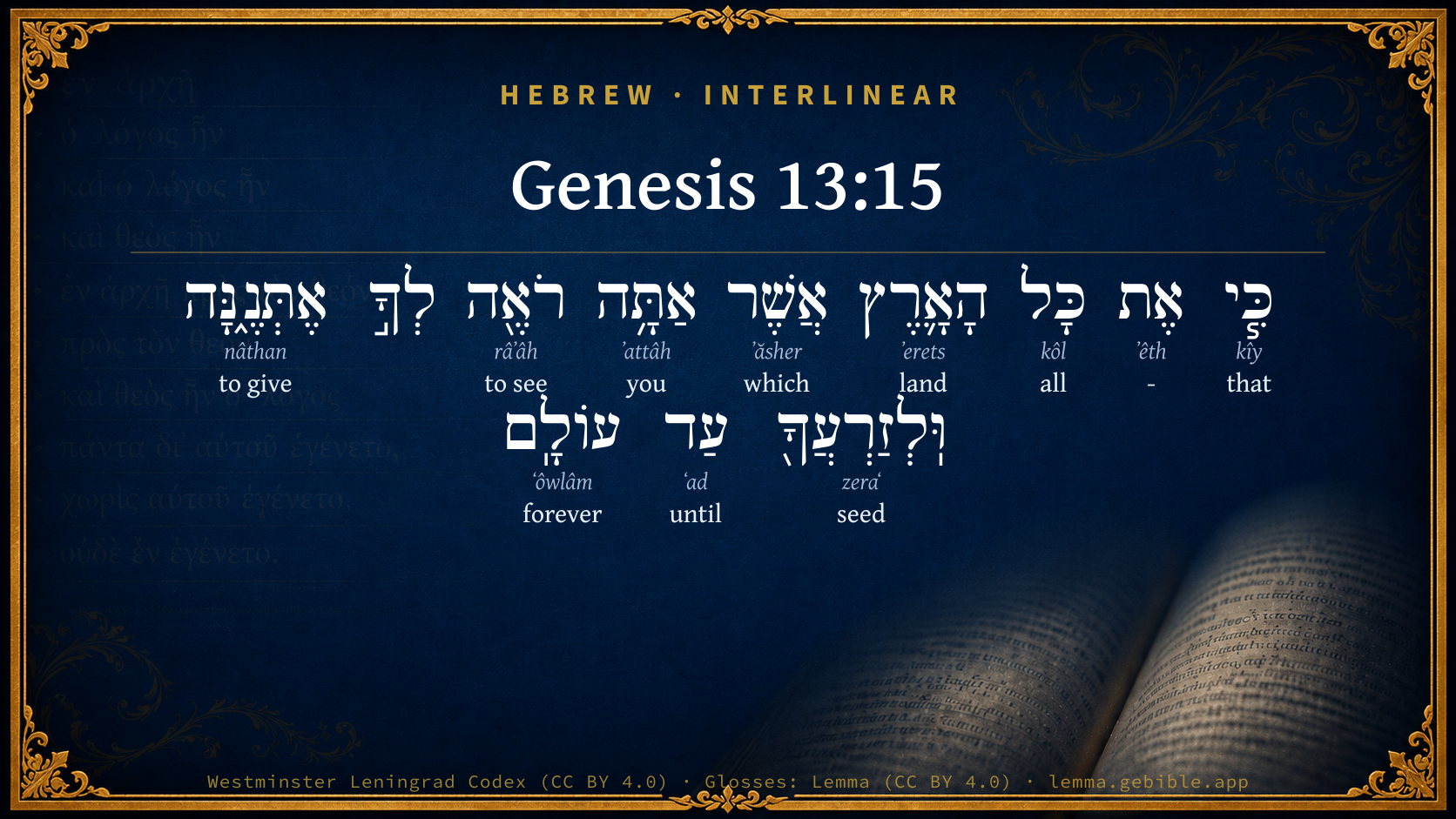
  1. כִּ֧י kîy H3588 “that” Conjunction
  2. אֶת ʼêth H853 “-” Particle, Direct Object
  3. כָּל kôl H3605 “all of” Noun, Common, Masculine, Singular, Construct
  4. הָאָ֛רֶץ ʼerets H776 “the · land” Particle, Definite Article + Noun, Common, Both, Singular, Absolute
  5. אֲשֶׁר ʼăsher H834 “which” Particle, Relative
  6. אַתָּ֥ה ʼattâh H859 “you” Pronoun, Personal, 2nd Person, Masculine, Singular
  7. רֹאֶ֖ה râʼâh H7200 “seeing” Verb, Qal, Participle Active, Masculine, Singular, Absolute
  8. אֶתְּנֶ֑נָּה nâthan H5414 “to give · her” Verb, Qal, Imperfect, 1st Person, Common, Singular + Suffix, Personal, 3rd Person, Feminine, Singular
  9. עַד ʻad H5704 “until” Preposition
  10. עוֹלָֽם ʻôwlâm H5769 “forever” Noun, Common, Masculine, Singular, Absolute

About this verse

These counts appear in no published source. They are computed here, from the morphology-tagged text and Lemma’s own curated glosses. What Lemma adds →

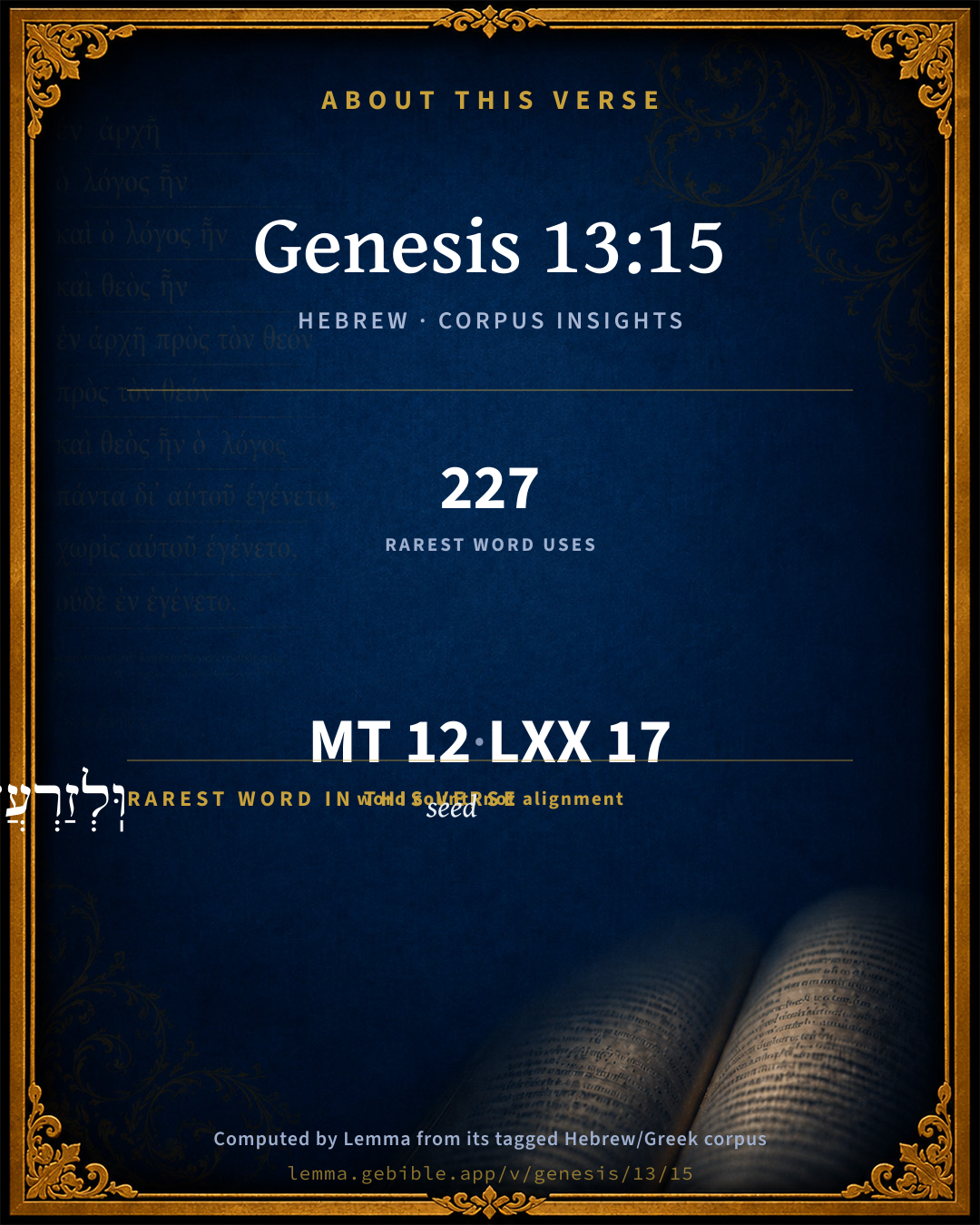
12
words
11
distinct lemmas
Pentateuch
section

Grammatical profile

  • 2 verbs
  • 4 nouns
  • 1 pronoun
  • 2 prepositions
  • 1 conjunction
  • 2 particles

Verb forms

  • רֹאֶ֖ה Qal · Participle Active
  • אֶתְּנֶ֑נָּה Qal · Imperfect

Hebrew & Septuagint length

In English translation the verse runs 17 words from the Hebrew and 19 from the Septuagint (LXX English) — closely comparable.

A rough comparison of the two English renderings, which tokenize alike — not a word-level alignment.

Word counts can differ between the Hebrew and the Greek without any difference in meaning — e.g. the Hebrew direct-object marker אֵת has no separate Greek word, and Greek often adds the article ὁ.

In the original languages it is 12 Hebrew tokens and 17 Greek tokens — but the two are counted differently (Hebrew bundles its prefixes and suffixes into one token; the Greek is in lemma form), so that isn’t a like-for-like length.

Cross-references

24

Topical passages linked to Genesis 13:15 in the Treasury of Scripture Knowledge — connected by theme and wording, ordered by reader-vote popularity; previews shown in the World English Bible.

  • 2 Chronicles 20:7 Did not you, our God, drive out the inhabitants of this land before your people Israel, and give it to the seed of Abraham your friend forever?
  • Genesis 12:7 Yahweh appeared to Abram, and said, "I will give this land to your seed." He built an altar there to Yahweh, who appeared to him.
  • Genesis 15:18 In that day Yahweh made a covenant with Abram, saying, "To your seed have I given this land, from the river of Egypt to the great river, the river Euphrates:
  • Genesis 35:12 The land which I gave to Abraham and Isaac, I will give it to you, and to your seed after you will I give the land."
  • Psalms 37:22 For such as are blessed by him shall inherit the land. Those who are cursed by him shall be cut off.
  • Acts 7:5 He gave him no inheritance in it, no, not so much as to set his foot on. He promised that he would give it to him for a possession, and to his seed after him, when he still had no child.
  • Nehemiah 9:7–8 You are Yahweh the God, who did choose Abram, and brought him forth out of Ur of the Chaldees, and gave him the name of Abraham,
  • Psalms 37:29 The righteous shall inherit the land, And live in it forever.
  • Psalms 105:9–12 The covenant which he made with Abraham, His oath to Isaac,
  • Genesis 17:7–8 I will establish my covenant between me and you and your seed after you throughout their generations for an everlasting covenant, to be a God to you and to your seed after you.
  • Genesis 24:7 Yahweh, the God of heaven, who took me from my father's house, and from the land of my birth, who spoke to me, and who swore to me, saying, 'I will give this land to your seed.' He will send his angel before you, and you shall take a wife for my son from there.
  • Genesis 26:3–4 Sojourn in this land, and I will be with you, and will bless you. For to you, and to your seed, I will give all these lands, and I will establish the oath which I swore to Abraham your father.
  • Genesis 28:4 and give you the blessing of Abraham, to you, and to your seed with you, that you may inherit the land where you travel, which God gave to Abraham."
  • Genesis 28:13 Behold, Yahweh stood above it, and said, "I am Yahweh, the God of Abraham your father, and the God of Isaac. The land whereon you lie, to you will I give it, and to your seed.
  • Genesis 48:4 and said to me, 'Behold, I will make you fruitful, and multiply you, and I will make of you a company of peoples, and will give this land to your seed after you for an everlasting possession.'
  • Exodus 33:1 Yahweh spoke to Moses, "Depart, go up from here, you and the people that you have brought up out of the land of Egypt, to the land of which I swore to Abraham, to Isaac, and to Jacob, saying, 'I will give it to your seed.'
  • Numbers 34:2 Command the children of Israel, and tell them, When you come into the land of Canaan (this is the land that shall fall to you for an inheritance, even the land of Canaan according to the borders of it),
  • Numbers 34:12–29 and the border shall go down to the Jordan, and the goings out of it shall be at the Salt Sea. This shall be your land according to the borders of it round about.
  • Deuteronomy 26:2–4 that you shall take of the first of all the fruit of the ground, which you shall bring in from your land that Yahweh your God gives you; and you shall put it in a basket, and shall go to the place which Yahweh your God shall choose, to cause his name to dwell there.
  • Deuteronomy 34:4 Yahweh said to him, This is the land which I swore to Abraham, to Isaac, and to Jacob, saying, I will give it to your seed: I have caused you to see it with your eyes, but you shall not go over there.
  • Matthew 5:5 Blessed are the gentle, For they shall inherit the earth.
  • Psalms 112:1–2 Praise Yah! Blessed is the man who fears Yahweh, Who delights greatly in his commandments.
  • Isaiah 63:18 Your holy people possessed [it] but a little while: our adversaries have trodden down your sanctuary.
  • Genesis 18:18 seeing that Abraham has surely become a great and mighty nation, and all the nations of the earth will be blessed in him?

Cross-references courtesy of OpenBible.info (CC BY 4.0).

Hebrew and Greek witnesses Masoretic Hebrew ↔ Greek Septuagint

The same verse in the two great witnesses to the Old Testament, shown verse-for-verse.

These are two independent witnesses, not word-aligned to each other, and the Septuagint is shown in lemma (dictionary) form.

Hebrew Genesis 13:15 Masoretic · Westminster Leningrad Codex

כִּ֧י אֶת כָּל הָאָ֛רֶץ אֲשֶׁר אַתָּ֥ה רֹאֶ֖ה לְךָ֣ אֶתְּנֶ֑נָּה וּֽלְזַרְעֲךָ֖ עַד עוֹלָֽם

for all the land which you see, I will give to you, and to your offspring forever.

World English Bible · Public Domain

Greek LXX Genesis 13:15 Septuagint · lemma form

ὅτι πᾶς ὁ γῆ ὅς σύ ὁράω σύ δίδωμι αὐτός καί ὁ σπέρμα σύ ἕως ὁ αἰών

for all the land which you see, I will give it to you and to your seed for ever.

LXX2012 (modern English Septuagint) · Public Domain

Hebrew: Westminster Leningrad Codex (CC BY 4.0). Greek: Septuagint (public domain); English from LXX2012 (modern English Septuagint) (Public Domain). How the Septuagint differs from the Hebrew →

Targum (Aramaic paraphrase)

2

The Targum is the ancient Jewish Aramaic paraphrase of the Hebrew Scriptures — an interpretive translation, not the Hebrew text itself. Onkelos (literal) and Pseudo-Jonathan (expansive) render the Torah, and Jonathan the Prophets. Coverage is partial: where no permissively-licensed English translation exists for a verse, only the Aramaic is shown. This is verse-level text, not a word-by-word alignment to the Hebrew.

  1. Targum Onkelos Torah (Genesis–Deuteronomy)
    אֲרֵי יָת כָּל אַרְעָא דִי אַתְּ חָזֵי לָךְ אֶתְּנִנַהּ וְלִבְנָיךְ עַד עָלָם

    for all this land that thou seest, to thee will I give it, and to thy children for ever.

    Targum Onkelos — Aramaic: “Onkelos Genesis” (public domain); “Onkelos Exodus” (public domain); “Onkelos Leviticus” (public domain); “Onkelos Numbers” (public domain); “Onkelos Deuteronomy” (public domain). English: “Sefaria Community Translation” (CC0 1.0 (public-domain dedication)); “J.W. Etheridge. The Targums of Onkelos and Jonathan Ben Uzziel on the Pentateuch. London: Longmans, Green, 1862” (public domain). Text via Sefaria.

  2. Targum Pseudo-Jonathan Torah (Genesis–Deuteronomy)
    אֲרוּם יַת כָּל אַרְעָא דְאַנְתְּ חָמֵי לָךְ אֶתְּנִינָהּ וְלִבְנָךְ עַד עַלְמָא

    for all the land that thou seest will I give unto thee, and to thy sons, for ever.

    Targum Pseudo-Jonathan — Aramaic: “Targum Jonathan on Genesis” (public domain); “Targum Jonathan on Exodus” (public domain); “Targum Jonathan on Leviticus” (public domain); “Targum Jonathan on Numbers” (public domain); “Targum Jonathan on Deuteronomy” (public domain). English: “The Targum of Jonathan ben Uzziel, trans. J. W. Etheridge, London, 1862” (public domain). Text via Sefaria.

Commentary

Notes on Genesis 13:15 from classic Christian and Jewish commentators (each source and its license shown beneath its notes). The classic Christian expositions comment on the surrounding passage and are grouped to its opening verse, so a note may address several verses; the Jewish commentaries on the Tanakh (Rashi and others) are per-verse, so they appear only where the commentator wrote on this verse.

Lemma curates 59 commentaries, every one of them public domain or Creative Commons licensed, each selected and text-cleaned for this edition rather than reprinted as found. About our sources →

Trapp's Complete Commentary

John Trapp

Gen 13:15 For all the land which thou seest, to thee will I give it, and to thy seed for ever.

Ver. 15. For all the land which thou seest is thine.] "God gave him no inheritance in it, no, not so much as a foot breadth"; {Act 7:5} yet he promised that he would give it to him: and that Abram took for good freehold. Men use to reckon their wealth, not by what ready money they have only, but by the good bonds and leases they can produce. A great part of a Christian’s estate lies in bonds and bills of God’s hand.

John Trapp, A Commentary or Exposition upon All the Books of the Old and New Testament (1647–1656) — public domain. Text from a community e-Sword module.

Geneva Bible (1599)

Geneva Bible translators

Meaning, a long time, and till the coming of Christ as Exod. 12:14 and 21:6; Deut. 15:17, and spiritually this is referred to the true children of Abram, born according to the promise, and not according to the flesh, which are heirs of the true land of Canaan.

Geneva Bible (1599) marginal notes — public domain. Text via Bolls.life.

Adam Clarke's Commentary

Verse 15. To thee will I give it, and to thy seed for ever.] This land was given to Abram, that it might lineally and legally descend to his posterity; and though Abram himself cannot be said to have possessed it, Ac 7:5, yet it was the gift of God to him in behalf of his seed; and this was always the design of God, not that Abram himself should possess it, but that his posterity should, till the manifestation of Christ in the flesh. And this is chiefly what is to be understood by the words for ever, אד עולם ad olam, to the end of the present dispensation, and the commencement of the new. עולם olam means either ETERNITY, which implies the termination of all time or duration, such as is measured by the celestial luminaries: or a hidden, unknown period, such as includes a completion or final termination of a particular era, dispensation, c. therefore the first is its proper meaning, the latter its accommodated meaning. See Clarke on Ge 17:7. See Clarke on Ge 21:33.

Adam Clarke's Commentary on the Bible (1810–1826) — public domain. Text from a community e-Sword/MySword module.

The Cambridge Bible for Schools and Colleges

gen. ed. J. J. S. Perowne

15. to thee will I give it, and to thy seed for ever] The gift to Abram is one of promise and prediction. The gift to his “seed” was to be fulfilled in history. If the words “for ever” are to have their fullest meaning, the land is a pledge symbolic of God’s mercy and goodness towards the people. Their expansion and discipline will be in Palestine. The land and the people will be identified.

The Cambridge Bible for Schools and Colleges (gen. ed. J. J. S. Perowne; Cambridge University Press, 1878–1918) — public domain. Text from a community e-Sword module.

John Gill's Exposition

For all the land which thou seest, to thee will I give it,.... Not only so much of it as his eye could reach, but all of it, as far as it went, which way soever he looked; and this he gave him to sojourn in now where he pleased, and for his posterity to dwell in hereafter; he gave him the title to it now, and to them the possession of it for future times:

and to thy seed for ever; the meaning is, that he gave it to his posterity to be enjoyed by them until the Messiah came, when a new world would begin; and which Abram in person shall enjoy, with all his spiritual seed, after the resurrection, when that part of the earth will be renewed, as the rest; and where particularly Christ will make his personal appearance and residence, the principal seed of Abram, and will reign a thousand years; see Gill on Mat 22:32; besides, this may be typical of the heavenly Canaan given to Abram, and all his spiritual seed, and which shall be enjoyed by them for evermore.

John Gill's Exposition of the Whole Bible (1746–1763) — public domain (CC PDM 1.0). Text via the HelloAO Bible API.

Haydock's Catholic Bible Commentary

And to: This is by way of explanation to the former words: (Haydock) for Abram never possessed a foot of this land by inheritance, Acts viii. 5. Even his posterity never enjoyed it, at least, for any long time. St. Augustine gives the reason; because the promise was conditional, and the Jews did not fulfil their part by obedience and fidelity. (q. 3. in Gen.) It is better, however, to understand these promises of another land, which the people, who imitate the faith of Abram, shall enjoy in the world to come. (Calmet) (Romans iv. 16.)

George Leo Haydock (1774–1849), Haydock's Catholic Family Bible and Commentary, 1859 edition — public domain. Excludes Psalms (Douay-Rheims chapter numbering differs from Protestant) and Deuterocanonical books (Catholic canon only).

Matthew Poole's English Annotations

Object. Abram could see but a little part of the land.

Answ.

1. He might now possibly be upon a mountain, from whence he might have a large prospect every way.

2. He gave him all that he saw, but not only that, but also the rest of the land, and therefore he bids him walk through and view the whole land, Gen 13:17.

Quest. How was the land given to Abram, when it is expressly said: He, i.e. God, gave him none inheritance in it, no, not so much as to set his foot on, Act 7:5.

Answ.

1. God gave Abram the right to it, though not the actual possession of it, until the time that God appointed; as God gave the right of the kingdom to David, but not the possession till Saul's death.

2. God explains himself, To thee and to thy seed, i.e. to thee, that is, to thy seed, and that for thy sake; the particle and being put oft for that is, as 1Ch 21:12, compared with 2Sa 24:13; Eph 1:3, and in many other plaecs, as we shall see.

Quest. How was this for ever, when after some hundreds of years they were turned out of it?

Answer.

1. This promise was made to them upon condition of their obedience, which is oft expressed in other places, as Lev 18:26; Deu 4:25-26; Isa 48:18-19.

2. The word olam, rendered for ever, doth not always signify eternity, but a long continuance, as is evident from Gen 17:13; 48:4; Exo 21:6; Psa 132:14, and many other places of Scripture; and in particular, when it is applied to the Jewish rites and privileges, it commonly signifies no more than during the standing of that commonwealth, or until the coming of the Messias; and so it may here be understood.

Matthew Poole's English Annotations on the Holy Bible (1683–1685) — public domain. Text from a community e-Sword/MySword module.

Radak

Rabbi David Kimhi (Radak)

כי את כל הארץ, even though Avram could not see the whole of the land of Canaan from where he stood, G’d told him to look in all the four directions of the globe to tell him that just as the land extended beyond his range of physical vision in every direction, so G’d would give to his descendants all of this as an inheritance, after at this time already having given it to Avram as a gift. The fact that at the moment this land was under the sovereignty of the Canaanites was legally irrelevant. He, Avram, would transfer title to his descendants as his heirs. [an inheritance cannot be revoked, whereas a gift can be revoked by the donor. Ed.]

עד עולם, they would expel the nations living here from this land. Even though, eventually, the Israelites themselves would be exiled from their land, in the end they would return there on a permanent enduring basis.

Radak on the Tanakh — English translations: “Sefaria Community Translation” (CC0 1.0 (public-domain dedication)); “Eliyahu Munk, HaChut Hameshulash” (CC BY 4.0); “Rabbi Mike Feuer, Jerusalem Anthology” (CC BY 4.0); and “R. David Kimhi on the first book of Psalms, Translated by R.G. Finch, London, 1919” (public domain). Text via Sefaria.

Lesson kit

Teaching starters — assembled from the data on this page, not authored interpretation. Every prompt links to the verse data it draws on. Edit before teaching.

Genesis, in the Pentateuch, opens this verse with 12 words (11 distinct Hebrew lemmas). Its most distinctive word is zeraʻ (“seed”). A historical commentator’s framing appears above. Read the whole chapter for the surrounding context.

Discussion questions

  1. How does “seed” (zeraʻ) shape what this verse is saying?
  2. 2 Chronicles 20:7 shares this passage’s theme. How do the two illuminate each other?
  3. These translations render this verse differently; the difference is in the English rendering, not the original. What questions does that raise?
  4. The verb «רֹאֶ֖ה» is Qal Participle Active. How does its form color the action?
  5. Reading how Trapp's Complete Commentary and Geneva Bible (1599) read this verse, where do the two commentators agree and where do they part?

Things to notice

Reading settings

Reading text

Shown beneath each verse's original-language words.

Old Testament
Old Testament edition

Read the OT as the Masoretic Hebrew (MT) or the Greek Septuagint (LXX).

English shown for the Greek Septuagint (in the Hebrew ↔ Greek comparison).

Comparing translations? Open the Compare panel on any verse page to stack up to four side by side.