
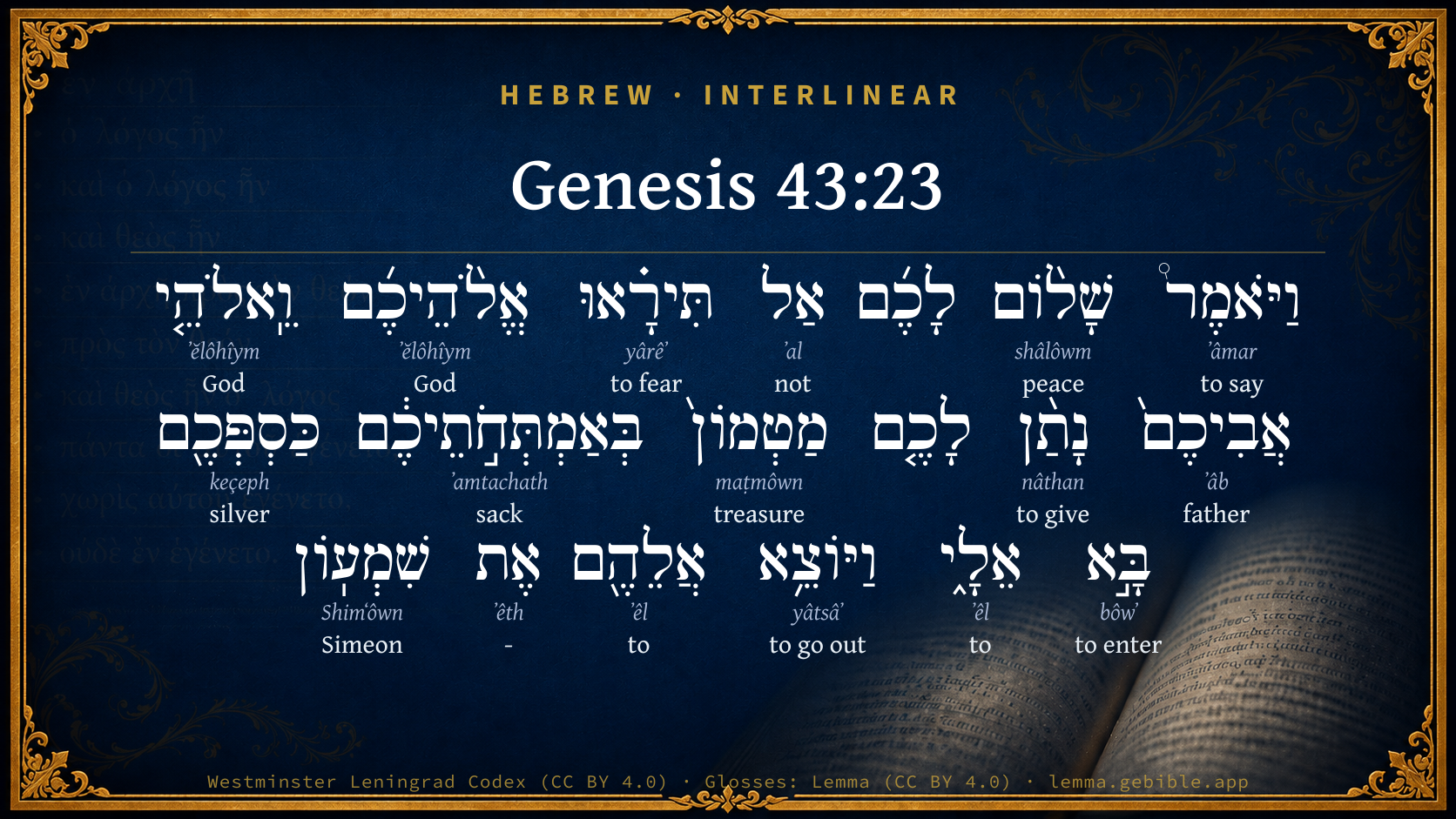
Genesis 43:23

Hebrew (Westminster Leningrad Codex) Genesis 43:23 appears in the Hebrew Old Testament. The text above is from the Westminster Leningrad Codex. Each word links to its Strong’s number, a concise gloss, and parsing drawn from the Open Scriptures Hebrew Bible morphology. Click any word for its full Brown-Driver-Briggs (BDB) entry.
Download image
Cite this verse

Genesis 43:23 (World English Bible). Public Domain. Lemma interlinear Bible study tool, https://lemma.gebible.app/v/genesis/43/23.

Show BibTeX & RIS
BibTeX
RIS
English Translation
He said, "Peace be to you. Don't be afraid. Your God, and the God of your father, has given you treasure in your sacks. I received your money." He brought Simeon out to them.
World English Bible · Public Domain
Highlights
  • 1 first appearance in the Hebrew Bible
Full analysis ↓
Download a study sheet

One document with this verse’s original text, its word-by-word gloss line, the meaning frame, cross-references with their text, attributed commentary, and full source and license credits — printable, and it pastes into notes with its structure intact.

This verse Autodidact and up

Study sheet (.html) Plain text (.txt)

A passage Seminary Student

Up to 50 verses in one chapter. A passage sheet keeps up to 6 commentary sources and 12 cross-references per verse, in the order this page ranks them, and says so on the sheet whenever that leaves anything out. Ask for a single verse and you get the Autodidact verse sheet above.

Everything on this page stays free to read, with no account — the sheet is a download of what is already on screen, not access to it.

Want to remove ads? Support Godless Engineer
Compare translations 3

The same verse in 3 English versions, stacked beneath the original-language interlinear above. Click any original word for its lexicon entry.

Each is an independent rendering of the whole verse — the interlinear is not word-aligned to these translations.

Highlighted words mark where these versions differ — a whole-verse word diff, not a word-by-word alignment.

  • World English Bible Public Domain
    He said, "Peace be to you. Don't be afraid. Your God, and the God of your father, has given you treasure in your sacks. I received your money." He brought Simeon out to them.
  • King James Version Public Domain
    And he said, Peace be to you, fear not: your God, and the God of your father, hath given you treasure in your sacks: I had your money. And he brought Simeon out unto them.
  • unfoldingWord Literal Text CC BY-SA 4.0
    But he said, “Peace to you, do not be afraid. Your God and the God of your father has given you hidden treasure in your sacks; your silver came to me.” Then he brought Simeon out to them.

unfoldingWord Literal Text — © unfoldingWord, licensed CC BY-SA 4.0. Word-aligned USFM3 via Door43 (git.door43.org/unfoldingWord/en_ult).

Versions to compare (up to 4)

3 of 4 selected

Show all 18 translations

Every available English version of this verse, each an independent rendering of the whole verse.

  • World English Bible Public Domain
    He said, "Peace be to you. Don't be afraid. Your God, and the God of your father, has given you treasure in your sacks. I received your money." He brought Simeon out to them.
  • Berean Standard Bible Public Domain
    “It is fine,” said the steward. “Do not be afraid. Your God, the God of your father, gave you the treasure that was in your sacks. I received your silver.” Then he brought Simeon out to them.
  • Majority Standard Bible Public Domain
    “It is fine,” said the steward. “Do not be afraid. Your God, the God of your father, gave you the treasure that was in your sacks. I received your silver.” Then he brought Simeon out to them.
  • King James Version Public Domain
    And he said, Peace be to you, fear not: your God, and the God of your father, hath given you treasure in your sacks: I had your money. And he brought Simeon out unto them.
  • American Standard Version (1901) Public Domain
    And he said, Peace be to you, fear not: your God, and the God of your father, hath given you treasure in your sacks: I had your money. And he brought Simeon out unto them.
  • Revised Version (1885) Public Domain
    And he said, Peace be to you, fear not: your God, and the God of your father, hath given you treasure in your sacks: I had your money. And he brought Simeon out unto them.
  • Geneva Bible (1599) Public Domain
    And he said, Peace be vnto you, feare not: your God and the God of your father hath giuen you that treasure in your sackes, I had your money: and he brought forth Simeon to them.
  • Douay-Rheims (1899) Public Domain
    But he answered: Peace be with you, fear not: your God, and the God of your Father hath given you treasure in your sacks. For the money, which you gave me, I have for good. And he brought Simeon out to them.
  • Young's Literal Translation Public Domain
    And he saith, `Peace to you, fear not: your God and the God of your father hath given to you hidden treasure in your bags, your money came unto me;' and he bringeth out Simeon unto them.
  • Literal Standard Version CC BY-SA 4.0
    And he says, “Peace to you, do not fear: your God and the God of your father has given to you hidden treasure in your bags, your money came to me”; and he brings out Simeon to them.
  • Unlocked Literal Bible CC BY-SA 4.0
    The steward said, “Peace be to you, do not fear. Your God and the God of your father must have put your money in your sacks. I received your money.” The steward then brought Simeon out to them.
  • unfoldingWord Literal Text CC BY-SA 4.0
    But he said, “Peace to you, do not be afraid. Your God and the God of your father has given you hidden treasure in your sacks; your silver came to me.” Then he brought Simeon out to them.
  • Darby Bible Public Domain
    And he said, Peace be to you, fear not: your God, and the God of your father, has given you treasure in your sacks; your money came to me. And he brought Simeon out to them.
  • World Messianic Bible Public Domain
    He said, “Peace be to you. Don’t be afraid. Your God, and the God of your father, has given you treasure in your sacks. I received your money.” He brought Simeon out to them.
  • Webster's Bible Public Domain
    \\43:24\\And the man brought the men into Joseph's house, and gave them water, and they washed their feet; and he gave their asses provender.
  • Free Bible Version CC BY-SA 4.0
    “Everything's fine!” he told them. “Don't worry! Your God, the God of your father, must have given you the treasure hidden in your sacks. I got your money.” Then he brought Simeon out to meet them.
  • Bible in Basic English Public Domain
    And the servant took them into Joseph's house, and gave them water for washing their feet; and he gave their asses food.
  • JPS Tanakh (1917) Public Domain
    And he said: 'Peace be to you, fear not; your God, and the God of your father, hath given you treasure in your sacks; I had your money.' And he brought Simeon out unto them.

Literal Standard Version (2020), Covenant Press — licensed CC BY-SA 4.0. Text via the HelloAO Bible API (eBible.org). Unlocked Literal Bible (unfoldingWord) — licensed CC BY-SA 4.0. Text via the HelloAO Bible API (eBible.org). unfoldingWord Literal Text — © unfoldingWord, licensed CC BY-SA 4.0. Word-aligned USFM3 via Door43 (git.door43.org/unfoldingWord/en_ult). Free Bible Version, Dr. Jonathan Gallagher — licensed CC BY-SA 4.0. Text via the HelloAO Bible API (eBible.org).

Word by word

More ways to search: Search by grammar → Find every occurrence → Compare this word →

Practice this passage: Drill this verse → Learn its vocabulary →

מַטְמוֹן֙
maṭmôwn
H4301
“treasure”
Noun, Common, Masculine, Singular, Absolute
Part of Speech
Noun
Type
Common
Gender
Masculine
Number
Singular
State
Absolute
Full BDB Definition

Origin: from H2934

TWOT: 811a

hidden treasure, treasure
  1. וַיֹּאמֶר֩ ʼâmar H559 “and · to say” Conjunction + Verb, Qal, Sequential Imperfect, 3rd Person, Masculine, Singular
  2. שָׁל֨וֹם shâlôwm H7965 “peace” Noun, Common, Masculine, Singular, Absolute
  3. אַל ʼal H408 “not” Particle, Negative
  4. תִּירָ֗אוּ yârêʼ H3372 “to fear” Verb, Qal, Jussive, 2nd Person, Masculine, Plural
  5. אֱלֹ֨הֵיכֶ֜ם ʼĕlôhîym H430 “God(s) · your” Noun, Common, Masculine, Plural, Construct + Suffix, Personal, 2nd Person, Masculine, Plural
  6. וֵֽאלֹהֵ֤י ʼĕlôhîym H430 “and · God(s) of” Conjunction + Noun, Common, Masculine, Plural, Construct
  7. אֲבִיכֶם֙ ʼâb H1 “father · your” Noun, Common, Masculine, Singular, Construct + Suffix, Personal, 2nd Person, Masculine, Plural
  8. נָתַ֨ן nâthan H5414 “to give” Verb, Qal, Perfect, 3rd Person, Masculine, Singular
  9. בְּאַמְתְּחֹ֣תֵיכֶ֔ם ʼamtachath H572 “in/at · sacks · your” Preposition + Noun, Common, Feminine, Plural, Construct + Suffix, Personal, 2nd Person, Masculine, Plural
  10. כַּסְפְּכֶ֖ם keçeph H3701 “silver · your” Noun, Common, Masculine, Singular, Construct + Suffix, Personal, 2nd Person, Masculine, Plural
  11. בָּ֣א bôwʼ H935 “to enter” Verb, Qal, Perfect, 3rd Person, Masculine, Singular
  12. אֵלָ֑י ʼêl H413 “to · me” Preposition + Suffix, Personal, 1st Person, Common, Singular
  13. וַיּוֹצֵ֥א yâtsâʼ H3318 “and · to go out” Conjunction + Verb, Hiphil, Sequential Imperfect, 3rd Person, Masculine, Singular
  14. אֲלֵהֶ֖ם ʼêl H413 “to · them” Preposition + Suffix, Personal, 3rd Person, Masculine, Plural
  15. אֶת ʼêth H853 “-” Particle, Direct Object
  16. שִׁמְעֽוֹן Shimʻôwn H8095 “Simeon” Noun, Proper

About this verse

These counts appear in no published source. They are computed here, from the morphology-tagged text and Lemma’s own curated glosses. What Lemma adds →

19
words
15
distinct lemmas
Pentateuch
section

Notable vocabulary

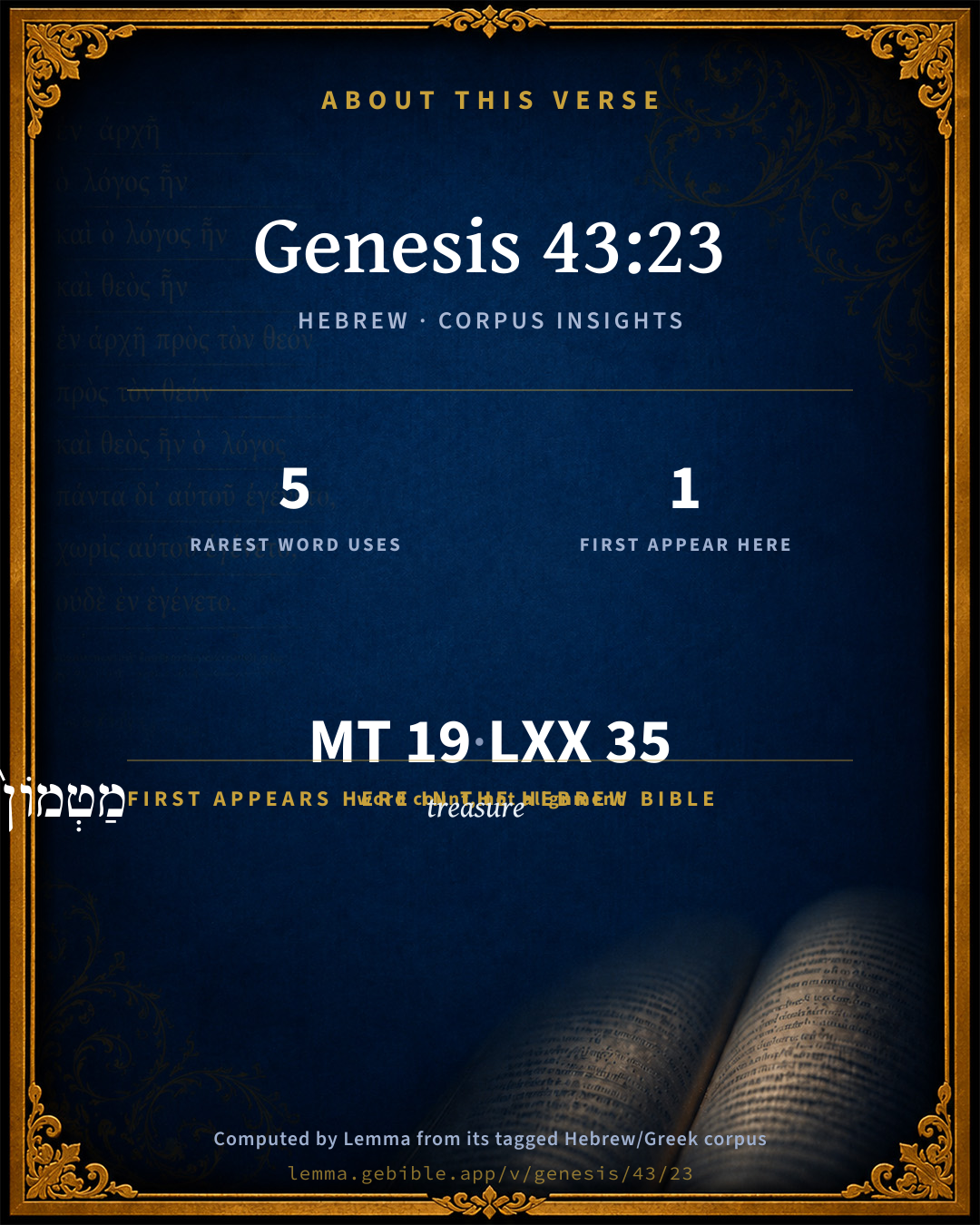
The rarest word here is מַטְמוֹן֙ treasure H4301 — appearing just 5 times in the whole Hebrew Bible.

First appearance in Scripture

This word makes its first canonical appearance in the Hebrew Bible here:

  • מַטְמוֹן֙ treasure H4301

Shared distinctive vocabulary

מַטְמוֹן֙ treasure H4301 occurs in 5 verses of the Hebrew Bible. Also found in:

Grammatical profile

  • 5 verbs
  • 8 nouns
  • 4 prepositions
  • 2 particles

Verb forms

  • וַיֹּאמֶר֩ Qal · Sequential Imperfect
  • תִּירָ֗אוּ Qal · Jussive
  • נָתַ֨ן Qal · Perfect
  • בָּ֣א Qal · Perfect
  • וַיּוֹצֵ֥א Hiphil · Sequential Imperfect

Repetition

Words recur within this verse — often emphatic in Hebrew:

  • אֱלֹ֨הֵיכֶ֜ם God H430 ×2
  • אֵלָ֑י to H413 ×2

Hebrew & Septuagint length

In English translation the verse runs 34 words from the Hebrew and 43 from the Septuagint (LXX English) — closely comparable.

A rough comparison of the two English renderings, which tokenize alike — not a word-level alignment.

Word counts can differ between the Hebrew and the Greek without any difference in meaning — e.g. the Hebrew direct-object marker אֵת has no separate Greek word, and Greek often adds the article ὁ.

In the original languages it is 19 Hebrew tokens and 35 Greek tokens — but the two are counted differently (Hebrew bundles its prefixes and suffixes into one token; the Greek is in lemma form), so that isn’t a like-for-like length.

Cross-references

15

Topical passages linked to Genesis 43:23 in the Treasury of Scripture Knowledge — connected by theme and wording, ordered by reader-vote popularity; previews shown in the World English Bible.

  • Genesis 42:24 He turned himself about from them, and wept, and he returned to them, and spoke to them, and took Simeon from among them, and bound him before their eyes.
  • John 20:26 After eight days again his disciples were inside, and Thomas was with them. Jesus came, the doors being locked, and stood in the midst, and said, "Peace be to you."
  • John 14:27 Peace I leave with you. My peace I give to you; not as the world gives, give I to you. Don't let your heart be troubled, neither let it be fearful.
  • Genesis 42:28 He said to his brothers, "My money is restored! Behold, it is even in my sack." Their hearts failed them, and they turned trembling one to another, saying, "What is this that God has done to us?"
  • Luke 10:5 Into whatever house you enter, first say, 'Peace be to this house.'
  • Luke 24:36 As they said these things, Jesus himself stood among them, and said to them, "Peace be to you."
  • John 20:19 When therefore it was evening, on that day, the first day of the week, and when the doors were locked where the disciples were assembled, for fear of the Jews, Jesus came and stood in the midst, and said to them, "Peace be to you."
  • John 20:21 Jesus therefore said to them again, "Peace be to you. As the Father has sent me, even so I send you."
  • Genesis 42:36 Jacob, their father, said to them, "You have bereaved me of my children! Joseph is no more, Simeon is no more, and you want to take Benjamin away. All these things are against me."
  • Genesis 43:14 May God Almighty give you mercy before the man, that he may release to you your other brother and Benjamin. If I am bereaved of my children, I am bereaved."
  • Judges 6:23 Yahweh said to him, Peace be to you; don't be afraid: you shall not die.
  • Judges 19:20 The old man said, Peace be to you; howsoever let all your wants lie on me; only don't lodge in the street.
  • 1 Samuel 25:6 and thus shall you tell him who lives [in prosperity], Peace be to you, and peace be to your house, and peace be to all that you have.
  • 1 Chronicles 12:18 Then the Spirit came on Amasai, who was chief of the thirty, [and he said], "We are yours, David, and on your side, you son of Jesse: peace, peace be to you, and peace be to your helpers; for your God helps you." Then David received them, and made them captains of the band.
  • Ezra 4:17 [Then] sent the king an answer to Rehum the chancellor, and to Shimshai the scribe, and to the rest of their companions who dwell in Samaria, and in the rest [of the country] beyond the River: Peace, and so forth.

Cross-references courtesy of OpenBible.info (CC BY 4.0).

Hebrew and Greek witnesses Masoretic Hebrew ↔ Greek Septuagint

The same verse in the two great witnesses to the Old Testament, shown verse-for-verse.

These are two independent witnesses, not word-aligned to each other, and the Septuagint is shown in lemma (dictionary) form.

Hebrew Genesis 43:23 Masoretic · Westminster Leningrad Codex

וַיֹּאמֶר֩ שָׁל֨וֹם לָכֶ֜ם אַל תִּירָ֗אוּ אֱלֹ֨הֵיכֶ֜ם וֵֽאלֹהֵ֤י אֲבִיכֶם֙ נָתַ֨ן לָכֶ֤ם מַטְמוֹן֙ בְּאַמְתְּחֹ֣תֵיכֶ֔ם כַּסְפְּכֶ֖ם בָּ֣א אֵלָ֑י וַיּוֹצֵ֥א אֲלֵהֶ֖ם אֶת שִׁמְעֽוֹן

He said, "Peace be to you. Don't be afraid. Your God, and the God of your father, has given you treasure in your sacks. I received your money." He brought Simeon out to them.

World English Bible · Public Domain

Greek LXX Genesis 43:23 Septuagint · lemma form

εἶπον δέ αὐτός ἵλεως σύ μή φοβέω ὁ θεός σύ καί ὁ θεός ὁ πατήρ σύ δίδωμι σύ θησαυρός ἐν ὁ μάρσιππος σύ ὁ δέ ἀργύριον σύ εὐδοκιμέω ἀποἔχω καί ἐκἄγω πρός αὐτός ὁ συμεων

And he said to them, God deal mercifully with you; be not afraid; your God, and the God of your fathers, has given you treasures in your sacks, and I have enough of your good money. And he brought Symeon out to them.

LXX2012 (modern English Septuagint) · Public Domain

On this verse, The Cambridge Bible for Schools and Colleges discusses the Septuagint’s reading. Read the note in Commentary ↓

Hebrew: Westminster Leningrad Codex (CC BY 4.0). Greek: Septuagint (public domain); English from LXX2012 (modern English Septuagint) (Public Domain). How the Septuagint differs from the Hebrew →

Targum (Aramaic paraphrase)

2

The Targum is the ancient Jewish Aramaic paraphrase of the Hebrew Scriptures — an interpretive translation, not the Hebrew text itself. Onkelos (literal) and Pseudo-Jonathan (expansive) render the Torah, and Jonathan the Prophets. Coverage is partial: where no permissively-licensed English translation exists for a verse, only the Aramaic is shown. This is verse-level text, not a word-by-word alignment to the Hebrew.

  1. Targum Onkelos Torah (Genesis–Deuteronomy)
    וַאֲמַר שְׁלַם לְכוֹן לָא תִדְחֲלוּן אֱלָהֲכוֹן וֵאֱלָהָא דַּאֲבוּכוֹן יְהַב לְכוֹן סִימָּא בְּטוֹעֲנֵיכוֹן כַּסְפְּכוֹן אֲתָא לְוָתִי וְאַפֵּיק לְוָתְהוֹן יָת שִׁמְעוֹן

    (no public-domain English translation for this verse)

    Targum Onkelos — Aramaic: “Onkelos Genesis” (public domain); “Onkelos Exodus” (public domain); “Onkelos Leviticus” (public domain); “Onkelos Numbers” (public domain); “Onkelos Deuteronomy” (public domain). English: “Sefaria Community Translation” (CC0 1.0 (public-domain dedication)); “J.W. Etheridge. The Targums of Onkelos and Jonathan Ben Uzziel on the Pentateuch. London: Longmans, Green, 1862” (public domain). Text via Sefaria.

  2. Targum Pseudo-Jonathan Torah (Genesis–Deuteronomy)
    וַאֲמַר שְׁלָם לְכוֹן מִן רִבּוֹנִי לָא תִידַחֲלוּן אֱלָהֵיכוֹן וֵאלָהָא דַאֲבוּכוֹן יְהַב לְכוֹן סִימָא בְּטוֹנֵיכוֹן כַּסְפֵּיכוֹן אָתָא לְוָתִי וְאַפֵּיק לְוַותְהוֹן יַת שִׁמְעוֹן

    And he said, Peace to you; be not afraid of my lord. Your God and the God of your fathers gave you treasure in your sacks: your money came to me. And he brought out Shimeon to them.

    Targum Pseudo-Jonathan — Aramaic: “Targum Jonathan on Genesis” (public domain); “Targum Jonathan on Exodus” (public domain); “Targum Jonathan on Leviticus” (public domain); “Targum Jonathan on Numbers” (public domain); “Targum Jonathan on Deuteronomy” (public domain). English: “The Targum of Jonathan ben Uzziel, trans. J. W. Etheridge, London, 1862” (public domain). Text via Sefaria.

Commentary

Notes on Genesis 43:23 from classic Christian and Jewish commentators (each source and its license shown beneath its notes). The classic Christian expositions comment on the surrounding passage and are grouped to its opening verse, so a note may address several verses; the Jewish commentaries on the Tanakh (Rashi and others) are per-verse, so they appear only where the commentator wrote on this verse.

Lemma curates 59 commentaries, every one of them public domain or Creative Commons licensed, each selected and text-cleaned for this edition rather than reprinted as found. About our sources →

Trapp's Complete Commentary

John Trapp

Gen 43:23 And he said, Peace [be] to you, fear not: your God, and the God of your father, hath given you treasure in your sacks: I had your money. And he brought Simeon out unto them.

Ver. 23. Peace be to you, fear not.] "The feeble minded" must be "comforted"; {1Th 5:14} not crushed, or cashiered, as the wounded deer is by the whole herd. David, in the spirit of prophecy, pronounceth a bitter curse upon those that "persecuted him whom God hath smitten, and talked to the grief of those whom he had wounded." {Psa 69:26} Joseph’s steward had learned better things of his master.

John Trapp, A Commentary or Exposition upon All the Books of the Old and New Testament (1647–1656) — public domain. Text from a community e-Sword module.

Joseph Benson's Commentary

Gen 43:23. And he said, Peace be to you — No harm shall come to you for that matter. God hath given you treasure in your sacks — By his power and providence secretly putting it there. He speaks thus, because Joseph had instructed him, as well as others of his family, in the knowledge and worship of the true God. By this he meant to show that he had no suspicion of dishonesty in them: for what we get by deceit we cannot say God gives it us. He silences their further inquiry about it: ask not how it came thither; Providence brought it you, and let that satisfy you. We must own ourselves indebted to God as our God, and the God of our fathers, (a God in covenant with us and them,) for all our successes and advantages, and the kindnesses of our friends; for every creature is that to us, and no more, than God makes it to be.

Joseph Benson's Commentary on the Old and New Testaments (1811–1818) — public domain. Text from a community e-Sword module.

Geneva Bible (1599)

Geneva Bible translators

Notwithstanding the corruptions of Egypt, yet Joseph taught his family to fear God.

Or, you are well.

Geneva Bible (1599) marginal notes — public domain. Text via Bolls.life.

Adam Clarke's Commentary

Verse 23. And he said] The address of the steward in this verse plainly proves that the knowledge of the true God was in Egypt. It is probable that the steward himself was a Hebrew, and that Joseph had given him intimation of the whole affair; and though he was not at liberty to reveal it, yet he gives them assurances that the whole business would issue happily.

I had your money.] כספכם בא אלי caspechem ba elai, your money comes to me. As I am the steward, the cash for the corn belongs to me. Ye have no reason to be apprehensive of any evil; the whole transaction is between myself and you; receive therefore the money as a present from the God of your father, no matter whose hands he makes use of to convey it. The conduct of the steward, as well as his words, had a great tendency to relieve their burdened minds.

Adam Clarke's Commentary on the Bible (1810–1826) — public domain. Text from a community e-Sword/MySword module.

John Calvin's Commentaries

23. Peace be to you. Because שלום (shalom,) among the Hebrews, signifies not only peace, but any prosperous and desirable condition, as well as any joyful event, this passage may be expounded in two ways: either that the ruler of Joseph’s house commands them to be of a peaceful and secure mind; or that he pronounces it to be well and happy with them. The sum of his answer, however, amounts to this, that there was no reason for fear, because their affairs were in a prosperous state. And since, after the manner of men, it was not possible that they should have paid the money for the corn which was found in their sacks, he ascribes this to the favor of God. For though true religion was then almost extinct in the world, God nevertheless caused some knowledge of his goodness always to remain in the hearts of men, which should render them responsible. Hence it has happened that, following nature as their guide, unbelievers have called every peculiarly excellent gift Divine. Moreover, because corruption was so prevalent, that each nation deemed it lawful to worship different gods, the ruler of Joseph’s house distinguishes the God worshipped by the sons of Jacob from Egyptian idols. The conjecture, however, is probable, that this man had been imbued with some sense of religion. We know how great was the arrogance of that nation, and that it supposed the whole world besides, to be deceived in the worship of gods. Therefore, unless he had learned something better, he never would have assigned so great an honor to any other gods than those of his own country. Moreover, he does not ascribe the miracle to the God of the land of Canaan, but to the peculiar God of their father. I, therefore, do not doubt that Joseph, though not permitted openly to correct anything in the received superstitions, endeavored, at least in his own house, to establish the true worship of the one God, and always held fast the covenant, concerning which, as a boy, he had heard his father speak. This is the more to be observed, because the holy man could not swerve, even in the least degree, from the common practice, without incurring the odium of a nation so proud. Therefore, the excellency of Joseph is commended in the person of his steward; because without fear of public envy, he gives honor, within his own walls, to the true God. If any one should ask, whence he knew that Jacob was a worshipped of the true God; the answer is ready; that Joseph, notwithstanding his assumed severity, had commanded that Simon should be gently treated in prison. Though he had been left as a hostage, yet, if he had been regarded as a spy, the keeper of the prison would have dealt more harshly with him. There must, therefore, have been some command given respecting the humane or moderate treatment of him. Whence the probable conjecture is elicited, that Joseph had explained the affair to his steward, who was admitted to his secret counsels.

John Calvin's Commentaries (1540-1563) — public domain. Text from the Calvin Translation Society English edition (1840s-50s) via the Christian Classics Ethereal Library (ccel.org). Calvin's coverage is partial (roughly two-thirds of the Bible); uncommented books and verses are honest gaps, never fabricated. The 19th-century editor's footnotes and remarks are omitted so the notes are faithfully Calvin's own voice.

Ellicott's Commentary for English Readers

(23) Your God . . . —Either Joseph had instructed his steward what to say, or he had trained his household generally in the truths of his religion. (See Note on Gen_42:18.) The word for “treasure” means hidden treasure, or as we call it a “windfall.” By bringing out Simeon he would remove their worst fears, and so at last they consent to go in.

A Bible Commentary for English Readers, edited by Charles John Ellicott (1878–1897) — public domain. Text from a community e-Sword module.

The Cambridge Bible for Schools and Colleges

gen. ed. J. J. S. Perowne

23. Peace be to you] A formula of encouragement and reassurance, as in Jdg_6:23; 1Sa_20:21; Dan_10:19.

the God of your father] The steward reverently ascribes their good fortune to the influence of the God of their family, concerning whom he himself could have had no knowledge. Their God had put their money in their sacks. It was mysterious. Their payments had duly been made; he had received them. They were innocent. Joseph had evidently instructed his steward what to say.

I had your money] Lit. “your money came unto me.” The versions introduce a paraphrase. LXX τὸ ἀργύριον ὑμῶν εὐδοκιμοῦν ἀπέχω; Lat. pecuniam quam dedistis mihi probatam ego habeo.

he brought Simeon out] This clause harmonizes the narrative of J with that of E; see notes on Gen_43:3; Gen_43:5; Gen_43:14.

The Cambridge Bible for Schools and Colleges (gen. ed. J. J. S. Perowne; Cambridge University Press, 1878–1918) — public domain. Text from a community e-Sword module.

John Gill's Exposition

And the man brought the men into Joseph's house,.... After the above discourse had passed between them, and he had made their minds easy, both with respect to the money, and by bringing Simeon unbound to them:

and gave them water, and they washed their feet; which was usually done in the eastern countries after travelling, and when about to take a meal, and was both for refreshment and cleanliness:

and he gave their asses provender; thus were they hospitably entertained, they and all that belonged to them.

John Gill's Exposition of the Whole Bible (1746–1763) — public domain (CC PDM 1.0). Text via the HelloAO Bible API.

Haydock's Catholic Bible Commentary

Your God. To Him we must always refer what advantage we derive from men. He inspired Joseph to give such orders to his steward. --- I have for good. I received it, and was satisfied that it was good: you need not be uneasy; you are not suspected of any fraud. (Haydock) --- Hebrew, "Your money came into my hands." (Menochius)

George Leo Haydock (1774–1849), Haydock's Catholic Family Bible and Commentary, 1859 edition — public domain. Excludes Psalms (Douay-Rheims chapter numbering differs from Protestant) and Deuterocanonical books (Catholic canon only).

Matthew Poole's English Annotations

Peace be to you; no harm shall come to you for that matter.

Your God, and the God of your father: thus he speaks, because Joseph had instructed him, as well as others of his family, in the true religion.

Hath given you treasure, by his power and providence secretly putting it there.

Matthew Poole's English Annotations on the Holy Bible (1683–1685) — public domain. Text from a community e-Sword/MySword module.

Whedon's Commentary on the Bible

Daniel D. Whedon

23. Peace be to you — The steward’s words were admirably adapted to quiet the fears of these men. Especially would the words your God and the God of your father assure them that no harm was intended against them, and that their religion was known and respected.

I had your money — Or, your money came to me. This same steward thus acknowledges the receipt of their money, and assures them that that is not charged against them.

Daniel D. Whedon (gen. ed.), Commentary on the Old and New Testaments (1874–1909) — public domain. Text from a community e-Sword module.

The Pulpit Commentary

And he said, Peace be to you, fear not: your God (Elohim), and the God of your father, an indication that Joseph"s steward had been taught to fear and trust the God of the Hebrews (Wordsworth, Murphy)hath given you treasure in your sacks: I had your money (literally, your money came to me). And he brought Simeon out unto them.

The Pulpit Commentary (1880–1919), ed. H.D.M. Spence-Jones & Joseph S. Exell — public domain. Text from a community e-Sword module.

John Wesley's Explanatory Notes

Your God, and the God of your father, has given you treasure in your sacks - Hereby he shews that he had no suspicion of dishonesty in them: for what we get by deceit we cannot say God gives it us. He silences their farther enquiry about it: ask not how it came thither, providence brought it you, and let that satisfy you. It appears by what he said, that by his master's instructions he was brought to the knowledge of the true God, the God of the Hebrews. He directs them to look up to God, and acknowledge his providence in the good bargain they had. We must own ourselves indebted to God as our God, and the God of our fathers, (a God in covenant with us and them) for all our successes and advantages, and the kindnesses of our friends; for every creature is that to us, and no more, than God makes it to be.

John Wesley, Explanatory Notes Upon the Whole Bible (1754–1765) — public domain. Text via the GEBible commentary corpus.

Rashi

Rabbi Shlomo Yitzchaki (Rashi)

אלהיכם YOUR GOD — your God because of your own merits: and if your own merits do not suffice, then ואלהי אביכם THE GOD OF YOUR FATHER — because of your father’s merits HE HAS GIVEN YOU A TREASURE (Genesis Rabbah 92:4).

Rashi on the Tanakh — English translations: “The Judaica Press complete Tanach with Rashi, translated by A. J. Rosenberg” (CC BY 4.0); “Pentateuch with Rashi's commentary by M. Rosenbaum and A.M. Silbermann, 1929-1934” (public domain); “The Metsudah Tanach series, Lakewood, N.J” (CC BY 4.0); and “The Book of Joshua, Metsudah Publications, 1997” (CC BY 4.0). Text via Sefaria.

Ramban (Nachmanides)

Rabbi Moshe ben Nachman (Ramban / Nachmanides)

HE HATH GIVEN YOU A HIDDEN TREASURE (‘MATMON’) IN YOUR BAGS. Rabbi Abraham ibn Ezra said that Joseph told them that “it is possible that some one had a hidden treasure in his house which he forgot, and it fell to your lot for your money came to me.”Now these are but words of consolation, for how did it happen that each one of the brothers received the precise amount of money which he paid for the grain! Rather, the correct interpretation is that all matter which is hidden is called matmon in Hebrew: The lazy man hides (‘taman’) his hand in the dish; We have stores hidden (‘matmonim’) in the field. Thus Joseph told them that it is customary for ass-drivers who buy grain that each one put his money in his sack, and the attendant in charge of the sales took the sacks from those who came and filled ten sacks with grain, and the money remained hidden under the grain. Then the attendant’s master came and commanded him to pour these ten bags into the vessels of Jacob’s sons as he wanted to send them away in a hurry or because he was not in charge of taking money. Thus it happened that each one found his exact amount of money at the opening of the sack, as each one had brought the amount of money for a donkey’s load worth of bread. This constantly occurs in market-places and store-houses where sales take place in a great confusion of people.

Ramban (Nachmanides) on the Tanakh — English translation: “Commentary on the Torah by Ramban (Nachmanides). Translated and annotated by Charles B. Chavel. New York, Shilo Pub. House, 1971-1976” (CC BY 4.0). Text via Sefaria.

Radak

Rabbi David Kimhi (Radak)

מטמון, if you found this money in your sacks it was a gift from heaven, comparable to if a human being had given you a treasure. But as far as the money you owed for your purchases is concerned, כספכם בא אלי, “I did receive your money.”

Immediately after saying this, ויוצא, he gave instructions to have Shimon brought out to join them. He did this so promptly in order to allay their fears and suspicions and to comfort them.

Radak on the Tanakh — English translations: “Sefaria Community Translation” (CC0 1.0 (public-domain dedication)); “Eliyahu Munk, HaChut Hameshulash” (CC BY 4.0); “Rabbi Mike Feuer, Jerusalem Anthology” (CC BY 4.0); and “R. David Kimhi on the first book of Psalms, Translated by R.G. Finch, London, 1919” (public domain). Text via Sefaria.

Lesson kit

Teaching starters — assembled from the data on this page, not authored interpretation. Every prompt links to the verse data it draws on. Edit before teaching.

Genesis, in the Pentateuch, opens this verse with 19 words (15 distinct Hebrew lemmas). Its most distinctive word is maṭmôwn (“treasure”). A historical commentator’s framing appears above. Read the whole chapter for the surrounding context.

Discussion questions

  1. The word maṭmôwn carries the sense “treasure.” How does it shape the verse?
  2. The word “treasure” first appears here in Scripture. What is being introduced at this debut?
  3. Job 3:21 shares the word «treasure» with this verse. How do the two illuminate each other?
  4. “God” occurs 2× in this one verse. What is the effect of the repetition?
  5. These translations render this verse differently. What is at stake in choosing one wording over another?
  6. The verb «וַיֹּאמֶר֩» is Qal Sequential Imperfect. How does its form color the action?
  7. Reading how Trapp's Complete Commentary and Joseph Benson's Commentary read this verse, where do the two commentators agree and where do they part?

Things to notice

Reading settings

Reading text

Shown beneath each verse's original-language words.

Old Testament
Old Testament edition

Read the OT as the Masoretic Hebrew (MT) or the Greek Septuagint (LXX).

English shown for the Greek Septuagint (in the Hebrew ↔ Greek comparison).

Comparing translations? Open the Compare panel on any verse page to stack up to four side by side.