
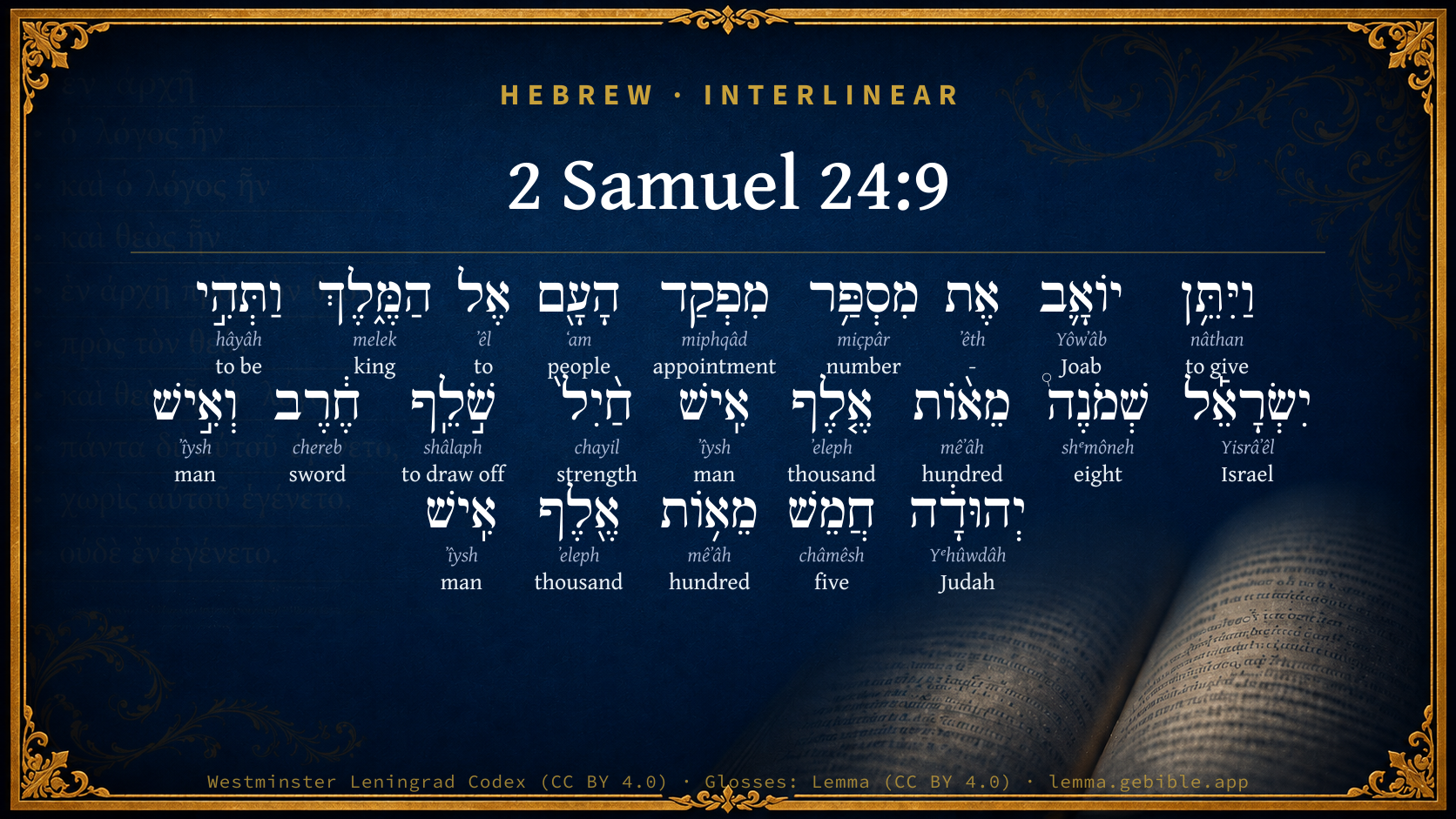
2 Samuel 24:9

Hebrew (Westminster Leningrad Codex) 2 Samuel 24:9 appears in the Hebrew Old Testament. The text above is from the Westminster Leningrad Codex. Each word links to its Strong’s number, a concise gloss, and parsing drawn from the Open Scriptures Hebrew Bible morphology. Click any word for its full Brown-Driver-Briggs (BDB) entry.
Download image
Cite this verse

2 Samuel 24:9 (World English Bible). Public Domain. Lemma interlinear Bible study tool, https://lemma.gebible.app/v/2-samuel/24/9.

Show BibTeX & RIS
BibTeX
RIS
English Translation
Joab gave up the sum of the numbering of the people to the king: and there were in Israel eight hundred thousand valiant men who drew the sword; and the men of Judah were five hundred thousand men.
World English Bible · Public Domain
Highlights
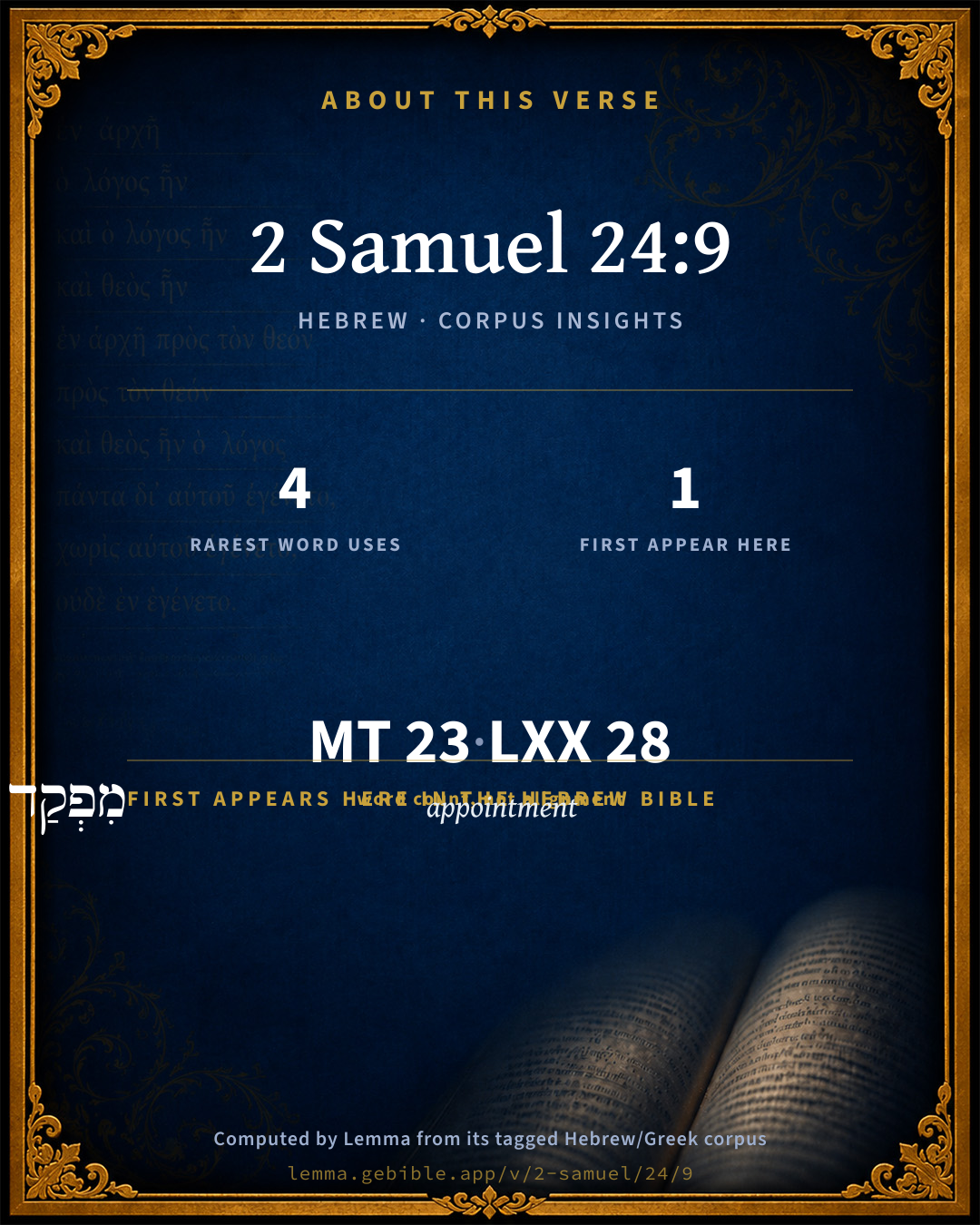
  • 1 first appearance in the Hebrew Bible
Full analysis ↓
Download a study sheet

One document with this verse’s original text, its word-by-word gloss line, the meaning frame, cross-references with their text, attributed commentary, and full source and license credits — printable, and it pastes into notes with its structure intact.

This verse Autodidact and up

Study sheet (.html) Plain text (.txt)

A passage Seminary Student

Up to 50 verses in one chapter. A passage sheet keeps up to 6 commentary sources and 12 cross-references per verse, in the order this page ranks them, and says so on the sheet whenever that leaves anything out. Ask for a single verse and you get the Autodidact verse sheet above.

Everything on this page stays free to read, with no account — the sheet is a download of what is already on screen, not access to it.

Want to remove ads? Support Godless Engineer
Compare translations 3

The same verse in 3 English versions, stacked beneath the original-language interlinear above. Click any original word for its lexicon entry.

Each is an independent rendering of the whole verse — the interlinear is not word-aligned to these translations.

Highlighted words mark where these versions differ — a whole-verse word diff, not a word-by-word alignment.

  • World English Bible Public Domain
    Joab gave up the sum of the numbering of the people to the king: and there were in Israel eight hundred thousand valiant men who drew the sword; and the men of Judah were five hundred thousand men.
  • King James Version Public Domain
    And Joab gave up the sum of the number of the people unto the king: and there were in Israel eight hundred thousand valiant men that drew the sword; and the men of Judah were five hundred thousand men.
  • unfoldingWord Literal Text CC BY-SA 4.0
    And Joab gave the number of the mustering of the people to the king. And Israel was 800,000 men of valor drawing the sword, and the men of Judah 500,000 men.

unfoldingWord Literal Text — © unfoldingWord, licensed CC BY-SA 4.0. Word-aligned USFM3 via Door43 (git.door43.org/unfoldingWord/en_ult).

Versions to compare (up to 4)

3 of 4 selected

Show all 18 translations

Every available English version of this verse, each an independent rendering of the whole verse.

  • World English Bible Public Domain
    Joab gave up the sum of the numbering of the people to the king: and there were in Israel eight hundred thousand valiant men who drew the sword; and the men of Judah were five hundred thousand men.
  • Berean Standard Bible Public Domain
    And Joab reported to the king the total number of the troops. In Israel there were 800,000 men of valor who drew the sword, and in Judah there were 500,000.
  • Majority Standard Bible Public Domain
    And Joab reported to the king the total number of the troops. In Israel there were 800,000 men of valor who drew the sword, and in Judah there were 500,000.
  • King James Version Public Domain
    And Joab gave up the sum of the number of the people unto the king: and there were in Israel eight hundred thousand valiant men that drew the sword; and the men of Judah were five hundred thousand men.
  • American Standard Version (1901) Public Domain
    And Joab gave up the sum of the numbering of the people unto the king: and there were in Israel eight hundred thousand valiant men that drew the sword; and the men of Judah were five hundred thousand men.
  • Revised Version (1885) Public Domain
    And Joab gave up the sum of the numbering of the people unto the king: and there were in Israel eight hundred thousand valiant men that drew the sword; and the men of Judah were five hundred thousand men.
  • Geneva Bible (1599) Public Domain
    And Ioab deliuered the nomber and summe of the people vnto the King: and there were in Israel eight hundreth thousande strong men that drewe swordes, and the men of Iudah were fiue hundreth thousand men.
  • Douay-Rheims (1899) Public Domain
    And Joab gave up the sum of the number of the people to the king, and there were found of Israel eight hundred thousand valiant men that drew the sword: and of Juda five hundred thousand fighting men.
  • Young's Literal Translation Public Domain
    and Joab giveth the account of the inspection of the people unto the king, and Israel is eight hundred thousand men of valour, drawing sword, and the men of Judah five hundred thousand men.
  • Literal Standard Version CC BY-SA 4.0
    and Joab gives the account of the inspection of the people to the king, and Israel is eight hundred thousand men of valor, drawing sword, and the men of Judah five hundred thousand men.
  • Unlocked Literal Bible CC BY-SA 4.0
    Then Joab reported the total of the count of the fighting men to the king. There were in Israel 800,000 brave men who drew the sword, and the men of Judah were 500,000 men.
  • unfoldingWord Literal Text CC BY-SA 4.0
    And Joab gave the number of the mustering of the people to the king. And Israel was 800,000 men of valor drawing the sword, and the men of Judah 500,000 men.
  • Darby Bible Public Domain
    And Joab gave the sum of the number of the people to the king; and there were of Israel eight hundred thousand valiant men that drew sword; and the men of Judah were five hundred thousand men.
  • World Messianic Bible Public Domain
    Joab gave up the sum of the counting of the people to the king; and there were in Israel eight hundred thousand valiant men who drew the sword, and the men of Judah were five hundred thousand men.
  • Webster's Bible Public Domain
    And Joab presented the sum of the number of the people to the king: and there were in Israel eight hundred thousand valiant men that drew the sword; and the men of Judah were five hundred thousand men.
  • Free Bible Version CC BY-SA 4.0
    Joab reported to the king the number of people that had been counted. In Israel there were 800,000 fighting men who could use the sword, and in Judah there were 500,000.
  • Bible in Basic English Public Domain
    And Joab gave the king the number of all the people: there were in Israel eight hundred thousand fighting men able to take up arms; and the men of Judah were five hundred thousand.
  • JPS Tanakh (1917) Public Domain
    And Joab gave up the sum of the numbering of the people unto the king; and there were in Israel eight hundred thousand valiant men that drew the sword; and the men of Judah were five hundred thousand men.

Literal Standard Version (2020), Covenant Press — licensed CC BY-SA 4.0. Text via the HelloAO Bible API (eBible.org). Unlocked Literal Bible (unfoldingWord) — licensed CC BY-SA 4.0. Text via the HelloAO Bible API (eBible.org). unfoldingWord Literal Text — © unfoldingWord, licensed CC BY-SA 4.0. Word-aligned USFM3 via Door43 (git.door43.org/unfoldingWord/en_ult). Free Bible Version, Dr. Jonathan Gallagher — licensed CC BY-SA 4.0. Text via the HelloAO Bible API (eBible.org).

Word by word

More ways to search: Search by grammar → Find every occurrence → Compare this word →

Practice this passage: Drill this verse → Learn its vocabulary →

מִפְקַד
miphqâd
H4662
“appointment of”
Noun, Common, Masculine, Singular, Construct
Part of Speech
Noun
Type
Common
Gender
Masculine
Number
Singular
State
Construct
Full BDB Definition

Origin: from H6485

TWOT: 1802g

muster, appointment, appointed place - muster (of people) - appointment - appointed place - (TWOT) number
  1. וַיִּתֵּ֥ן nâthan H5414 “and · to give” Conjunction + Verb, Qal, Sequential Imperfect, 3rd Person, Masculine, Singular
  2. יוֹאָ֛ב Yôwʼâb H3097 “Joab” Noun, Proper
  3. אֶת ʼêth H853 “-” Particle, Direct Object
  4. מִסְפַּ֥ר miçpâr H4557 “number of” Noun, Common, Masculine, Singular, Construct
  5. הָעָ֖ם ʻam H5971 “the · people” Particle, Definite Article + Noun, Common, Masculine, Singular, Absolute
  6. אֶל ʼêl H413 “to” Preposition
  7. הַמֶּ֑לֶךְ melek H4428 “the · king” Particle, Definite Article + Noun, Common, Masculine, Singular, Absolute
  8. וַתְּהִ֣י hâyâh H1961 “and · to be” Conjunction + Verb, Qal, Sequential Imperfect, 3rd Person, Feminine, Singular
  9. יִשְׂרָאֵ֡ל Yisrâʼêl H3478 “Israel” Noun, Proper
  10. שְׁמֹנֶה֩ shᵉmôneh H8083 “eight” Adjective, Cardinal number, Feminine, Singular, Absolute
  11. מֵא֨וֹת mêʼâh H3967 “hundred” Adjective, Cardinal number, Both, Plural, Absolute
  12. אֶ֤לֶף ʼeleph H505 “thousand” Adjective, Cardinal number, Both, Singular, Absolute
  13. אִֽישׁ ʼîysh H376 “man of” Noun, Common, Masculine, Singular, Construct
  14. חַ֨יִל֙ chayil H2428 “strength” Noun, Common, Masculine, Singular, Absolute
  15. שֹׁ֣לֵֽף shâlaph H8025 “drawing off” Verb, Qal, Participle Active, Masculine, Singular, Absolute
  16. חֶ֔רֶב chereb H2719 “sword” Noun, Common, Feminine, Singular, Absolute
  17. וְאִ֣ישׁ ʼîysh H376 “and · man of” Conjunction + Noun, Common, Masculine, Singular, Construct
  18. יְהוּדָ֔ה Yᵉhûwdâh H3063 “Judah” Noun, Proper
  19. חֲמֵשׁ châmêsh H2568 “five” Adjective, Cardinal number, Feminine, Singular, Absolute
  20. מֵא֥וֹת mêʼâh H3967 “hundred” Adjective, Cardinal number, Both, Plural, Absolute
  21. אֶ֖לֶף ʼeleph H505 “thousand” Adjective, Cardinal number, Both, Singular, Absolute
  22. אִֽישׁ ʼîysh H376 “man” Noun, Common, Masculine, Singular, Absolute

About this verse

These counts appear in no published source. They are computed here, from the morphology-tagged text and Lemma’s own curated glosses. What Lemma adds →

23
words
19
distinct lemmas
Historical
section

Notable vocabulary

The rarest word here is מִפְקַד appointment H4662 — appearing just 4 times in the whole Hebrew Bible.

First appearance in Scripture

This word makes its first canonical appearance in the Hebrew Bible here:

  • מִפְקַד appointment H4662

Shared distinctive vocabulary

מִפְקַד appointment H4662 occurs in 4 verses of the Hebrew Bible. Also found in:

Grammatical profile

  • 3 verbs
  • 12 nouns
  • 6 adjectives
  • 1 preposition
  • 1 particle

Verb forms

  • וַיִּתֵּ֥ן Qal · Sequential Imperfect
  • וַתְּהִ֣י Qal · Sequential Imperfect
  • שֹׁ֣לֵֽף Qal · Participle Active

Repetition

Words recur within this verse — often emphatic in Hebrew:

  • אִֽישׁ man H376 ×3
  • מֵא֨וֹת hundred H3967 ×2
  • אֶ֤לֶף thousand H505 ×2

Hebrew & Septuagint length

In English translation the verse runs 38 words from the Hebrew and 38 from the Septuagint (LXX English) — the same length.

A rough comparison of the two English renderings, which tokenize alike — not a word-level alignment.

Word counts can differ between the Hebrew and the Greek without any difference in meaning — e.g. the Hebrew direct-object marker אֵת has no separate Greek word, and Greek often adds the article ὁ.

In the original languages it is 23 Hebrew tokens and 28 Greek tokens — but the two are counted differently (Hebrew bundles its prefixes and suffixes into one token; the Greek is in lemma form), so that isn’t a like-for-like length.

Cross-references

3

Topical passages linked to 2 Samuel 24:9 in the Treasury of Scripture Knowledge — connected by theme and wording, ordered by reader-vote popularity; previews shown in the World English Bible.

  • 1 Chronicles 21:5–6 Joab gave up the sum of the numbering of the people to David. All those of Israel were one million one hundred thousand men who drew sword: and in Judah were four hundred seventy thousand men who drew sword.
  • 1 Chronicles 27:23–24 But David didn't take the number of them from twenty years old and under, because Yahweh had said he would increase Israel like the stars of the sky.
  • Numbers 1:44–46 These are those who were numbered, whom Moses and Aaron numbered, and the princes of Israel, being twelve men: they were each one for his fathers' house.

Cross-references courtesy of OpenBible.info (CC BY 4.0).

Hebrew and Greek witnesses Masoretic Hebrew ↔ Greek Septuagint

The same verse in the two great witnesses to the Old Testament, shown verse-for-verse.

These are two independent witnesses, not word-aligned to each other, and the Septuagint is shown in lemma (dictionary) form.

Hebrew 2 Samuel 24:9 Masoretic · Westminster Leningrad Codex

וַיִּתֵּ֥ן יוֹאָ֛ב אֶת מִסְפַּ֥ר מִפְקַד הָעָ֖ם אֶל הַמֶּ֑לֶךְ וַתְּהִ֣י יִשְׂרָאֵ֡ל שְׁמֹנֶה֩ מֵא֨וֹת אֶ֤לֶף אִֽישׁ חַ֨יִל֙ שֹׁ֣לֵֽף חֶ֔רֶב וְאִ֣ישׁ יְהוּדָ֔ה חֲמֵשׁ מֵא֥וֹת אֶ֖לֶף אִֽישׁ

Joab gave up the sum of the numbering of the people to the king: and there were in Israel eight hundred thousand valiant men who drew the sword; and the men of Judah were five hundred thousand men.

World English Bible · Public Domain

Greek LXX 2 Samuel 24:9 Septuagint · lemma form

καί δίδωμι ιωαβ ὁ ἀριθμός ὁ ἐπίσκεψις ὁ λαός πρός ὁ βασιλεύς καί γίγνομαι ἰσραήλ ὀκτακόσιοι χιλίας ἀνήρ δύναμις σπάω ῥομφαία καί ἀνήρ ιουδα πεντακόσιοι χιλίας ἀνήρ μαχητής

And Joab gave in the number of the census of the people to the king: and Israel consisted of eight hundred thousand men of might that drew sword; and the men of Juda, five hundred thousand fighting men.

LXX2012 (modern English Septuagint) · Public Domain

Hebrew: Westminster Leningrad Codex (CC BY 4.0). Greek: Septuagint (public domain); English from LXX2012 (modern English Septuagint) (Public Domain). How the Septuagint differs from the Hebrew →

Targum (Aramaic paraphrase)

1

The Targum is the ancient Jewish Aramaic paraphrase of the Hebrew Scriptures — an interpretive translation, not the Hebrew text itself. Onkelos (literal) and Pseudo-Jonathan (expansive) render the Torah, and Jonathan the Prophets. Coverage is partial: where no permissively-licensed English translation exists for a verse, only the Aramaic is shown. This is verse-level text, not a word-by-word alignment to the Hebrew.

  1. Targum Jonathan Prophets (Joshua–Malachi)
    וִיהַב יוֹאָב יַת חֻשְׁבַּן מִנְיַן עַמָא לְמַלְכָּא וַהֲווֹ יִשְׂרָאֵל תַּמְנֵי מְאָה אַלְפִין גְבַר גִבַּר שַׁלְפֵי סַיָפָא וֶאֱנַשׁ יְהוּדָה חֲמֵשׁ מְאָה אַלְפִין גַבְרָא:

    (no public-domain English translation for this verse)

    Targum Jonathan — Aramaic: “Mikraot Gedolot” (public domain). English: “Sefaria Community Translation” (CC0 1.0 (public-domain dedication)); “London "Chaldee Paraphrase," 1871” (public domain). Text via Sefaria.

Commentary

Notes on 2 Samuel 24:9 from classic Christian and Jewish commentators (each source and its license shown beneath its notes). The classic Christian expositions comment on the surrounding passage and are grouped to its opening verse, so a note may address several verses; the Jewish commentaries on the Tanakh (Rashi and others) are per-verse, so they appear only where the commentator wrote on this verse.

Lemma curates 59 commentaries, every one of them public domain or Creative Commons licensed, each selected and text-cleaned for this edition rather than reprinted as found. About our sources →

Trapp's Complete Commentary

John Trapp

2Sa 24:9 And Joab gave up the sum of the number of the people unto the king: and there were in Israel eight hundred thousand valiant men that drew the sword; and the men of Judah [were] five hundred thousand men.

Ver. 9. And there were in Israel eight hundred thousand valiant men.] Another prophet saith, eleven hundred thousand, {1Ch 21:5} taking in Levi and Benjamin, which Joab reckoned not. {1Ch 21:6} The men of Judah also were five hundred thousand men. Now a man would wonder at so great numbers in so small a land: for Judea was not above two hundred miles long and fifty miles broad, say geographers; not near the half of England by much. These great numbers were somewhat abated by the following pestilence: like as the English lately were by the sweating sickness, which reigned here some forty years together, and slew so many, that strangers wondered how this island could be so populous, to bear and bury such incredible multitudes.

John Trapp, A Commentary or Exposition upon All the Books of the Old and New Testament (1647–1656) — public domain. Text from a community e-Sword module.

Tyndale Open Study Notes

Tyndale Open Resources

24:9 The phrase capable warriors shows that the census focused largely on those fit for military service. The total for Judah here might be rounded up from the total in 1 Chr 21:5; the different number for Israel in 1 Chr 21:5 (1,100,000) might come from combining a regular standing army of 300,000 (elsewhere unrecorded) with the 800,000 discovered through the census.

Tyndale Open Study Notes — © Tyndale Open Resources, licensed CC BY-SA 4.0. Text via the HelloAO Bible API.

Geneva Bible (1599)

Geneva Bible translators

According to Joab’s count: for in all there were eleven hundred thousand, 1 Chron. 21:5.

Concluding under them the Benjamites: for else they had but four hundred and seventy thousand, 1 Chron. 21:5.

Geneva Bible (1599) marginal notes — public domain. Text via Bolls.life.

Jamieson, Fausset & Brown

Robert Jamieson, A. R. Fausset & David Brown

Joab gave up the sum of the number of the people unto the king--The amount here stated, compared with Ch1 21:5, gives a difference of three hundred thousand. The discrepancy is only apparent, and admits of an easy reconciliation; thus (see Ch1 27:1-15), there were twelve divisions of generals, who commanded monthly, and whose duty was to keep guard on the royal person, each having a body of troops consisting of twenty-four thousand men, which, together, formed an army of two hundred eighty-eight thousand; and as a separate detachment of twelve thousand was attendant on the twelve princes of the twelve tribes mentioned in the same chapter, so both are equal to three hundred thousand. These were not reckoned in this book, because they were in the actual service of the king as a regular militia. But Ch1 21:5 joins them to the rest, saying, "all those of Israel were one million, one hundred thousand"; whereas the author of Samuel, who reckons only the eight hundred thousand, does not say, "all those of Israel," but barely "and Israel were," &c. It must also be observed that, exclusive of the troops before mentioned, there was an army of observation on the frontiers of the Philistines' country, composed of thirty thousand men, as appears from Sa2 6:1; which, it seems, were included in the number of five hundred thousand of the people of Judah by the author of Samuel. But the author of Chronicles, who mentions only four hundred seventy thousand, gives the number of that tribe exclusive of those thirty thousand men, because they were not all of the tribe of Judah, and therefore he does not say, "all those of Judah," as he had said, "all those of Israel," but only, "and those of Judah." Thus both accounts may be reconciled [DAVIDSON].

Jamieson, Fausset & Brown — Commentary Critical and Explanatory on the Whole Bible (1871) — public domain (CC PDM 1.0). Text via the HelloAO Bible API.

Adam Clarke's Commentary

Verse 9. In Israel eight hundred thousand - the men of Judah were five hundred thousand] In the parallel place, 1Ch 21:5, the sums are widely different: in Israel one million one hundred thousand, in Judah four hundred and seventy thousand. Neither of these sums is too great, but they cannot be both correct; and which is the true number is difficult to say. The former seems the most likely; but more corruptions have taken place in the numbers of the historical books of the Old Testament, than in any other part of the sacred records. To attempt to reconcile them in every part is lost labour; better at once acknowledge what cannot be successfully denied, that although the original writers of the Old Testament wrote under the influence of the Divine Spirit, yet we are not told that the same influence descended on all copiers of their words, so as absolutely to prevent them from making mistakes. They might mistake, and they did mistake; but a careful collation of the different historical books serves to correct all essential errors of the scribes. See the Dissertations of Dr. Kennicott mentioned at the conclusion of the preceding chapter. 2Sa 23:39.

Adam Clarke's Commentary on the Bible (1810–1826) — public domain. Text from a community e-Sword/MySword module.

Ellicott's Commentary for English Readers

(9) In Israel eight hundred thousand.—The numbers here differ greatly from those given in 1Ch_21:5-6; but there is no reason to suppose any corruption of the text in either case. Joab undertook the work unwillingly, and performed it imperfectly. According to 1Ch_21:6 he refused altogether to number Levi and Benjamin; and according to 1Ch_27:24 “he finished not,” and no official record was made of the result; “neither was the number put in the account of the chronicles of king David.” The numbers were, therefore, in part mere estimates. Here Israel is said to be 800,000, in Chronicles 1,100,000; but the latter probably includes an estimate of the omitted tribes of Benjamin and Levi, and perhaps of portions of other tribes. On the other hand, Judah is here 500,000 (a round number like all the rest), and in Chronicles 470,000. The difference is due perhaps to an estimate of the officiating priests and Levities reckoned to Judah. Another supposition is that the regular army of 288,000 (twelve divisions of 24,000 each) is included in Israel in one case and excluded in the other, and that in the same way in regard to Judah “the thirty” may have had command of a special body of 30,000. Possibly in one case the descendants of the old Canaanites were reckoned (since it appears from 2Ch_2:17 that David “had numbered them”), and in the other were excluded. There is no reason to doubt the general reliability of the numbers, which would give a probable total population of five or six millions, or from 415 to 500 to a geographical square mile—a number not at all impossible in so fertile a country. (Robinson’s estimate of the area of the country is about 12,000 geographical square miles.)

A Bible Commentary for English Readers, edited by Charles John Ellicott (1878–1897) — public domain. Text from a community e-Sword module.

The Cambridge Bible for Schools and Colleges

gen. ed. J. J. S. Perowne

9. eight hundred thousand … five hundred thousand] In 1Ch_21:5 the numbers are given as 1,100,000 for Israel, and 470,000 for Judah. This discrepancy may be due to textual corruption, but more probably arises from a difference in the original estimates, or in the oral tradition with respect to them, since the result of the census was not authoritatively registered in the state records (1Ch_27:24). The conjecture that the standing army of 288,000 men (1Ch_27:1-15) is here deducted from Israel, and some body of 30,000 troops added to Judah, is ingenious, but rendered improbable by the fact that it is necessary to add to the one and subtract from the other to make the totals equal to those of 1 Chron.

The numbers have been attacked as exaggerated, and far exceeding the possible capacity of the country. The numbers given imply a total population of five or six millions at least, and the area of the country is estimated at about 11,000 square miles. This gives (making allowance for the excepted tribes) between 500 and 600 to the square mile, a high but not impossible rate of population when the extreme fertility of the country in ancient times is taken into consideration. The ruins with which Palestine is covered in every direction prove that the population was exceptionally dense. See Smith’s Dict. of the Bible, Art. Census.

The Cambridge Bible for Schools and Colleges (gen. ed. J. J. S. Perowne; Cambridge University Press, 1878–1918) — public domain. Text from a community e-Sword module.

John Gill's Exposition

And Joab gave up the sum of the number of the people unto the king,.... Having collected from the several captains employed in this work their several particular numbers, he put them together, and gave in the sum total to David:

and there were in Israel eight hundred thousand valiant men that drew the sword; though many of them might be under the age of twenty, yet being robust and tall, and fit to bear arms, though but sixteen, seventeen, eighteen, or nineteen years of age, were mustered, contrary to the law; which, according to Cornelius Bertram (z) was David's sin, see Ch1 27:23. In Ch1 21:5, they are said to be a million and an hundred thousand, which is three hundred thousand more than the sum here given; several methods are taken to reconcile this; but what seems to be the best solution of the difficulty is what is observed by a Jew (a), that here the number of the people in the several parts of the land of Israel was given, which were eight hundred thousand, there along with them, the numbers of the standing army which waited on the king in their courses, which were twenty four thousand every, month, and amounted in the twelve months to 288,000, and reckoning lo thousand officers to them, they make the sum of three hundred thousand wanted, see Ch1 27:1, &c.

and the men of Judah were five hundred thousand men. In Ch1 21:5, they are said to be only 470,000, thirty thousand less than here; which may be accounted for by making use of a round number, though something wanting, as is often done; or else the thirty companies, consisting of a thousand each, under the eighty captains mentioned in Sa2 23:8, are taken into the account here, but left out in the book of Chronicles; or there were so many in the sum total of the men of Judah before the plague, but thirty thousand being consumed thereby, are left out in the latter accounts, so Kimchi; but the other solutions seem best: Levi and Benjamin were not counted; it being abominable to Joab, he did not finish it, and especially being displeasing to God, who smote Israel for it, Ch1 21:6.

(z) Lucubrat. Frauktall, c. 2. (a) R. Eliezer in Halicot Olam, tract. 4. c. 3. p. 181.

John Gill's Exposition of the Whole Bible (1746–1763) — public domain (CC PDM 1.0). Text via the HelloAO Bible API.

Albert Barnes' Notes on the Bible

1Ch 27:23 indicates sufficiently why the numbering was sinful. It is also stated in 1Ch 21:6, that Joab purposely omitted Levi and Benjamin from the reckoning.

Eight hundred thousand ... five hundred thousand - In Chronicles the numbers are differently given. It is probable therefore that the Chronicler has included in his statement of the sum total some numbers which are not included here.

Albert Barnes' Notes on the Bible (1834–1885) — public domain. Text from a community e-Sword/MySword module.

Haydock's Catholic Bible Commentary

Eight....and five. Theodotion says nine and four, which comes to the same sum. (Haydock) --- But 1 Paralipomenon xxi. 5, reads, eleven hundred thousand, and four hundred and seventy thousand fighting men: though even there the Arabic version has the number here specified, which is less incredible. The fighting men are not above a fifth part of the population; and we may allow that David might have about seven million subjects. It seems, therefore, best to abandon the latter number as incorrect, since all commentators confess that similar mistakes have been made by the transcribers; and to maintain the contrary, would be indirectly to throw the blame upon the sacred writers. (Calmet) --- Yet some account for the variation, by saying, that Joab gave not in the full number here, (Menochius; Abulensis; &c.) which seems contrary to the text, there were found, &c. (Haydock) --- Cornelius a Lapide supposes, that the excess of number was occasioned by the subsequent list of the Levites, &c. But could they amount to so many? (Calmet) --- And what proof is there that they were numbered, after the anger of God had manifested itself so severely? (Haydock) --- Others affirm, that Joab did not take an account of the 288,000 chosen out of the twelve tribes, that 24,000 of them might guard the palace by turns, in each of the twelve months, 1 Paralipomenon xxvii. 1. (Bochart, Anim. p. 1. B. ii. 37.; Grotius; &c.) --- But thus there will be 18,000 more than even in Paralipomenon, where we find in all 1,570,000, though the tribe of Juda have fewer, by 30,000, than in this book. To account for this, some say, (Haydock) the proselytes are here taken in, or the inhabitants of all the territory, which was at first assigned to Juda, Josue xix. 29. (Menochius) --- All this is conjecture, (Haydock) and must remain among the systems of history. (Calmet) --- If Joab chose to diminish the numbers of Israel, why has he increased those of Juda? Did he wish to flatter the king’s vanity, or partiality for his own tribe? It is difficult to say what interest Joab could have in withholding the truth; and for the sacred historian to countenance his delusion, would expose us to the same danger of mistake, and overthrow the authority of Scripture, therefore, most rational to suppose that we have here the true list of the warriors, and that the book of Paralipomenon has been injured by the negligence of transcribers, as it has on many other occasions. (Haydock)

George Leo Haydock (1774–1849), Haydock's Catholic Family Bible and Commentary, 1859 edition — public domain. Excludes Psalms (Douay-Rheims chapter numbering differs from Protestant) and Deuterocanonical books (Catholic canon only).

Matthew Poole's English Annotations

Eight hundred thousand.

Object. In 1Ch 21:5, they are numbered 1,100,000.

Answ. The sum here expressed is only of such as were not in the ordinary and settled militia waiting upon the king, which being 24,000 for every month, as is largely related, 1Ch 27, amounts to 288,000, which either with their several commanders, or with the soldiers, placed in several garrisons, might very well make up 300,000. Or 288,000 may pass in such accounts for 300,000; it being frequent in such great sums to neglect a smaller number. But in the Book of the Chronicles, which was to gather up the fragments omitted in the former books, both sorts are put together, and so they amount to 1,100,000.

Five hundred thousand. In 1Ch 21:5, but 470,000.

Answ. Either,

1. They were exactly no more, but are called 500,000 in a round sum, as is usual in Scripture and other authors. Or,

2. The garrison soldiers, and such as were employed in other services about the king, are here included, which are there excluded. Or,

3. They were 300,000 when Joab gave up the number to the king, though presently after that they were but 470,000; 30,000 being slain by the plague in the tribe of Judah; which being David’s own tribe, it was but just and fit it should suffer more than the rest for this sin. And though it be true that Joab gave up the sum before the plague begun, yet the sacred penman of the Book of Chronicles thought fit to make a defalcation of them who had been swept away by the plague, that the judgment of God therein might be observed. Or,

4. There are included here the 30,000 which belonged to the thirty colonels mentioned 2Sa 23, who are excluded 1Ch 21, although it be questionable whether those were all of the tribe of Judah.

Matthew Poole's English Annotations on the Holy Bible (1683–1685) — public domain. Text from a community e-Sword/MySword module.

Whedon's Commentary on the Bible

Daniel D. Whedon

9. Eight hundred thousand… five hundred thousand — 1Ch_21:5, has one million one hundred thousand and four hundred and seventy thousand. Which of the two texts is the correct one it is impossible to decide. “They are only approximate statements in round numbers; and the difference in the two texts arose chiefly from the fact that the statements were merely founded upon oral tradition, since, according to 1Ch_27:24, the result of the census was not inserted in the annals of the kingdom.” — Keil.

Daniel D. Whedon (gen. ed.), Commentary on the Old and New Testaments (1874–1909) — public domain. Text from a community e-Sword module.

The Pulpit Commentary

There were in Israel eight hundred thousand valiant men that drew the sword; and the men of Judah were five hundred thousand men. In Chronicles the numbers are, "of Israel eleven hundred thousand men, and of Judah four hundred and sixty-five thousand men." These discrepancies are a remarkable confirmation of the truth of what is said in 1Ch_27:24 that because of the outbreak of the Divine wrath, "the number was not put in the account of the Chronicles of King David." Neither the writer of the Books of Samuel nor of Chronicles had any official document to refer to; and as the numbers are lump sums, and derived probably from what was said by the enumerators, the more exact four hundred and sixty-five thousand men of the Chronicles might easily in round numbers be called a half million. The other is a much larger discrepancy, and no satisfactory explanation of it has been given. It is, however, quite possible that the additional three hundred thousand men were made up of the thirty-eight thousand Levites, as numbered on a later occasion by David, of the Benjamites, and of the aborigines, who belonged to the northern part of the kingdom, and might be included among "all they of Israel". (1Ch_21:5) The numbers are further attacked on the ground of exaggeration. A million and a half of fighting men means a general population of six or seven millions. Now, Palestine at most does not contain more than eleven thousand square miles, and a population of six millions means five hundred and forty-five persons to every square mile, or one to every acre. The country was undoubtedly very fertile in ancient times, and the ruins of populous cities are found where now there is a waste. But there were vast forests and pasture lands and downs, where there were the means of subsistence for only a few. But we must remember that the enumerators went as far north as Tyre, and counted the inhabitants, therefore, of the seaboard between it and Sidon. Probably they also acted in the same way in the south, where the limits of Simeon were very uncertain. Besides this, there is a very remarkable undesigned coincidence. We read in 1Ch 27. that David had a force of two hundred and eighty-eight thousand men, who formed his regular army, and of whom twenty-four thousand were called up for training every month. But there are reasons for believing that David took for this purpose each fifth man of those of the military age (see Sime, "Kingdom of All Israel," p. 389); and thus the whole number of such men would be one million four hundred and forty thousand. This, as Mr. Sime has shown (ibid., p. 378), holds a middle place between the one million three hundred thousand of the Book of Samuel, and the one million five hundred and seventy thousand of Chronicles, and shows that these numbers are not to be rejected on the score of exaggeration.

The Pulpit Commentary (1880–1919), ed. H.D.M. Spence-Jones & Joseph S. Exell — public domain. Text from a community e-Sword module.

Scofield Reference Notes

C. I. Scofield

in Israel

Cf. 1Ch 21:5. The total military strength of Israel (the northern kingdom) was 1,100,000, and of Judah 500,000. The numbers actually set in array were, of Israel, 800,000; of Judah, 470,000.

The Scofield Reference Bible (1917 edition), notes by C. I. Scofield — public domain. Text from a community e-Sword module.

Rashi

Rabbi Shlomo Yitzchaki (Rashi)

The sum of the people's census. If there was a counting, why was a [second] counting [needed]? He [Yoav] made two countings, one major one and one smaller one. He reasoned, "I will show him [Dovid] the smaller one and if he gets angry, I will show him the larger one." That is why the verse uses the word מִפְקָד which conveys [that something is] missing. This is how [the verse] is interpreted in the Pesikta.

Yisroel's [total] was. They became enfeebled like a woman.

Eight hundred thousand. But in Divrei Hayomim it says, "One million and one hundred thousand"? In the Aggadah of the Amoroyim we find, Rabbi Yehoshua, the son of Levi said The verses fill in in one place what is missing in another place; there are two tribes which were not counted because this is what is written in Divrei Hayomim, "Levi and Binyomin were not counted among them because the king's command was abhorrent to Yoav." Yoav said, With these [tribes] I can escape [from my commitment] and say [as an excuse] The tribe of Levi is not counted together with the rest of the tribes but [instead] is counted from one month old and up [and as far as] Binyomin [is concerned] it is enough that [their ranks] were depleted by the incident of the concubine in the valley. In the tract about the thirty-two rules [by which the Torah is elucidated] [authored] by Rabbi Eliezer, the son of Rabbi Yosse the Galilite we learned [as follows], one verse says, "The [total of] all Yisroel was one million and one hundred thousand… and Yehudah [totaled] four hundred and seventy thousand." Another verse says, "Yisroel's [total] was eight hundred thousand… and the men of Yehudah were five hundred thousand." The difference between the two [accounts] is three hundred thousand." What happenned to them? A third verse redresses the imbalance, "The people of Yisroel by their number, of the heads of families and the officers in charge of thousands and of hundreds and their marshals serving the king in all matters pertaining to the division those entering [the service] and those leaving, for every month of the year, each division had twenty-four thousand men." This teaches us that the [missing] three hundred thousand were [already] accounted for in the royal record and did not need to be counted [again]. How does this work? Twenty four thousand for [each of the] twelve [months] gives us two hundred and eighty-eight thousand this leaves us with twelve thousand [still unaccounted for] these are the leaders of Yisroel themselves.

Rashi on the Tanakh — English translations: “The Judaica Press complete Tanach with Rashi, translated by A. J. Rosenberg” (CC BY 4.0); “Pentateuch with Rashi's commentary by M. Rosenbaum and A.M. Silbermann, 1929-1934” (public domain); “The Metsudah Tanach series, Lakewood, N.J” (CC BY 4.0); and “The Book of Joshua, Metsudah Publications, 1997” (CC BY 4.0). Text via Sefaria.

Lesson kit

Teaching starters — assembled from the data on this page, not authored interpretation. Every prompt links to the verse data it draws on. Edit before teaching.

2 Samuel, in the Historical, opens this verse with 23 words (19 distinct Hebrew lemmas). Its most distinctive word is miphqâd (“appointment”). A historical commentator’s framing appears above. Read the whole chapter for the surrounding context.

Discussion questions

  1. How does “appointment” (miphqâd) shape what this verse is saying?
  2. The word “appointment” first appears here in Scripture. What is being introduced at this debut?
  3. 1 Chronicles 21:5 shares the word «appointment» with this verse. How do the two illuminate each other?
  4. “man” occurs 3× in this one verse. What is the effect of the repetition?
  5. These translations render this verse differently; the difference is in the English rendering, not the original. What questions does that raise?
  6. The verb «וַיִּתֵּ֥ן» is Qal Sequential Imperfect. How does its form color the action?
  7. Reading how Trapp's Complete Commentary and Tyndale Open Study Notes read this verse, where do the two commentators agree and where do they part?

Things to notice

Reading settings

Reading text

Shown beneath each verse's original-language words.

Old Testament
Old Testament edition

Read the OT as the Masoretic Hebrew (MT) or the Greek Septuagint (LXX).

English shown for the Greek Septuagint (in the Hebrew ↔ Greek comparison).

Comparing translations? Open the Compare panel on any verse page to stack up to four side by side.