Genesis 27:28

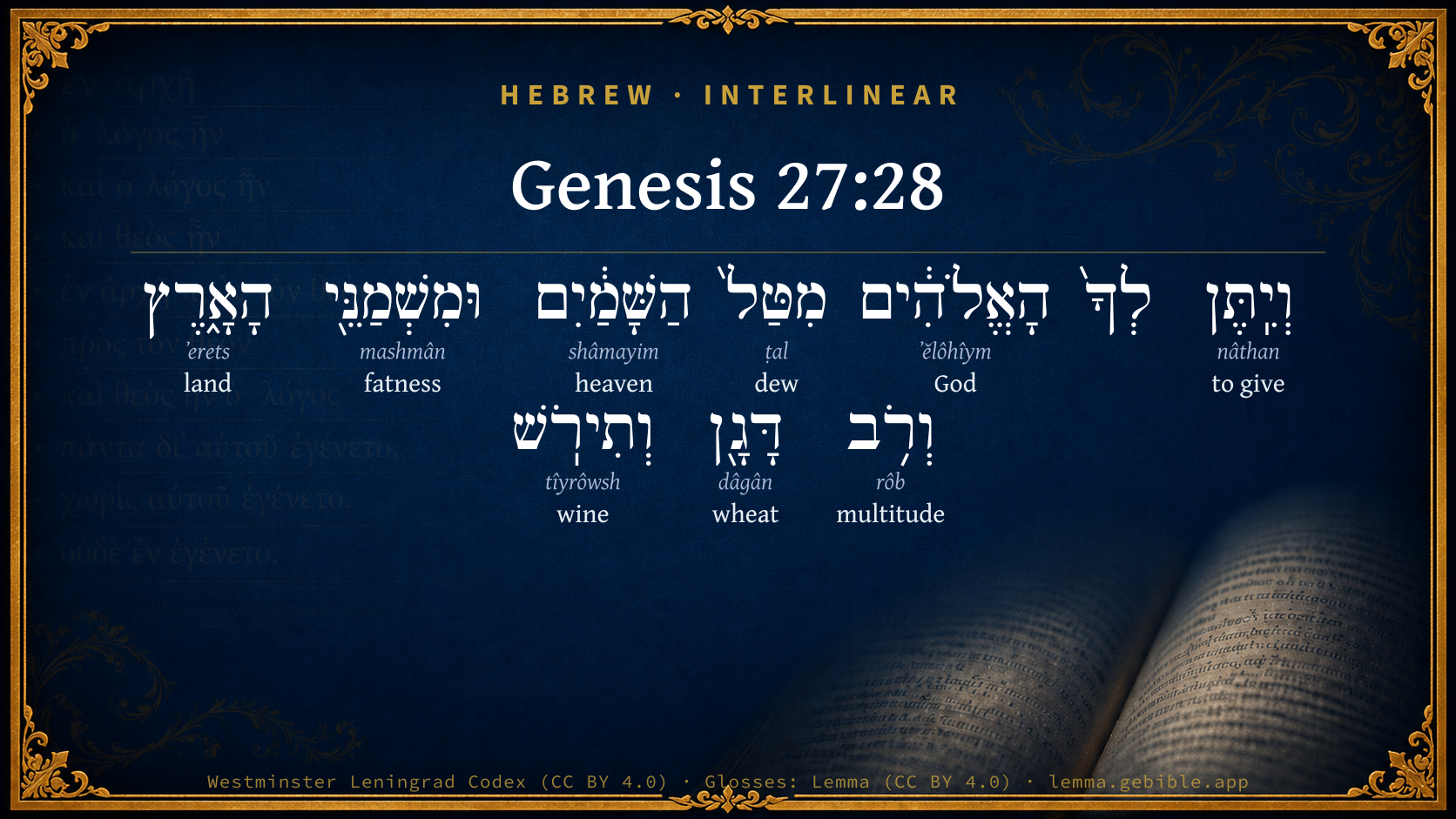
Hebrew (Westminster Leningrad Codex) Genesis 27:28 appears in the Hebrew Old Testament. The text above is from the Westminster Leningrad Codex. Each word links to its Strong’s number, a concise gloss, and parsing drawn from the Open Scriptures Hebrew Bible morphology. Click any word for its full Brown-Driver-Briggs (BDB) entry.
Download image
Cite this verse

Genesis 27:28 (World English Bible). Public Domain. Lemma interlinear Bible study tool, https://lemma.gebible.app/v/genesis/27/28.

Show BibTeX & RIS
BibTeX
RIS
English Translation
God give you of the dew of the sky, of the fatness of the earth, and plenty of grain and new wine.
World English Bible · Public Domain
Highlights
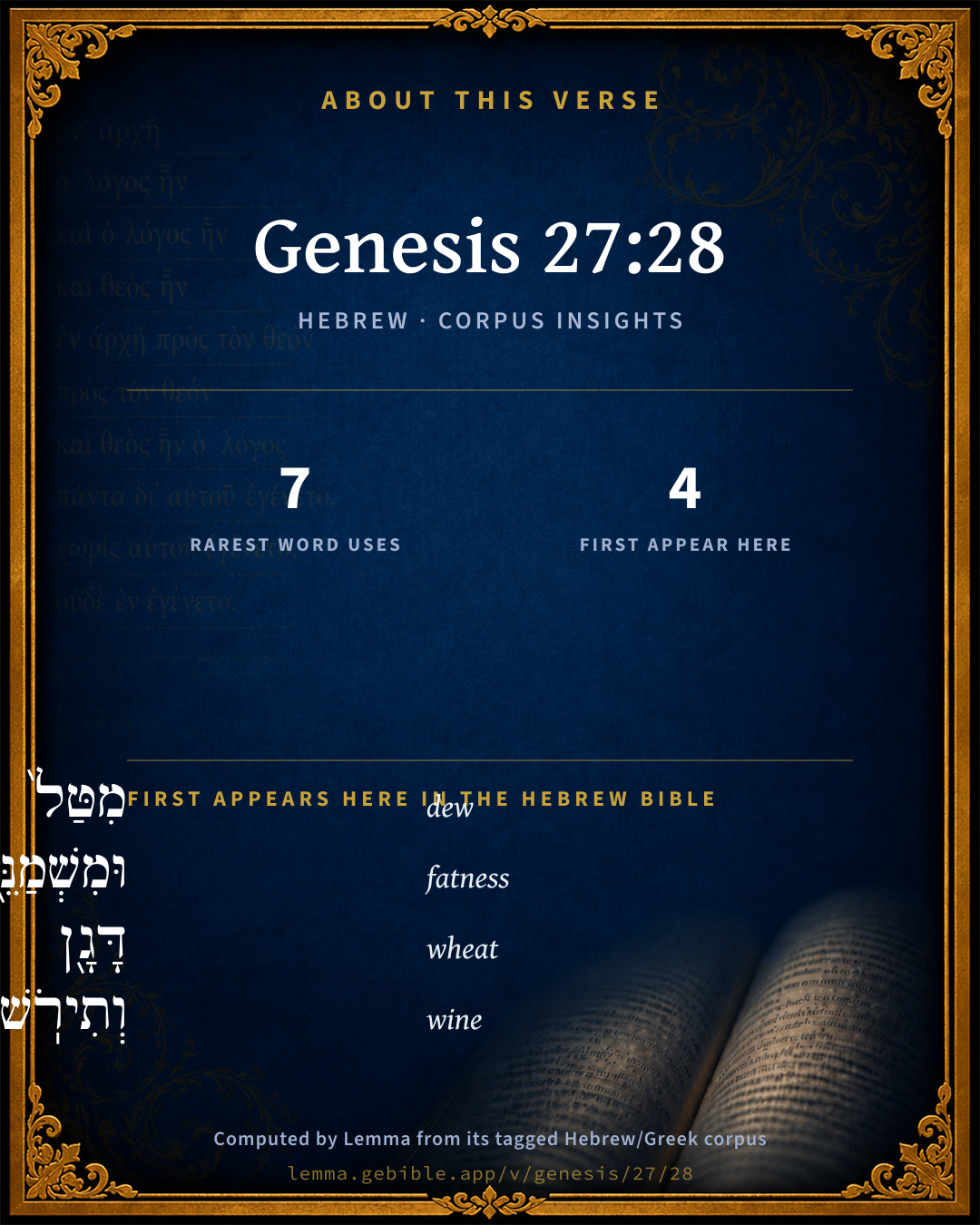
  • 4 first appearances in the Hebrew Bible
Full analysis ↓
Download a study sheet

One document with this verse’s original text, its word-by-word gloss line, the meaning frame, cross-references with their text, attributed commentary, and full source and license credits — printable, and it pastes into notes with its structure intact.

This verse Autodidact and up

Study sheet (.html) Plain text (.txt)

A passage Seminary Student

Up to 50 verses in one chapter. A passage sheet keeps up to 6 commentary sources and 12 cross-references per verse, in the order this page ranks them, and says so on the sheet whenever that leaves anything out. Ask for a single verse and you get the Autodidact verse sheet above.

Everything on this page stays free to read, with no account — the sheet is a download of what is already on screen, not access to it.

Want to remove ads? Support Godless Engineer
Compare translations 3

The same verse in 3 English versions, stacked beneath the original-language interlinear above. Click any original word for its lexicon entry.

Each is an independent rendering of the whole verse — the interlinear is not word-aligned to these translations.

Highlighted words mark where these versions differ — a whole-verse word diff, not a word-by-word alignment.

  • World English Bible Public Domain
    God give you of the dew of the sky, of the fatness of the earth, and plenty of grain and new wine.
  • King James Version Public Domain
    Therefore God give thee of the dew of heaven, and the fatness of the earth, and plenty of corn and wine:
  • unfoldingWord Literal Text CC BY-SA 4.0
    And may God give to you from the dew of the heavens and from the fatness of the earth, and an abundance of grain and wine.

unfoldingWord Literal Text — © unfoldingWord, licensed CC BY-SA 4.0. Word-aligned USFM3 via Door43 (git.door43.org/unfoldingWord/en_ult).

Versions to compare (up to 4)

3 of 4 selected

Show all 18 translations

Every available English version of this verse, each an independent rendering of the whole verse.

  • World English Bible Public Domain
    God give you of the dew of the sky, of the fatness of the earth, and plenty of grain and new wine.
  • Berean Standard Bible Public Domain
    May God give to you the dew of heaven and the richness of the earth—an abundance of grain and new wine.
  • Majority Standard Bible Public Domain
    May God give to you the dew of heaven and the richness of the earth—an abundance of grain and new wine.
  • King James Version Public Domain
    Therefore God give thee of the dew of heaven, and the fatness of the earth, and plenty of corn and wine:
  • American Standard Version (1901) Public Domain
    And God give thee of the dew of heaven, And of the fatness of the earth, And plenty of grain and new wine.
  • Revised Version (1885) Public Domain
    And God give thee of the dew of heaven, And of the fatness of the earth, And plenty of corn and wine:
  • Geneva Bible (1599) Public Domain
    God giue thee therefore of the dewe of heauen, and the fatnesse of the earth, and plentie of wheate and wine.
  • Douay-Rheims (1899) Public Domain
    God give thee the dew of heaven, and of the fatness of the earth, abundance of corn and wine.
  • Young's Literal Translation Public Domain
    and God doth give to thee of the dew of heaven, and of the fatness of the earth, and abundance of corn and wine;
  • Literal Standard Version CC BY-SA 4.0
    and God gives to you of the dew of the heavens, and of the fatness of the earth, and abundance of grain and wine;
  • Unlocked Literal Bible CC BY-SA 4.0
    May God give you a portion of the dew of heaven, a portion of the fatness of the earth, and plenty of grain and new wine.
  • unfoldingWord Literal Text CC BY-SA 4.0
    And may God give to you from the dew of the heavens and from the fatness of the earth, and an abundance of grain and wine.
  • Darby Bible Public Domain
    And God give thee of the dew of heaven, And of the fatness of the earth, And plenty of corn and new wine.
  • World Messianic Bible Public Domain
    God give you of the dew of the sky, of the fatness of the earth, and plenty of grain and new wine.
  • Webster's Bible Public Domain
    Therefore God give thee of the dew of heaven, and the fatness of the earth, and plenty of corn and wine:
  • Free Bible Version CC BY-SA 4.0
    “May God use the dew of heaven and fertile land to give you rich harvests of grain and new wine!
  • Bible in Basic English Public Domain
    May God give you the dew of heaven, and the good things of the earth, and grain and wine in full measure:
  • JPS Tanakh (1917) Public Domain
    So God give thee of the dew of heaven, and of the fat places of the earth, and plenty of corn and wine.

Literal Standard Version (2020), Covenant Press — licensed CC BY-SA 4.0. Text via the HelloAO Bible API (eBible.org). Unlocked Literal Bible (unfoldingWord) — licensed CC BY-SA 4.0. Text via the HelloAO Bible API (eBible.org). unfoldingWord Literal Text — © unfoldingWord, licensed CC BY-SA 4.0. Word-aligned USFM3 via Door43 (git.door43.org/unfoldingWord/en_ult). Free Bible Version, Dr. Jonathan Gallagher — licensed CC BY-SA 4.0. Text via the HelloAO Bible API (eBible.org).

Word by word

More ways to search: Search by grammar → Find every occurrence → Compare this word →

Practice this passage: Drill this verse → Learn its vocabulary →

וּמִשְׁמַנֵּ֖י
mashmân
H4924
“and · from · fat pieces of”
Conjunction + Preposition + Noun, Common, Masculine, Plural, Construct
Part of Speech
Conjunction + Preposition + Noun
Type
Common
Gender
Masculine
Number
Plural
State
Construct
Full BDB Definition

Origin: from H8080

TWOT: 2410e , 2410f

fatness, fat piece, fertile place, richly prepared food - fat, fatness, fat pieces - oil, olive oil - fatness - stout, vigorous - fertile spots or places
  1. וְיִֽתֶּן nâthan H5414 “and · to give” Conjunction + Verb, Qal, Jussive, 3rd Person, Masculine, Singular
  2. הָאֱלֹהִ֔ים ʼĕlôhîym H430 “the · God(s)” Particle, Definite Article + Noun, Common, Masculine, Plural, Absolute
  3. מִטַּל֙ ṭal H2919 “from · dew of” Preposition + Noun, Common, Masculine, Singular, Construct
  4. הַשָּׁמַ֔יִם shâmayim H8064 “the · heaven(s)” Particle, Definite Article + Noun, Common, Masculine, Plural, Absolute
  5. הָאָ֑רֶץ ʼerets H776 “the · land” Particle, Definite Article + Noun, Common, Both, Singular, Absolute
  6. וְרֹ֥ב rôb H7230 “and · multitude of” Conjunction + Noun, Common, Both, Singular, Construct
  7. דָּגָ֖ן dâgân H1715 “wheat” Noun, Common, Masculine, Singular, Absolute
  8. וְתִירֹֽשׁ tîyrôwsh H8492 “and · wine” Conjunction + Noun, Common, Masculine, Singular, Absolute

About this verse

These counts appear in no published source. They are computed here, from the morphology-tagged text and Lemma’s own curated glosses. What Lemma adds →

10
words
9
distinct lemmas
Pentateuch
section

Notable vocabulary

The rarest word here is וּמִשְׁמַנֵּ֖י fatness H4924 — appearing just 7 times in the whole Hebrew Bible.

First appearance in Scripture

These words make their first canonical appearance in the Hebrew Bible here:

  • מִטַּל֙ dew H2919
  • וּמִשְׁמַנֵּ֖י fatness H4924
  • דָּגָ֖ן wheat H1715
  • וְתִירֹֽשׁ wine H8492

Shared distinctive vocabulary

וּמִשְׁמַנֵּ֖י fatness H4924 occurs in 7 verses of the Hebrew Bible. Also found in:

Grammatical profile

  • 1 verb
  • 8 nouns
  • 1 preposition

Verb forms

  • וְיִֽתֶּן Qal · Jussive

Hebrew & Septuagint length

In English translation the verse runs 22 words from the Hebrew and 23 from the Septuagint (LXX English) — closely comparable.

A rough comparison of the two English renderings, which tokenize alike — not a word-level alignment.

Word counts can differ between the Hebrew and the Greek without any difference in meaning — e.g. the Hebrew direct-object marker אֵת has no separate Greek word, and Greek often adds the article ὁ.

Cross-references

28

Topical passages linked to Genesis 27:28 in the Treasury of Scripture Knowledge — connected by theme and wording, ordered by reader-vote popularity; previews shown in the World English Bible.

  • Deuteronomy 33:28 Israel dwells in safety, The fountain of Jacob alone, In a land of grain and new wine; Yes, his heavens drop down dew.
  • Deuteronomy 33:13 Of Joseph he said, Blessed of Yahweh be his land, For the precious things of the heavens, for the dew, For the deep that couches beneath,
  • Psalms 133:3 Like the dew of Hermon, That comes down on the hills of Zion: For there Yahweh gives the blessing, Even life forevermore.
  • Hosea 14:5–7 I will be like the dew to Israel. He will blossom like the lily, And send down his roots like Lebanon.
  • Deuteronomy 7:13 and he will love you, and bless you, and multiply you; he will also bless the fruit of your body and the fruit of your ground, your grain and your new wine and your oil, the increase of your cattle and the young of your flock, in the land which he swore to your fathers to give you.
  • 2 Samuel 1:21 You mountains of Gilboa, Let there be no dew nor rain on you, neither fields of offerings: For there the shield of the mighty was vilely cast away, The shield of Saul, not anointed with oil.
  • Psalms 65:9–13 You visit the earth, and water it. You greatly enrich it. The river of God is full of water. You provide them grain, for so you have ordained it.
  • Zechariah 8:12 "For the seed of peace and the vine will yield its fruit, and the ground will give its increase, and the heavens will give their dew; and I will cause the remnant of this people to inherit all these things.
  • Deuteronomy 32:2 My doctrine shall drop as the rain; My speech shall condense as the dew, As the small rain on the tender grass, As the showers on the herb.
  • Joel 2:19 Yahweh answered his people, "Behold, I will send you grain, new wine, and oil, And you will be satisfied with them; And I will no more make you a reproach among the nations.
  • Genesis 45:18 Take your father and your households, and come to me, and I will give you the good of the land of Egypt, and you will eat the fat of the land.'
  • Numbers 18:12 All the best of the oil, and all the best of the vintage, and of the grain, the first fruits of them which they give to Yahweh, to you have I given them.
  • Deuteronomy 8:7–9 For Yahweh your God brings you into a good land, a land of brooks of water, of springs and springs, flowing forth in valleys and hills;
  • Deuteronomy 11:11–12 but the land, where you go over to possess it, is a land of hills and valleys, [and] drinks water of the rain of the sky,
  • 1 Kings 17:1 Elijah the Tishbite, who was of the foreigners of Gilead, said to Ahab, As Yahweh, the God of Israel, lives, before whom I stand, there shall not be dew nor rain these years, but according to my word.
  • Psalms 36:8 They shall be abundantly satisfied with the abundance of your house. You will make them drink of the river of your pleasures.
  • Psalms 104:15 Wine that makes glad the heart of man, Oil to make his face to shine, And bread that strengthens man's heart.
  • Isaiah 45:8 Distil, you heavens, from above, and let the skies pour down righteousness: let the earth open, that it may bring forth salvation, and let it cause righteousness to spring up together; I, Yahweh, have created it.
  • Micah 5:7 The remnant of Jacob will be in the midst of many peoples, Like dew from Yahweh, Like showers on the grass, That don't wait for man, Nor wait for the sons of men.
  • Hebrews 11:20 By faith, Isaac blessed Jacob and Esau, even concerning things to come.
  • Genesis 49:20 Out of Asher his bread will be fat, He will yield royal dainties.
  • Joshua 5:6 For the children of Israel walked forty years in the wilderness, until all the nation, even the men of war who came forth out of Egypt, were consumed, because they didn't listen to the voice of Yahweh: to whom Yahweh swore that he wouldn't let them see the land which Yahweh swore to their fathers that he would give us, a land flowing with milk and honey.
  • 1 Kings 5:11 Solomon gave Hiram twenty thousand measures of wheat for food to his household, and twenty measures of pure oil: thus gave Solomon to Hiram year by year.
  • 2 Chronicles 2:10 Behold, I will give to your servants, the cutters who cut timber, twenty thousand measures of beaten wheat, and twenty thousand measures of barley, and twenty thousand baths of wine, and twenty thousand baths of oil.
  • Jeremiah 14:22 Are there any among the vanities of the nations that can cause rain? or can the sky give showers? Aren't you he, Yahweh our God? therefore we will wait for you; for you have made all these things.
  • Zechariah 9:17 For how great is his goodness, And how great is his beauty! Grain will make the young men flourish, And new wine the virgins.
  • Numbers 13:20 and what the land is, whether it is fat or lean, whether there is wood therein, or not. Be of good courage, and bring of the fruit of the land. Now the time was the time of the first-ripe grapes.
  • Romans 11:17 But if some of the branches were broken off, and you, being a wild olive, were grafted in among them, and became partaker with them of the root and of the richness of the olive tree;

Cross-references courtesy of OpenBible.info (CC BY 4.0).

Hebrew and Greek witnesses Masoretic Hebrew ↔ Greek Septuagint

The same verse in the two great witnesses to the Old Testament, shown verse-for-verse.

These are two independent witnesses, not word-aligned to each other, and the Septuagint is shown in lemma (dictionary) form.

Hebrew Genesis 27:28 Masoretic · Westminster Leningrad Codex

וְיִֽתֶּן לְךָ֙ הָאֱלֹהִ֔ים מִטַּל֙ הַשָּׁמַ֔יִם וּמִשְׁמַנֵּ֖י הָאָ֑רֶץ וְרֹ֥ב דָּגָ֖ן וְתִירֹֽשׁ

God give you of the dew of the sky, of the fatness of the earth, and plenty of grain and new wine.

World English Bible · Public Domain

Greek LXX Genesis 27:28 Septuagint · lemma form

καί δίδωμι σύ ὁ θεός ἀπό ὁ δρόσος ὁ οὐρανός καί ἀπό ὁ πιότης ὁ γῆ καί πλῆθος σῖτος καί οἶνος

And may God give you of the dew of heaven, and of the fatness of the earth, and abundance of corn and wine.

LXX2012 (modern English Septuagint) · Public Domain

Hebrew: Westminster Leningrad Codex (CC BY 4.0). Greek: Septuagint (public domain); English from LXX2012 (modern English Septuagint) (Public Domain). How the Septuagint differs from the Hebrew →

Targum (Aramaic paraphrase)

2

The Targum is the ancient Jewish Aramaic paraphrase of the Hebrew Scriptures — an interpretive translation, not the Hebrew text itself. Onkelos (literal) and Pseudo-Jonathan (expansive) render the Torah, and Jonathan the Prophets. Coverage is partial: where no permissively-licensed English translation exists for a verse, only the Aramaic is shown. This is verse-level text, not a word-by-word alignment to the Hebrew.

  1. Targum Onkelos Torah (Genesis–Deuteronomy)
    וְיִתֶּן לָךְ יְיָ מִטַּלָּא דִּשְׁמַיָּא וּמִטּוּבָא דְאַרְעָא וּסְגִיאוּת (נ''י וְסַגְיוּת) עִיבוּר וַחֲמָר

    (no public-domain English translation for this verse)

    Targum Onkelos — Aramaic: “Onkelos Genesis” (public domain); “Onkelos Exodus” (public domain); “Onkelos Leviticus” (public domain); “Onkelos Numbers” (public domain); “Onkelos Deuteronomy” (public domain). English: “Sefaria Community Translation” (CC0 1.0 (public-domain dedication)); “J.W. Etheridge. The Targums of Onkelos and Jonathan Ben Uzziel on the Pentateuch. London: Longmans, Green, 1862” (public domain). Text via Sefaria.

  2. Targum Pseudo-Jonathan Torah (Genesis–Deuteronomy)
    וְיִתֶּן לְךָ מֵימְרָא דַיְיָ מִטוּב טַלִין דְנַחֲתִין מִן שְׁמַיָא וּמִטוּב מַבּוּעִין דְסַלְקִין וּמִרְבְּיַין צִמְחֵי אַרְעָא מִלְרַע וְסוּגְנוֹי עִבּוּר וַחֲמַר

    Therefore the Word of the Lord give thee of the good dews which descend from the heavens, and of the good fountains that spring up, and make the herbage of the earth to grow from beneath, and plenty of provision and wine.

    Targum Pseudo-Jonathan — Aramaic: “Targum Jonathan on Genesis” (public domain); “Targum Jonathan on Exodus” (public domain); “Targum Jonathan on Leviticus” (public domain); “Targum Jonathan on Numbers” (public domain); “Targum Jonathan on Deuteronomy” (public domain). English: “The Targum of Jonathan ben Uzziel, trans. J. W. Etheridge, London, 1862” (public domain). Text via Sefaria.

Commentary

Notes on Genesis 27:28 from classic Christian and Jewish commentators (each source and its license shown beneath its notes). The classic Christian expositions comment on the surrounding passage and are grouped to its opening verse, so a note may address several verses; the Jewish commentaries on the Tanakh (Rashi and others) are per-verse, so they appear only where the commentator wrote on this verse.

Lemma curates 59 commentaries, every one of them public domain or Creative Commons licensed, each selected and text-cleaned for this edition rather than reprinted as found. About our sources →

Jamieson, Fausset & Brown

Robert Jamieson, A. R. Fausset & David Brown

THE BLESSING. (Gen. 27:28-46)

God give thee of the dew of heaven--To an Oriental mind, this phraseology implied the highest flow of prosperity. The copious fall of dew is indispensable to the fruitfulness of lands, which would be otherwise arid and sterile through the violent heat; and it abounds most in hilly regions, such as Canaan, hence called the "fat land" (Neh 9:25, Neh 9:35).

plenty of corn and wine--Palestine was famous for vineyards, and it produced varieties of corn, namely, wheat, barley, oats, and rye.

Jamieson, Fausset & Brown — Commentary Critical and Explanatory on the Whole Bible (1871) — public domain (CC PDM 1.0). Text via the HelloAO Bible API.

Trapp's Complete Commentary

John Trapp

Gen 27:28 Therefore God give thee of the dew of heaven, and the fatness of the earth, and plenty of corn and wine:

Ver. 28. God give thee of the dew.] For that country was dry and thirsty. They had rain, say some, but twice a year; the former in seedtime, and the latter rain in May. The blessings here bestowed are plenty, victory, domestical preeminency, and outward prosperity. Esau likewise hath the like, but not with a God give thee. But beyond all these, "some better thing" was provided and promised. Erant enim speculum, et pignus coelestium. The Church of Rome borrows her mark from the market plenty, or cheapness, &c.; she vaunts of her temporal felicity, and makes a catalogue of the strange victories which the Catholics have had. Immo vix unquam fuerunt Haeretici superiores, quando iusto proelio dimicatum est, saith Bellarmine. {a} Upon one of the Easter holidays, saith George Marsh, martyr, Master Sherburn and Master More sent for me, persuading me much to leave mine opinions, saying, all the bringers up and favourers of that religion had ill luck, and were either put to death, or in prison, and in danger of life. {b} Again, the favourers of the religion now used, had wondrous good luck and prosperity in all things. These wizards, these "disputers of this world," as the apostle calls them, {1Co 1:20} either knew not, or believed not, that the Church is the heir of the Cross, Ecclesia haeres Crucis, as an ancient speaketh; that opposition is, as Calvin wrote to the French king, Evangelii genius , - the bad genius that dogs the gospel; that truth breeds hatred, {c} as the fair nymphs did the ill favoured fawns and satyrs, and seldom goes without a scratched face. Some halcyons the Church hath here, as in Constantine’s time ( Repugnante contra temetipsam tua faelicitate, saith Salvian, in his first book to the Catholic Church); but grace she shall be sure of here, "with persecution"; and glory hereafter without interruption. As for outward things, aut aderunt sane, aut non oberunt; either she shall have them, or be as well without them. God shall be her cornucopia; her All-sufficient; her "shield and exceeding great reward." Sine Deo, omnis copia est egestas.

{a} Bell., tom. ii. lib. iv. cap. ult.

{b} Act. and Mon., fol. 1421.

{c} Veritas odium parit. - Ter.

John Trapp, A Commentary or Exposition upon All the Books of the Old and New Testament (1647–1656) — public domain. Text from a community e-Sword module.

Adam Clarke's Commentary

Verse 28. God give thee of the dew of heaven] Bp. Newton's view of these predictions is so correct and appropriate, as to leave no wish for any thing farther on the subject.

"It is here foretold, and in Ge 27:39, of these two brethren, that as to situation, and other temporal advantages, they should be much alike. It was said to Jacob: God give thee of the dew of heaven, and the fatness of the earth, and plenty of corn and wine; and much the same is said to Esau, Ge 27:39: Behold, thy dwelling shall be the fatness of the earth, and of the dew of heaven from above. The spiritual blessing, or the promise of the blessed seed, could be given only to ONE; but temporal good things might be imparted to both. Mount Seir, and the adjacent country, was at first in the possession of the Edomites; they afterwards extended themselves farther into Arabia, and into the southern parts of Judea. But wherever they were situated, we find in fact that the Edomites, in temporal advantages, were little inferior to the Israelites. Esau had cattle and beasts and substance in abundance, and he went to dwell in Seir of his own accord; but he would hardly have removed thither with so many cattle, had it been such a barren and desolate country as some would represent it. The Edomites had dukes and kings reigning over them, while the Israelites were slaves in Egypt. When the Israelites, on their return, desired leave to pass through the territories of Edom, it appears that the country abounded with FRUITFUL FIELDS and VINEYARDS: Let us pass, I pray thee, through thy country; we will not pass through the fields, or through the vineyards, neither will we drink of the water of the wells; Nu 20:17. And the prophecy of Malachi, which is generally alleged as a proof of the barrenness of the country, is rather a proof of the contrary: I hated Esau, and laid his mountains and his heritage waste for the dragons of the wilderness, Mal 1:3; for this implies that the country was fruitful before, and that its present unfruitfulness was rather an effect of war, than any natural defect in the soil. If the country is unfruitful now, neither is Judea what it was formerly." As there was but little rain in Judea, except what was termed the early rain, which fell about the beginning of spring, and the latter rain, which fell about September, the lack of this was supplied by the copious dews which fell both morning and evening, or rather through the whole of the night. And we may judge, says Calmet, of the abundance of those dews by what fell on Gideon's fleece, Jdg 6:38, which being wrung filled a bowl. And Hushai compares an army ready to fall upon its enemies to a dew falling on the ground, 2Sa 17:12, which gives us the idea that this fluid fell in great profusion, so as to saturate every thing. Travellers in these countries assure us that the dews fall there in an extraordinary abundance.

The fatness of the earth] What Homer calls ουθαρ αρουρης, Ilias ix., 141, and Virgil uber glebae, AEneis i., 531, both signifying a soil naturally fertile. Under this, therefore, and the former expressions, Isaac wishes his son all the blessings which a plentiful country can produce; for, as Le Clerc rightly observes, if the dews and seasonable rains of heaven fall upon a fruitful soil, nothing but human industry is wanting to the plentiful enjoyment of all temporal good things. Hence they are represented in the Scripture as emblems of prosperity, of plenty, and of the blessing of God, De 33:13; De 33:28; Mic 5:7; Zec 8:12; and, on the other hand, the withholding of these denotes barrenness, distress, and the curse of God; 2Sa 1:21. See Dodd.

Adam Clarke's Commentary on the Bible (1810–1826) — public domain. Text from a community e-Sword/MySword module.

Ellicott's Commentary for English Readers

(28) Therefore God give thee.—Heb., And the Elohim give thee. Here, as not unfrequently is the case, the name Elohim follows immediately upon that of Jehovah. As the blessings of dew and fertile land are the gifts of the God of nature, the use of the title Elohim is in accordance with the general rule.

The fatness of the earth.—Heb., the fatnesses: that is, the fat places. In the countries where Esau and Jacob were to have their homes, the land varies from districts of extraordinary fertility to regions of barren rock and sterile sand. It was these rich fields which Isaac’s blessing conveyed to Jacob.

Wine.—Not the word used in Gen_27:25, but tirosh, the unfermented juice of the grape. It thus goes properly with corn, both being the natural produce of the field.

A Bible Commentary for English Readers, edited by Charles John Ellicott (1878–1897) — public domain. Text from a community e-Sword module.

The Cambridge Bible for Schools and Colleges

gen. ed. J. J. S. Perowne

28. And God give thee] The blessing of the firstborn in this and the following verse is solemnly pronounced by Isaac. It is irrevocable; see Gen_27:33. It invokes (a) blessings of fertility upon the soil, (b) blessings of victory over other nations, (c) blessings of predominance over kindred tribes and clans.

This invocation is closed by the short and solemn utterance of a curse against the foe, and of a benediction upon the friend.

the dew of heaven] The blessing from above, cf. Gen_49:25, “with blessings of heaven above.” In a hot country the dew falling heavily by night is a source of fruitfulness to the land; and gives refreshing coolness to the atmosphere. Cf. Deu_33:13; Deu_33:28; Zec_8:12.

the fatness of the earth] The other side of the blessing of prosperity is supplied by the fertility of the soil, for which the Heb. expression is “the fat things.” By “the earth” is clearly indicated a parallel to “the heaven” in the previous clause. There is no need for supposing, as some scholars have done, that Isaac here identifies Canaan with “the earth.” See Num_13:20; Neh_9:25; Neh_9:35, “fat land”; Isa_28:1, “fat valley”; Eze_34:14, “fat pasture.”

plenty of corn and wine] The two most typical illustrations of agricultural wealth; cf. Exo_22:5; Num_20:17. We find “corn,” “wine,” and “oil,” represented as the three blessings of the soil in Deu_7:13; and “corn” and “wine” in Deu_33:28; Psa_4:7.

The Cambridge Bible for Schools and Colleges (gen. ed. J. J. S. Perowne; Cambridge University Press, 1878–1918) — public domain. Text from a community e-Sword module.

John Gill's Exposition

Therefore God give thee of the dew of heaven,.... Or "shall" or "will give thee" (x), seeing he was blessed of God, and the blessed seed should spring from him, as well as his posterity should inherit the land of Canaan; for this is said rather by way of prophecy than wish, and so all that follow; and the dew of heaven is the rather mentioned, not only because that makes the earth fruitful on which it plentifully falls, but likewise because the land of Canaan, the portion of Jacob's posterity, much needed it, and had it, for rain fell there but seldom, only twice a year, in spring and autumn; and between these two rains, the one called the former, the other the latter rain, the land was impregnated and made fruitful by plentiful dews; and these signified figuratively both the doctrines and blessings of grace, which all Jacob's spiritual offspring, such as are Israelites indeed, are partakers of, and especially under the Gospel dispensation, see Deu 32:2,

and the fatness of the earth, and plenty of corn and wine; and such the land of Canaan was, a fat and fertile land, abounding with all good things, see Deu 8:8; by which are figured the plenty of Gospel provisions, the word and ordinances, which God has given to his Jacob and Israel in all ages, as he has not given to other people, and especially in the times of the Messiah, Jacob's eminent seed and son, see Psa 147:19.

(x) "dabit ergo tibi", Schmidt; so Ainsworth.

John Gill's Exposition of the Whole Bible (1746–1763) — public domain (CC PDM 1.0). Text via the HelloAO Bible API.

Haydock's Catholic Bible Commentary

Wine. "By which Christ gathers together the multitude, in the Sacrament of his Body and Blood." (St. Augustine)

George Leo Haydock (1774–1849), Haydock's Catholic Family Bible and Commentary, 1859 edition — public domain. Excludes Psalms (Douay-Rheims chapter numbering differs from Protestant) and Deuterocanonical books (Catholic canon only).

Matthew Poole's English Annotations

God give thee, or, will give; for it is both a prayer and a prophecy. He mentions the

dew rather than the rain, because it was of more constant use and necessity in those parts than the rain, which fell considerably but twice in a year, the first being called the former, and the other the latter rain. And under this and the following blessings, which are but temporal, are comprehended all manner of blessings, both spiritual, temporal, and eternal, according to the usage of that time and state of the church.

The fatness of the earth; a fat and fruitfill land, which Canaan was, abounding with all sorts of precious fruits. Compare Deu 8:8; 32:13,14.

Matthew Poole's English Annotations on the Holy Bible (1683–1685) — public domain. Text from a community e-Sword/MySword module.

Whedon's Commentary on the Bible

Daniel D. Whedon

28. Dew of heaven — Of the greatest importance to the fruitfulness of a land like Palestine. Comp. Gen_49:25; Deu_33:13; Deu_33:28; Hos_14:6.

Fatness of the earth — The fat portions of the land, or most fertile districts. Thus Isaac wills to this son the more desirable portions of the land of promise.

Corn and wine — Representatives of the income of the fields.

Daniel D. Whedon (gen. ed.), Commentary on the Old and New Testaments (1874–1909) — public domain. Text from a community e-Sword module.

The Pulpit Commentary

Therefore God give thee of the dew of heaven, literally, and the Elohim will give thee, with an optative sense; i.e. and may the Elohim give thee! The occurrence of in what is usually assigned to the Jehovist (Tuch, Bleek, Davidson) is not to be explained as a special Jehovistic formula (Colenso), or as a remnant of the fundamental Elohistic writing (Kalisch), or as indicating that the personal God, and not Jehovah, the God of the covenant, was the source of the blessing (Keil, Gosman in Lange), or as intimating a remaining doubt as to whether Esau was the chosen one of Jehovah (Lange); but as identifying Jehovah with Elohim, the art. being the art. of reference, as in Gen_22:1. (Hengstenberg; cf. Quarry "on Genesis," p. 483) The blessing craved was substantially that of a fertile soil, in Oriental countries the copious dew deposited by the atmosphere supplying the place of rain. Hence dew is employed in Scripture as a symbol of material prosperity (Deu_33:13, Deu_33:28; Zec_8:12) and the absence of dew and rain represented as a signal of Divine displeasure (2Sa_1:21; 1Ki_17:1; Hag_1:10, Hag_1:11) and the fatness of the earth, literally, of the fat-nesses, or choicest parts, of the earth (Gen_45:18) and plenty of corn and wine i.e. abundance of the produce of the soil (cf. Deu_33:28)

The Pulpit Commentary (1880–1919), ed. H.D.M. Spence-Jones & Joseph S. Exell — public domain. Text from a community e-Sword module.

unfoldingWord translationNotes

Door43 World Missions Community

General Information:

This is Isaac's blessing. He thought he was speaking to Esau, but he was speaking to Jacob.

give you

Here "you" is singular and refers to Jacob. But the blessing would also apply to Jacob's descendants. (See: Forms of You and Synecdoche)

dew of heaven

"Dew" is drops of water that form on the plants during the night. This can be made explicit in the translation. AT: "night mist from heaven to water your crops" (See: Assumed Knowledge and Implicit Information)

fatness of the earth

Having fertile land is spoken of as if the earth were fat or rich. AT: "good soil for producing crops" (See: Metaphor)

plenty of grain and new wine

If "grain" and "wine" are unknown, this can be stated more generally. AT: "plenty of food and drink" (See: Assumed Knowledge and Implicit Information)

translationWords

God

heaven

grain

wine

unfoldingWord translationNotes — © Distant Shores Media and the Door43 World Missions Community, licensed CC BY-SA 4.0. Source: git.door43.org/Door43/en_tn.

Rashi

Rabbi Shlomo Yitzchaki (Rashi)

ויתן לך THEREFORE GOD GIVE THEE — May he give thee and give thee repeatedly (Genesis Rabbah 66:3). However, according to its real meaning it must be connected with the preceding statement — viz., with the words, “See, the smell of my son, which the Holy One, blessed be He, has given him is like the smell of the field etc.“ And may He also give thee of the dew of heaven

מטל השמים OF THE DEW OF HEAVEN — Take it in the ordinary sense of the words; but there are Midrashic explanations giving many different meanings

האלהים GOD [GIVE THEE]—What denotes the use here of the Divine Name אלהים which signifies God in His attribute of Justice? May He act in justice! If you are worthy of it may He give it to you, and if not, let Him not give it to you. But to Esau he said, (Genesis 27:39) “The fat places of the earth shall be thy dwelling” —whether you be righteous or wicked He will give you this. From him (Isaac) did Solomon learn when he built the Temple how to compose his prayer (having in mind a similar idea): An Israelite who is a man of faith and acknowledges that God’s judgment is just will not reproach You;—therefore (1 Kings 8:39) “Render unto every man (Israelite; 1 Kings 8:38) according to his ways whose heart thou knowest”. A stranger, however, is lacking in faith; therefore Solomon said, (1 Kings 8:43) “Hear thou in heaven … and do according to all that the stranger calleth to thee for — whether he be worthy or unworthy grant him his request in order that he may not reproach You. This explanation of האלהים is found in an old and correct text of Rashi.

Rashi on the Tanakh — English translations: “The Judaica Press complete Tanach with Rashi, translated by A. J. Rosenberg” (CC BY 4.0); “Pentateuch with Rashi's commentary by M. Rosenbaum and A.M. Silbermann, 1929-1934” (public domain); “The Metsudah Tanach series, Lakewood, N.J” (CC BY 4.0); and “The Book of Joshua, Metsudah Publications, 1997” (CC BY 4.0). Text via Sefaria.

Ramban (Nachmanides)

Rabbi Moshe ben Nachman (Ramban / Nachmanides)

OF THE DEW OF HEAVEN. The blessing is not that G-d give him of the dew of heaven for the dew descends in all places. Now had he said that G-d give him an abundance of dew, or that it come in its season, even as it says, Then I will give your rains in their season, that would have constituted a blessing. Instead, its meaning is as follows: Since above he mentioned G-d’s blessing, As the odor of a field which the Eternal hath blessed, meaning “which G-d had blessed for my son”, as referring back to the word b’ni (my son), thus making it “the field which G-d had blessed for my son.” Isaac thus continues his blessing by saying, “Just as He has blessed the field for you, my son, may He also give you another blessing, namely, of the dew of the heavens.” — that is, since G-d blessed him in the field by giving him success there in his hunt and by guarding him from death or any mishap — he now says, So G-d give thee, [as an additional blessing], of the dew of heaven, and of the fat places of the earth. It is thus a blessing of addition and abundance. It may be that the expression, And plenty (‘verov’) of corn and wine, is written in the Torah with an extra vav, [which should not affect the meaning], with the sense of the verse being: “So G-d give thee of the dew of heaven and of the places of the earth, i.e., plenty of corn and wine.”In my opinion the correct interpretation is that G-d’s gift is steady and there is never any interruption in it. Therefore he says, “So G-d give thee for the extent of your days upon your land of the dew of heaven, and give thee of the fat places of the earth,” meaning the fattest of all lands, even as it is written, The beauty of all lands. Now Rabbi Abraham ibn Ezra says that the prefix mem in the word mital, (of the dew) applies to itself and yet to another word, [namely, mishmanei (the fat places of the earth), which is then to be understood as] umimishmanei ha’aretz and from the fat places of the earth. To Esau, on the other hand, he gave a blessing which mentions neither through a gift of G-d nor with abundance. Rather he said, “For you too I have reserved a blessing after him: of the fat places of the earth and of the dew of heaven shall your dwelling be.” That is “as long as you will dwell there,” thereby alluding that he will ultimately be destroyed and lost, for only as long as he will live will his lot be good.

Ramban (Nachmanides) on the Tanakh — English translation: “Commentary on the Torah by Ramban (Nachmanides). Translated and annotated by Charles B. Chavel. New York, Shilo Pub. House, 1971-1976” (CC BY 4.0). Text via Sefaria.

Sforno

Rabbi Ovadia Sforno

And abundance of grain. Sufficient that he would be able to support others.

Sforno on the Tanakh — English translation: “Yalkut, Sifsei Chachomim Chumash, Metsudah Publications, 2009” (CC BY 4.0). Text via Sefaria.

Radak

Rabbi David Kimhi (Radak)

ויתן לך...מטל השמים, something that you will require. Yitzchok did not mention rain, seeing that dew is always beneficial whereas rain can prove very destructive on occasion, as we know from the deluge or when it falls at the wrong time. These blessings were said not only to Yaakov (Esau) personally, but were meant to remain effective also for his offspring. Similarly, the blessing Yitzchok gave to Esau afterwards was also meant not only for himself but for his descendants afterwards.

ומשמני, the letter מ in the word מטל is to be understood as if it were written twice as if the Torah had written וממטל (the מ in front of the letter ש not having been a formative letter in the word ומשמני) Alternatively, the meaning of the word assuming the letter מ was a formative letter, it would be the same as the word משמני in the blessing Esau received in verse 39.

Radak on the Tanakh — English translations: “Sefaria Community Translation” (CC0 1.0 (public-domain dedication)); “Eliyahu Munk, HaChut Hameshulash” (CC BY 4.0); “Rabbi Mike Feuer, Jerusalem Anthology” (CC BY 4.0); and “R. David Kimhi on the first book of Psalms, Translated by R.G. Finch, London, 1919” (public domain). Text via Sefaria.

Lesson kit

Teaching starters — assembled from the data on this page, not authored interpretation. Every prompt links to the verse data it draws on. Edit before teaching.

Genesis, in the Pentateuch, opens this verse with 10 words (9 distinct Hebrew lemmas). Its most distinctive word is mashmân (“fatness”). A historical commentator’s framing appears above. Read the whole chapter for the surrounding context.

Discussion questions

  1. What does “fatness” (mashmân) contribute to the verse as a whole?
  2. 4 words make their first appearance in Scripture here. What does this debut establish?
  3. How does Genesis 27:39, which shares the word «fatness», read alongside this verse?
  4. These translations render this verse differently. What is at stake in choosing one wording over another?
  5. «וְיִֽתֶּן» is a Qal Jussive verb. How does that grammatical form shape the action described?
  6. Compare how Jamieson, Fausset & Brown and Trapp's Complete Commentary read this verse. Where do they agree or differ?

Things to notice

Reading settings

Reading text

Shown beneath each verse's original-language words.

Old Testament
Old Testament edition

Read the OT as the Masoretic Hebrew (MT) or the Greek Septuagint (LXX).

English shown for the Greek Septuagint (in the Hebrew ↔ Greek comparison).

Comparing translations? Open the Compare panel on any verse page to stack up to four side by side.