
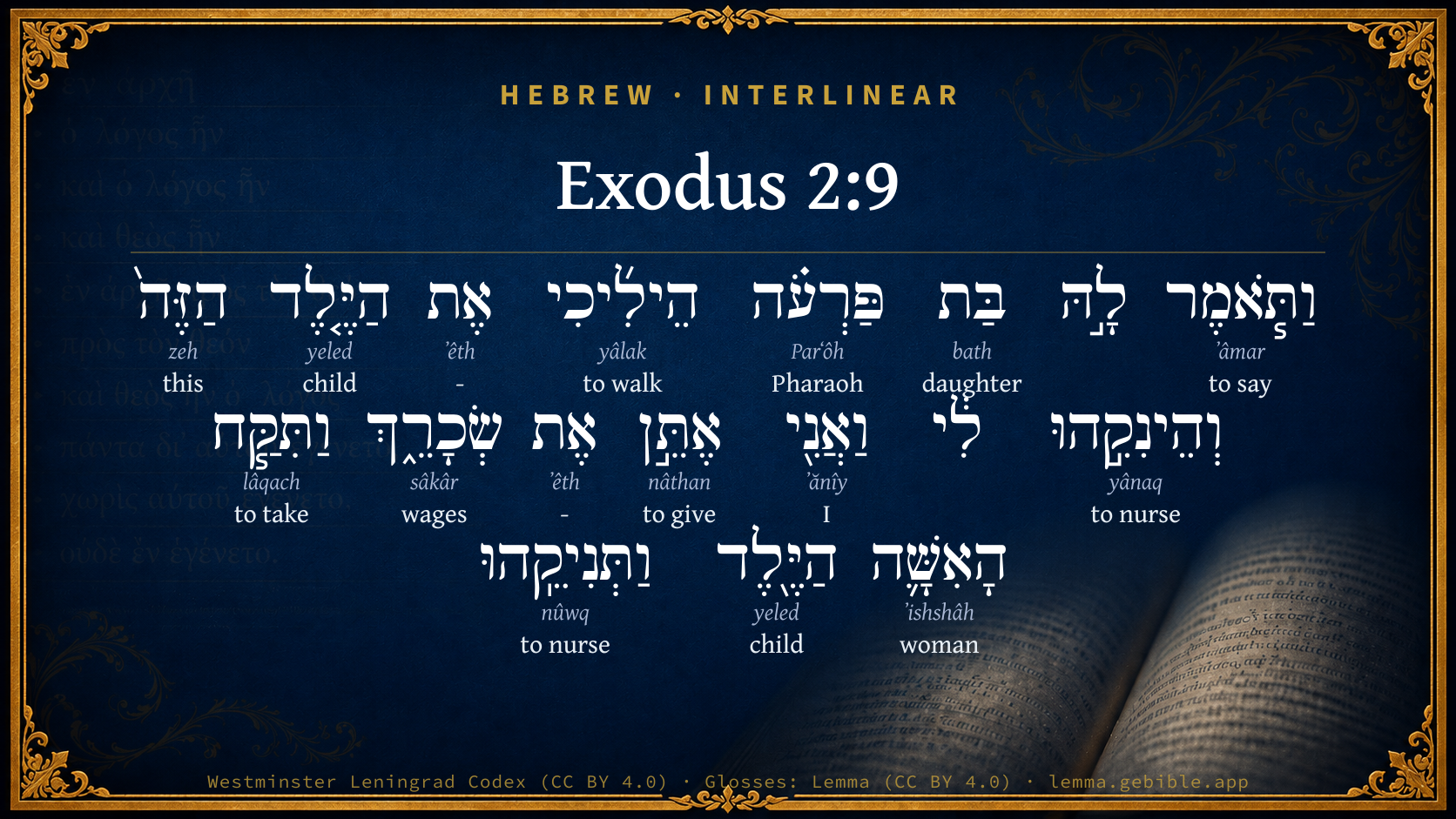
Exodus 2:9

Hebrew (Westminster Leningrad Codex) Exodus 2:9 appears in the Hebrew Old Testament. The text above is from the Westminster Leningrad Codex. Each word links to its Strong’s number, a concise gloss, and parsing drawn from the Open Scriptures Hebrew Bible morphology. Click any word for its full Brown-Driver-Briggs (BDB) entry.
Download image
Cite this verse

Exodus 2:9 (World English Bible). Public Domain. Lemma interlinear Bible study tool, https://lemma.gebible.app/v/exodus/2/9.

Show BibTeX & RIS
BibTeX
RIS
English Translation
Pharaoh's daughter said to her, "Take this child away, and nurse him for me, and I will give you your wages." The woman took the child, and nursed it.
World English Bible · Public Domain
Highlights
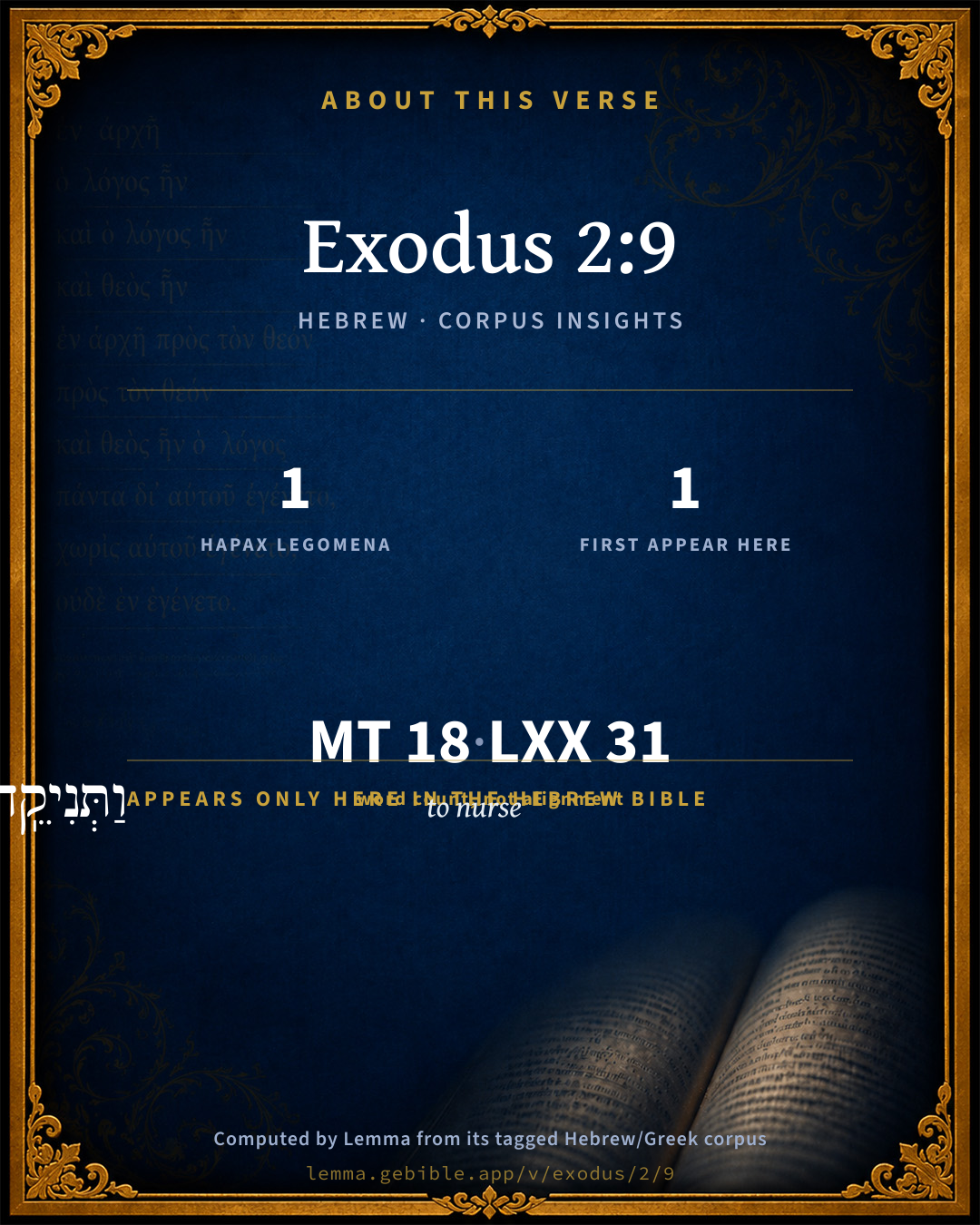
  • 1 hapax legomenon — only here in the Hebrew Bible
  • 1 first appearance in the Hebrew Bible
Full analysis ↓
Download a study sheet

One document with this verse’s original text, its word-by-word gloss line, the meaning frame, cross-references with their text, attributed commentary, and full source and license credits — printable, and it pastes into notes with its structure intact.

This verse Autodidact and up

Study sheet (.html) Plain text (.txt)

A passage Seminary Student

Up to 50 verses in one chapter. A passage sheet keeps up to 6 commentary sources and 12 cross-references per verse, in the order this page ranks them, and says so on the sheet whenever that leaves anything out. Ask for a single verse and you get the Autodidact verse sheet above.

Everything on this page stays free to read, with no account — the sheet is a download of what is already on screen, not access to it.

Want to remove ads? Support Godless Engineer
Compare translations 3

The same verse in 3 English versions, stacked beneath the original-language interlinear above. Click any original word for its lexicon entry.

Each is an independent rendering of the whole verse — the interlinear is not word-aligned to these translations.

Highlighted words mark where these versions differ — a whole-verse word diff, not a word-by-word alignment.

  • World English Bible Public Domain
    Pharaoh's daughter said to her, "Take this child away, and nurse him for me, and I will give you your wages." The woman took the child, and nursed it.
  • King James Version Public Domain
    And Pharaoh's daughter said unto her, Take this child away, and nurse it for me, and I will give thee thy wages. And the women took the child, and nursed it.
  • unfoldingWord Literal Text CC BY-SA 4.0
    And the daughter of Pharaoh said to her, “Take this child and cause him to nurse for me, and I shall give your wages.” And the woman took the child and caused him to nurse.

unfoldingWord Literal Text — © unfoldingWord, licensed CC BY-SA 4.0. Word-aligned USFM3 via Door43 (git.door43.org/unfoldingWord/en_ult).

Versions to compare (up to 4)

3 of 4 selected

Show all 18 translations

Every available English version of this verse, each an independent rendering of the whole verse.

  • World English Bible Public Domain
    Pharaoh's daughter said to her, "Take this child away, and nurse him for me, and I will give you your wages." The woman took the child, and nursed it.
  • Berean Standard Bible Public Domain
    Pharaoh’s daughter said to her, “Take this child and nurse him for me, and I will pay your wages.” So the woman took the boy and nursed him.
  • Majority Standard Bible Public Domain
    Pharaoh’s daughter said to her, “Take this child and nurse him for me, and I will pay your wages.” So the woman took the boy and nursed him.
  • King James Version Public Domain
    And Pharaoh's daughter said unto her, Take this child away, and nurse it for me, and I will give thee thy wages. And the women took the child, and nursed it.
  • American Standard Version (1901) Public Domain
    And Pharaoh's daughter said unto her, Take this child away, and nurse it for me, and I will give thee thy wages. And the woman took the child, and nursed it.
  • Revised Version (1885) Public Domain
    And Pharaoh’s daughter said unto her, Take this child away, and nurse it for me, and I will give thee thy wages. And the woman took the child, and nursed it.
  • Geneva Bible (1599) Public Domain
    To whome Pharaohs daughter sayde, Take this childe away, and nurce it for me, and I wil reward thee. Then the woman tooke the childe and nurced him.
  • Douay-Rheims (1899) Public Domain
    And Pharao's daughter said to her. Take this child and nurse him for me: I will give thee thy wages. The woman took, and nursed the child: and when he was grown up, she delivered him to Pharao's daughter.
  • Young's Literal Translation Public Domain
    and the daughter of Pharaoh saith to her, `Take this lad away, and suckle him for me, and I -- I give thy hire;' and the woman taketh the lad, and suckleth him.
  • Literal Standard Version CC BY-SA 4.0
    and the daughter of Pharaoh says to her, “Take this boy away, and suckle him for me, and I give your hire”; and the woman takes the boy, and suckles him.
  • Unlocked Literal Bible CC BY-SA 4.0
    Pharaoh's daughter said to the baby's mother, “Take this child and nurse him for me, and I will pay you wages.” So the woman took the child and nursed him.
  • unfoldingWord Literal Text CC BY-SA 4.0
    And the daughter of Pharaoh said to her, “Take this child and cause him to nurse for me, and I shall give your wages.” And the woman took the child and caused him to nurse.
  • Darby Bible Public Domain
    And Pharaoh's daughter said to her, Take this child away and nurse it for me, and I will give [thee] thy wages. And the woman took the child and nursed it.
  • World Messianic Bible Public Domain
    Pharaoh’s daughter said to her, “Take this child away, and nurse him for me, and I will give you your wages.” The woman took the child, and nursed it.
  • Webster's Bible Public Domain
    And Pharaoh's daughter said to her, Take this child away and nurse it for me, and I will give thee thy wages. And the woman took the child and nursed it.
  • Free Bible Version CC BY-SA 4.0
    “Take this baby boy and nurse him for me,” Pharaoh's daughter told his mother. “I will pay you myself.” So his mother took him home and nursed him.
  • Bible in Basic English Public Domain
    And Pharaoh's daughter said to her, Take the child away and give it milk for me, and I will give you payment. And the woman took the child and gave it milk at her breast.
  • JPS Tanakh (1917) Public Domain
    And Pharaoh's daughter said unto her: 'Take this child away, and nurse it for me, and I will give thee thy wages.' And the woman took the child, and nursed it.

Literal Standard Version (2020), Covenant Press — licensed CC BY-SA 4.0. Text via the HelloAO Bible API (eBible.org). Unlocked Literal Bible (unfoldingWord) — licensed CC BY-SA 4.0. Text via the HelloAO Bible API (eBible.org). unfoldingWord Literal Text — © unfoldingWord, licensed CC BY-SA 4.0. Word-aligned USFM3 via Door43 (git.door43.org/unfoldingWord/en_ult). Free Bible Version, Dr. Jonathan Gallagher — licensed CC BY-SA 4.0. Text via the HelloAO Bible API (eBible.org).

Word by word

More ways to search: Search by grammar → Find every occurrence → Compare this word →

Practice this passage: Drill this verse → Learn its vocabulary →

וַתְּנִיקֵֽהוּ
nûwq
H5134
“and · to nurse · him”
Conjunction + Verb, Hiphil, Sequential Imperfect, 3rd Person, Feminine, Singular + Suffix, Personal, 3rd Person, Masculine, Singular
Part of Speech
Conjunction + Verb
Stem
Hiphil
Form
Sequential Imperfect
Person
3rd Person
Gender
Feminine
Number
Singular
Full BDB Definition

Origin: a primitive root

TWOT: 1332

(Hiphil) to suckle, nurse
  1. וַתֹּ֧אמֶר ʼâmar H559 “and · to say” Conjunction + Verb, Qal, Sequential Imperfect, 3rd Person, Feminine, Singular
  2. בַּת bath H1323 “daughter of” Noun, Common, Feminine, Singular, Construct
  3. פַּרְעֹ֗ה Parʻôh H6547 “Pharaoh” Noun, Proper
  4. הֵילִ֜יכִי yâlak H3212 “walk” Verb, Hiphil, Imperative, 2nd Person, Feminine, Singular
  5. אֶת ʼêth H853 “-” Particle, Direct Object
  6. הַיֶּ֤לֶד yeled H3206 “the · child” Particle, Definite Article + Noun, Common, Masculine, Singular, Absolute
  7. הַזֶּה֙ zeh H2088 “the · this” Particle, Definite Article + Pronoun, Demonstrative, Masculine, Singular
  8. וְהֵינִקִ֣הוּ yânaq H3243 “and · nurse · him” Conjunction + Verb, Hiphil, Imperative, 2nd Person, Feminine, Singular + Suffix, Personal, 3rd Person, Masculine, Singular
  9. וַאֲנִ֖י ʼănîy H589 “and · I” Conjunction + Pronoun, Personal, 1st Person, Common, Singular
  10. אֶתֵּ֣ן nâthan H5414 “to give” Verb, Qal, Imperfect, 1st Person, Common, Singular
  11. אֶת ʼêth H853 “-” Particle, Direct Object
  12. שְׂכָרֵ֑ךְ sâkâr H7939 “wages · your” Noun, Common, Masculine, Singular, Construct + Suffix, Personal, 2nd Person, Feminine, Singular
  13. וַתִּקַּ֧ח lâqach H3947 “and · to take” Conjunction + Verb, Qal, Sequential Imperfect, 3rd Person, Feminine, Singular
  14. הָאִשָּׁ֛ה ʼishshâh H802 “the · woman” Particle, Definite Article + Noun, Common, Feminine, Singular, Absolute
  15. הַיֶּ֖לֶד yeled H3206 “the · child” Particle, Definite Article + Noun, Common, Masculine, Singular, Absolute

About this verse

These counts appear in no published source. They are computed here, from the morphology-tagged text and Lemma’s own curated glosses. What Lemma adds →

18
words
14
distinct lemmas
Pentateuch
section

Notable vocabulary

1 hapax legomenon — a word that appears only here in the entire Hebrew Bible:

  • וַתְּנִיקֵֽהוּ to nurse H5134

First appearance in Scripture

This word makes its first canonical appearance in the Hebrew Bible here:

  • וַתְּנִיקֵֽהוּ to nurse H5134

Shared distinctive vocabulary

שְׂכָרֵ֑ךְ wages H7939 occurs in 25 verses of the Hebrew Bible. Also found in:

Grammatical profile

  • 6 verbs
  • 6 nouns
  • 2 pronouns
  • 2 prepositions
  • 2 particles

Verb forms

  • וַתֹּ֧אמֶר Qal · Sequential Imperfect
  • הֵילִ֜יכִי Hiphil · Imperative
  • וְהֵינִקִ֣הוּ Hiphil · Imperative
  • אֶתֵּ֣ן Qal · Imperfect
  • וַתִּקַּ֧ח Qal · Sequential Imperfect
  • וַתְּנִיקֵֽהוּ Hiphil · Sequential Imperfect

Repetition

A word recurs within this verse — often emphatic in Hebrew:

  • הַיֶּ֤לֶד child H3206 ×2

Hebrew & Septuagint length

In English translation the verse runs 29 words from the Hebrew and 34 from the Septuagint (LXX English) — closely comparable.

A rough comparison of the two English renderings, which tokenize alike — not a word-level alignment.

Word counts can differ between the Hebrew and the Greek without any difference in meaning — e.g. the Hebrew direct-object marker אֵת has no separate Greek word, and Greek often adds the article ὁ.

In the original languages it is 18 Hebrew tokens and 31 Greek tokens — but the two are counted differently (Hebrew bundles its prefixes and suffixes into one token; the Greek is in lemma form), so that isn’t a like-for-like length.

Hebrew and Greek witnesses Masoretic Hebrew ↔ Greek Septuagint

The same verse in the two great witnesses to the Old Testament, shown verse-for-verse.

These are two independent witnesses, not word-aligned to each other, and the Septuagint is shown in lemma (dictionary) form.

Hebrew Exodus 2:9 Masoretic · Westminster Leningrad Codex

וַתֹּ֧אמֶר לָ֣הּ בַּת פַּרְעֹ֗ה הֵילִ֜יכִי אֶת הַיֶּ֤לֶד הַזֶּה֙ וְהֵינִקִ֣הוּ לִ֔י וַאֲנִ֖י אֶתֵּ֣ן אֶת שְׂכָרֵ֑ךְ וַתִּקַּ֧ח הָאִשָּׁ֛ה הַיֶּ֖לֶד וַתְּנִיקֵֽהוּ

Pharaoh's daughter said to her, "Take this child away, and nurse him for me, and I will give you your wages." The woman took the child, and nursed it.

World English Bible · Public Domain

Greek LXX Exodus 2:9 Septuagint · lemma form

εἶπον δέ πρός αὐτός ὁ θυγάτηρ φαραώ διατηρέω ἐγώ ὁ παιδίον οὗτος καί θηλάζω ἐγώ αὐτός ἐγώ δέ δίδωμι σύ ὁ μισθός λαμβάνω δέ ὁ γυνή ὁ παιδίον καί θηλάζω αὐτός

And the daughter of Pharao said to her, Take care of this child, and suckled it for me, and I will give you the wages; and the woman took the child, and suckled it.

LXX2012 (modern English Septuagint) · Public Domain

Hebrew: Westminster Leningrad Codex (CC BY 4.0). Greek: Septuagint (public domain); English from LXX2012 (modern English Septuagint) (Public Domain). How the Septuagint differs from the Hebrew →

Targum (Aramaic paraphrase)

2

The Targum is the ancient Jewish Aramaic paraphrase of the Hebrew Scriptures — an interpretive translation, not the Hebrew text itself. Onkelos (literal) and Pseudo-Jonathan (expansive) render the Torah, and Jonathan the Prophets. Coverage is partial: where no permissively-licensed English translation exists for a verse, only the Aramaic is shown. This is verse-level text, not a word-by-word alignment to the Hebrew.

  1. Targum Onkelos Torah (Genesis–Deuteronomy)
    וַאֲמֶרֶת לַהּ בַּת פַּרְעֹה אוֹבִילִי יָת רַבְיָא הָדֵין וְאוֹנְקִיהִי לִי וַאֲנָא אֶתֵּן יָת אַגְרָךְ וּנְסֵיבַת אִתְּתָא יָת רַבְיָא וְאוֹנִקְתֵּהּ:

    (no public-domain English translation for this verse)

    Targum Onkelos — Aramaic: “Onkelos Genesis” (public domain); “Onkelos Exodus” (public domain); “Onkelos Leviticus” (public domain); “Onkelos Numbers” (public domain); “Onkelos Deuteronomy” (public domain). English: “Sefaria Community Translation” (CC0 1.0 (public-domain dedication)); “J.W. Etheridge. The Targums of Onkelos and Jonathan Ben Uzziel on the Pentateuch. London: Longmans, Green, 1862” (public domain). Text via Sefaria.

  2. Targum Pseudo-Jonathan Torah (Genesis–Deuteronomy)
    וַאֲמָרַת לָהּ בְּרַת פַּרְעה אוֹבִילִי יַת רַבְיָא הָדֵין וְאוֹנִיקְתֵּיה לִי וַאֲנָא אִיתִּין יַת סוּטְרָךְ וּנְסִיבַת אִיתְּתָא יַת רַבְיָא וְאוֹנִיקְתֵּיהּ

    And the daughter of Pharoh said, Take this child and suckle it for me, and I will give thee thy wages And the woman took the child and suckled him.

    Targum Pseudo-Jonathan — Aramaic: “Targum Jonathan on Genesis” (public domain); “Targum Jonathan on Exodus” (public domain); “Targum Jonathan on Leviticus” (public domain); “Targum Jonathan on Numbers” (public domain); “Targum Jonathan on Deuteronomy” (public domain). English: “The Targum of Jonathan ben Uzziel, trans. J. W. Etheridge, London, 1862” (public domain). Text via Sefaria.

Commentary

Notes on Exodus 2:9 from classic Christian and Jewish commentators (each source and its license shown beneath its notes). The classic Christian expositions comment on the surrounding passage and are grouped to its opening verse, so a note may address several verses; the Jewish commentaries on the Tanakh (Rashi and others) are per-verse, so they appear only where the commentator wrote on this verse.

Lemma curates 59 commentaries, every one of them public domain or Creative Commons licensed, each selected and text-cleaned for this edition rather than reprinted as found. About our sources →

Trapp's Complete Commentary

John Trapp

Exo 2:9 And Pharaoh’s daughter said unto her, Take this child away, and nurse it for me, and I will give [thee] thy wages. And the woman took the child, and nursed it.

Ver. 9. And I will give thee thy wages.] The nurse expects not her pay from the child, but from the parents. Ministers, in case their people prove unkind or unthankful, must look up.

John Trapp, A Commentary or Exposition upon All the Books of the Old and New Testament (1647–1656) — public domain. Text from a community e-Sword module.

The Biblical Illustrator

Joseph S. Exell

Exo_2:9

Take this child away, and nurse it for me.

Care for children

I. To none is Gods commendation vouchsafed more fully than to those who love children for Christs sake. The presence of childhood represents and brings back our own. Children confide in those around them with a sweet and simple faith. They obey from affection, not fear. And so our Father in heaven would have His children trust Him, casting all our care upon Him, for He careth for us.

II. Children teach us reverence as well as faith. They listen with a solemn awe when we talk to them of God. They tread softly, and speak with bated breath in His holy place.

III. Children teach us to be kind, pitiful, and tender-hearted. They cannot bear to witness pain. They do all they can to soothe. Have we these sorrowful sympathies?

IV. If the love of Christ is in our hearts, it should constrain us to do our very best, thoughtfully, prayerfully, generously, to preserve in the children and to restore in ourselves that which made them so precious in His sight, And makes them so like Him now--like Him in their innocence, their sweet humility, their love. (Dean Hole.)

The providence of God in relation to the young

I. As rescuing them from the peril of unhappy circumstances.

1. Moses was rescued from murder--in the Egyptian palace he was safe.

2. Moses was rescued from slavery--in the Egyptian palace he was free.

II. As ensuring an education necessary to fit them for their future engagements.

1. As the son of Pharaohs daughter, Moses had the opportunity of a good scholastic education.

2. As the son of Pharaohs daughter he would be prepared to undertake the freedom of his nation.

III. As employing the most unlikely agency. The tyrants daughter was the means of rescuing Moses from peril, and of educating him for his future calling. Unlikely means--

1. Because her father had issued an edict for the death of all Israelitish children.

2. Because it appeared unlikely that a royal daughter should wish to adopt the son of an Israelite.

IV. As employing the most efficient instrumentality.

1. The mother of the boy--who could better teach him the wrongs of his country than she--that hundreds had suffered the fate he had managed to escape--the slavery of his people the tyranny of the king. She instructed him during the earliest days of his youth--her instruction would therefore be enduring--hence he would go to the Egyptian court with a knowledge of his countrys woe--and of his fathers God.

2. The daughter of the king.

V. As requiring the utmost human effort possible.

1. His mother did the best for Moses that she could.

2. His mother was judicious in her conduct towards Moses.

VI. As perfectly consistent with the free agency of individuals. (J. S. Exell, M. A.)

The training of children

I. The first qualification for the training of children is the love of children. The hard heart in which the merriment of childhood kindles no sunshine and wakens no music, is no more fit for the resting and growing place of an infant, than the sands of the desert are fit for the planting of a vineyard or the sowing of a wheatfield.

II. The second grand essential to the right training of children, is to receive them as sacred trusts from God to be nursed for him. Whence do we think the child comes to us? What do we desire it to be, in its relation to ourselves, and to the world, and to God? A mere doll, to be dressed for the gratification of our vanity? A mere pet animal, to be fed and fondled for our amusement? A mere competitor in the race of life, to struggle for a little while after its pleasures, honours, and riches, and then pass away for ever? Or do we regard it as a being of unbounded susceptibilities, and destined to eternity, which God has committed to us to train for His glory and the enjoyment of Himself for ever? When this simple but sublime thought, that a human soul has been committed to us to be trained for God, has once possessed us, it will ally itself with our love for children working itself out without effort, and almost without thought into our daily conduct.

III. A third essential to the right training of children is the requirement of un-answering obedience. The best answer to a childs, Why must I do this, or abstain from that? is Because your father or mother requires it. If further explanations are to be given, they should come after as a reward for obedience, and not before, as its condition. The habit of unanswering obedience is easily established, and when once fixed is permanent. And it should be further remembered that this requirement of unanswering obedience is saturated and sweetened through and through by the love of children. It is exalted and lifted above the impulses of selfish petulance and passion, by a sense of the Divine trust committed to us.

IV. Parents ought diligently to cultivate and win the absolute confidence and affection of their children. So, as years roll on, authority will broaden out into loving companionship, and obedience become a delightful conformity to the wishes of those who are dearer than themselves. Tempered and guided by the principles already announced, this plan will succeed. I do not say there will be no exceptional eases. There is a mystery in the heredity of evil and in the working of iniquity which seems at times to defy all general rules. Let parents understand this: that their children may attain the highest ends of life without wealth, without social distinction, and even without the higher forms of secular education; but they cannot inherit the richest blessings of the family relation, without being thoroughly in love with their father and mother, as the representatives and appointed agents of God, who says, Take this child and nurse it for Me, and I will give thee thy wages. (H. J. Van Dyke, D. D.)

The education of Moses

There from a mothers lips he learned the story of the great forefather Abraham, his call, and gods covenant with him and his seed; the meaning of the mark of circumcision in his flesh, and the duties to which it bound him; the Divine unity and holiness; the worship and service that is the Creators due; was made tenderly alive to the wrongs and sufferings of his people; was taught patriotism and piety, and prepared to become in due time the vindicator of Israels freedom and faith. (R. A. Hallam, D. D.)

The education of Moses

1. See how much in the making up of the leader of His chosen people God makes of secular instruction--what ample provision God made for it in his equipment for his arduous and difficult task. The Scriptures give no countenance to ignorance. The world has knowledge to impart which the Church may gladly accept. The Church is in many ways beholden to the world. Egypt was largely a benefactor to Moses and to the Israelitish people. Nothing that Egypt had imparted would be without its use in such a task. God did not despise it as a means, but subsidized it, and brought all its resources and influences to bear in making for Himself the man who was to lift His Church from a tribe into a nation, from slavery to independence. Though He could have communicated all these qualifications to Moses by a direct gift, He did not, but chose to bestow them upon him by means. To despise secular knowledge, and think that we are better Christians for being destitute of worldly lore, is fanatacism, and not piety. Civilization is the ally of religion and not its foe. Intelligence strengthens godliness, and does not lower or injure it,

2. Finally, see the value of early and specially of maternal influence, in its bearing on the religious character and life. What a power both of impulsion and of resistance it had in the case of Moses! By this means Jochebed against fearful odds was successful, more than a match for them. An obscure woman, with no more than ordinary attainments, of a proscribed race, acting in a capacity little better than menial, she was too much for all Egypts sages, and scholars, and priests, and nobles and rulers. There were two things that gave her great advantage in the contest. She got the start of them. She worked by the law of love. Before any Egyptian influence could reach the child, she had possession of his ear and of his heart. What an encouragement is here to all mothers, to all parents! How much greater things they may be labouring for than they contemplate or foresee. (R. A. Hallam, D. D.)

Infancy of Moses

I. The duty enjoined.

1. The object--This child.

(1) What it may become. Philosopher, warrior, statesman, philanthropist, etc.

(2) What it must become. A responsible moral agent.

2. The duty--Nurse it. This includes--

(1) Attention to physical wants.

(2) Cultivation of mental faculties.

(3) Religious instruction.

II. The reward promised--And I will pay thee thy wages. You may be rewarded--

1. By seeing your efforts crowned with success.

2. You shall at any rate possess the consciousness of the Divine favour.

3. You shall leave your children with composure when you come to die.

4. You shall stand before them with confidence in the judgment day.

(1) Let pious parents be encouraged in the way of duty.

(2) Let negligent parents consider the cruelty of their conduct, and the bitter consequences which must result from it. (J. Burns, D. D.)

Gods method of raising up souls for His service

I. God gives and sends them as they are needed.

II. That they may be fully trained and prepared for their work, they are made like unto their brethren.

III. The very family and people that sought to destroy israel are made instrumental in nourishing and rearing the deliverer of israel and the avenger of his brethrens wrongs. Injustice and cruelty are made to avenge themselves in the end.

IV. In the raising up of the man Moses we have a most instructive exemplification of the doctrine and working of the Divine providence.

V. In Pharaohs daughter, and the part she takes, we have the proof that human nature, the human heart, is one; and that all classes of mankind, all nations, are destined to become one in Gods great saving plan. (Pulpit Analyst.)

The power of a mothers love

1. To control its impulse.

2. To school its utterance.

3. To make self-denial for the good of her child.

4. To enter into the method of Providence concerning the future of her boy. (J. S. Exell, M. A.)

A beautiful pattern of self-control

1. Not arising from indifference.

2. Not arising from hard-heartedness.

3. But arising from the calm indwelling of faith. (J. S. Exell, M. A.)

This mother a model nurse

1. Because she taught her son to have sympathy with the slave.

2. Because she taught him to despise injustice (Exo_2:12).

3. Because she taught him the folly of anger (Exo_2:13).

4. Because she taught him to defend the weak (Exo_2:17). (J. S. Exell, M. A.)

A mother the best nurse

1. Because she has truest sympathy with the circumstances of the childs life.

2. Because she is more truly concerned for the right development of its moral character.

3. Because then she will have gladdening memories of its infancy and childhood. (J. S. Exell, M. A.)

Bringing up in the faith

How can an outward action, or ceremony, like the baptism of water, alter the inward state and affect the real course of life? It can do it just as the Egyptian princess, by one gesture of her arm and one command from her lips, does in fact raise a new-born infant from the slaves cabin to the fellowship of monarchs. It is no miraculous or talismanic transformation. There is no violent revolution of the secret forces or moral circulations of the soul. But the child is set into new relations, and out of those new relations flow, as naturally as the stream through a new channel cut in the hills, new habitudes, new dispositions, a new life, a new heart, a new destiny. Observe that there is nothing here which insures the childs safety: nothing that precludes the possibility of his falling back again, if he chooses, into bondage; nothing that compels him to stay in his Lords house or in any way overrules his liberty--the awful liberty to apostatize into guilt and perdition. Now we pass on to another question. What will it be to nourish your child for Christ?

1. In the first place, it will be to keep in your own heart a constant feeling of the charge laid upon you in the childs spiritual nature. The power of this feeling will be manifested not only in express words and direct actions, but in countless and daily signs of your faith which the child is sure to understand. The unconscious part of education, especially of the education of the soul, is always, probably, the more important part, yet the least considered. In other words, what we are tells more on a child, in the long run, than what we say. Every father or mother is not only either for Christ or against Him in the house--but they are perpetually, inevitably, helping to set out and enlist their offspring for Him or against Him.

2. Again, those parents nourish the child for Christ, who, after they have presented him in holy baptism, take care not to contradict the vow they have there made by a systematic indoctrination of him into ideas and fashions which Christ abhors. They do not come here to give him up by a ceremony to his Maker, and then begin steadily to baptize him themselves into the bitter and polluted spirit of this world.

3. Turn to a more positive and attractive aspect of your obligation. You are to nourish your child into a familiar knowledge of his personal membership in Christ and his sonship in Christs kingdom.

Two other things must accompany this work; the one as a help, the other as a hope, but both of them powers, indispensable to your success.

1. The child is to be nourished with the habitual practice of intercessory prayer. Whatever you may fail of in your knowledge, or your earthly providing, or your power of religious influence otherwise, have hope in your intercessions.

2. And therefore, finally, take this child away and nourish him for Christ with the expectation of a blessing. That expectation is to be not only a comfort to you on the way, but one of the spiritual forces with which you are to prevail. This Lord, who has lent you the little one, not only loves the importunities of His people; He delights in their largest confidences. (Bp. F. D. Huntington.)

The children of the poor, the charge of the Church

I. First, let us look at the class of children who are specially committed to our care and concern. It seems a truth sufficiently obvious from analogy, that the strong ought to take care of the weak, and the rich ought peculiarly to regard the poor.

1. God especially regards the poor.

2. The souls of the poor are as valuable as the rich.

3. God has selected from among the poor many of the most eminent characters both in the Church and in the world.

II. Now let us glance at another point of the doctrine, and that is--the training we are to give them. Take this child, and nurse it for Me. We are to nurse them and train them for God. Here I would lay great emphasis. Education is an engine of great moral power. It enlarges the mind; it ennobles the individual; it furnishes him with a fund of enjoyment; it capacitates him for usefulness; it directs his energies to proper objects. But let it be well and thoroughly understood that if education be not founded on religious and on scriptural principles, you put a weapon into the hand of an individual to do more evil--to do it secretly and effectually. You render him a more expert agent to fight against God and to oppose the reign of holiness.

III. But there is another point which ought to be touched upon: and that is--the reward we may expect. I will give thee thy wages. Not apples of gold; not pictures of silver; not honours that shall adorn our brows, achieved by the victories of the noble and the wiles of the great. Not literal wages. But still there is a reward; good, and blessed and large. And what is this reward? Wages far higher than money can bring. Is there no reward in doing good? No reward, that when the ear hears you, then it blesses you; and when the eye sees you, it bears witness to you? No reward, to see those dear children growing up to fill important stations in life by your instrumentality? No reward, to reflect that you have been turning many in your generation to serve God, and to serve their generation? No reward, to think that you are acting out true patriotism, and training children who shall serve their country and bless the age in which they live? But especially, is there no reward, when the Master, whose glance is life and whose favour is better than life, shall at the last day say, Inasmuch as ye have done it, etc. (J. Sherman.)

The training of children for God

God speaks to every parent, teacher, pastor, with every child He puts into their care.

I. So He speaks to the parent with a definite and individual charge. He says not: Take some child, but, This one take and train. There is no question here as to which out of the many is to be the object of your care. How that definiteness enhances the solemnity of the charge! It is the very charge you would have chosen, too. The tie of nature is a stronger one than you can make with bands of gold or fetters of brass, and when that tie receives the strengthening sanction of Gods approval, it is the most enduring thing in all the world. God has organized, and He sanctions, the family and its sweet bonds.

II. For in these words of Pharaohs daughter, taken as the Kings own word to us, we find the secret of the training of the child. Nurse it for Me. Not for yourself are you to train this child entrusted to your care. It was not given for your amusement or your service. Nor may you train them for themselves, as though the world was made for them and all their business was to please themselves with it. The only right and worthy object of our labours for the children, and it should be an aim clearly before us, is to bring them up for God. We surely cannot do it unless it be our definite purpose. Train it not for, but in, Christian faith and love and obedience, and teach it always to live to please the Lord that bought us. The New Testament teaching is like the Old: based on the same principles, uttered in similar form--And ye fathers, provoke not your children to wrath: but bring them up in the nurture and admonition of the Lord.

III. And so we shall receive the reward. I will give thee thy wages. It was the daughter of the king who promised thus to Moses mother. It is the King Himself who gives His word to us. He pays us for taking care not of our children, but of His. Here is the worst mistake of all, if we do not recognize them as Gods children and we as only nurses in His employ. The promise is as definite as the charge. I will pay thee. It is the faithful parent or the faithful teacher who wilt be rewarded. (G. M. Boynton.)

Children to be educated for God

I. What is implied in educating children for God.

1. A realizing, heartfelt conviction that they are His property, His children, rather than ours; and that He commits them for a time to our care, merely for the purpose of education, as we place children under the care of human instructors for the same purpose.

2. A cordial and solemn dedication or surrender of them to Him, to be His for ever.

3. We must do all that we do for them from right motives.

4. If we would educate our children for God, we must educate them for His service.

(1) This implies that we pay more attention to the soul than to the body.

(2) It implies that we pay more attention to the heart or disposition than to the mind.

(3) It implies that we educate them for eternity rather than for time; for a future world--rather than for this.

II. The reward which He gives to those who perform this duty aright. This reward consists--

1. In the pleasure which attends every attempt to educate children for God.

2. Another part of the reward which God bestows on those who educate their children for Him, is the happiness which they enjoy when they see their labours crowned with success. (E. Payson, D. D.)

On the Christian education of children

What are the wages of fidelity in the important work of the Christian education of children?

1. In the first place, then, a part of the reward of fidelity in religiously educating your children consists in the pleasure of the work. It is an innocent, an interesting, and an honourable occupation.

2. There enters into the reward of religiously educating children, the pleasure which arises from doing good to society.

3. There is high honour in cooperating with God, and great happiness in conforming to the intentions of His providence.

4. The good of his children is what every parent purposes to himself, as the object, perhaps, of his fondest desire, as the motive to all his parental conduct. And herein is a large part of the wages of fidelity in religiously educating them, that thereby their great good in this life will be most effectually promoted. It is a perilous and unhappy world into which you introduce them. And yet the misfortune is, that in education respect is more generally had to its pleasures than its sorrows, to its honours than its snares. The great question concerning your offspring is, where in it shall wisdom be found, and where is the place of satisfaction? Look around you. See in what path they shall be most likely to find peace. Examine the claims of wealth, of honour, of rank, of power, of pleasure. Turn to religion. Institute a comparison between her claims and theirs. Inquire which of them has most efficacy to quell the passions, which are the parents of evil; to soothe the sorrows, which are the offspring of our condition; to open sources of happiness at which the weary spirit may always be refreshed; and to take the barbs from the arrows of death? Such a comparison will assuredly produce a result in favour of a Christian education.

5. The faithful parent has a recompense for his care in the religious education of his children, in the greater security of his own happiness. It is through the child that the heart of a parent is most vulnerable. The hour comes when your children shall stand around you, and you will perceive that you are leaving them without you in this evil world. What can mitigate this anguish of death? What but to be able to say of them, when you cast on them your final look, I am going unto my Father, and their Father; and to my God, and their God. They will honour me in their lives when I shall be gone. The Almighty is their Friend and He will protect them.

6. But not in this life is the reward of the faithful in any case complete. By far the largest part of the wages, which God, in His mercy, has promised to any of their good works, is reserved to be given them in the great day of the final consummation. (Bp. Dehon.)

Permanence of early impressions

A farmer decided to remove an old beech-tree which grew on his farm. The wood-cutter noticed on the bark of the tree some curious marks looking like the letters J. L., roughly cut, and below them some ornamental design. After the tree had been cut down and was being separated into lengths he was startled to find on the hard dry wood at the core of the tree, directly opposite the place on the bark where he had noticed the marks, the clearly cut letters J. L., on a dark background, and below them an anchor. On inquiries being made, it was found that the letters were the initials of a sailor named John Leland, who, in aa idle hour, had cut them on the beech-tree when it was young. There were thirty-seven rings between the letters and the bark of the tree, and the woodsman said that each ring represented one years growth of the tree. He inferred that the letters must have been cut in the year 1853, and his belief was confirmed when he learned that it was in that year that the sailor had spent some time in that neighbourhood. Thus the inscription had not only remained in the place where it was cut at the first, but as each year added to the growth of the tree, the letters still appeared on the surface, scarcely legible there, it is true, but perfectly clear at the core. It is so with human character. Many an old man, in spite of the rough usage of the world and the scar of time and trouble, bears upon his walk and conversation the marks of the handwriting which in his youth God put in his heart.

Care of children

A florist, who was so absorbed with his cuttings that he did not hear until twice spoken to, apologized, saying, I beg your pardon, but you see one must put his whole mind on these young things, if he would have them do well; and I cannot bear that one should die on my hands, for I should almost feel as if I had murdered it.

The Biblical Illustrator, edited by Joseph S. Exell (c. 1880s–1900s) — public domain. Text from a community e-Sword module.

Ellicott's Commentary for English Readers

(9) Nurse it for me.—The princess adopts Miriam’s suggestion; the child is to be nursed for her—is to be hers. She will place it out to nurse, and pay the customary wages.

A Bible Commentary for English Readers, edited by Charles John Ellicott (1878–1897) — public domain. Text from a community e-Sword module.

The Cambridge Bible for Schools and Colleges

gen. ed. J. J. S. Perowne

9. and I] The pron. is emphatic.

The Cambridge Bible for Schools and Colleges (gen. ed. J. J. S. Perowne; Cambridge University Press, 1878–1918) — public domain. Text from a community e-Sword module.

John Gill's Exposition

And Pharaoh's daughter said unto her,.... Being come, having made all possible haste:

take this child away, and nurse it for me, and I will give thee thy wages; by which means she had not only the nursing of her own child, but was paid for it: according to a Jewish writer (t), Pharaoh's daughter agreed with her for two pieces of silver a day.

(t) Dibre Hayamim; sive Chronicon Mosis, fol. 4. 1.

John Gill's Exposition of the Whole Bible (1746–1763) — public domain (CC PDM 1.0). Text via the HelloAO Bible API.

unfoldingWord translationNotes

Door43 World Missions Community

she brought him

"the Hebrew woman brought him"

he became her son

"he became the adopted son of Pharaoh's daughter"

Because I drew him from the water

Translators may add a footnote that says "The name Moses sounds like the Hebrew word that means 'pull.'"

drew him

"pulled him"

translationWords

Pharaoh

son

Moses

unfoldingWord translationNotes — © Distant Shores Media and the Door43 World Missions Community, licensed CC BY-SA 4.0. Source: git.door43.org/Door43/en_tn.

Rashi

Rabbi Shlomo Yitzchaki (Rashi)

היליכי (the word may be explained as a compound of two Aramaic words, הי, here is, and ליכי, that which belongs to thee — thine own) — she prophesied without knowing what she was prophesying (unconsciously she stated the actual fact) — here is thine own (Exodus Rabbah 1:21 and Sotah 12b).

Rashi on the Tanakh — English translations: “The Judaica Press complete Tanach with Rashi, translated by A. J. Rosenberg” (CC BY 4.0); “Pentateuch with Rashi's commentary by M. Rosenbaum and A.M. Silbermann, 1929-1934” (public domain); “The Metsudah Tanach series, Lakewood, N.J” (CC BY 4.0); and “The Book of Joshua, Metsudah Publications, 1997” (CC BY 4.0). Text via Sefaria.

Lesson kit

Teaching starters — assembled from the data on this page, not authored interpretation. Every prompt links to the verse data it draws on. Edit before teaching.

Exodus, in the Pentateuch, opens this verse with 18 words (14 distinct Hebrew lemmas). Its most distinctive word is nûwq (“to nurse”). A historical commentator’s framing appears above. Read the whole chapter for the surrounding context.

Discussion questions

  1. What does “to nurse” (nûwq) contribute to the verse as a whole?
  2. 1 word here appears nowhere else in the Hebrew Bible. Why might the author reach for such rare wording?
  3. This is the first place “to nurse” appears in Scripture (first appears here). What does its debut here establish?
  4. How does Genesis 15:1, which shares the word «wages», read alongside this verse?
  5. What does the repetition of “child” (2× in this one verse) do in this verse?
  6. The translations on this page render this verse differently — a whole-verse word diff, not a word-by-word alignment. What might account for the different wordings?
  7. «וַתֹּ֧אמֶר» is a Qal Sequential Imperfect verb. How does that grammatical form shape the action described?
  8. Compare how Trapp's Complete Commentary and The Biblical Illustrator read this verse. Where do they agree or differ?

Things to notice

  • 1 word in this verse appears nowhere else in the Hebrew Bible.
  • 1 word makes its first canonical appearance in Scripture here.
  • This verse counts 18 Hebrew ↔ 31 Greek words.
  • These translations choose different wording for 12 words in this verse.
  • “child” occurs 2× in this single verse.

Reading settings

Reading text

Shown beneath each verse's original-language words.

Old Testament
Old Testament edition

Read the OT as the Masoretic Hebrew (MT) or the Greek Septuagint (LXX).

English shown for the Greek Septuagint (in the Hebrew ↔ Greek comparison).

Comparing translations? Open the Compare panel on any verse page to stack up to four side by side.