Genesis 4:12

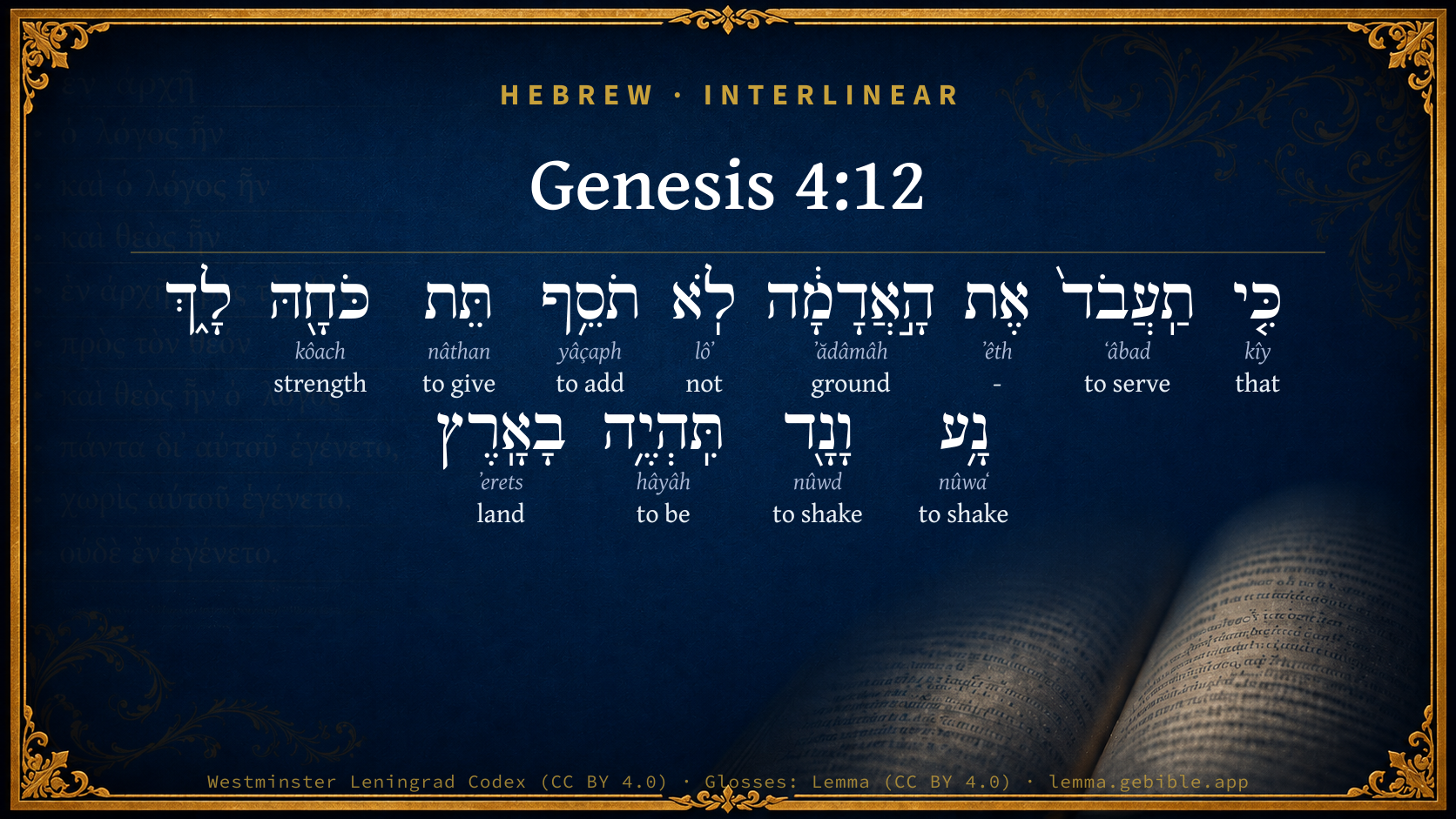
Hebrew (Westminster Leningrad Codex) Genesis 4:12 appears in the Hebrew Old Testament. The text above is from the Westminster Leningrad Codex. Each word links to its Strong’s number, a concise gloss, and parsing drawn from the Open Scriptures Hebrew Bible morphology. Click any word for its full Brown-Driver-Briggs (BDB) entry.
Download image
Cite this verse

Genesis 4:12 (World English Bible). Public Domain. Lemma interlinear Bible study tool, https://lemma.gebible.app/v/genesis/4/12.

Show BibTeX & RIS
BibTeX
RIS
English Translation
From now on, when you till the ground, it won't yield its strength to you. You shall be a fugitive and a wanderer in the earth."
World English Bible · Public Domain
Highlights
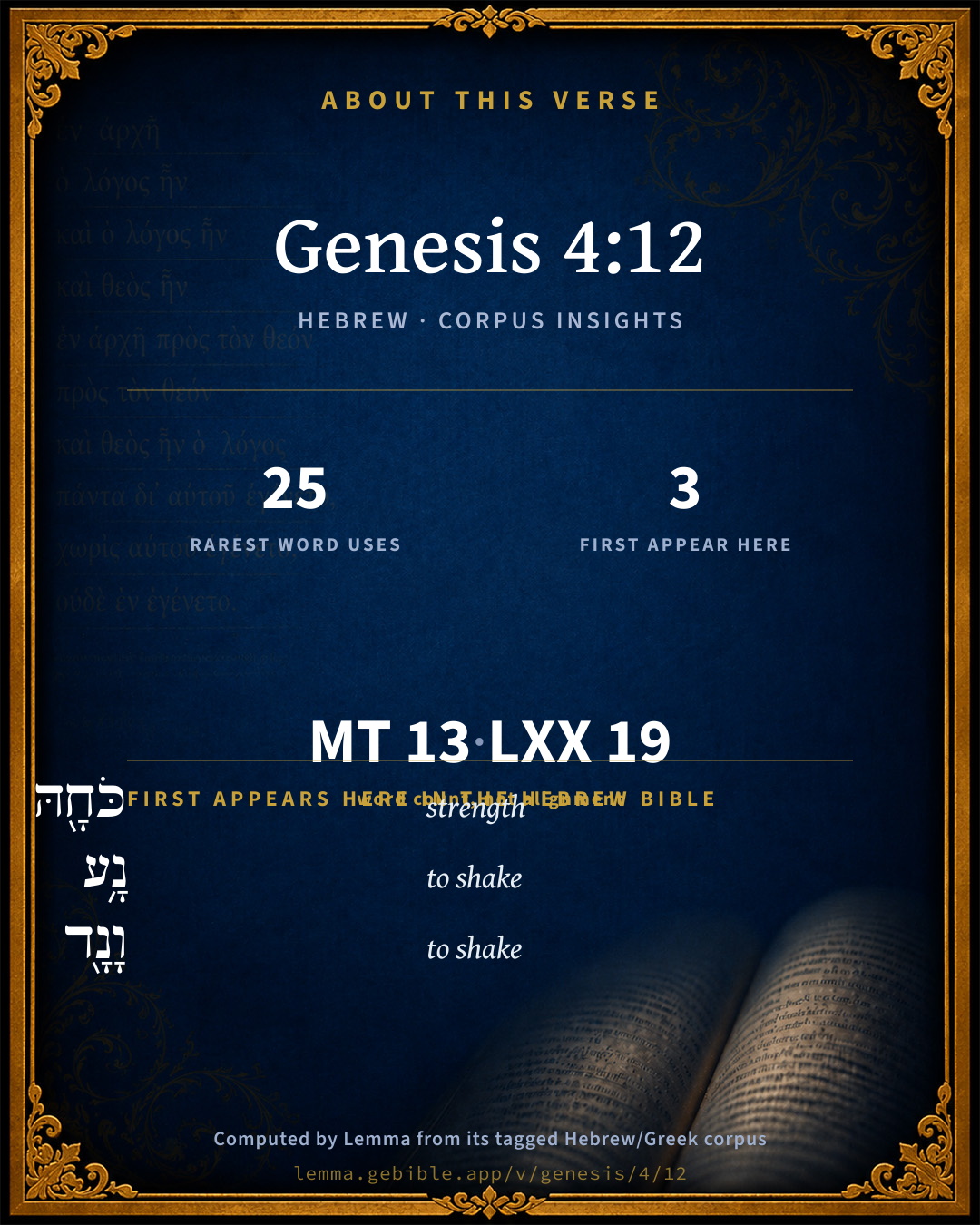
  • 3 first appearances in the Hebrew Bible
Full analysis ↓
Download a study sheet

One document with this verse’s original text, its word-by-word gloss line, the meaning frame, cross-references with their text, attributed commentary, and full source and license credits — printable, and it pastes into notes with its structure intact.

This verse Autodidact and up

Study sheet (.html) Plain text (.txt)

A passage Seminary Student

Up to 50 verses in one chapter. A passage sheet keeps up to 6 commentary sources and 12 cross-references per verse, in the order this page ranks them, and says so on the sheet whenever that leaves anything out. Ask for a single verse and you get the Autodidact verse sheet above.

Everything on this page stays free to read, with no account — the sheet is a download of what is already on screen, not access to it.

Want to remove ads? Support Godless Engineer
Compare translations 3

The same verse in 3 English versions, stacked beneath the original-language interlinear above. Click any original word for its lexicon entry.

Each is an independent rendering of the whole verse — the interlinear is not word-aligned to these translations.

Highlighted words mark where these versions differ — a whole-verse word diff, not a word-by-word alignment.

  • World English Bible Public Domain
    From now on, when you till the ground, it won't yield its strength to you. You shall be a fugitive and a wanderer in the earth."
  • King James Version Public Domain
    When thou tillest the ground, it shall not henceforth yield unto thee her strength; a fugitive and a vagabond shalt thou be in the earth.
  • unfoldingWord Literal Text CC BY-SA 4.0
    When you work the ground, it will not continue to yield its strength for you. You will be a fugitive and a wanderer on the earth.”

unfoldingWord Literal Text — © unfoldingWord, licensed CC BY-SA 4.0. Word-aligned USFM3 via Door43 (git.door43.org/unfoldingWord/en_ult).

Versions to compare (up to 4)

3 of 4 selected

Show all 18 translations

Every available English version of this verse, each an independent rendering of the whole verse.

  • World English Bible Public Domain
    From now on, when you till the ground, it won't yield its strength to you. You shall be a fugitive and a wanderer in the earth."
  • Berean Standard Bible Public Domain
    When you till the ground, it will no longer yield its produce to you. You will be a fugitive and a wanderer on the earth.”
  • Majority Standard Bible Public Domain
    When you till the ground, it will no longer yield its produce to you. You will be a fugitive and a wanderer on the earth.”
  • King James Version Public Domain
    When thou tillest the ground, it shall not henceforth yield unto thee her strength; a fugitive and a vagabond shalt thou be in the earth.
  • American Standard Version (1901) Public Domain
    when thou tillest the ground, it shall not henceforth yield unto thee its strength; a fugitive and a wanderer shalt thou be in the earth.
  • Revised Version (1885) Public Domain
    when thou tillest the ground, it shall not henceforth yield unto thee her strength; a fugitive and a wanderer shalt thou be in the earth.
  • Geneva Bible (1599) Public Domain
    When thou shalt till the grounde, it shall not henceforth yeelde vnto thee her strength: a vagabond and a runnagate shalt thou be in the earth.
  • Douay-Rheims (1899) Public Domain
    When thou shalt till it, it shall not yield to thee its fruit: a fugitive and vagabond shalt thou be upon the earth.
  • Young's Literal Translation Public Domain
    when thou tillest the ground, it doth not add to give its strength to thee -- a wanderer, even a trembling one, thou art in the earth.'
  • Literal Standard Version CC BY-SA 4.0
    when you till the ground, it will not add to give its strength to you—a wanderer, even a trembling one, you are in the earth.”
  • Unlocked Literal Bible CC BY-SA 4.0
    When you cultivate the ground, from now on it will not yield to you its strength. A fugitive and a wanderer you will be in the earth.”
  • unfoldingWord Literal Text CC BY-SA 4.0
    When you work the ground, it will not continue to yield its strength for you. You will be a fugitive and a wanderer on the earth.”
  • Darby Bible Public Domain
    When thou tillest the ground, it shall not henceforth yield thee its strength; a wanderer and fugitive shalt thou be on the earth.
  • World Messianic Bible Public Domain
    From now on, when you till the ground, it won’t yield its strength to you. You will be a fugitive and a wanderer in the earth.”
  • Webster's Bible Public Domain
    When thou tillest the ground, it shall not henceforth yield to thee its strength: A fugitive and a vagabond shalt thou be in the earth.
  • Free Bible Version CC BY-SA 4.0
    When you cultivate the ground, it won't produce crops for you. You'll be always on the run, wandering all over the earth.”
  • Bible in Basic English Public Domain
    No longer will the earth give you her fruit as the reward of your work; you will be a wanderer in flight over the earth.
  • JPS Tanakh (1917) Public Domain
    When thou tillest the ground, it shall not henceforth yield unto thee her strength; a fugitive and a wanderer shalt thou be in the earth.'

Literal Standard Version (2020), Covenant Press — licensed CC BY-SA 4.0. Text via the HelloAO Bible API (eBible.org). Unlocked Literal Bible (unfoldingWord) — licensed CC BY-SA 4.0. Text via the HelloAO Bible API (eBible.org). unfoldingWord Literal Text — © unfoldingWord, licensed CC BY-SA 4.0. Word-aligned USFM3 via Door43 (git.door43.org/unfoldingWord/en_ult). Free Bible Version, Dr. Jonathan Gallagher — licensed CC BY-SA 4.0. Text via the HelloAO Bible API (eBible.org).

Word by word

More ways to search: Search by grammar → Find every occurrence → Compare this word →

Practice this passage: Drill this verse → Learn its vocabulary →

וָנָ֖ד
nûwd
H5110
“and · shaking”
Conjunction + Verb, Qal, Participle Active, Masculine, Singular, Absolute
Part of Speech
Conjunction + Verb
Stem
Qal
Form
Participle Active
Gender
Masculine
Number
Singular
State
Absolute
Full BDB Definition

Origin: a primitive root

TWOT: 1319

to shake, waver, wander, move to and fro, flutter, show grief, have compassion on - (Qal) - to move to and fro, wander (aimlessly), take flight - to flutter - to waver, wave, shake - to show grief - to lament, condole, show sympathy - (Hiphil) - to cause to wander (aimlessly) - to make a wagging, wag (with the head) - (Hithpolel) - to move oneself to and fro, sway, totter - to shake oneself - to bemoan oneself
  1. כִּ֤י kîy H3588 “that” Conjunction
  2. תַֽעֲבֹד֙ ʻâbad H5647 “to serve” Verb, Qal, Imperfect, 2nd Person, Masculine, Singular
  3. אֶת ʼêth H853 “-” Particle, Direct Object
  4. הָ֣אֲדָמָ֔ה ʼădâmâh H127 “the · ground” Particle, Definite Article + Noun, Common, Feminine, Singular, Absolute
  5. לֹֽא lôʼ H3808 “not” Particle, Negative
  6. תֹסֵ֥ף yâçaph H3254 “to add” Verb, Hiphil, Jussive, 3rd Person, Feminine, Singular
  7. תֵּת nâthan H5414 “to give” Verb, Qal, Infinitive Construct
  8. כֹּחָ֖הּ kôach H3581 “strength · her” Noun, Common, Masculine, Singular, Construct + Suffix, Personal, 3rd Person, Feminine, Singular
  9. נָ֥ע nûwaʻ H5128 “shaking” Verb, Qal, Participle Active, Masculine, Singular, Absolute
  10. תִּֽהְיֶ֥ה hâyâh H1961 “to be” Verb, Qal, Imperfect, 2nd Person, Masculine, Singular
  11. בָאָֽרֶץ ʼerets H776 “in/at the · land” Preposition, Determined + Noun, Common, Both, Singular, Absolute

About this verse

These counts appear in no published source. They are computed here, from the morphology-tagged text and Lemma’s own curated glosses. What Lemma adds →

13
words
12
distinct lemmas
Pentateuch
section

Notable vocabulary

The rarest word here is וָנָ֖ד to shake H5110 — appearing just 25 times in the whole Hebrew Bible.

First appearance in Scripture

These words make their first canonical appearance in the Hebrew Bible here:

  • כֹּחָ֖הּ strength H3581
  • נָ֥ע to shake H5128
  • וָנָ֖ד to shake H5110

Shared distinctive vocabulary

וָנָ֖ד to shake H5110 occurs in 24 verses of the Hebrew Bible. Also found in:

Grammatical profile

  • 6 verbs
  • 3 nouns
  • 1 preposition
  • 1 conjunction
  • 2 particles

Verb forms

  • תַֽעֲבֹד֙ Qal · Imperfect
  • תֹסֵ֥ף Hiphil · Jussive
  • תֵּת Qal · Infinitive Construct
  • נָ֥ע Qal · Participle Active
  • וָנָ֖ד Qal · Participle Active
  • תִּֽהְיֶ֥ה Qal · Imperfect

Hebrew & Septuagint length

In English translation the verse runs 26 words from the Hebrew and 25 from the Septuagint (LXX English) — closely comparable.

A rough comparison of the two English renderings, which tokenize alike — not a word-level alignment.

Word counts can differ between the Hebrew and the Greek without any difference in meaning — e.g. the Hebrew direct-object marker אֵת has no separate Greek word, and Greek often adds the article ὁ.

In the original languages it is 13 Hebrew tokens and 19 Greek tokens — but the two are counted differently (Hebrew bundles its prefixes and suffixes into one token; the Greek is in lemma form), so that isn’t a like-for-like length.

Cross-references

10

Topical passages linked to Genesis 4:12 in the Treasury of Scripture Knowledge — connected by theme and wording, ordered by reader-vote popularity; previews shown in the World English Bible.

  • Hosea 9:17 My God will cast them away, because they did not listen to him; And they will be wanderers among the nations.
  • Leviticus 26:20 and your strength will be spent in vain; for your land won't yield its increase, neither will the trees of the land yield their fruit.
  • Leviticus 26:36 "'As for those of you who are left, I will send a faintness into their hearts in the lands of their enemies: and the sound of a driven leaf will put them to flight; and they shall flee, as one flees from the sword; and they will fall when no one pursues.
  • Deuteronomy 28:23–24 Your sky that is over your head shall be brass, and the earth that is under you shall be iron.
  • Genesis 3:17–18 To Adam he said, "Because you have listened to your wife's voice, and have eaten of the tree, of which I commanded you, saying, 'You shall not eat of it,' cursed is the ground for your sake. In toil you will eat of it all the days of your life.
  • Genesis 4:14 Behold, you have driven me out this day from the surface of the ground. I will be hidden from your face, and I will be a fugitive and a wanderer in the earth. It will happen that whoever finds me will kill me."
  • Deuteronomy 28:65–66 Among these nations shall you find no ease, and there shall be no rest for the sole of your foot: but Yahweh will give you there a trembling heart, and failing of eyes, and pining of soul;
  • Psalms 109:10 Let his children be wandering beggars. Let them be sought from their ruins.
  • Jeremiah 20:3–4 It happened on the next day, that Pashhur brought forth Jeremiah out of the stocks. Then said Jeremiah to him, Yahweh has not called your name Pashhur, but Magormissabib.
  • Romans 8:20 For the creation was subjected to vanity, not of its own will, but because of him who subjected it, in hope

Cross-references courtesy of OpenBible.info (CC BY 4.0).

Hebrew and Greek witnesses Masoretic Hebrew ↔ Greek Septuagint

The same verse in the two great witnesses to the Old Testament, shown verse-for-verse.

These are two independent witnesses, not word-aligned to each other, and the Septuagint is shown in lemma (dictionary) form.

Hebrew Genesis 4:12 Masoretic · Westminster Leningrad Codex

כִּ֤י תַֽעֲבֹד֙ אֶת הָ֣אֲדָמָ֔ה לֹֽא תֹסֵ֥ף תֵּת כֹּחָ֖הּ לָ֑ךְ נָ֥ע וָנָ֖ד תִּֽהְיֶ֥ה בָאָֽרֶץ

From now on, when you till the ground, it won't yield its strength to you. You shall be a fugitive and a wanderer in the earth."

World English Bible · Public Domain

Greek LXX Genesis 4:12 Septuagint · lemma form

ὅτι ἐργάζομαι ὁ γῆ καί οὐ προςτίθημι ὁ ἰσχύς αὐτός δίδωμι σύ στένω καί τρέμω εἰμί ἐπί ὁ γῆ

When you till the earth, then it shall not continue to give its strength to you: you shall be groaning and trembling on the earth.

LXX2012 (modern English Septuagint) · Public Domain

On this verse, Adam Clarke's Commentary discusses the Septuagint’s reading. Read the note in Commentary ↓

Hebrew: Westminster Leningrad Codex (CC BY 4.0). Greek: Septuagint (public domain); English from LXX2012 (modern English Septuagint) (Public Domain). How the Septuagint differs from the Hebrew →

Targum (Aramaic paraphrase)

2

The Targum is the ancient Jewish Aramaic paraphrase of the Hebrew Scriptures — an interpretive translation, not the Hebrew text itself. Onkelos (literal) and Pseudo-Jonathan (expansive) render the Torah, and Jonathan the Prophets. Coverage is partial: where no permissively-licensed English translation exists for a verse, only the Aramaic is shown. This is verse-level text, not a word-by-word alignment to the Hebrew.

  1. Targum Onkelos Torah (Genesis–Deuteronomy)
    אֲרֵי תִפְלַח בְאַרְעָא לָא תוֹסִיף לְמִתַּן חֵילַהּ לָךְ מִטַלְטֵּל וְגָלֵי תְּהֵא בְאַרְעָא

    (no public-domain English translation for this verse)

    Targum Onkelos — Aramaic: “Onkelos Genesis” (public domain); “Onkelos Exodus” (public domain); “Onkelos Leviticus” (public domain); “Onkelos Numbers” (public domain); “Onkelos Deuteronomy” (public domain). English: “Sefaria Community Translation” (CC0 1.0 (public-domain dedication)); “J.W. Etheridge. The Targums of Onkelos and Jonathan Ben Uzziel on the Pentateuch. London: Longmans, Green, 1862” (public domain). Text via Sefaria.

  2. Targum Pseudo-Jonathan Torah (Genesis–Deuteronomy)
    אֲרוּם תִּפְלַח יַת אַרְעָא לָא תוֹסִיף לְמִתַּן חִיל פֵּירָהָא לָךְ מְטַלְטֵל וְגָלֵי תְּהֵי בְּאַרְעָא

    When thou tillest the earth, it shall not add to give strength to its fruits for thee. A wanderer and an exile shalt thou be in the earth.

    Targum Pseudo-Jonathan — Aramaic: “Targum Jonathan on Genesis” (public domain); “Targum Jonathan on Exodus” (public domain); “Targum Jonathan on Leviticus” (public domain); “Targum Jonathan on Numbers” (public domain); “Targum Jonathan on Deuteronomy” (public domain). English: “The Targum of Jonathan ben Uzziel, trans. J. W. Etheridge, London, 1862” (public domain). Text via Sefaria.

Commentary

Notes on Genesis 4:12 from classic Christian and Jewish commentators (each source and its license shown beneath its notes). The classic Christian expositions comment on the surrounding passage and are grouped to its opening verse, so a note may address several verses; the Jewish commentaries on the Tanakh (Rashi and others) are per-verse, so they appear only where the commentator wrote on this verse.

Lemma curates 59 commentaries, every one of them public domain or Creative Commons licensed, each selected and text-cleaned for this edition rather than reprinted as found. About our sources →

Trapp's Complete Commentary

John Trapp

Gen 4:12 When thou tillest the ground, it shall not henceforth yield unto thee her strength; a fugitive and a vagabond shalt thou be in the earth.

Ver. 12. A fugitive and a vagabond, &c.] The patriarchs were pilgrims, and stayed not long in a place. The apostles also were hurried about, {Rom 15:19} and had "no certain dwellingplace." {2Co 4:11} But first, God numbered their wanderings. {Psa 56:8} He kept just reckoning of therein his count-book. Secondly, Their hearts were fixed, trusting in the Lord. {Psa 112:7} They could call their souls to rest, when they had no rest in their bones; and fly up to heaven with the wings of a dove, when hunted on earth as so many partridges. So could not Cain the prisoner. He was not more a fugitive in the earth, than in his own conscience; {a} fain he would have fled from the terrors of it, but could not; he was prisoner to it, and must abide by it. Hence the Greek translates this text, Sighing and trembling shall you be on the earth; and so the word here used is applied elsewhere to the trembling of the heart, {Isa 7:2} to the walking of the lips, {1Sa 1:13} to the shaking of the forest by a violent wind, {Isa 7:2} to the leaping of the lintel at the presence of the Lord {Isa 6:4-8} And this, in all probability, was that mark that God set upon him. {Gen 4:15} Not a horn in his forehead, as the Jews feign, but a hornet in his conscience, such as God vexed the Hivites with, {Exo 23:28} stinging them with unquestionable conviction and horror. For assuredly a body is not so tormented with stings, or torn with stripes, as a mind with remembrance of wicked actions. {b}

{a} Facti sunt a corde suo fugitivi. - Tertul.

{b} Cicer. Orat. pro Ros. Amer.

John Trapp, A Commentary or Exposition upon All the Books of the Old and New Testament (1647–1656) — public domain. Text from a community e-Sword module.

The Expositor's Bible

CAINS LINE, AND ENOCH

Gen_4:12-24

"MY punishment is greater than I can bear," so felt Cain as soon as his passion had spent itself and the consequences of his wickedness became apparent-and so feels every one who finds he has now to live in the presence of the irrevocable deed he has done. It seems too heavy a penalty to endure for the one hour of passion; and yet as little as Cain could rouse the dead Abel so little can we revive the past we have destroyed. Thoughtlessness has set in motion agencies we are powerless to control; the whole world is changed to us. One can fancy Cain turning to see if his victim gave no sign of life, striving to reanimate the dead body, calling the familiar name, but only to see with growing dismay that the one blow had finished all with which that name was associated, and that he had made himself a new world. So are we drawn back and back in thought to that which has forever changed life to us, striving to see if there is no possibility of altering the past, but only to find we might quite as well try to raise the dead. No voice responds to our cries of grief and dismay and too late repentance. All life now seems but a reaping of the consequences of the past. We have put ourselves in every respect at a disadvantage. The earth seems cursed so that we are hampered in our employments and cannot make as much of them as we would had we been innocent. We have got out of right relations to our fellow-men and cannot feel the same to them as we ought to feel; and the face of God is hid from us, so that now and again as time after time our hopes are blighted, our life darkened and disturbed by the obvious results of our own past deeds, we are tempted to cry out with Cain: "My punishment is greater than I can bear."

Yet Cains punishment was less than he expected. He was not put to death as he would have been at any later period of the worlds history, but was banished. And even this punishment was lightened by his having a token from God, that he would not be put to death by any zealous avenger of Abel. He would experience the hardships of a man entering unexplored territory, but to an enterprising spirit this would not be without its charms. As the fresh beauties of the worlds youth were disclosed to him and by their bright and peaceful friendliness allayed the bitterness of his spirit, and as the mysteries and dangers of the new regions excited him and called his thoughts from the past, some of the old delight in life may have been recovered by him. Probably in many a lonely hour the recollection of his crime would return and with it all the horrors of a remorse which would drive rest and peace from his soul, and render him the most wretched of men. But busied as he was with his new enterprises there is little doubt that he would find it, as it is still found, not impossible to banish such dreary thoughts and live in the measure of contentment which many enjoy who are as far from God as Cain.

It is not difficult to detect the spirit he carried with him, and the tone he gave to his line of the race. The facts recorded are few but significant. He begat a son, he built a city; and he gave to both the name Enoch, that is "initiation," or "beginning," as if he were saying in his heart. "What so great harm after all in cutting short one line in Abel? I can begin another and find a new starting point for the race. I am driven forth cursed as a vagabond, but a vagabond I will not be; I will make for myself a settled abode, and I will fence it round with knife-blade thorns so that no man will be able to assault me."

In this settling of Cain, however, we see not any symptom of his ceasing to be a vagabond, but the surest evidence that now he was content to be a fugitive from God and had cut himself off from hope. His heart had found rest and had found it apart from God. Here, in this city he would make a fresh beginning for himself and for men. Here he abandoned all clinging memories of former things, of his old home, and of the God there worshipped. He had wisdom enough not to call his city by his own name, and so invite men to consider his former career or trace back anything to his old life. He cut it all off from him; his crime, his God also, all that was in it was to be no more to him and his comrades. He would make a clean start, and that men might be led to expect a great future he called his city, Enoch, a Beginning.

But it is one thing to forgive ourselves, another thing to have Gods forgiveness. It is one thing to reconcile ourselves to the curse that runs through our life, another thing to be reconciled to God and so defeat the curse. It is sometimes, though by no means always, possible to escape some of the consequences of sin: we can change our front so as to lessen the breadth of life that is exposed to them, or we can accustom and harden ourselves to a very second-rate kind of life. We can teach ourselves to live without much love in our homes or in our connections with those outside; we can learn to be satisfied if we can pay our way and make the time pass and be outwardly like other people; we can build a little city, and be content to be on no very friendly terms with any but the select few inside the trench, and actually be quite satisfied if we can defend ourselves against the rest of men; we can forget the one commandment, that we should love one another. We can all find much in the world to comfort, to lull, to soothe sorrowful but wholesome remembrances; much to aid us in an easy treatment of the curse; much to shed superficial brightness on a life darkened and debased by sin, much to hush up the sad echoes that mutter from the dark mountains of vanity we have left behind us, much that assures us we have nothing to do but forget our old sins and busily occupy ourselves with new duties. But no David will say, nor will any man of true spiritual discernment say, "Blessed is the man whose transgression is forgotten; " but only, "Blessed is the man whose transgression is forgiven." By all means make a fresh start, a new beginning, but let it be in your own broken heart, in a spirit humble and contrite, frankly acknowledging your guilt and finding rest and settlement for your soul in reconciliation with God.

It is in the family of Lamech the characteristics of Cains line are most distinctly seen, and the significance of their tendencies becomes apparent. As Cain had set himself to cultivate the curse out of the world, so have his children derived from him the self-reliant hardiness and hardihood which are resolute to make of this world as bright and happy a home as may be. They make it their task to subdue the world and compel it to yield them a life in which they can delight. They are so far successful that in a few generations they have formed a home in which all the essentials of civilised life are found-the arts are cultivated and female society is appreciated.

Of his three sons, Jabal-or "Increase"-was "the father of such as dwell in tents and of such as have cattle." He had originality enough to step beyond all traditional habits and to invent a new mode of life. Hitherto men had been tied to one spot by their fixed habitations, or found shelter when overtaken by storm in caves or trees. To Jabal the idea first occurs, I can carry my house about with me and regulate its movements and not it mine. I need not return every night this long weary way from the pastures, but may go wherever grass is green and streams run cool. He and his comrades would thus become aware of the vast resources of other lands, and would unconsciously lay the foundations both of commerce and of wars of conquest. For both in ancient and more modern times the most formidable armies have been those vast moving shepherd races bred outside the borders of civilisation and flooding as with an irresistible tide the territories of more settled and less hardy tribes.

Jubal again was, as his name denotes, the reputed father of all such as handle the harp and the organ, stringed and wind instruments. The stops of the reed or flute and the divisions of the string being once discovered, all else necessarily followed. The twanging of a bow-string in a musical ear was enough to give the suggestion to an observant mind; the varying notes of the birds; the winds, expressing at one time unbridled fury and at another a breathing benediction, could not fail to move and stir the susceptible spirit. The spontaneous though untuned singing of children, that follows no mere melody made by another to express his joy, but is the instinctive expression of their own Joy, could not but give however meagrely the first rudiments of music. But here was the man who first made a piece of wood help him; who out of the commonest material of the physical world found for himself a means of expressing the most impalpable moods of his spirit. Once the idea was caught that matter inanimate as well as animate was mans servant and could do his finest work for him, Jabal and his brother Jubal would make rapid work between them. If the rude matter of the world could sing for them, what might it not do for them? They would see that there was a precision in machine-work which mans hand could not rival-a regularity which no nervous throb could throw out and no feeling interrupt, and yet at the same time, when they found how these rude instruments responded to every finest shade of feeling, and how all external nature seemed able to express what was in man, must it not have been the birth of poetry as well as of music? Jubal in short originates what we now compendiously describe as the Fine Arts.

The third brother again may be taken as the originator of the Useful Arts - though not exclusively-for being the instructor of every artificer inbrass and iron, having something of his brothers genius for invention and more than his brothers handiness and practical faculty for embodying his ideas in material forms, he must have promoted all arts which require tools for their culture.

Thus among these three brothers we find distributed the various kinds of genius and faculty which ever since have enriched the world. Here in germ was really all that the world can do. The great lines in which individual and social activity have since run were then laid down.

This notable family circle was completed by Naamah, the sister of Tubal-Cain. The strength of female influence began to be felt contemporaneously with the cultivation of the arts. Very early in the worlds history it was perceived that although debarred from the rougher activities of life, women have an empire of their own. Men have the making of civilisation, but women have the making of men. It is they who form the character of the individual and give its tone to the society in which they live. It is natural to men to consider the feelings and tastes of women and to adapt their manners and conversation to them; and it is for women to exercise worthily the sway they thus possess. Practically and to a large extent women settle what subjects shall be spoken of, and in what tone, trifling or serious; and each ought therefore to recognise her own burden of responsibility, and see to it that the deference paid to her shall not lower him who pays it, and that the respect shown to her shall help him who shows it to respect what is pure and true, charitable, just, and worthy. Let women show that it is worldly trifling or slanderous malignity or empty tittle-tattle that delights them, then they act the part of Eve and tempt to sin; let them show that they prize most highly the mirth that is innocent and the conversation that is elevating and helpful, and while they win admiration for themselves they win it also for what is healthy and purifying. No woman can renounce her influence; helpful or hurtful she certainly is and must be, in proportion as she is pleasing and attractive.

Thus early did it appear how much of what is admirable and serviceable clung to human nature apart from any recognition of God. The worldly life was then what it is now, a life not wholly and obviously polluted by excess, nor destroyed by violence, but displaying features which appeal to our sensibilities and provoke applause; a life of manifold beauty, of great power and resource, of abundant promise. There is abundant material in the world for beautifying and elevating human life, and this material may be used and is used by men who acknowledge neither its origin in God nor the ends He would serve by it. The interests of men may be advanced and the best work of the world done by three distinct classes of men-by those who work as Gods children in thorough sympathy with His purposes; by those who do not know God but who are humble in heart and would sympathise with Gods purposes, did they become acquainted with them; and by those who are proud and self-willed, positively alienated from God, and who do the worlds work for their own ends. And so far as the external work goes the last-named class of men may be most efficient. In mental endowment, social and political wisdom, scientific aptitude, and all that tends to substantial utility, it is quite possible they may excel the godly, for "not many noble, not many wise are called." But we have nothing to measure permanent success by, save conformity with Gods will; and we have nothing by which we can estimate how character will endure and how deeply it is rooted save conformity with the nature of God. If a man believes in God, in one Supreme Who rules and orders all things for just, holy, and wise ends; if he is in sympathy with the nature and will of God and finds his truest satisfaction in forwarding the purposes of God, then you have a guarantee for this mans continuance in good and for his ultimate success.

The precarious nature of all godless civilisation and the real tendency of self-sufficing pride are shown in Lamech.

It is in Lamech the tendency culminates and in him the issue of all this brilliant but godless life is seen. Therefore though he is the father, the historian speaks of him after his children. In his one recorded utterance his character leaps to view definite and complete-a character of boundless force, self-reliance, and godlessness. It is a little uncertain whether he means that he has actually slain a man, or whether he is putting a hypothetical case-the character of his speech is the same whichever view is taken.

"I have slain," he says, or suppose I slay, "a man for wounding me, A young man for hurting me: But if Cain shall be avenged seven-fold-then Lamech seventy and seven-fold."

That is, I take vengeance for myself with those good weapons my son has forged for me. He has furnished me with a means of defence many times more effectual than Gods avenging of Cain. This is the climax of the self-sufficiency to which the line of Cain has been tending. Cain besought Gods protection; he needed God for at least one purpose, this one thread bound him yet to God. Lamech has no need of God for any purpose; what his sons can make and his own right hand do is enough for him. This is what comes of finding enough in the world without God-a boastful, self-sufficient man, dangerous to society, the incarnation of the pride of life. In the long run separation from God becomes isolation from man and cruel self-sufficiency.

The line of Seth is followed from father to son, . for the sake of showing that the promise of a seed which should be victorious over evil was being fulfilled. Apparently it is also meant that during this uneventful period long ages elapsed. Nothing can be told of these old-world people but that they lived and died, leaving behind them heirs to transmit the promise.

Only once is the monotony broken; but this in so striking a manner as to rescue us from the idea that the historian is mechanically copying a barren list of names. For in the seventh generation, contemporaneous with the culmination of Cains line in the family of Lamech, we come upon the simple but anything but mechanical statement: "Enoch walked with God and he was not; for God took him." The phrase is full of meaning. Enoch walked with God because he was His friend and liked His company, because he was going in the same direction as God, and had no desire for anything but what lay in Gods path. We walk with God when He is in all our thoughts; not because we consciously think of Him at all times, but because He is naturally suggested to us by all we think of; as when any person or plan or idea has become important to us, no matter what we think of, our thought is always found recurring to this favourite object, so with the godly man everything has a connection with God and must be ruled by that connection. When some change in his circumstances is thought of, he has first of all to determine how the proposed change will affect his connection with God-will his conscience be equally clear, will he be able to live on the same friendly terms with God, and so forth. When he falls into sin he cannot rest till he has resumed his place at Gods side and walks again with Him. This is the general nature of walking with God; it is a persistent endeavour to hold all our life open to Gods inspection and in conformity to His will; a readiness to give up what we find does cause any misunderstanding between us and God; a feeling of loneliness if we have not some satisfaction in our efforts at holding fellowship with God, a cold and desolate feeling when we are conscious of doing something that displeases Him. This walking with God necessarily tells on the whole life and character. As you instinctively avoid subjects which you know will jar upon the feelings of your friend, as you naturally endeavour to suit yourself to your company, so when the consciousness of Gods presence begins to have some weight with you, you are found instinctively endeavouring to please Him, repressing the thoughts you know He disapproves, and endeavouring to educate such dispositions as reflect His own nature.

It is easy then to understand how we may practically walk with God-it is to open to Him all our purposes and hopes, to seek His judgment on our scheme of life and idea of happiness-it is to be on thoroughly friendly terms with God. Why then do any not walk with God? Because they seek what is wrong. You would walk with Him if the same idea of good possessed you as possesses Him; if you were as ready as He to make no deflexion from the straight path. Is not the very crown of life depicted in the testimony given to Enoch, that "he pleased God"? Cannot you take your way through life with a resolute and joyous spirit if you are conscious that you please Him Who judges not by appearances, not by your manners, but by your real state, by your actual character and the eternal promise it bears? Things were not made easy to Enoch. In evil days, with much to mislead him, with everything to oppose him, he had by faith and diligent seeking, as the Epistle to the Hebrews says, to cleave to the path on which God walked, often left in darkness, often thrown off the track, often listening but unable to hear the footfall of God or to hear his own name called upon, receiving no sign but still diligently seeking the God he knew would lead him only to good. Be it yours to give such diligence. Do not accept it as a thing fixed that you are to be one of the graceless and ungodly, always feeble, always vacillating, always without a character, always in doubt about your state, and whether life might not be some other and better thing to you.

"Enoch was not, for God took him." Suddenly his place on earth was empty and men drew their own conclusions. He had been known as the Friend of God, where could he be but in Gods dwelling-place? No sickness had slowly worn him to the grave, no mark of decay had been visible in his unabated vigour. His departure was a favour conferred and as such men recognised it. "God has taken him," they said, and their thoughts followed upward, and essayed to conceive the finished bliss of the man whom God has taken away where blessing may be more fully conferred. His age corresponded to our thirty-three, the age when the world has usually got fair hold of a man, when a man has found his place in life and means to live and see good days. The awkward, unfamiliar ways of youth that keep him outside of much of life are past, and the satiety of age is not yet reached; a man has begun to learn there is something he can do, and has not yet learned how little. It is an age at which it is most painful to relinquish life, but it was at this age God took him away, and men knew it was in kindness. Others had begun to gather round him, and depend upon him, hopes were resting in him, great things were expected of him, life was strong in him. But let life dress itself in its most attractive guise, let it shine on a man with its most fascinating smile, let him be happy at home and the pleasing centre of a pleasing circle of friends, let him be in that bright summer of life when a man begins to fear he is too prosperous and happy. and yet there is for man a better thing than all this, a thing so immeasurably and independently superior to it that all this may be taken away and yet the man be far more blessed. If God would confer His highest favours, He must take a man out of all this and bring him closer to Himself.

William Robertson Nicoll, ed., The Expositor's Bible (London: Hodder & Stoughton, 1887–1910) — public domain. 65 of 66 books (1 Corinthians is not separately keyed, as that volume carries no machine-parseable verse references); section-level commentary keyed to the opening verse. Introductory and overview sections not keyed to a specific passage are excluded.

Geneva Bible (1599)

Geneva Bible translators

Thou shalt never have rest: for thine heart shall be in continual fear and care.

Geneva Bible (1599) marginal notes — public domain. Text via Bolls.life.

Jamieson, Fausset & Brown

Robert Jamieson, A. R. Fausset & David Brown

a fugitive--condemned to perpetual exile; a degraded outcast; the miserable victim of an accusing conscience.

Jamieson, Fausset & Brown — Commentary Critical and Explanatory on the Whole Bible (1871) — public domain (CC PDM 1.0). Text via the HelloAO Bible API.

Adam Clarke's Commentary

Verse 12. A fugitive and a vagabond shalt thou be] Thou shalt be expelled from the presence of God, and from thy family connections, and shalt have no fixed secure residence in any place. The Septuagint render this στενων και τρεμων εση, thou shalt be groaning and trembling upon the earth - the horror of thy crime shall ever haunt thee, and thou shalt never have any well-grounded hope that God will remit the punishment thou deservest. No state out of endless perdition can be considered more awful than this.

Adam Clarke's Commentary on the Bible (1810–1826) — public domain. Text from a community e-Sword/MySword module.

John Calvin's Commentaries

12. When thou tillest the ground. This verse is the exposition of the former; for it expresses more clearly what is meant by being cursed from the earth, namely, that the earth defrauds its cultivators of the fruit of their toil. Should any one object that this punishment had before been alike inflicted on all mortals, in the person of Adam; my answer is, I have no doubt that something of the benediction which had hitherto remained, was now further withdrawn with respect to the murderer, in order that he might privately feel the very earth to be hostile to him. For although, generally, God causes his sun daily to rise upon the good and the evil, (Matthew 5:45,) yet, in the meantime, (as often as he sees good,) he punished the sins, sometimes of a whole nation, and sometimes of certain men, with rain and hail, and clouds, so far, at least, as is useful to give determinate proof of future judgment; and also for the purpose of admonishing the world, by such examples, that nothing can succeed when God is angry with and opposed to them. Moreover in the first murder, God designed to exhibit a singular example of malediction, the memory of which should remain in all ages.

A fugitive and a vagabond shalt thou be Another punishment is now also inflicted; namely, that he never could be safe, to whatever place he might come. Moses uses two words, little differing from each other, except that the former is derived from נועnoa, which is to wander, the other from נדדnadad, which signifies to flee. The distinction which some make, that נעna is he who never has a settled habitations but נדnad, he who knows not which way he ought to turn; as it is defective in proof, is with me of no weight. The genuine sense then of the words is, that wherever Cain might come, he should be unsettled and a fugitive ; as robbers are wont to be, who have no quiet and secure resting-place; for the face of every man strikes terror into them; and, on the other hand, they have a horror of solitude. But this seems to some by no means a suitable punishment for a murderer, since it is rather the destined condition of the sons of God; for they, more than all others, feel themselves to be strangers in the world. And Paul complains that both he and his companions are without a certain dwelling-place, (1 Corinthians 4:11) To which I answer, that Cain was not only condemned to personal exile, but was also subjected to still more severe punishment; namely, that he should find no region of the earth where he would not be of a restless and fearful mind; for as a good conscience is properly called ‘a brazen walls’ so neither a hundred walls, nor as many fortresses, can free the wicked from disquietude. The faithful are strangers upon the earth, yet, nevertheless, they enjoy a tranquil temporary abode. Often, constrained by necessity, they wander from place to place, but wheresoever the tempest bears them, they carry with them a sedate mind; till finally by perpetual change of place, they so run their course, and pass through the world, that they are everywhere sustained by the supporting hand of God. Such security is denied to the wicked, whom all creatures threaten; and should even all creatures favor them, still the mind itself is so turbulent that it does not suffer them to rest. In this manner, Cain, even if he bad not changed his place, could not have shaken off the trepidation which God had fixed in his mind; nor did the fact, that he was the first man who built a city, prevent him from being always restless even in his own nest.

John Calvin's Commentaries (1540-1563) — public domain. Text from the Calvin Translation Society English edition (1840s-50s) via the Christian Classics Ethereal Library (ccel.org). Calvin's coverage is partial (roughly two-thirds of the Bible); uncommented books and verses are honest gaps, never fabricated. The 19th-century editor's footnotes and remarks are omitted so the notes are faithfully Calvin's own voice.

The Cambridge Bible for Schools and Colleges

gen. ed. J. J. S. Perowne

12. when thou tillest, &c.] The meaning is, that when, or if, after this curse, Cain continues to till the ground, the ground will refuse to give a return for his labour. Therefore, he will not be able to live on the cultivated ground. He must leave it and wander forth.

her strength] That is, “her fruits.” So the Vulg. “fructus suos.” The word “strength” is used in this sense for the produce of the soil in Job_31:39, “If I have eaten the fruits (marg. Heb. strength) thereof (i.e. of the land) without money.”

a fugitive and a wanderer] The alliteration of the two words in the original (n‘â vâ-nâd) is difficult to reproduce in English. The word for “a fugitive” means “one who staggers, or reels,” from weakness, faintness, or weariness.

“Weary and wandering,” or “staggering and straying” would be attempts at reproducing the original. The LXX στένων καὶ τρέμως = “groaning and trembling,” is more of a comment than a translation; and the Lat. “vagus et profugus,” like the English version, is inexact.

Two points are to be noticed in this sentence upon Cain:

(1) He is sent forth from the cultivated soil: in other words, he is banished into the desert. He is to lead the life, neither of the shepherd, nor of the tiller of the soil, but of the roaming Bedouin of the desert.

(2) His wandering is not the result of a guilty conscience, but of a Divine sentence. It is his penalty to lead the nomad life of the desert, homeless and insecure and restless. Whereas Adam was banished from the garden to till the soil (Gen_3:17), now that soil is to refuse its fruits to Cain, and he must fly into the desert.

The Cambridge Bible for Schools and Colleges (gen. ed. J. J. S. Perowne; Cambridge University Press, 1878–1918) — public domain. Text from a community e-Sword module.

John Gill's Exposition

And Cain said unto the Lord,.... In the anguish of his spirit and the distress of his mind:

my punishment is greater than I can bear; thus complaining of the mercy of God, as if he acted a cruel part, inflicting on him more than he could endure; and arraigning his justice, as if it was more than he deserved, or ought in equity to be laid on him; whereas it was abundantly less than the demerit of his sin, for his punishment was but a temporal one; for, excepting the horrors and terrors of his guilty conscience, it was no other than a heavier curse on the land he tilled, and banishment from his native place, and being a fugitive and wanderer in other countries; and if such a punishment is intolerable, what must the torments of hell be? the worm that never dies? the fire that is never quenched? and the wrath of God, which is a consuming fire, and burns to the lowest hell? some render the words, "my sin is greater than can be forgiven" (u); as despairing of the mercy of God, having no faith in the promised seed, and in the pardon of sin through his atonement, blood, and sacrifice; or, "is my sin greater than can be forgiven" (w)? is there no forgiveness of it? is it the unpardonable sin? but Cain seems not to be so much concerned about sin, and the pardon of it, as about his temporal punishment for it; wherefore the first sense seems best, and best agrees with what follows.

(u) "major est iniquitas mea, quam ut veniam merear", V. L. "iniqutas mea? major est quam ut remittatur", Tigurine version, Fagius; "quam ut remittat, sub. Deus mihi", Vatablus; so the Targum of Onkelos, Sept. Syr. & Ar. (w) "Ergone majus est delictum meum, quam ut remittatur"; Schmidt.

John Gill's Exposition of the Whole Bible (1746–1763) — public domain (CC PDM 1.0). Text via the HelloAO Bible API.

Matthew Poole's English Annotations

Or, that ground, which doth or shall fall to thy share, besides the first and general curse inflicted upon the whole earth, shall have this peculiar curse added to it,

it shall not henceforth yield unto thee her strength, i.e. its virtue and fruit, in such proportion as it hath hitherto done.

A vagabond shalt thou be, banished from thy own land and kindred, and father’s house, and from the whole society of the faithful, and wandering hither and thither. Others render the words mourning and trembling; or, trembling and wandering. These two words note both the unquietness and horror of his mind and conscience, and the unsettledness of his habitation and condition, and, as some add, the trembling of his body.

Matthew Poole's English Annotations on the Holy Bible (1683–1685) — public domain. Text from a community e-Sword/MySword module.

Whedon's Commentary on the Bible

Daniel D. Whedon

12. Not henceforth yield — Not add, or continue to yield, so abundantly as in the past. How much has righteousness in man to do in securing bountiful harvests, and averting pestilence and famine!

Her strength — Her full fruitage, as the forceful and legitimate outcome of her fertility. In Job_31:39, the word (כח) is translated fruits.

A fugitive and a vagabond — The Hebrew words here form a paranomasia, נע ונד, na’ wa-nadh, something like plodding and nodding. The first word means a restless wanderer, the second a roving fugitive.

Daniel D. Whedon (gen. ed.), Commentary on the Old and New Testaments (1874–1909) — public domain. Text from a community e-Sword module.

Rashi

Rabbi Shlomo Yitzchaki (Rashi)

נע ונד A VAGABOND AND A WANDERER — You shall not be permitted to dwell in one place.

Rashi on the Tanakh — English translations: “The Judaica Press complete Tanach with Rashi, translated by A. J. Rosenberg” (CC BY 4.0); “Pentateuch with Rashi's commentary by M. Rosenbaum and A.M. Silbermann, 1929-1934” (public domain); “The Metsudah Tanach series, Lakewood, N.J” (CC BY 4.0); and “The Book of Joshua, Metsudah Publications, 1997” (CC BY 4.0). Text via Sefaria.

Radak

Rabbi David Kimhi (Radak)

כי תעבד, G’d cursed the earth because Kayin’s occupation involved getting his sustenance from the earth. לא תסף תת כוחה לך, even though the earth had already been cursed ever since Adam had eaten from the tree of knowledge, now G;d added another curse on account of Kayin. He said that even the amount of yield that the earth had been in the habit of providing since being cursed previously, it would not be capable of producing for Kayin the murderer. It is entirely possible that this new curse was restricted to the results Kayin’s efforts would have, and does not mean that all other human beings, farmers, were made to suffer for Kayin’s act of fratricide. Possibly, it applied only to Kayin and his direct descendants until the time of Noach. Maybe it even applied also to the descendants of Sheth until Noach. It seems that with Noach’s birth, Lemech his father, had knowledge that the curse had run its course. We read in Bereshit Rabbah 22,10 that in the view of Rabbi Eleazar the word לך in our verse means that whereas the earth would not yield up its strength for Kayin, it would do so for others. On the other hand, Rabbi Yossi bar Chanina is on record that the curse applied both to Kayin and to others. It appears more likely that the word לך in our verse is indeed restrictive and means that other people farming the earth would experience better success than Kayin. [Kayin’s failure as a farmer would demonstrate to the others that he, and not they, had indeed been punished on an ongoing basis for his having committed murder, hoping to benefit by it at the expense of his brother. Ed.] There is no question, however, that the first curse earth experienced after Adam had eaten from the tree of knowledge was a permanent curse still in effect nowadays. The word בעבורך in 3,14 has a different connotation entirely from the word לך, meaning “on your account,” not “for you personally.”

נע ונד תהיה בארץ, this is yet another curse, one that most certainly applied only to Kayin personally, a curse which resulted in his not being able to feel at home permanently in any one place on earth. This was something psychological, forcing Kayin to adopt a nomadic lifestyle, trying his luck at growing things by moving to a new location every time he experienced crop failure. G’d did not kill him outright, something that every murderer deserves. The reason was that killing him now would be counterproductive as it would leave the earth without males other than Adam, and Adam could not be expected to sire more children after he had lost the two sons he had helped produce. We know, that even with Kayin surviving, the trauma of what happened prevented Adam from maintaining marital relations with his wife for 130 years. (5,3) Although G’d had not killed Kayin, he was under sentence of exile in addition to the earth having been cursed as an instrument of providing his livelihood. The words נע ונד are as if the word נע had been repeated, stressing the seriousness of the curse. Our sages, in commenting on the line כל הורג קין שבעתים יוקם, “that anyone killing Kayin, he (Kayin) will be avenged sevenfold,” explain that seeing that Kayin personally had not been executed for his murder, people would reason that murder goes relatively unpunished. In order for people not to draw such a conclusion from what had not happened to Kayin, the curse of murdering even someone already as guilty as Kayin, had to be highlighted in such terms. (Bereshit Rabbah 22,12) Another reason explaining why Kayin was not subjected to immediate execution is that Kayin, being the first murderer, had not known that the penalty for murder is execution. Subsequent generations knowing the penalty for murder, could not expect to be treated so leniently. It is even possible to consider Kayin’s killing Hevel as having been an inadvertent killing, seeing that he did not know what injury would prove fatal. He had never seen a person who had been killed, and when hitting Hevel he had not thought that he had injured him fatally. If that is so, the penalty of exile, i.e. נע ונד תהיה בארץ, “you will not be at home anywhere on earth,” is exactly the penalty devised by the Torah for people who killed inadvertently In Torah Shleymah on our chapter item #96 the word נע is understood to mean that Kayin will be forever on the move, whereas the word נד is understood to mean that he will not be able to sit down and relax but that his body will remain in constant motion, much like that of a drunken person. Once he had repented, one of these curses was removed from him, as we know from Genesis 4,15 וישב בארץ נוד. The Torah did not say, however, בארץ נוע, because he was not able to settle in one location for long.

Radak on the Tanakh — English translations: “Sefaria Community Translation” (CC0 1.0 (public-domain dedication)); “Eliyahu Munk, HaChut Hameshulash” (CC BY 4.0); “Rabbi Mike Feuer, Jerusalem Anthology” (CC BY 4.0); and “R. David Kimhi on the first book of Psalms, Translated by R.G. Finch, London, 1919” (public domain). Text via Sefaria.

Lesson kit

Teaching starters — assembled from the data on this page, not authored interpretation. Every prompt links to the verse data it draws on. Edit before teaching.

Genesis, in the Pentateuch, opens this verse with 13 words (12 distinct Hebrew lemmas). Its most distinctive word is nûwd (“to shake”). A historical commentator’s framing appears above. Read the whole chapter for the surrounding context.

Discussion questions

  1. What does “to shake” (nûwd) contribute to the verse as a whole?
  2. 3 words make their first appearance in Scripture here. What does this debut establish?
  3. How does Genesis 4:14, which shares the word «to shake», read alongside this verse?
  4. The translations on this page render this verse differently — a whole-verse word diff, not a word-by-word alignment. What might account for the different wordings?
  5. «תַֽעֲבֹד֙» is a Qal Imperfect verb. How does that grammatical form shape the action described?
  6. Compare how Trapp's Complete Commentary and The Expositor's Bible read this verse. Where do they agree or differ?

Things to notice

Reading settings

Reading text

Shown beneath each verse's original-language words.

Old Testament
Old Testament edition

Read the OT as the Masoretic Hebrew (MT) or the Greek Septuagint (LXX).

English shown for the Greek Septuagint (in the Hebrew ↔ Greek comparison).

Comparing translations? Open the Compare panel on any verse page to stack up to four side by side.