Exodus 29:3

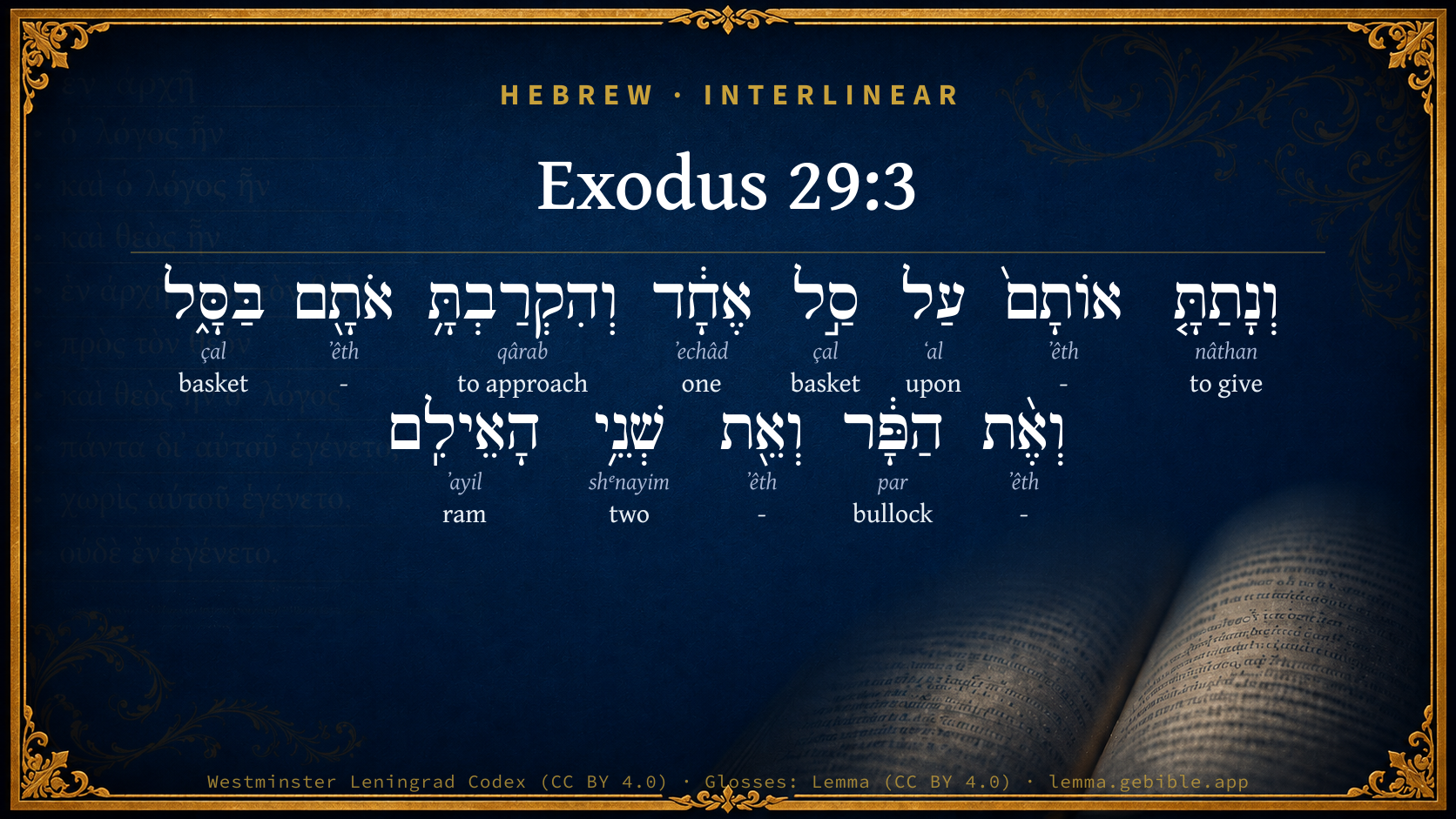
Hebrew (Westminster Leningrad Codex) Exodus 29:3 appears in the Hebrew Old Testament. The text above is from the Westminster Leningrad Codex. Each word links to its Strong’s number, a concise gloss, and parsing drawn from the Open Scriptures Hebrew Bible morphology. Click any word for its full Brown-Driver-Briggs (BDB) entry.
Download image
Cite this verse

Exodus 29:3 (World English Bible). Public Domain. Lemma interlinear Bible study tool, https://lemma.gebible.app/v/exodus/29/3.

Show BibTeX & RIS
BibTeX
RIS
English Translation
You shall put them into one basket, and bring them in the basket, with the bull and the two rams.
World English Bible · Public Domain
Download a study sheet

One document with this verse’s original text, its word-by-word gloss line, the meaning frame, cross-references with their text, attributed commentary, and full source and license credits — printable, and it pastes into notes with its structure intact.

This verse Autodidact and up

Study sheet (.html) Plain text (.txt)

A passage Seminary Student

Up to 50 verses in one chapter. A passage sheet keeps up to 6 commentary sources and 12 cross-references per verse, in the order this page ranks them, and says so on the sheet whenever that leaves anything out. Ask for a single verse and you get the Autodidact verse sheet above.

Everything on this page stays free to read, with no account — the sheet is a download of what is already on screen, not access to it.

Want to remove ads? Support Godless Engineer
Compare translations 3

The same verse in 3 English versions, stacked beneath the original-language interlinear above. Click any original word for its lexicon entry.

Each is an independent rendering of the whole verse — the interlinear is not word-aligned to these translations.

Highlighted words mark where these versions differ — a whole-verse word diff, not a word-by-word alignment.

  • World English Bible Public Domain
    You shall put them into one basket, and bring them in the basket, with the bull and the two rams.
  • King James Version Public Domain
    And thou shalt put them into one basket, and bring them in the basket, with the bullock and the two rams.
  • unfoldingWord Literal Text CC BY-SA 4.0
    And you shall put them into one basket, and you shall bring them near in the basket, and the bull and the two rams.

unfoldingWord Literal Text — © unfoldingWord, licensed CC BY-SA 4.0. Word-aligned USFM3 via Door43 (git.door43.org/unfoldingWord/en_ult).

Versions to compare (up to 4)

3 of 4 selected

Show all 18 translations

Every available English version of this verse, each an independent rendering of the whole verse.

  • World English Bible Public Domain
    You shall put them into one basket, and bring them in the basket, with the bull and the two rams.
  • Berean Standard Bible Public Domain
    put them in a basket, and present them in the basket, along with the bull and the two rams.
  • Majority Standard Bible Public Domain
    put them in a basket, and present them in the basket, along with the bull and the two rams.
  • King James Version Public Domain
    And thou shalt put them into one basket, and bring them in the basket, with the bullock and the two rams.
  • American Standard Version (1901) Public Domain
    And thou shalt put them into one basket, and bring them in the basket, with the bullock and the two rams.
  • Revised Version (1885) Public Domain
    And thou shalt put them into one basket, and bring them in the basket, with the bullock and the two rams.
  • Geneva Bible (1599) Public Domain
    Then thou shalt put them in one basket, and present them in the basket with the calfe and the two rammes,
  • Douay-Rheims (1899) Public Domain
    And thou shalt put them in a basket and offer them: and the calf and the two rams.
  • Young's Literal Translation Public Domain
    and thou hast put them on one basket, and hast brought them near in the basket, also the bullock and the two rams.
  • Literal Standard Version CC BY-SA 4.0
    and you have put them on one basket, and have brought them near in the basket, also the bullock and the two rams.
  • Unlocked Literal Bible CC BY-SA 4.0
    You must put them into a single basket, bring them in the basket, and present them with the bull and the two rams.
  • unfoldingWord Literal Text CC BY-SA 4.0
    And you shall put them into one basket, and you shall bring them near in the basket, and the bull and the two rams.
  • Darby Bible Public Domain
    And thou shalt put them into one basket, and present them in the basket, with the bullock and the two rams.
  • World Messianic Bible Public Domain
    You shall put them into one basket, and bring them in the basket, with the bull and the two rams.
  • Webster's Bible Public Domain
    And thou shalt put them into one basket, and bring them in the basket, with the bullock and the two rams.
  • Free Bible Version CC BY-SA 4.0
    Put them all in a basket, and bring them as an offering, along with the bull and the two rams.
  • Bible in Basic English Public Domain
    Put these in a basket and take them, with the ox and the two sheep.
  • JPS Tanakh (1917) Public Domain
    And thou shalt put them into one basket, and bring them in the basket, with the bullock and the two rams.

Literal Standard Version (2020), Covenant Press — licensed CC BY-SA 4.0. Text via the HelloAO Bible API (eBible.org). Unlocked Literal Bible (unfoldingWord) — licensed CC BY-SA 4.0. Text via the HelloAO Bible API (eBible.org). unfoldingWord Literal Text — © unfoldingWord, licensed CC BY-SA 4.0. Word-aligned USFM3 via Door43 (git.door43.org/unfoldingWord/en_ult). Free Bible Version, Dr. Jonathan Gallagher — licensed CC BY-SA 4.0. Text via the HelloAO Bible API (eBible.org).

Word by word

More ways to search: Search by grammar → Find every occurrence → Compare this word →

Practice this passage: Drill this verse → Learn its vocabulary →

סַ֣ל
çal
H5536
“basket”
Noun, Common, Masculine, Singular, Absolute
Part of Speech
Noun
Type
Common
Gender
Masculine
Number
Singular
State
Absolute
Full BDB Definition

Origin: from H5549

TWOT: 1507a

basket
  1. וְנָתַתָּ֤ nâthan H5414 “and · to give” Conjunction + Verb, Qal, Sequential Perfect, 2nd Person, Masculine, Singular
  2. אוֹתָם֙ ʼêth H853 “- · them” Particle, Direct Object + Suffix, Personal, 3rd Person, Masculine, Plural
  3. עַל ʻal H5921 “upon” Preposition
  4. אֶחָ֔ד ʼechâd H259 “one” Adjective, Cardinal number, Masculine, Singular, Absolute
  5. וְהִקְרַבְתָּ֥ qârab H7126 “and · to approach” Conjunction + Verb, Hiphil, Sequential Perfect, 2nd Person, Masculine, Singular
  6. אֹתָ֖ם ʼêth H853 “- · them” Particle, Direct Object + Suffix, Personal, 3rd Person, Masculine, Plural
  7. בַּסָּ֑ל çal H5536 “in/at the · basket” Preposition, Determined + Noun, Common, Masculine, Singular, Absolute
  8. וְאֶ֨ת ʼêth H853 “and · -” Conjunction + Particle, Direct Object
  9. הַפָּ֔ר par H6499 “the · bullock” Particle, Definite Article + Noun, Common, Masculine, Singular, Absolute
  10. וְאֵ֖ת ʼêth H853 “and · -” Conjunction + Particle, Direct Object
  11. שְׁנֵ֥י shᵉnayim H8147 “two” Adjective, Cardinal number, Masculine, Dual, Construct
  12. הָאֵילִֽם ʼayil H352 “the · rams” Particle, Definite Article + Noun, Common, Masculine, Plural, Absolute

About this verse

These counts appear in no published source. They are computed here, from the morphology-tagged text and Lemma’s own curated glosses. What Lemma adds →

13
words
9
distinct lemmas
Pentateuch
section

Notable vocabulary

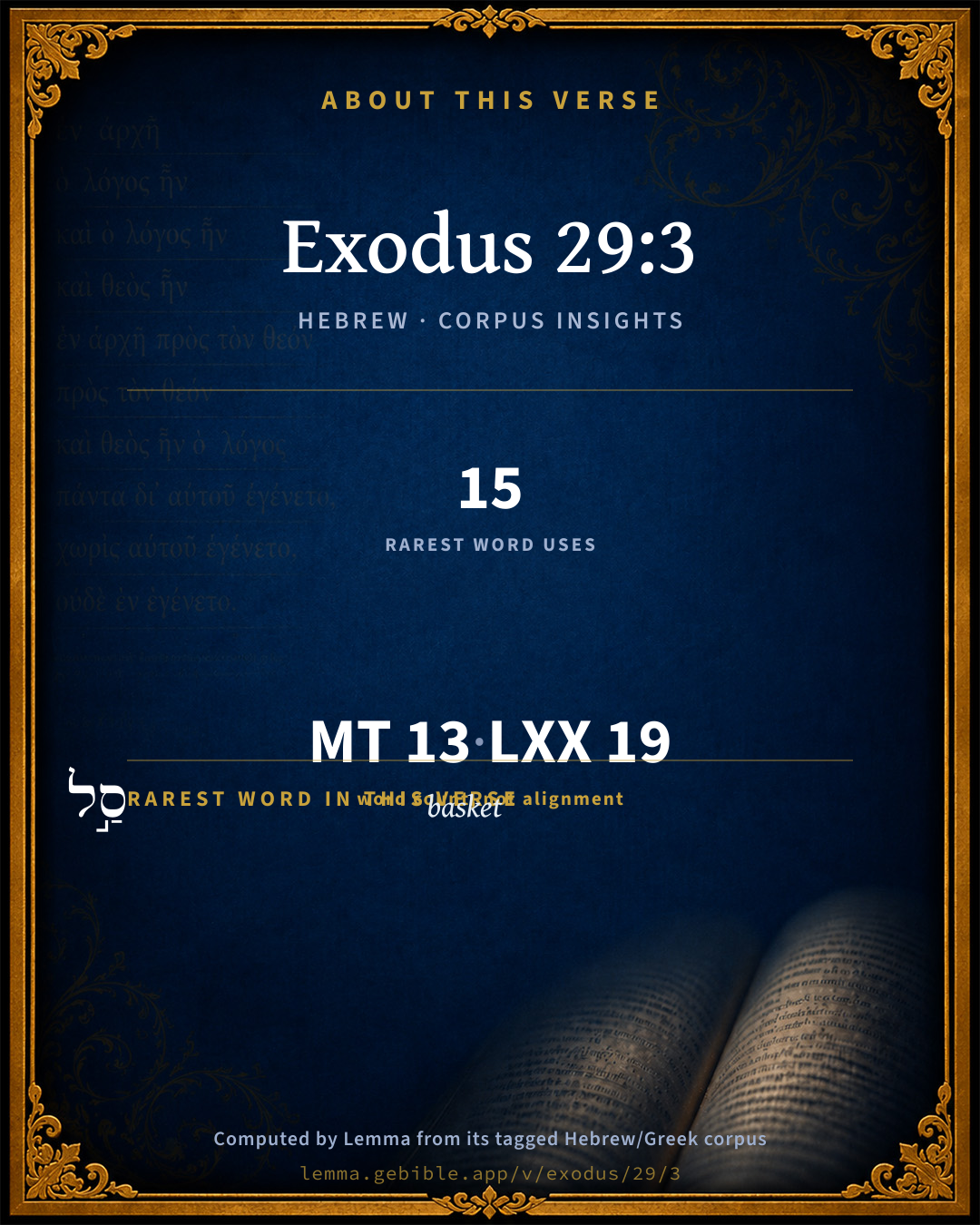
The rarest word here is סַ֣ל basket H5536 — appearing just 15 times in the whole Hebrew Bible.

Shared distinctive vocabulary

סַ֣ל basket H5536 occurs in 13 verses of the Hebrew Bible. Also found in:

Grammatical profile

  • 2 verbs
  • 4 nouns
  • 2 adjectives
  • 1 preposition
  • 4 particles

Verb forms

  • וְנָתַתָּ֤ Qal · Sequential Perfect
  • וְהִקְרַבְתָּ֥ Hiphil · Sequential Perfect

Repetition

A word recurs within this verse — often emphatic in Hebrew:

  • סַ֣ל basket H5536 ×2

Hebrew & Septuagint length

In English translation the verse runs 20 words from the Hebrew and 24 from the Septuagint (LXX English) — closely comparable.

A rough comparison of the two English renderings, which tokenize alike — not a word-level alignment.

Word counts can differ between the Hebrew and the Greek without any difference in meaning — e.g. the Hebrew direct-object marker אֵת has no separate Greek word, and Greek often adds the article ὁ.

In the original languages it is 13 Hebrew tokens and 19 Greek tokens — but the two are counted differently (Hebrew bundles its prefixes and suffixes into one token; the Greek is in lemma form), so that isn’t a like-for-like length.

Cross-references

4

Topical passages linked to Exodus 29:3 in the Treasury of Scripture Knowledge — connected by theme and wording, ordered by reader-vote popularity; previews shown in the World English Bible.

  • Leviticus 8:2 "Take Aaron and his sons with him, and the garments, and the anointing oil, and the bull of the sin offering, and the two rams, and the basket of unleavened bread;
  • Leviticus 8:26 and out of the basket of unleavened bread, that was before Yahweh, he took one unleavened cake, and one cake of oiled bread, and one wafer, and placed them on the fat, and on the right thigh.
  • Leviticus 8:31 Moses said to Aaron and to his sons, "Boil the flesh at the door of the Tent of Meeting, and there eat it and the bread that is in the basket of consecration, as I commanded, saying, 'Aaron and his sons shall eat it.'
  • Numbers 6:17 He shall offer the ram for a sacrifice of peace offerings to Yahweh, with the basket of unleavened bread. The priest shall offer also its meal offering, and its drink offering.

Cross-references courtesy of OpenBible.info (CC BY 4.0).

Hebrew and Greek witnesses Masoretic Hebrew ↔ Greek Septuagint

The same verse in the two great witnesses to the Old Testament, shown verse-for-verse.

These are two independent witnesses, not word-aligned to each other, and the Septuagint is shown in lemma (dictionary) form.

Hebrew Exodus 29:3 Masoretic · Westminster Leningrad Codex

וְנָתַתָּ֤ אוֹתָם֙ עַל סַ֣ל אֶחָ֔ד וְהִקְרַבְתָּ֥ אֹתָ֖ם בַּסָּ֑ל וְאֶ֨ת הַפָּ֔ר וְאֵ֖ת שְׁנֵ֥י הָאֵילִֽם

You shall put them into one basket, and bring them in the basket, with the bull and the two rams.

World English Bible · Public Domain

Greek LXX Exodus 29:3 Septuagint · lemma form

καί ἐπιτίθημι αὐτός ἐπί κανοῦν εἷς καί προςφέρω αὐτός ἐπί ὁ κανοῦν καί ὁ μοσχάριον καί ὁ δύο κριός

And you shall put them on one basket, and you shall offer them on the basket, and the young calf and the two rams.

LXX2012 (modern English Septuagint) · Public Domain

Hebrew: Westminster Leningrad Codex (CC BY 4.0). Greek: Septuagint (public domain); English from LXX2012 (modern English Septuagint) (Public Domain). How the Septuagint differs from the Hebrew →

Targum (Aramaic paraphrase)

2

The Targum is the ancient Jewish Aramaic paraphrase of the Hebrew Scriptures — an interpretive translation, not the Hebrew text itself. Onkelos (literal) and Pseudo-Jonathan (expansive) render the Torah, and Jonathan the Prophets. Coverage is partial: where no permissively-licensed English translation exists for a verse, only the Aramaic is shown. This is verse-level text, not a word-by-word alignment to the Hebrew.

  1. Targum Onkelos Torah (Genesis–Deuteronomy)
    וְתִתֵּן יָתְהוֹן עַל סַלָא חַד וּתְקָרֵב יָתְהוֹן בְּסַלָא וְיָת תּוֹרָא וְיָת תְּרֵין דִכְרִין:

    (no public-domain English translation for this verse)

    Targum Onkelos — Aramaic: “Onkelos Genesis” (public domain); “Onkelos Exodus” (public domain); “Onkelos Leviticus” (public domain); “Onkelos Numbers” (public domain); “Onkelos Deuteronomy” (public domain). English: “Sefaria Community Translation” (CC0 1.0 (public-domain dedication)); “J.W. Etheridge. The Targums of Onkelos and Jonathan Ben Uzziel on the Pentateuch. London: Longmans, Green, 1862” (public domain). Text via Sefaria.

  2. Targum Pseudo-Jonathan Torah (Genesis–Deuteronomy)
    וְתִתֵּן יַתְהוֹן עַל סַלָא חָד וּתְקָרֵב יַתְהוֹן בְּסַלָא וְיַת תּוֹרָא וְיַת תְּרֵין דִּכְרִין יְסוֹבְרוּן בְּאַסְלָא

    And thou shalt put them upon one basket, and offer them in the basket, and the bullock and the two rams they shall bring in a vehicle.

    Targum Pseudo-Jonathan — Aramaic: “Targum Jonathan on Genesis” (public domain); “Targum Jonathan on Exodus” (public domain); “Targum Jonathan on Leviticus” (public domain); “Targum Jonathan on Numbers” (public domain); “Targum Jonathan on Deuteronomy” (public domain). English: “The Targum of Jonathan ben Uzziel, trans. J. W. Etheridge, London, 1862” (public domain). Text via Sefaria.

Commentary

Notes on Exodus 29:3 from classic Christian and Jewish commentators (each source and its license shown beneath its notes). The classic Christian expositions comment on the surrounding passage and are grouped to its opening verse, so a note may address several verses; the Jewish commentaries on the Tanakh (Rashi and others) are per-verse, so they appear only where the commentator wrote on this verse.

Lemma curates 59 commentaries, every one of them public domain or Creative Commons licensed, each selected and text-cleaned for this edition rather than reprinted as found. About our sources →

Geneva Bible (1599)

Geneva Bible translators

To offer them in sacrifice.

Geneva Bible (1599) marginal notes — public domain. Text via Bolls.life.

John Gill's Exposition

And thou shalt put them into one basket,.... The unleavened bread, cakes and wafers; this basket may be an emblem of the Gospel and the ministration of it, in which Christ the bread of life is carried, and ministered to his people:

and bring them in the basket, with the bullock and the two rams; not that the bullock and the rams were to be brought in the basket along with the bread, cakes, and wafers; but at the same time that they were brought to the door of the tabernacle of the congregation, these were to be brought, led, or drove to the altar, in order to be slain and sacrificed.

John Gill's Exposition of the Whole Bible (1746–1763) — public domain (CC PDM 1.0). Text via the HelloAO Bible API.

Matthew Poole's English Annotations

To the door of the tabernacle, as it follows, Exo 29:4.

Matthew Poole's English Annotations on the Holy Bible (1683–1685) — public domain. Text from a community e-Sword/MySword module.

The Pulpit Commentary

Thou shalt bring them in the basket. Rather, "Thou shalt offer them." A preliminary offering of the animals and of the "meatofferings," in the lump seems to be intended. This, apparently, preceded the ablution.

The Pulpit Commentary (1880–1919), ed. H.D.M. Spence-Jones & Joseph S. Exell — public domain. Text from a community e-Sword module.

unfoldingWord translationNotes

Door43 World Missions Community

General Information:

Yahweh continues to speak to Moses

You must put them

"You must put the bread, cake, and wafer"

present them with the bull and the two rams

Here "present" means to offer as a sacrifice. The full meaning of this can be translated clearly. AT: "offer them to me when you sacrifice the bull and the two rams" (See: Assumed Knowledge and Implicit Information)

tent of meeting

This is another name for the tabernacle. See how you translated this in Exodus 27:21.

translationWords

basket

cow

ewe

Aaron

tent of meeting

unfoldingWord translationNotes — © Distant Shores Media and the Door43 World Missions Community, licensed CC BY-SA 4.0. Source: git.door43.org/Door43/en_tn.

Rashi

Rabbi Shlomo Yitzchaki (Rashi)

והקרבת אתם AND THOU SHALT OFFER THEM (lit., bring them near) to the court of the Tabernacle on the day when it will be first erected.

Rashi on the Tanakh — English translations: “The Judaica Press complete Tanach with Rashi, translated by A. J. Rosenberg” (CC BY 4.0); “Pentateuch with Rashi's commentary by M. Rosenbaum and A.M. Silbermann, 1929-1934” (public domain); “The Metsudah Tanach series, Lakewood, N.J” (CC BY 4.0); and “The Book of Joshua, Metsudah Publications, 1997” (CC BY 4.0). Text via Sefaria.

Ramban (Nachmanides)

Rabbi Moshe ben Nachman (Ramban / Nachmanides)

AND THOU SHALT BRING THEM IN THE BASKET. This is connected with the following verse [… unto the door of the Tent of Meeting], from Verse 4 and transposing it to Verse 3, thus meaning: “and thou shalt bring them in the basket — unto the door of the Tent of Meeting.” Under “the more correct interpretation” Ramban will explain that the phrase rightfully belongs in Verse 4, teaching that the washing of Aaron and his sons must be done in the Sanctuary Court. Scripture thus stating that he [Moses] shall bring the bread in the basket, the bullock, the rams, and Aaron and his sons, to the door of the Tent of Meeting. And thou shalt wash them with water from Verse 4 and transposing it to Verse 3, thus meaning: “and thou shalt bring them in the basket — unto the door of the Tent of Meeting.” Under “the more correct interpretation” Ramban will explain that the phrase rightfully belongs in Verse 4, teaching that the washing of Aaron and his sons must be done in the Sanctuary Court. — that is, Aaron and his sons. A more correct interpretation is that the expression and thou shalt bring them in the basket leaves the matter unspecified, for without further explanation it is known that he should bring them to the place where He commands the priests to come [it being sufficient if they come before the door of the court of the Tabernacle]. And the second verse speaks only of Aaron and his sons, and therefore He says [thou shalt bring unto the door of the Tent of Meeting] and thou shalt wash them with water. from Verse 4 and transposing it to Verse 3, thus meaning: “and thou shalt bring them in the basket — unto the door of the Tent of Meeting.” Under “the more correct interpretation” Ramban will explain that the phrase rightfully belongs in Verse 4, teaching that the washing of Aaron and his sons must be done in the Sanctuary Court.

Ramban (Nachmanides) on the Tanakh — English translation: “Commentary on the Torah by Ramban (Nachmanides). Translated and annotated by Charles B. Chavel. New York, Shilo Pub. House, 1971-1976” (CC BY 4.0). Text via Sefaria.

Lesson kit

Teaching starters — assembled from the data on this page, not authored interpretation. Every prompt links to the verse data it draws on. Edit before teaching.

Exodus, in the Pentateuch, opens this verse with 13 words (9 distinct Hebrew lemmas). Its most distinctive word is çal (“basket”). A historical commentator’s framing appears above. Read the whole chapter for the surrounding context.

Discussion questions

  1. The word çal carries the sense “basket.” How does it shape the verse?
  2. Genesis 40:16 shares the word «basket» with this verse. How do the two illuminate each other?
  3. “basket” occurs 2× in this one verse. What is the effect of the repetition?
  4. The translations on this page render this verse differently — a whole-verse word diff, not a word-by-word alignment. What might account for the different wordings?
  5. The verb «וְנָתַתָּ֤» is Qal Sequential Perfect. How does its form color the action?
  6. Reading how Geneva Bible (1599) and John Gill's Exposition read this verse, where do the two commentators agree and where do they part?

Things to notice

Reading settings

Reading text

Shown beneath each verse's original-language words.

Old Testament
Old Testament edition

Read the OT as the Masoretic Hebrew (MT) or the Greek Septuagint (LXX).

English shown for the Greek Septuagint (in the Hebrew ↔ Greek comparison).

Comparing translations? Open the Compare panel on any verse page to stack up to four side by side.