Genesis 39:8

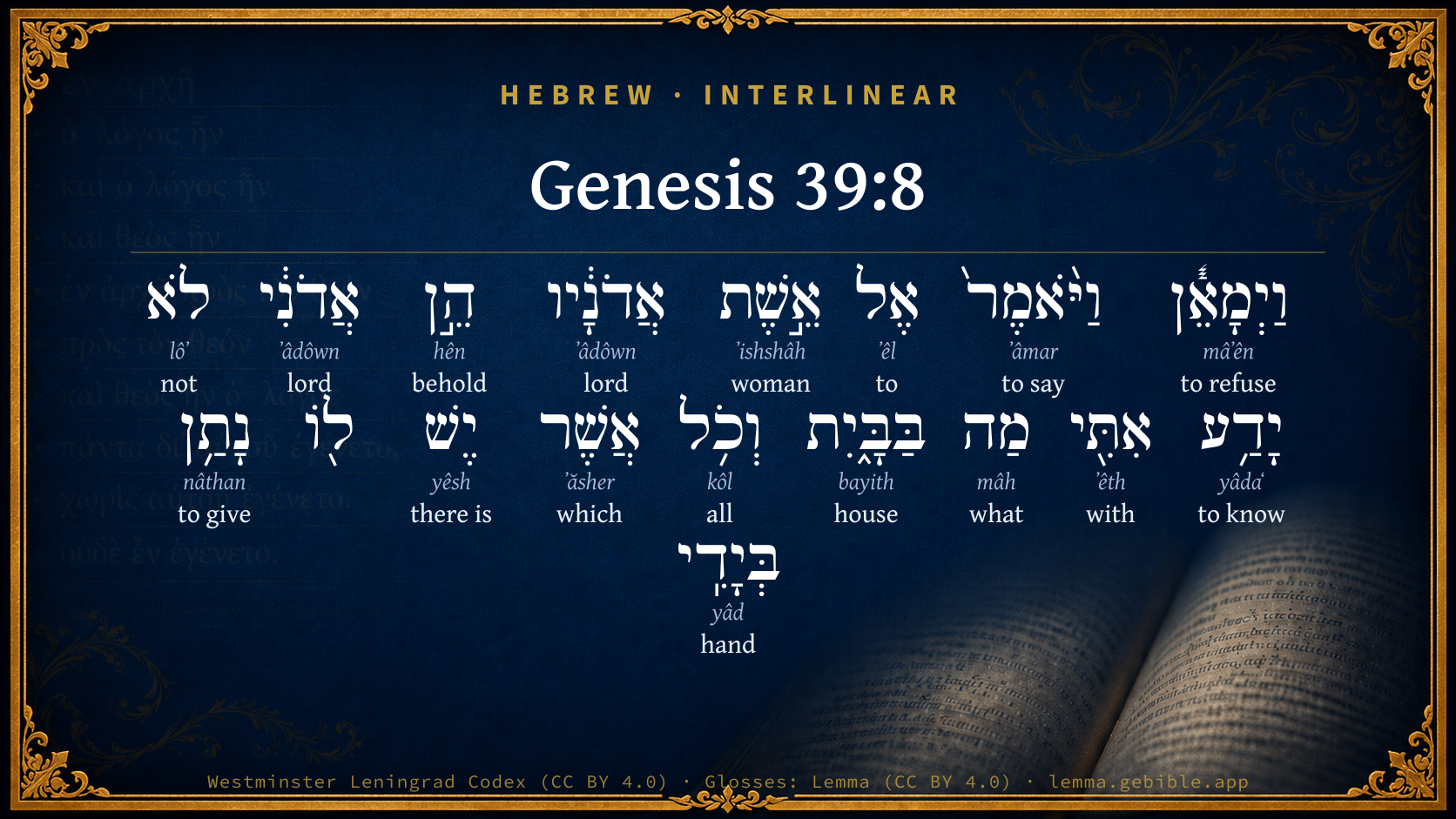
Hebrew (Westminster Leningrad Codex) Genesis 39:8 appears in the Hebrew Old Testament. The text above is from the Westminster Leningrad Codex. Each word links to its Strong’s number, a concise gloss, and parsing drawn from the Open Scriptures Hebrew Bible morphology. Click any word for its full Brown-Driver-Briggs (BDB) entry.
Download image
Cite this verse

Genesis 39:8 (World English Bible). Public Domain. Lemma interlinear Bible study tool, https://lemma.gebible.app/v/genesis/39/8.

Show BibTeX & RIS
BibTeX
RIS
English Translation
But he refused, and said to his master's wife, "Behold, my master doesn't know what is with me in the house, and he has put all that he has into my hand.
World English Bible · Public Domain
Download a study sheet

One document with this verse’s original text, its word-by-word gloss line, the meaning frame, cross-references with their text, attributed commentary, and full source and license credits — printable, and it pastes into notes with its structure intact.

This verse Autodidact and up

Study sheet (.html) Plain text (.txt)

A passage Seminary Student

Up to 50 verses in one chapter. A passage sheet keeps up to 6 commentary sources and 12 cross-references per verse, in the order this page ranks them, and says so on the sheet whenever that leaves anything out. Ask for a single verse and you get the Autodidact verse sheet above.

Everything on this page stays free to read, with no account — the sheet is a download of what is already on screen, not access to it.

Want to remove ads? Support Godless Engineer
Compare translations 3

The same verse in 3 English versions, stacked beneath the original-language interlinear above. Click any original word for its lexicon entry.

Each is an independent rendering of the whole verse — the interlinear is not word-aligned to these translations.

Highlighted words mark where these versions differ — a whole-verse word diff, not a word-by-word alignment.

  • World English Bible Public Domain
    But he refused, and said to his master's wife, "Behold, my master doesn't know what is with me in the house, and he has put all that he has into my hand.
  • King James Version Public Domain
    But he refused, and said unto his master's wife, Behold, my master wotteth not what is with me in the house, and he hath committed all that he hath to my hand;
  • unfoldingWord Literal Text CC BY-SA 4.0
    But he refused and said to the wife of his master, “Behold, with me, my master does not think what in the house, and all that is his he has given into my hand.

unfoldingWord Literal Text — © unfoldingWord, licensed CC BY-SA 4.0. Word-aligned USFM3 via Door43 (git.door43.org/unfoldingWord/en_ult).

Versions to compare (up to 4)

3 of 4 selected

Show all 18 translations

Every available English version of this verse, each an independent rendering of the whole verse.

  • World English Bible Public Domain
    But he refused, and said to his master's wife, "Behold, my master doesn't know what is with me in the house, and he has put all that he has into my hand.
  • Berean Standard Bible Public Domain
    But he refused. “Look,” he said to his master’s wife, “with me here, my master does not concern himself with anything in his house, and he has entrusted everything he owns to my care.
  • Majority Standard Bible Public Domain
    But he refused. “Look,” he said to his master’s wife, “with me here, my master does not concern himself with anything in his house, and he has entrusted everything he owns to my care.
  • King James Version Public Domain
    But he refused, and said unto his master's wife, Behold, my master wotteth not what is with me in the house, and he hath committed all that he hath to my hand;
  • American Standard Version (1901) Public Domain
    But he refused, and said unto his master's wife, Behold, my master knoweth not what is with me in the house, and he hath put all that he hath into my hand:
  • Revised Version (1885) Public Domain
    But he refused, and said unto his master’s wife, Behold, my master knoweth not what is with me in the house, and he hath put all that he hath into my hand;
  • Geneva Bible (1599) Public Domain
    But he refused and said to his masters wife, Beholde, my master knoweth not what he hath in the house with me, but hath committed all that he hath to mine hande.
  • Douay-Rheims (1899) Public Domain
    Neither knew he any other thing, but the bread which he ate. And Joseph was of a beautiful countenance, and comely to behold.
  • Young's Literal Translation Public Domain
    and he refuseth, and saith unto his lord's wife, `Lo, my lord hath not known what `is' with me in the house, and all that he hath he hath given into my hand;
  • Literal Standard Version CC BY-SA 4.0
    and he refuses and says to his lord’s wife, “Behold, my lord has not known what [is] with me in the house, and all that he has he has given into my hand;
  • Unlocked Literal Bible CC BY-SA 4.0
    But he refused and said to his master's wife, “Look, my master does not pay attention to what I do in the house, and he has put everything that he owns under my care.
  • unfoldingWord Literal Text CC BY-SA 4.0
    But he refused and said to the wife of his master, “Behold, with me, my master does not think what in the house, and all that is his he has given into my hand.
  • Darby Bible Public Domain
    But he refused, and said to his master's wife, Behold, my master takes cognizance of nothing with me: what is in the house, and all that he has, he has given into my hand.
  • World Messianic Bible Public Domain
    But he refused, and said to his master’s wife, “Behold, my master doesn’t know what is with me in the house, and he has put all that he has into my hand.
  • Webster's Bible Public Domain
    But he refused, and said to his master's wife, Behold, my master knoweth not what is with me in the house, and he hath committed all that he hath to my hand:
  • Free Bible Version CC BY-SA 4.0
    But he turned her down, telling his master's wife, “Look, my master trusts me so much he doesn't even bother to find out how his household is running. He's put me in charge of everything he owns—
  • Bible in Basic English Public Domain
    But he would not, and said to her, You see that my master keeps no account of what I do in his house, and has put all his property in my control;
  • JPS Tanakh (1917) Public Domain
    But he refused, and said unto his master's wife: 'Behold, my master, having me, knoweth not what is in the house, and he hath put all that he hath into my hand;

Literal Standard Version (2020), Covenant Press — licensed CC BY-SA 4.0. Text via the HelloAO Bible API (eBible.org). Unlocked Literal Bible (unfoldingWord) — licensed CC BY-SA 4.0. Text via the HelloAO Bible API (eBible.org). unfoldingWord Literal Text — © unfoldingWord, licensed CC BY-SA 4.0. Word-aligned USFM3 via Door43 (git.door43.org/unfoldingWord/en_ult). Free Bible Version, Dr. Jonathan Gallagher — licensed CC BY-SA 4.0. Text via the HelloAO Bible API (eBible.org).

Word by word

More ways to search: Search by grammar → Find every occurrence → Compare this word →

Practice this passage: Drill this verse → Learn its vocabulary →

וַיְמָאֵ֓ן
mâʼên
H3985
“and · to refuse”
Conjunction + Verb, Piel, Sequential Imperfect, 3rd Person, Masculine, Singular
Part of Speech
Conjunction + Verb
Stem
Piel
Form
Sequential Imperfect
Person
3rd Person
Gender
Masculine
Number
Singular
Full BDB Definition

Origin: a primitive root

TWOT: 1138

(Piel) to refuse
  1. וַיֹּ֨אמֶר֙ ʼâmar H559 “and · to say” Conjunction + Verb, Qal, Sequential Imperfect, 3rd Person, Masculine, Singular
  2. אֶל ʼêl H413 “to” Preposition
  3. אֵ֣שֶׁת ʼishshâh H802 “woman of” Noun, Common, Feminine, Singular, Construct
  4. אֲדֹנָ֔יו ʼâdôwn H113 “lords · his” Noun, Common, Masculine, Plural, Construct + Suffix, Personal, 3rd Person, Masculine, Singular
  5. הֵ֣ן hên H2005 “behold” Particle, Demonstrative
  6. אֲדֹנִ֔י ʼâdôwn H113 “lord · my” Noun, Common, Masculine, Singular, Construct + Suffix, Personal, 1st Person, Common, Singular
  7. לֹא lôʼ H3808 “not” Particle, Negative
  8. יָדַ֥ע yâdaʻ H3045 “to know” Verb, Qal, Perfect, 3rd Person, Masculine, Singular
  9. אִתִּ֖י ʼêth H854 “with · me” Preposition + Suffix, Personal, 1st Person, Common, Singular
  10. מַה mâh H4100 “what” Particle, Interrogative
  11. בַּבָּ֑יִת bayith H1004 “in/at the · house” Preposition, Determined + Noun, Common, Masculine, Singular, Absolute
  12. וְכֹ֥ל kôl H3605 “and · all” Conjunction + Noun, Common, Masculine, Singular, Absolute
  13. אֲשֶׁר ʼăsher H834 “which” Particle, Relative
  14. יֶשׁ yêsh H3426 “there is” Particle, Demonstrative
  15. נָתַ֥ן nâthan H5414 “to give” Verb, Qal, Perfect, 3rd Person, Masculine, Singular
  16. בְּיָדִֽי yâd H3027 “in/at · hand · my” Preposition + Noun, Common, Both, Singular, Construct + Suffix, Personal, 1st Person, Common, Singular

About this verse

These counts appear in no published source. They are computed here, from the morphology-tagged text and Lemma’s own curated glosses. What Lemma adds →

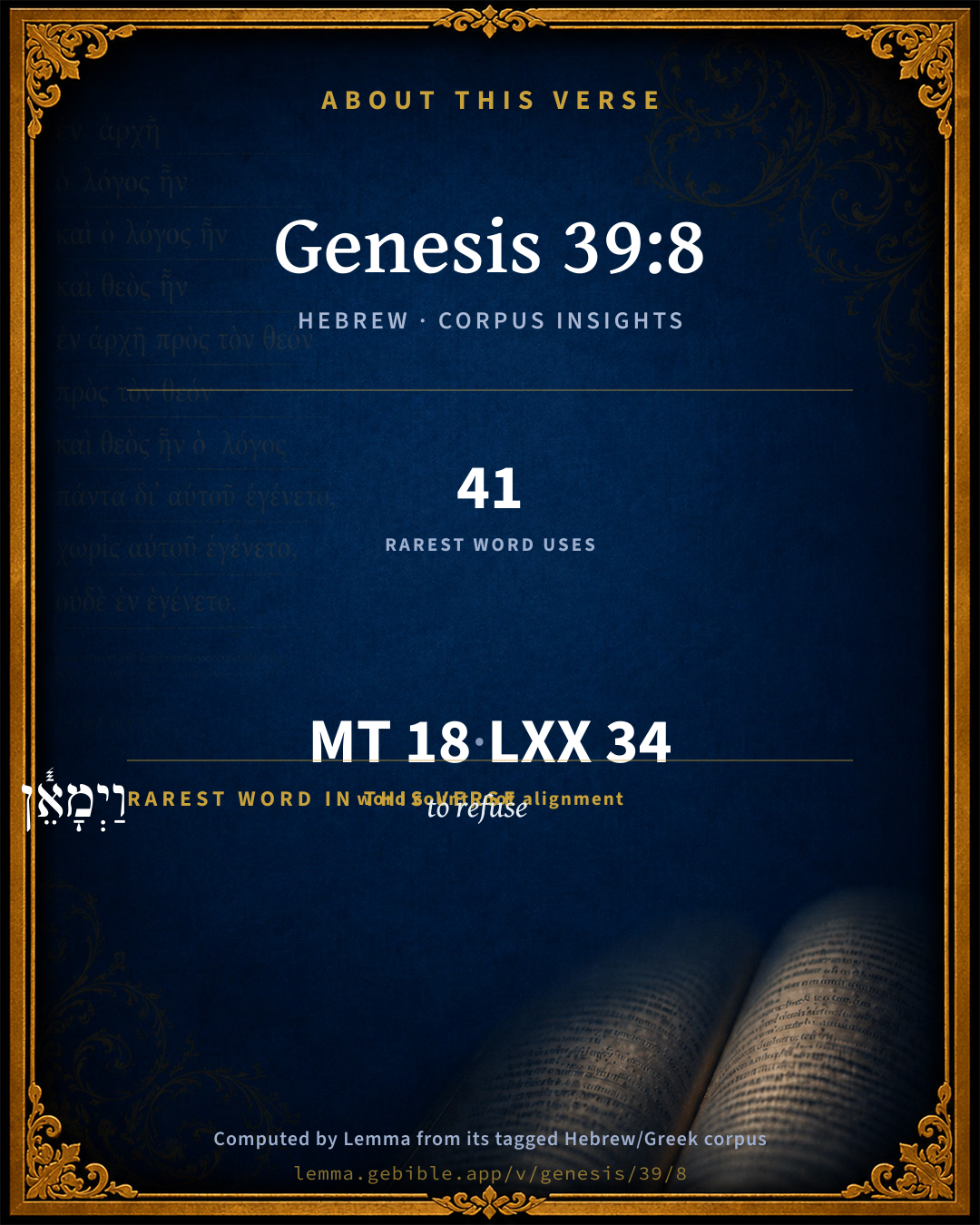
18
words
16
distinct lemmas
Pentateuch
section

Shared distinctive vocabulary

וַיְמָאֵ֓ן to refuse H3985 occurs in 39 verses of the Hebrew Bible. Also found in:

Grammatical profile

  • 4 verbs
  • 6 nouns
  • 3 prepositions
  • 5 particles

Verb forms

  • וַיְמָאֵ֓ן Piel · Sequential Imperfect
  • וַיֹּ֨אמֶר֙ Qal · Sequential Imperfect
  • יָדַ֥ע Qal · Perfect
  • נָתַ֥ן Qal · Perfect

Repetition

A word recurs within this verse — often emphatic in Hebrew:

  • אֲדֹנָ֔יו lord H113 ×2

Hebrew & Septuagint length

In English translation the verse runs 32 words from the Hebrew and 33 from the Septuagint (LXX English) — closely comparable.

A rough comparison of the two English renderings, which tokenize alike — not a word-level alignment.

Word counts can differ between the Hebrew and the Greek without any difference in meaning — e.g. the Hebrew direct-object marker אֵת has no separate Greek word, and Greek often adds the article ὁ.

In the original languages it is 18 Hebrew tokens and 34 Greek tokens — but the two are counted differently (Hebrew bundles its prefixes and suffixes into one token; the Greek is in lemma form), so that isn’t a like-for-like length.

Cross-references

13

Topical passages linked to Genesis 39:8 in the Treasury of Scripture Knowledge — connected by theme and wording, ordered by reader-vote popularity; previews shown in the World English Bible.

  • Proverbs 22:14 The mouth of an adulteress is a deep pit: He who is under Yahweh's wrath will fall into it.
  • Proverbs 23:26–28 My son, give me your heart; And let your eyes keep in my ways.
  • Proverbs 1:10 My son, if sinners entice you, don't consent.
  • Proverbs 7:5 That they may keep you from the strange woman, From the foreigner who flatters with her words.
  • Proverbs 9:13–18 The foolish woman is loud, Undisciplined, and knows nothing.
  • Proverbs 2:10 For wisdom will enter into your heart. Knowledge will be pleasant to your soul.
  • Proverbs 5:3–8 For the lips of an adulteress drip honey. Her mouth is smoother than oil,
  • Proverbs 6:20–25 My son, keep your father's commandment, And don't forsake your mother's teaching.
  • Proverbs 6:29 So is he who goes in to his neighbor's wife. Whoever touches her will not be unpunished.
  • Proverbs 6:32–33 He who commits adultery with a woman is void of understanding. He who does it destroys his own soul.
  • Proverbs 7:25–27 Don't let your heart turn to her ways. Don't go astray in her paths,
  • Proverbs 18:24 A man of many companions may be ruined, But there is a friend who sticks closer than a brother.
  • Proverbs 2:16–19 To deliver you from the strange woman, Even from the foreigner who flatters with her words;

Cross-references courtesy of OpenBible.info (CC BY 4.0).

Hebrew and Greek witnesses Masoretic Hebrew ↔ Greek Septuagint

The same verse in the two great witnesses to the Old Testament, shown verse-for-verse.

These are two independent witnesses, not word-aligned to each other, and the Septuagint is shown in lemma (dictionary) form.

Hebrew Genesis 39:8 Masoretic · Westminster Leningrad Codex

וַיְמָאֵ֓ן וַיֹּ֨אמֶר֙ אֶל אֵ֣שֶׁת אֲדֹנָ֔יו הֵ֣ן אֲדֹנִ֔י לֹא יָדַ֥ע אִתִּ֖י מַה בַּבָּ֑יִת וְכֹ֥ל אֲשֶׁר יֶשׁ ל֖וֹ נָתַ֥ן בְּיָדִֽי

But he refused, and said to his master's wife, "Behold, my master doesn't know what is with me in the house, and he has put all that he has into my hand.

World English Bible · Public Domain

Greek LXX Genesis 39:8 Septuagint · lemma form

ὁ δέ οὐ θέλω εἶπον δέ ὁ γυνή ὁ κύριος αὐτός εἰ ὁ κύριος ἐγώ οὐ γιγνώσκω διά ἐγώ οὐδείς ἐν ὁ οἶκος αὐτός καί πᾶς ὅσος εἰμί αὐτός δίδωμι εἰς ὁ χείρ ἐγώ

But he would not; but said to his master's wife, If because of me my master knows nothing in his house, and has given into my hands all things that belong to him:

LXX2012 (modern English Septuagint) · Public Domain

Hebrew: Westminster Leningrad Codex (CC BY 4.0). Greek: Septuagint (public domain); English from LXX2012 (modern English Septuagint) (Public Domain). How the Septuagint differs from the Hebrew →

Targum (Aramaic paraphrase)

2

The Targum is the ancient Jewish Aramaic paraphrase of the Hebrew Scriptures — an interpretive translation, not the Hebrew text itself. Onkelos (literal) and Pseudo-Jonathan (expansive) render the Torah, and Jonathan the Prophets. Coverage is partial: where no permissively-licensed English translation exists for a verse, only the Aramaic is shown. This is verse-level text, not a word-by-word alignment to the Hebrew.

  1. Targum Onkelos Torah (Genesis–Deuteronomy)
    וְסָרֵיב וַאֲמַר לְוַת אִתַּת רִבּוֹנֵהּ הָא רִבּוֹנִי לָא יְדַע עִמִּי מָה דִּבְבֵיתָא וְכֹל דִּי אִית לֵהּ מְסַר בִּידִי

    (no public-domain English translation for this verse)

    Targum Onkelos — Aramaic: “Onkelos Genesis” (public domain); “Onkelos Exodus” (public domain); “Onkelos Leviticus” (public domain); “Onkelos Numbers” (public domain); “Onkelos Deuteronomy” (public domain). English: “Sefaria Community Translation” (CC0 1.0 (public-domain dedication)); “J.W. Etheridge. The Targums of Onkelos and Jonathan Ben Uzziel on the Pentateuch. London: Longmans, Green, 1862” (public domain). Text via Sefaria.

  2. Targum Pseudo-Jonathan Torah (Genesis–Deuteronomy)
    וְסָרִיב לְמִקַרְבַיָא לְגַבָּה וַאֲמַר לְאִתַּת רִבּוֹנֵיהּ הָא רִבּוֹנִי לָא יְדַע עִמִי מִדַעַם מַה בְּבֵיתָא וְכָל דְאִית לֵיהּ מָסַר בִּידִי

    But he refused to come near her, and said to his master's wife, Behold, my master taketh no knowledge of what is with me in the house, and all he hath he delivereth into my hand;

    Targum Pseudo-Jonathan — Aramaic: “Targum Jonathan on Genesis” (public domain); “Targum Jonathan on Exodus” (public domain); “Targum Jonathan on Leviticus” (public domain); “Targum Jonathan on Numbers” (public domain); “Targum Jonathan on Deuteronomy” (public domain). English: “The Targum of Jonathan ben Uzziel, trans. J. W. Etheridge, London, 1862” (public domain). Text via Sefaria.

Commentary

Notes on Genesis 39:8 from classic Christian and Jewish commentators (each source and its license shown beneath its notes). The classic Christian expositions comment on the surrounding passage and are grouped to its opening verse, so a note may address several verses; the Jewish commentaries on the Tanakh (Rashi and others) are per-verse, so they appear only where the commentator wrote on this verse.

Lemma curates 59 commentaries, every one of them public domain or Creative Commons licensed, each selected and text-cleaned for this edition rather than reprinted as found. About our sources →

Trapp's Complete Commentary

John Trapp

Gen 39:8 But he refused, and said unto his master’s wife, Behold, my master wotteth not what [is] with me in the house, and he hath committed all that he hath to my hand;

Ver. 8. But he refused.] So would but a few have done of his years (he was now about twenty-seven), and that might have committed this sweet sin, as they wickedly call it, with so much security and secrecy, &c. The fear of God is both a virtue, and a keeper of other virtues. It is the bond of perfections, as Paul saith of charity. It is the ribbon or string that ties together all those precious pearls, the graces, as Peter saith of humility. {a} It is, as Basil saith of the same grace, caeterarum virtutum θησαυροφυλακιον, the storehouse of other virtues; and, as Chrysostom, the mother, and root, and nurse, and foundation, and ligament of all good things in us. {b}

Behold, my master wotteth not, &c.] Beneficium postulat officium. To argue from bounty to duty, is but right reason: but to argue, as most do, from God’s liberality to liberty in sin, is the devil’s logic. Joseph will not deal so basely with his master, though an Egyptian. To render good for evil is divine; good for good is human; evil for evil is brutish; but evil for good is devilish. "Should we again break thy commandments," saith holy Ezra, {Ezr 9:14} after so many mercies and deliverances? There is so much unthankfulness and disingenuity in such an entertainment of mercy, that heaven and earth, he thinks, would be ashamed of it. Every blessing is a binder, and each new deliverance a new tie to obedience. The "goodness of God should lead us to repentance," saith Paul. {Rom 2:4} And this Peter picks out of Paul’s Epistles, as one of the choicest sentences, and urged it upon those to whom he wrote. {2Pe 3:15}

{a} εγκομβωσασθε. {1Pe 5:5}

{b} Mητηρ, και ριζα, και τραφος, και υπδθερις, και συνδερμδς των αγαθων. - Chrysost.

John Trapp, A Commentary or Exposition upon All the Books of the Old and New Testament (1647–1656) — public domain. Text from a community e-Sword module.

Adam Clarke's Commentary

Verse 8. My master wotteth not] Knoweth not, from the old Anglo-Saxon [A.S.], witan, to know; hence [A.S.], wit, intellect, understanding, wisdom, prudence.

Adam Clarke's Commentary on the Bible (1810–1826) — public domain. Text from a community e-Sword/MySword module.

The Cambridge Bible for Schools and Colleges

gen. ed. J. J. S. Perowne

7–20. The False Accusation

8. knoweth not, &c.] Here, as in Gen_39:6, the marg., knoweth not with me what is, gives the meaning of the passage.

The Cambridge Bible for Schools and Colleges (gen. ed. J. J. S. Perowne; Cambridge University Press, 1878–1918) — public domain. Text from a community e-Sword module.

John Gill's Exposition

But he refused, and said unto his master's wife,.... Reasoning with her about the evil nature of the crime she tempted him to, which to commit would be ingratitude, as well as injury to his master, and a sin against God; by which it appears that Joseph was a partaker of the grace of God, and that this was in strong exercise at this time, by which he was preserved from the temptation he was beset with:

behold, my master wotteth not what is with me in the house; what goods or money are in it:

and he hath committed all that he hath to my hand: such confidence did he repose in him, wherefore to do such an injury to him as to commit adultery with his wife, would be making a sad return, and acting a most ungrateful part for such favour shown him.

John Gill's Exposition of the Whole Bible (1746–1763) — public domain (CC PDM 1.0). Text via the HelloAO Bible API.

The Pulpit Commentary

Vers. 8, 9. But he refused, may be that the absence of personal charms facilitated Joseph s resistance (Kalisch); but Joseph assigns a different reason for his noncompliance with her utterly immoral proposition and said unto his master"s wife, her unclean solicitation he returneth pure and wholesome words" (Hughes)Behold, my master wotteth not what is with me in the house (literally, knoweth not, along with me, what is in the house), and he hath committed all that he hath to my hand, (literally, and all that is to him he hath given to or placed in my hand); there is none greater in this house than I; neither hath he kept back anything from me but thee, because thou art his wife: how then can I do this great wickedness, and sin (cf. Gen_20:6; 2Sa_12:13; Psa_51:4 for the estimate of this act taken by God and good men) against God? Elohim, since Jehovah would have been unintelligible to a heathen woman.

The Pulpit Commentary (1880–1919), ed. H.D.M. Spence-Jones & Joseph S. Exell — public domain. Text from a community e-Sword module.

Ramban (Nachmanides)

Rabbi Moshe ben Nachman (Ramban / Nachmanides)

BUT HE REFUSED, AND SAID UNTO HIS MASTER’s WIFE. Scripture relates that he refused to do her will even though she was his mistress, i.e., his master’s wife, and he feared her, for he feared G-d more. This is the meaning of the expression, unto his master’s wife.

Ramban (Nachmanides) on the Tanakh — English translation: “Commentary on the Torah by Ramban (Nachmanides). Translated and annotated by Charles B. Chavel. New York, Shilo Pub. House, 1971-1976” (CC BY 4.0). Text via Sefaria.

Radak

Rabbi David Kimhi (Radak)

וימאן, the meaning is clear beyond mistake.

Radak on the Tanakh — English translations: “Sefaria Community Translation” (CC0 1.0 (public-domain dedication)); “Eliyahu Munk, HaChut Hameshulash” (CC BY 4.0); “Rabbi Mike Feuer, Jerusalem Anthology” (CC BY 4.0); and “R. David Kimhi on the first book of Psalms, Translated by R.G. Finch, London, 1919” (public domain). Text via Sefaria.

Lesson kit

Teaching starters — assembled from the data on this page, not authored interpretation. Every prompt links to the verse data it draws on. Edit before teaching.

Genesis, in the Pentateuch, opens this verse with 18 words (16 distinct Hebrew lemmas). Its most distinctive word is mâʼên (“to refuse”). A historical commentator’s framing appears above. Read the whole chapter for the surrounding context.

Discussion questions

  1. What does “to refuse” (mâʼên) contribute to the verse as a whole?
  2. Genesis 37:35 shares the word «to refuse» with this verse. How do the two illuminate each other?
  3. “lord” occurs 2× in this one verse. What is the effect of the repetition?
  4. These translations render this verse differently; the difference is in the English rendering, not the original. What questions does that raise?
  5. The verb «וַיְמָאֵ֓ן» is Piel Sequential Imperfect. How does its form color the action?
  6. Reading how Trapp's Complete Commentary and Adam Clarke's Commentary read this verse, where do the two commentators agree and where do they part?

Things to notice

Reading settings

Reading text

Shown beneath each verse's original-language words.

Old Testament
Old Testament edition

Read the OT as the Masoretic Hebrew (MT) or the Greek Septuagint (LXX).

English shown for the Greek Septuagint (in the Hebrew ↔ Greek comparison).

Comparing translations? Open the Compare panel on any verse page to stack up to four side by side.