
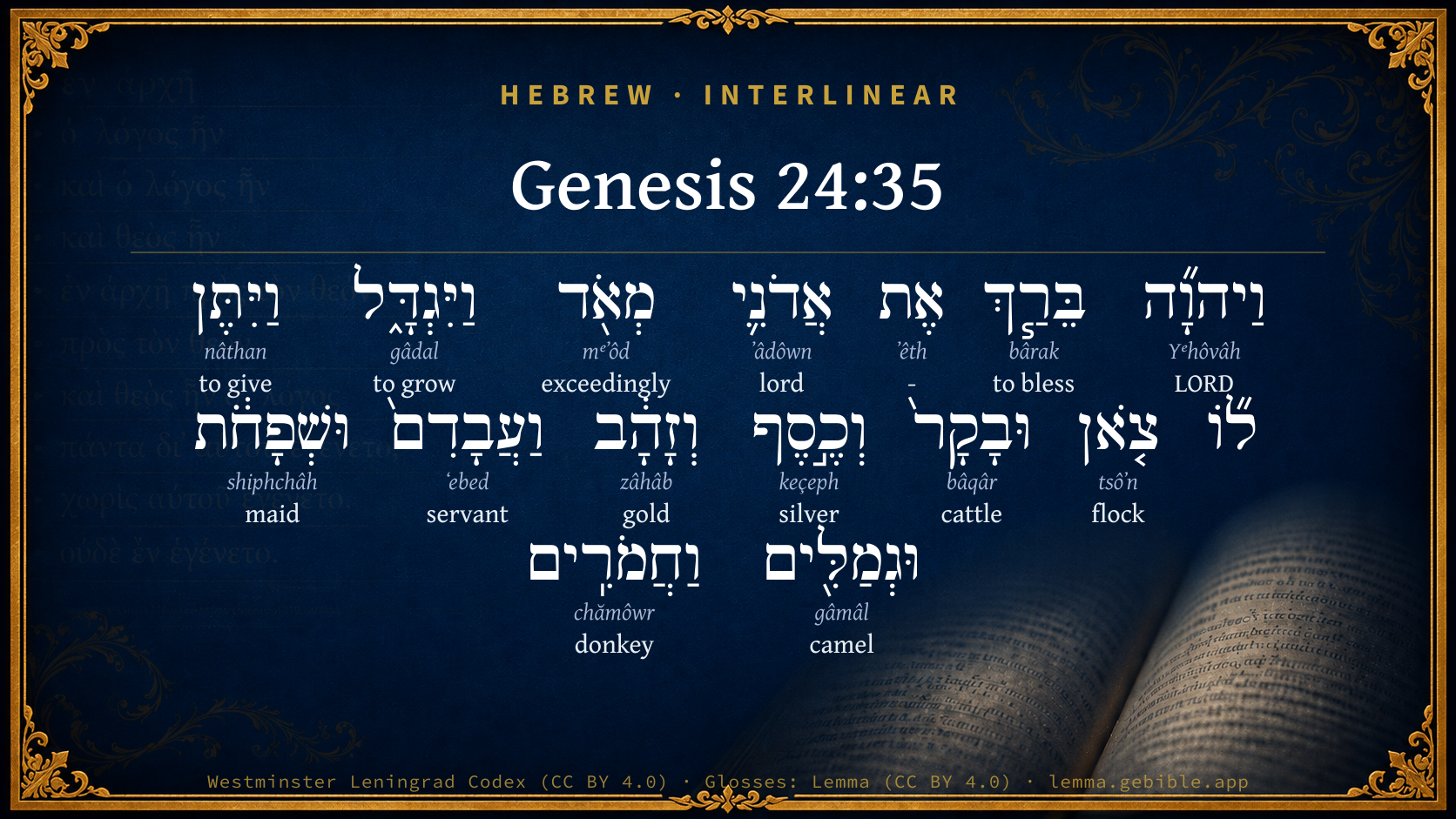
Genesis 24:35

Hebrew (Westminster Leningrad Codex) Genesis 24:35 appears in the Hebrew Old Testament. The text above is from the Westminster Leningrad Codex. Each word links to its Strong’s number, a concise gloss, and parsing drawn from the Open Scriptures Hebrew Bible morphology. Click any word for its full Brown-Driver-Briggs (BDB) entry.
Download image
Cite this verse

Genesis 24:35 (World English Bible). Public Domain. Lemma interlinear Bible study tool, https://lemma.gebible.app/v/genesis/24/35.

Show BibTeX & RIS
BibTeX
RIS
English Translation
Yahweh has blessed my master greatly. He has become great. He has given him flocks and herds, silver and gold, men-servants and maid-servants, and camels and donkeys.
World English Bible · Public Domain
Download a study sheet

One document with this verse’s original text, its word-by-word gloss line, the meaning frame, cross-references with their text, attributed commentary, and full source and license credits — printable, and it pastes into notes with its structure intact.

This verse Autodidact and up

Study sheet (.html) Plain text (.txt)

A passage Seminary Student

Up to 50 verses in one chapter. A passage sheet keeps up to 6 commentary sources and 12 cross-references per verse, in the order this page ranks them, and says so on the sheet whenever that leaves anything out. Ask for a single verse and you get the Autodidact verse sheet above.

Everything on this page stays free to read, with no account — the sheet is a download of what is already on screen, not access to it.

Want to remove ads? Support Godless Engineer
Compare translations 3

The same verse in 3 English versions, stacked beneath the original-language interlinear above. Click any original word for its lexicon entry.

Each is an independent rendering of the whole verse — the interlinear is not word-aligned to these translations.

Highlighted words mark where these versions differ — a whole-verse word diff, not a word-by-word alignment.

  • World English Bible Public Domain
    Yahweh has blessed my master greatly. He has become great. He has given him flocks and herds, silver and gold, men-servants and maid-servants, and camels and donkeys.
  • King James Version Public Domain
    And the LORD hath blessed my master greatly; and he is become great: and he hath given him flocks, and herds, and silver, and gold, and menservants, and maidservants, and camels, and asses.
  • unfoldingWord Literal Text CC BY-SA 4.0
    And Yahweh has greatly blessed my master, so that he has become great. And he has given him flock and herd, and silver and gold, and men slaves and women slaves, and camels and donkeys.

unfoldingWord Literal Text — © unfoldingWord, licensed CC BY-SA 4.0. Word-aligned USFM3 via Door43 (git.door43.org/unfoldingWord/en_ult).

Versions to compare (up to 4)

3 of 4 selected

Show all 18 translations

Every available English version of this verse, each an independent rendering of the whole verse.

  • World English Bible Public Domain
    Yahweh has blessed my master greatly. He has become great. He has given him flocks and herds, silver and gold, men-servants and maid-servants, and camels and donkeys.
  • Berean Standard Bible Public Domain
    “The LORD has greatly blessed my master, and he has become rich. He has given him sheep and cattle, silver and gold, menservants and maidservants, camels and donkeys.
  • Majority Standard Bible Public Domain
    “The LORD has greatly blessed my master, and he has become rich. He has given him sheep and cattle, silver and gold, menservants and maidservants, camels and donkeys.
  • King James Version Public Domain
    And the LORD hath blessed my master greatly; and he is become great: and he hath given him flocks, and herds, and silver, and gold, and menservants, and maidservants, and camels, and asses.
  • American Standard Version (1901) Public Domain
    And Jehovah hath blessed my master greatly. And he is become great. And he hath given him flocks and herds, and silver and gold, and men-servants and maid-servants, and camels and asses.
  • Revised Version (1885) Public Domain
    And the LORD hath blessed my master greatly; and he is become great: and he hath given him flocks and herds, and silver and gold, and menservants and maidservants, and camels and asses.
  • Geneva Bible (1599) Public Domain
    And the Lord hath blessed my master wonderfully, that he is become great: for he hath giuen him sheepe, and beeues, and siluer, and golde, and men seruants, and maide seruants, and camels, and asses.
  • Douay-Rheims (1899) Public Domain
    And the Lord hath blessed my master wonderfully, and he is become great: and he hath given him sheep and oxen, silver and gold, menservants and womenservants, camels and asses.
  • Young's Literal Translation Public Domain
    and Jehovah hath blessed my lord exceedingly, and he is great; and He giveth to him flock, and herd, and silver, and gold, and men-servants, and maid-servants, and camels, and asses;
  • Literal Standard Version CC BY-SA 4.0
    and YHWH has blessed my lord exceedingly, and he is great; and He gives to him flock, and herd, and silver, and gold, and menservants, and maidservants, and camels, and donkeys;
  • Unlocked Literal Bible CC BY-SA 4.0
    Yahweh has blessed my master very much and he has become great. He has given him flocks and herds, silver and gold, male servants and female servants, and camels and donkeys.
  • unfoldingWord Literal Text CC BY-SA 4.0
    And Yahweh has greatly blessed my master, so that he has become great. And he has given him flock and herd, and silver and gold, and men slaves and women slaves, and camels and donkeys.
  • Darby Bible Public Domain
    And Jehovah has blessed my master greatly, and he is become great; and he has given him sheep and cattle, and silver and gold, and bondmen and bondwomen, and camels and asses.
  • World Messianic Bible Public Domain
    The LORD has blessed my master greatly. He has become great. The LORD has given him flocks and herds, silver and gold, male servants and female servants, and camels and donkeys.
  • Webster's Bible Public Domain
    And the LORD hath blessed my master greatly, and he is become great: and he hath given him flocks, and herds, and silver, and gold, and men-servants, and maid-servants, and camels, and asses.
  • Free Bible Version CC BY-SA 4.0
    “The Lord has blessed my master so much, and now he is a wealthy and powerful man. The Lord has given him sheep and cattle, silver and gold, male and female servants, and camels and donkeys.
  • Bible in Basic English Public Domain
    The Lord has given my master every blessing, and he has become great: he has given him flocks and herds and silver and gold, and men-servants and women-servants and camels and asses.
  • JPS Tanakh (1917) Public Domain
    And the LORD hath blessed my master greatly; and he is become great; and He hath given him flocks and herds, and silver and gold, and men-servants and maid-servants, and camels and asses.

Literal Standard Version (2020), Covenant Press — licensed CC BY-SA 4.0. Text via the HelloAO Bible API (eBible.org). Unlocked Literal Bible (unfoldingWord) — licensed CC BY-SA 4.0. Text via the HelloAO Bible API (eBible.org). unfoldingWord Literal Text — © unfoldingWord, licensed CC BY-SA 4.0. Word-aligned USFM3 via Door43 (git.door43.org/unfoldingWord/en_ult). Free Bible Version, Dr. Jonathan Gallagher — licensed CC BY-SA 4.0. Text via the HelloAO Bible API (eBible.org).

Word by word

More ways to search: Search by grammar → Find every occurrence → Compare this word →

Practice this passage: Drill this verse → Learn its vocabulary →

וּגְמַלִּ֖ים
gâmâl
H1581
“and · camels”
Conjunction + Noun, Common, Masculine, Plural, Absolute
Part of Speech
Conjunction + Noun
Type
Common
Gender
Masculine
Number
Plural
State
Absolute
Full BDB Definition

Origin: apparently from H1580

TWOT: 360d

camel - as property, as beast of burden, for riding, forbidden for food
  1. וַיהוָ֞ה Yᵉhôvâh H3068 “and · LORD” Conjunction + Noun, Proper
  2. בֵּרַ֧ךְ bârak H1288 “to bless” Verb, Piel, Perfect, 3rd Person, Masculine, Singular
  3. אֶת ʼêth H853 “-” Particle, Direct Object
  4. אֲדֹנִ֛י ʼâdôwn H113 “lord · my” Noun, Common, Masculine, Singular, Construct + Suffix, Personal, 1st Person, Common, Singular
  5. מְאֹ֖ד mᵉʼôd H3966 “exceedingly” Adverb
  6. וַיִּגְדָּ֑ל gâdal H1431 “and · to grow” Conjunction + Verb, Qal, Sequential Imperfect, 3rd Person, Masculine, Singular
  7. וַיִּתֶּן nâthan H5414 “and · to give” Conjunction + Verb, Qal, Sequential Imperfect, 3rd Person, Masculine, Singular
  8. צֹ֤אן tsôʼn H6629 “flock” Noun, Common, Both, Singular, Absolute
  9. וּבָקָר֙ bâqâr H1241 “and · cattle” Conjunction + Noun, Common, Both, Singular, Absolute
  10. וְכֶ֣סֶף keçeph H3701 “and · silver” Conjunction + Noun, Common, Masculine, Singular, Absolute
  11. וְזָהָ֔ב zâhâb H2091 “and · gold” Conjunction + Noun, Common, Masculine, Singular, Absolute
  12. וַעֲבָדִם֙ ʻebed H5650 “and · servants” Conjunction + Noun, Common, Masculine, Plural, Absolute
  13. וּשְׁפָחֹ֔ת shiphchâh H8198 “and · maids” Conjunction + Noun, Common, Feminine, Plural, Absolute
  14. וַחֲמֹרִֽים chămôwr H2543 “and · donkeys” Conjunction + Noun, Common, Both, Plural, Absolute

About this verse

These counts appear in no published source. They are computed here, from the morphology-tagged text and Lemma’s own curated glosses. What Lemma adds →

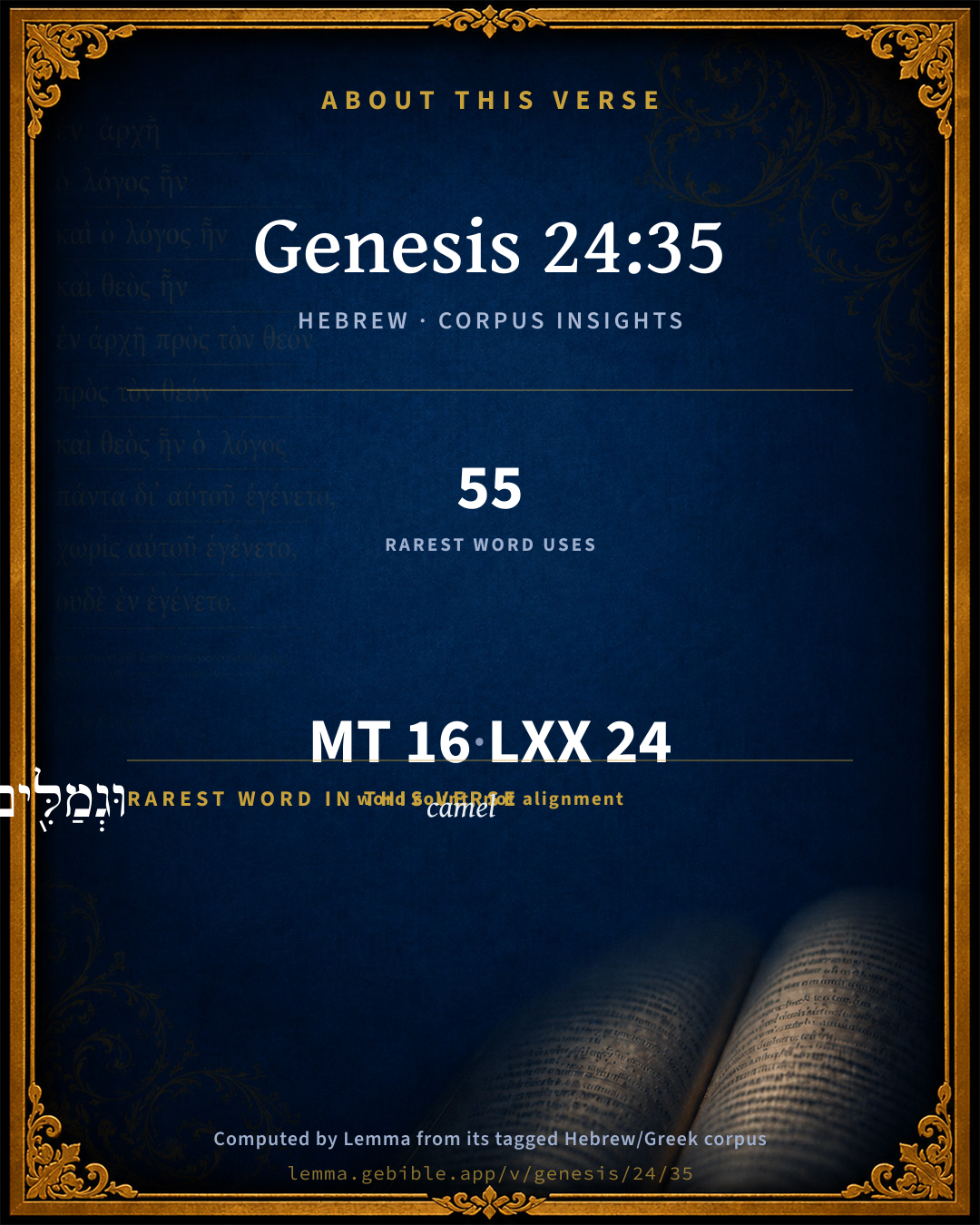
16
words
15
distinct lemmas
Pentateuch
section

Shared distinctive vocabulary

וּגְמַלִּ֖ים camel H1581 occurs in 52 verses of the Hebrew Bible. Also found in:

Grammatical profile

  • 3 verbs
  • 10 nouns
  • 1 preposition
  • 1 adverb
  • 1 particle

Verb forms

  • בֵּרַ֧ךְ Piel · Perfect
  • וַיִּגְדָּ֑ל Qal · Sequential Imperfect
  • וַיִּתֶּן Qal · Sequential Imperfect

Hebrew & Septuagint length

In English translation the verse runs 27 words from the Hebrew and 30 from the Septuagint (LXX English) — closely comparable.

A rough comparison of the two English renderings, which tokenize alike — not a word-level alignment.

Word counts can differ between the Hebrew and the Greek without any difference in meaning — e.g. the Hebrew direct-object marker אֵת has no separate Greek word, and Greek often adds the article ὁ.

In the original languages it is 16 Hebrew tokens and 24 Greek tokens — but the two are counted differently (Hebrew bundles its prefixes and suffixes into one token; the Greek is in lemma form), so that isn’t a like-for-like length.

Cross-references

16

Topical passages linked to Genesis 24:35 in the Treasury of Scripture Knowledge — connected by theme and wording, ordered by reader-vote popularity; previews shown in the World English Bible.

  • Genesis 13:2 Abram was very rich in cattle, in silver, and in gold.
  • Genesis 24:1 Abraham was old, and well stricken in age. Yahweh had blessed Abraham in all things.
  • Psalms 107:38 He blesses them also, so that they are multiplied greatly. He doesn't allow their cattle to decrease.
  • Proverbs 10:22 Yahweh's blessing brings wealth, And he adds no trouble to it.
  • Matthew 6:33 But seek first God's Kingdom, and his righteousness; and all these things will be given to you as well.
  • Genesis 12:2 I will make of you a great nation. I will bless you, and make your name great. You will be a blessing.
  • Genesis 12:16 He dealt well with Abram for her sake. He had sheep, and oxen, and male donkeys, and men-servants, and maid-servants, and female donkeys, and camels.
  • Genesis 25:11 It happened after the death of Abraham, that God blessed Isaac, his son. Isaac lived by Beer Lahai Roi.
  • Genesis 26:12–14 Isaac sowed in that land, and reaped in the same year one hundred times what he planted. Yahweh blessed him.
  • Psalms 18:35 You have also given me the shield of your salvation. Your right hand sustains me. Your gentleness has made me great.
  • Proverbs 22:4 The result of humility and the fear of Yahweh Is wealth, honor, and life.
  • Genesis 49:25 Even by the God of your father, who will help you, By the Almighty, who will bless you, With blessings of heaven above, Blessings of the deep that lies below, Blessings of the breasts, and of the womb.
  • Job 42:10–12 Yahweh turned the captivity of Job, when he prayed for his friends. Yahweh gave Job twice as much as he had before.
  • Psalms 112:3 Wealth and riches are in his house. His righteousness endures forever.
  • 1 Timothy 4:8 For bodily exercise has some value, but godliness has value for all things, having the promise of the life which is now, and of that which is to come.
  • Job 1:3 His possessions also were seven thousand sheep, three thousand camels, five hundred yoke of oxen, five hundred she-donkeys, and a very great household; so that this man was the greatest of all the children of the east.

Cross-references courtesy of OpenBible.info (CC BY 4.0).

Hebrew and Greek witnesses Masoretic Hebrew ↔ Greek Septuagint

The same verse in the two great witnesses to the Old Testament, shown verse-for-verse.

These are two independent witnesses, not word-aligned to each other, and the Septuagint is shown in lemma (dictionary) form.

Hebrew Genesis 24:35 Masoretic · Westminster Leningrad Codex

וַיהוָ֞ה בֵּרַ֧ךְ אֶת אֲדֹנִ֛י מְאֹ֖ד וַיִּגְדָּ֑ל וַיִּתֶּן ל֞וֹ צֹ֤אן וּבָקָר֙ וְכֶ֣סֶף וְזָהָ֔ב וַעֲבָדִם֙ וּשְׁפָחֹ֔ת וּגְמַלִּ֖ים וַחֲמֹרִֽים

Yahweh has blessed my master greatly. He has become great. He has given him flocks and herds, silver and gold, men-servants and maid-servants, and camels and donkeys.

World English Bible · Public Domain

Greek LXX Genesis 24:35 Septuagint · lemma form

κύριος δέ εὐλογέω ὁ κύριος ἐγώ σφόδρα καί ὑψόω καί δίδωμι αὐτός πρόβατον καί μόσχος ἀργύριον καί χρυσίον παῖς καί παιδίσκη κάμηλος καί ὄνος

and the Lord has blessed my master greatly, and he is exalted, and he has given him sheep, and calves, and silver, and gold, servants and servant-maids, camels, and asses.

LXX2012 (modern English Septuagint) · Public Domain

Hebrew: Westminster Leningrad Codex (CC BY 4.0). Greek: Septuagint (public domain); English from LXX2012 (modern English Septuagint) (Public Domain). How the Septuagint differs from the Hebrew →

Targum (Aramaic paraphrase)

2

The Targum is the ancient Jewish Aramaic paraphrase of the Hebrew Scriptures — an interpretive translation, not the Hebrew text itself. Onkelos (literal) and Pseudo-Jonathan (expansive) render the Torah, and Jonathan the Prophets. Coverage is partial: where no permissively-licensed English translation exists for a verse, only the Aramaic is shown. This is verse-level text, not a word-by-word alignment to the Hebrew.

  1. Targum Onkelos Torah (Genesis–Deuteronomy)
    וַיְיָ בְּרִיךְ יָת רִבּוֹנִי לַחֲדָא וּרְבָא וִיהַב לֵהּ עָאן וְתוֹרִין וּכְסַף וּדְהַב וְעַבְדִּין וְאַמְהָן וְגַמְלִין וְחַמָרִין

    (no public-domain English translation for this verse)

    Targum Onkelos — Aramaic: “Onkelos Genesis” (public domain); “Onkelos Exodus” (public domain); “Onkelos Leviticus” (public domain); “Onkelos Numbers” (public domain); “Onkelos Deuteronomy” (public domain). English: “Sefaria Community Translation” (CC0 1.0 (public-domain dedication)); “J.W. Etheridge. The Targums of Onkelos and Jonathan Ben Uzziel on the Pentateuch. London: Longmans, Green, 1862” (public domain). Text via Sefaria.

  2. Targum Pseudo-Jonathan Torah (Genesis–Deuteronomy)
    וַיְיָ בְּרִיךְ יַת רִבּוֹנִי לַחֲדָא וּרְבָא וִיהַב לֵיהּ עָאן וְתוֹרִין וְכַסְפָּא וְדַהֲבָא וְעַבְדִין וְאַמְהָן וְגַמְלִין וְחַמְרִין

    And the Lord hath blessed my master greatly, and hath increased, and given him sheep and oxen, silver and gold, servants and handmaids, and camels and asses.

    Targum Pseudo-Jonathan — Aramaic: “Targum Jonathan on Genesis” (public domain); “Targum Jonathan on Exodus” (public domain); “Targum Jonathan on Leviticus” (public domain); “Targum Jonathan on Numbers” (public domain); “Targum Jonathan on Deuteronomy” (public domain). English: “The Targum of Jonathan ben Uzziel, trans. J. W. Etheridge, London, 1862” (public domain). Text via Sefaria.

Commentary

Notes on Genesis 24:35 from classic Christian and Jewish commentators (each source and its license shown beneath its notes). The classic Christian expositions comment on the surrounding passage and are grouped to its opening verse, so a note may address several verses; the Jewish commentaries on the Tanakh (Rashi and others) are per-verse, so they appear only where the commentator wrote on this verse.

Lemma curates 59 commentaries, every one of them public domain or Creative Commons licensed, each selected and text-cleaned for this edition rather than reprinted as found. About our sources →

Trapp's Complete Commentary

John Trapp

Gen 24:35 And the LORD hath blessed my master greatly; and he is become great: and he hath given him flocks, and herds, and silver, and gold, and menservants, and maidservants, and camels, and asses.

Ver. 35. And the Lord hath blessed my master.] Ministers, Christ’s spokesmen, must likewise woo for Christ, by setting forth his great wealth; and not speak one word for Christ and two for themselves, as those did in Php 1:15. John Baptist was no such spokesman. {Joh 3:29} It is the special office of the ministry to lay Christ open, to hold up the tapestry, and let men see him as he is set forth, {Heb 1:2-3} that they may be sick of love; for otherwise, Christ is like to have but a cold suit of it.

John Trapp, A Commentary or Exposition upon All the Books of the Old and New Testament (1647–1656) — public domain. Text from a community e-Sword module.

Geneva Bible (1599)

Geneva Bible translators

To bless, signifieth here to enrich, or increase with substance, as the text in the same verse declareth.

Geneva Bible (1599) marginal notes — public domain. Text via Bolls.life.

The Cambridge Bible for Schools and Colleges

gen. ed. J. J. S. Perowne

35. hath blessed] Cf. Gen_24:1. The servant recounts the wealth of Abraham of which we have heard in Gen_12:16, Gen_13:2. The servant’s first object is to represent that, from a worldly point of view, a marriage with Abraham’s son would be not only prudent, but desirable.

The Cambridge Bible for Schools and Colleges (gen. ed. J. J. S. Perowne; Cambridge University Press, 1878–1918) — public domain. Text from a community e-Sword module.

John Gill's Exposition

And Sarah, my master's wife,.... Who must be well known to this family, by name at least, being, as is generally supposed, the sister of Milcah, Nahor's wife, and Bethuel's mother; the same

bare a son to my master when she was old; even when ninety years of age, Gen 17:17; this is mentioned because it was an extraordinary thing, and an instance of divine power and of the favour of God; and this son of their old age must be very dear unto Abraham, as it follows:

and unto him hath he given all that he hath; by his will: Jarchi says, the servant had now the schedule of all in his hands, which he showed; but this is mere conjecture.

John Gill's Exposition of the Whole Bible (1746–1763) — public domain (CC PDM 1.0). Text via the HelloAO Bible API.

Radak

Rabbi David Kimhi (Radak)

וה' ברך את אדוני, to such an extent that I, his slave, am received with such honour.

Radak on the Tanakh — English translations: “Sefaria Community Translation” (CC0 1.0 (public-domain dedication)); “Eliyahu Munk, HaChut Hameshulash” (CC BY 4.0); “Rabbi Mike Feuer, Jerusalem Anthology” (CC BY 4.0); and “R. David Kimhi on the first book of Psalms, Translated by R.G. Finch, London, 1919” (public domain). Text via Sefaria.

Lesson kit

Teaching starters — assembled from the data on this page, not authored interpretation. Every prompt links to the verse data it draws on. Edit before teaching.

Genesis, in the Pentateuch, opens this verse with 16 words (15 distinct Hebrew lemmas). Its most distinctive word is gâmâl (“camel”). A historical commentator’s framing appears above. Read the whole chapter for the surrounding context.

Discussion questions

  1. What does “camel” (gâmâl) contribute to the verse as a whole?
  2. Genesis 12:16 shares the word «camel» with this verse. How do the two illuminate each other?
  3. These translations render this verse differently. What is at stake in choosing one wording over another?
  4. The verb «בֵּרַ֧ךְ» is Piel Perfect. How does its form color the action?
  5. Reading how Trapp's Complete Commentary and Geneva Bible (1599) read this verse, where do the two commentators agree and where do they part?

Things to notice

Reading settings

Reading text

Shown beneath each verse's original-language words.

Old Testament
Old Testament edition

Read the OT as the Masoretic Hebrew (MT) or the Greek Septuagint (LXX).

English shown for the Greek Septuagint (in the Hebrew ↔ Greek comparison).

Comparing translations? Open the Compare panel on any verse page to stack up to four side by side.