
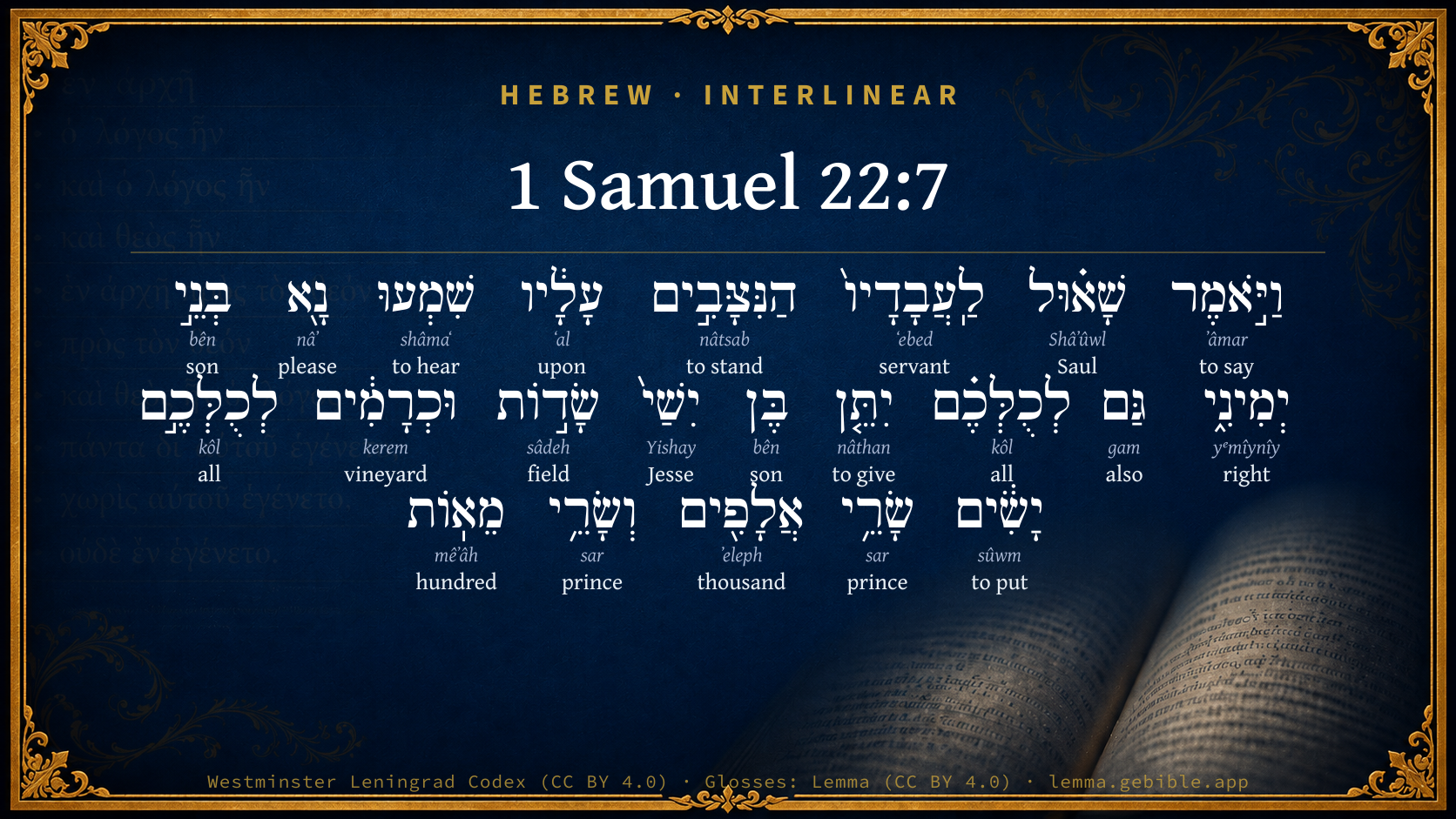
1 Samuel 22:7

Hebrew (Westminster Leningrad Codex) 1 Samuel 22:7 appears in the Hebrew Old Testament. The text above is from the Westminster Leningrad Codex. Each word links to its Strong’s number, a concise gloss, and parsing drawn from the Open Scriptures Hebrew Bible morphology. Click any word for its full Brown-Driver-Briggs (BDB) entry.
Download image
Cite this verse

1 Samuel 22:7 (World English Bible). Public Domain. Lemma interlinear Bible study tool, https://lemma.gebible.app/v/1-samuel/22/7.

Show BibTeX & RIS
BibTeX
RIS
English Translation
Saul said to his servants who stood about him, Hear now, you Benjamites; will the son of Jesse give everyone of you fields and vineyards, will he make you all captains of thousands and captains of hundreds,
World English Bible · Public Domain
Download a study sheet

One document with this verse’s original text, its word-by-word gloss line, the meaning frame, cross-references with their text, attributed commentary, and full source and license credits — printable, and it pastes into notes with its structure intact.

This verse Autodidact and up

Study sheet (.html) Plain text (.txt)

A passage Seminary Student

Up to 50 verses in one chapter. A passage sheet keeps up to 6 commentary sources and 12 cross-references per verse, in the order this page ranks them, and says so on the sheet whenever that leaves anything out. Ask for a single verse and you get the Autodidact verse sheet above.

Everything on this page stays free to read, with no account — the sheet is a download of what is already on screen, not access to it.

Want to remove ads? Support Godless Engineer
Compare translations 3

The same verse in 3 English versions, stacked beneath the original-language interlinear above. Click any original word for its lexicon entry.

Each is an independent rendering of the whole verse — the interlinear is not word-aligned to these translations.

Highlighted words mark where these versions differ — a whole-verse word diff, not a word-by-word alignment.

  • World English Bible Public Domain
    Saul said to his servants who stood about him, Hear now, you Benjamites; will the son of Jesse give everyone of you fields and vineyards, will he make you all captains of thousands and captains of hundreds,
  • King James Version Public Domain
    Then Saul said unto his servants that stood about him, Hear now, ye Benjamites; will the son of Jesse give every one of you fields and vineyards, and make you all captains of thousands, and captains of hundreds;
  • unfoldingWord Literal Text CC BY-SA 4.0
    And Saul said to his servants having stationed themselves beside him, “Listen now, Benjaminite! Will the son of Jesse give fields and vineyards even to all of you? Will he make all of you commanders of thousands and commanders of hundreds?

unfoldingWord Literal Text — © unfoldingWord, licensed CC BY-SA 4.0. Word-aligned USFM3 via Door43 (git.door43.org/unfoldingWord/en_ult).

Versions to compare (up to 4)

3 of 4 selected

Show all 18 translations

Every available English version of this verse, each an independent rendering of the whole verse.

  • World English Bible Public Domain
    Saul said to his servants who stood about him, Hear now, you Benjamites; will the son of Jesse give everyone of you fields and vineyards, will he make you all captains of thousands and captains of hundreds,
  • Berean Standard Bible Public Domain
    Then Saul said to his servants, “Listen, men of Benjamin! Is the son of Jesse giving all of you fields and vineyards and making you commanders of thousands or hundreds?
  • Majority Standard Bible Public Domain
    Then Saul said to his servants, “Listen, men of Benjamin! Is the son of Jesse giving all of you fields and vineyards and making you commanders of thousands or hundreds?
  • King James Version Public Domain
    Then Saul said unto his servants that stood about him, Hear now, ye Benjamites; will the son of Jesse give every one of you fields and vineyards, and make you all captains of thousands, and captains of hundreds;
  • American Standard Version (1901) Public Domain
    And Saul said unto his servants that stood about him, Hear now, ye Benjamites; will the son of Jesse give every one of you fields and vineyards, will he make you all captains of thousands and captains of hundreds,
  • Revised Version (1885) Public Domain
    And Saul said unto his servants that stood about him, Hear now, ye Benjamites; will the son of Jesse give every one of you fields and vineyards, will he make you all captains of thousands and captains of hundreds;
  • Geneva Bible (1599) Public Domain
    And Saul said vnto his seruants that stood about him, Heare now, ye sonnes of Iemini, wil the sonne of Ishai giue euery one of you fields and vineyardes: will he make you all captaines ouer thousands, and captaines ouer hundreths:
  • Douay-Rheims (1899) Public Domain
    He said to his servants that stood about him: Hear me now, ye sons of Jemini: will the son of Isai give everyone of you fields, and vineyards, and make you all tribunes, and centurions:
  • Young's Literal Translation Public Domain
    And Saul saith to his servants who are standing by him, `Hear, I pray you, ye Benjamites; also to all of you doth the son of Jesse give fields and vineyards! all of you he doth appoint heads of thousands and heads of hundreds!
  • Literal Standard Version CC BY-SA 4.0
    And Saul says to his servants who are standing by him, “Now hear, sons of Benjamin; does the son of Jesse also give fields and vineyards to all of you? Does he appoint all of you [to be] heads of thousands and heads of hundreds?
  • Unlocked Literal Bible CC BY-SA 4.0
    Saul said to his servants who stood around him, “Listen now, people of Benjamin! Will the son of Jesse give every one of you fields and vineyards? Will he make you all captains of thousands and captains of hundreds,
  • unfoldingWord Literal Text CC BY-SA 4.0
    And Saul said to his servants having stationed themselves beside him, “Listen now, Benjaminite! Will the son of Jesse give fields and vineyards even to all of you? Will he make all of you commanders of thousands and commanders of hundreds?
  • Darby Bible Public Domain
    Then Saul said to his servants that stood by him, Hear now, ye Benjaminites: will the son of Jesse give every one of you also fields and vineyards? Will he make you all captains of thousands and captains of hundreds,
  • World Messianic Bible Public Domain
    Saul said to his servants who stood around him, “Hear now, you Benjamites! Will the son of Jesse give everyone of you fields and vineyards? Will he make you all captains of thousands and captains of hundreds?
  • Webster's Bible Public Domain
    Then Saul said to his servants that stood about him, Hear now, ye Benjaminites; will the son of Jesse give every one of you fields and vineyards, and make you all captains of thousands, and captains of hundreds;
  • Free Bible Version CC BY-SA 4.0
    Saul said to them, “Listen to me, you men of Benjamin! Is the son of Jesse going to give all of you fields and vineyards and make you commanders and officers in the army?
  • Bible in Basic English Public Domain
    Then Saul said to his servants who were there about him, Give ear now, you Benjamites; will the son of Jesse give to every one of you fields and vine-gardens, will he make you all captains of hundreds and captains of thousands;
  • JPS Tanakh (1917) Public Domain
    And Saul said unto his servants that stood about him: 'Hear now, ye Benjamites; will the son of Jesse give every one of you fields and vineyards, will he make you all captains of thousands and captains of hundreds;

Literal Standard Version (2020), Covenant Press — licensed CC BY-SA 4.0. Text via the HelloAO Bible API (eBible.org). Unlocked Literal Bible (unfoldingWord) — licensed CC BY-SA 4.0. Text via the HelloAO Bible API (eBible.org). unfoldingWord Literal Text — © unfoldingWord, licensed CC BY-SA 4.0. Word-aligned USFM3 via Door43 (git.door43.org/unfoldingWord/en_ult). Free Bible Version, Dr. Jonathan Gallagher — licensed CC BY-SA 4.0. Text via the HelloAO Bible API (eBible.org).

Word by word

More ways to search: Search by grammar → Find every occurrence → Compare this word →

Practice this passage: Drill this verse → Learn its vocabulary →

יְמִינִ֑י
yᵉmîynîy
H3227
“right”
Noun, Gentilic, Masculine, Singular, Absolute
Part of Speech
Noun
Type
Gentilic
Gender
Masculine
Number
Singular
State
Absolute
Full BDB Definition

Origin: for H3225

TWOT: 872b

right, on the right, right hand
  1. וַיֹּ֣אמֶר ʼâmar H559 “and · to say” Conjunction + Verb, Qal, Sequential Imperfect, 3rd Person, Masculine, Singular
  2. שָׁא֗וּל Shâʼûwl H7586 “Saul” Noun, Proper
  3. לַֽעֲבָדָיו֙ ʻebed H5650 “to/for · servants · his” Preposition + Noun, Common, Masculine, Plural, Construct + Suffix, Personal, 3rd Person, Masculine, Singular
  4. הַנִּצָּבִ֣ים nâtsab H5324 “the · standing” Particle, Definite Article + Verb, Niphal, Participle Active, Masculine, Plural, Absolute
  5. עָלָ֔יו ʻal H5921 “upon · him” Preposition + Suffix, Personal, 3rd Person, Masculine, Singular
  6. שִׁמְעוּ shâmaʻ H8085 “hear” Verb, Qal, Imperative, 2nd Person, Masculine, Plural
  7. נָ֖א nâʼ H4994 “please” Particle, Exhortation
  8. בְּנֵ֣י bên H1121 “sons” Noun, Gentilic, Masculine, Plural, Construct
  9. גַּם gam H1571 “also” Particle, Accusative
  10. לְכֻלְּכֶ֗ם kôl H3605 “to/for · all · your” Preposition + Noun, Common, Masculine, Singular, Construct + Suffix, Personal, 2nd Person, Masculine, Plural
  11. יִתֵּ֤ן nâthan H5414 “to give” Verb, Qal, Imperfect, 3rd Person, Masculine, Singular
  12. בֶּן bên H1121 “son of” Noun, Common, Masculine, Singular, Construct
  13. יִשַׁי֙ Yishay H3448 “Jesse” Noun, Proper
  14. שָׂד֣וֹת sâdeh H7704 “fields” Noun, Common, Masculine, Plural, Absolute
  15. וּכְרָמִ֔ים kerem H3754 “and · vineyards” Conjunction + Noun, Common, Both, Plural, Absolute
  16. לְכֻלְּכֶ֣ם kôl H3605 “to/for · all · your” Preposition + Noun, Common, Masculine, Singular, Construct + Suffix, Personal, 2nd Person, Masculine, Plural
  17. יָשִׂ֔ים sûwm H7760 “to put” Verb, Qal, Imperfect, 3rd Person, Masculine, Singular
  18. שָׂרֵ֥י sar H8269 “princes of” Noun, Common, Masculine, Plural, Construct
  19. אֲלָפִ֖ים ʼeleph H505 “thousand” Adjective, Cardinal number, Both, Plural, Absolute
  20. וְשָׂרֵ֥י sar H8269 “and · princes of” Conjunction + Noun, Common, Masculine, Plural, Construct
  21. מֵאֽוֹת mêʼâh H3967 “hundred” Adjective, Cardinal number, Both, Plural, Absolute

About this verse

These counts appear in no published source. They are computed here, from the morphology-tagged text and Lemma’s own curated glosses. What Lemma adds →

22
words
19
distinct lemmas
Historical
section

Notable vocabulary

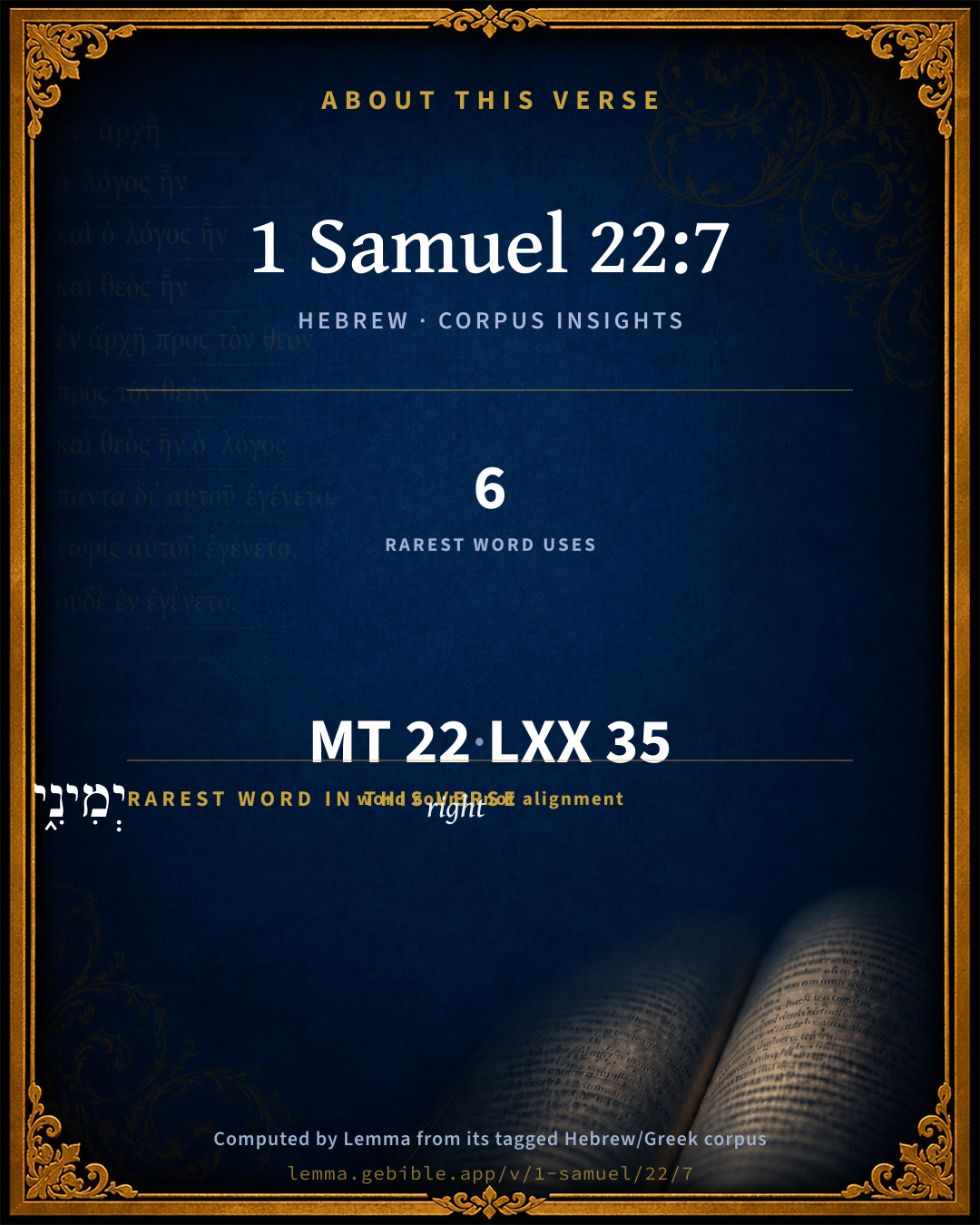
The rarest word here is יְמִינִ֑י right H3227 — appearing just 6 times in the whole Hebrew Bible.

Shared distinctive vocabulary

יְמִינִ֑י right H3227 occurs in 6 verses of the Hebrew Bible. Also found in:

Grammatical profile

  • 5 verbs
  • 12 nouns
  • 2 adjectives
  • 1 preposition
  • 2 particles

Verb forms

  • וַיֹּ֣אמֶר Qal · Sequential Imperfect
  • הַנִּצָּבִ֣ים Niphal · Participle Active
  • שִׁמְעוּ Qal · Imperative
  • יִתֵּ֤ן Qal · Imperfect
  • יָשִׂ֔ים Qal · Imperfect

Repetition

Words recur within this verse — often emphatic in Hebrew:

  • בְּנֵ֣י son H1121 ×2
  • לְכֻלְּכֶ֗ם all H3605 ×2
  • שָׂרֵ֥י prince H8269 ×2

Hebrew & Septuagint length

In English translation the verse runs 37 words from the Hebrew and 42 from the Septuagint (LXX English) — closely comparable.

A rough comparison of the two English renderings, which tokenize alike — not a word-level alignment.

Word counts can differ between the Hebrew and the Greek without any difference in meaning — e.g. the Hebrew direct-object marker אֵת has no separate Greek word, and Greek often adds the article ὁ.

In the original languages it is 22 Hebrew tokens and 35 Greek tokens — but the two are counted differently (Hebrew bundles its prefixes and suffixes into one token; the Greek is in lemma form), so that isn’t a like-for-like length.

Cross-references

12

Topical passages linked to 1 Samuel 22:7 in the Treasury of Scripture Knowledge — connected by theme and wording, ordered by reader-vote popularity; previews shown in the World English Bible.

  • 1 Samuel 8:14–15 He will take your fields, and your vineyards, and your olive groves, even the best of them, and give them to his servants.
  • 1 Kings 12:16 When all Israel saw that the king didn't listen to them, the people answered the king, saying, What portion have we in David? neither have we inheritance in the son of Jesse: to your tents, Israel: now see to your own house, David. So Israel departed to their tents.
  • 1 Samuel 8:11–12 He said, This will be the manner of the king who shall reign over you: he will take your sons, and appoint them to him, for his chariots, and to be his horsemen; and they shall run before his chariots;
  • 1 Samuel 18:14 David behaved himself wisely in all his ways; and Yahweh was with him.
  • 1 Samuel 20:27 It happened on the next day after the new moon, [which was] the second [day], that David's place was empty: and Saul said to Jonathan his son, Why doesn't the son of Jesse come to meat, neither yesterday, nor today?
  • 1 Samuel 20:30 Then Saul's anger was kindled against Jonathan, and he said to him, You son of a perverse rebellious woman, don't I know that you have chosen the son of Jesse to your own shame, and to the shame of your mother's nakedness?
  • 1 Samuel 22:9 Then answered Doeg the Edomite, who stood by the servants of Saul, and said, I saw the son of Jesse coming to Nob, to Ahimelech the son of Ahitub.
  • 1 Samuel 22:13 Saul said to him, Why have you conspired against me, you and the son of Jesse, in that you have given him bread, and a sword, and have inquired of God for him, that he should rise against me, to lie in wait, as at this day?
  • 1 Samuel 25:10 Nabal answered David's servants, and said, Who is David? and who is the son of Jesse? there are many servants now-a-days who break away every man from his master.
  • 2 Samuel 20:1 There happened to be there a base fellow, whose name was Sheba, the son of Bichri, a Benjamite: and he blew the trumpet, and said, We have no portion in David, neither have we inheritance in the son of Jesse: every man to his tents, Israel.
  • Isaiah 11:1 There shall come forth a shoot out of the stock of Jesse, and a branch out of his roots shall bear fruit.
  • Isaiah 11:10 It shall happen in that day, that the root of Jesse, who stands for an ensign of the peoples, to him shall the nations seek; and his resting-place shall be glorious.

Cross-references courtesy of OpenBible.info (CC BY 4.0).

Hebrew and Greek witnesses Masoretic Hebrew ↔ Greek Septuagint

The same verse in the two great witnesses to the Old Testament, shown verse-for-verse.

These are two independent witnesses, not word-aligned to each other, and the Septuagint is shown in lemma (dictionary) form.

Hebrew 1 Samuel 22:7 Masoretic · Westminster Leningrad Codex

וַיֹּ֣אמֶר שָׁא֗וּל לַֽעֲבָדָיו֙ הַנִּצָּבִ֣ים עָלָ֔יו שִׁמְעוּ נָ֖א בְּנֵ֣י יְמִינִ֑י גַּם לְכֻלְּכֶ֗ם יִתֵּ֤ן בֶּן יִשַׁי֙ שָׂד֣וֹת וּכְרָמִ֔ים לְכֻלְּכֶ֣ם יָשִׂ֔ים שָׂרֵ֥י אֲלָפִ֖ים וְשָׂרֵ֥י מֵאֽוֹת

Saul said to his servants who stood about him, Hear now, you Benjamites; will the son of Jesse give everyone of you fields and vineyards, will he make you all captains of thousands and captains of hundreds,

World English Bible · Public Domain

Greek LXX 1 Samuel 22:7 Septuagint · lemma form

καί εἶπον σαούλ πρός ὁ παῖς αὐτός ὁ παραἵστημι αὐτός καί εἶπον αὐτός ἀκούω δή υἱός βενιαμίν εἰ ἀληθῶς πᾶς σύ δίδωμι ὁ υἱός ιεσσαι ἀγρός καί ἀμπελών καί πᾶς σύ τάσσω ἑκατόνταρχος καί χιλίαρχος

And Saul said to his servants that stood by him, Hear now, you⌃ sons of Benjamin, will the son of Jessae indeed give all of you fields and vineyards, and will he make you all captains of hundreds and captains of thousands?

LXX2012 (modern English Septuagint) · Public Domain

Hebrew: Westminster Leningrad Codex (CC BY 4.0). Greek: Septuagint (public domain); English from LXX2012 (modern English Septuagint) (Public Domain). How the Septuagint differs from the Hebrew →

Targum (Aramaic paraphrase)

1

The Targum is the ancient Jewish Aramaic paraphrase of the Hebrew Scriptures — an interpretive translation, not the Hebrew text itself. Onkelos (literal) and Pseudo-Jonathan (expansive) render the Torah, and Jonathan the Prophets. Coverage is partial: where no permissively-licensed English translation exists for a verse, only the Aramaic is shown. This is verse-level text, not a word-by-word alignment to the Hebrew.

  1. Targum Jonathan Prophets (Joshua–Malachi)
    וַאֲמַר שָׁאוּל לְעַבְדוֹהִי דְקַיְמִין עֲלוֹהִי שְׁמָעוּ כְעַן בְּנֵי שִׁבְטָא דְבֵית בִּנְיָמִין אַף לְכֻלְכוֹן יִתֵּן בַּר יִשַׁי חַקְלִין וְכַרְמִין לְכֻלְכוֹן יְמַנֵי רַבָּנֵי אַלְפִין וְרַבָּנֵי מַאֲוָתָא:

    (no public-domain English translation for this verse)

    Targum Jonathan — Aramaic: “Mikraot Gedolot” (public domain). English: “Sefaria Community Translation” (CC0 1.0 (public-domain dedication)); “London "Chaldee Paraphrase," 1871” (public domain). Text via Sefaria.

Commentary

Notes on 1 Samuel 22:7 from classic Christian and Jewish commentators (each source and its license shown beneath its notes). The classic Christian expositions comment on the surrounding passage and are grouped to its opening verse, so a note may address several verses; the Jewish commentaries on the Tanakh (Rashi and others) are per-verse, so they appear only where the commentator wrote on this verse.

Lemma curates 59 commentaries, every one of them public domain or Creative Commons licensed, each selected and text-cleaned for this edition rather than reprinted as found. About our sources →

Trapp's Complete Commentary

John Trapp

1Sa 22:7 Then Saul said unto his servants that stood about him, Hear now, ye Benjamites; will the son of Jesse give every one of you fields and vineyards, [and] make you all captains of thousands, and captains of hundreds;

Ver. 7. Hear now, ye Benjamites.] Will ye suffer the kingdom to be translated from your tribe, to David of the tribe of Judah? bestir you, that it may not.

Will the son of Jesse give every one of you.] As I have done, and yet will do. Thus also the Pope tempteth people on his side, as he did Aeneas Sylvius, Luther, and others, by great rewards and preferments; which yet he sometimes but slenderly performeth, as he did to Allin, Sanders, Stapleton, Reynold, Harding, Dr Smith, and other English fugitives, his best champions.

John Trapp, A Commentary or Exposition upon All the Books of the Old and New Testament (1647–1656) — public domain. Text from a community e-Sword module.

Tyndale Open Study Notes

Tyndale Open Resources

22:7-8 men of Benjamin: Saul was suspicious of his own tribesmen, believing that David had bought their loyalty. Worse, Saul did not even trust his own son, convinced that he had joined the supposed conspiracy.

Tyndale Open Study Notes — © Tyndale Open Resources, licensed CC BY-SA 4.0. Text via the HelloAO Bible API.

Geneva Bible (1599)

Geneva Bible translators

Ye that are of my tribe and lineage.

Geneva Bible (1599) marginal notes — public domain. Text via Bolls.life.

Jamieson, Fausset & Brown

Robert Jamieson, A. R. Fausset & David Brown

Hear now, ye Benjamites--This was an appeal to stimulate the patriotism or jealousy of his own tribe, from which he insinuated it was the design of David to transfer the kingdom to another. This address seems to have been made on hearing of David's return with his four hundred men to Judah. A dark suspicion had risen in the jealous mind of the king that Jonathan was aware of this movement, which he dreaded as a conspiracy against the crown.

Jamieson, Fausset & Brown — Commentary Critical and Explanatory on the Whole Bible (1871) — public domain (CC PDM 1.0). Text via the HelloAO Bible API.

Ellicott's Commentary for English Readers

(7) Hear now, ye Benjamites.—We have here a fair specimen of Saul’s manner of ruling in his later years. It is no wonder that the heart of the people gradually was estranged from one of whom in earlier years they had been so proud. The suspicious and gloomy king had evidently—we have it here from his own mouth—gradually given all the posts of honour and dignity to men of his own tribe and family, or to strangers like Doeg. “Hear now, ye Benjamites”—so the “fidèles” were evidently men of his own favoured tribe; indeed, he refers to his own weak partiality as the reason why they of all men should be loyal. “Who but a Benjamite,” he says, “would only honour Benjamites?” Such a sovereign had surely forfeited his kingdom. The consequences of such a weak and shortsighted policy were plainly visible in the thin array he was able in his hour of bitter need to muster together on the fatal field of Mount Gilboa against his sleepless Philistine enemies. (See 1 Samuel 31)

A Bible Commentary for English Readers, edited by Charles John Ellicott (1878–1897) — public domain. Text from a community e-Sword module.

The Cambridge Bible for Schools and Colleges

gen. ed. J. J. S. Perowne

7. ye Benjamites] Saul appeals to tribal jealousies. Will not David promote his own fellow-tribesmen rather than the Benjamites?

captains of thousands, &c.] The sarcasm of these words gains point, if we may suppose that Saul had just heard of the organization of David’s handful of men (1Ch_12:16-18).

The Cambridge Bible for Schools and Colleges (gen. ed. J. J. S. Perowne; Cambridge University Press, 1878–1918) — public domain. Text from a community e-Sword module.

John Gill's Exposition

Then Saul said unto his servants that stood about him,.... He took this opportunity of addressing them in the following manner, upon the report of David being at the head of a certain number of men:

hear now, ye Benjamites; for Saul being of the tribe of Benjamin, his courtiers and his bodyguards chiefly, if not altogether, consisted of persons of that tribe; and therefore as they were under obligation to him, and ought to abide by him, and adhere closely to him, so it was the more ungrateful in them, as he thought, not to be concerned for his honour and interest:

will the son of Jesse give everyone of you fields and vineyards; as Saul had done, or was capable of doing, and would do if they were faithful to him; whereas it was not in the power of David, whom in contempt he calls the son of Jesse, to do it; and even should he ever be king, and in his power to make such donations, it cannot be thought he would give them to them, but to the favourites of his own tribe:

and make you all captains of thousands and captains of hundreds; which he now could not do, since he had with him but four hundred men in all; and should his army increase, and the kingdom come into his hands, so far would all of them be from being advanced to posts in the army, that it was probable none of them would, but those of his own tribe and party.

John Gill's Exposition of the Whole Bible (1746–1763) — public domain (CC PDM 1.0). Text via the HelloAO Bible API.

Albert Barnes' Notes on the Bible

Ye Benjamites - Showing how isolated the tribes still were, and how for the most part Saul was surrounded by his own tribesmen only.

Albert Barnes' Notes on the Bible (1834–1885) — public domain. Text from a community e-Sword/MySword module.

Haydock's Catholic Bible Commentary

Jemini. Benjamites, my countrymen. Saul approaches them with being too little concerned about his interests, and falsely accuses his own son, who, it seems, had retired from court, after his father had attempted to kill him. But he shewed no signs of disloyalty. (Calmet) --- The king mentions the league between Jonathan and David, on suspicion, chap. xx. 23. (Menochius)

George Leo Haydock (1774–1849), Haydock's Catholic Family Bible and Commentary, 1859 edition — public domain. Excludes Psalms (Douay-Rheims chapter numbering differs from Protestant) and Deuterocanonical books (Catholic canon only).

Matthew Poole's English Annotations

Ye Benjamites; you that are of my own tribe and kindred, from whom David designs to translate the kingdom to another tribe, will he distribute profits and preferments amongst you

Benjamites as I have done, and intend still to do? will he not rather prefer those of his own tribe before you?

Matthew Poole's English Annotations on the Holy Bible (1683–1685) — public domain. Text from a community e-Sword/MySword module.

Whedon's Commentary on the Bible

Daniel D. Whedon

7. Benjamites — From this address Keil infers that Saul had chosen his immediate attendants from his own tribe.

Daniel D. Whedon (gen. ed.), Commentary on the Old and New Testaments (1874–1909) — public domain. Text from a community e-Sword module.

The Pulpit Commentary

Vers. 7, 8. Ye Benjamites. Saul had evidently failed in blending the twelve tribes into one nation. He had begun well, and his great feat of delivering Jabesh Gilead by summoning the militia of all Israel together must have given them something of a corporate feeling, and taught them their power when united. Yet now we find him isolated, and this address to his officers seems to show that he had aggrandised his own tribe at the expense of the rest. Moreover, he appeals to the worst passions of these men, and asks whether they can expect David to continue this favouritism, which had given them riches and all posts of power. And then he turns upon them, and fiercely accuses them of banding together in a conspiracy against him, to conceal from him the private understanding which existed between his own son and his enemy. Hath made a league. Hebrew, "hath cut." This use of the formal phrase forsaking a covenant seems to show that Saul was at length aware of the solemn bond of friendship entered into by Jonathan with David. To lie in wait. To Saul"s mind, diseased with that suspicion which is the scourge of tyrants, David is secretly plotting his murder. As at this day. Ie. as today is manifest (see ver. 13).

The Pulpit Commentary (1880–1919), ed. H.D.M. Spence-Jones & Joseph S. Exell — public domain. Text from a community e-Sword module.

John Wesley's Explanatory Notes

Ye Benjamites - You that are of my own tribe and kindred, from whom David designs to translate the kingdom to another tribe. Will he distribute profits and preferments among you Benjamites, as I have done? Will he not rather prefer those of his own tribe before you?

John Wesley, Explanatory Notes Upon the Whole Bible (1754–1765) — public domain. Text via the GEBible commentary corpus.

unfoldingWord translationNotes

Door43 World Missions Community

Will the son of Jesse give every one of you fields and vineyards?

Saul uses a question to emphasize that David, who is from the tribe of Judah, does not desire to do this for the people of the tribe of Benjamin. AT: "The son of Jesse will not give you fields or vineyards." (See: Rhetorical Question)

Will the son of Jesse give

The time when he will give can be made explicit. AT: "When the son of Jesse becomes king, will he give" (See: Assumed Knowledge and Implicit Information)

the son of Jesse

"David"

Will he make you all captains ... me?

Saul uses a question to emphasize that David, who is from the tribe of Judah, does not desire to do this for the people of the tribe of Benjamin. AT: "He will not make you captains ... against me." (See: Rhetorical Question)

Will he make you all captains

You may need to make explicit when he will make them captains. AT: "When he becomes king, will he make you all captains" (See: Assumed Knowledge and Implicit Information)

captains of thousands and captains of hundreds

Possible meanings are 1) these numbers represent the exact amount of soldiers that these captains led. AT: "captains of 1,000 soldiers and captains of 100 soldiers" or 2) the words translated as "thousands" and "hundreds" do not represent exact numbers, but are the names of larger and smaller military divisions. AT: "captains of large military divisions and captains of smaller military divisions" See how you translated a similar phrase in 1 Samuel 17:18. (See: Numbers)

translationWords

Saul (OT)

servant

people group

Benjamin

Jesse

vineyard

covenant

unfoldingWord translationNotes — © Distant Shores Media and the Door43 World Missions Community, licensed CC BY-SA 4.0. Source: git.door43.org/Door43/en_tn.

Lesson kit

Teaching starters — assembled from the data on this page, not authored interpretation. Every prompt links to the verse data it draws on. Edit before teaching.

1 Samuel, in the Historical, opens this verse with 22 words (19 distinct Hebrew lemmas). Its most distinctive word is yᵉmîynîy (“right”). A historical commentator’s framing appears above. Read the whole chapter for the surrounding context.

Discussion questions

  1. The word yᵉmîynîy carries the sense “right.” How does it shape the verse?
  2. How does 1 Samuel 9:1, which shares the word «right», read alongside this verse?
  3. What does the repetition of “son” (2× in this one verse) do in this verse?
  4. These translations render this verse differently. What is at stake in choosing one wording over another?
  5. «וַיֹּ֣אמֶר» is a Qal Sequential Imperfect verb. How does that grammatical form shape the action described?
  6. Compare how Trapp's Complete Commentary and Tyndale Open Study Notes read this verse. Where do they agree or differ?

Things to notice

Reading settings

Reading text

Shown beneath each verse's original-language words.

Old Testament
Old Testament edition

Read the OT as the Masoretic Hebrew (MT) or the Greek Septuagint (LXX).

English shown for the Greek Septuagint (in the Hebrew ↔ Greek comparison).

Comparing translations? Open the Compare panel on any verse page to stack up to four side by side.