
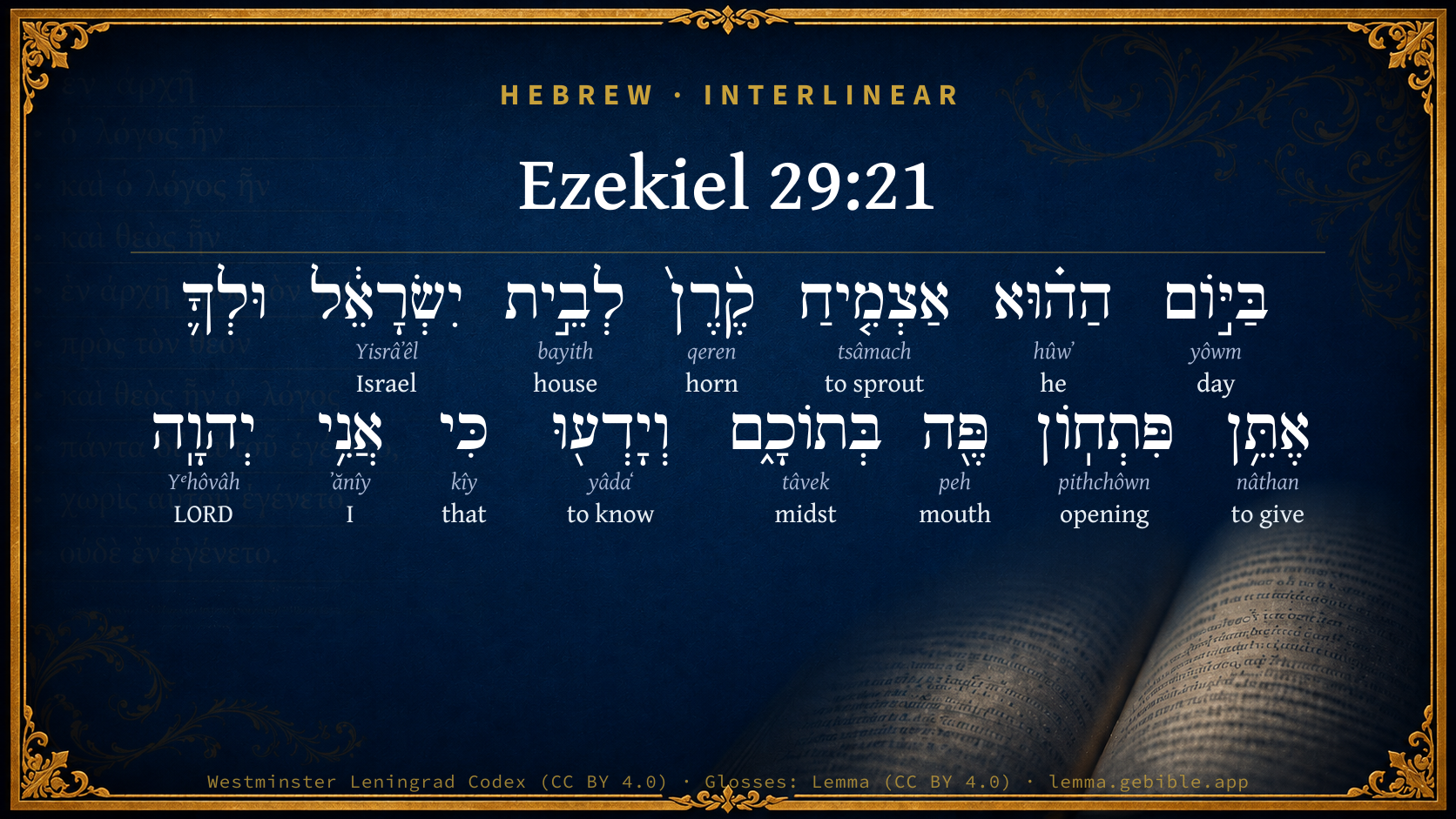
Ezekiel 29:21

Hebrew (Westminster Leningrad Codex) Ezekiel 29:21 appears in the Hebrew Old Testament. The text above is from the Westminster Leningrad Codex. Each word links to its Strong’s number, a concise gloss, and parsing drawn from the Open Scriptures Hebrew Bible morphology. Click any word for its full Brown-Driver-Briggs (BDB) entry.
Download image
Cite this verse

Ezekiel 29:21 (World English Bible). Public Domain. Lemma interlinear Bible study tool, https://lemma.gebible.app/v/ezekiel/29/21.

Show BibTeX & RIS
BibTeX
RIS
English Translation
In that day will I cause a horn to bud forth to the house of Israel, and I will give you the opening of the mouth in the midst of them; and they shall know that I am Yahweh.
World English Bible · Public Domain
Download a study sheet

One document with this verse’s original text, its word-by-word gloss line, the meaning frame, cross-references with their text, attributed commentary, and full source and license credits — printable, and it pastes into notes with its structure intact.

This verse Autodidact and up

Study sheet (.html) Plain text (.txt)

A passage Seminary Student

Up to 50 verses in one chapter. A passage sheet keeps up to 6 commentary sources and 12 cross-references per verse, in the order this page ranks them, and says so on the sheet whenever that leaves anything out. Ask for a single verse and you get the Autodidact verse sheet above.

Everything on this page stays free to read, with no account — the sheet is a download of what is already on screen, not access to it.

Want to remove ads? Support Godless Engineer
Compare translations 3

The same verse in 3 English versions, stacked beneath the original-language interlinear above. Click any original word for its lexicon entry.

Each is an independent rendering of the whole verse — the interlinear is not word-aligned to these translations.

Highlighted words mark where these versions differ — a whole-verse word diff, not a word-by-word alignment.

  • World English Bible Public Domain
    In that day will I cause a horn to bud forth to the house of Israel, and I will give you the opening of the mouth in the midst of them; and they shall know that I am Yahweh.
  • King James Version Public Domain
    In that day will I cause the horn of the house of Israel to bud forth, and I will give thee the opening of the mouth in the midst of them; and they shall know that I am the LORD.
  • unfoldingWord Literal Text CC BY-SA 4.0
    On that day I will make a horn sprout up for the house of Israel, and I make you speak in their midst, so that they will know that I am Yahweh.’”

unfoldingWord Literal Text — © unfoldingWord, licensed CC BY-SA 4.0. Word-aligned USFM3 via Door43 (git.door43.org/unfoldingWord/en_ult).

Versions to compare (up to 4)

3 of 4 selected

Show all 18 translations

Every available English version of this verse, each an independent rendering of the whole verse.

  • World English Bible Public Domain
    In that day will I cause a horn to bud forth to the house of Israel, and I will give you the opening of the mouth in the midst of them; and they shall know that I am Yahweh.
  • Berean Standard Bible Public Domain
    In that day I will cause a horn to sprout for the house of Israel, and I will open your mouth to speak among them. Then they will know that I am the LORD.”
  • Majority Standard Bible Public Domain
    In that day I will cause a horn to sprout for the house of Israel, and I will open your mouth to speak among them. Then they will know that I am the LORD.”
  • King James Version Public Domain
    In that day will I cause the horn of the house of Israel to bud forth, and I will give thee the opening of the mouth in the midst of them; and they shall know that I am the LORD.
  • American Standard Version (1901) Public Domain
    In that day will I cause a horn to bud forth unto the house of Israel, and I will give thee the opening of the mouth in the midst of them; and they shall know that I am Jehovah.
  • Revised Version (1885) Public Domain
    In that day will I cause an horn to bud forth unto the house of Israel, and I will give thee the opening of the mouth in the midst of them; and they shall know that I am the LORD.
  • Geneva Bible (1599) Public Domain
    In that day will I cause the horne of the house of Israel to growe, and I will giue thee an open mouth in the middes of them, and they shall knowe that I am the Lord.
  • Douay-Rheims (1899) Public Domain
    In that day a horn shall bud forth to the house of Israel, and I will give thee an open mouth in the midst of them: and they shall know that I am the Lord.
  • Young's Literal Translation Public Domain
    In that day I cause to shoot up a horn to the house of Israel, And to thee I give an opening of the mouth in their midst, And they have known that I `am' Jehovah!'
  • Literal Standard Version CC BY-SA 4.0
    In that day I cause a horn to shoot up for the house of Israel, || And I give an opening to your mouth in their midst, || And they have known that I [am] YHWH!”
  • Unlocked Literal Bible CC BY-SA 4.0
    On that day I will make a horn sprout up for the house of Israel, and I make you speak in their midst, so that they will know that I am Yahweh.'”
  • unfoldingWord Literal Text CC BY-SA 4.0
    On that day I will make a horn sprout up for the house of Israel, and I make you speak in their midst, so that they will know that I am Yahweh.’”
  • Darby Bible Public Domain
    In that day will I cause the horn of the house of Israel to bud forth, and I will give thee the opening of the mouth in the midst of them: and they shall know that I [am] Jehovah.
  • World Messianic Bible Public Domain
    “In that day I will cause a horn to sprout for the house of Israel, and I will open your mouth among them. Then they will know that I am the LORD.”
  • Webster's Bible Public Domain
    In that day will I cause the horn of the house of Israel to bud forth, and I will give thee the opening of the mouth in the midst of them; and they shall know that I am the LORD.
  • Free Bible Version CC BY-SA 4.0
    At that time I will give power back to the people of Israel and I will help you speak to them. Then they will know that I am the Lord.”
  • Bible in Basic English Public Domain
    In that day I will make a horn put out buds for the children of Israel, and I will let your words come freely among them, and they will be certain that I am the Lord.
  • JPS Tanakh (1917) Public Domain
    In that day will I cause a horn to shoot up unto the house of Israel, and I will give thee the opening of the mouth in the midst of them; and they shall know that I am the LORD.'

Literal Standard Version (2020), Covenant Press — licensed CC BY-SA 4.0. Text via the HelloAO Bible API (eBible.org). Unlocked Literal Bible (unfoldingWord) — licensed CC BY-SA 4.0. Text via the HelloAO Bible API (eBible.org). unfoldingWord Literal Text — © unfoldingWord, licensed CC BY-SA 4.0. Word-aligned USFM3 via Door43 (git.door43.org/unfoldingWord/en_ult). Free Bible Version, Dr. Jonathan Gallagher — licensed CC BY-SA 4.0. Text via the HelloAO Bible API (eBible.org).

Word by word

More ways to search: Search by grammar → Find every occurrence → Compare this word →

Practice this passage: Drill this verse → Learn its vocabulary →

פִּתְחֽוֹן
pithchôwn
H6610
“opening of”
Noun, Common, Masculine, Singular, Construct
Part of Speech
Noun
Type
Common
Gender
Masculine
Number
Singular
State
Construct
Full BDB Definition

Origin: from H6605

TWOT: 1854c

opening
  1. בַּיּ֣וֹם yôwm H3117 “in/at the · day” Preposition, Determined + Noun, Common, Masculine, Singular, Absolute
  2. הַה֗וּא hûwʼ H1931 “the · he” Particle, Definite Article + Pronoun, Personal, 3rd Person, Masculine, Singular
  3. אַצְמִ֤יחַ tsâmach H6779 “to sprout” Verb, Hiphil, Imperfect, 1st Person, Common, Singular
  4. קֶ֨רֶן֙ qeren H7161 “horn” Noun, Common, Both, Singular, Absolute
  5. לְבֵ֣ית bayith H1004 “to/for · house of” Preposition + Noun, Common, Masculine, Singular, Construct
  6. יִשְׂרָאֵ֔ל Yisrâʼêl H3478 “Israel” Noun, Proper
  7. אֶתֵּ֥ן nâthan H5414 “to give” Verb, Qal, Imperfect, 1st Person, Common, Singular
  8. פֶּ֖ה peh H6310 “mouth” Noun, Common, Masculine, Singular, Absolute
  9. בְּתוֹכָ֑ם tâvek H8432 “in/at · midst · their” Preposition + Noun, Common, Masculine, Singular, Construct + Suffix, Personal, 3rd Person, Masculine, Plural
  10. וְיָדְע֖וּ yâdaʻ H3045 “and · to know” Conjunction + Verb, Qal, Sequential Perfect, 3rd Person, Common, Plural
  11. כִּי kîy H3588 “that” Conjunction
  12. אֲנִ֥י ʼănîy H589 “I” Pronoun, Personal, 1st Person, Common, Singular
  13. יְהוָֽה Yᵉhôvâh H3068 “LORD” Noun, Proper

About this verse

These counts appear in no published source. They are computed here, from the morphology-tagged text and Lemma’s own curated glosses. What Lemma adds →

15
words
14
distinct lemmas
Prophets
section

Notable vocabulary

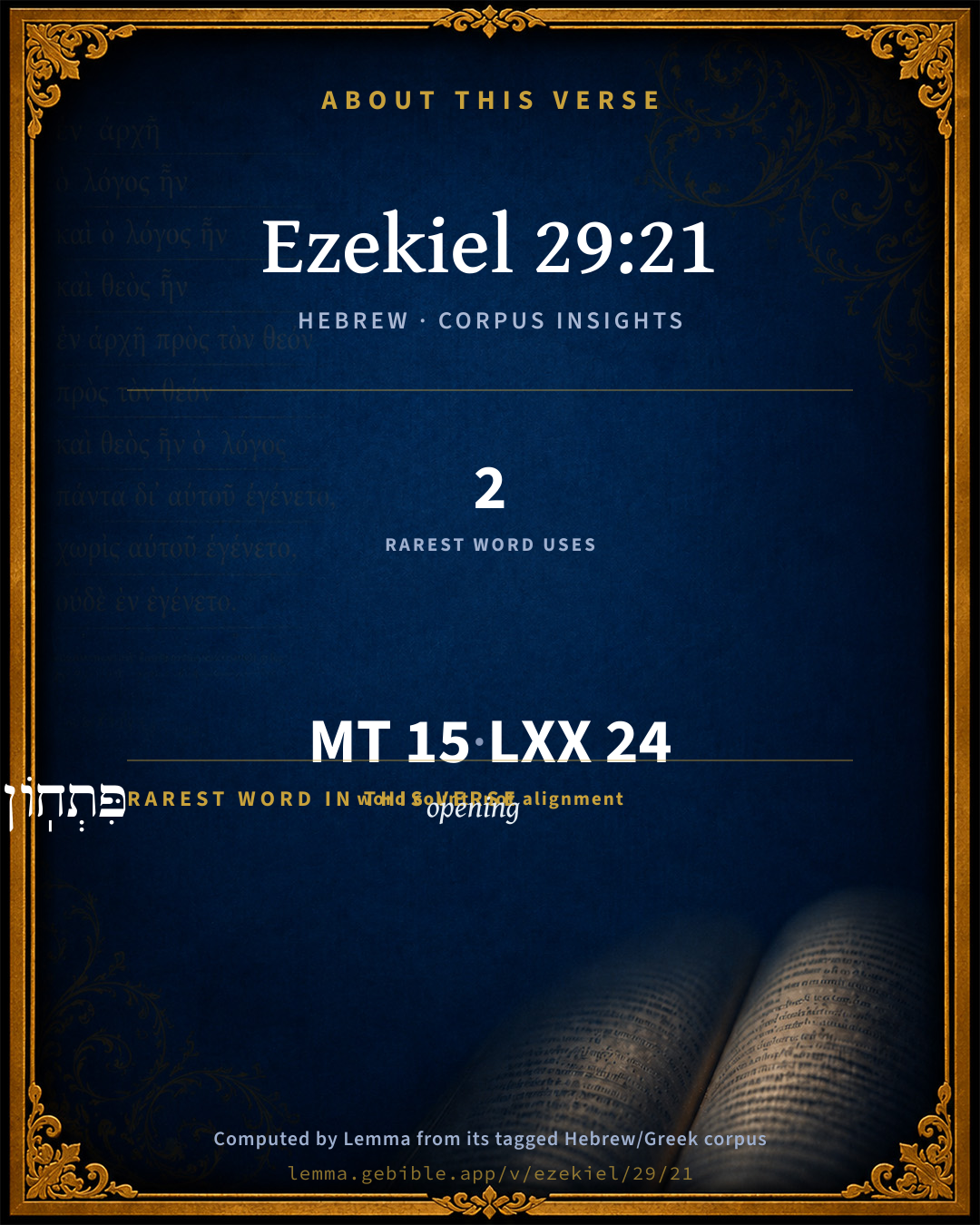
The rarest word here is פִּתְחֽוֹן opening H6610 — appearing just 2 times in the whole Hebrew Bible.

Shared distinctive vocabulary

פִּתְחֽוֹן opening H6610 occurs in 2 verses of the Hebrew Bible. Also found in:

Grammatical profile

  • 3 verbs
  • 8 nouns
  • 2 pronouns
  • 1 preposition
  • 1 conjunction

Verb forms

  • אַצְמִ֤יחַ Hiphil · Imperfect
  • אֶתֵּ֥ן Qal · Imperfect
  • וְיָדְע֖וּ Qal · Sequential Perfect

Hebrew & Septuagint length

In English translation the verse runs 39 words from the Hebrew and 36 from the Septuagint (LXX English) — closely comparable.

A rough comparison of the two English renderings, which tokenize alike — not a word-level alignment.

Word counts can differ between the Hebrew and the Greek without any difference in meaning — e.g. the Hebrew direct-object marker אֵת has no separate Greek word, and Greek often adds the article ὁ.

In the original languages it is 15 Hebrew tokens and 24 Greek tokens — but the two are counted differently (Hebrew bundles its prefixes and suffixes into one token; the Greek is in lemma form), so that isn’t a like-for-like length.

Cross-references

19

Topical passages linked to Ezekiel 29:21 in the Treasury of Scripture Knowledge — connected by theme and wording, ordered by reader-vote popularity; previews shown in the World English Bible.

  • 1 Samuel 2:10 Those who strive with Yahweh shall be broken to pieces; Against them will he thunder in the sky: Yahweh will judge the ends of the earth; He will give strength to his king, Exalt the horn of his anointed.
  • Psalms 132:17 There I will make the horn of David to bud. I have ordained a lamp for my anointed.
  • Luke 21:15 for I will give you a mouth and wisdom which all your adversaries will not be able to withstand or to contradict.
  • Amos 3:7–8 Surely the Lord Yahweh will do nothing, Unless he reveals his secret to his servants the prophets.
  • Psalms 92:10 But you have exalted my horn like that of the wild ox. I am anointed with fresh oil.
  • Ezekiel 24:27 In that day shall your mouth be opened to him who is escaped, and you shall speak, and be no more mute: so shall you be a sign to them; and they shall know that I am Yahweh.
  • Ezekiel 33:22 Now the hand of Yahweh had been on me in the evening, before he who was escaped came; and he had opened my mouth, until he came to me in the morning; and my mouth was opened, and I was no more mute.
  • Luke 1:69 And has raised up a horn of salvation for us in the house of his servant David
  • Psalms 51:15 Lord, open my lips. My mouth shall declare your praise.
  • Psalms 112:9 He has dispersed, he has given to the poor. His righteousness endures forever. His horn will be exalted with honor.
  • Psalms 148:14 He has lifted up the horn of his people, The praise of all his saints; Even of the children of Israel, a people near to him. Praise Yah!
  • Isaiah 27:6 In days to come shall Jacob take root; Israel shall blossom and bud; and they shall fill the surface of the world with fruit.
  • Jeremiah 23:5 Behold, the days come, says Yahweh, that I will raise to David a righteous Branch, and he shall reign as king and deal wisely, and shall execute justice and righteousness in the land.
  • Ezekiel 28:25–26 Thus says the Lord Yahweh: When I shall have gathered the house of Israel from the peoples among whom they are scattered, and shall be sanctified in them in the sight of the nations, then shall they dwell in their own land which I gave to my servant Jacob.
  • Ezekiel 29:6 All the inhabitants of Egypt shall know that I am Yahweh, because they have been a staff of reed to the house of Israel.
  • Ezekiel 29:9 The land of Egypt shall be a desolation and a waste; and they shall know that I am Yahweh. Because he has said, The river is mine, and I have made it;
  • Ezekiel 29:16 It shall be no more the confidence of the house of Israel, bringing iniquity to memory, when they turn to look after them: and they shall know that I am the Lord Yahweh.
  • Colossians 4:3–4 praying together for us also, that God may open to us a door for the word, to speak the mystery of Christ, for which I am also in bonds;
  • Ezekiel 3:26 and I will make your tongue cleave to the roof of your mouth, that you shall be mute, and shall not be to them a reprover; for they are a rebellious house.

Cross-references courtesy of OpenBible.info (CC BY 4.0).

Hebrew and Greek witnesses Masoretic Hebrew ↔ Greek Septuagint

The same verse in the two great witnesses to the Old Testament, shown verse-for-verse.

These are two independent witnesses, not word-aligned to each other, and the Septuagint is shown in lemma (dictionary) form.

Hebrew Ezekiel 29:21 Masoretic · Westminster Leningrad Codex

בַּיּ֣וֹם הַה֗וּא אַצְמִ֤יחַ קֶ֨רֶן֙ לְבֵ֣ית יִשְׂרָאֵ֔ל וּלְךָ֛ אֶתֵּ֥ן פִּתְחֽוֹן פֶּ֖ה בְּתוֹכָ֑ם וְיָדְע֖וּ כִּי אֲנִ֥י יְהוָֽה

In that day will I cause a horn to bud forth to the house of Israel, and I will give you the opening of the mouth in the midst of them; and they shall know that I am Yahweh.

World English Bible · Public Domain

Greek LXX Ezekiel 29:21 Septuagint · lemma form

ἐν ὁ ἡμέρα ἐκεῖνος ἀνατέλλω κέρας πᾶς ὁ οἶκος ἰσραήλ καί σύ δίδωμι στόμα ἀναοἴγω ἐν μέσος αὐτός καί γιγνώσκω ὅτι ἐγώ εἰμί κύριος

In that day shall a horn spring forth for all the house of Israel, and I will give you an open mouth in the midst of them; and they shall know that I am the Lord.

LXX2012 (modern English Septuagint) · Public Domain

Hebrew: Westminster Leningrad Codex (CC BY 4.0). Greek: Septuagint (public domain); English from LXX2012 (modern English Septuagint) (Public Domain). How the Septuagint differs from the Hebrew →

Targum (Aramaic paraphrase)

1

The Targum is the ancient Jewish Aramaic paraphrase of the Hebrew Scriptures — an interpretive translation, not the Hebrew text itself. Onkelos (literal) and Pseudo-Jonathan (expansive) render the Torah, and Jonathan the Prophets. Coverage is partial: where no permissively-licensed English translation exists for a verse, only the Aramaic is shown. This is verse-level text, not a word-by-word alignment to the Hebrew.

  1. Targum Jonathan Prophets (Joshua–Malachi)
    בְּיוֹמָא הַהוּא אַיְתֵי פוּרְקַן לְבֵית יִשְׂרָאֵל וְלָךְ אֶתֵּן מִפְתַּח פּוּמָא בִּנְבוּאָה בֵינֵיהוֹן וְיֵדְעוּן אֲרֵי אֲנָא יְיָ:

    (no public-domain English translation for this verse)

    Targum Jonathan — Aramaic: “Mikraot Gedolot” (public domain). English: “Sefaria Community Translation” (CC0 1.0 (public-domain dedication)); “London "Chaldee Paraphrase," 1871” (public domain). Text via Sefaria.

Commentary

Notes on Ezekiel 29:21 from classic Christian and Jewish commentators (each source and its license shown beneath its notes). The classic Christian expositions comment on the surrounding passage and are grouped to its opening verse, so a note may address several verses; the Jewish commentaries on the Tanakh (Rashi and others) are per-verse, so they appear only where the commentator wrote on this verse.

Lemma curates 59 commentaries, every one of them public domain or Creative Commons licensed, each selected and text-cleaned for this edition rather than reprinted as found. About our sources →

Trapp's Complete Commentary

John Trapp

Eze 29:21 In that day will I cause the horn of the house of Israel to bud forth, and I will give thee the opening of the mouth in the midst of them; and they shall know that I [am] the LORD.

Ver. 21. The horn,] i.e., The strength, power, and authority, in the kingdom of Christ especially. {Luk 1:69}

The opening.] Occasion to bless my name.

They shall know.] Nebuchadnezzar also, and his Babylonians.

John Trapp, A Commentary or Exposition upon All the Books of the Old and New Testament (1647–1656) — public domain. Text from a community e-Sword module.

Joseph Benson's Commentary

Eze 29:21. In that day — The phrase frequently denotes, in the prophets, not the same time which was last mentioned, but an extraordinary season, remarkable for some signal events of providence: in this sense it is to be understood here. I will cause the horn of the house of Israel to bud forth — The horns being the token of strength in beasts, and that in which their power chiefly consists; therefore the word is put to signify strength, or dominion, or a flourishing condition; and therefore to say, that the horn of Israel should bud forth, was as much as to say, that the Jewish nation should grow prosperous, and come to a flourishing condition again. This seems to be spoken of the return of the Jews from their captivity, and settling again in Judea. I will give thee the opening of the mouth in the midst of them — When thy prophecies are made good by the event, this shall add a new authority to what thou speakest: see Eze 24:27.

Joseph Benson's Commentary on the Old and New Testaments (1811–1818) — public domain. Text from a community e-Sword module.

Tyndale Open Study Notes

Tyndale Open Resources

29:21 Even in these oracles against the nations, God’s primary interest was in his own people. He would match the downward turn in Egypt’s fortunes by commensurately reviving Israel. • I will cause the ancient glory of Israel to revive: Literally I will cause a horn to sprout for the house of Israel. A horn was a common symbol of strength and dignity (see Ps 132:17, where “power” represents the same Hebrew word; cp. Dan 7:7-8; 8:3). This restoration of Israel’s glory would in turn validate Ezekiel’s status as a true prophet, and he would be respected as he deserved. As a prophet, Ezekiel had fought a hard campaign in the Lord’s service and had seen little public reward or recognition from his hearers. In the end, people would see that Ezekiel was indeed a true prophet, something that Nebuchadnezzar’s failure to conquer Tyre may have called into question.

Tyndale Open Study Notes — © Tyndale Open Resources, licensed CC BY-SA 4.0. Text via the HelloAO Bible API.

Jamieson, Fausset & Brown

Robert Jamieson, A. R. Fausset & David Brown

In the evil only, not in the good, was Egypt to be parallel to Israel. The very downfall of Egypt will be the signal for the rise of Israel, because of God's covenant with the latter.

I cause the horn of . . . Israel to bud-- (Psa 132:17). I will cause its ancient glory to revive: an earnest of Israel's full glory under Messiah, the son of David (Luk 1:69). Even in Babylon an earnest was given of this in Daniel (Dan 6:2) and Jeconiah (Jer 52:31).

I will give thee . . . opening of . . . mouth--When thy predictions shall have come to pass, thy words henceforth shall be more heeded (compare Eze 24:27).

Two distinct messages: (1) At Eze 30:1-9, a repetition of Eze. 29:1-16, with fuller details of lifelike distinctness. The date is probably not long after that mentioned in Eze 29:17, on the eve of Nebuchadnezzar's march against Egypt after subjugating Tyre. (2) A vision relating directly to Pharaoh and the overthrow of his kingdom; communicated at an earlier date, the seventh of the first month of the eleventh year. Not a year after the date in Eze 29:1, and three months before the taking of Jerusalem by Nebuchadnezzar.

Next: Ezekiel Chapter 30

Jamieson, Fausset & Brown — Commentary Critical and Explanatory on the Whole Bible (1871) — public domain (CC PDM 1.0). Text via the HelloAO Bible API.

Adam Clarke's Commentary

Verse 21. Will I cause the horn of the house of Israel to bud] This may refer generally to the restoration; but particularly to Zerubbabel, who became one of the leaders of the people from Babylon. Or it may respect Daniel, or Mordecai, or Jeconiah, who, about this time, was brought out of prison by Evil-merodach, and afterwards kindly treated.

Adam Clarke's Commentary on the Bible (1810–1826) — public domain. Text from a community e-Sword/MySword module.

Ellicott's Commentary for English Readers

(21) In that day.—The tenses here change to the future, indicating that if the conquest of Egypt had already taken place, its consequences to Israel were to be only gradually developed. These consequences were primarily the conviction of the futility of trust in any earthly aid, and hence a turning to their neglected God, and, as a result of this, the giving up of their long cherished idolatries. The prophet speaks of this as only in germ, but looking on to its further development, under the figure of making a horn to bud forth, that is, to sprout or grow. (Comp. Psa_132:17.) Israel’s reviving prosperity should date from the destruction of its trust in earthly aid.

The opening of the mouth.—This is elsewhere (Eze_24:27) promised to the prophet as a consequence of the fall of Jerusalem, of which he had heard (Eze_33:21-22) more than fourteen years before. There is no recorded prophecy of Ezekiel’s of later date; the expression must therefore be understood of those encouraging and helpful instructions of the prophet, as the people improved under the discipline of the captivity, which it was not seen fitting to put on permanent record.

A Bible Commentary for English Readers, edited by Charles John Ellicott (1878–1897) — public domain. Text from a community e-Sword module.

The Cambridge Bible for Schools and Colleges

gen. ed. J. J. S. Perowne

21. The passage concludes with a promise to Israel.

In that day] An indefinite term common in all the prophets. The ref. is to the general time when Neb. shall have humbled Egypt. After that shall the time of Israel’s prosperity come in. Cf. Isa_4:2; Isa_11:10; Isa_19:18-19.

the horn of the house] I will cause a horn to bud forth to the house of Israel. The “horn” is the symbol of power (Lam_4:3); with the budding of the horn power waxes or is exhibited. The ref. is general, to the restoration of Israel to prosperity and influence, hardly particularly to the raising up of the personal Messiah (Psa_132:17). On figure cf. 1Ki_22:11; Amo_6:13; Jer_48:25; 1Sa_2:1.

the opening] opening of. The prophet felt his mouth closed by the incredulity of the people, and the improbability, as it seemed to them, of his predictions. His mouth was opened and he had boldness of speech when his anticipations were verified. It is the causing of a horn to bud to Israel that will give the prophet opening of the mouth. All his prophecies since the exile had been prophecies of Israel’s restoration, and Israel’s restored felicity will fulfil them. The phrase give thee opening of the mouth means little more than give verification to thy words. The idea of the prophet’s own presence when this occurs is hardly to be pressed.

The Cambridge Bible for Schools and Colleges (gen. ed. J. J. S. Perowne; Cambridge University Press, 1878–1918) — public domain. Text from a community e-Sword module.

John Gill's Exposition

In that day will I cause the horn of the house of Israel to bud forth,.... Not at the time of Egypt's destruction, unless it can be thought that this refers to the advancement of Daniel in the court of Babylon; or to the taking of Jehoiachin out of prison, and setting his throne above the rest of the kings; which events came to pass a little after this: but rather this respects the time of Egypt's restoration forty years after, when Cyrus came to the throne, and proclaimed liberty to the Jews to return to their own land, and build their city and temple, under the government of Zerubbabel their prince: besides, it may not be limited to either of these times, but may regard the famous day, when the kingdom of Israel, in a spiritual sense, should flourish under the Messiah, the Horn of salvation, and Branch of David, often promised to bud forth, and was fulfilled in Jesus, Psa 132:17. The Targum is,

"in that day will I bring redemption to the house of Israel.''

And I will give thee the opening of the mouth in the midst of them; in prophecy among them, as the Targum; who after this, might deliver other prophecies, though we have no account of them; or he should have boldness and courage when he and they should see his prophecies fulfilled, by which it would appear that he was a true prophet of the Lord:

and they shall know that I am the Lord; who sent the prophet, and from whom he had these prophecies, and by whom they were fulfilled.

Next: Ezekiel Chapter 30

John Gill's Exposition of the Whole Bible (1746–1763) — public domain (CC PDM 1.0). Text via the HelloAO Bible API.

Haydock's Catholic Bible Commentary

Horn: Zorobabel; (St. Jerome) Jechonias, who was honoured by Evil-merodac; (Tirinus) or Daniel and Mardochai, with all the nation. --- Month. Thou shalt speak boldly, and they will give credit to thee henceforward. (Calmet)

George Leo Haydock (1774–1849), Haydock's Catholic Family Bible and Commentary, 1859 edition — public domain. Excludes Psalms (Douay-Rheims chapter numbering differs from Protestant) and Deuterocanonical books (Catholic canon only).

Matthew Poole's English Annotations

In that day; about that time, when Egypt was spoiled, Nebuchadnezzar returned to Babylon, his wars first, and soon after his life, ended, about four or five years after his return out of Egypt into Babylon; for about the thirty-seventh or thirty-eighth of his reign he finished his conquest of Egypt, and in the forty-third year he died at Babylon.

The horn; Jehoiachin by Evil-merodach was advanced, Jer 52:31-33; beside dignities given to Daniel, the three children, and many others, under whose authority and favour the affairs of the Jews began, as a root that hath life in it, to spring and flourish; and whatever was the more immediate visible cause that prevailed with Evil-merodach, we are sure the principal cause was this, God’s mercy and veracity, who had promised he would do it, and foretold the time when he would begin to do it.

The opening of the mouth; thou shalt with greater authority be heard speaking, when the sorrows thou foretoldest, and the joys thou promisedst, both come to pass; and both Jews and Babylonians shall see and own it; or, thou shalt have liberty and freedom, as well as will and cause to speak, to open thy mouth in comforting the good among them, and to give praise to God, who revived their hopes, and made them know him as the Lord their God.

Matthew Poole's English Annotations on the Holy Bible (1683–1685) — public domain. Text from a community e-Sword/MySword module.

Whedon's Commentary on the Bible

Daniel D. Whedon

21. The horn of the house of Israel to bud — R.V., “an horn to bud forth unto the house of Israel.” The horn is the symbol of power (Psa_132:17; Lam_2:3). Israel’s power, which had seemed utterly broken, is to spring up again, and when the people shall see this verification of prophecy they will be glad to have Ezekiel again open his mouth and teach. (Compare Eze_24:27.)

Daniel D. Whedon (gen. ed.), Commentary on the Old and New Testaments (1874–1909) — public domain. Text from a community e-Sword module.

The Pulpit Commentary

The horn of the house of Israel. The "horn" is, as always (1Sa_2:1; Psa_92:10 Psa_112:9 Psa_132:17) the symbol of power. Jeremiah"s use of it (Lam_2:3) may well have been present to Ezekiel"s thoughts. That horn had been cut off, but it should begin to sprout again, and the prophet himself should resume his work as the teacher of his people, which had apparently been suspended for many years after the closing vision of the restoration of the temple and of Israel. The words justify the conclusion that Ezekiel resumed his labors after B.C. 572. Was he watching the growth of Saiathiel or Zerubbabel?

The budding horn.

We are not to think of a full-grown horn putting forth buds, like Aaron"s rod in this case a useless monstrosity of growth. The idea is that of a young horn first appearing as in a bud and then growing. A horn is to bud and grow on the house of Israel.

I THE PROMISE.

1. In the nature of the horn. This signifies three things.

(1) Strength. The horn is a symbol of strength. God promises an end of weakness, a time of power and energy.

(2) Defense. The horn is a weapon, and by means of it its possessor wards off attack. The people of God have been harassed and oppressed. But this time of helplessness is to be succeeded by one of security.

(3) Glory. The horn is an ornament. The stag"s antler is the animal"s pride and beauty. Women wore horns as part of their head-attire. The exalted (Psa_112:9) stands for the raising up of honor and dignity.

2. In the growth of the horn. It buds:

(1) With a small beginning. The budding horn is at first only discovered as a slight swelling on the head of the animal from which it grows. The best things begin in a small way the obscure spring of the great river, the grain of mustard seed, the little child, the Christian experience.

(2) With continuous advance. The horn buds, pushes forward, develops into maturity. The best things are living and growing. They cannot remain in a stationary condition. The type to be followed is not the fossil horn in the museum, but the budding horn on the living head. All things of worth have a future towards which they press onward.

II THE FULFILMENT.

1. In Israel. A horn budded on the head of the restored Israel. From the doleful captivity by the waters of Babylon the Jews returned to their own land. At first they were but a small and feeble folk like the first appearance of the horn. But the horn was present in the bud. Israel was alive and growing, and she had yet a great destiny before her.

2. In Christ. Christ appeared like a horn growing out of Israel. He came as

1. the strength,

2. the defense, and

3. the glory of Israel.

He was born an infant in a lowly condition. Elsewhere he is compared to a sprout from the stem of Jesse. (Isa_11:1) Christ was a Jew, and hegrew up quietly in the Jewish nation. His beginning was humble; but his complete life is beyond all description in its greatness and glory. All the hope of the future is with him.

3. In the Church. Christ lives in his people. He is born again in his Church, and he grows again in the growth of this his new, mystical body. Thus on the weary, faded world there is seen to grow a new and surprising life. The Christian Church came in strength and promise as a horn of salvation to the old world. It is still a growing horn. All Christians may enjoy its great advantages, and all men may be Christians. Thus there is for all the threefold promise of the budding horn its strength, its defense, and its glory. No man enjoys these privileges to the full at first. The horn appears as a bud. The Christian life begins in lowly spheres. But it grows like Israel"s horn.

Speech, silence, and prophecy.

will give thee the opening, of the mouth." We may be led up to the proper subject of the text by reference to

I THE GIFT OF SPEECH. We wonder how animals succeed in communicating with one another; that they are supplied with some method of making known and passing on is unquestionable. But whatever their means may be, they fall very short of the great gift of speech which it is our priceless advantage to possess. So common and so familiar has it become, that we little heed its value or the goodness of God in bestowing it. But when we dwell in thought upon all the difference it has made to human life, and the extent to which it has enriched us, we may well bless God with fervent feeling that he has given to our race "the opening of the mouth" in speech and in song. How has it multiplied our power to instruct and enlighten, to warn and save, to comfort and to heal, to cheer and to gladden, to pray and to praise and to exhort, to prepare for all the duty and the burden of life, to make ready for the brighter scenes and ampler spheres of immortality! And as this is so,

(1) how carefully should we guard, how earnestly pray, how seriously admonish, against its abuse!

(2) how studious should we be to make the best and wisest use of this inestimable gift of God.

II THE GRACE OF SILENCE. If there is a great value in "the opening of the mouth," so also is there much virtue in keeping it closed when "only silence suiteth best." To spare the stinging but severe retort that rises to the lips; to delay the accusation until more knowledge has been gained; to bear without rebuke the sound that tries our nerves, but is the delight of others; to refuse to pass on the unproved default; to refrain from the commonplaces of comfort in presence of some fresh, acute, overwhelming sorrow; to wait our time and. our turn until others have spoken who should, precede us, or until we have earned the right to speak; to "be dumb, to open not our mouth".under the chastening hand of God, and to retire into the sanctuary of the inner chamber that we may think and understand; this is a true "grace," which they who seek the best in human character and life will not fail to desire and to pursue.

III THE PRIVILEGE OF PROPHECY. No nobler order of men ever rose and wrought than the Hebrew prophets. They were "men that spoke for God" as their name indicates they should have been. And they" opened their mouth" fearlessly, faithfully, even heroically. They were to be found in the front when there was unpalatable truth to be spoken, uninviting duty to be done, serious danger to be dared. They did not shrink from speaking the straightforward truth to the people, the army, the sovereign. The Lord "before whom they stood," and in whose near presence they felt that they were safe, gave them the wisdom to speak and the courage to act. He "gave them the opening of the mouth;" and hence these strong, brave, searching, sometimes scathing, sometimes cheering words, which we still read in our homes and in our sanctuaries, which still help to form our character and to shape our life. Their true successors are found in those Christian ministers, and in those who do not call themselves by that name, who "speak for God," and who do speak for him because, like their prototypes, they

(1) are enriched by him with knowledge and insight under-standing of his will and insight into the nature and character of their fellowmen;

(2) are endowed by him with the power of utterance such utterance as constrains attention and secures reflection and emotion;

(3) are impressed, if not oppressed, with an inextinguishable impulse to speak what they have learned of God C. (Jer_20:9; Psa_39:3; Act_4:20; 1Co_9:16)

The Pulpit Commentary (1880–1919), ed. H.D.M. Spence-Jones & Joseph S. Exell — public domain. Text from a community e-Sword module.

John Wesley's Explanatory Notes

The horn - Jehoiakim, who was then advanced by Evil- Merodach. The opening of the mouth - Thou shalt have liberty, to open thy mouth in comforting the good among them, and to give praise to God.

John Wesley, Explanatory Notes Upon the Whole Bible (1754–1765) — public domain. Text via the GEBible commentary corpus.

unfoldingWord translationNotes

Door43 World Missions Community

I will make a horn sprout up for the house of Israel

An animal horn represents the animal's strength, so horn is a metonym for strength. God speaks of making Israel strong as if Israel were an animal, and he were to cause its horn to grow. AT: "I will make the people of Israel strong" (See: Metonymy and Metaphor)

the house of Israel

The word "house" is a metonym for the family that lives in the house. Here it refers to the people of Israel, the descendants of Jacob whom God called Israel. AT: "the people of Israel" or "the nation of Israel" (See: Metonymy)

speak in their midst

"speak to them"

translationWords

know

Yahweh

unfoldingWord translationNotes — © Distant Shores Media and the Door43 World Missions Community, licensed CC BY-SA 4.0. Source: git.door43.org/Door43/en_tn.

Rashi

Rabbi Shlomo Yitzchaki (Rashi)

On that day will I cause the horn of the House of Israel to blossom out I have neither heard nor found the explanation of this verse. What is the blossoming of the horn of Israel in the downfall of Egypt? Was not Israel exiled eight years before the downfall of Egypt? [Therefore,] I say that “On that day” refers back to the above section, (verse 13): “At the end of forty years, I will gather the Egyptians.” That count ends in the year that Belshazzar assumed the throne, and we find in Daniel that in that year the kings of Persia began to gain strength, and downfall was decreed upon Babylon, as it is said (Dan. 7:1): “In the first year of Belshazzar,...Daniel saw a dream, etc.”; (verse 4) “The first one was like a lion” - that is Babylon. And it is written (ad loc.): “I saw until its wings were plucked off, etc. (verse 5) And behold another, second beast, resembling a bear” that is Persia. And it is written (ad loc.) “And thus it was said to it, ‘Devour much flesh.’” i.e., seize the kingdom. And the kingdom of Persia was the blossoming of the horn of Israel, as it is said regarding Cyrus (Isa. 45:13): “He shall build My city and free My exiles.” Now, how do we know that the forty years of Egypt ended at that time? [The proof is that] Egypt was given into the hands of Nebuchadnezzar in the twenty-seventh [year] of Nebuchadnezzar, in the year that this prophecy was said to Ezekiel. Add forty years, and you have sixty-seven. Deduct from them forty-five for Nebuchadnezzar and twenty-three for Evil- Merodach, as we say in Megillah (11b), one of these years counting for both [kings], as we say there: “they were incomplete years.”

and I will give you free speech in their midst You, Ezekiel, will have free speech when they see your prophecy being fulfilled.

Rashi on the Tanakh — English translations: “The Judaica Press complete Tanach with Rashi, translated by A. J. Rosenberg” (CC BY 4.0); “Pentateuch with Rashi's commentary by M. Rosenbaum and A.M. Silbermann, 1929-1934” (public domain); “The Metsudah Tanach series, Lakewood, N.J” (CC BY 4.0); and “The Book of Joshua, Metsudah Publications, 1997” (CC BY 4.0). Text via Sefaria.

Lesson kit

Teaching starters — assembled from the data on this page, not authored interpretation. Every prompt links to the verse data it draws on. Edit before teaching.

Ezekiel, in the Prophets, opens this verse with 15 words (14 distinct Hebrew lemmas). Its most distinctive word is pithchôwn (“opening”). A historical commentator’s framing appears above. Read the whole chapter for the surrounding context.

Discussion questions

  1. The word pithchôwn carries the sense “opening.” How does it shape the verse?
  2. How does Ezekiel 16:63, which shares the word «opening», read alongside this verse?
  3. The translations on this page render this verse differently — a whole-verse word diff, not a word-by-word alignment. What might account for the different wordings?
  4. «אַצְמִ֤יחַ» is a Hiphil Imperfect verb. How does that grammatical form shape the action described?
  5. Compare how Trapp's Complete Commentary and Joseph Benson's Commentary read this verse. Where do they agree or differ?

Things to notice

Reading settings

Reading text

Shown beneath each verse's original-language words.

Old Testament
Old Testament edition

Read the OT as the Masoretic Hebrew (MT) or the Greek Septuagint (LXX).

English shown for the Greek Septuagint (in the Hebrew ↔ Greek comparison).

Comparing translations? Open the Compare panel on any verse page to stack up to four side by side.