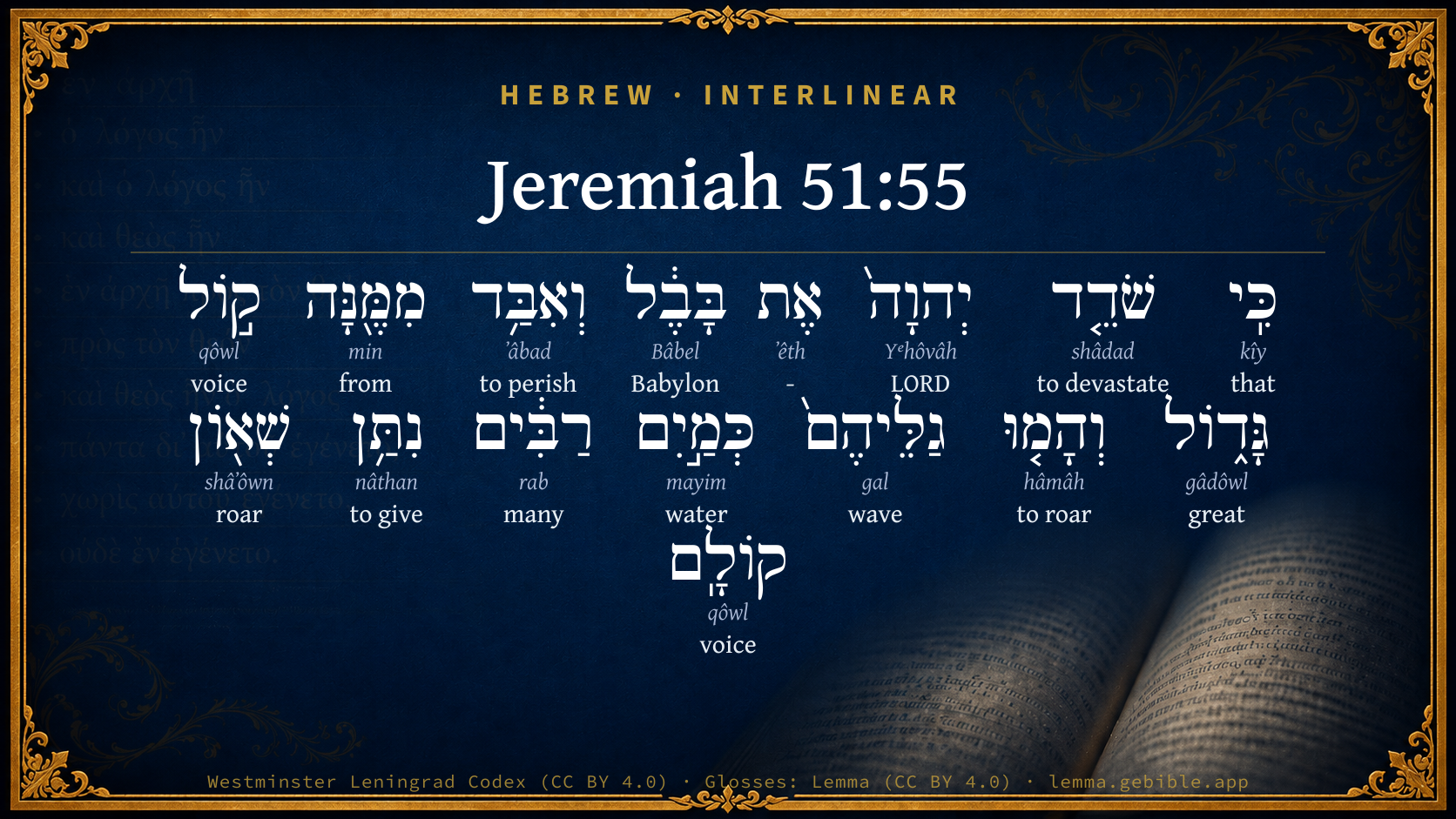
Jeremiah 51:55

Hebrew (Westminster Leningrad Codex) Jeremiah 51:55 appears in the Hebrew Old Testament. The text above is from the Westminster Leningrad Codex. Each word links to its Strong’s number, a concise gloss, and parsing drawn from the Open Scriptures Hebrew Bible morphology. Click any word for its full Brown-Driver-Briggs (BDB) entry.
Download image
Cite this verse

Jeremiah 51:55 (World English Bible). Public Domain. Lemma interlinear Bible study tool, https://lemma.gebible.app/v/jeremiah/51/55.

Show BibTeX & RIS
BibTeX
RIS
English Translation
For Yahweh lays Babylon waste, and destroys out of her the great voice; and their waves roar like many waters; the noise of their voice is uttered:
World English Bible · Public Domain
Download a study sheet

One document with this verse’s original text, its word-by-word gloss line, the meaning frame, cross-references with their text, attributed commentary, and full source and license credits — printable, and it pastes into notes with its structure intact.

This verse Autodidact and up

Study sheet (.html) Plain text (.txt)

A passage Seminary Student

Up to 50 verses in one chapter. A passage sheet keeps up to 6 commentary sources and 12 cross-references per verse, in the order this page ranks them, and says so on the sheet whenever that leaves anything out. Ask for a single verse and you get the Autodidact verse sheet above.

Everything on this page stays free to read, with no account — the sheet is a download of what is already on screen, not access to it.

Want to remove ads? Support Godless Engineer
Compare translations 3

The same verse in 3 English versions, stacked beneath the original-language interlinear above. Click any original word for its lexicon entry.

Each is an independent rendering of the whole verse — the interlinear is not word-aligned to these translations.

Highlighted words mark where these versions differ — a whole-verse word diff, not a word-by-word alignment.

  • World English Bible Public Domain
    For Yahweh lays Babylon waste, and destroys out of her the great voice; and their waves roar like many waters; the noise of their voice is uttered:
  • King James Version Public Domain
    Because the LORD hath spoiled Babylon, and destroyed out of her the great voice; when her waves do roar like great waters, a noise of their voice is uttered:
  • unfoldingWord Literal Text CC BY-SA 4.0
    For Yahweh is destroying Babylon. He is causing her loud voice to perish. Their enemies roar like the waves of many waters; their noise becomes very strong.

unfoldingWord Literal Text — © unfoldingWord, licensed CC BY-SA 4.0. Word-aligned USFM3 via Door43 (git.door43.org/unfoldingWord/en_ult).

Versions to compare (up to 4)

3 of 4 selected

Show all 18 translations

Every available English version of this verse, each an independent rendering of the whole verse.

  • World English Bible Public Domain
    For Yahweh lays Babylon waste, and destroys out of her the great voice; and their waves roar like many waters; the noise of their voice is uttered:
  • Berean Standard Bible Public Domain
    For the LORD will destroy Babylon; He will silence her mighty voice. The waves will roar like great waters; the tumult of their voices will resound.
  • Majority Standard Bible Public Domain
    For the LORD will destroy Babylon; He will silence her mighty voice. The waves will roar like great waters; the tumult of their voices will resound.
  • King James Version Public Domain
    Because the LORD hath spoiled Babylon, and destroyed out of her the great voice; when her waves do roar like great waters, a noise of their voice is uttered:
  • American Standard Version (1901) Public Domain
    For Jehovah layeth Babylon waste, and destroyeth out of her the great voice; and their waves roar like many waters; the noise of their voice is uttered:
  • Revised Version (1885) Public Domain
    For the LORD spoileth Babylon, and destroyeth out of her the great voice; and their waves roar like many waters, the noise of their voice is uttered:
  • Geneva Bible (1599) Public Domain
    Because the Lord hath layde Babel waste and destroyed from her the great voyce, and her waues shall roare like great waters, and a sounde was made by their noyse:
  • Douay-Rheims (1899) Public Domain
    Because the Lord hath laid Babylon waste, and destroyed out of her the great voice: and their wave shall roar like many waters: their voice hath made a noise:
  • Young's Literal Translation Public Domain
    For Jehovah is spoiling Babylon, And hath destroyed out of it a great voice, And sounded have its billows as many waters, Given forth a noise hath their voice.
  • Literal Standard Version CC BY-SA 4.0
    For YHWH is spoiling Babylon, || And has destroyed her great voice, || And her billows have sounded as many waters, || Their voice has given forth a noise.
  • Unlocked Literal Bible CC BY-SA 4.0
    For Yahweh is destroying Babylon. He is causing her loud voice to perish. Their enemies roar like the waves of many waters; their noise becomes very strong.
  • unfoldingWord Literal Text CC BY-SA 4.0
    For Yahweh is destroying Babylon. He is causing her loud voice to perish. Their enemies roar like the waves of many waters; their noise becomes very strong.
  • Darby Bible Public Domain
    for Jehovah spoileth Babylon, and he will destroy out of her the great voice; and their waves roar like great waters, the noise of their voice resoundeth.
  • World Messianic Bible Public Domain
    For the LORD lays Babylon waste, and destroys out of her the great voice! Their waves roar like many waters. The noise of their voice is uttered.
  • Webster's Bible Public Domain
    Because the LORD hath laid waste Babylon, and destroyed out of her the great voice; when her waves roar like great waters, a noise of their voice is uttered:
  • Free Bible Version CC BY-SA 4.0
    For the Lord is going to destroy Babylon; he will put an end to her boastful talk. The waves of attacking army will roar like the crashing sea; the noise of their shouts will echo all around.
  • Bible in Basic English Public Domain
    For the Lord is making Babylon waste, and putting an end to the great voice coming out of her; and her waves are thundering like great waters, their voice is sounding loud:
  • JPS Tanakh (1917) Public Domain
    For the LORD spoileth Babylon, and destroyeth out of her the great voice; and their waves roar like many waters, the noise of their voice is uttered;

Literal Standard Version (2020), Covenant Press — licensed CC BY-SA 4.0. Text via the HelloAO Bible API (eBible.org). Unlocked Literal Bible (unfoldingWord) — licensed CC BY-SA 4.0. Text via the HelloAO Bible API (eBible.org). unfoldingWord Literal Text — © unfoldingWord, licensed CC BY-SA 4.0. Word-aligned USFM3 via Door43 (git.door43.org/unfoldingWord/en_ult). Free Bible Version, Dr. Jonathan Gallagher — licensed CC BY-SA 4.0. Text via the HelloAO Bible API (eBible.org).

Word by word

More ways to search: Search by grammar → Find every occurrence → Compare this word →

Practice this passage: Drill this verse → Learn its vocabulary →

שְׁא֖וֹן
shâʼôwn
H7588
“roar of”
Noun, Common, Masculine, Singular, Construct
Part of Speech
Noun
Type
Common
Gender
Masculine
Number
Singular
State
Construct
Full BDB Definition

Origin: from H7582

TWOT: 2301c

roar, din, crash, uproar - roar (of water) - uproar (of revellers)
  1. כִּֽי kîy H3588 “that” Conjunction
  2. שֹׁדֵ֤ד shâdad H7703 “devastating” Verb, Qal, Participle Active, Masculine, Singular, Absolute
  3. יְהוָה֙ Yᵉhôvâh H3068 “LORD” Noun, Proper
  4. אֶת ʼêth H853 “-” Particle, Direct Object
  5. בָּבֶ֔ל Bâbel H894 “Babylon” Noun, Proper
  6. וְאִבַּ֥ד ʼâbad H6 “and · to perish” Conjunction + Verb, Piel, Sequential Perfect, 3rd Person, Masculine, Singular
  7. מִמֶּ֖נָּה min H4480 “from · her” Preposition + Suffix, Personal, 3rd Person, Feminine, Singular
  8. ק֣וֹל qôwl H6963 “voice” Noun, Common, Masculine, Singular, Absolute
  9. גָּד֑וֹל gâdôwl H1419 “great” Adjective, Adjective, Masculine, Singular, Absolute
  10. וְהָמ֤וּ hâmâh H1993 “and · to roar” Conjunction + Verb, Qal, Sequential Perfect, 3rd Person, Common, Plural
  11. גַלֵּיהֶם֙ gal H1530 “waves · their” Noun, Common, Masculine, Plural, Construct + Suffix, Personal, 3rd Person, Masculine, Plural
  12. כְּמַ֣יִם mayim H4325 “like/as · water(s)” Preposition + Noun, Common, Masculine, Plural, Absolute
  13. רַבִּ֔ים rab H7227 “many” Adjective, Adjective, Masculine, Plural, Absolute
  14. נִתַּ֥ן nâthan H5414 “to give” Verb, Niphal, Perfect, 3rd Person, Masculine, Singular
  15. קוֹלָֽם qôwl H6963 “voice · their” Noun, Common, Masculine, Singular, Construct + Suffix, Personal, 3rd Person, Masculine, Plural

About this verse

These counts appear in no published source. They are computed here, from the morphology-tagged text and Lemma’s own curated glosses. What Lemma adds →

16
words
15
distinct lemmas
Prophets
section

Notable vocabulary

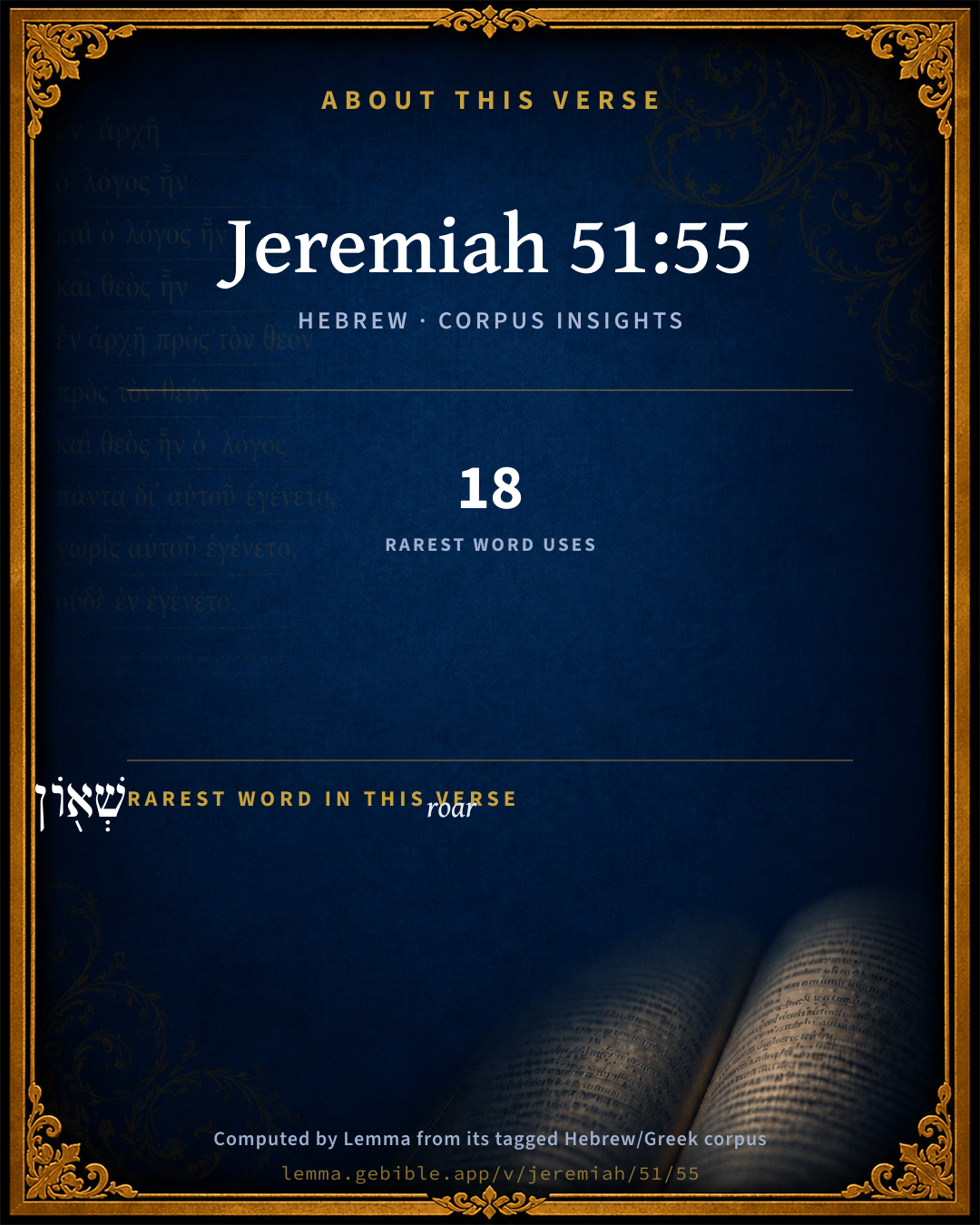
The rarest word here is שְׁא֖וֹן roar H7588 — appearing just 18 times in the whole Hebrew Bible.

Shared distinctive vocabulary

שְׁא֖וֹן roar H7588 occurs in 16 verses of the Hebrew Bible. Also found in:

Grammatical profile

  • 4 verbs
  • 7 nouns
  • 2 adjectives
  • 1 preposition
  • 1 conjunction
  • 1 particle

Verb forms

  • שֹׁדֵ֤ד Qal · Participle Active
  • וְאִבַּ֥ד Piel · Sequential Perfect
  • וְהָמ֤וּ Qal · Sequential Perfect
  • נִתַּ֥ן Niphal · Perfect

Repetition

A word recurs within this verse — often emphatic in Hebrew:

  • ק֣וֹל voice H6963 ×2

Cross-references

15

Topical passages linked to Jeremiah 51:55 in the Treasury of Scripture Knowledge — connected by theme and wording, ordered by reader-vote popularity; previews shown in the World English Bible.

  • Jeremiah 25:10 Moreover I will take from them the voice of mirth and the voice of gladness, the voice of the bridegroom and the voice of the bride, the sound of the millstones, and the light of the lamp.
  • Psalms 18:4 The cords of death surrounded me. The floods of ungodliness made me afraid.
  • Psalms 65:7 Who stills the roaring of the seas, The roaring of their waves, And the turmoil of the nations.
  • Psalms 93:3–4 The floods have lifted up, Yahweh, The floods have lifted up their voice. The floods lift up their waves.
  • Isaiah 15:1 The burden of Moab. For in a night Ar of Moab is laid waste, [and] brought to nothing; for in a night Kir of Moab is laid waste, [and] brought to nothing.
  • Isaiah 17:13 The nations shall rush like the rushing of many waters: but he shall rebuke them, and they shall flee far off, and shall be chased as the chaff of the mountains before the wind, and like the whirling dust before the storm.
  • Isaiah 24:8–11 The mirth of tambourines ceases, the noise of those who rejoice ends, the joy of the harp ceases.
  • Isaiah 47:5 Sit you silent, and get you into darkness, daughter of the Chaldeans; for you shall no more be called The mistress of kingdoms.
  • Jeremiah 50:10–15 Chaldea shall be a prey: all who prey on her shall be satisfied, says Yahweh.
  • Jeremiah 51:38–39 They shall roar together like young lions; they shall growl as lions' cubs.
  • Jeremiah 51:42 The sea is come up on Babylon; she is covered with the multitude of the waves of it.
  • Ezekiel 26:3 therefore thus says the Lord Yahweh, Behold, I am against you, Tyre, and will cause many nations to come up against you, as the sea causes its waves to come up.
  • Luke 21:25 There will be signs in the sun, moon, and stars; and on the earth anxiety of nations, in perplexity for the roaring of the sea and the waves;
  • Revelation 17:15 He said to me, "The waters which you saw, where the prostitute sits, are peoples, multitudes, nations, and languages.
  • Revelation 18:22–23 The voice of harpists, minstrels, flute players, and trumpeters will be heard no more at all in you. No craftsman, of whatever craft, will be found any more at all in you. The sound of a mill will be heard no more at all in you.

Cross-references courtesy of OpenBible.info (CC BY 4.0).

Hebrew and Greek witnesses Masoretic Hebrew ↔ Greek Septuagint

The same verse in the two great witnesses to the Old Testament, shown verse-for-verse.

These are two independent witnesses, not word-aligned to each other, and the Septuagint is shown in lemma (dictionary) form.

Hebrew Jeremiah 51:55 Masoretic · Westminster Leningrad Codex

כִּֽי שֹׁדֵ֤ד יְהוָה֙ אֶת בָּבֶ֔ל וְאִבַּ֥ד מִמֶּ֖נָּה ק֣וֹל גָּד֑וֹל וְהָמ֤וּ גַלֵּיהֶם֙ כְּמַ֣יִם רַבִּ֔ים נִתַּ֥ן שְׁא֖וֹן קוֹלָֽם

For Yahweh lays Babylon waste, and destroys out of her the great voice; and their waves roar like many waters; the noise of their voice is uttered:

World English Bible · Public Domain

Greek LXX Structure differs

In the Septuagint, Jeremiah is about an eighth shorter than the Hebrew and arranges its material differently — the Oracles Against the Nations (Hebrew chapters 46–51) appear in the middle of the Greek book, after 25:13. Because the chapter and verse boundaries do not line up, a verse-for-verse comparison with the Hebrew is not shown.

A verse-for-verse comparison isn’t shown here because the chapters and verses don’t line up. Switch to the LXX edition with the MT / LXX toggle above to read the Greek directly.

Hebrew: Westminster Leningrad Codex (CC BY 4.0). Greek: Septuagint (public domain); English from a public-domain English Septuagint. How the Septuagint differs from the Hebrew →

Targum (Aramaic paraphrase)

1

The Targum is the ancient Jewish Aramaic paraphrase of the Hebrew Scriptures — an interpretive translation, not the Hebrew text itself. Onkelos (literal) and Pseudo-Jonathan (expansive) render the Torah, and Jonathan the Prophets. Coverage is partial: where no permissively-licensed English translation exists for a verse, only the Aramaic is shown. This is verse-level text, not a word-by-word alignment to the Hebrew.

  1. Targum Jonathan Prophets (Joshua–Malachi)
    אֲרֵי אַבֵּיז יְיָ יַת בָּבֶל וְאַבֵיד מִנָהּ מַשִׁרְיָן סַגִיאִין וְיִתְכַּנְשׁוּן עֲלֵיהוֹן מַשִׁרְיַת עַמְמִין סַגִיאִין וִירִימוּן בְּאִתְרְגוּשַׁת קָלְהוֹן:

    (no public-domain English translation for this verse)

    Targum Jonathan — Aramaic: “Mikraot Gedolot” (public domain). English: “Sefaria Community Translation” (CC0 1.0 (public-domain dedication)); “London "Chaldee Paraphrase," 1871” (public domain). Text via Sefaria.

Commentary

Notes on Jeremiah 51:55 from classic Christian and Jewish commentators (each source and its license shown beneath its notes). The classic Christian expositions comment on the surrounding passage and are grouped to its opening verse, so a note may address several verses; the Jewish commentaries on the Tanakh (Rashi and others) are per-verse, so they appear only where the commentator wrote on this verse.

Lemma curates 59 commentaries, every one of them public domain or Creative Commons licensed, each selected and text-cleaned for this edition rather than reprinted as found. About our sources →

Trapp's Complete Commentary

John Trapp

Jer 51:55 Because the LORD hath spoiled Babylon, and destroyed out of her the great voice; when her waves do roar like great waters, a noise of their voice is uttered:

Ver. 55. Because the Lord hath spoiled Babylon.] Heb., Is spoiling. For it was long in doing; but as sure as if done together, and at once. In like sort many of the promises are not to have their full accomplishment till the end of the world; as those about the full deliverance of the godly, the destruction of the wicked, the confusion of Antichrist, &c.

And destroyed out of her the great voice.] Of the revellers and roaring boys; or of their enemies, as some rather sense it, breaking in upon them.

John Trapp, A Commentary or Exposition upon All the Books of the Old and New Testament (1647–1656) — public domain. Text from a community e-Sword module.

Joseph Benson's Commentary

Jer 51:55-57. Because the Lord hath spoiled Babylon, and destroyed out of her the great voice — “When cities are populous, they are of course noisy: see Isa 22:2. Silence is therefore a mark of depopulation; and in this sense we are to understand God’s destroying, or taking away out of Babylon, the great noise, which, during the time of her prosperity, was constantly heard there, ‘the busy hum of men,’ as the poet very expressly calls it. In this manner the mystical Babylon is threatened, Rev 18:22-23. Compare Jer 7:34; Jer 16:9; Jer 25:10.” — Blaney. Every one of their bows is broken — Their strength is quite broken, and they cannot defend themselves, or hurt their enemies. I will make drunk her princes and her wise men, &c. — I will permit her princes, her commanders, and directors to be intoxicated, so that they shall neglect what should be done for their defence, and thereby be slain.

Joseph Benson's Commentary on the Old and New Testaments (1811–1818) — public domain. Text from a community e-Sword module.

Tyndale Open Study Notes

Tyndale Open Resources

51:55-56 The destruction of Babylon was not a historical accident—the Lord was in control and would bring it to pass. • The noise (51:54) would dissolve into the silence of death. The invading army would kill or capture the Babylonian soldiers, and the population would flee into the countryside.

Tyndale Open Study Notes — © Tyndale Open Resources, licensed CC BY-SA 4.0. Text via the HelloAO Bible API.

Jamieson, Fausset & Brown

Robert Jamieson, A. R. Fausset & David Brown

great voice--Where once was the great din of a mighty city. there shall be the silence of death [VATABLUS]. Or, the "great voice" of the revellers (Jer 51:38-39; Isa 22:2). Or, the voice of mighty boasting [CALVIN], (compare Jer 51:53).

her waves--"when" her calamities shall cause her to give forth a widely different "voice," even such a one as the waves give that lash the shores (Jer 51:42) [GROTIUS]. Or, "when" is connected thus: "the great voice" in her, when her "waves," &c. (compare Jer 51:13). CALVIN translates, "their waves," that is, the Medes bursting on her as impetuous waves; so Jer 51:42. But the parallel, "a great voice," belongs to her, therefore the wave-like "roar" of "their voice" ought also belong to her (compare Jer 51:54). The "great voice" of commercial din, boasting, and feasting, is "destroyed"; but in its stead there is the wave-like roar of her voice in her "destruction" (Jer 51:54).

Jamieson, Fausset & Brown — Commentary Critical and Explanatory on the Whole Bible (1871) — public domain (CC PDM 1.0). Text via the HelloAO Bible API.

Adam Clarke's Commentary

Verse 55. The great voice] Its pride and insufferable boasting.

Adam Clarke's Commentary on the Bible (1810–1826) — public domain. Text from a community e-Sword/MySword module.

John Calvin's Commentaries

The reason for the crashing is now added, even because God had resolved to lay waste Babylon, and to reduce it to nothing. Jeremiah again calls the faithful to consider the power of God. He then says, that it would not be a work done by men, because God would put forth his great power, which cannot be comprehended by human minds. He then sets the name of God in opposition to all creatures, as though he had said, that what exceeds all the efforts of men, would yet be easily done by God. He, indeed, represents God here as before our eyes, and says that Babylon would perish, but that it was God who would lay it waste. He thus sets forth God here as already armed for the purpose of cutting off Babylon. And he will destroy from her the magnificent voice, that is, her immoderate boasting.

What follows is explained by many otherwise than I can approve; for they say that the waves made a noise among the Babylonians at the time when the city was populous; for where there is a great concourse of men, a great noise is heard, but solitude and desolation bring silence. They thus, then, explain the words of the Prophet, that though now waves, that is, noises, resounded in Babylon like great waters, and the sound of their voice went forth, yet God would destroy their great or magnificent voice. But I have no doubt but that what the Prophet meant by their great voice, was their grandiloquent boasting in which the Babylonians indulged during their prosperity. While, then, the monarchy flourished, they spoke as from the height. Their silence from fear and shame would follow, as the Prophet intimates, when God checked that proud glorying.

But what follows I take in a different sense; for I apply it to the Medes and the Persians: and so there is a relative without an antecedent — a mode of speaking not unfrequent in Hebrew. He then expresses the manner in which God would destroy or abolish the grandiloquent boasting of the Babylonians, even because their waves, that is, of the Persians, would make a noise like great waters; that is, the Persians, and the Medes would rush on them like impetuous waves, and thus the Babylonians would be brought to silence and reduced to desolation. When they were at peace, and no enemy disturbed them, they then gave full vent to their pride; and thus vaunting was the speech of Babylon as long as it flourished; but when suddenly the enemies made an irruption, then Babylon became silent or mute on account of the frightful sound within it. We hence see why he compares the Persians and the Medes to violent waves which would break and put an end to that sound which was before heard in Babylon. It follows, —

John Calvin's Commentaries (1540-1563) — public domain. Text from the Calvin Translation Society English edition (1840s-50s) via the Christian Classics Ethereal Library (ccel.org). Calvin's coverage is partial (roughly two-thirds of the Bible); uncommented books and verses are honest gaps, never fabricated. The 19th-century editor's footnotes and remarks are omitted so the notes are faithfully Calvin's own voice.

Ellicott's Commentary for English Readers

(55) Because the Lord hath spoiled Babylon . . .—In Jer_51:54 the prophet hears the cry of the captured city. The “great voice” which Jehovah “destroys” or “makes to cease” is the stir and tumult of life that surged, as it were, through the city (Isa. 18:12, 13). The “waves” are those of the “sea” of the legions of her conqueror (see Jer_51:42), and they “roar” while the voices that were heard before are hushed in the silence of death.

A Bible Commentary for English Readers, edited by Charles John Ellicott (1878–1897) — public domain. Text from a community e-Sword module.

The Cambridge Bible for Schools and Colleges

gen. ed. J. J. S. Perowne

55. the great voice] the hum of the city’s life.

and their waves] the surging hosts which pour into the city. See on Jer_51:42.

the noise of their voice] Cp. Jer_6:23; Isa_17:12.

The Cambridge Bible for Schools and Colleges (gen. ed. J. J. S. Perowne; Cambridge University Press, 1878–1918) — public domain. Text from a community e-Sword module.

John Gill's Exposition

And I will make drunk her princes,.... With the wine of divine wrath; that is, slay them; though there may be an allusion to their being drunk with wine at the feast Belshazzar made for his thousand lords; who are the princes here intended, together with the king and his royal family, Dan 5:1;

and her wise men, her captains, and her rulers, and her mighty men: the counsellors of state, priests, magicians, and astrologers; officers in the army, superior and inferior ones; and the soldiers and warriors, whom Cyrus and his men slew; when they entered the city; compare with this Rev 19:18;

and they shall sleep a perpetual sleep, and not awake; be all asleep in their drunken fits, and be slain therein; and so never wake, or live more. The Targum is,

"and they shall die the second death, and not come into the world to come;''

See Gill on Jer 51:39;

saith the king, whose name is the Lord of hosts; the King of kings and Lord of lords; the Lord of armies in heaven and earth; and can do, and does, what he pleases in both worlds.

John Gill's Exposition of the Whole Bible (1746–1763) — public domain (CC PDM 1.0). Text via the HelloAO Bible API.

Albert Barnes' Notes on the Bible

Render, “For Yahweh wasteth Babylon, and will make to cease from her the loud noise (of busy life); and their wares (the surging masses of the enemy) roar like many waters: the noise of their shouting is given forth, i. e., resounds.”

Albert Barnes' Notes on the Bible (1834–1885) — public domain. Text from a community e-Sword/MySword module.

Haydock's Catholic Bible Commentary

Great voice, or boasting and songs of joy, usual at public meetings. --- Noise. They groan under affliction.

George Leo Haydock (1774–1849), Haydock's Catholic Family Bible and Commentary, 1859 edition — public domain. Excludes Psalms (Douay-Rheims chapter numbering differs from Protestant) and Deuterocanonical books (Catholic canon only).

Matthew Poole's English Annotations

The sword is not so much the sword of the Medes a the sword of the Lord. It is he who is to be looked at, a the spoiler of Babylon.

And destroyed out of her the great voice; and hath made to cease in that great city the noise caused from the multitudes of people in it walking up an, down, and trafficking together. The noise of her enemies that shall break in upon her shall be like the noise and roarings of the sea, when it dasheth upon the shore or upon some rocks. That shall be the only noise shall be heard in her, instead of the noises wont there to be made from the multitude of people, or from revellers.

Matthew Poole's English Annotations on the Holy Bible (1683–1685) — public domain. Text from a community e-Sword/MySword module.

The Pulpit Commentary

The great voice; rather, the loud sound; i.e. the tumult of the city. When her waves; rather, and her waves; i.e. the conquering hosts. (Jer_46:7)

The Pulpit Commentary (1880–1919), ed. H.D.M. Spence-Jones & Joseph S. Exell — public domain. Text from a community e-Sword module.

John Wesley's Explanatory Notes

The great voice - The noises caused from multitudes of people walking up and trafficking together. A noise - The noise of her enemies that shall break in upon her shall be like the roaring of the sea.

John Wesley, Explanatory Notes Upon the Whole Bible (1754–1765) — public domain. Text via the GEBible commentary corpus.

Rashi

Rabbi Shlomo Yitzchaki (Rashi)

the stirring of their voice was uttered The sound of their cry is heard.

Rashi on the Tanakh — English translations: “The Judaica Press complete Tanach with Rashi, translated by A. J. Rosenberg” (CC BY 4.0); “Pentateuch with Rashi's commentary by M. Rosenbaum and A.M. Silbermann, 1929-1934” (public domain); “The Metsudah Tanach series, Lakewood, N.J” (CC BY 4.0); and “The Book of Joshua, Metsudah Publications, 1997” (CC BY 4.0). Text via Sefaria.

Lesson kit

Teaching starters — assembled from the data on this page, not authored interpretation. Every prompt links to the verse data it draws on. Edit before teaching.

Jeremiah, in the Prophets, opens this verse with 16 words (15 distinct Hebrew lemmas). Its most distinctive word is shâʼôwn (“roar”). A historical commentator’s framing appears above. Read the whole chapter for the surrounding context.

Discussion questions

  1. How does “roar” (shâʼôwn) shape what this verse is saying?
  2. How does Psalms 40:2, which shares the word «roar», read alongside this verse?
  3. What does the repetition of “voice” (2× in this one verse) do in this verse?
  4. These translations render this verse differently. What is at stake in choosing one wording over another?
  5. «שֹׁדֵ֤ד» is a Qal Participle Active verb. How does that grammatical form shape the action described?
  6. Compare how Trapp's Complete Commentary and Joseph Benson's Commentary read this verse. Where do they agree or differ?

Things to notice

Reading settings

Reading text

Shown beneath each verse's original-language words.

Old Testament
Old Testament edition

Read the OT as the Masoretic Hebrew (MT) or the Greek Septuagint (LXX).

English shown for the Greek Septuagint (in the Hebrew ↔ Greek comparison).

Comparing translations? Open the Compare panel on any verse page to stack up to four side by side.