
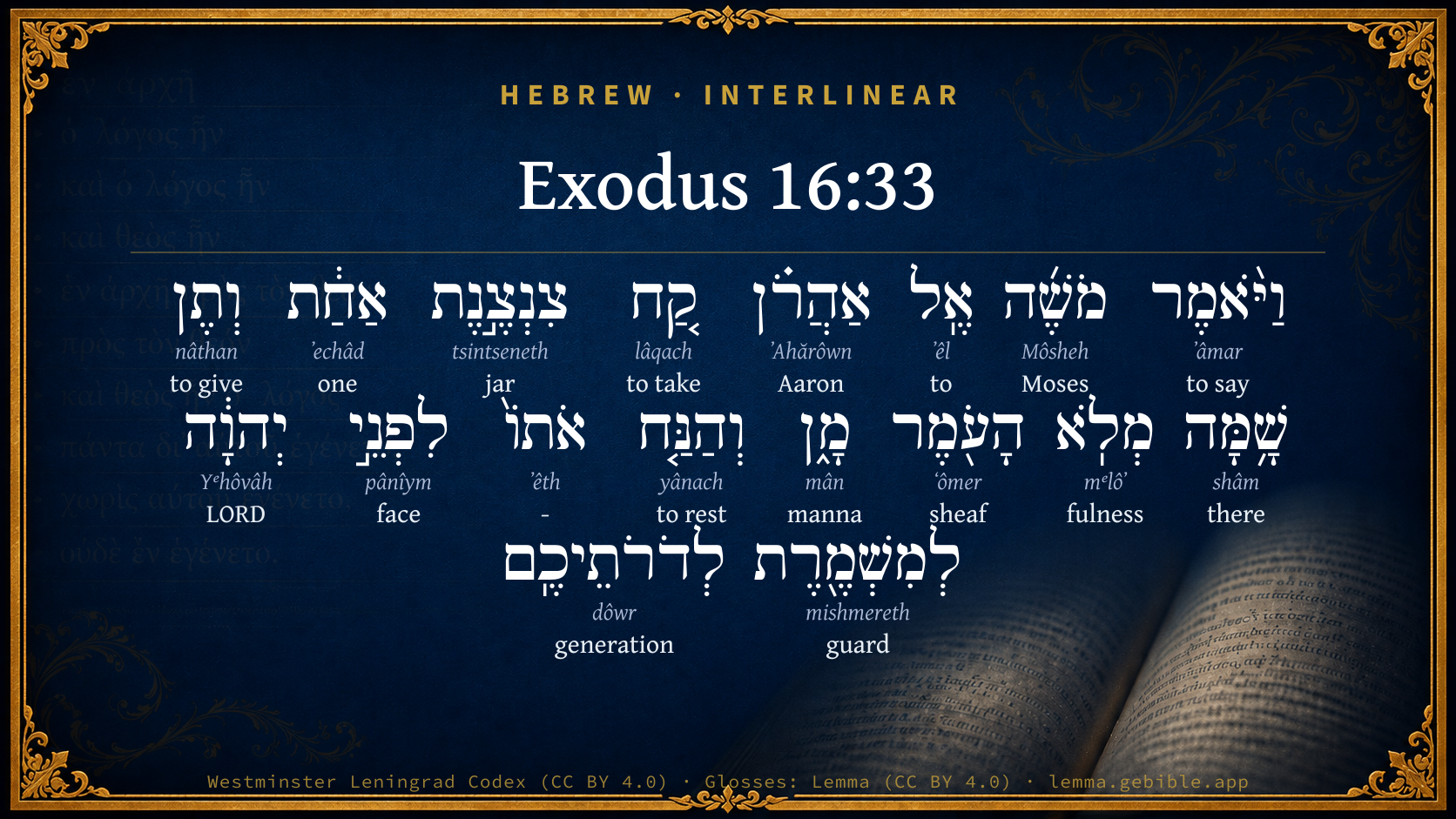
Exodus 16:33

Hebrew (Westminster Leningrad Codex) Exodus 16:33 appears in the Hebrew Old Testament. The text above is from the Westminster Leningrad Codex. Each word links to its Strong’s number, a concise gloss, and parsing drawn from the Open Scriptures Hebrew Bible morphology. Click any word for its full Brown-Driver-Briggs (BDB) entry.
Download image
Cite this verse

Exodus 16:33 (World English Bible). Public Domain. Lemma interlinear Bible study tool, https://lemma.gebible.app/v/exodus/16/33.

Show BibTeX & RIS
BibTeX
RIS
English Translation
Moses said to Aaron, "Take a pot, and put an omer-full of manna in it, and lay it up before Yahweh, to be kept throughout your generations."
World English Bible · Public Domain
Highlights
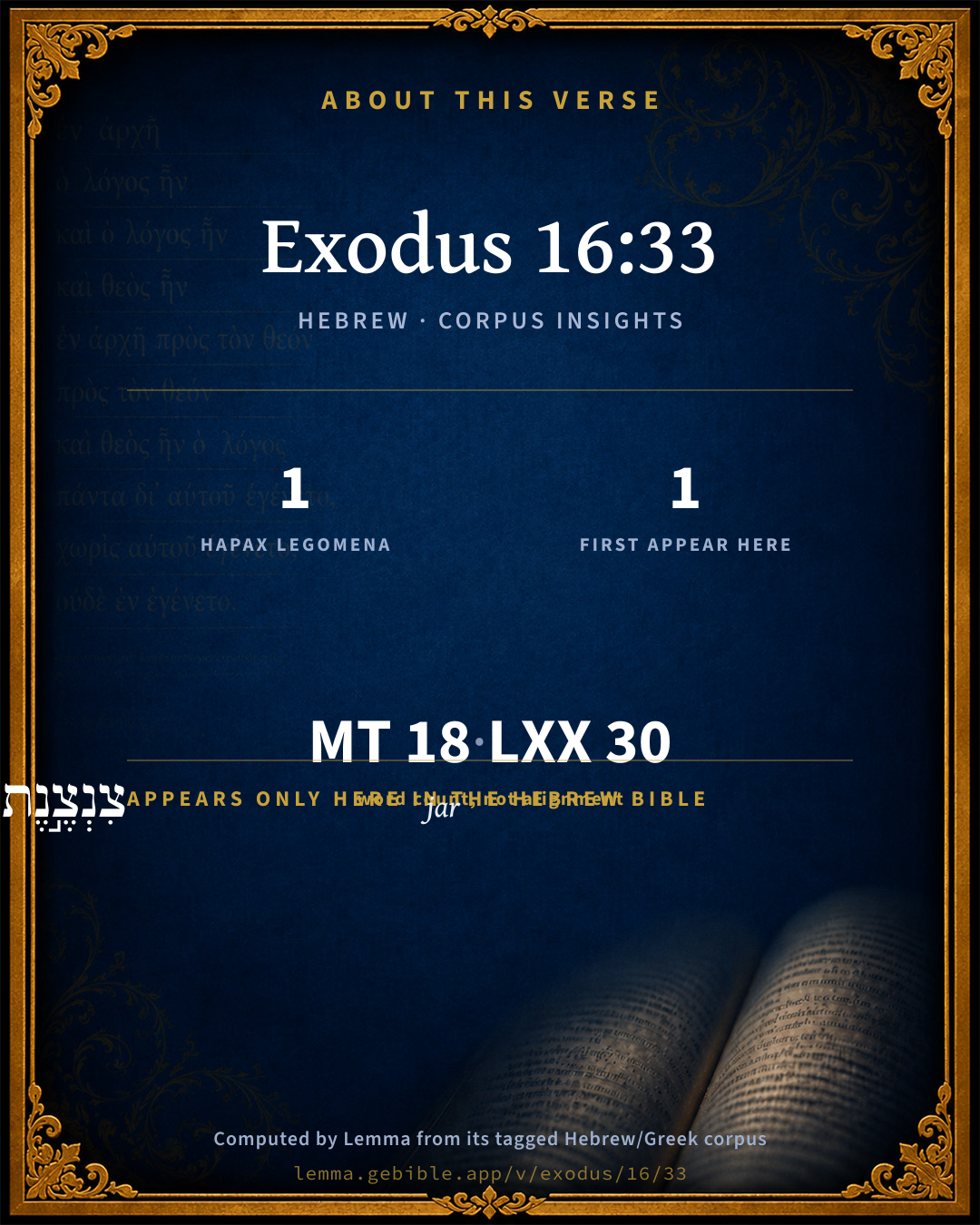
  • 1 hapax legomenon — only here in the Hebrew Bible
  • 1 first appearance in the Hebrew Bible
Full analysis ↓
Download a study sheet

One document with this verse’s original text, its word-by-word gloss line, the meaning frame, cross-references with their text, attributed commentary, and full source and license credits — printable, and it pastes into notes with its structure intact.

This verse Autodidact and up

Study sheet (.html) Plain text (.txt)

A passage Seminary Student

Up to 50 verses in one chapter. A passage sheet keeps up to 6 commentary sources and 12 cross-references per verse, in the order this page ranks them, and says so on the sheet whenever that leaves anything out. Ask for a single verse and you get the Autodidact verse sheet above.

Everything on this page stays free to read, with no account — the sheet is a download of what is already on screen, not access to it.

Want to remove ads? Support Godless Engineer
Compare translations 3

The same verse in 3 English versions, stacked beneath the original-language interlinear above. Click any original word for its lexicon entry.

Each is an independent rendering of the whole verse — the interlinear is not word-aligned to these translations.

Highlighted words mark where these versions differ — a whole-verse word diff, not a word-by-word alignment.

  • World English Bible Public Domain
    Moses said to Aaron, "Take a pot, and put an omer-full of manna in it, and lay it up before Yahweh, to be kept throughout your generations."
  • King James Version Public Domain
    And Moses said unto Aaron, Take a pot, and put an omer full of manna therein, and lay it up before the LORD, to be kept for your generations.
  • unfoldingWord Literal Text CC BY-SA 4.0
    And Moses said to Aaron, “Take one pot and put there a full omer of manna. Put it before the face of Yahweh, for preservation for your descendants.”

unfoldingWord Literal Text — © unfoldingWord, licensed CC BY-SA 4.0. Word-aligned USFM3 via Door43 (git.door43.org/unfoldingWord/en_ult).

Versions to compare (up to 4)

3 of 4 selected

Show all 18 translations

Every available English version of this verse, each an independent rendering of the whole verse.

  • World English Bible Public Domain
    Moses said to Aaron, "Take a pot, and put an omer-full of manna in it, and lay it up before Yahweh, to be kept throughout your generations."
  • Berean Standard Bible Public Domain
    So Moses told Aaron, “Take a jar and fill it with an omer of manna. Then place it before the LORD to be preserved for the generations to come.”
  • Majority Standard Bible Public Domain
    So Moses told Aaron, “Take a jar and fill it with an omer of manna. Then place it before the LORD to be preserved for the generations to come.”
  • King James Version Public Domain
    And Moses said unto Aaron, Take a pot, and put an omer full of manna therein, and lay it up before the LORD, to be kept for your generations.
  • American Standard Version (1901) Public Domain
    And Moses said unto Aaron, Take a pot, and put an omerful of manna therein, and lay it up before Jehovah, to be kept throughout your generations.
  • Revised Version (1885) Public Domain
    And Moses said unto Aaron, Take a pot, and put an omerful of manna therein, and lay it up before the LORD, to be kept for your generations.
  • Geneva Bible (1599) Public Domain
    Moses also said to Aaron, Take a pot and put an Omer full of MAN therein, and set it before the Lord to be kept for your posteritie.
  • Douay-Rheims (1899) Public Domain
    And Moses said to Aaron: Take a vessel, and put manna into it, as much as a gomor can hold: and lay it up before the Lord to keep unto your generations,
  • Young's Literal Translation Public Domain
    And Moses saith unto Aaron, `Take one pot, and put there the fulness of the omer of manna, and let it rest before Jehovah, for a charge for your generations;'
  • Literal Standard Version CC BY-SA 4.0
    And Moses says to Aaron, “Take one pot, and put the fullness of the omer of manna [in] there, and let it rest before YHWH, for a charge for your generations”;
  • Unlocked Literal Bible CC BY-SA 4.0
    Moses said to Aaron, “Take a pot and put an omer of manna into it. Preserve it before Yahweh to be kept throughout the people's generations.”
  • unfoldingWord Literal Text CC BY-SA 4.0
    And Moses said to Aaron, “Take one pot and put there a full omer of manna. Put it before the face of Yahweh, for preservation for your descendants.”
  • Darby Bible Public Domain
    And Moses said to Aaron, Take a pot, and put in it an omer full of manna, and deposit it before Jehovah, to be kept for your generations.
  • World Messianic Bible Public Domain
    Moses said to Aaron, “Take a pot, and put an omer-full of manna in it, and lay it up before the LORD, to be kept throughout your generations.”
  • Webster's Bible Public Domain
    And Moses said to Aaron, Take a pot, and put an omer full of manna therein, and lay it up before the LORD, to be kept for your generations.
  • Free Bible Version CC BY-SA 4.0
    So Moses told Aaron, “Take a jar and put an omer of manna in it. Then place it before the Lord to be kept as a reminder for future generations.”
  • Bible in Basic English Public Domain
    And Moses said to Aaron, Take a pot and put one omer of manna in it, and put it away before the Lord, to be kept for future generations.
  • JPS Tanakh (1917) Public Domain
    And Moses said unto Aaron: 'Take a jar, and put an omerful of manna therein, and lay it up before the LORD, to be kept throughout your generations.'

Literal Standard Version (2020), Covenant Press — licensed CC BY-SA 4.0. Text via the HelloAO Bible API (eBible.org). Unlocked Literal Bible (unfoldingWord) — licensed CC BY-SA 4.0. Text via the HelloAO Bible API (eBible.org). unfoldingWord Literal Text — © unfoldingWord, licensed CC BY-SA 4.0. Word-aligned USFM3 via Door43 (git.door43.org/unfoldingWord/en_ult). Free Bible Version, Dr. Jonathan Gallagher — licensed CC BY-SA 4.0. Text via the HelloAO Bible API (eBible.org).

Word by word

More ways to search: Search by grammar → Find every occurrence → Compare this word →

Practice this passage: Drill this verse → Learn its vocabulary →

צִנְצֶ֣נֶת
tsintseneth
H6803
“jar of”
Noun, Common, Feminine, Singular, Construct
Part of Speech
Noun
Type
Common
Gender
Feminine
Number
Singular
State
Construct
Full BDB Definition

Origin: from the same as H6791

TWOT: 1938b

jar, pot, receptacle
  1. וַיֹּ֨אמֶר ʼâmar H559 “and · to say” Conjunction + Verb, Qal, Sequential Imperfect, 3rd Person, Masculine, Singular
  2. מֹשֶׁ֜ה Môsheh H4872 “Moses” Noun, Proper
  3. אֶֽל ʼêl H413 “to” Preposition
  4. אַהֲרֹ֗ן ʼAhărôwn H175 “Aaron” Noun, Proper
  5. קַ֚ח lâqach H3947 “take” Verb, Qal, Imperative, 2nd Person, Masculine, Singular
  6. אַחַ֔ת ʼechâd H259 “one” Adjective, Cardinal number, Feminine, Singular, Absolute
  7. וְתֶן nâthan H5414 “and · give” Conjunction + Verb, Qal, Imperative, 2nd Person, Masculine, Singular
  8. שָׁ֥מָּה shâm H8033 “there · toward” Adverb + Suffix, Demonstrative
  9. מְלֹֽא mᵉlôʼ H4393 “fulness of” Noun, Common, Masculine, Singular, Construct
  10. הָעֹ֖מֶר ʻômer H6016 “the · sheaf” Particle, Definite Article + Noun, Common, Masculine, Singular, Absolute
  11. מָ֑ן mân H4478 “manna” Noun, Common, Masculine, Singular, Absolute
  12. וְהַנַּ֤ח yânach H3240 “and · rest” Conjunction + Verb, Hiphil, Imperative, 2nd Person, Masculine, Singular
  13. אֹתוֹ֙ ʼêth H853 “- · him” Particle, Direct Object + Suffix, Personal, 3rd Person, Masculine, Singular
  14. לִפְנֵ֣י pânîym H6440 “to/for · face(s) of” Preposition + Noun, Common, Both, Plural, Construct
  15. יְהוָ֔ה Yᵉhôvâh H3068 “LORD” Noun, Proper
  16. לְמִשְׁמֶ֖רֶת mishmereth H4931 “to/for · guard” Preposition + Noun, Common, Feminine, Singular, Absolute
  17. לְדֹרֹתֵיכֶֽם dôwr H1755 “to/for · generations · your” Preposition + Noun, Common, Masculine, Plural, Construct + Suffix, Personal, 2nd Person, Masculine, Plural

About this verse

These counts appear in no published source. They are computed here, from the morphology-tagged text and Lemma’s own curated glosses. What Lemma adds →

18
words
18
distinct lemmas
Pentateuch
section

Notable vocabulary

1 hapax legomenon — a word that appears only here in the entire Hebrew Bible:

  • צִנְצֶ֣נֶת jar H6803

First appearance in Scripture

This word makes its first canonical appearance in the Hebrew Bible here:

  • צִנְצֶ֣נֶת jar H6803

Shared distinctive vocabulary

הָעֹ֖מֶר sheaf H6016 occurs in 14 verses of the Hebrew Bible. Also found in:

Grammatical profile

  • 4 verbs
  • 10 nouns
  • 1 adjective
  • 1 preposition
  • 1 adverb
  • 1 particle

Verb forms

  • וַיֹּ֨אמֶר Qal · Sequential Imperfect
  • קַ֚ח Qal · Imperative
  • וְתֶן Qal · Imperative
  • וְהַנַּ֤ח Hiphil · Imperative

Hebrew & Septuagint length

In English translation the verse runs 27 words from the Hebrew and 32 from the Septuagint (LXX English) — closely comparable.

A rough comparison of the two English renderings, which tokenize alike — not a word-level alignment.

Word counts can differ between the Hebrew and the Greek without any difference in meaning — e.g. the Hebrew direct-object marker אֵת has no separate Greek word, and Greek often adds the article ὁ.

In the original languages it is 18 Hebrew tokens and 30 Greek tokens — but the two are counted differently (Hebrew bundles its prefixes and suffixes into one token; the Greek is in lemma form), so that isn’t a like-for-like length.

Cross-references

1

Topical passages linked to Exodus 16:33 in the Treasury of Scripture Knowledge — connected by theme and wording, ordered by reader-vote popularity; previews shown in the World English Bible.

  • Hebrews 9:4 having a golden altar of incense, and the ark of the covenant overlaid on all sides with gold, in which was a golden pot holding the manna, Aaron's rod that budded, and the tables of the covenant;

Cross-references courtesy of OpenBible.info (CC BY 4.0).

Hebrew and Greek witnesses Masoretic Hebrew ↔ Greek Septuagint

The same verse in the two great witnesses to the Old Testament, shown verse-for-verse.

These are two independent witnesses, not word-aligned to each other, and the Septuagint is shown in lemma (dictionary) form.

Hebrew Exodus 16:33 Masoretic · Westminster Leningrad Codex

וַיֹּ֨אמֶר מֹשֶׁ֜ה אֶֽל אַהֲרֹ֗ן קַ֚ח צִנְצֶ֣נֶת אַחַ֔ת וְתֶן שָׁ֥מָּה מְלֹֽא הָעֹ֖מֶר מָ֑ן וְהַנַּ֤ח אֹתוֹ֙ לִפְנֵ֣י יְהוָ֔ה לְמִשְׁמֶ֖רֶת לְדֹרֹתֵיכֶֽם

Moses said to Aaron, "Take a pot, and put an omer-full of manna in it, and lay it up before Yahweh, to be kept throughout your generations."

World English Bible · Public Domain

Greek LXX Exodus 16:33 Septuagint · lemma form

καί εἶπον μωυσῆς πρός ααρων λαμβάνω στάμνος χρυσοῦς εἷς καί ἐνβάλλω εἰς αὐτός πλήρης ὁ γομορ ὁ μαν καί ἀποτίθημι αὐτός ἐναντίον ὁ θεός εἰς διατήρησις εἰς ὁ γενεά σύ

And Moses said to Aaron, Take a golden pot, and cast into it one full homer of manna; and you shall lay it up before God, to be kept for your generations,

LXX2012 (modern English Septuagint) · Public Domain

On this verse, The Cambridge Bible for Schools and Colleges discusses the Septuagint’s reading. Read the note in Commentary ↓

Hebrew: Westminster Leningrad Codex (CC BY 4.0). Greek: Septuagint (public domain); English from LXX2012 (modern English Septuagint) (Public Domain). How the Septuagint differs from the Hebrew →

Targum (Aramaic paraphrase)

2

The Targum is the ancient Jewish Aramaic paraphrase of the Hebrew Scriptures — an interpretive translation, not the Hebrew text itself. Onkelos (literal) and Pseudo-Jonathan (expansive) render the Torah, and Jonathan the Prophets. Coverage is partial: where no permissively-licensed English translation exists for a verse, only the Aramaic is shown. This is verse-level text, not a word-by-word alignment to the Hebrew.

  1. Targum Onkelos Torah (Genesis–Deuteronomy)
    וַאֲמַר משֶׁה לְאַהֲרֹן סַב צְלוֹחִית חֲדָא וְהַב תַמָן מְלֵי עֻמְרָא מָן וְאַצְנַע יָתֵהּ קֳדָם יְיָ לְמַטְרָא לְדָרֵיכוֹן:

    (no public-domain English translation for this verse)

    Targum Onkelos — Aramaic: “Onkelos Genesis” (public domain); “Onkelos Exodus” (public domain); “Onkelos Leviticus” (public domain); “Onkelos Numbers” (public domain); “Onkelos Deuteronomy” (public domain). English: “Sefaria Community Translation” (CC0 1.0 (public-domain dedication)); “J.W. Etheridge. The Targums of Onkelos and Jonathan Ben Uzziel on the Pentateuch. London: Longmans, Green, 1862” (public domain). Text via Sefaria.

  2. Targum Pseudo-Jonathan Torah (Genesis–Deuteronomy)
    וַאֲמַר משֶׁה לְאַהֲרן סַב צְלוּחִית דְּפָחַר חֲדָא וְהַב תַּמָּן מְלֵי עוּמְרָא מַנָא וְאַצְנַע יָתֵיהּ קֳדָם יְיָ לְמַטְרָא לְדָרֵיכוֹן

    And Mosheh said to Aharon, Take one earthen vase, and put therein a full homera of manna, and lay it up before the Lord to be kept unto your generations.

    Targum Pseudo-Jonathan — Aramaic: “Targum Jonathan on Genesis” (public domain); “Targum Jonathan on Exodus” (public domain); “Targum Jonathan on Leviticus” (public domain); “Targum Jonathan on Numbers” (public domain); “Targum Jonathan on Deuteronomy” (public domain). English: “The Targum of Jonathan ben Uzziel, trans. J. W. Etheridge, London, 1862” (public domain). Text via Sefaria.

Commentary

Notes on Exodus 16:33 from classic Christian and Jewish commentators (each source and its license shown beneath its notes). The classic Christian expositions comment on the surrounding passage and are grouped to its opening verse, so a note may address several verses; the Jewish commentaries on the Tanakh (Rashi and others) are per-verse, so they appear only where the commentator wrote on this verse.

Lemma curates 59 commentaries, every one of them public domain or Creative Commons licensed, each selected and text-cleaned for this edition rather than reprinted as found. About our sources →

Ellicott's Commentary for English Readers

(33) Lay it up before the Lord.—Comp. Exo_16:33, where Aaron is said to have “laid it up before the Testimony,” i.e., the Two Tables. According to the writer of the Epistle to the Hebrews, the Ark of the Covenant contained three things only—the tables, the pot of manna, and Aaron’s rod that budded (Heb_9:4). The deposit of the manna in so sacred a place may be accounted for by its typifying “the true bread from heaven” (Joh_6:32).

A Bible Commentary for English Readers, edited by Charles John Ellicott (1878–1897) — public domain. Text from a community e-Sword module.

Trapp's Complete Commentary

John Trapp

Exo 16:33 And Moses said unto Aaron, Take a pot, and put an omer full of manna therein, and lay it up before the LORD, to be kept for your generations.

Ver. 33. Take a pot.] A golden pot. {Heb 9:4} Strabo {a} writeth, that the Metapontini, after a plentiful harvest which had much enriched them, dedicated to Apollo at Delphi χρυσουν θερος, a harvest of gold.

{a} Geog.

John Trapp, A Commentary or Exposition upon All the Books of the Old and New Testament (1647–1656) — public domain. Text from a community e-Sword module.

Joseph Benson's Commentary

Exo 16:33-34. Take a pot — A golden pot, Heb 9:4. For all the vessels of the sanctuary were of gold. Lay it up before the Lord — That is, in the tabernacle, and by the ark, when they should be built: Before the testimony — The ark of the testimony, or witness, because in it were the tables of the covenant, or the law of God, which was a testimony of God’s authority and will, and of man’s subjection and duty, or of the covenant made between God and man. The preservation of this pot of manna from waste and corruption, was a standing miracle; and, therefore, the more proper memorial of this miraculous food. The manna is called spiritual meat, (1Co 10:3,) because it was typical of spiritual blessings. Christ himself is the true manna, the bread of life, of which that was a figure, Joh 6:49-51. The word of God is the manna by which our souls are nourished, Mat 4:4. The comforts of the Spirit are hidden manna, Rev 2:17. These comforts come from heaven, as the manna did, and are the support of the divine life in the soul, while we are in the wilderness of this world: it is food for Israelites, for those only that follow the pillar of cloud and fire: it is to be gathered; Christ in the word is to be applied to the soul, and the means of grace must be used: we must every one of us gather for ourselves. There was manna enough for all, enough for each, and none had too much; so in Christ there is a complete sufficiency, and no superfluity. But they that did eat manna hungered again, died at last, and with many of them God was not well pleased: whereas they that feed on Christ by faith shall never hunger, and shall die no more, and with them God will be for ever well pleased. The Lord evermore give us this bread!

Joseph Benson's Commentary on the Old and New Testaments (1811–1818) — public domain. Text from a community e-Sword module.

Geneva Bible (1599)

Geneva Bible translators

Of this vessel, read Heb. 9:4.

Geneva Bible (1599) marginal notes — public domain. Text via Bolls.life.

The Cambridge Bible for Schools and Colleges

gen. ed. J. J. S. Perowne

33. a pot] or jar: ṣinṣéneth, only here: LXX. σταμνὸς (an earthen jar).

lay it up] As Num_17:4, in a similar connexion.

before Jehovah] before the Ark, in the Tent of Meeting; cf. on v. 9.

The Cambridge Bible for Schools and Colleges (gen. ed. J. J. S. Perowne; Cambridge University Press, 1878–1918) — public domain. Text from a community e-Sword module.

John Gill's Exposition

Now an omer is the tenth part of an ephah. Frequent mention being made of this measure in the above relation, as containing the quantity of each man's share of the manna daily, during the forty years' stay in the wilderness; an account is given by the historian how much it contained, by which it may appear what a sufficient provision was made: an ephah, according to Jarchi, contained three seahs (or pecks); a scab, six kabs; a kab, four logs; a log, six egg shells; and the tenth part of an ephah was forty three egg shells, and the fifth part of one: but Dr. Cumberland (b) has reduced this to our measure, and has given it more clearly and distinctly; an ephah, according to him, contained, in wine measure, seven gallons, two quarts, and about half a pint; in corn measure, six gallons, three pints, and three solid inches; and an omer three quarts; which being made into bread, must be more than any ordinary man could well eat; for, as Ainsworth observes, an omer was twice as much as the choenix, (a measure mentioned in Rev 6:6.) which was wont to be a man's allowance of bread corn for a day; and what a vast quantity must fall every day to supply so large a number of people with such a measure; some have reckoned it at 94,466 bushels every day, and that there must be consumed in forty years 1,379,203,600 bushels (c).

(b) Of Scripture Weights and Measures, ch. 3. p. 64, 86, 87. ch. 4. p. 137. (c) Vid. Scheuchzer. Physic. Saer. vol. 2. p. 177, 178.

Next: Exodus Chapter 17

John Gill's Exposition of the Whole Bible (1746–1763) — public domain (CC PDM 1.0). Text via the HelloAO Bible API.

Albert Barnes' Notes on the Bible

A pot - The word here used occurs in no other passage. It corresponds in form and use to the Egyptian for a casket or vase in which oblations were presented.

Albert Barnes' Notes on the Bible (1834–1885) — public domain. Text from a community e-Sword/MySword module.

Haydock's Catholic Bible Commentary

A vessel, "a golden urn," as the Septuagint and St. Paul (Hebrews ix. 4,) express it. This was placed in the tabernacle, where the Hebrews met to pray, till the ark was made. (Calmet)

George Leo Haydock (1774–1849), Haydock's Catholic Family Bible and Commentary, 1859 edition — public domain. Excludes Psalms (Douay-Rheims chapter numbering differs from Protestant) and Deuterocanonical books (Catholic canon only).

Matthew Poole's English Annotations

In the tabernacle, and by the ark, when they shall be built, and at present in the place where you meet for the solemn worship of God.

Matthew Poole's English Annotations on the Holy Bible (1683–1685) — public domain. Text from a community e-Sword/MySword module.

The Pulpit Commentary

Take a pot. The word here translated "pot" does not occur elsewhere in Scripture, and is believed to be of Egyptian origin Gesenius translates it "basket;" but the author of the Epistle to themnov, Heb_9:4 follows the LXX in representing the word used by sta) which certainly means "a jar" or "pot." Lay it up before the Lord. The "pot of manna" was laid up before the Lord with the "tables of the covenant," and "Aaron"s rod that budded" as symbolical that God"s mercy was as eternal and essential, and as much to be remembered as his justice, and perhaps also as especially symbolising the "true bread of life."

The Pulpit Commentary (1880–1919), ed. H.D.M. Spence-Jones & Joseph S. Exell — public domain. Text from a community e-Sword module.

unfoldingWord translationNotes

Door43 World Missions Community

Now an omer is a tenth of an ephah

An omer and an ephah are both containers for measuring volume. The original readers would have known how much an ephah was. This sentence would help them know how much an omer was. For languages that do not use fractions, this can be reworded. AT: "Now ten omers equal one ephah" (See: Biblical Volume and Fractions)

an omer

"two liters" (See: Biblical Volume)

translationWords

Aaron

generation

ark of the covenant

Canaan

unfoldingWord translationNotes — © Distant Shores Media and the Door43 World Missions Community, licensed CC BY-SA 4.0. Source: git.door43.org/Door43/en_tn.

Rashi

Rabbi Shlomo Yitzchaki (Rashi)

צנצנת is an earthern flask, as it is translated in the Targum (cf. Mekhilta).

‘והנח אתו לפני ה AND LAY IT UP BEFORE THE LORD — before the Ark; this verse, of course, was not spoken until the tent of meeting had been built and the Ark was placed therein, but it is written here in the chapter about the Manna, as being its appropriate place.

Rashi on the Tanakh — English translations: “The Judaica Press complete Tanach with Rashi, translated by A. J. Rosenberg” (CC BY 4.0); “Pentateuch with Rashi's commentary by M. Rosenbaum and A.M. Silbermann, 1929-1934” (public domain); “The Metsudah Tanach series, Lakewood, N.J” (CC BY 4.0); and “The Book of Joshua, Metsudah Publications, 1997” (CC BY 4.0). Text via Sefaria.

Lesson kit

Teaching starters — assembled from the data on this page, not authored interpretation. Every prompt links to the verse data it draws on. Edit before teaching.

Exodus, in the Pentateuch, opens this verse with 18 words (18 distinct Hebrew lemmas). Its most distinctive word is tsintseneth (“jar”). A historical commentator’s framing appears above. Read the whole chapter for the surrounding context.

Discussion questions

  1. What does “jar” (tsintseneth) contribute to the verse as a whole?
  2. 1 word here appears nowhere else in the Hebrew Bible. Why might the author reach for such rare wording?
  3. This is the first place “jar” appears in Scripture (first appears here). What does its debut here establish?
  4. How does Exodus 16:16, which shares the word «sheaf», read alongside this verse?
  5. These translations render this verse differently. What is at stake in choosing one wording over another?
  6. «וַיֹּ֨אמֶר» is a Qal Sequential Imperfect verb. How does that grammatical form shape the action described?
  7. Compare how Ellicott's Commentary for English Readers and Trapp's Complete Commentary read this verse. Where do they agree or differ?

Things to notice

Reading settings

Reading text

Shown beneath each verse's original-language words.

Old Testament
Old Testament edition

Read the OT as the Masoretic Hebrew (MT) or the Greek Septuagint (LXX).

English shown for the Greek Septuagint (in the Hebrew ↔ Greek comparison).

Comparing translations? Open the Compare panel on any verse page to stack up to four side by side.