
Judges 1:2

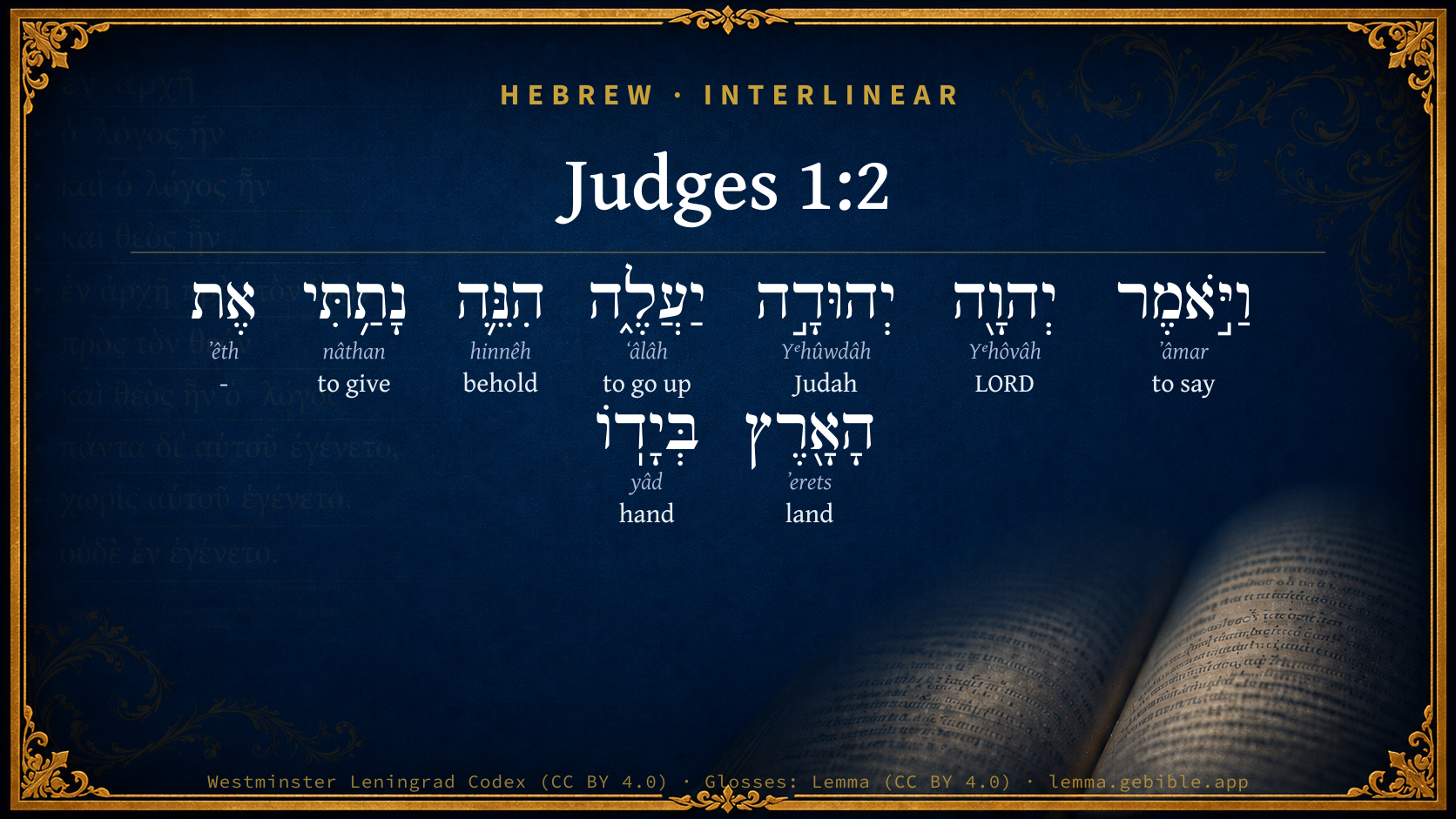
Hebrew (Westminster Leningrad Codex) Judges 1:2 appears in the Hebrew Old Testament. The text above is from the Westminster Leningrad Codex. Each word links to its Strong’s number, a concise gloss, and parsing drawn from the Open Scriptures Hebrew Bible morphology. Click any word for its full Brown-Driver-Briggs (BDB) entry.
Download image
Cite this verse

Judges 1:2 (World English Bible). Public Domain. Lemma interlinear Bible study tool, https://lemma.gebible.app/v/judges/1/2.

Show BibTeX & RIS
BibTeX
RIS
English Translation
Yahweh said, Judah shall go up: behold, I have delivered the land into his hand.
World English Bible · Public Domain
Download a study sheet

One document with this verse’s original text, its word-by-word gloss line, the meaning frame, cross-references with their text, attributed commentary, and full source and license credits — printable, and it pastes into notes with its structure intact.

This verse Autodidact and up

Study sheet (.html) Plain text (.txt)

A passage Seminary Student

Up to 50 verses in one chapter. A passage sheet keeps up to 6 commentary sources and 12 cross-references per verse, in the order this page ranks them, and says so on the sheet whenever that leaves anything out. Ask for a single verse and you get the Autodidact verse sheet above.

Everything on this page stays free to read, with no account — the sheet is a download of what is already on screen, not access to it.

Want to remove ads? Support Godless Engineer
Compare translations 3

The same verse in 3 English versions, stacked beneath the original-language interlinear above. Click any original word for its lexicon entry.

Each is an independent rendering of the whole verse — the interlinear is not word-aligned to these translations.

Highlighted words mark where these versions differ — a whole-verse word diff, not a word-by-word alignment.

  • World English Bible Public Domain
    Yahweh said, Judah shall go up: behold, I have delivered the land into his hand.
  • King James Version Public Domain
    And the LORD said, Judah shall go up: behold, I have delivered the land into his hand.
  • unfoldingWord Literal Text CC BY-SA 4.0
    And Yahweh said, “Judah will go up. Behold, I have given the land into his hand.”

unfoldingWord Literal Text — © unfoldingWord, licensed CC BY-SA 4.0. Word-aligned USFM3 via Door43 (git.door43.org/unfoldingWord/en_ult).

Versions to compare (up to 4)

3 of 4 selected

Show all 18 translations

Every available English version of this verse, each an independent rendering of the whole verse.

  • World English Bible Public Domain
    Yahweh said, Judah shall go up: behold, I have delivered the land into his hand.
  • Berean Standard Bible Public Domain
    “Judah shall go up,” answered the LORD. “Indeed, I have delivered the land into their hands.”
  • Majority Standard Bible Public Domain
    “Judah shall go up,” answered the LORD. “Indeed, I have delivered the land into their hands.”
  • King James Version Public Domain
    And the LORD said, Judah shall go up: behold, I have delivered the land into his hand.
  • American Standard Version (1901) Public Domain
    And Jehovah said, Judah shall go up: behold, I have delivered the land into his hand.
  • Revised Version (1885) Public Domain
    And the LORD said, Judah shall go up: behold, I have delivered the land into his hand.
  • Geneva Bible (1599) Public Domain
    And the Lord said, Iudah shall goe vp: behold, I haue giuen the land into his hande.
  • Douay-Rheims (1899) Public Domain
    And the Lord said: Juda shall go up: behold I have delivered the land into his hands.
  • Young's Literal Translation Public Domain
    And Jehovah saith, `Judah doth go up; lo, I have given the land into his hand.'
  • Literal Standard Version CC BY-SA 4.0
    And YHWH says, “Judah goes up; behold, I have given the land into his hand.”
  • Unlocked Literal Bible CC BY-SA 4.0
    Yahweh said, “Judah will attack. See, I have given them control of this land.”
  • unfoldingWord Literal Text CC BY-SA 4.0
    And Yahweh said, “Judah will go up. Behold, I have given the land into his hand.”
  • Darby Bible Public Domain
    The LORD said, "Judah shall go up; behold, I have given the land into his hand."
  • World Messianic Bible Public Domain
    The LORD said, “Judah shall go up. Behold, I have delivered the land into his hand.”
  • Webster's Bible Public Domain
    And the LORD said, Judah shall go up: behold, I have delivered the land into his hand.
  • Free Bible Version CC BY-SA 4.0
    “Judah is to go first,” the Lord replied. “I have handed the land over to them.”
  • Bible in Basic English Public Domain
    And the Lord said, Judah is to go up: see, I have given the land into his hands.
  • JPS Tanakh (1917) Public Domain
    And LORD said: 'Judah shall go up; behold, I have delivered the land into his hand.'

Literal Standard Version (2020), Covenant Press — licensed CC BY-SA 4.0. Text via the HelloAO Bible API (eBible.org). Unlocked Literal Bible (unfoldingWord) — licensed CC BY-SA 4.0. Text via the HelloAO Bible API (eBible.org). unfoldingWord Literal Text — © unfoldingWord, licensed CC BY-SA 4.0. Word-aligned USFM3 via Door43 (git.door43.org/unfoldingWord/en_ult). Free Bible Version, Dr. Jonathan Gallagher — licensed CC BY-SA 4.0. Text via the HelloAO Bible API (eBible.org).

Word by word

More ways to search: Search by grammar → Find every occurrence → Compare this word →

Practice this passage: Drill this verse → Learn its vocabulary →

יְהוּדָ֣ה
Yᵉhûwdâh
H3063
“Judah”
Noun, Proper
Part of Speech
Noun
Type
Proper
Full BDB Definition

Origin: from H3034

TWOT: 850c

Judah = "praised" - the son of Jacob by Leah - the tribe descended from Judah the son of Jacob - the territory occupied by the tribe of Judah - the kingdom comprised of the tribes of Judah and Benjamin which occupied the southern part of Canaan after the nation split upon the death of Solomon - a Levite in Ezra's time - an overseer of Jerusalem in the time of Nehemiah - a Levite musician in the time of Nehemiah - a priest in the time of Nehemiah
  1. וַיֹּ֣אמֶר ʼâmar H559 “and · to say” Conjunction + Verb, Qal, Sequential Imperfect, 3rd Person, Masculine, Singular
  2. יְהוָ֖ה Yᵉhôvâh H3068 “LORD” Noun, Proper
  3. יַעֲלֶ֑ה ʻâlâh H5927 “to go up” Verb, Qal, Imperfect, 3rd Person, Masculine, Singular
  4. הִנֵּ֛ה hinnêh H2009 “behold” Particle, Demonstrative
  5. נָתַ֥תִּי nâthan H5414 “to give” Verb, Qal, Perfect, 1st Person, Common, Singular
  6. אֶת ʼêth H853 “-” Particle, Direct Object
  7. הָאָ֖רֶץ ʼerets H776 “the · land” Particle, Definite Article + Noun, Common, Both, Singular, Absolute
  8. בְּיָדֽוֹ yâd H3027 “in/at · hand · his” Preposition + Noun, Common, Both, Singular, Construct + Suffix, Personal, 3rd Person, Masculine, Singular

About this verse

These counts appear in no published source. They are computed here, from the morphology-tagged text and Lemma’s own curated glosses. What Lemma adds →

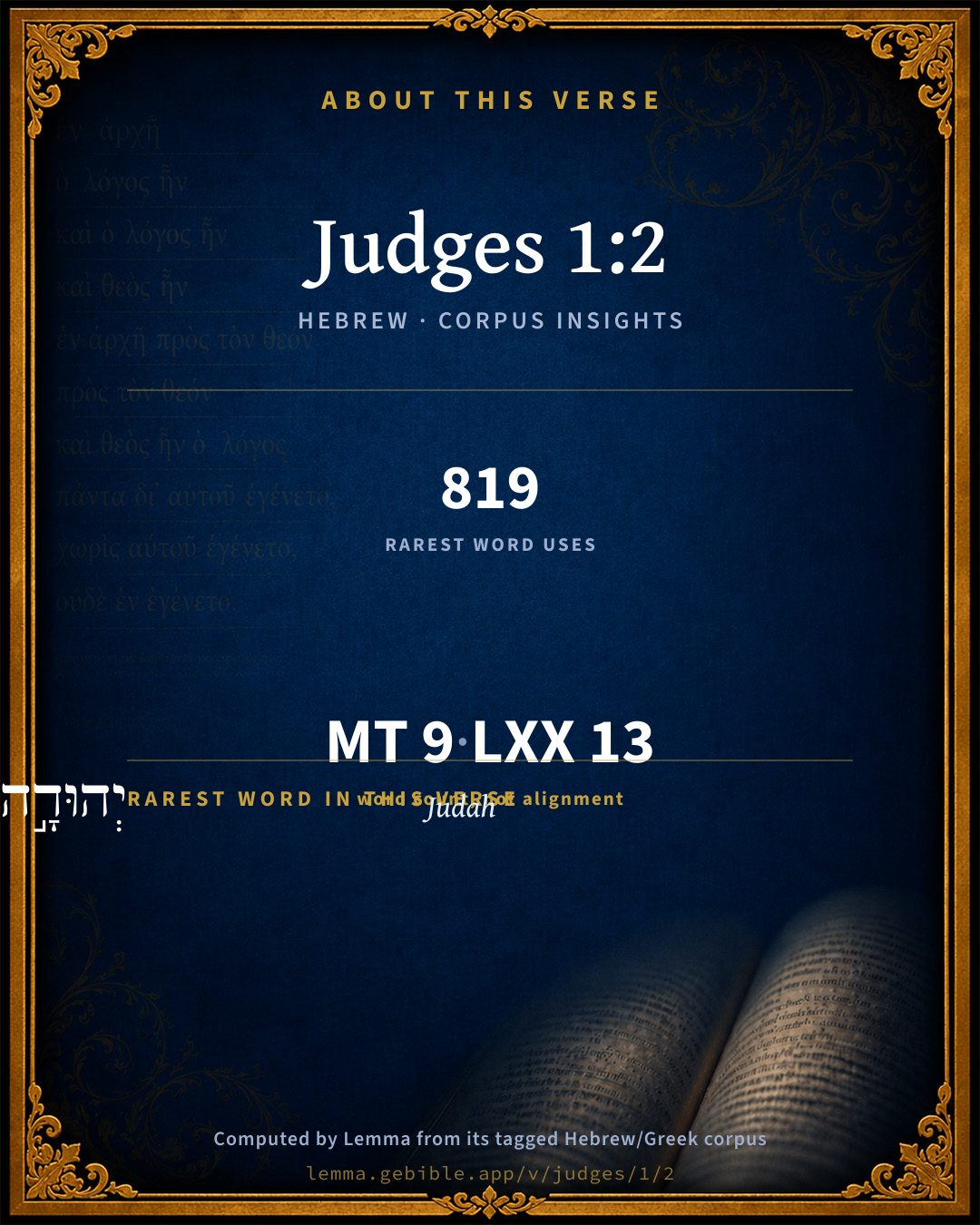
9
words
9
distinct lemmas
Historical
section

Grammatical profile

  • 3 verbs
  • 4 nouns
  • 2 particles

Verb forms

  • וַיֹּ֣אמֶר Qal · Sequential Imperfect
  • יַעֲלֶ֑ה Qal · Imperfect
  • נָתַ֥תִּי Qal · Perfect

Hebrew & Septuagint length

In English translation the verse runs 15 words from the Hebrew and 17 from the Septuagint (LXX English) — closely comparable.

A rough comparison of the two English renderings, which tokenize alike — not a word-level alignment.

Word counts can differ between the Hebrew and the Greek without any difference in meaning — e.g. the Hebrew direct-object marker אֵת has no separate Greek word, and Greek often adds the article ὁ.

In the original languages it is 9 Hebrew tokens and 13 Greek tokens — but the two are counted differently (Hebrew bundles its prefixes and suffixes into one token; the Greek is in lemma form), so that isn’t a like-for-like length.

Cross-references

7

Topical passages linked to Judges 1:2 in the Treasury of Scripture Knowledge — connected by theme and wording, ordered by reader-vote popularity; previews shown in the World English Bible.

  • Revelation 5:5 One of the elders said to me, "Don't weep. Behold, the Lion who is of the tribe of Judah, the Root of David, has overcome; he who opens the book and its seven seals."
  • Hebrews 7:14 For it is evident that our Lord has sprung out of Judah, about which tribe Moses spoke nothing concerning priesthood.
  • Genesis 49:8–10 "Judah, your brothers will praise you: Your hand will be on the neck of your enemies; Your father's sons will bow down before you.
  • Numbers 2:3 Those who encamp on the east side toward the sunrise shall be of the standard of the camp of Judah, according to their divisions: and the prince of the children of Judah shall be Nahshon the son of Amminadab.
  • Numbers 7:12 He who offered his offering the first day was Nahshon the son of Amminadab, of the tribe of Judah,
  • Psalms 78:68–70 But chose the tribe of Judah, Mount Zion which he loved.
  • Revelation 19:11–16 I saw the heaven opened, and behold, a white horse, and he who sat on it is called Faithful and True. In righteousness he judges and makes war.

Cross-references courtesy of OpenBible.info (CC BY 4.0).

Hebrew and Greek witnesses Masoretic Hebrew ↔ Greek Septuagint

The same verse in the two great witnesses to the Old Testament, shown verse-for-verse.

These are two independent witnesses, not word-aligned to each other, and the Septuagint is shown in lemma (dictionary) form.

Hebrew Judges 1:2 Masoretic · Westminster Leningrad Codex

וַיֹּ֣אמֶר יְהוָ֖ה יְהוּדָ֣ה יַעֲלֶ֑ה הִנֵּ֛ה נָתַ֥תִּי אֶת הָאָ֖רֶץ בְּיָדֽוֹ

Yahweh said, Judah shall go up: behold, I have delivered the land into his hand.

World English Bible · Public Domain

Greek LXX Judges 1:2 Septuagint · lemma form

καί εἶπον κύριος ἰούδας ἀναβαίνω ἰδού δίδωμι ὁ γῆ ἐν ὁ χείρ αὐτός

And the Lord said, Judas shall go up: behold, I have delivered the land into his hand.

LXX2012 (modern English Septuagint) · Public Domain

Hebrew: Westminster Leningrad Codex (CC BY 4.0). Greek: Septuagint (public domain); English from LXX2012 (modern English Septuagint) (Public Domain). How the Septuagint differs from the Hebrew →

Targum (Aramaic paraphrase)

1

The Targum is the ancient Jewish Aramaic paraphrase of the Hebrew Scriptures — an interpretive translation, not the Hebrew text itself. Onkelos (literal) and Pseudo-Jonathan (expansive) render the Torah, and Jonathan the Prophets. Coverage is partial: where no permissively-licensed English translation exists for a verse, only the Aramaic is shown. This is verse-level text, not a word-by-word alignment to the Hebrew.

  1. Targum Jonathan Prophets (Joshua–Malachi)
    וַאֲמַר יְיָ יְהוּדָה יִסַק הָא מַסְרִית יַת יַתְבֵי אַרְעָא בִּידֵיהּ:

    (no public-domain English translation for this verse)

    Targum Jonathan — Aramaic: “Mikraot Gedolot” (public domain). English: “Sefaria Community Translation” (CC0 1.0 (public-domain dedication)); “London "Chaldee Paraphrase," 1871” (public domain). Text via Sefaria.

Commentary

Notes on Judges 1:2 from classic Christian and Jewish commentators (each source and its license shown beneath its notes). The classic Christian expositions comment on the surrounding passage and are grouped to its opening verse, so a note may address several verses; the Jewish commentaries on the Tanakh (Rashi and others) are per-verse, so they appear only where the commentator wrote on this verse.

Lemma curates 59 commentaries, every one of them public domain or Creative Commons licensed, each selected and text-cleaned for this edition rather than reprinted as found. About our sources →

Trapp's Complete Commentary

John Trapp

Jdg 1:2 And the LORD said, Judah shall go up: behold, I have delivered the land into his hand.

Ver. 2. And the Lord said,] viz., By the ministry of the high priest.

Judah shall go up.] A valiant, prudent, and hitherto a prosperous tribe, ever preferred according to Gen 49:8, and with reference to Messiah the Prince, that Lion of this tribe.

2 Mercy unto you, and peace, and love, be multiplied.

Ver. 2. Mercy unto you, &c.] Mercy from the Father, peace from the Son, and love from the Holy Ghost.

John Trapp, A Commentary or Exposition upon All the Books of the Old and New Testament (1647–1656) — public domain. Text from a community e-Sword module.

Joseph Benson's Commentary

Jdg 1:2. Judah — The tribe of Judah is chosen for the first enterprise, because they were both most populous, and so most needed enlargement; and withal most valiant, and therefore most likely to succeed; for God chooseth fit means for the work which he designs. Moreover, the Canaanites were numerous and strong in those parts, and therefore it was necessary they should be suppressed before they grew too strong for them.

Joseph Benson's Commentary on the Old and New Testaments (1811–1818) — public domain. Text from a community e-Sword module.

Jamieson, Fausset & Brown

Robert Jamieson, A. R. Fausset & David Brown

the Lord said, Judah shall go up--The predicted pre-eminence (Gen 49:8) was thus conferred upon Judah by divine direction, and its appointment to take the lead in the ensuing hostilities was of great importance, as the measure of success by which its arms were crowned, would animate the other tribes to make similar attempts against the Canaanites within their respective territories.

I have delivered the land into his hand--not the whole country, but the district assigned for his inheritance.

Jamieson, Fausset & Brown — Commentary Critical and Explanatory on the Whole Bible (1871) — public domain (CC PDM 1.0). Text via the HelloAO Bible API.

Adam Clarke's Commentary

Verse 2. The Lord said, Judah shall go up] They had inquired of the Lord by Phinehas the high priest; and he had communicated to them the Divine counsel.

Adam Clarke's Commentary on the Bible (1810–1826) — public domain. Text from a community e-Sword/MySword module.

Ellicott's Commentary for English Readers

(2) The Lord said.—The answer is given to the priest by the Urim, and he announces it to the people.

Judah shall go up.—The phrase “go up” is used in a military sense (Jos_6:5). The question had not been, “Who shall be our leader?” but, “Which tribe shall fight first?” The reason why Judah is chosen is from the eminence and power of the tribe, which was also the most numerous at both of the censuses taken in the wilderness (Num_1:26; Num_26:19-22). Jacob’s blessing on the tribe had been, “Judah, thou art he whom thy brethren shall praise: thy hand shall be in the neck of thine enemies” (Gen_49:8). (Comp. Num_34:19; Jos_15:1.) In the arrangement of the camp, Judah was stationed at the east, with Issachar and Zebulon, and always started first on the march (Num_2:3-9), with its lion-standard, which was a symbol of its lion-courage (Gen_49:9; Rev_5:5). The same answer is given by Urim in Jdg_20:18.

A Bible Commentary for English Readers, edited by Charles John Ellicott (1878–1897) — public domain. Text from a community e-Sword module.

The Cambridge Bible for Schools and Colleges

gen. ed. J. J. S. Perowne

2–21. The conquests of Judah

2. the land] Not the whole land, but the part which had fallen to Judah’s lot.

The Cambridge Bible for Schools and Colleges (gen. ed. J. J. S. Perowne; Cambridge University Press, 1878–1918) — public domain. Text from a community e-Sword module.

John Gill's Exposition

And the Lord said,.... By an articulate voice, which it is probable was the usual way of answering by Urim and Thummim:

Judah shall go up; not Judah in person, who was long ago dead, but the tribe of Judah; it was the will of the Lord that that tribe should engage first with the Canaanites, being the principal one, and the most numerous, powerful, and valiant, and perhaps had the greatest number of Canaanites among them; and who succeeding, would inspire the other tribes with courage, and fill their enemies with a panic:

behold, I have delivered the land into his hands; that part of it which belonged to that tribe as yet unsubdued, the conquest of which they are assured of for their encouragement.

John Gill's Exposition of the Whole Bible (1746–1763) — public domain (CC PDM 1.0). Text via the HelloAO Bible API.

Albert Barnes' Notes on the Bible

And the Lord said - i. e. answered by Urim and Thummim. The land was the portion which fell to Judah by lot, not the whole land of Canaan (see Jdg 3:11). The priority given to Judah is a plain indication of divine direction. It points to the birth of our Lord of the tribe of Judah. Judah associated Simeon with him Jdg 1:3 because their lots were intermingled Jos 19:1.

Albert Barnes' Notes on the Bible (1834–1885) — public domain. Text from a community e-Sword/MySword module.

Haydock's Catholic Bible Commentary

Said, by the mouth of Phinees, (Josephus, [Antiquities?] v. 2,) who had succeeded Eleazar in the pontificate. The latter survived Josue some time, so that this must have happened some time later. Le Clerc offers violence to the text, when he asserts that the war against Adonibezec took place under the government of Josue. --- Juda. Some suppose that this is the name of the leader: but most people conclude from the sequel, that it designated the tribe. (Calmet) --- This first judge was of this tribe, but not all of them. The manner of consulting the Lord was by the high priest praying before the tabernacle, Exodus xxix. (Worthington)

George Leo Haydock (1774–1849), Haydock's Catholic Family Bible and Commentary, 1859 edition — public domain. Excludes Psalms (Douay-Rheims chapter numbering differs from Protestant) and Deuterocanonical books (Catholic canon only).

Matthew Poole's English Annotations

Not a person so called, but the tribe of Judah, as is manifest from Jdg 1:3,4,8,9, which is chosen for the first enterprise, because they were both most populous, and so most needing enlargement; and withal most valiant, and therefore most likely to succeed; for God chooseth fit means for the work which he designs; and because the Canaanites were numerous and strong in those parts, and therefore where in time to be suppressed, before they grew too strong for them.

Matthew Poole's English Annotations on the Holy Bible (1683–1685) — public domain. Text from a community e-Sword/MySword module.

Whedon's Commentary on the Bible

Daniel D. Whedon

2. Judah — The tribe; the individual had long been dead.

Deu_1:35. This designation of Judah to the pre-eminence was in substance a repetition of the prophetic blessing of dying Jacob: “Thou art he whom thy brethren shall praise; thy hand shall be upon the neck of thine enemies; thy father’s children shall bow down before thee.” Gen_49:8. But although God thus clearly designated Judah for the leadership, the tribe failed to understand that from among its thousands a personal leader and national executive should be sought, and measures at once be taken to organize a strong central government, and realize as soon as possible the ideal presented in the book of the Law. Here was Judah’s divine call, but the tribe neglected it, entered into a league with Simeon, andthrough all the period of the Judges kept sinking into comparative insignificance. In Samson’s time this tribe seems to have been the most cowardly in Israel, and utterly afraid to resist the Philistine conquerors.

Compare Jdg_15:11, note. Not until David attained the throne did Judah recover from the effects of the failure to improve fully this divine call.

I have delivered — It was the divine purpose that the ultimate and complete conquest of the Promised Land should be wrought by Judah’s sceptre, but it was not done till the days of David.

The land — Not only the lot of Judah, but the whole land of Canaan.

Daniel D. Whedon (gen. ed.), Commentary on the Old and New Testaments (1874–1909) — public domain. Text from a community e-Sword module.

John Wesley's Explanatory Notes

Judah - The tribe of Judah is chosen for the first enterprise, because they were both most populous, and so most needing enlargement; and withal most valiant, and therefore most likely to succeed: for God chooseth fit means for the work which he designs. Moreover the Canaanites were numerous and strong in those parts, and therefore to be suppressed, before they grew too strong for them.

John Wesley, Explanatory Notes Upon the Whole Bible (1754–1765) — public domain. Text via the GEBible commentary corpus.

Rashi

Rabbi Shlomo Yitzchaki (Rashi)

Let Yehudah go up. Let the tribe of Yehudah go up first to conquer their alloted territory.

Rashi on the Tanakh — English translations: “The Judaica Press complete Tanach with Rashi, translated by A. J. Rosenberg” (CC BY 4.0); “Pentateuch with Rashi's commentary by M. Rosenbaum and A.M. Silbermann, 1929-1934” (public domain); “The Metsudah Tanach series, Lakewood, N.J” (CC BY 4.0); and “The Book of Joshua, Metsudah Publications, 1997” (CC BY 4.0). Text via Sefaria.

Lesson kit

Teaching starters — assembled from the data on this page, not authored interpretation. Every prompt links to the verse data it draws on. Edit before teaching.

Judges, in the Historical, opens this verse with 9 words (9 distinct Hebrew lemmas). Its most distinctive word is Yᵉhûwdâh (“Judah”). A historical commentator’s framing appears above. Read the whole chapter for the surrounding context.

Discussion questions

  1. What does “Judah” (Yᵉhûwdâh) contribute to the verse as a whole?
  2. How does Revelation 5:5, which shares this passage’s theme, read alongside this verse?
  3. These translations render this verse differently. What is at stake in choosing one wording over another?
  4. «וַיֹּ֣אמֶר» is a Qal Sequential Imperfect verb. How does that grammatical form shape the action described?
  5. Compare how Trapp's Complete Commentary and Joseph Benson's Commentary read this verse. Where do they agree or differ?

Things to notice

Reading settings

Reading text

Shown beneath each verse's original-language words.

Old Testament
Old Testament edition

Read the OT as the Masoretic Hebrew (MT) or the Greek Septuagint (LXX).

English shown for the Greek Septuagint (in the Hebrew ↔ Greek comparison).

Comparing translations? Open the Compare panel on any verse page to stack up to four side by side.