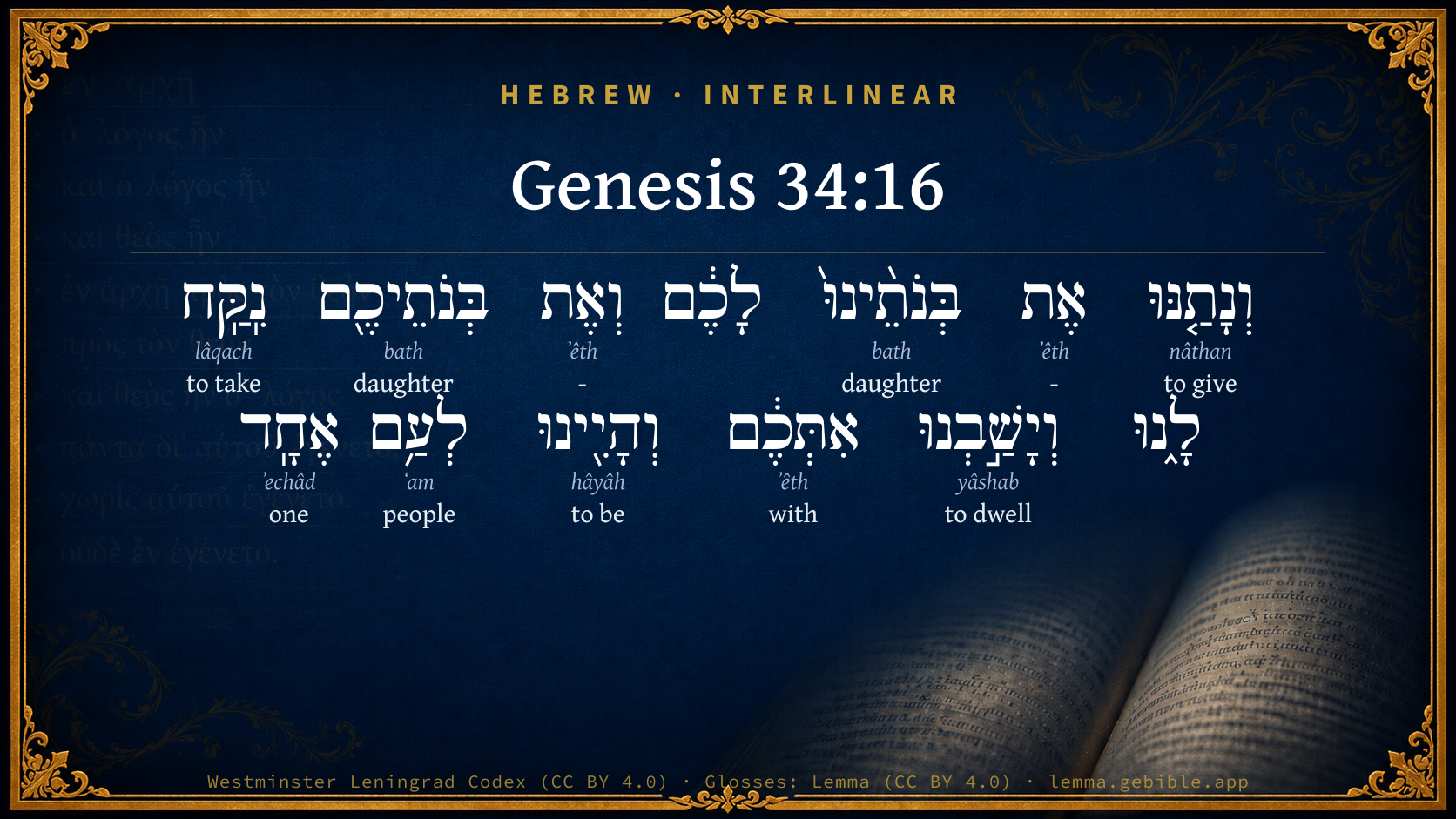
Genesis 34:16

Hebrew (Westminster Leningrad Codex) Genesis 34:16 appears in the Hebrew Old Testament. The text above is from the Westminster Leningrad Codex. Each word links to its Strong’s number, a concise gloss, and parsing drawn from the Open Scriptures Hebrew Bible morphology. Click any word for its full Brown-Driver-Briggs (BDB) entry.
Download image
Cite this verse

Genesis 34:16 (World English Bible). Public Domain. Lemma interlinear Bible study tool, https://lemma.gebible.app/v/genesis/34/16.

Show BibTeX & RIS
BibTeX
RIS
English Translation
then will we give our daughters to you, and we will take your daughters to us, and we will dwell with you, and we will become one people.
World English Bible · Public Domain
Download a study sheet

One document with this verse’s original text, its word-by-word gloss line, the meaning frame, cross-references with their text, attributed commentary, and full source and license credits — printable, and it pastes into notes with its structure intact.

This verse Autodidact and up

Study sheet (.html) Plain text (.txt)

A passage Seminary Student

Up to 50 verses in one chapter. A passage sheet keeps up to 6 commentary sources and 12 cross-references per verse, in the order this page ranks them, and says so on the sheet whenever that leaves anything out. Ask for a single verse and you get the Autodidact verse sheet above.

Everything on this page stays free to read, with no account — the sheet is a download of what is already on screen, not access to it.

Want to remove ads? Support Godless Engineer
Compare translations 3

The same verse in 3 English versions, stacked beneath the original-language interlinear above. Click any original word for its lexicon entry.

Each is an independent rendering of the whole verse — the interlinear is not word-aligned to these translations.

Highlighted words mark where these versions differ — a whole-verse word diff, not a word-by-word alignment.

  • World English Bible Public Domain
    then will we give our daughters to you, and we will take your daughters to us, and we will dwell with you, and we will become one people.
  • King James Version Public Domain
    Then will we give our daughters unto you, and we will take your daughters to us, and we will dwell with you, and we will become one people.
  • unfoldingWord Literal Text CC BY-SA 4.0
    Then we will give our daughters to you, and we will take your daughters for us. And we will settle with you, and we will become one people.

unfoldingWord Literal Text — © unfoldingWord, licensed CC BY-SA 4.0. Word-aligned USFM3 via Door43 (git.door43.org/unfoldingWord/en_ult).

Versions to compare (up to 4)

3 of 4 selected

Show all 18 translations

Every available English version of this verse, each an independent rendering of the whole verse.

  • World English Bible Public Domain
    then will we give our daughters to you, and we will take your daughters to us, and we will dwell with you, and we will become one people.
  • Berean Standard Bible Public Domain
    Then we will give you our daughters and take your daughters for ourselves. We will dwell among you and become one people.
  • Majority Standard Bible Public Domain
    Then we will give you our daughters and take your daughters for ourselves. We will dwell among you and become one people.
  • King James Version Public Domain
    Then will we give our daughters unto you, and we will take your daughters to us, and we will dwell with you, and we will become one people.
  • American Standard Version (1901) Public Domain
    then will we give our daughters unto you, and we will take your daughters to us, and we will dwell with you, and we will become one people.
  • Revised Version (1885) Public Domain
    then will we give our daughters unto you, and we will take your daughters to us, and we will dwell with you, and we will become one people.
  • Geneva Bible (1599) Public Domain
    Then will we giue our daughters to you, and we will take your daughters to vs, and will dwell with you, and be one people.
  • Douay-Rheims (1899) Public Domain
    Then will we mutually give and take your daughters, and ours: and we will dwell with you, and will be one people:
  • Young's Literal Translation Public Domain
    then we have given our daughters to you, and your daughters we take to ourselves, and we have dwelt with you, and have become one people;
  • Literal Standard Version CC BY-SA 4.0
    then we have given our daughters to you, and we take your daughters for ourselves, and we have dwelt with you, and have become one people;
  • Unlocked Literal Bible CC BY-SA 4.0
    Then will we give our daughters to you, and we will take your daughters to ourselves, and we will live with you and become one people.
  • unfoldingWord Literal Text CC BY-SA 4.0
    Then we will give our daughters to you, and we will take your daughters for us. And we will settle with you, and we will become one people.
  • Darby Bible Public Domain
    then will we give our daughters to you, and take your daughters to us, and we will dwell with you, and be one people.
  • World Messianic Bible Public Domain
    then will we give our daughters to you; and we will take your daughters to us, and we will dwell with you, and we will become one people.
  • Webster's Bible Public Domain
    Then will we give our daughters to you, and we will take your daughters to us, and we will dwell with you, and we will become one people.
  • Free Bible Version CC BY-SA 4.0
    Then we will give you our daughters and take your daughters, and we will live among you and become one family.
  • Bible in Basic English Public Domain
    Then we will give our daughters to you and take your daughters to us and go on living with you as one people.
  • JPS Tanakh (1917) Public Domain
    then will we give our daughters unto you, and we will take your daughters to us, and we will dwell with you, and we will become one people.

Literal Standard Version (2020), Covenant Press — licensed CC BY-SA 4.0. Text via the HelloAO Bible API (eBible.org). Unlocked Literal Bible (unfoldingWord) — licensed CC BY-SA 4.0. Text via the HelloAO Bible API (eBible.org). unfoldingWord Literal Text — © unfoldingWord, licensed CC BY-SA 4.0. Word-aligned USFM3 via Door43 (git.door43.org/unfoldingWord/en_ult). Free Bible Version, Dr. Jonathan Gallagher — licensed CC BY-SA 4.0. Text via the HelloAO Bible API (eBible.org).

Word by word

More ways to search: Search by grammar → Find every occurrence → Compare this word →

Practice this passage: Drill this verse → Learn its vocabulary →

בְּנֹתֵ֨ינוּ֙
bath
H1323
“daughters · our”
Noun, Common, Feminine, Plural, Construct + Suffix, Personal, 1st Person, Common, Plural
Part of Speech
Noun
Type
Common
Gender
Feminine
Number
Plural
State
Construct
Full BDB Definition

Origin: from H1129 and H1121

TWOT: 254b

daughter (noun feminine) - daughter, girl, adopted daughter, daughter-in-law, sister, granddaughters, female child, cousin - as polite address - as designation of women of a particular place (noun proper feminine) - young women, women (noun feminine) - as personification - daughter-villages - description of character
  1. וְנָתַ֤נּוּ nâthan H5414 “and · to give” Conjunction + Verb, Qal, Sequential Perfect, 1st Person, Common, Plural
  2. אֶת ʼêth H853 “-” Particle, Direct Object
  3. וְאֶת ʼêth H853 “and · -” Conjunction + Particle, Direct Object
  4. בְּנֹתֵיכֶ֖ם bath H1323 “daughters · your” Noun, Common, Feminine, Plural, Construct + Suffix, Personal, 2nd Person, Masculine, Plural
  5. נִֽקַּֽח lâqach H3947 “to take” Verb, Qal, Imperfect, 1st Person, Common, Plural
  6. וְיָשַׁ֣בְנוּ yâshab H3427 “and · to dwell” Conjunction + Verb, Qal, Sequential Perfect, 1st Person, Common, Plural
  7. אִתְּכֶ֔ם ʼêth H854 “with · you” Preposition + Suffix, Personal, 2nd Person, Masculine, Plural
  8. וְהָיִ֖ינוּ hâyâh H1961 “and · to be” Conjunction + Verb, Qal, Sequential Perfect, 1st Person, Common, Plural
  9. לְעַ֥ם ʻam H5971 “to/for · people” Preposition + Noun, Common, Masculine, Singular, Absolute
  10. אֶחָֽד ʼechâd H259 “one” Adjective, Cardinal number, Masculine, Singular, Absolute

About this verse

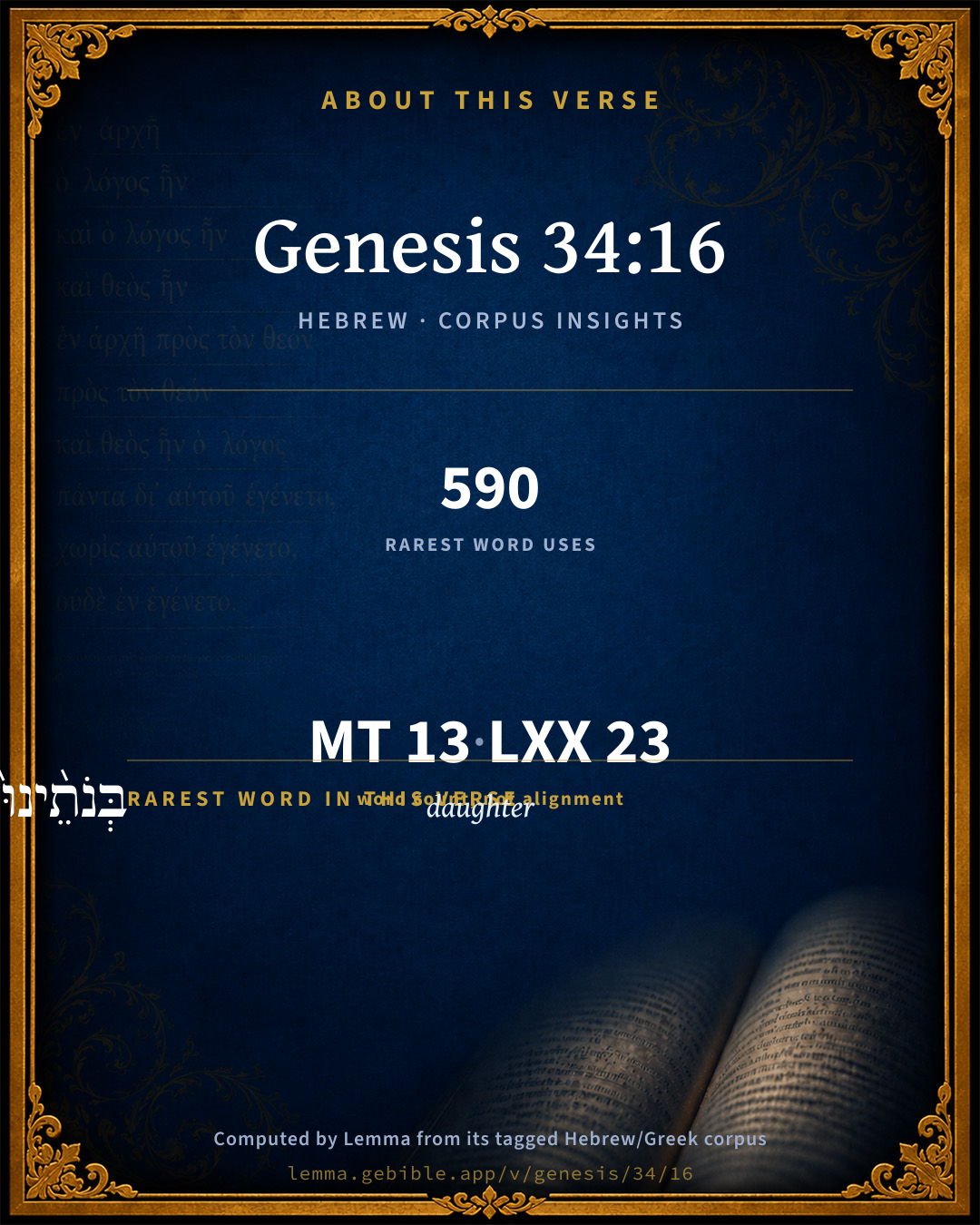
These counts appear in no published source. They are computed here, from the morphology-tagged text and Lemma’s own curated glosses. What Lemma adds →

13
words
9
distinct lemmas
Pentateuch
section

Grammatical profile

  • 4 verbs
  • 3 nouns
  • 1 adjective
  • 3 prepositions
  • 2 particles

Verb forms

  • וְנָתַ֤נּוּ Qal · Sequential Perfect
  • נִֽקַּֽח Qal · Imperfect
  • וְיָשַׁ֣בְנוּ Qal · Sequential Perfect
  • וְהָיִ֖ינוּ Qal · Sequential Perfect

Repetition

A word recurs within this verse — often emphatic in Hebrew:

  • בְּנֹתֵ֨ינוּ֙ daughter H1323 ×2

Hebrew & Septuagint length

In English translation the verse runs 28 words from the Hebrew and 32 from the Septuagint (LXX English) — closely comparable.

A rough comparison of the two English renderings, which tokenize alike — not a word-level alignment.

Word counts can differ between the Hebrew and the Greek without any difference in meaning — e.g. the Hebrew direct-object marker אֵת has no separate Greek word, and Greek often adds the article ὁ.

In the original languages it is 13 Hebrew tokens and 23 Greek tokens — but the two are counted differently (Hebrew bundles its prefixes and suffixes into one token; the Greek is in lemma form), so that isn’t a like-for-like length.

Hebrew and Greek witnesses Masoretic Hebrew ↔ Greek Septuagint

The same verse in the two great witnesses to the Old Testament, shown verse-for-verse.

These are two independent witnesses, not word-aligned to each other, and the Septuagint is shown in lemma (dictionary) form.

Hebrew Genesis 34:16 Masoretic · Westminster Leningrad Codex

וְנָתַ֤נּוּ אֶת בְּנֹתֵ֨ינוּ֙ לָכֶ֔ם וְאֶת בְּנֹתֵיכֶ֖ם נִֽקַּֽח לָ֑נוּ וְיָשַׁ֣בְנוּ אִתְּכֶ֔ם וְהָיִ֖ינוּ לְעַ֥ם אֶחָֽד

then will we give our daughters to you, and we will take your daughters to us, and we will dwell with you, and we will become one people.

World English Bible · Public Domain

Greek LXX Genesis 34:16 Septuagint · lemma form

καί δίδωμι ὁ θυγάτηρ ἐγώ σύ καί ἀπό ὁ θυγάτηρ σύ λαμβάνω ἐγώ γυνή καί οἰκέω παρά σύ καί εἰμί ὡς γένος εἷς

And we will give our daughters to you, and we will take of your daughters for wives to us, and we will dwell with you, and we will be as one race.

LXX2012 (modern English Septuagint) · Public Domain

Hebrew: Westminster Leningrad Codex (CC BY 4.0). Greek: Septuagint (public domain); English from LXX2012 (modern English Septuagint) (Public Domain). How the Septuagint differs from the Hebrew →

Targum (Aramaic paraphrase)

2

The Targum is the ancient Jewish Aramaic paraphrase of the Hebrew Scriptures — an interpretive translation, not the Hebrew text itself. Onkelos (literal) and Pseudo-Jonathan (expansive) render the Torah, and Jonathan the Prophets. Coverage is partial: where no permissively-licensed English translation exists for a verse, only the Aramaic is shown. This is verse-level text, not a word-by-word alignment to the Hebrew.

  1. Targum Onkelos Torah (Genesis–Deuteronomy)
    וְנִתַּן יָת בְּנָתָנָא לְכוֹן וְיָת בְּנָתֵיכוֹן נִסַּב לָנָא וְנִתּוּב עִמְּכוֹן וְנֵיהֵי לְעַמָּא חָד

    (no public-domain English translation for this verse)

    Targum Onkelos — Aramaic: “Onkelos Genesis” (public domain); “Onkelos Exodus” (public domain); “Onkelos Leviticus” (public domain); “Onkelos Numbers” (public domain); “Onkelos Deuteronomy” (public domain). English: “Sefaria Community Translation” (CC0 1.0 (public-domain dedication)); “J.W. Etheridge. The Targums of Onkelos and Jonathan Ben Uzziel on the Pentateuch. London: Longmans, Green, 1862” (public domain). Text via Sefaria.

  2. Targum Pseudo-Jonathan Torah (Genesis–Deuteronomy)
    וְנִיתַּן יַת בְּנָתָנָא לְכוֹן וְיַת בְּנָתֵיכוֹן נִיסַב לָנָא וְנִיתַב עִמְכוֹן וּנְהֵי לְעַמָא חָד

    And we will give our daughters to you, and will take your daughters to us, and dwell with you, and be one people.

    Targum Pseudo-Jonathan — Aramaic: “Targum Jonathan on Genesis” (public domain); “Targum Jonathan on Exodus” (public domain); “Targum Jonathan on Leviticus” (public domain); “Targum Jonathan on Numbers” (public domain); “Targum Jonathan on Deuteronomy” (public domain). English: “The Targum of Jonathan ben Uzziel, trans. J. W. Etheridge, London, 1862” (public domain). Text via Sefaria.

Commentary

Notes on Genesis 34:16 from classic Christian and Jewish commentators (each source and its license shown beneath its notes). The classic Christian expositions comment on the surrounding passage and are grouped to its opening verse, so a note may address several verses; the Jewish commentaries on the Tanakh (Rashi and others) are per-verse, so they appear only where the commentator wrote on this verse.

Lemma curates 59 commentaries, every one of them public domain or Creative Commons licensed, each selected and text-cleaned for this edition rather than reprinted as found. About our sources →

Trapp's Complete Commentary

John Trapp

Gen 34:16 Then will we give our daughters unto you, and we will take your daughters to us, and we will dwell with you, and we will become one people.

Ver. 16. Then will we give our daughters.] Whether Jacob were present at this whole conference, it is not certain. It is probable that he was not. For surely, he would either have dissuaded them from thus doing; or, if he had consented, he would have said something more to the Shechemites, for their better assurance. It is a maxim in Maehiavel; Fidem tamdiu servandam esse, quamdiu expediat. But Jacob had not known this depth of the devil: his sons better could skill of it. They seem to be somewhat akin to those Thracians, of whom it was anciently said, Eos foedera nescire; that they knew no covenants: or the Turks at this day, whose covenants, grounded upon the law of nations, be they with never so strong capitulations concluded, or solemnity of oath confirmed, have, with them, no longer force, than standeth with their own profit; serving, indeed, but as snares to entangle other princes in. {a} There is no faith, say they, to be kept with dogs; that is, with Christians. {b} And this, perhaps, they have learned of those pseudo-Christians, the Papists, who dealt so perfidiously with them at the great battle of Varna; where Amurath, the great Turk, seeing the great slaughter of his men, in spite of the oath given him by king Ladislaus, dispensed with by the Pope’s legate, and beholding the picture of the crucifix in the displayed ensigns of the voluntary Christians, he plucked the writing out of his bosom, wherein the late league was comprised, and holding it up in his hand, with his eyes cast up to heaven, said, Behold, thou crucified Christ, this is the league thy Christians, in thy Name, made with me, which they have, without cause, violated: Now, if thou be a God, as they say thou art, and as we dream, revenge the wrong now done to thy Name, and me; and show thy power upon thy perjurious people, who, in their deeds, deny thee their God. {c} And it happened out accordingly: for God hates foul and faithless dealing. {Zec 5:4 Rom 1:31} Periurii poena divina exitium; humana, dedecus. This was one of the laws of the twelve tables in Rome. {d}

{a} Turk. Hist.

{b} Ibid., 755.

{c} Ibid., 297.

{d} Heu miser, etsi quis primo periuria celat, Sera tamen tacitus poena venit pedibus - Tibull.

John Trapp, A Commentary or Exposition upon All the Books of the Old and New Testament (1647–1656) — public domain. Text from a community e-Sword module.

John Gill's Exposition

Then will we give our daughters unto you,.... Meaning Dinah, whom they call their daughter, Gen 34:17; because she was the daughter of their family, and because they were entreating in the name of their father, and in conformity to the language used by those they were treating with, Gen 34:9,

and we will take your daughters to us; in marriage for wives:

and we will dwell with you; not as sojourners but as fellow citizens:

and we will become one people; being so nearly related by marriage, and professing one religion, alike submitting to circumcision, which was the distinguished badge of Abraham's seed.

John Gill's Exposition of the Whole Bible (1746–1763) — public domain (CC PDM 1.0). Text via the HelloAO Bible API.

Rashi

Rabbi Shlomo Yitzchaki (Rashi)

וְנָתַנּוּ THEN WILL WE GIVE — The second נ has a Dagesh because it serves the purpose of two -נs - וְנָתַנְנוּ (cf. Rashi on Genesis חנני 33:11).

ואת בנותיכם נקח לנו AND WE WILL TAKE YOUR DAUGHTERS TO US — You will find that in the proposition which Hamor made to Jacob (Genesis 34:9) and in the reply of Jacob’s sons to Hamor (in this verse) they (both parties to the proposition) regarded the sons of Jacob as being the more important — that they should take of the daughters of Shechem whomsoever they would select for themselves and that they should give their daughters to them (the men of Shechem) as they (Jacob’s sons) would think fit, as it is written, “and we will give our daughters’’ — as we think fit — “and we will take your daughters unto us” — whomsoever we please. When, however, Hamor and his son spoke to the inhabitants of their city (v. 21) they reversed the matter, saying, “their daughters we will take to us for wives, and our daughters we will give unto them", instead of saying “they will give their daughters to us, and they will take our daughters to themselves", in order to induce them to consent to be circumcised.

Rashi on the Tanakh — English translations: “The Judaica Press complete Tanach with Rashi, translated by A. J. Rosenberg” (CC BY 4.0); “Pentateuch with Rashi's commentary by M. Rosenbaum and A.M. Silbermann, 1929-1934” (public domain); “The Metsudah Tanach series, Lakewood, N.J” (CC BY 4.0); and “The Book of Joshua, Metsudah Publications, 1997” (CC BY 4.0). Text via Sefaria.

Lesson kit

Teaching starters — assembled from the data on this page, not authored interpretation. Every prompt links to the verse data it draws on. Edit before teaching.

Genesis, in the Pentateuch, opens this verse with 13 words (9 distinct Hebrew lemmas). Its most distinctive word is bath (“daughter”). A historical commentator’s framing appears above. Read the whole chapter for the surrounding context.

Discussion questions

  1. How does “daughter” (bath) shape what this verse is saying?
  2. “daughter” occurs 2× in this one verse. What is the effect of the repetition?
  3. These translations render this verse differently. What is at stake in choosing one wording over another?
  4. The verb «וְנָתַ֤נּוּ» is Qal Sequential Perfect. How does its form color the action?
  5. Reading how Trapp's Complete Commentary and John Gill's Exposition read this verse, where do the two commentators agree and where do they part?

Things to notice

Reading settings

Reading text

Shown beneath each verse's original-language words.

Old Testament
Old Testament edition

Read the OT as the Masoretic Hebrew (MT) or the Greek Septuagint (LXX).

English shown for the Greek Septuagint (in the Hebrew ↔ Greek comparison).

Comparing translations? Open the Compare panel on any verse page to stack up to four side by side.