
Genesis 17:16

Hebrew (Westminster Leningrad Codex) Genesis 17:16 appears in the Hebrew Old Testament. The text above is from the Westminster Leningrad Codex. Each word links to its Strong’s number, a concise gloss, and parsing drawn from the Open Scriptures Hebrew Bible morphology. Click any word for its full Brown-Driver-Briggs (BDB) entry.
Download image
Cite this verse

Genesis 17:16 (World English Bible). Public Domain. Lemma interlinear Bible study tool, https://lemma.gebible.app/v/genesis/17/16.

Show BibTeX & RIS
BibTeX
RIS
English Translation
I will bless her, and moreover I will give you a son by her. Yes, I will bless her, and she will be a mother of nations. Kings of peoples will come from her."
World English Bible · Public Domain
Download a study sheet

One document with this verse’s original text, its word-by-word gloss line, the meaning frame, cross-references with their text, attributed commentary, and full source and license credits — printable, and it pastes into notes with its structure intact.

This verse Autodidact and up

Study sheet (.html) Plain text (.txt)

A passage Seminary Student

Up to 50 verses in one chapter. A passage sheet keeps up to 6 commentary sources and 12 cross-references per verse, in the order this page ranks them, and says so on the sheet whenever that leaves anything out. Ask for a single verse and you get the Autodidact verse sheet above.

Everything on this page stays free to read, with no account — the sheet is a download of what is already on screen, not access to it.

Want to remove ads? Support Godless Engineer
Compare translations 3

The same verse in 3 English versions, stacked beneath the original-language interlinear above. Click any original word for its lexicon entry.

Each is an independent rendering of the whole verse — the interlinear is not word-aligned to these translations.

Highlighted words mark where these versions differ — a whole-verse word diff, not a word-by-word alignment.

  • World English Bible Public Domain
    I will bless her, and moreover I will give you a son by her. Yes, I will bless her, and she will be a mother of nations. Kings of peoples will come from her."
  • King James Version Public Domain
    And I will bless her, and give thee a son also of her: yea, I will bless her, and she shall be a mother of nations; kings of people shall be of her.
  • unfoldingWord Literal Text CC BY-SA 4.0
    And I will bless her, and I will also give to you a son from her. Indeed, I will bless her and she will become nations; kings of peoples will come from her.”

unfoldingWord Literal Text — © unfoldingWord, licensed CC BY-SA 4.0. Word-aligned USFM3 via Door43 (git.door43.org/unfoldingWord/en_ult).

Versions to compare (up to 4)

3 of 4 selected

Show all 18 translations

Every available English version of this verse, each an independent rendering of the whole verse.

  • World English Bible Public Domain
    I will bless her, and moreover I will give you a son by her. Yes, I will bless her, and she will be a mother of nations. Kings of peoples will come from her."
  • Berean Standard Bible Public Domain
    And I will bless her and will surely give you a son by her. I will bless her, and she will be the mother of nations; kings of peoples will descend from her.”
  • Majority Standard Bible Public Domain
    And I will bless her and will surely give you a son by her. I will bless her, and she will be the mother of nations; kings of peoples will descend from her.”
  • King James Version Public Domain
    And I will bless her, and give thee a son also of her: yea, I will bless her, and she shall be a mother of nations; kings of people shall be of her.
  • American Standard Version (1901) Public Domain
    And I will bless her, and moreover I will give thee a son of her: yea, I will bless her, and she shall be `a mother of' nations; kings of peoples shall be of her.
  • Revised Version (1885) Public Domain
    And I will bless her, and moreover I will give thee a son of her: yea, I will bless her, and she shall be a mother of nations; kings of peoples shall be of her.
  • Geneva Bible (1599) Public Domain
    And I will blesse her, and will also giue thee a sonne of her, yea, I will blesse her, and she shall be the mother of nations: Kings also of people shall come of her.
  • Douay-Rheims (1899) Public Domain
    And I will bless her, and of her I will give thee a son, whom I will bless, and he shell become nations, and kings of people shall spring from him.
  • Young's Literal Translation Public Domain
    and I have blessed her, and have also given to thee a son from her; and I have blessed her, and she hath become nations -- kings of peoples are from her.'
  • Literal Standard Version CC BY-SA 4.0
    and I have blessed her, and have also given to you a son from her; and I have blessed her, and she has become nations—kings of peoples are from her.”
  • Unlocked Literal Bible CC BY-SA 4.0
    I will bless her, and I will give you a son by her. I will bless her, and she will become the mother of nations. Kings of peoples will come from her.”
  • unfoldingWord Literal Text CC BY-SA 4.0
    And I will bless her, and I will also give to you a son from her. Indeed, I will bless her and she will become nations; kings of peoples will come from her.”
  • Darby Bible Public Domain
    And I will bless her, and I will give thee a son also of her; and I will bless her, and she shall become nations: kings of peoples shall be of her.
  • World Messianic Bible Public Domain
    I will bless her, and moreover I will give you a son by her. Yes, I will bless her, and she will be a mother of nations. Kings of peoples will come from her.”
  • Webster's Bible Public Domain
    And I will bless her, and give thee a son also by her: yea, I will bless her, and she shall be a mother of nations; kings of people shall proceed from her.
  • Free Bible Version CC BY-SA 4.0
    I will bless her and I promise to give you a son by her. I will bless her so that she will become the mother of nations, and kings will be among her descendants.”
  • Bible in Basic English Public Domain
    And I will give her a blessing so that you will have a son by her: truly my blessing will be on her, and she will be the mother of nations: kings of peoples will be her offspring.
  • JPS Tanakh (1917) Public Domain
    And I will bless her, and moreover I will give thee a son of her; yea, I will bless her, and she shall be a mother of nations; kings of peoples shall be of her.'

Literal Standard Version (2020), Covenant Press — licensed CC BY-SA 4.0. Text via the HelloAO Bible API (eBible.org). Unlocked Literal Bible (unfoldingWord) — licensed CC BY-SA 4.0. Text via the HelloAO Bible API (eBible.org). unfoldingWord Literal Text — © unfoldingWord, licensed CC BY-SA 4.0. Word-aligned USFM3 via Door43 (git.door43.org/unfoldingWord/en_ult). Free Bible Version, Dr. Jonathan Gallagher — licensed CC BY-SA 4.0. Text via the HelloAO Bible API (eBible.org).

Word by word

More ways to search: Search by grammar → Find every occurrence → Compare this word →

Practice this passage: Drill this verse → Learn its vocabulary →

וּבֵרַכְתִּ֣י
bârak
H1288
“and · to bless”
Conjunction + Verb, Piel, Sequential Perfect, 1st Person, Common, Singular
Part of Speech
Conjunction + Verb
Stem
Piel
Form
Sequential Perfect
Person
1st Person
Gender
Common
Number
Singular
Full BDB Definition

Origin: a primitive root

TWOT: 285

to bless, kneel - (Qal) - to kneel - to bless - (Niphal) to be blessed, bless oneself - (Piel) to bless - (Pual) to be blessed, be adored - (Hiphil) to cause to kneel - (Hithpael) to bless oneself - (TWOT) to praise, salute, curse
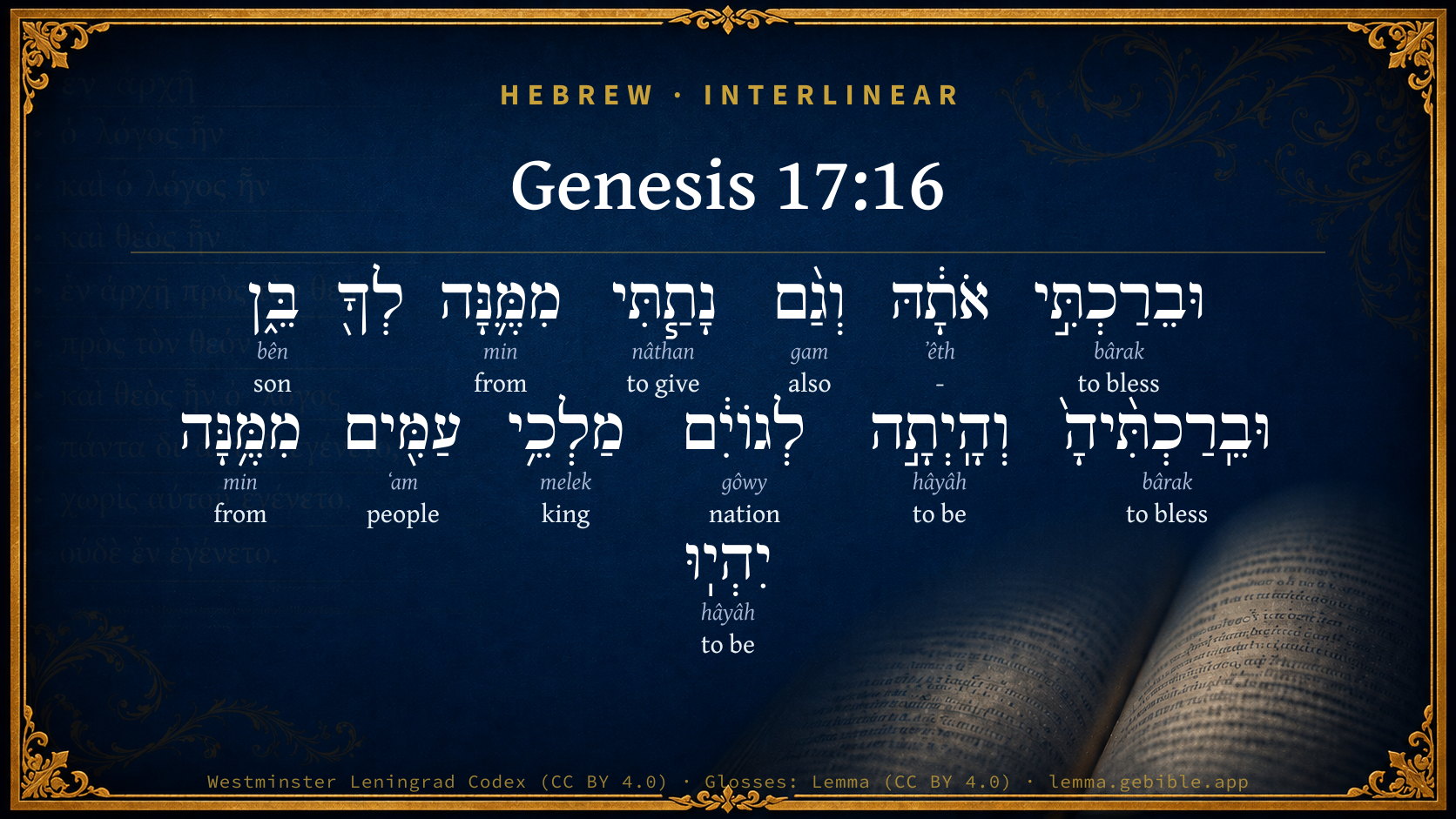
  1. אֹתָ֔הּ ʼêth H853 “- · her” Particle, Direct Object + Suffix, Personal, 3rd Person, Feminine, Singular
  2. וְגַ֨ם gam H1571 “and · also” Conjunction + Particle, Accusative
  3. נָתַ֧תִּי nâthan H5414 “to give” Verb, Qal, Perfect, 1st Person, Common, Singular
  4. מִמֶּ֛נָּה min H4480 “from · her” Preposition + Suffix, Personal, 3rd Person, Feminine, Singular
  5. בֵּ֑ן bên H1121 “son” Noun, Common, Masculine, Singular, Absolute
  6. וּבֵֽרַכְתִּ֨יהָ֙ bârak H1288 “and · to bless · her” Conjunction + Verb, Piel, Sequential Perfect, 1st Person, Common, Singular + Suffix, Personal, 3rd Person, Feminine, Singular
  7. וְהָֽיְתָ֣ה hâyâh H1961 “and · to be” Conjunction + Verb, Qal, Sequential Perfect, 3rd Person, Feminine, Singular
  8. לְגוֹיִ֔ם gôwy H1471 “to/for · nations” Preposition + Noun, Common, Masculine, Plural, Absolute
  9. מַלְכֵ֥י melek H4428 “kings of” Noun, Common, Masculine, Plural, Construct
  10. עַמִּ֖ים ʻam H5971 “peoples” Noun, Common, Masculine, Plural, Absolute
  11. מִמֶּ֥נָּה min H4480 “from · her” Preposition + Suffix, Personal, 3rd Person, Feminine, Singular
  12. יִהְיֽוּ hâyâh H1961 “to be” Verb, Qal, Imperfect, 3rd Person, Masculine, Plural

About this verse

These counts appear in no published source. They are computed here, from the morphology-tagged text and Lemma’s own curated glosses. What Lemma adds →

14
words
10
distinct lemmas
Pentateuch
section

Grammatical profile

  • 5 verbs
  • 4 nouns
  • 3 prepositions
  • 2 particles

Verb forms

  • וּבֵרַכְתִּ֣י Piel · Sequential Perfect
  • נָתַ֧תִּי Qal · Perfect
  • וּבֵֽרַכְתִּ֨יהָ֙ Piel · Sequential Perfect
  • וְהָֽיְתָ֣ה Qal · Sequential Perfect
  • יִהְיֽוּ Qal · Imperfect

Repetition

Words recur within this verse — often emphatic in Hebrew:

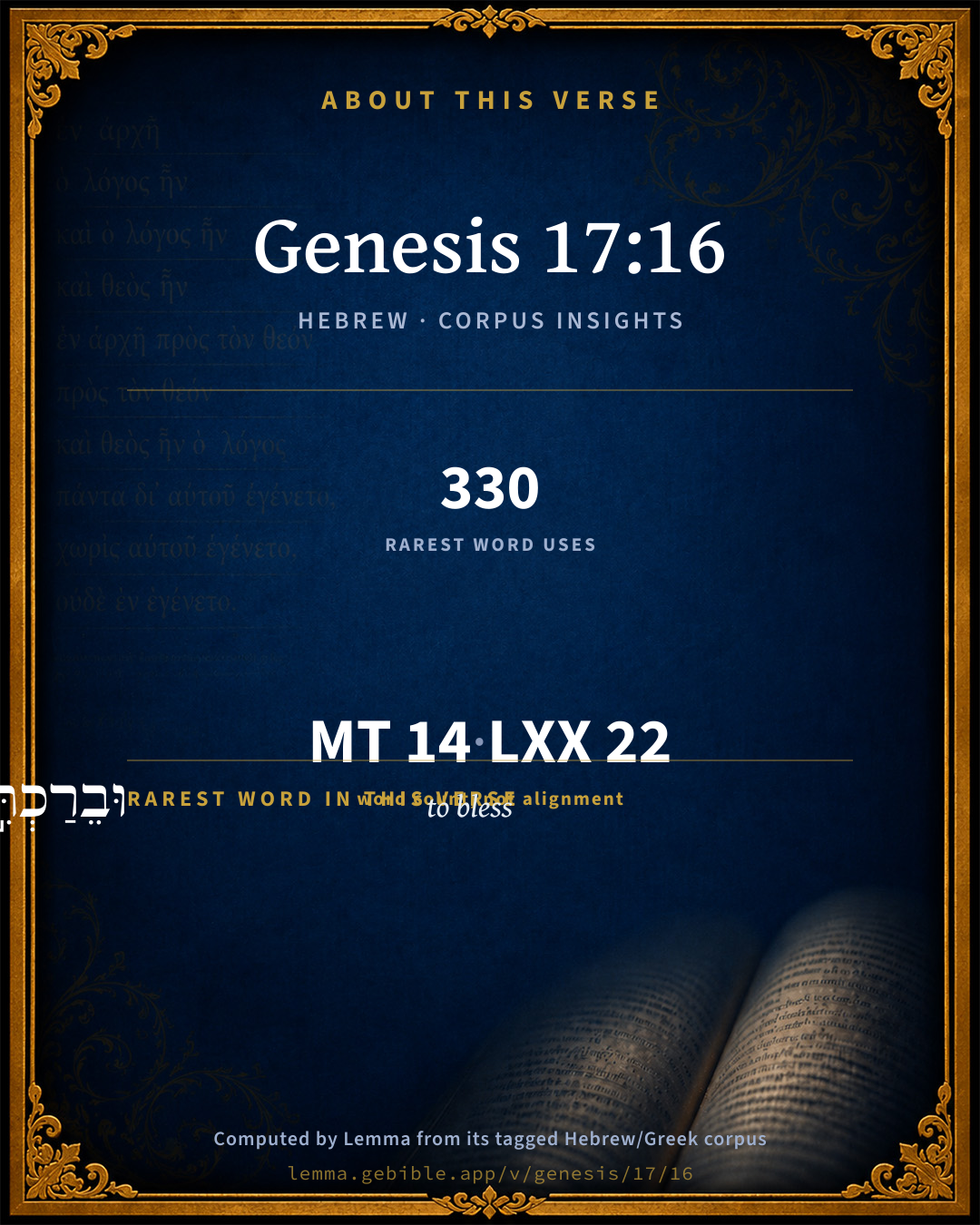
  • וּבֵרַכְתִּ֣י to bless H1288 ×2
  • וְהָֽיְתָ֣ה to be H1961 ×2
  • מִמֶּ֛נָּה from H4480 ×2

Hebrew & Septuagint length

In English translation the verse runs 34 words from the Hebrew and 30 from the Septuagint (LXX English) — closely comparable.

A rough comparison of the two English renderings, which tokenize alike — not a word-level alignment.

Word counts can differ between the Hebrew and the Greek without any difference in meaning — e.g. the Hebrew direct-object marker אֵת has no separate Greek word, and Greek often adds the article ὁ.

In the original languages it is 14 Hebrew tokens and 22 Greek tokens — but the two are counted differently (Hebrew bundles its prefixes and suffixes into one token; the Greek is in lemma form), so that isn’t a like-for-like length.

Cross-references

10

Topical passages linked to Genesis 17:16 in the Treasury of Scripture Knowledge — connected by theme and wording, ordered by reader-vote popularity; previews shown in the World English Bible.

  • Genesis 35:11 God said to him, "I am God Almighty. Be fruitful and multiply. A nation and a company of nations will be from you, and kings will come out of your loins.
  • Genesis 17:6 I will make you exceeding fruitful, and I will make nations of you. Kings will come out of you.
  • Genesis 18:10–14 He said, "I will certainly return to you when the season comes round. Behold, Sarah your wife will have a son." Sarah heard in the tent door, which was behind him.
  • Isaiah 49:23 Kings shall be your nursing fathers, and their queens your nursing mothers: they shall bow down to you with their faces to the earth, and lick the dust of your feet; and you shall know that I am Yahweh; and those who wait for me shall not be disappointed.
  • Galatians 4:26–31 But the Jerusalem that is above is free, which is the mother of us all.
  • 1 Peter 3:6 as Sarah obeyed Abraham, calling him lord, whose children you now are, if you do well, and are not put in fear by any terror.
  • Genesis 1:28 God blessed them. God said to them, "Be fruitful, multiply, fill the earth, and subdue it. Have dominion over the fish of the sea, over the birds of the sky, and over every living thing that moves on the earth."
  • Genesis 12:2 I will make of you a great nation. I will bless you, and make your name great. You will be a blessing.
  • Genesis 24:60 They blessed Rebekah, and said to her, "Our sister, may you be the mother of thousands of ten thousands, and let your seed possess the gate of those who hate them."
  • Romans 9:9 For this is a word of promise, "At the appointed time I will come, and Sarah will have a son."

Cross-references courtesy of OpenBible.info (CC BY 4.0).

Hebrew and Greek witnesses Masoretic Hebrew ↔ Greek Septuagint

The same verse in the two great witnesses to the Old Testament, shown verse-for-verse.

These are two independent witnesses, not word-aligned to each other, and the Septuagint is shown in lemma (dictionary) form.

Hebrew Genesis 17:16 Masoretic · Westminster Leningrad Codex

וּבֵרַכְתִּ֣י אֹתָ֔הּ וְגַ֨ם נָתַ֧תִּי מִמֶּ֛נָּה לְךָ֖ בֵּ֑ן וּבֵֽרַכְתִּ֨יהָ֙ וְהָֽיְתָ֣ה לְגוֹיִ֔ם מַלְכֵ֥י עַמִּ֖ים מִמֶּ֥נָּה יִהְיֽוּ

I will bless her, and moreover I will give you a son by her. Yes, I will bless her, and she will be a mother of nations. Kings of peoples will come from her."

World English Bible · Public Domain

Greek LXX Genesis 17:16 Septuagint · lemma form

εὐλογέω δέ αὐτός καί δίδωμι σύ ἐκ αὐτός τέκνον καί εὐλογέω αὐτός καί εἰμί εἰς ἔθνος καί βασιλεύς ἔθνος ἐκ αὐτός εἰμί

And I will bless her, and give you a son of her, and I will bless him, and he shall become nations, and kings of nations shall be of him.

LXX2012 (modern English Septuagint) · Public Domain

Hebrew: Westminster Leningrad Codex (CC BY 4.0). Greek: Septuagint (public domain); English from LXX2012 (modern English Septuagint) (Public Domain). How the Septuagint differs from the Hebrew →

Targum (Aramaic paraphrase)

2

The Targum is the ancient Jewish Aramaic paraphrase of the Hebrew Scriptures — an interpretive translation, not the Hebrew text itself. Onkelos (literal) and Pseudo-Jonathan (expansive) render the Torah, and Jonathan the Prophets. Coverage is partial: where no permissively-licensed English translation exists for a verse, only the Aramaic is shown. This is verse-level text, not a word-by-word alignment to the Hebrew.

  1. Targum Onkelos Torah (Genesis–Deuteronomy)
    וֶאֱבָרֵךְ יָתַהּ וְאַף אֶתֵּן מִנַהּ לָךְ בָּר וֶאֱבָרֲכִנַהּ וּתְהֵי לְכִנְשִׁין מַלְכִין דְשַׁלִּיטִין בְעַמְמַיָּא מִנַהּ יְהוֹן

    (no public-domain English translation for this verse)

    Targum Onkelos — Aramaic: “Onkelos Genesis” (public domain); “Onkelos Exodus” (public domain); “Onkelos Leviticus” (public domain); “Onkelos Numbers” (public domain); “Onkelos Deuteronomy” (public domain). English: “Sefaria Community Translation” (CC0 1.0 (public-domain dedication)); “J.W. Etheridge. The Targums of Onkelos and Jonathan Ben Uzziel on the Pentateuch. London: Longmans, Green, 1862” (public domain). Text via Sefaria.

  2. Targum Pseudo-Jonathan Torah (Genesis–Deuteronomy)
    וַאֲבָרֵךְ יָתָהּ בְּגוּפָהּ וְאַף אֶתֵּן מִנָהּ לָךְ בַּר וַאֲבָרְכִינָהּ בֵּיהּ וּתְהִי לְכִנְשִׁין וּמַלְכִין שַׁלִיטִין בְּעַמְמַיָא מִינָהּ יְהוֹן

    And I will bless in her body, and will also give from her a son to thee, and I will bless, him, and he shall be for assemblies, and kings ruling over nations shall be from her.

    Targum Pseudo-Jonathan — Aramaic: “Targum Jonathan on Genesis” (public domain); “Targum Jonathan on Exodus” (public domain); “Targum Jonathan on Leviticus” (public domain); “Targum Jonathan on Numbers” (public domain); “Targum Jonathan on Deuteronomy” (public domain). English: “The Targum of Jonathan ben Uzziel, trans. J. W. Etheridge, London, 1862” (public domain). Text via Sefaria.

Commentary

Notes on Genesis 17:16 from classic Christian and Jewish commentators (each source and its license shown beneath its notes). The classic Christian expositions comment on the surrounding passage and are grouped to its opening verse, so a note may address several verses; the Jewish commentaries on the Tanakh (Rashi and others) are per-verse, so they appear only where the commentator wrote on this verse.

Lemma curates 59 commentaries, every one of them public domain or Creative Commons licensed, each selected and text-cleaned for this edition rather than reprinted as found. About our sources →

Trapp's Complete Commentary

John Trapp

Gen 17:16 And I will bless her, and give thee a son also of her: yea, I will bless her, and she shall be [a mother] of nations; kings of people shall be of her.

Ver. 16. Yea, I will bless her.] This is repeated, for the greater comfort of this good old couple, q.d., I will double-bless her, bless her with a witness. Margarita in mari nascitur, verum ex rore coelesti .

John Trapp, A Commentary or Exposition upon All the Books of the Old and New Testament (1647–1656) — public domain. Text from a community e-Sword module.

Adam Clarke's Commentary

Verse 16. I will bless her, c.] Sarah certainly stands at the head of all the women of the Old Testament, on account of her extraordinary privileges. I am quite of Calmet's opinion that Sarah was a type of the blessed Virgin. St. Paul considers her a type of the New Testament and heavenly Jerusalem and as all true believers are considered as the children of Abraham, so all faithful holy women are considered the daughters of Sarah, Ga 4:22; Ga 4:24; Ga 4:26. See also 1Pe 3:6.

Adam Clarke's Commentary on the Bible (1810–1826) — public domain. Text from a community e-Sword/MySword module.

Ellicott's Commentary for English Readers

(16) A son . . . of her.—This is the first place where it was definitely promised that Abram’s heir should be Sarah’s own son. This must be remembered in estimating the conduct of Abram and Sarah in the matter of Hagar. They had long waited, and hoped, before taking measures of their own for the fulfilment of the promise. The rest of the verse should be translated, “she shall become (grow into) nations: kings of peoples shall become of her, that is, “shall spring from her.”

A Bible Commentary for English Readers, edited by Charles John Ellicott (1878–1897) — public domain. Text from a community e-Sword module.

The Cambridge Bible for Schools and Colleges

gen. ed. J. J. S. Perowne

16. nations … kings of peoples] See note on Gen_17:6.

The Cambridge Bible for Schools and Colleges (gen. ed. J. J. S. Perowne; Cambridge University Press, 1878–1918) — public domain. Text from a community e-Sword module.

John Gill's Exposition

And I will bless her,.... The Targum of Jonathan adds, "in her body", with fruitfulness, who before was barren, and in her soul with spiritual blessings, and in both with the blessing of eternal life:

and give thee a son also of her; as he had given him one of Hagar: God had before promised Abraham a son that should be his heir, but he had not till now told him that he should be born of Sarah his wife:

yea, I will bless her; which is repeated for the confirmation of it, and for the greater strengthening Abraham's faith in it:

and she shall be a mother of nations; of the twelve tribes of Israel; of the two nations of Israel and Judah:

kings of people shall be of her; as David, Solomon, and others, and especially the King Messiah.

John Gill's Exposition of the Whole Bible (1746–1763) — public domain (CC PDM 1.0). Text via the HelloAO Bible API.

Haydock's Catholic Bible Commentary

Bless, and enable her to have a son, who shall also have many children. --- Whom. This is referred to Sara, in Hebrew and Chaldean; but to Isaac, in the Syriac. The blessing, at any rate, reverts to the mother; who was a figure of the blessed Virgin, and of the Church; both persecuted with their children; both, in the end, triumphant. (Galatians iv. 23.) (Calmet)

George Leo Haydock (1774–1849), Haydock's Catholic Family Bible and Commentary, 1859 edition — public domain. Excludes Psalms (Douay-Rheims chapter numbering differs from Protestant) and Deuterocanonical books (Catholic canon only).

Whedon's Commentary on the Bible

Daniel D. Whedon

16. She shall be a mother of nations — Hebrews, she shall become nations. Hence appropriately named Sarah, the princess.

Daniel D. Whedon (gen. ed.), Commentary on the Old and New Testaments (1874–1909) — public domain. Text from a community e-Sword module.

The Pulpit Commentary

And I will bless her, and give thee a son also of her (the first intimation that the promised seed was to be Sarai"s child), and she shall be a mother of nations; literally, she shall become nations (cf. Ver. 4)kings of people shall be of her.

The Pulpit Commentary (1880–1919), ed. H.D.M. Spence-Jones & Joseph S. Exell — public domain. Text from a community e-Sword module.

Rashi

Rabbi Shlomo Yitzchaki (Rashi)

וברבתי אותה AND I WILL BLESS HER — And in what did the blessing consist? In that she resumed her youthfulness, as it is said, (Genesis 18:12) “shall I have the pleasure of youth again?” (Genesis Rabbah 47:2)

וברכתיה AND I WILL BLESS HER with teeming breasts. And this happened when she really needed this on the day of Isaac’s feast. For people were speaking spitefully about them, that they had adopted a foundling from the street saying, “This is our son.” Every one, therefore, brought her child with her, but did not bring the wet-nurse and she (Sarah) suckled all of them. To this refers that which is said (Genesis 21:7) “Sarah has given suck to children”. In Genesis Rabbah 47:2 this is alluded to in part.

Rashi on the Tanakh — English translations: “The Judaica Press complete Tanach with Rashi, translated by A. J. Rosenberg” (CC BY 4.0); “Pentateuch with Rashi's commentary by M. Rosenbaum and A.M. Silbermann, 1929-1934” (public domain); “The Metsudah Tanach series, Lakewood, N.J” (CC BY 4.0); and “The Book of Joshua, Metsudah Publications, 1997” (CC BY 4.0). Text via Sefaria.

Radak

Rabbi David Kimhi (Radak)

וברכתי, I will restore her youthfulness so that she will begin having her periods again. Another, even greater miracle, will be the fact that she will give birth. This is meant by the additional words וגם נתתי ממנה לך בן, "and I will also give you a son from her." The word נתתי is similarly used in Genesis 23,13 נתתי כסף השדה "I have given the money for the field," where also the transaction had not taken place yet, but Avraham made plain that he had already made all the arrangement s from his side. When G'd promised it is as if it had happened already.

וברכתיה, with numerous seed which will emerge from her son. This is the meaning of the words והיתה לגוים, "she will develop into nations." The reference is to her grandchildren Esau and Yaakov, each of whom became founding fathers of large nations. Possible, G'd referred only to the descendants of Yaakov as per Onkelos. This too is meant by the words מלכי עמים, "kings of nations." Compare verse 6 above.

Radak on the Tanakh — English translations: “Sefaria Community Translation” (CC0 1.0 (public-domain dedication)); “Eliyahu Munk, HaChut Hameshulash” (CC BY 4.0); “Rabbi Mike Feuer, Jerusalem Anthology” (CC BY 4.0); and “R. David Kimhi on the first book of Psalms, Translated by R.G. Finch, London, 1919” (public domain). Text via Sefaria.

Lesson kit

Teaching starters — assembled from the data on this page, not authored interpretation. Every prompt links to the verse data it draws on. Edit before teaching.

Genesis, in the Pentateuch, opens this verse with 14 words (10 distinct Hebrew lemmas). Its most distinctive word is bârak (“to bless”). A historical commentator’s framing appears above. Read the whole chapter for the surrounding context.

Discussion questions

  1. What does “to bless” (bârak) contribute to the verse as a whole?
  2. How does Genesis 35:11, which shares this passage’s theme, read alongside this verse?
  3. What does the repetition of “to bless” (2× in this one verse) do in this verse?
  4. These translations render this verse differently. What is at stake in choosing one wording over another?
  5. «וּבֵרַכְתִּ֣י» is a Piel Sequential Perfect verb. How does that grammatical form shape the action described?
  6. Compare how Trapp's Complete Commentary and Adam Clarke's Commentary read this verse. Where do they agree or differ?

Things to notice

Reading settings

Reading text

Shown beneath each verse's original-language words.

Old Testament
Old Testament edition

Read the OT as the Masoretic Hebrew (MT) or the Greek Septuagint (LXX).

English shown for the Greek Septuagint (in the Hebrew ↔ Greek comparison).

Comparing translations? Open the Compare panel on any verse page to stack up to four side by side.