
Genesis 38:16

Hebrew (Westminster Leningrad Codex) Genesis 38:16 appears in the Hebrew Old Testament. The text above is from the Westminster Leningrad Codex. Each word links to its Strong’s number, a concise gloss, and parsing drawn from the Open Scriptures Hebrew Bible morphology. Click any word for its full Brown-Driver-Briggs (BDB) entry.
Download image
Cite this verse

Genesis 38:16 (World English Bible). Public Domain. Lemma interlinear Bible study tool, https://lemma.gebible.app/v/genesis/38/16.

Show BibTeX & RIS
BibTeX
RIS
English Translation
He turned to her by the way, and said, "Please come, let me come in to you:" for he didn't know that she was his daughter-in-law. She said, "What will you give me, that you may come in to me?"
World English Bible · Public Domain
Download a study sheet

One document with this verse’s original text, its word-by-word gloss line, the meaning frame, cross-references with their text, attributed commentary, and full source and license credits — printable, and it pastes into notes with its structure intact.

This verse Autodidact and up

Study sheet (.html) Plain text (.txt)

A passage Seminary Student

Up to 50 verses in one chapter. A passage sheet keeps up to 6 commentary sources and 12 cross-references per verse, in the order this page ranks them, and says so on the sheet whenever that leaves anything out. Ask for a single verse and you get the Autodidact verse sheet above.

Everything on this page stays free to read, with no account — the sheet is a download of what is already on screen, not access to it.

Want to remove ads? Support Godless Engineer
Compare translations 3

The same verse in 3 English versions, stacked beneath the original-language interlinear above. Click any original word for its lexicon entry.

Each is an independent rendering of the whole verse — the interlinear is not word-aligned to these translations.

Highlighted words mark where these versions differ — a whole-verse word diff, not a word-by-word alignment.

  • World English Bible Public Domain
    He turned to her by the way, and said, "Please come, let me come in to you:" for he didn't know that she was his daughter-in-law. She said, "What will you give me, that you may come in to me?"
  • King James Version Public Domain
    And he turned unto her by the way, and said, Go to, I pray thee, let me come in unto thee; (for he knew not that she was his daughter in law.) And she said, What wilt thou give me, that thou mayest come in unto me?
  • unfoldingWord Literal Text CC BY-SA 4.0
    So he turned to her beside the road and said, “Please come, let me come to you,” because he did not know that she his daughter-in-law. And she said, “What will you give to me if you will come to me?”

unfoldingWord Literal Text — © unfoldingWord, licensed CC BY-SA 4.0. Word-aligned USFM3 via Door43 (git.door43.org/unfoldingWord/en_ult).

Versions to compare (up to 4)

3 of 4 selected

Show all 18 translations

Every available English version of this verse, each an independent rendering of the whole verse.

  • World English Bible Public Domain
    He turned to her by the way, and said, "Please come, let me come in to you:" for he didn't know that she was his daughter-in-law. She said, "What will you give me, that you may come in to me?"
  • Berean Standard Bible Public Domain
    Not realizing that she was his daughter-in-law, he went over to her and said, “Come now, let me sleep with you.” “What will you give me for sleeping with you?” she inquired.
  • Majority Standard Bible Public Domain
    Not realizing that she was his daughter-in-law, he went over to her and said, “Come now, let me sleep with you.” “What will you give me for sleeping with you?” she inquired.
  • King James Version Public Domain
    And he turned unto her by the way, and said, Go to, I pray thee, let me come in unto thee; (for he knew not that she was his daughter in law.) And she said, What wilt thou give me, that thou mayest come in unto me?
  • American Standard Version (1901) Public Domain
    And he turned unto her by the way, and said, Come, I pray thee, let me come in unto thee: for he knew not that she was his daughter-in-law. And she said, What wilt thou give me, that thou mayest come in unto me?
  • Revised Version (1885) Public Domain
    And he turned unto her by the way, and said, Go to, I pray thee, let me come in unto thee: for he knew not that she was his daughter in law. And she said, What wilt thou give me, that thou mayest come in unto me?
  • Geneva Bible (1599) Public Domain
    And he turned to the way towardes her, and saide, Come, I pray thee, let me lie with thee. (for he knewe not that she was his daughter in lawe) And she answered, What wilt thou giue me for to lie with me?
  • Douay-Rheims (1899) Public Domain
    When Juda saw her, he thought she was a harlot: for she had covered her face, lest she should be known.
  • Young's Literal Translation Public Domain
    and he turneth aside unto her by the way, and saith, `Come, I pray thee, let me come in unto thee,' (for he hath not known that she `is' his daughter-in-law); and she saith, `What dost thou give to me, that thou mayest come in unto me?'
  • Literal Standard Version CC BY-SA 4.0
    and he turns aside to her by the way and says, “Please come, let me come in to you,” for he has not known that she [is] his daughter-in-law; and she says, “What do you give to me, that you may come in to me?”
  • Unlocked Literal Bible CC BY-SA 4.0
    He went to her by the road and said, “Come, please let me sleep with you”—for he did not know that she was his daughter-in-law—and she said, “What will you give me so you can sleep with me?”
  • unfoldingWord Literal Text CC BY-SA 4.0
    So he turned to her beside the road and said, “Please come, let me come to you,” because he did not know that she his daughter-in-law. And she said, “What will you give to me if you will come to me?”
  • Darby Bible Public Domain
    And he turned aside to her by the way, and said, Come, I pray thee, let me go in to thee; for he did not know that she was his daughter-in-law. And she said, What wilt thou give me, that thou mayest come in to me?
  • World Messianic Bible Public Domain
    He turned to her by the way, and said, “Please come, let me come in to you,” for he didn’t know that she was his daughter-in-law. She said, “What will you give me, that you may come in to me?”
  • Webster's Bible Public Domain
    And he turned to her by the way, and said, Come, I pray thee, let me have access to thee; (for he knew not that she was his daughter-in-law:) and she said, What wilt thou give me, that thou mayst have access to me?
  • Free Bible Version CC BY-SA 4.0
    He went over to her at the side of the road and said, “I want to sleep with you.” He didn't know she was his daughter-in-law. “What will you give me if I let you sleep with me?” she asked.
  • Bible in Basic English Public Domain
    And turning to her by the roadside, he said to her, Let me come in to you; for he had no idea that she was his daughter-in-law. And she said, What will you give me as my price?
  • JPS Tanakh (1917) Public Domain
    And he turned unto her by the way, and said: 'Come, I pray thee, let me come in unto thee'; for he knew not that she was his daughter-in-law. And she said: 'What wilt thou give me, that thou mayest come in unto me?'

Literal Standard Version (2020), Covenant Press — licensed CC BY-SA 4.0. Text via the HelloAO Bible API (eBible.org). Unlocked Literal Bible (unfoldingWord) — licensed CC BY-SA 4.0. Text via the HelloAO Bible API (eBible.org). unfoldingWord Literal Text — © unfoldingWord, licensed CC BY-SA 4.0. Word-aligned USFM3 via Door43 (git.door43.org/unfoldingWord/en_ult). Free Bible Version, Dr. Jonathan Gallagher — licensed CC BY-SA 4.0. Text via the HelloAO Bible API (eBible.org).

Word by word

More ways to search: Search by grammar → Find every occurrence → Compare this word →

Practice this passage: Drill this verse → Learn its vocabulary →

הָֽבָה
yâhab
H3051
“give”
Verb, Qal, Imperative, 2nd Person, Masculine, Singular + Suffix, h
Part of Speech
Verb
Stem
Qal
Form
Imperative
Person
2nd Person
Gender
Masculine
Number
Singular
Full BDB Definition

Origin: a primitive root

TWOT: 849

to give, provide, ascribe, come - (Qal) - to give - to set, place - to provide (with reflexive) - to ascribe (glory) - to grant, permit, come now
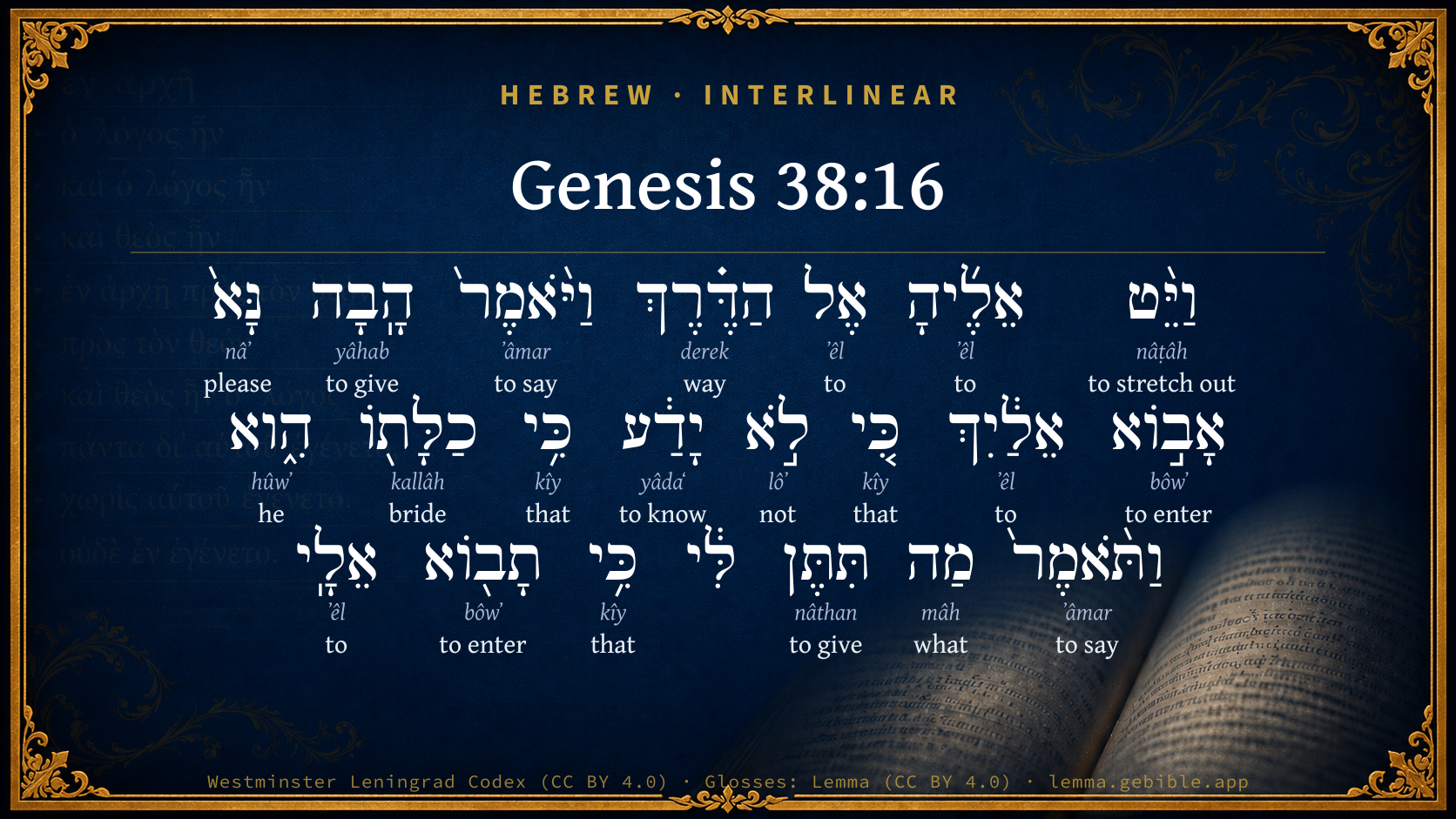
  1. וַיֵּ֨ט nâṭâh H5186 “and · to stretch out” Conjunction + Verb, Qal, Sequential Imperfect, 3rd Person, Masculine, Singular
  2. אֵלֶ֜יהָ ʼêl H413 “to · her” Preposition + Suffix, Personal, 3rd Person, Feminine, Singular
  3. אֶל ʼêl H413 “to” Preposition
  4. הַדֶּ֗רֶךְ derek H1870 “the · way” Particle, Definite Article + Noun, Common, Both, Singular, Absolute
  5. וַיֹּ֨אמֶר֙ ʼâmar H559 “and · to say” Conjunction + Verb, Qal, Sequential Imperfect, 3rd Person, Masculine, Singular
  6. נָּא֙ nâʼ H4994 “please” Particle, Interjection
  7. אָב֣וֹא bôwʼ H935 “to enter” Verb, Qal, Cohortative, 1st Person, Common, Singular
  8. אֵלַ֔יִךְ ʼêl H413 “to · you” Preposition + Suffix, Personal, 2nd Person, Feminine, Singular
  9. כִּ֚י kîy H3588 “that” Conjunction
  10. לֹ֣א lôʼ H3808 “not” Particle, Negative
  11. יָדַ֔ע yâdaʻ H3045 “to know” Verb, Qal, Perfect, 3rd Person, Masculine, Singular
  12. כִּ֥י kîy H3588 “that” Conjunction
  13. כַלָּת֖וֹ kallâh H3618 “bride · his” Noun, Common, Feminine, Singular, Construct + Suffix, Personal, 3rd Person, Masculine, Singular
  14. הִ֑וא hûwʼ H1931 “he” Pronoun, Personal, 3rd Person, Feminine, Singular
  15. וַתֹּ֨אמֶר֙ ʼâmar H559 “and · to say” Conjunction + Verb, Qal, Sequential Imperfect, 3rd Person, Feminine, Singular
  16. מַה mâh H4100 “what” Particle, Interrogative
  17. תִּתֶּן nâthan H5414 “to give” Verb, Qal, Imperfect, 2nd Person, Masculine, Singular
  18. כִּ֥י kîy H3588 “that” Conjunction
  19. תָב֖וֹא bôwʼ H935 “to enter” Verb, Qal, Imperfect, 2nd Person, Masculine, Singular
  20. אֵלָֽי ʼêl H413 “to · me” Preposition + Suffix, Personal, 1st Person, Common, Singular

About this verse

These counts appear in no published source. They are computed here, from the morphology-tagged text and Lemma’s own curated glosses. What Lemma adds →

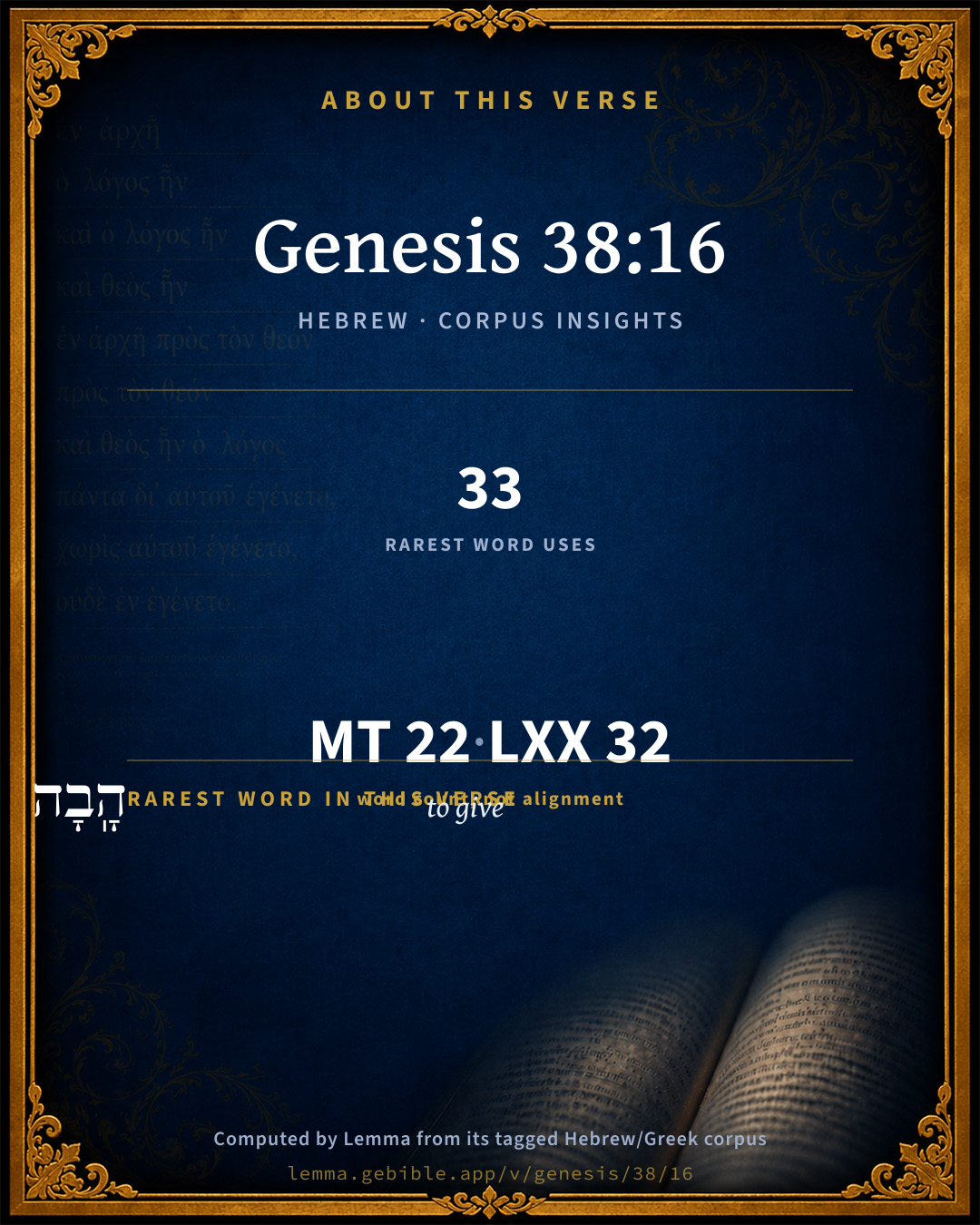
22
words
14
distinct lemmas
Pentateuch
section

Shared distinctive vocabulary

הָֽבָה to give H3051 occurs in 29 verses of the Hebrew Bible. Also found in:

Grammatical profile

  • 8 verbs
  • 2 nouns
  • 1 pronoun
  • 5 prepositions
  • 3 conjunctions
  • 3 particles

Verb forms

  • וַיֵּ֨ט Qal · Sequential Imperfect
  • וַיֹּ֨אמֶר֙ Qal · Sequential Imperfect
  • הָֽבָה Qal · Imperative
  • אָב֣וֹא Qal · Cohortative
  • יָדַ֔ע Qal · Perfect
  • וַתֹּ֨אמֶר֙ Qal · Sequential Imperfect
  • תִּתֶּן Qal · Imperfect
  • תָב֖וֹא Qal · Imperfect

Repetition

Words recur within this verse — often emphatic in Hebrew:

  • וַיֹּ֨אמֶר֙ to say H559 ×2
  • אָב֣וֹא to enter H935 ×2
  • אֵלֶ֜יהָ to H413 ×4
  • כִּ֚י that H3588 ×3

Hebrew & Septuagint length

In English translation the verse runs 40 words from the Hebrew and 43 from the Septuagint (LXX English) — closely comparable.

A rough comparison of the two English renderings, which tokenize alike — not a word-level alignment.

Word counts can differ between the Hebrew and the Greek without any difference in meaning — e.g. the Hebrew direct-object marker אֵת has no separate Greek word, and Greek often adds the article ὁ.

In the original languages it is 22 Hebrew tokens and 32 Greek tokens — but the two are counted differently (Hebrew bundles its prefixes and suffixes into one token; the Greek is in lemma form), so that isn’t a like-for-like length.

Cross-references

5

Topical passages linked to Genesis 38:16 in the Treasury of Scripture Knowledge — connected by theme and wording, ordered by reader-vote popularity; previews shown in the World English Bible.

  • 2 Samuel 13:11 When she had brought them near to him to eat, he took hold of her, and said to her, Come, lie with me, my sister.
  • Matthew 26:15 and said, "What are you willing to give me, that I should deliver him to you?" They weighed out for him thirty pieces of silver.
  • 1 Timothy 6:10 For the love of money is a root of all kinds of evil. Some have been led astray from the faith in their greed, and have pierced themselves through with many sorrows.
  • Deuteronomy 23:18 You shall not bring the hire of a prostitute, or the wages of a dog, into the house of Yahweh your God for any vow: for even both these are an abomination to Yahweh your God.
  • Ezekiel 16:33 They give gifts to all prostitutes; but you give your gifts to all your lovers, and bribe them, that they may come to you on every side for your prostitution.

Cross-references courtesy of OpenBible.info (CC BY 4.0).

Hebrew and Greek witnesses Masoretic Hebrew ↔ Greek Septuagint

The same verse in the two great witnesses to the Old Testament, shown verse-for-verse.

These are two independent witnesses, not word-aligned to each other, and the Septuagint is shown in lemma (dictionary) form.

Hebrew Genesis 38:16 Masoretic · Westminster Leningrad Codex

וַיֵּ֨ט אֵלֶ֜יהָ אֶל הַדֶּ֗רֶךְ וַיֹּ֨אמֶר֙ הָֽבָה נָּא֙ אָב֣וֹא אֵלַ֔יִךְ כִּ֚י לֹ֣א יָדַ֔ע כִּ֥י כַלָּת֖וֹ הִ֑וא וַתֹּ֨אמֶר֙ מַה תִּתֶּן לִּ֔י כִּ֥י תָב֖וֹא אֵלָֽי

He turned to her by the way, and said, "Please come, let me come in to you:" for he didn't know that she was his daughter-in-law. She said, "What will you give me, that you may come in to me?"

World English Bible · Public Domain

Greek LXX Genesis 38:16 Septuagint · lemma form

ἐκκλίνω δέ πρός αὐτός ὁ ὁδός καί εἶπον αὐτός ἐάω ἐγώ εἰςἔρχομαι πρός σύ οὐ γάρ γιγνώσκω ὅτι ὁ νύμφη αὐτός εἰμί ὁ δέ εἶπον τίς ἐγώ δίδωμι ἐάν εἰςἔρχομαι πρός ἐγώ

And he went out of his way to her, and said to her, Let me come in to you; for he knew not that she was his daughter-in-law; and she said, What will you give me if you should come in to me?

LXX2012 (modern English Septuagint) · Public Domain

Hebrew: Westminster Leningrad Codex (CC BY 4.0). Greek: Septuagint (public domain); English from LXX2012 (modern English Septuagint) (Public Domain). How the Septuagint differs from the Hebrew →

Targum (Aramaic paraphrase)

2

The Targum is the ancient Jewish Aramaic paraphrase of the Hebrew Scriptures — an interpretive translation, not the Hebrew text itself. Onkelos (literal) and Pseudo-Jonathan (expansive) render the Torah, and Jonathan the Prophets. Coverage is partial: where no permissively-licensed English translation exists for a verse, only the Aramaic is shown. This is verse-level text, not a word-by-word alignment to the Hebrew.

  1. Targum Onkelos Torah (Genesis–Deuteronomy)
    וּסְטָא לְוָתַהּ לְאָרְחָא וַאֲמַר הָבִי כְעַן אֵיעוֹל לְוָתִיךְ אֲרֵי לָא יְדַע אֲרֵי כַלְּתֵהּ הִיא וַאֲמֶרֶת מַה תִּתֵּן לִי אֲרֵי תֵיעוֹל לְוָתִי

    (no public-domain English translation for this verse)

    Targum Onkelos — Aramaic: “Onkelos Genesis” (public domain); “Onkelos Exodus” (public domain); “Onkelos Leviticus” (public domain); “Onkelos Numbers” (public domain); “Onkelos Deuteronomy” (public domain). English: “Sefaria Community Translation” (CC0 1.0 (public-domain dedication)); “J.W. Etheridge. The Targums of Onkelos and Jonathan Ben Uzziel on the Pentateuch. London: Longmans, Green, 1862” (public domain). Text via Sefaria.

  2. Targum Pseudo-Jonathan Torah (Genesis–Deuteronomy)
    וּסְטָא לְוָותָהּ לְאָרְחָא וַאֲמַר הֲבִי כְּדוֹן אֵיעוֹל לְוָותִיךְ אֲרוּם לָא יָדַע אֲרוּם כַּלְתֵיהּ הִיא וַאֲמָרַת מַה תִתֵּן לִי אֲרוּם תֵיעוֹל לְוָתִי

    And he inclined to her in the way and said, Let me now go in with thee: for he knew not that she was his daughter--in--law. And she said What wilt thou give me to go in with me?

    Targum Pseudo-Jonathan — Aramaic: “Targum Jonathan on Genesis” (public domain); “Targum Jonathan on Exodus” (public domain); “Targum Jonathan on Leviticus” (public domain); “Targum Jonathan on Numbers” (public domain); “Targum Jonathan on Deuteronomy” (public domain). English: “The Targum of Jonathan ben Uzziel, trans. J. W. Etheridge, London, 1862” (public domain). Text via Sefaria.

Commentary

Notes on Genesis 38:16 from classic Christian and Jewish commentators (each source and its license shown beneath its notes). The classic Christian expositions comment on the surrounding passage and are grouped to its opening verse, so a note may address several verses; the Jewish commentaries on the Tanakh (Rashi and others) are per-verse, so they appear only where the commentator wrote on this verse.

Lemma curates 59 commentaries, every one of them public domain or Creative Commons licensed, each selected and text-cleaned for this edition rather than reprinted as found. About our sources →

Trapp's Complete Commentary

John Trapp

Gen 38:16 And he turned unto her by the way, and said, Go to, I pray thee, let me come in unto thee; (for he knew not that she [was] his daughter in law.) And she said, What wilt thou give me, that thou mayest come in unto me?

Ver. 16. Let me come in unto thee.] This is recorded, (1.) To cut the comb of those proud Jews, that glory so much of their pedigree, and name of Judah. How could they say, "We be not born of fornication?" {Joh 8:41} (2.) To mind us that there is no Church to be found on earth without blot and blemish. (3.) That we may consider and admire the utter abasement of our Lord Christ, who would be born, not only of holy, but of impure parentage. And this, to show, [1.] That he borrowed no grace or glory from his progenitors, and as he needed not to be ennobled, so neither was he disparaged by them; [2.] That by his purity and passion all our sins are expiated and done away; like as the sun cleareth whatsoever filth is found in the air or on the earth. Three women only are mentioned in his genealogy; Rahab the harlot, Bathsheba the adulteress, and this incestuous Tamar; {Mat 1:3; Mat 1:5-6} to show his readiness to receive the most notorious offenders, that come unto him with bleeding and believing hearts. {1Ti 1:15}

John Trapp, A Commentary or Exposition upon All the Books of the Old and New Testament (1647–1656) — public domain. Text from a community e-Sword module.

Geneva Bible (1599)

Geneva Bible translators

God had wonderfully blinded him that he could not know her by her talk.

Geneva Bible (1599) marginal notes — public domain. Text via Bolls.life.

John Calvin's Commentaries

16. What wilt thou give me, etc. Tamar did not wish to make a gain by the prostitution of her person, but to have a certain pledge, in order that she might boast of the revenge taken for the injury she had received: and indeed there is no doubt that God blinded Judah, as he deserved; for how did it happen that he did not know the voice of his daughter-in-law, with which he had been long familiar? Besides, if a pledge must be given for the promised kid, what folly to deliver up his ring to a harlot? I pass over the absurdity of his giving a double pledge. It appears, therefore, that he was then bereft of all judgment; and for no other cause are these things written by Moses, than to teach us that his miserable mind was darkened by the just judgment of God, because, by heaping sin upon sin, he had quenched the light of the Spirit.

John Calvin's Commentaries (1540-1563) — public domain. Text from the Calvin Translation Society English edition (1840s-50s) via the Christian Classics Ethereal Library (ccel.org). Calvin's coverage is partial (roughly two-thirds of the Bible); uncommented books and verses are honest gaps, never fabricated. The 19th-century editor's footnotes and remarks are omitted so the notes are faithfully Calvin's own voice.

John Gill's Exposition

And he said, I will send thee a kid from the flock,.... Either from Timnath, where his flock was shearing, or rather from Adullam, where he lived; since it is probable he was now returning from Timnath, where he had been feasting and making merry with his shearers, and so in a disposition to commit such an action:

and she said, wilt thou give me a pledge, till thou send it? she made no objection to the hire or present, only required a pawn, or security for it till she had it; and this was her view indeed in asking an hire that she might have something to produce, should she prove with child by him, to convince him by whom it was.

John Gill's Exposition of the Whole Bible (1746–1763) — public domain (CC PDM 1.0). Text via the HelloAO Bible API.

The Pulpit Commentary

And he turned unto her by the way, and said, Go to, I pray thee, let me come in unto thee; (for he knew not that she was his daughter-in-law). Though willing to commit adultery or fornication, Judah would have shrank from the sin of incest. And she said, What wilt thou give me, that thou mayest come in unto me? The conduct of Tamer, though in every way reprehensible, is not to be attributed to mere lust, or inordinate desire for offspring, if not from the son Shelah, then from the father Judah, but was probably traceable to a secret wish on the one hand to be avenged on Judah, and on the other hand to assert her right to a place amongst the ancestresses of the patriarchal family. Yet Tamar was really guilty of both adultery and incest, though Lange thinks the wickedness of Er and Onan renders this open to question.

The Pulpit Commentary (1880–1919), ed. H.D.M. Spence-Jones & Joseph S. Exell — public domain. Text from a community e-Sword module.

Rashi

Rabbi Shlomo Yitzchaki (Rashi)

ויט אליה אל הדרך AND HE TURNED UNTO HER BY THE WAY — from the road he was following he turned to the road where she was. In old French détourner; English to turn aside.

הבה נא COME, I PRAY THEE — Prepare yourself and your mind for this. Wherever הבה occurs it signifies “preparing oneself”, except in any passage where it must necessarily be translated by “giving”. And, indeed, those signifying “preparation” have almost the meaning of “giving”. (ערבון (17— means a PLEDGE.

Rashi on the Tanakh — English translations: “The Judaica Press complete Tanach with Rashi, translated by A. J. Rosenberg” (CC BY 4.0); “Pentateuch with Rashi's commentary by M. Rosenbaum and A.M. Silbermann, 1929-1934” (public domain); “The Metsudah Tanach series, Lakewood, N.J” (CC BY 4.0); and “The Book of Joshua, Metsudah Publications, 1997” (CC BY 4.0). Text via Sefaria.

Sforno

Rabbi Ovadia Sforno

What will you give me. If he had offered immediate payment she would not have accepted it, because what she wanted was evidence that she could present later on to prove that he was the father.

Sforno on the Tanakh — English translation: “Yalkut, Sifsei Chachomim Chumash, Metsudah Publications, 2009” (CC BY 4.0). Text via Sefaria.

Radak

Rabbi David Kimhi (Radak)

ויט אליה, he detoured in her direction from the direction he had been walking. אל הדרך, to the beginning of the path where she was sitting, there being an opportunity nearby to enjoy privacy.

הכר נא, an expression demanding an immediate response, similar to such expressions we had explained in connection with הבה נא in Genesis 11,4.

Radak on the Tanakh — English translations: “Sefaria Community Translation” (CC0 1.0 (public-domain dedication)); “Eliyahu Munk, HaChut Hameshulash” (CC BY 4.0); “Rabbi Mike Feuer, Jerusalem Anthology” (CC BY 4.0); and “R. David Kimhi on the first book of Psalms, Translated by R.G. Finch, London, 1919” (public domain). Text via Sefaria.

Lesson kit

Teaching starters — assembled from the data on this page, not authored interpretation. Every prompt links to the verse data it draws on. Edit before teaching.

Genesis, in the Pentateuch, opens this verse with 22 words (14 distinct Hebrew lemmas). Its most distinctive word is yâhab (“to give”). A historical commentator’s framing appears above. Read the whole chapter for the surrounding context.

Discussion questions

  1. How does “to give” (yâhab) shape what this verse is saying?
  2. Genesis 11:3 shares the word «to give» with this verse. How do the two illuminate each other?
  3. “to say” occurs 2× in this one verse. What is the effect of the repetition?
  4. These translations render this verse differently. What is at stake in choosing one wording over another?
  5. The verb «וַיֵּ֨ט» is Qal Sequential Imperfect. How does its form color the action?
  6. Reading how Trapp's Complete Commentary and Geneva Bible (1599) read this verse, where do the two commentators agree and where do they part?

Things to notice

Reading settings

Reading text

Shown beneath each verse's original-language words.

Old Testament
Old Testament edition

Read the OT as the Masoretic Hebrew (MT) or the Greek Septuagint (LXX).

English shown for the Greek Septuagint (in the Hebrew ↔ Greek comparison).

Comparing translations? Open the Compare panel on any verse page to stack up to four side by side.