
Deuteronomy 14:26

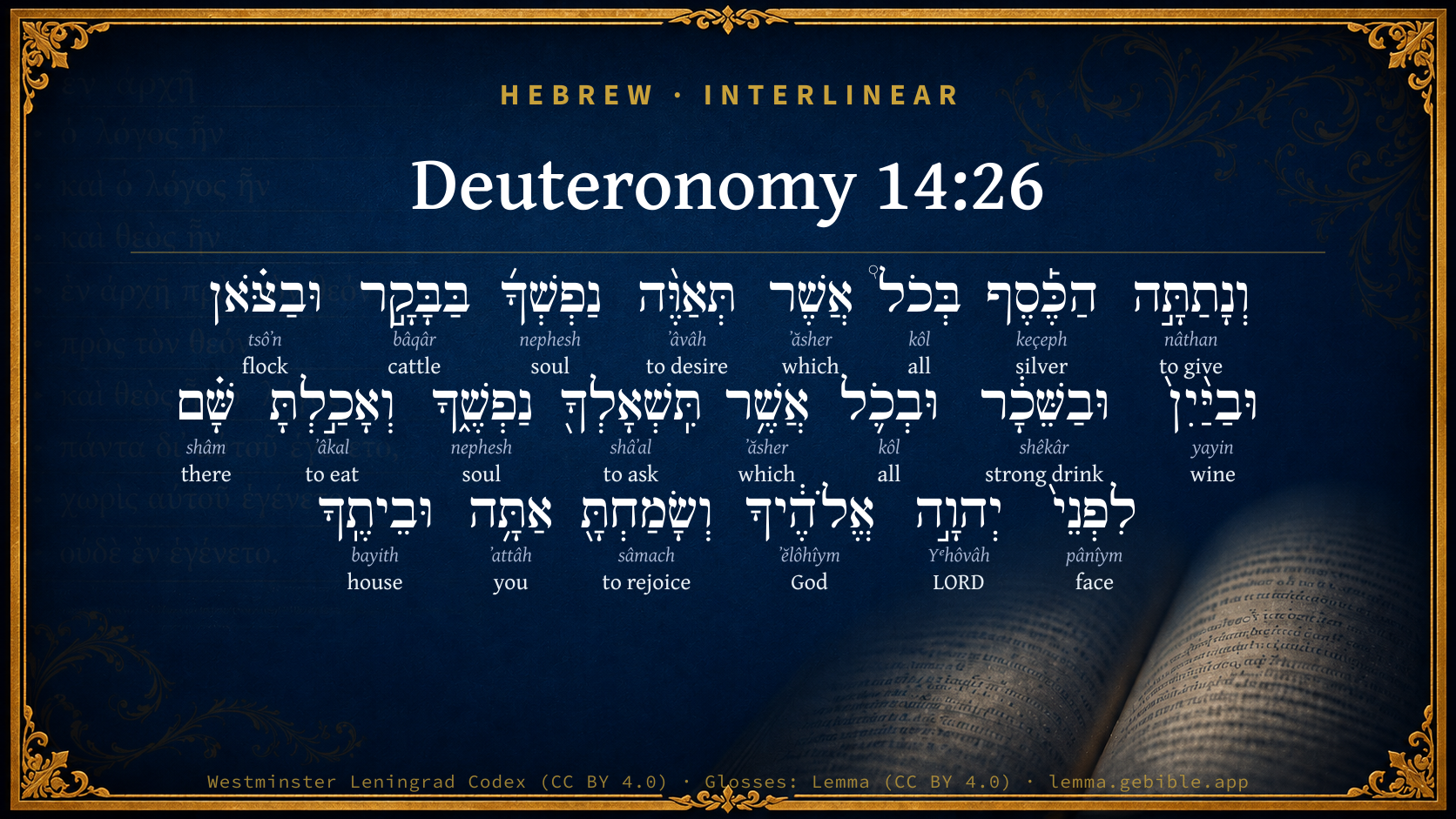
Hebrew (Westminster Leningrad Codex) Deuteronomy 14:26 appears in the Hebrew Old Testament. The text above is from the Westminster Leningrad Codex. Each word links to its Strong’s number, a concise gloss, and parsing drawn from the Open Scriptures Hebrew Bible morphology. Click any word for its full Brown-Driver-Briggs (BDB) entry.
Download image
Cite this verse

Deuteronomy 14:26 (World English Bible). Public Domain. Lemma interlinear Bible study tool, https://lemma.gebible.app/v/deuteronomy/14/26.

Show BibTeX & RIS
BibTeX
RIS
English Translation
and you shall bestow the money for whatever your soul desires, for oxen, or for sheep, or for wine, or for strong drink, or for whatever your soul asks of you; and you shall eat there before Yahweh your God, and you shall rejoice, you and your household.
World English Bible · Public Domain
Download a study sheet

One document with this verse’s original text, its word-by-word gloss line, the meaning frame, cross-references with their text, attributed commentary, and full source and license credits — printable, and it pastes into notes with its structure intact.

This verse Autodidact and up

Study sheet (.html) Plain text (.txt)

A passage Seminary Student

Up to 50 verses in one chapter. A passage sheet keeps up to 6 commentary sources and 12 cross-references per verse, in the order this page ranks them, and says so on the sheet whenever that leaves anything out. Ask for a single verse and you get the Autodidact verse sheet above.

Everything on this page stays free to read, with no account — the sheet is a download of what is already on screen, not access to it.

Want to remove ads? Support Godless Engineer
Compare translations 3

The same verse in 3 English versions, stacked beneath the original-language interlinear above. Click any original word for its lexicon entry.

Each is an independent rendering of the whole verse — the interlinear is not word-aligned to these translations.

Highlighted words mark where these versions differ — a whole-verse word diff, not a word-by-word alignment.

  • World English Bible Public Domain
    and you shall bestow the money for whatever your soul desires, for oxen, or for sheep, or for wine, or for strong drink, or for whatever your soul asks of you; and you shall eat there before Yahweh your God, and you shall rejoice, you and your household.
  • King James Version Public Domain
    And thou shalt bestow that money for whatsoever thy soul lusteth after, for oxen, or for sheep, or for wine, or for strong drink, or for whatsoever thy soul desireth: and thou shalt eat there before the LORD thy God, and thou shalt rejoice, thou, and thine household,
  • unfoldingWord Literal Text CC BY-SA 4.0
    And give the money for anything that your soul desires, for oxen or for sheep or for wine or for strong drink or for anything that your soul desires, and you shall eat there to the face of Yahweh your God, and you shall rejoice, you and your household.

unfoldingWord Literal Text — © unfoldingWord, licensed CC BY-SA 4.0. Word-aligned USFM3 via Door43 (git.door43.org/unfoldingWord/en_ult).

Versions to compare (up to 4)

3 of 4 selected

Show all 18 translations

Every available English version of this verse, each an independent rendering of the whole verse.

  • World English Bible Public Domain
    and you shall bestow the money for whatever your soul desires, for oxen, or for sheep, or for wine, or for strong drink, or for whatever your soul asks of you; and you shall eat there before Yahweh your God, and you shall rejoice, you and your household.
  • Berean Standard Bible Public Domain
    Then you may spend the money on anything you desire: cattle, sheep, wine, strong drink, or anything you wish. You are to feast there in the presence of the LORD your God and rejoice with your household.
  • Majority Standard Bible Public Domain
    Then you may spend the money on anything you desire: cattle, sheep, wine, strong drink, or anything you wish. You are to feast there in the presence of the LORD your God and rejoice with your household.
  • King James Version Public Domain
    And thou shalt bestow that money for whatsoever thy soul lusteth after, for oxen, or for sheep, or for wine, or for strong drink, or for whatsoever thy soul desireth: and thou shalt eat there before the LORD thy God, and thou shalt rejoice, thou, and thine household,
  • American Standard Version (1901) Public Domain
    and thou shalt bestow the money for whatsoever thy soul desireth, for oxen, or for sheep, or for wine, or for strong drink, or for whatsoever thy soul asketh of thee; and thou shalt eat there before Jehovah thy God, and thou shalt rejoice, thou and thy household.
  • Revised Version (1885) Public Domain
    and thou shalt bestow the money for whatsoever thy soul desireth, for oxen, or for sheep, or for wine, or for strong drink, or for whatsoever thy soul asketh of thee: and thou shalt eat there before the LORD thy God, and thou shalt rejoice, thou and thine household:
  • Geneva Bible (1599) Public Domain
    And thou shalt bestowe the money for whatsoeuer thine heart desireth: whether it be oxe, or sheepe, or wine, or strong drinke, or whatsoeuer thine heart desireth: and shalt eate it there before the Lord thy God, and reioyce, both thou, and thine household.
  • Douay-Rheims (1899) Public Domain
    And thou shalt buy with the same money whatsoever pleaseth thee, either of the herds or of sheep, wine also and strong drink, and all that thy soul desireth: and thou shalt eat before the Lord thy God, and shalt feast, thou and thy house:
  • Young's Literal Translation Public Domain
    and thou hast given the money for any thing which thy soul desireth, for oxen, and for sheep, and for wine, and for strong drink, and for any thing which thy soul asketh, and thou hast eaten there before Jehovah thy God, and thou hast rejoiced, thou and thy house.
  • Literal Standard Version CC BY-SA 4.0
    and you have given the money for anything which your soul desires, for oxen, and for sheep, and for wine, and for strong drink, and for anything which your soul asks for, and you have eaten before your God YHWH there, and you have rejoiced, you and your house.
  • Unlocked Literal Bible CC BY-SA 4.0
    There you will spend the money for whatever you desire: for oxen, or for sheep, or for wine, or for strong drink, or for whatever you desire; you will eat there before Yahweh your God, and you will rejoice, you and your household.
  • unfoldingWord Literal Text CC BY-SA 4.0
    And give the money for anything that your soul desires, for oxen or for sheep or for wine or for strong drink or for anything that your soul desires, and you shall eat there to the face of Yahweh your God, and you shall rejoice, you and your household.
  • Darby Bible Public Domain
    and thou shalt give the money for whatever thy soul desireth, for oxen, or for sheep, or for wine, or for strong drink, or for whatever thy soul asketh of thee; and thou shalt eat there before Jehovah thy God, and thou shalt rejoice, thou, and thy house.
  • World Messianic Bible Public Domain
    You shall trade the money for whatever your soul desires: for cattle, or for sheep, or for wine, or for strong drink, or for whatever your soul asks of you. You shall eat there before the LORD your God, and you shall rejoice, you and your household.
  • Webster's Bible Public Domain
    And thou shalt bestow that money for whatever thy soul desireth, for oxen, or for sheep, or for wine, or for strong drink, or for whatever thy soul desireth: and thou shalt eat there before the LORD thy God, and thou shalt rejoice, thou, and thy household.
  • Free Bible Version CC BY-SA 4.0
    Then you can spend the money on anything you like—cattle, sheep, wine, alcoholic drink, or anything else you want. Then you can have a feast there in the presence of the Lord your God and celebrate with your family.
  • Bible in Basic English Public Domain
    And with the money get whatever you have a desire for, oxen or sheep or wine or strong drink, whatever your soul's desire may be: and make a feast there before the Lord your God, and be glad, you and all your house;
  • JPS Tanakh (1917) Public Domain
    And thou shalt bestow the money for whatsoever thy soul desireth, for oxen, or for sheep, or for wine, or for strong drink, or for whatsoever thy soul asketh of thee; and thou shalt eat there before the LORD thy God, and thou shalt rejoice, thou and thy household.

Literal Standard Version (2020), Covenant Press — licensed CC BY-SA 4.0. Text via the HelloAO Bible API (eBible.org). Unlocked Literal Bible (unfoldingWord) — licensed CC BY-SA 4.0. Text via the HelloAO Bible API (eBible.org). unfoldingWord Literal Text — © unfoldingWord, licensed CC BY-SA 4.0. Word-aligned USFM3 via Door43 (git.door43.org/unfoldingWord/en_ult). Free Bible Version, Dr. Jonathan Gallagher — licensed CC BY-SA 4.0. Text via the HelloAO Bible API (eBible.org).

Word by word

More ways to search: Search by grammar → Find every occurrence → Compare this word →

Practice this passage: Drill this verse → Learn its vocabulary →

וּבַשֵּׁכָ֔ר
shêkâr
H7941
“and · in/at the · strong drink”
Conjunction + Preposition, Determined + Noun, Common, Masculine, Singular, Absolute
Part of Speech
Conjunction + Preposition + Noun
Type
Common
Gender
Masculine
Number
Singular
State
Absolute
Full BDB Definition

Origin: from H7937

TWOT: 2388a

strong drink, intoxicating drink, fermented or intoxicating liquor
  1. וְנָתַתָּ֣ה nâthan H5414 “and · to give” Conjunction + Verb, Qal, Sequential Perfect, 2nd Person, Masculine, Singular
  2. הַכֶּ֡סֶף keçeph H3701 “the · silver” Particle, Definite Article + Noun, Common, Masculine, Singular, Absolute
  3. בְּכֹל֩ kôl H3605 “in/at · all” Preposition + Noun, Common, Masculine, Singular, Absolute
  4. אֲשֶׁר ʼăsher H834 “which” Particle, Relative
  5. תְּאַוֶּ֨ה ʼâvâh H183 “to desire” Verb, Piel, Imperfect, 3rd Person, Feminine, Singular
  6. נַפְשְׁךָ֜ nephesh H5315 “soul · your” Noun, Common, Both, Singular, Construct + Suffix, Personal, 2nd Person, Masculine, Singular
  7. בַּבָּקָ֣ר bâqâr H1241 “in/at the · cattle” Preposition, Determined + Noun, Common, Both, Singular, Absolute
  8. וּבַצֹּ֗אן tsôʼn H6629 “and · in/at the · flock” Conjunction + Preposition, Determined + Noun, Common, Both, Singular, Absolute
  9. וּבַיַּ֨יִן֙ yayin H3196 “and · in/at the · wine” Conjunction + Preposition, Determined + Noun, Common, Masculine, Singular, Absolute
  10. וּבְכֹ֛ל kôl H3605 “and · in/at · all of” Conjunction + Preposition + Noun, Common, Masculine, Singular, Construct
  11. אֲשֶׁ֥ר ʼăsher H834 “which” Particle, Relative
  12. תִּֽשְׁאָלְךָ֖ shâʼal H7592 “to ask · you” Verb, Qal, Imperfect, 3rd Person, Feminine, Singular + Suffix, Personal, 2nd Person, Masculine, Singular
  13. נַפְשֶׁ֑ךָ nephesh H5315 “soul · your” Noun, Common, Both, Singular, Construct + Suffix, Personal, 2nd Person, Masculine, Singular
  14. וְאָכַ֣לְתָּ ʼâkal H398 “and · to eat” Conjunction + Verb, Qal, Sequential Perfect, 2nd Person, Masculine, Singular
  15. שָּׁ֗ם shâm H8033 “there” Adverb
  16. לִפְנֵי֙ pânîym H6440 “to/for · face(s) of” Preposition + Noun, Common, Both, Plural, Construct
  17. יְהוָ֣ה Yᵉhôvâh H3068 “LORD” Noun, Proper
  18. אֱלֹהֶ֔יךָ ʼĕlôhîym H430 “God(s) · your” Noun, Common, Masculine, Plural, Construct + Suffix, Personal, 2nd Person, Masculine, Singular
  19. וְשָׂמַחְתָּ֖ sâmach H8055 “and · to rejoice” Conjunction + Verb, Qal, Sequential Perfect, 2nd Person, Masculine, Singular
  20. אַתָּ֥ה ʼattâh H859 “you” Pronoun, Personal, 2nd Person, Masculine, Singular
  21. וּבֵיתֶֽךָ bayith H1004 “and · house · your” Conjunction + Noun, Common, Masculine, Singular, Construct + Suffix, Personal, 2nd Person, Masculine, Singular

About this verse

These counts appear in no published source. They are computed here, from the morphology-tagged text and Lemma’s own curated glosses. What Lemma adds →

22
words
19
distinct lemmas
Pentateuch
section

Notable vocabulary

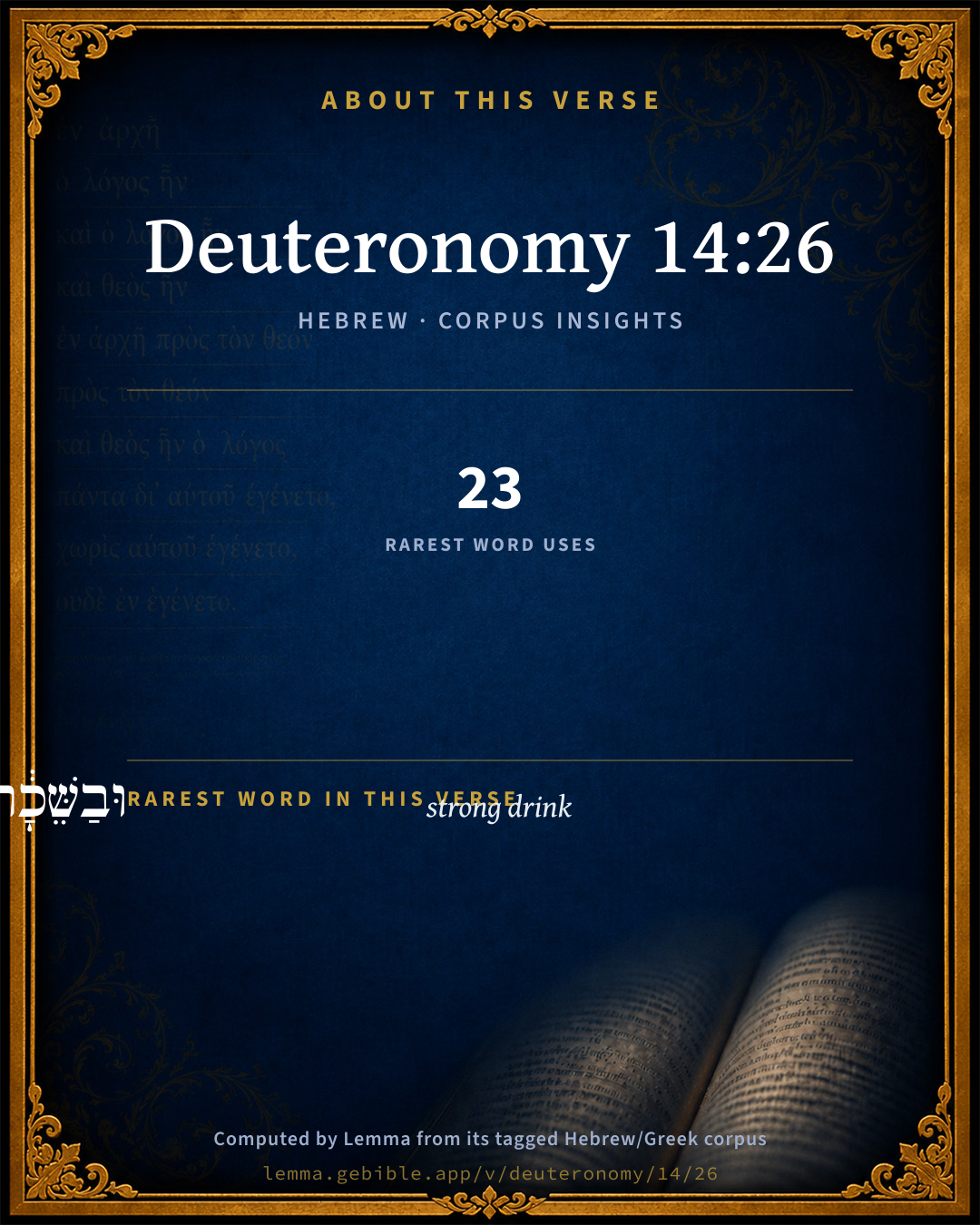
The rarest word here is וּבַשֵּׁכָ֔ר strong drink H7941 — appearing just 23 times in the whole Hebrew Bible.

Shared distinctive vocabulary

וּבַשֵּׁכָ֔ר strong drink H7941 occurs in 20 verses of the Hebrew Bible. Also found in:

Grammatical profile

  • 5 verbs
  • 13 nouns
  • 1 pronoun
  • 1 adverb
  • 2 particles

Verb forms

  • וְנָתַתָּ֣ה Qal · Sequential Perfect
  • תְּאַוֶּ֨ה Piel · Imperfect
  • תִּֽשְׁאָלְךָ֖ Qal · Imperfect
  • וְאָכַ֣לְתָּ Qal · Sequential Perfect
  • וְשָׂמַחְתָּ֖ Qal · Sequential Perfect

Repetition

Words recur within this verse — often emphatic in Hebrew:

  • בְּכֹל֩ all H3605 ×2
  • נַפְשְׁךָ֜ soul H5315 ×2
  • אֲשֶׁר which H834 ×2

Hebrew & Septuagint length

In English translation the verse runs 48 words from the Hebrew and 53 from the Septuagint (LXX English) — closely comparable.

A rough comparison of the two English renderings, which tokenize alike — not a word-level alignment.

Word counts can differ between the Hebrew and the Greek without any difference in meaning — e.g. the Hebrew direct-object marker אֵת has no separate Greek word, and Greek often adds the article ὁ.

Cross-references

15

Topical passages linked to Deuteronomy 14:26 in the Treasury of Scripture Knowledge — connected by theme and wording, ordered by reader-vote popularity; previews shown in the World English Bible.

  • Ecclesiastes 9:7 Go your way--eat your bread with joy, and drink your wine with a merry heart; for God has already accepted your works.
  • Deuteronomy 12:7 and there you shall eat before Yahweh your God, and you shall rejoice in all that you put your hand to, you and your households, in which Yahweh your God has blessed you.
  • Deuteronomy 12:20–21 When Yahweh your God shall enlarge your border, as he has promised you, and you shall say, I will eat flesh, because your soul desires to eat flesh; you may eat flesh, after all the desire of your soul.
  • Deuteronomy 26:11 and you shall rejoice in all the good which Yahweh your God has given to you, and to your house, you, and the Levite, and the foreigner who is in the midst of you.
  • Psalms 106:14 But gave in to craving in the desert, And tested God in the wasteland.
  • Matthew 21:12 Jesus entered into the temple of God, and drove out all of those who sold and bought in the temple, and overthrew the money-changers' tables and the seats of those who sold the doves.
  • 1 Corinthians 6:12–13 "All things are lawful for me," but not all things are expedient. "All things are lawful for me," but I will not be brought under the power of anything.
  • Deuteronomy 12:12 You shall rejoice before Yahweh your God, you, and your sons, and your daughters, and your men-servants, and your maid-servants, and the Levite who is within your gates, because he has no portion nor inheritance with you.
  • Deuteronomy 12:15 Notwithstanding, you may kill and eat flesh within all your gates, after all the desire of your soul, according to the blessing of Yahweh your God which he has given you: the unclean and the clean may eat of it, as of the gazelle, and as of the hart.
  • Ezra 7:15–17 and to carry the silver and gold, which the king and his counselors have freely offered to the God of Israel, whose habitation is in Jerusalem,
  • Ezra 7:22 to one hundred talents of silver, and to one hundred measures of wheat, and to one hundred baths of wine, and to one hundred baths of oil, and salt without prescribing how much.
  • Mark 11:15 They came to Jerusalem, and Jesus entered into the temple, and began to throw out those who sold and those who bought in the temple, and overthrew the tables of the money-changers, and the seats of those who sold the doves.
  • John 2:14–16 He found in the temple those who sold oxen, sheep, and doves, and the changers of money sitting.
  • 1 Corinthians 10:6 Now these things were our examples, to the intent we should not lust after evil things, as they also lusted.
  • Deuteronomy 12:18 but you shall eat them before Yahweh your God in the place which Yahweh your God shall choose, you, and your son, and your daughter, and your man-servant, and your maid-servant, and the Levite who is within your gates: and you shall rejoice before Yahweh your God in all that you put your hand to.

Cross-references courtesy of OpenBible.info (CC BY 4.0).

Hebrew and Greek witnesses Masoretic Hebrew ↔ Greek Septuagint

The same verse in the two great witnesses to the Old Testament, shown verse-for-verse.

These are two independent witnesses, not word-aligned to each other, and the Septuagint is shown in lemma (dictionary) form.

Hebrew Deuteronomy 14:26 Masoretic · Westminster Leningrad Codex

וְנָתַתָּ֣ה הַכֶּ֡סֶף בְּכֹל֩ אֲשֶׁר תְּאַוֶּ֨ה נַפְשְׁךָ֜ בַּבָּקָ֣ר וּבַצֹּ֗אן וּבַיַּ֨יִן֙ וּבַשֵּׁכָ֔ר וּבְכֹ֛ל אֲשֶׁ֥ר תִּֽשְׁאָלְךָ֖ נַפְשֶׁ֑ךָ וְאָכַ֣לְתָּ שָּׁ֗ם לִפְנֵי֙ יְהוָ֣ה אֱלֹהֶ֔יךָ וְשָׂמַחְתָּ֖ אַתָּ֥ה וּבֵיתֶֽךָ

and you shall bestow the money for whatever your soul desires, for oxen, or for sheep, or for wine, or for strong drink, or for whatever your soul asks of you; and you shall eat there before Yahweh your God, and you shall rejoice, you and your household.

World English Bible · Public Domain

Greek LXX Deuteronomy 14:26 Septuagint · lemma form

καί δίδωμι ὁ ἀργύριον ἐπί πᾶς ὅς ἐάν ἐπιθυμέω ὁ ψυχή σύ ἐπί βοῦς ἤ ἐπί πρόβατον ἐπί οἶνος ἤ ἐπί σικερα ἤ ἐπί πᾶς ὅς ἐάν ἐπιθυμέω ὁ ψυχή σύ καί ἐσθίω ἐκεῖ ἐναντίον κύριος ὁ θεός σύ καί εὐφραίνω σύ καί ὁ οἶκος σύ

And you shall give the money for whatever your soul shall desire, for oxen or for sheep, or for wine, or you shall lay it out on strong drink, or on whatever your soul may desire, and you shall eat there before the Lord your God, and you shall rejoice and your house,

LXX2012 (modern English Septuagint) · Public Domain

Hebrew: Westminster Leningrad Codex (CC BY 4.0). Greek: Septuagint (public domain); English from LXX2012 (modern English Septuagint) (Public Domain). How the Septuagint differs from the Hebrew →

Targum (Aramaic paraphrase)

2

The Targum is the ancient Jewish Aramaic paraphrase of the Hebrew Scriptures — an interpretive translation, not the Hebrew text itself. Onkelos (literal) and Pseudo-Jonathan (expansive) render the Torah, and Jonathan the Prophets. Coverage is partial: where no permissively-licensed English translation exists for a verse, only the Aramaic is shown. This is verse-level text, not a word-by-word alignment to the Hebrew.

  1. Targum Onkelos Torah (Genesis–Deuteronomy)
    וְתִתֵּן כַּסְפָּא בְּכֹל דִי יִתִּרְעֵי נַפְשָׁךְ בְּתוֹרֵי וּבְעָנָא וּבַחֲמַר חֲדַת וְעַתִּיק וּבְכֹל דִי תִשְׁאֲלִנָךְ נַפְשָׁךְ וְתֵיכוּל תַּמָן קֳדָם יְיָ אֱלָהָךְ וְתֶחֱדֵי אַתְּ וֶאֱנַשׁ בֵּיתָךְ

    (no public-domain English translation for this verse)

    Targum Onkelos — Aramaic: “Onkelos Genesis” (public domain); “Onkelos Exodus” (public domain); “Onkelos Leviticus” (public domain); “Onkelos Numbers” (public domain); “Onkelos Deuteronomy” (public domain). English: “Sefaria Community Translation” (CC0 1.0 (public-domain dedication)); “J.W. Etheridge. The Targums of Onkelos and Jonathan Ben Uzziel on the Pentateuch. London: Longmans, Green, 1862” (public domain). Text via Sefaria.

  2. Targum Pseudo-Jonathan Torah (Genesis–Deuteronomy)
    וְתִתֵּן כַּסְפָּא בְּכָל דְּיִתְרְעֵי נַפְשָׁךְ בְּתוֹרֵי וּבְעָנָא וּבַחֲמַר חֲדַת וְעַתִּיק וּבְכָל דִּתְשַׁיְילִינָךְ נַפְשָׁךְ וְתֵיכְלוּן תַּמָּן קֳדָם יְיָ אֱלָהָכוֹן וְתֶחְדוּן אַתּוּן וֶאֱנַשׁ בָּתֵּיכוֹן

    and give the silver for any thing that thy soul pleaseth, of oxen, sheep, wine new or old, or whatever thy soul desireth; and you shall eat there before the Lord your God and rejoice, you and the men of your house.

    Targum Pseudo-Jonathan — Aramaic: “Targum Jonathan on Genesis” (public domain); “Targum Jonathan on Exodus” (public domain); “Targum Jonathan on Leviticus” (public domain); “Targum Jonathan on Numbers” (public domain); “Targum Jonathan on Deuteronomy” (public domain). English: “The Targum of Jonathan ben Uzziel, trans. J. W. Etheridge, London, 1862” (public domain). Text via Sefaria.

Commentary

Notes on Deuteronomy 14:26 from classic Christian and Jewish commentators (each source and its license shown beneath its notes). The classic Christian expositions comment on the surrounding passage and are grouped to its opening verse, so a note may address several verses; the Jewish commentaries on the Tanakh (Rashi and others) are per-verse, so they appear only where the commentator wrote on this verse.

Lemma curates 59 commentaries, every one of them public domain or Creative Commons licensed, each selected and text-cleaned for this edition rather than reprinted as found. About our sources →

Joseph Benson's Commentary

Deu 14:26. Thou shalt bestow that money, &c. — This was an injunction to the Israelites to use a part of their income in hospitality; to rejoice in the goodness of God, when they came before his presence, to acknowledge he was the author of all their blessings, and to gladden the hearts of the poor, the fatherless, and the widow, by entertaining them; thus imitating God’s goodness to themselves by acts of kindness to others. Thou shalt eat there before the Lord thy God — The comfortable and cheerful using of what God hath given us, with temperance and sobriety, is really the honouring of God with it. Contentment, holy joy, and thankfulness, make every meal a religious feast.

Joseph Benson's Commentary on the Old and New Testaments (1811–1818) — public domain. Text from a community e-Sword module.

Tyndale Open Study Notes

Tyndale Open Resources

14:26 Both wine and other alcoholic drink were used in worship ceremonies (Gen 14:18; 35:14; Exod 29:40-41; Matt 26:27) and in celebrations; they signified God’s blessing (Gen 27:25, 28; 49:11; 1 Chr 12:40; Ps 104:15; Song 4:10; 5:1; Isa 25:6; Matt 26:29).

Tyndale Open Study Notes — © Tyndale Open Resources, licensed CC BY-SA 4.0. Text via the HelloAO Bible API.

Geneva Bible (1599)

Geneva Bible translators

After the Priest hath received the Lord’s part.

Geneva Bible (1599) marginal notes — public domain. Text via Bolls.life.

Adam Clarke's Commentary

Verse 26. Or for strong drink] What the sikera or strong drink of the Hebrews was, See Clarke on Le 10:9. This one verse sufficiently shows that the Mosaic law made ample provision for the comfort and happiness of the people.

Adam Clarke's Commentary on the Bible (1810–1826) — public domain. Text from a community e-Sword/MySword module.

Ellicott's Commentary for English Readers

(26) Thou shalt bestow that money.—The Jews were very particular in not permitting the second tithe to be expended upon anything not permitted here. The rules as to its disposal form a separate treatise in the Talmud, called Ma’aser Shênî, “second tithe.”

Or for strong drink.—From this it is clear that the use of strong drink is not sinful in itself. The same word appears in its Greek form (Heb., shêcar; Greek, sikêr) in Luk_1:15.

A Bible Commentary for English Readers, edited by Charles John Ellicott (1878–1897) — public domain. Text from a community e-Sword module.

The Cambridge Bible for Schools and Colleges

gen. ed. J. J. S. Perowne

26. and thou shalt bestow the money] It was this law, which with other customs led to the rise of markets for cattle and other commodities in the Temple Courts with the consequent abuses, fostered by the priests for their own enrichment, which our Lord chastised. Cp. Jer_6:13; Jer_7:11; Jer_23:11.

for whatsoever thy soul desireth … asketh of thee] On the soul as seat of the appetite see Deu_12:20; on desireth, Deu_5:21. The emphatic liberality of this provision is striking. Though the tithe is a vegetable one, flesh may be substituted for it: cp. Deu_14:23 according to which it was to be eaten with the firstlings.

or for wine, or for strong drink] The attempt is sometimes made to argue that the juice of the vine when praised or prescribed in the O.T. is never an intoxicating liquor. That is clearly contradicted here; strong drink is a true transl. of the Heb. shekar, ‘omne quod inebriare potest’ (Jerome), which because of its effects is condemned in Isa_5:11; Isa_5:22; Isa_28:7; Mic_2:11; 1Sa_1:15; Pro_20:1, and is forbidden to priests on duty, Lev_10:9; cp. Pro_31:4, prescribed to invalids. The adj. from it shikkor = drunkard. In Israel there was the same difference of opinion as to its use which prevails among ourselves.

and thou shalt rejoice] See on Deu_12:7.

thou and thine household] As in Deu_12:7; Deu_12:12; Deu_12:18 : the tithes or their equivalent are to be enjoyed, not as in P by the Temple Levites and Priests but by the offerers and their families including—

The Cambridge Bible for Schools and Colleges (gen. ed. J. J. S. Perowne; Cambridge University Press, 1878–1918) — public domain. Text from a community e-Sword module.

John Gill's Exposition

And the Levite, because he hath no part nor inheritance with thee,.... Shall come and take the first tithe, according to Jarchi; but though this he was to do, yet is not what is intended here, but he was to partake of the second tithe, or what was in the room of it, the poor's tithe, with whom he is here joined:

and the stranger, and the fatherless, and the widow, which are within thy gates, shall come; and take the second tithe, as the above writer rightly interprets it, and which he says is the poor's of this year; see Deu 12:12,

and shall eat and be satisfied; make a plentiful meal, eat freely as at a feast; and, as the same writer observes, they were not obliged to eat it at Jerusalem, according to the way they were bound to eat the second tithe of the two years, that is, the two preceding this:

that the Lord thy God may bless thee in all the work of thine hand which thou doest; as might be expected, when his commands, and particularly those respecting the tithes and firstlings, were obeyed.

Next: Deuteronomy Chapter 15

John Gill's Exposition of the Whole Bible (1746–1763) — public domain (CC PDM 1.0). Text via the HelloAO Bible API.

Haydock's Catholic Bible Commentary

Herds. Hebrew, "oxen." --- Sheep; under which name are comprised goats.

George Leo Haydock (1774–1849), Haydock's Catholic Family Bible and Commentary, 1859 edition — public domain. Excludes Psalms (Douay-Rheims chapter numbering differs from Protestant) and Deuterocanonical books (Catholic canon only).

The Pulpit Commentary

Strong drink; shecar (rkve). "Any drink which can inebriate, whether that is made from grain, or the juice of apples, or when honey is boiled into a sweet and barbarous potion, or the fruit of the palm dates, is expressed into liquor, and the duller water is colored by the prepared fruits" (Jerome, "De Vit. Cler.").

The Pulpit Commentary (1880–1919), ed. H.D.M. Spence-Jones & Joseph S. Exell — public domain. Text from a community e-Sword module.

unfoldingWord translationNotes

Door43 World Missions Community

for whatever you desire

"for whatever you want"

before Yahweh

"in the presence of Yahweh"

The Levite who is within your gates

Here "gate" represents the entire city or town. AT: "Any Levite who lives in your towns" (See: Synecdoche)

do not forsake him

This can be stated in positive form. AT: "make sure to give some of your tithe to the Levite" (See: Double Negatives)

for he has no portion nor inheritance with you

The tribe of Levi did not receive a portion of land as their inheritance. Their share of the inheritance was the honor of serving Yahweh as his priests. The full meaning of this statement can be made explicit. (See: Assumed Knowledge and Implicit Information)

no portion nor inheritance with you

God not giving land to the Levites is spoken of as if he were not giving them an inheritance. (See: Metaphor)

translationWords

cow

ewe

wine

strong drink

joy

household

Levi

gate

inherit

unfoldingWord translationNotes — © Distant Shores Media and the Door43 World Missions Community, licensed CC BY-SA 4.0. Source: git.door43.org/Door43/en_tn.

Rashi

Rabbi Shlomo Yitzchaki (Rashi)

בכל אשר תאוה נפשך [AND THOU SHALT GIVE THAT MONEY] FOR WHATSOEVER THY SOUL LONGETH AFTER — this is a general statement,

בבקר ובצאן וביין ובשכר FOR ANY OF THE HERD, OR ANY OF THE FLOCK, OR FOR WINE, OR FOR STRONG DRINK — this is a particularisation,

ובכל אשר תאוה נפשך OR FOR WHATEVER THY SOUL DESIRES — Scripture again includes them in a general statement. [The rule is that when a verse expresses a כְּלָל, a פְּרָט, and then a כְּלָל again, as in this case, we apply the characteristics of the פְּרָט to the whole matter. Therefore,] just as the particulars mentioned have the characteristic of being products (ולד) of things themselves produced by the earth during the week of Creation, and are fitted to be food for man, etc. [So, too, the money must be expended only on things of this character] (Eruvin 27b).

Rashi on the Tanakh — English translations: “The Judaica Press complete Tanach with Rashi, translated by A. J. Rosenberg” (CC BY 4.0); “Pentateuch with Rashi's commentary by M. Rosenbaum and A.M. Silbermann, 1929-1934” (public domain); “The Metsudah Tanach series, Lakewood, N.J” (CC BY 4.0); and “The Book of Joshua, Metsudah Publications, 1997” (CC BY 4.0). Text via Sefaria.

Ibn Ezra

Rabbi Abraham ibn Ezra

You and your household. You are your sons are obligated, and your household is optional, for the mitzvah of coming to Yerushalayim three times a year is only on males. A woman who comes to this chosen place, like Elkana’s wives, receives reward.

Ibn Ezra on the Tanakh — English translations: “Sefaria Community Translation” (CC0 1.0 (public-domain dedication)); “Yalkut, Sifsei Chachomim Chumash, Metsudah Publications, 2009” (CC BY 4.0); and “Commentary of Ibn Ezra on Isaiah - trans. by M. Friedlander, 1873” (public domain). Text via Sefaria.

Lesson kit

Teaching starters — assembled from the data on this page, not authored interpretation. Every prompt links to the verse data it draws on. Edit before teaching.

Deuteronomy, in the Pentateuch, opens this verse with 22 words (19 distinct Hebrew lemmas). Its most distinctive word is shêkâr (“strong drink”). A historical commentator’s framing appears above. Read the whole chapter for the surrounding context.

Discussion questions

  1. The word shêkâr carries the sense “strong drink.” How does it shape the verse?
  2. Leviticus 10:9 shares the word «strong drink» with this verse. How do the two illuminate each other?
  3. “all” occurs 2× in this one verse. What is the effect of the repetition?
  4. The translations on this page render this verse differently — a whole-verse word diff, not a word-by-word alignment. What might account for the different wordings?
  5. The verb «וְנָתַתָּ֣ה» is Qal Sequential Perfect. How does its form color the action?
  6. Reading how Joseph Benson's Commentary and Tyndale Open Study Notes read this verse, where do the two commentators agree and where do they part?

Things to notice

Reading settings

Reading text

Shown beneath each verse's original-language words.

Old Testament
Old Testament edition

Read the OT as the Masoretic Hebrew (MT) or the Greek Septuagint (LXX).

English shown for the Greek Septuagint (in the Hebrew ↔ Greek comparison).

Comparing translations? Open the Compare panel on any verse page to stack up to four side by side.