Genesis 39:21

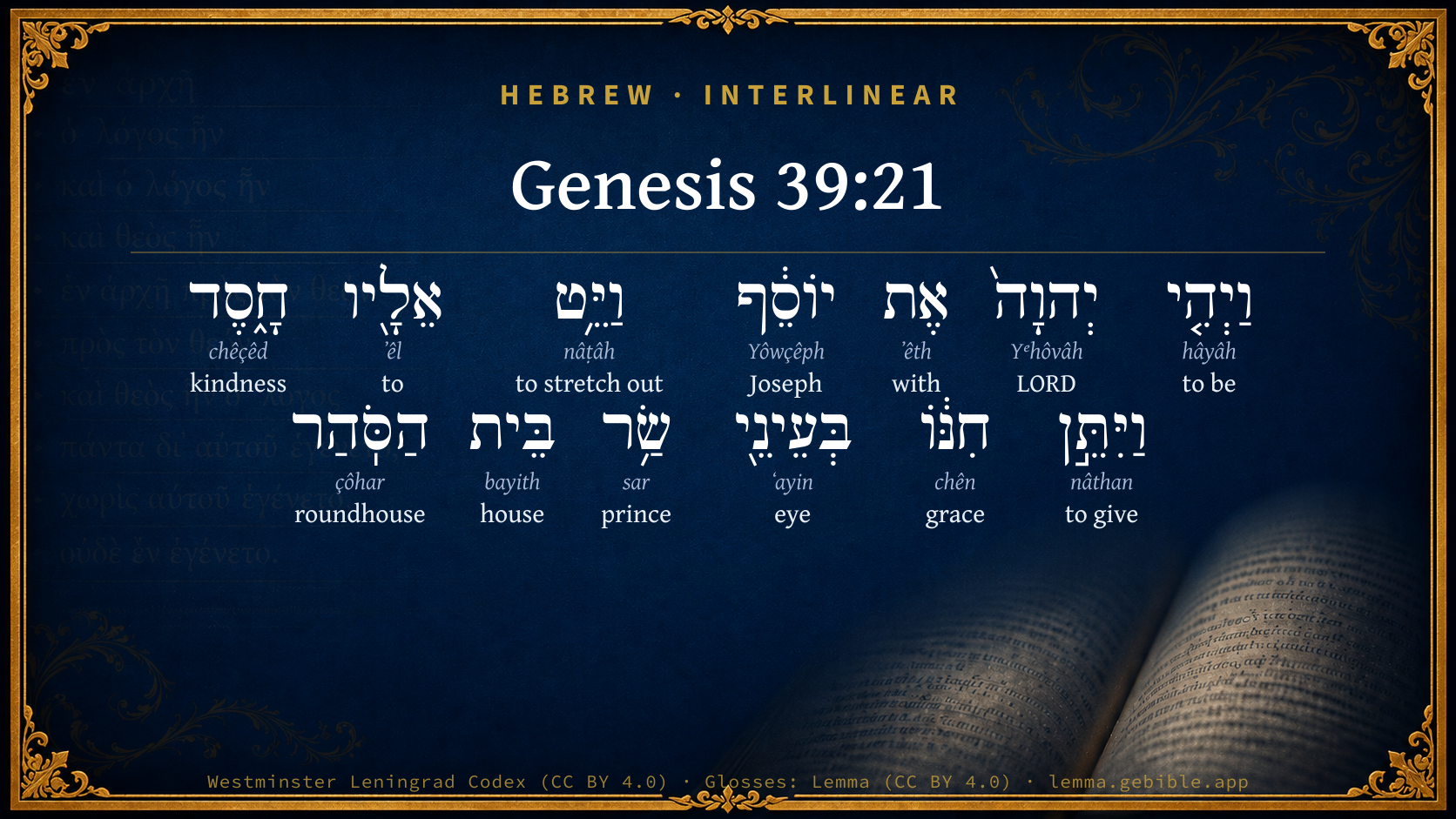
Hebrew (Westminster Leningrad Codex) Genesis 39:21 appears in the Hebrew Old Testament. The text above is from the Westminster Leningrad Codex. Each word links to its Strong’s number, a concise gloss, and parsing drawn from the Open Scriptures Hebrew Bible morphology. Click any word for its full Brown-Driver-Briggs (BDB) entry.
Download image
Cite this verse

Genesis 39:21 (World English Bible). Public Domain. Lemma interlinear Bible study tool, https://lemma.gebible.app/v/genesis/39/21.

Show BibTeX & RIS
BibTeX
RIS
English Translation
But Yahweh was with Joseph, and showed kindness to him, and gave him favor in the sight of the keeper of the prison.
World English Bible · Public Domain
Download a study sheet

One document with this verse’s original text, its word-by-word gloss line, the meaning frame, cross-references with their text, attributed commentary, and full source and license credits — printable, and it pastes into notes with its structure intact.

This verse Autodidact and up

Study sheet (.html) Plain text (.txt)

A passage Seminary Student

Up to 50 verses in one chapter. A passage sheet keeps up to 6 commentary sources and 12 cross-references per verse, in the order this page ranks them, and says so on the sheet whenever that leaves anything out. Ask for a single verse and you get the Autodidact verse sheet above.

Everything on this page stays free to read, with no account — the sheet is a download of what is already on screen, not access to it.

Want to remove ads? Support Godless Engineer
Compare translations 3

The same verse in 3 English versions, stacked beneath the original-language interlinear above. Click any original word for its lexicon entry.

Each is an independent rendering of the whole verse — the interlinear is not word-aligned to these translations.

Highlighted words mark where these versions differ — a whole-verse word diff, not a word-by-word alignment.

  • World English Bible Public Domain
    But Yahweh was with Joseph, and showed kindness to him, and gave him favor in the sight of the keeper of the prison.
  • King James Version Public Domain
    But the LORD was with Joseph, and showed him mercy, and gave him favor in the sight of the keeper of the prison.
  • unfoldingWord Literal Text CC BY-SA 4.0
    but Yahweh was with Joseph and showed kindness to him and gave him favor in the eyes of the chief of the round-house.

unfoldingWord Literal Text — © unfoldingWord, licensed CC BY-SA 4.0. Word-aligned USFM3 via Door43 (git.door43.org/unfoldingWord/en_ult).

Versions to compare (up to 4)

3 of 4 selected

Show all 18 translations

Every available English version of this verse, each an independent rendering of the whole verse.

  • World English Bible Public Domain
    But Yahweh was with Joseph, and showed kindness to him, and gave him favor in the sight of the keeper of the prison.
  • Berean Standard Bible Public Domain
    the LORD was with him and extended kindness to him, granting him favor in the eyes of the prison warden.
  • Majority Standard Bible Public Domain
    the LORD was with him and extended kindness to him, granting him favor in the eyes of the prison warden.
  • King James Version Public Domain
    But the LORD was with Joseph, and showed him mercy, and gave him favor in the sight of the keeper of the prison.
  • American Standard Version (1901) Public Domain
    But Jehovah was with Joseph, and showed kindness unto him, and gave him favor in the sight of the keeper of the prison.
  • Revised Version (1885) Public Domain
    But the LORD was with Joseph, and shewed kindness unto him, and gave him favour in the sight of the keeper of the prison.
  • Geneva Bible (1599) Public Domain
    But the Lord was with Ioseph, and shewed him mercie, and got him fauour in the sight of the master of the prison.
  • Douay-Rheims (1899) Public Domain
    And said: The Hebrew servant, whom thou best brought, came to me to abuse me.
  • Young's Literal Translation Public Domain
    And Jehovah is with Joseph, and stretcheth out kindness unto him, and putteth his grace in the eyes of the chief of the round-house;
  • Literal Standard Version CC BY-SA 4.0
    And YHWH is with Joseph, and stretches out kindness to him, and puts his grace in the eyes of the chief of the round-house;
  • Unlocked Literal Bible CC BY-SA 4.0
    But Yahweh was with Joseph and showed covenant faithfulness to him. He gave him favor in the sight of the prison warden.
  • unfoldingWord Literal Text CC BY-SA 4.0
    but Yahweh was with Joseph and showed kindness to him and gave him favor in the eyes of the chief of the round-house.
  • Darby Bible Public Domain
    And Jehovah was with Joseph, and extended mercy to him, and gave him favour in the eyes of the chief of the tower-house.
  • World Messianic Bible Public Domain
    But the LORD was with Joseph, and showed kindness to him, and gave him favor in the sight of the keeper of the prison.
  • Webster's Bible Public Domain
    But the LORD was with Joseph, and showed him mercy, and gave him favor in the sight of the keeper of the prison.
  • Free Bible Version CC BY-SA 4.0
    But the Lord was with Joseph, showing him trustworthy love, and made the chief jailer pleased with him.
  • Bible in Basic English Public Domain
    But the Lord was with Joseph, and was good to him, and made the keeper of the prison his friend.
  • JPS Tanakh (1917) Public Domain
    But the LORD was with Joseph, and showed kindness unto him, and gave him favour in the sight of the keeper of the prison.

Literal Standard Version (2020), Covenant Press — licensed CC BY-SA 4.0. Text via the HelloAO Bible API (eBible.org). Unlocked Literal Bible (unfoldingWord) — licensed CC BY-SA 4.0. Text via the HelloAO Bible API (eBible.org). unfoldingWord Literal Text — © unfoldingWord, licensed CC BY-SA 4.0. Word-aligned USFM3 via Door43 (git.door43.org/unfoldingWord/en_ult). Free Bible Version, Dr. Jonathan Gallagher — licensed CC BY-SA 4.0. Text via the HelloAO Bible API (eBible.org).

Word by word

More ways to search: Search by grammar → Find every occurrence → Compare this word →

Practice this passage: Drill this verse → Learn its vocabulary →

הַסֹּֽהַר
çôhar
H5470
“the · roundhouse”
Particle, Definite Article + Noun, Common, Masculine, Singular, Absolute
Part of Speech
Particle + Noun
Type
Common
Gender
Masculine
Number
Singular
State
Absolute
Full BDB Definition

Origin: from the same as H5469

TWOT: 1468b

house of roundness, roundhouse, prison - name of a prison
  1. וַיְהִ֤י hâyâh H1961 “and · to be” Conjunction + Verb, Qal, Sequential Imperfect, 3rd Person, Masculine, Singular
  2. יְהוָה֙ Yᵉhôvâh H3068 “LORD” Noun, Proper
  3. אֶת ʼêth H854 “with” Preposition
  4. יוֹסֵ֔ף Yôwçêph H3130 “Joseph” Noun, Proper
  5. וַיֵּ֥ט nâṭâh H5186 “and · to stretch out” Conjunction + Verb, Qal, Sequential Imperfect, 3rd Person, Masculine, Singular
  6. אֵלָ֖יו ʼêl H413 “to · him” Preposition + Suffix, Personal, 3rd Person, Masculine, Singular
  7. חָ֑סֶד chêçêd H2617 “kindness” Noun, Common, Masculine, Singular, Absolute
  8. וַיִּתֵּ֣ן nâthan H5414 “and · to give” Conjunction + Verb, Qal, Sequential Imperfect, 3rd Person, Masculine, Singular
  9. חִנּ֔וֹ chên H2580 “grace · his” Noun, Common, Masculine, Singular, Construct + Suffix, Personal, 3rd Person, Masculine, Singular
  10. בְּעֵינֵ֖י ʻayin H5869 “in/at · eyes of” Preposition + Noun, Common, Both, Dual, Construct
  11. שַׂ֥ר sar H8269 “prince of” Noun, Common, Masculine, Singular, Construct
  12. בֵּית bayith H1004 “house of” Noun, Common, Masculine, Singular, Construct

About this verse

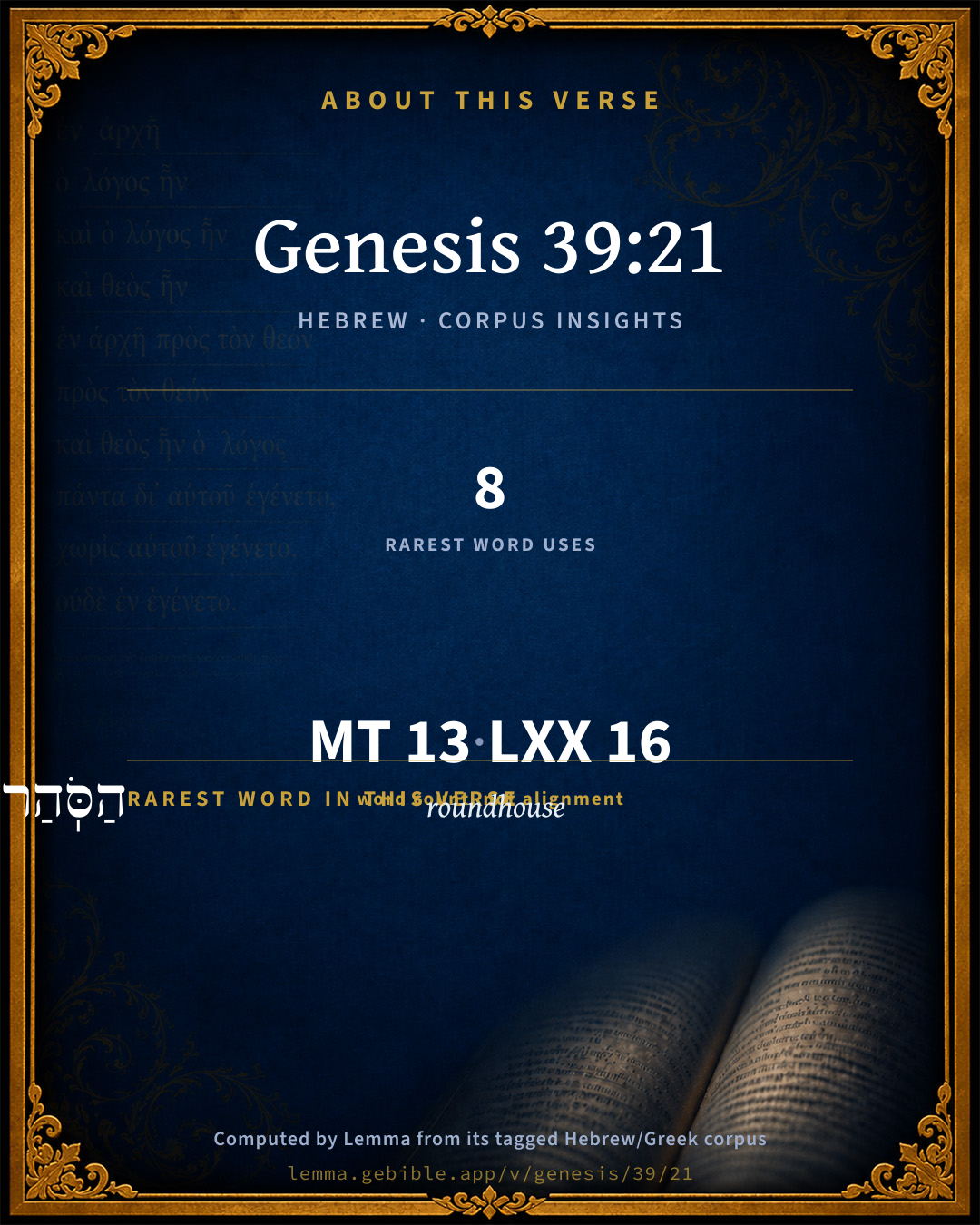
These counts appear in no published source. They are computed here, from the morphology-tagged text and Lemma’s own curated glosses. What Lemma adds →

13
words
13
distinct lemmas
Pentateuch
section

Notable vocabulary

The rarest word here is הַסֹּֽהַר roundhouse H5470 — appearing just 8 times in the whole Hebrew Bible.

Shared distinctive vocabulary

הַסֹּֽהַר roundhouse H5470 occurs in 6 verses of the Hebrew Bible. Also found in:

Grammatical profile

  • 3 verbs
  • 8 nouns
  • 2 prepositions

Verb forms

  • וַיְהִ֤י Qal · Sequential Imperfect
  • וַיֵּ֥ט Qal · Sequential Imperfect
  • וַיִּתֵּ֣ן Qal · Sequential Imperfect

Hebrew & Septuagint length

In English translation the verse runs 23 words from the Hebrew and 27 from the Septuagint (LXX English) — closely comparable.

A rough comparison of the two English renderings, which tokenize alike — not a word-level alignment.

Word counts can differ between the Hebrew and the Greek without any difference in meaning — e.g. the Hebrew direct-object marker אֵת has no separate Greek word, and Greek often adds the article ὁ.

In the original languages it is 13 Hebrew tokens and 16 Greek tokens — but the two are counted differently (Hebrew bundles its prefixes and suffixes into one token; the Greek is in lemma form), so that isn’t a like-for-like length.

Cross-references

21

Topical passages linked to Genesis 39:21 in the Treasury of Scripture Knowledge — connected by theme and wording, ordered by reader-vote popularity; previews shown in the World English Bible.

  • Isaiah 41:10 Don't you be afraid, for I am with you; don't be dismayed, for I am your God; I will strengthen you; yes, I will help you; yes, I will uphold you with the right hand of my righteousness.
  • Exodus 3:21 I will give this people favor in the sight of the Egyptians, and it will happen that when you go, you shall not go empty-handed.
  • Acts 7:9–10 "The patriarchs, moved with jealousy against Joseph, sold him into Egypt. God was with him,
  • 1 Peter 3:17 For it is better, if the will of God should so will, that you suffer for doing well than for doing evil.
  • Isaiah 43:2 When you pass through the waters, I will be with you; and through the rivers, they shall not overflow you: when you walk through the fire, you shall not be burned, neither shall the flame kindle on you.
  • Genesis 21:22 It happened at that time, that Abimelech and Phicol the captain of his host spoke to Abraham, saying, "God is with you in all that you do.
  • Genesis 39:2 Yahweh was with Joseph, and he was a prosperous man. He was in the house of his master the Egyptian.
  • Exodus 11:3 Yahweh gave the people favor in the sight of the Egyptians. Moreover the man Moses was very great in the land of Egypt, in the sight of Pharaoh's servants, and in the sight of the people.
  • Exodus 12:36 Yahweh gave the people favor in the sight of the Egyptians, so that they let them have what they asked. They despoiled the Egyptians.
  • Psalms 105:19 Until the time that his word happened, And Yahweh's word proved him true.
  • Daniel 1:9 Now God made Daniel to find kindness and compassion in the sight of the prince of the eunuchs.
  • Romans 8:31–32 What then shall we say about these things? If God is for us, who can be against us?
  • 1 Peter 4:14–16 If you are insulted for the name of Christ, blessed are you; because the Spirit of glory and of God rests on you. On their part he is blasphemed, but on your part he is glorified.
  • Genesis 40:3 He put them in custody in the house of the captain of the guard, into the prison, the place where Joseph was bound.
  • Proverbs 16:7 When a man's ways please Yahweh, He makes even his enemies to be at peace with him.
  • 1 Peter 3:13–14 Now who is he who will harm you, if you become imitators of that which is good?
  • Genesis 49:23–24 The archers have sorely grieved him, Shot at him, and persecute him:
  • Psalms 106:46 He made them also to be pitied By all those who carried them captive.
  • Daniel 6:22 My God has sent his angel, and has shut the lions' mouths, and they have not hurt me; because as before him innocence was found in me; and also before you, O king, have I done no hurt.
  • Romans 8:37 No, in all these things, we are more than conquerors through him who loved us.
  • Psalms 105:22 To discipline his princes at his pleasure, And to teach his elders wisdom.

Cross-references courtesy of OpenBible.info (CC BY 4.0).

Hebrew and Greek witnesses Masoretic Hebrew ↔ Greek Septuagint

The same verse in the two great witnesses to the Old Testament, shown verse-for-verse.

These are two independent witnesses, not word-aligned to each other, and the Septuagint is shown in lemma (dictionary) form.

Hebrew Genesis 39:21 Masoretic · Westminster Leningrad Codex

וַיְהִ֤י יְהוָה֙ אֶת יוֹסֵ֔ף וַיֵּ֥ט אֵלָ֖יו חָ֑סֶד וַיִּתֵּ֣ן חִנּ֔וֹ בְּעֵינֵ֖י שַׂ֥ר בֵּית הַסֹּֽהַר

But Yahweh was with Joseph, and showed kindness to him, and gave him favor in the sight of the keeper of the prison.

World English Bible · Public Domain

Greek LXX Genesis 39:21 Septuagint · lemma form

καί εἰμί κύριος μετά ιωσηφ καί καταχέω αὐτός ἔλεος καί δίδωμι αὐτός χάρις ἐναντίον ὁ ἀρχιδεσμοφύλαξ

And the Lord was with Joseph, and poured down mercy upon him; and he gave him favor in the sight of the chief keeper of the prison.

LXX2012 (modern English Septuagint) · Public Domain

Hebrew: Westminster Leningrad Codex (CC BY 4.0). Greek: Septuagint (public domain); English from LXX2012 (modern English Septuagint) (Public Domain). How the Septuagint differs from the Hebrew →

Targum (Aramaic paraphrase)

2

The Targum is the ancient Jewish Aramaic paraphrase of the Hebrew Scriptures — an interpretive translation, not the Hebrew text itself. Onkelos (literal) and Pseudo-Jonathan (expansive) render the Torah, and Jonathan the Prophets. Coverage is partial: where no permissively-licensed English translation exists for a verse, only the Aramaic is shown. This is verse-level text, not a word-by-word alignment to the Hebrew.

  1. Targum Onkelos Torah (Genesis–Deuteronomy)
    וַהֲוָה מֵימְרָא דַּיְיָ בְּסַעְדֵּהּ דְּיוֹסֵף וּנְגַד לֵהּ חִסְדָּא וִיהָבֵהּ לְרַחֲמִין בְּעֵינֵי רַב בֵּית אֲסִירֵי

    (no public-domain English translation for this verse)

    Targum Onkelos — Aramaic: “Onkelos Genesis” (public domain); “Onkelos Exodus” (public domain); “Onkelos Leviticus” (public domain); “Onkelos Numbers” (public domain); “Onkelos Deuteronomy” (public domain). English: “Sefaria Community Translation” (CC0 1.0 (public-domain dedication)); “J.W. Etheridge. The Targums of Onkelos and Jonathan Ben Uzziel on the Pentateuch. London: Longmans, Green, 1862” (public domain). Text via Sefaria.

  2. Targum Pseudo-Jonathan Torah (Genesis–Deuteronomy)
    וַהֲוָה מֵימְרָא דַיְיָ בְּסַעֲדֵיהּ דְיוֹסֵף וּנְגַד עֲלֵיהּ חִיסְדָא וִיהַב רַחֲמוּתֵיהּ בְּעֵינֵי רַב בֵּית אֲסִירֵי

    And the Word of the Lord was Joseph's Helper, and extended mercy to him, and gave him favour in the eyes of the captain of the prison.

    Targum Pseudo-Jonathan — Aramaic: “Targum Jonathan on Genesis” (public domain); “Targum Jonathan on Exodus” (public domain); “Targum Jonathan on Leviticus” (public domain); “Targum Jonathan on Numbers” (public domain); “Targum Jonathan on Deuteronomy” (public domain). English: “The Targum of Jonathan ben Uzziel, trans. J. W. Etheridge, London, 1862” (public domain). Text via Sefaria.

Commentary

Notes on Genesis 39:21 from classic Christian and Jewish commentators (each source and its license shown beneath its notes). The classic Christian expositions comment on the surrounding passage and are grouped to its opening verse, so a note may address several verses; the Jewish commentaries on the Tanakh (Rashi and others) are per-verse, so they appear only where the commentator wrote on this verse.

Lemma curates 59 commentaries, every one of them public domain or Creative Commons licensed, each selected and text-cleaned for this edition rather than reprinted as found. About our sources →

Trapp's Complete Commentary

John Trapp

Gen 39:21 But the LORD was with Joseph, and shewed him mercy, and gave him favour in the sight of the keeper of the prison.

Ver. 21. But the Lord was with Joseph.] A prison keeps not God from his; witness the apostles and martyrs, whose prisons, by God’s presence, became palaces; the fiery furnace, a gallery of pleasure; the stocks, a music school. {Act 16:25} Bradford, after he was put in prison, had better health than before; and found great favour with his keeper, who suffered him to go whither he would, upon his promise to return by such an hour to his prison again. {a}

{a} Act. and Mon., fol. 1489, 1457.

John Trapp, A Commentary or Exposition upon All the Books of the Old and New Testament (1647–1656) — public domain. Text from a community e-Sword module.

Tyndale Open Study Notes

Tyndale Open Resources

39:21-23 Joseph thrived in prison because God was with him. Each time Joseph prospered, he was put in charge of something.

Tyndale Open Study Notes — © Tyndale Open Resources, licensed CC BY-SA 4.0. Text via the HelloAO Bible API.

Geneva Bible (1599)

Geneva Bible translators

Hebrew, inclined mercy unto him.

Or, lord.

Geneva Bible (1599) marginal notes — public domain. Text via Bolls.life.

Jamieson, Fausset & Brown

Robert Jamieson, A. R. Fausset & David Brown

The Lord . . . gave him favour in the sight of the keeper of the prison, &c.--It is highly probable, from the situation of this prison (Gen 40:3), that the keeper might have been previously acquainted with Joseph and have had access to know his innocence of the crime laid to his charge, as well as with all the high integrity of his character. That may partly account for his showing so much kindness and confidence to his prisoner. But there was a higher influence at work; for "the Lord was with Joseph, and that which he did, the Lord made it to prosper."

Next: Genesis Chapter 40

Jamieson, Fausset & Brown — Commentary Critical and Explanatory on the Whole Bible (1871) — public domain (CC PDM 1.0). Text via the HelloAO Bible API.

Adam Clarke's Commentary

Verse 21. The Lord was with Joseph] It is but of little consequence where the lot of a servant of God may be cast; like Joseph he is ever employed for his master, and God honours him and prospers his work.

1. HE who acknowledges God in all his ways, has the promise that God shall direct all his steps. Joseph's captivity shall promote God's glory; and to this end God works in him, for him, by him. Even the irreligious can see when the Most High distinguishes his followers. Joseph's master saw that Jehovah was with him; and from this we may learn that the knowledge of the true God was in Egypt, even before the time of Joseph, though his worship was neither established nor even tolerated there. Both Abraham and Isaac had been in Egypt, and they had left a savour of true godliness behind them.

2. Joseph's virtue in resisting the solicitations of his mistress was truly exemplary. Had he reasoned after the manner of men, he might have soon found that the proposed intrigue might be carried on with the utmost secrecy and greatly to his secular advantage. But he chose to risk all rather than injure a kind benefactor, defile his conscience, and sin against God. Such conduct is so exceedingly rare that his example has stood on the records of time as almost without a parallel, admired by all, applauded by most, and in similar circumstances, I am afraid, imitated by few. The fable of the brave and virtuous Bellerophon and Sthenobaea, wife of Proetus, king of the Argives, was probably founded on this history.

3. Joseph fled and got him out. To know when to fight and when to fly are of great importance in the Christian life. Some temptations must be manfully met, resisted, and thus overcome; from others we must fly. He who stands to contend or reason, especially in such a case as that mentioned here, is infallibly ruined. Principiis obsta, "resist the first overtures of sin," is a good maxim. After-remedies come too late.

4. A woman of the spirit of Potiphar's wife is capable of any species of evil. When she could not get her wicked ends answered, she began to accuse. This is precisely Satan's custom: he first tempts men to sin, and then accuses them as having committed it, even where the temptation has been faithfully and perseveringly resisted! By this means he can trouble a tender conscience, and weaken faith by bringing confusion into the mind. Thus the inexperienced especially are often distracted and cast down; hence Satan is properly called the accuser of the brethren, Re 12:10.

Very useful lessons may be drawn from every part of the relation in this chapter, but detailing the facts and reasoning upon them would be more likely to produce than prevent the evil. An account of this kind cannot be touched with too gentle a hand. Others have been profuse here; I chose to be parsimonious, for reasons which the intelligent reader will feel as well as myself. Let this remark be applied to what has been said on the sin of Onan, See Clarke on Ge 38:29.

Adam Clarke's Commentary on the Bible (1810–1826) — public domain. Text from a community e-Sword/MySword module.

John Calvin's Commentaries

21. But the Lord was with Joseph. It appears, from the testimony of the Psalmist just cited, that Joseph’s extreme sufferings were not immediately alleviated. The Lord purposely suffered him to be reduced to extremity, that he might bring him back as from the grave. We know that as the light of the sun is most clearly seen when we are looking from a dark place; so, in the darkness of our miseries, the grace of God shines more brightly when, beyond expectation, he succors us. Moreover, Moses says, the Lord was with Joseph, because he extended this grace or mercy towards him; whence we may learn, that God, even when he delivers us from unjust violence, or when he assists us in a good cause, is yet induced to do so by his own goodness. For since we are unworthy that he should grant us his help, the cause of its communication must be in himself; seeing that he is merciful. Certainly if merits, which should lay God under obligation, are to be sought for in men, they would have been found in Joseph; yet Moses declares that he was assisted by the gratuitous favor of God. This, however, is no obstacle to his leaving received the reward of his piety, which is perfectly consistent with the gratuitous kindness of God. The manner of exercising this kindness is also added; namely, that the Lord gave him favor with the keeper of the prison. There is, indeed, no doubt that Joseph was acceptable to the keeper for many reasons: for even virtue conciliates favor to itself; and Moses has before shown that the holy man was amiable in many ways; but because it often happens that the children of God are treated with as great inhumanity as if they were the worst of all men, Moses expressly states that the keeper of the prison, at length, became humane; because his mind, which was not spontaneously disposed to equity, had been divinely inclined to it. Therefore, that the keeper of the prison, having laid aside his cruelty, acted with kindness and gentleness, was a change which proceeded from God, who governs the hearts of men according to his own will. But it is a wonder that the keeper of the prison did not fear lest he should incur the displeasure of Potiphar: and even that Potiphar himself, who without difficulty could have interfered, should yet have suffered a man whom he mortally hated to be thus kindly and liberally treated. It may be answered with truth, that his cruelty had been divinely restrained: but it is also probable that he had suspected, and at length, been made acquainted with the subtle scheme of his wife. Although, however, he might be appeased towards holy Joseph, he was unwilling to acquit him to his own dishonor. Meanwhile the remarkable integrity of Joseph manifests itself in this, that when he is made the guard of the prison, and has the free administration of it, he nevertheless does not attempt to escape, but waits for the proper season of his liberation.

John Calvin's Commentaries (1540-1563) — public domain. Text from the Calvin Translation Society English edition (1840s-50s) via the Christian Classics Ethereal Library (ccel.org). Calvin's coverage is partial (roughly two-thirds of the Bible); uncommented books and verses are honest gaps, never fabricated. The 19th-century editor's footnotes and remarks are omitted so the notes are faithfully Calvin's own voice.

The Cambridge Bible for Schools and Colleges

gen. ed. J. J. S. Perowne

21. But the Lord, &c.] See note on Gen_39:2. The favour of Jehovah towards Joseph is the cause of Joseph’s acceptability with the keeper of the prison. He receives the same degree of confidence in prison, as he had received from the master whom he had served as steward.

The Cambridge Bible for Schools and Colleges (gen. ed. J. J. S. Perowne; Cambridge University Press, 1878–1918) — public domain. Text from a community e-Sword module.

John Gill's Exposition

And the Lord was with Joseph,.... Comforting him with his presence under his afflictions; supporting him with his right hand; sanctifying all his troubles to him, and so causing him to bear them patiently and cheerfully:

and showed him mercy, and gave him favour in the sight of the keeper of the prison; who was the underkeeper to Potiphar; God so wrought upon the heart of this man, that he was merciful to him, and took off the iron fetters, which hurt his feet, and gave him liberty to walk about; and many other favours and kindnesses he showed unto him, as follow.

John Gill's Exposition of the Whole Bible (1746–1763) — public domain (CC PDM 1.0). Text via the HelloAO Bible API.

Haydock's Catholic Bible Commentary

Keeper. Pererius thinks this was the same Putiphar, who, recognizing the innocence of Joseph, allows him every indulgence in prison; but does not liberate him, for fear of the dishonour and resentment of his wife. (Calmet) --- He had before put him in irons. (Psalm civ. 18; Wisdom x. 13.) Joseph here exercises at once the four cardinal virtues. Prudence, in keeping out of the company of his mistress, as the Hebrew express it, ver. 10: "He yielded not to lie with her, or to be in her company." (Haydock) --- Justice, in regard to his master. Fortitude, in bearing with all sorts of hardships, loss of character, &c. And Temperance, by refusing to gratify the most violent of all passions, at an age when it is the most insidious and ungovernable. This makes the fathers exclaim, We wonder more at the conduct of Joseph, than at the delivery of the three children from the Babylonian furnace. [Daniel iii.] For, like them, Joseph continues unhurt, and more shining, in the midst of the flames. (St. Chrysostom) (Tirinus) --- The stories of Hippolitus, Bellerophon, &c., seem to be copied from this. (Calmet)

George Leo Haydock (1774–1849), Haydock's Catholic Family Bible and Commentary, 1859 edition — public domain. Excludes Psalms (Douay-Rheims chapter numbering differs from Protestant) and Deuterocanonical books (Catholic canon only).

Matthew Poole's English Annotations

The gaoler, who under Potiphar was the keeper of that particular person.

Matthew Poole's English Annotations on the Holy Bible (1683–1685) — public domain. Text from a community e-Sword/MySword module.

Whedon's Commentary on the Bible

Daniel D. Whedon

21. The Lord was with Joseph — “Jehovah is with him in the prison as well as in the house of Potiphar, and he wins the confidence of his new master, the jailer, as completely as he did that of Potiphar. Amid allurements and enticements, and amid degradation and suffering, in honour and dishonour, Joseph’s faith and integrity shine on the same. Unlike his father Jacob, or even his great-grandfather Abraham, Joseph is never seen to slip into temptation. He reveals the most steady and uniform faith, and on the whole the best-balanced character that we find in the patriarchal age. Especially is Joseph a remarkable example of youthful piety. In fact, while Abraham lives as a hoary sage in our imagination, Joseph rises before us ever in the beauty and freshness of youth. At the age of seventeen he exchanged the simple pastoral life of Palestine, with its tents and pastures and sheepfolds, for the massive cities and luxurious splendours of Egyptian civilization; the rude altars of Beth-el and Beer-sheba for the bewildering grandeur of temples which fill the soul with awe today; yet he never forgot the God of his fathers, and to the law of that God he clung, not only in obedience, but in love, when to disobey would seem to have been the dictate of every worldly interest. He came to that land a slave, and friendless, yet by the simple force of character he rose to be next to Pharaoh. This is moral greatness and grandeur.” — Newhall.

Daniel D. Whedon (gen. ed.), Commentary on the Old and New Testaments (1874–1909) — public domain. Text from a community e-Sword module.

The Pulpit Commentary

But (even if Joseph was harshly treated in the tower of Heliopolis) the Lord Jehovah (vide on ver. 5)was with Joseph (vide ver. 2), and showed him mercy (literally, extended kindness unto him), and gave him favor in the eyes of the keeper (or captain) of the prison (or round house).

HOMILIES BY F. HASTINGS Ver. 21.

Joseph in slavery.

the Lord was with Joseph," &c. Men would have thought, as they looked on the Hebrew slave, that he was God-forsaken. Not so. God blessed him. This was evidenced in the character he developed. The Lord was with him. ;

I DISCRETION, THE RESULT OF A SENSE OF THE DIVINE PRESENCE. He did not betray trust, or presume on the confidence placed in him, or the kind treatment he received; nor did he unwisely run into danger.

II DILIGENCE, THE OUTCOME OF A SENSE OF THE DIVINE PRESENCE. Toll kept off much temptation. If a slave by circumstances, he will yet do what he can to benefit his master. He worked under apparently hopeless conditions.

III DEVOUTNESS, THE CERTAIN CONSEQUENCE OF A SENSE OF THE DIVINE PRESENCE. Joseph lived as under the eye of God. Hence when special temptations came he repelled them in the Divine strength. "How can I do this great wickedness?" &c. Joseph was neither to be persecuted out of his religion nor enticed from it. This is the brightest chapter in Joseph"s life. He would not sin against himself, nor against God, who was with him. H. ;

HOMILIES BY J.F. MONTGOMERY Ver. 21.

God"s presence with his servants.

Joseph in slavery, yet the Lord was with him (cf. Rev_1:9) Twice stated in this chapter. Outward prosperity is no test of God"s presence (cf. Rom_5:3; 2Co_12:9) Often in times of trial God"s presence is most clearly felt. When all dark below, the eye is drawn upwards. The world"s good seen to be unprofitable. (Jam_4:4) There is a sense in which God is always with all. He guides men"s actions and course of life, whether they will or not. But while unbelief derives no comfort from this, (Zep_1:12) the knowledge of his presence gives peace to his people. (Isa_26:3-12)

I CHARACTER OF HIM WITH WHOM GOD WAS THUS PRESENT. A Godward mind habitually living-as in the sight of God, though left alone (cf. Gal_4:28) Fulfilled what his hand found to do. God"s will was his rule of life. He resisted temptation; (Jam_1:12) was faithful in the charge committed to him, though not of his own choice. Did not look upon the wrong he had suffered as excusing- him from fidelity. This faithful spirit can spring only from thorough belief in God s love and. (1Jn_4:19)

II THE BLESSING OF GOD"S PRESENCE EXTENDED TO EVERY PART OF HIS LIFE. Not merely in the fact of his being carried to Egypt, (Act_23:11) but in every incident God"s hand is seen. His management of Potiphar"s affairs was a training for rule over Egypt. His unjust accusation was a step towards his standing before Pharaoh. His experience in prison prepared him to be the deliverer of a nation (cf. Heb_2:18 Heb_4:15) Thus God"s presence is something better and higher thou merely a prosperous course. It is the certainty that everything that happens is ordered by infinite wisdom and love is a step towards the fullness of joy. (Deu_8:2) This holds good in spiritual experience not less than in temporal. A Christian is often led through times of darkness. Communion with God seems to be interrupted. (Rom_7:24) Temptation, opposition, difficulty in prayer make the soul sad. Yet the Lord is not absent; and these are all parts of the training by which he is preparing his servant for the fullness of blessing.

III HE WITH WHOM THE LORD ABIDES (Joh_14:23; Rev_3:20) IS A BLESSING TO OTHERS. So it was with Joseph. Potiphar, the jailer, Pharaoh, the Egyptian nation, were blessed through him. There is no such thing as keeping a blessing to ourselves; the very attempt destroys it as a blessing. Temporal possessions and powers, used selfishly, become vanity. They pass away, and leave no good, no joy behind. And so with spiritual good. He who has experienced the grace of God must care for others, or his own state will suffer. (Pro_11:24) The more we partake of the mind of Christ, the more we learn that wherever he leads us, it is that we may be channels of blessing to others. M.

The Pulpit Commentary (1880–1919), ed. H.D.M. Spence-Jones & Joseph S. Exell — public domain. Text from a community e-Sword module.

John Wesley's Explanatory Notes

But the Lord was with Joseph and shewed him mercy. God despiseth not his prisoners, Psalm lxix, 33. No gates nor bars can shut out his gracious presence from his people. God gave him favour in the sight of the keeper of the prison - God can raise up friends for his people even where they little expect them. The keeper saw that God was with him, and that every thing prospered under his hand, and therefore intrusted him with the management of the affairs of the prison.

John Wesley, Explanatory Notes Upon the Whole Bible (1754–1765) — public domain. Text via the GEBible commentary corpus.

Keil & Delitzsch

C. F. Keil & F. Delitzsch

In the prison itself Jehovah was with Joseph, procuring him favour in the eyes of the governor of the prison, so that he entrusted all the prisoners to his care, leaving everything that they had to do, to be done through him, and not troubling himself about anything that was in his hand, i.e., was committed to him, because Jehovah made all that he did to prosper. "The keeper" was the governor of the prison, or superintendent of the gaolers, and was under Potiphar, the captain of the trabantes and chief of the executioners (Gen 37:36).

Keil & Delitzsch — Biblical Commentary on the Old Testament (1861–1891) — public domain (CC PDM 1.0). Text via the HelloAO Bible API. (Old Testament only.)

unfoldingWord translationNotes

Door43 World Missions Community

But Yahweh was with Joseph

This refers to how Yahweh took care of Joseph and was kind to him. AT: "But Yahweh was kind to Joseph" or "But Yahweh took care of Joseph" (See: Idiom)

showed covenant faithfulness to him

The abstract noun "faithfulness" can be stated as "faithful" or "faithfully." AT: "was faithful to his covenant with him" or "faithfully loved him" (See: Abstract Nouns)

He gave him favor in the sight of the prison warden

This means Yahweh caused the prison warden to approve of Joseph and to treat him well. AT: "Yahweh caused the prison warden to be pleased with Joseph" (See: Idiom)

the prison warden

"the prison manager" or "the man in charge of the prison"

gave into Joseph's hand

Here "hand" represents Joseph's power or trust. AT: "put Joseph in charge of" (See: Metaphor)

Whatever they did there, Joseph was in charge of it

"Joseph was in charge of everything they did there"

because Yahweh was with him

This refers to how Yahweh helped Joseph and guided him. AT: "because Yahweh guided Joseph" (See: Idiom)

Whatever he did, Yahweh prospered

"Yahweh caused everything that Joseph did to prosper"

translationWords

Yahweh

covenant faithfulness

favor

prison

unfoldingWord translationNotes — © Distant Shores Media and the Door43 World Missions Community, licensed CC BY-SA 4.0. Source: git.door43.org/Door43/en_tn.

Rashi

Rabbi Shlomo Yitzchaki (Rashi)

ויט אליו חסד AND CAUSED HIM TO FIND FAVOUR — so that he was liked by all who saw him. We have the expression חסד in a like sense in the Mishna (Baraitha): “a handsome bride liked by all (חסודה)” (Ketubot 17a).

Rashi on the Tanakh — English translations: “The Judaica Press complete Tanach with Rashi, translated by A. J. Rosenberg” (CC BY 4.0); “Pentateuch with Rashi's commentary by M. Rosenbaum and A.M. Silbermann, 1929-1934” (public domain); “The Metsudah Tanach series, Lakewood, N.J” (CC BY 4.0); and “The Book of Joshua, Metsudah Publications, 1997” (CC BY 4.0). Text via Sefaria.

Lesson kit

Teaching starters — assembled from the data on this page, not authored interpretation. Every prompt links to the verse data it draws on. Edit before teaching.

Genesis, in the Pentateuch, opens this verse with 13 words (13 distinct Hebrew lemmas). Its most distinctive word is çôhar (“roundhouse”). A historical commentator’s framing appears above. Read the whole chapter for the surrounding context.

Discussion questions

  1. How does “roundhouse” (çôhar) shape what this verse is saying?
  2. How does Genesis 39:20, which shares the word «roundhouse», read alongside this verse?
  3. The translations on this page render this verse differently — a whole-verse word diff, not a word-by-word alignment. What might account for the different wordings?
  4. «וַיְהִ֤י» is a Qal Sequential Imperfect verb. How does that grammatical form shape the action described?
  5. Compare how Trapp's Complete Commentary and Tyndale Open Study Notes read this verse. Where do they agree or differ?

Things to notice

Reading settings

Reading text

Shown beneath each verse's original-language words.

Old Testament
Old Testament edition

Read the OT as the Masoretic Hebrew (MT) or the Greek Septuagint (LXX).

English shown for the Greek Septuagint (in the Hebrew ↔ Greek comparison).

Comparing translations? Open the Compare panel on any verse page to stack up to four side by side.