Genesis 41:10

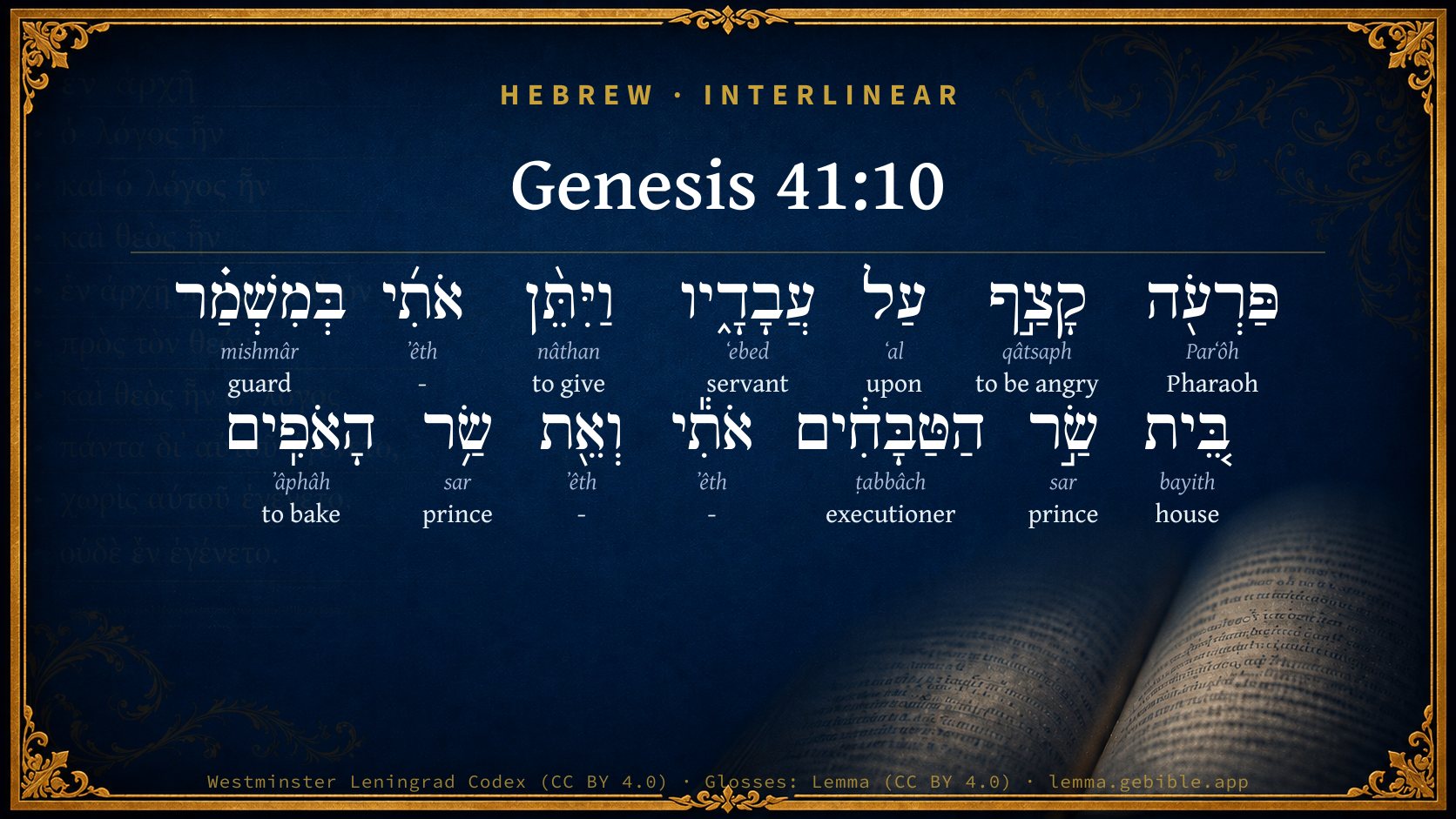
Hebrew (Westminster Leningrad Codex) Genesis 41:10 appears in the Hebrew Old Testament. The text above is from the Westminster Leningrad Codex. Each word links to its Strong’s number, a concise gloss, and parsing drawn from the Open Scriptures Hebrew Bible morphology. Click any word for its full Brown-Driver-Briggs (BDB) entry.
Download image
Cite this verse

Genesis 41:10 (World English Bible). Public Domain. Lemma interlinear Bible study tool, https://lemma.gebible.app/v/genesis/41/10.

Show BibTeX & RIS
BibTeX
RIS
English Translation
Pharaoh was angry with his servants, and put me in custody in the house of the captain of the guard, me and the chief baker.
World English Bible · Public Domain
Download a study sheet

One document with this verse’s original text, its word-by-word gloss line, the meaning frame, cross-references with their text, attributed commentary, and full source and license credits — printable, and it pastes into notes with its structure intact.

This verse Autodidact and up

Study sheet (.html) Plain text (.txt)

A passage Seminary Student

Up to 50 verses in one chapter. A passage sheet keeps up to 6 commentary sources and 12 cross-references per verse, in the order this page ranks them, and says so on the sheet whenever that leaves anything out. Ask for a single verse and you get the Autodidact verse sheet above.

Everything on this page stays free to read, with no account — the sheet is a download of what is already on screen, not access to it.

Want to remove ads? Support Godless Engineer
Compare translations 3

The same verse in 3 English versions, stacked beneath the original-language interlinear above. Click any original word for its lexicon entry.

Each is an independent rendering of the whole verse — the interlinear is not word-aligned to these translations.

Highlighted words mark where these versions differ — a whole-verse word diff, not a word-by-word alignment.

  • World English Bible Public Domain
    Pharaoh was angry with his servants, and put me in custody in the house of the captain of the guard, me and the chief baker.
  • King James Version Public Domain
    Pharaoh was wroth with his servants, and put me in ward in the captain of the guard's house, both me and the chief baker:
  • unfoldingWord Literal Text CC BY-SA 4.0
    Pharaoh broke out in anger against his servants, and he put me in custody the house of the chief of the guards, me and the chief of the bakers.

unfoldingWord Literal Text — © unfoldingWord, licensed CC BY-SA 4.0. Word-aligned USFM3 via Door43 (git.door43.org/unfoldingWord/en_ult).

Versions to compare (up to 4)

3 of 4 selected

Show all 18 translations

Every available English version of this verse, each an independent rendering of the whole verse.

  • World English Bible Public Domain
    Pharaoh was angry with his servants, and put me in custody in the house of the captain of the guard, me and the chief baker.
  • Berean Standard Bible Public Domain
    Pharaoh was once angry with his servants, and he put me and the chief baker in the custody of the captain of the guard.
  • Majority Standard Bible Public Domain
    Pharaoh was once angry with his servants, and he put me and the chief baker in the custody of the captain of the guard.
  • King James Version Public Domain
    Pharaoh was wroth with his servants, and put me in ward in the captain of the guard's house, both me and the chief baker:
  • American Standard Version (1901) Public Domain
    Pharaoh was wroth with his servants, and put me in ward in the house of the captain of the guard, me and the chief baker:
  • Revised Version (1885) Public Domain
    Pharaoh was wroth with his servants, and put me in ward in the house of the captain of the guard, me and the chief baker:
  • Geneva Bible (1599) Public Domain
    Pharaoh being angrie with his seruantes, put me in ward in the chiefe stewards house, both me and the chiefe baker.
  • Douay-Rheims (1899) Public Domain
    And when morning was come, being struck with fear, he sent to all the interpreters of Egypt, and to all the wise men: and they being called for, he told them his dream, and there was not any one that could interpret it.
  • Young's Literal Translation Public Domain
    Pharaoh hath been wroth against his servants, and giveth me into charge in the house of the chief of the executioners, me and the chief of the bakers;
  • Literal Standard Version CC BY-SA 4.0
    Pharaoh has been angry against his servants, and puts me in confinement in the house of the chief of the executioners, me and the chief of the bakers;
  • Unlocked Literal Bible CC BY-SA 4.0
    Pharaoh was angry with his servants, and put me in custody in the house of the captain of the guard, the chief baker and me.
  • unfoldingWord Literal Text CC BY-SA 4.0
    Pharaoh broke out in anger against his servants, and he put me in custody the house of the chief of the guards, me and the chief of the bakers.
  • Darby Bible Public Domain
    Pharaoh was wroth with his bondmen, and put me in custody into the captain of the life-guard's house, me and the chief of the bakers.
  • World Messianic Bible Public Domain
    Pharaoh was angry with his servants, and put me in custody in the house of the captain of the guard, with the chief baker.
  • Webster's Bible Public Domain
    Pharaoh was wroth with his servants, and put me in custody in the captain of the guard's house, both me, and the chief baker:
  • Free Bible Version CC BY-SA 4.0
    “Your Majesty was angry with some of your officials and you imprisoned me in the house of the commander of the guard, along with the chief baker.
  • Bible in Basic English Public Domain
    Pharaoh had been angry with his servants, and had put me in prison in the house of the captain of the army, together with the chief bread-maker;
  • JPS Tanakh (1917) Public Domain
    Pharaoh was wroth with his servants, and put me in the ward of the house of the captain of the guard, me and the chief baker.

Literal Standard Version (2020), Covenant Press — licensed CC BY-SA 4.0. Text via the HelloAO Bible API (eBible.org). Unlocked Literal Bible (unfoldingWord) — licensed CC BY-SA 4.0. Text via the HelloAO Bible API (eBible.org). unfoldingWord Literal Text — © unfoldingWord, licensed CC BY-SA 4.0. Word-aligned USFM3 via Door43 (git.door43.org/unfoldingWord/en_ult). Free Bible Version, Dr. Jonathan Gallagher — licensed CC BY-SA 4.0. Text via the HelloAO Bible API (eBible.org).

Word by word

More ways to search: Search by grammar → Find every occurrence → Compare this word →

Practice this passage: Drill this verse → Learn its vocabulary →

בְּמִשְׁמַ֗ר
mishmâr
H4929
“in/at · guard of”
Preposition + Noun, Common, Masculine, Singular, Construct
Part of Speech
Preposition + Noun
Type
Common
Gender
Masculine
Number
Singular
State
Construct
Full BDB Definition

Origin: from H8104

TWOT: 2414f

place of confinement, prison, guard, jail, guard post, watch, observance - jail, prison, guard-house - guard, guard post, act of guarding - observances
  1. פַּרְעֹ֖ה Parʻôh H6547 “Pharaoh” Noun, Proper
  2. קָצַ֣ף qâtsaph H7107 “to be angry” Verb, Qal, Perfect, 3rd Person, Masculine, Singular
  3. עַל ʻal H5921 “upon” Preposition
  4. עֲבָדָ֑יו ʻebed H5650 “servants · his” Noun, Common, Masculine, Plural, Construct + Suffix, Personal, 3rd Person, Masculine, Singular
  5. וַיִּתֵּ֨ן nâthan H5414 “and · to give” Conjunction + Verb, Qal, Sequential Imperfect, 3rd Person, Masculine, Singular
  6. אֹתִ֜י ʼêth H853 “- · me” Particle, Direct Object + Suffix, Personal, 1st Person, Common, Singular
  7. בֵּ֚ית bayith H1004 “house of” Noun, Common, Masculine, Singular, Construct
  8. שַׂ֣ר sar H8269 “prince of” Noun, Common, Masculine, Singular, Construct
  9. הַטַּבָּחִ֔ים ṭabbâch H2876 “the · executioners” Particle, Definite Article + Noun, Common, Masculine, Plural, Absolute
  10. אֹתִ֕י ʼêth H853 “- · me” Particle, Direct Object + Suffix, Personal, 1st Person, Common, Singular
  11. וְאֵ֖ת ʼêth H853 “and · -” Conjunction + Particle, Direct Object
  12. שַׂ֥ר sar H8269 “prince of” Noun, Common, Masculine, Singular, Construct
  13. הָאֹפִֽים ʼâphâh H644 “the · baking” Particle, Definite Article + Verb, Qal, Participle Active, Masculine, Plural, Absolute

About this verse

These counts appear in no published source. They are computed here, from the morphology-tagged text and Lemma’s own curated glosses. What Lemma adds →

14
words
11
distinct lemmas
Pentateuch
section

Notable vocabulary

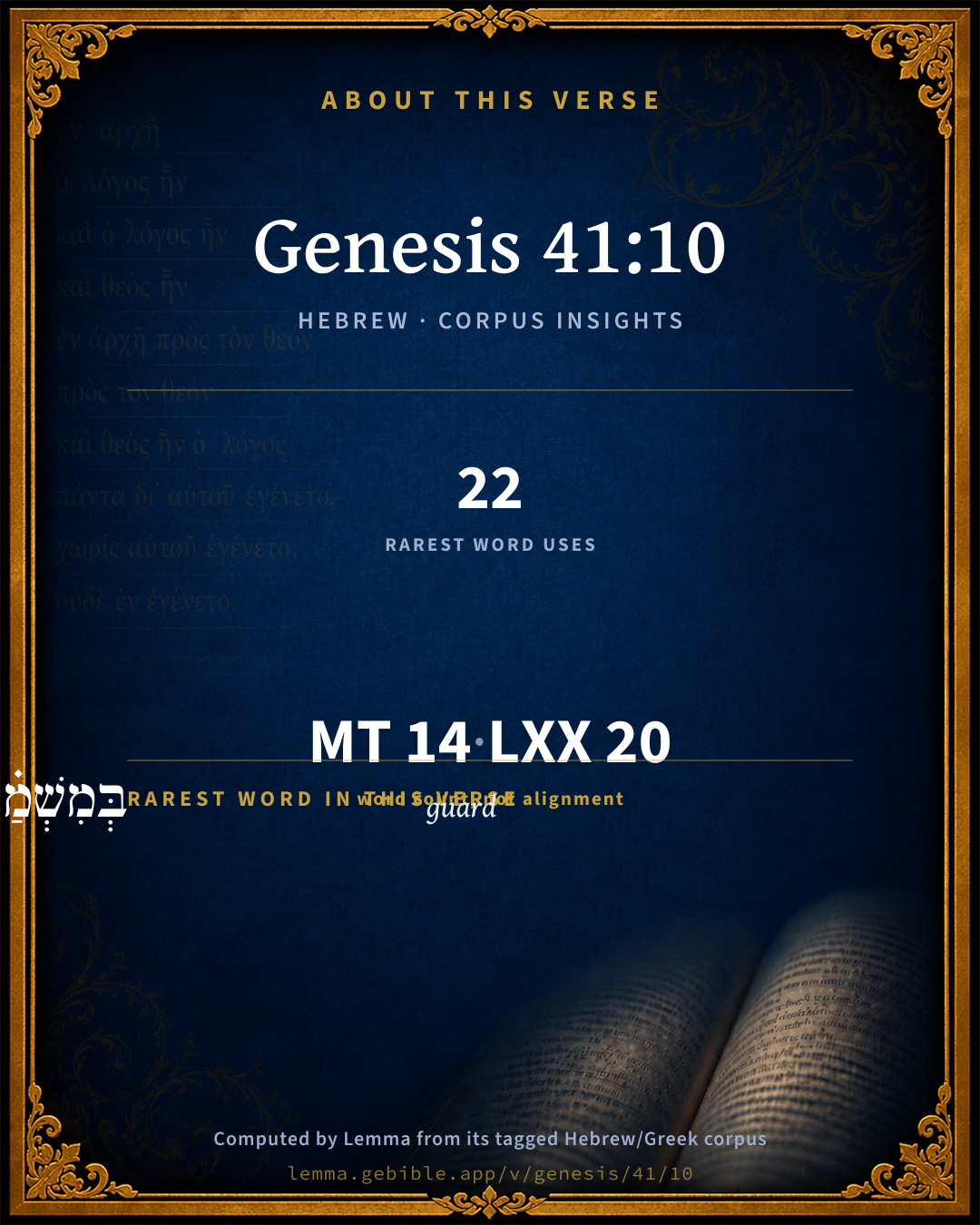
The rarest word here is בְּמִשְׁמַ֗ר guard H4929 — appearing just 22 times in the whole Hebrew Bible.

Shared distinctive vocabulary

בְּמִשְׁמַ֗ר guard H4929 occurs in 20 verses of the Hebrew Bible. Also found in:

Grammatical profile

  • 3 verbs
  • 7 nouns
  • 1 preposition
  • 3 particles

Verb forms

  • קָצַ֣ף Qal · Perfect
  • וַיִּתֵּ֨ן Qal · Sequential Imperfect
  • הָאֹפִֽים Qal · Participle Active

Repetition

A word recurs within this verse — often emphatic in Hebrew:

  • שַׂ֣ר prince H8269 ×2

Hebrew & Septuagint length

In English translation the verse runs 25 words from the Hebrew and 26 from the Septuagint (LXX English) — closely comparable.

A rough comparison of the two English renderings, which tokenize alike — not a word-level alignment.

Word counts can differ between the Hebrew and the Greek without any difference in meaning — e.g. the Hebrew direct-object marker אֵת has no separate Greek word, and Greek often adds the article ὁ.

In the original languages it is 14 Hebrew tokens and 20 Greek tokens — but the two are counted differently (Hebrew bundles its prefixes and suffixes into one token; the Greek is in lemma form), so that isn’t a like-for-like length.

Cross-references

3

Topical passages linked to Genesis 41:10 in the Treasury of Scripture Knowledge — connected by theme and wording, ordered by reader-vote popularity; previews shown in the World English Bible.

  • Genesis 39:20 Joseph's master took him, and put him into the prison, the place where the king's prisoners were bound, and he was there in custody.
  • Genesis 40:2–3 Pharaoh was angry with his two officers, the chief cupbearer and the chief baker.
  • Genesis 37:36 The Midianites sold him into Egypt to Potiphar, an officer of Pharaoh's, the captain of the guard.

Cross-references courtesy of OpenBible.info (CC BY 4.0).

Hebrew and Greek witnesses Masoretic Hebrew ↔ Greek Septuagint

The same verse in the two great witnesses to the Old Testament, shown verse-for-verse.

These are two independent witnesses, not word-aligned to each other, and the Septuagint is shown in lemma (dictionary) form.

Hebrew Genesis 41:10 Masoretic · Westminster Leningrad Codex

פַּרְעֹ֖ה קָצַ֣ף עַל עֲבָדָ֑יו וַיִּתֵּ֨ן אֹתִ֜י בְּמִשְׁמַ֗ר בֵּ֚ית שַׂ֣ר הַטַּבָּחִ֔ים אֹתִ֕י וְאֵ֖ת שַׂ֥ר הָאֹפִֽים

Pharaoh was angry with his servants, and put me in custody in the house of the captain of the guard, me and the chief baker.

World English Bible · Public Domain

Greek LXX Genesis 41:10 Septuagint · lemma form

φαραώ ὀργίζω ὁ παῖς αὐτός καί τίθημι ἐγώ ἐν φυλακή ἐν ὁ οἶκος ὁ ἀρχιμάγειρος ἐγώ τε καί ὁ ἀρχισιτοποιός

Pharao was angry with his servants, and put us in prison in the house of the captain of the guard, both me and the chief baker.

LXX2012 (modern English Septuagint) · Public Domain

Hebrew: Westminster Leningrad Codex (CC BY 4.0). Greek: Septuagint (public domain); English from LXX2012 (modern English Septuagint) (Public Domain). How the Septuagint differs from the Hebrew →

Targum (Aramaic paraphrase)

2

The Targum is the ancient Jewish Aramaic paraphrase of the Hebrew Scriptures — an interpretive translation, not the Hebrew text itself. Onkelos (literal) and Pseudo-Jonathan (expansive) render the Torah, and Jonathan the Prophets. Coverage is partial: where no permissively-licensed English translation exists for a verse, only the Aramaic is shown. This is verse-level text, not a word-by-word alignment to the Hebrew.

  1. Targum Onkelos Torah (Genesis–Deuteronomy)
    פַּרְעֹה רְגֵז עַל עַבְדוֹהִי וִיהַב יָתִי בְּמַטְּרָא בֵּית רַב קָטוֹלַיָּא יָתִי וְיָת רַב נַחְתּוֹמֵי

    (no public-domain English translation for this verse)

    Targum Onkelos — Aramaic: “Onkelos Genesis” (public domain); “Onkelos Exodus” (public domain); “Onkelos Leviticus” (public domain); “Onkelos Numbers” (public domain); “Onkelos Deuteronomy” (public domain). English: “Sefaria Community Translation” (CC0 1.0 (public-domain dedication)); “J.W. Etheridge. The Targums of Onkelos and Jonathan Ben Uzziel on the Pentateuch. London: Longmans, Green, 1862” (public domain). Text via Sefaria.

  2. Targum Pseudo-Jonathan Torah (Genesis–Deuteronomy)
    מִן קֳדָם יְיָ אִסְתַּקֵף דְפַרְעה רְגֵיז עַל עַבְדוֹי וִיהַב יָתִי בְּמַטְרָא בֵּי רַב סַפּוֹקְלַטוֹרְיָא יָתִי וְיַת רַב נַחְתּוֹמָא

    It was occasioned from the Lord that Pharoh was angry with his servants, and he put me in ward in the house of the chief executioner, me and the chief baker.

    Targum Pseudo-Jonathan — Aramaic: “Targum Jonathan on Genesis” (public domain); “Targum Jonathan on Exodus” (public domain); “Targum Jonathan on Leviticus” (public domain); “Targum Jonathan on Numbers” (public domain); “Targum Jonathan on Deuteronomy” (public domain). English: “The Targum of Jonathan ben Uzziel, trans. J. W. Etheridge, London, 1862” (public domain). Text via Sefaria.

Commentary

Notes on Genesis 41:10 from classic Christian and Jewish commentators (each source and its license shown beneath its notes). The classic Christian expositions comment on the surrounding passage and are grouped to its opening verse, so a note may address several verses; the Jewish commentaries on the Tanakh (Rashi and others) are per-verse, so they appear only where the commentator wrote on this verse.

Lemma curates 59 commentaries, every one of them public domain or Creative Commons licensed, each selected and text-cleaned for this edition rather than reprinted as found. About our sources →

Trapp's Complete Commentary

John Trapp

Gen 41:10 Pharaoh was wroth with his servants, and put me in ward in the captain of the guard’s house, [both] me and the chief baker:

Ver. 10. Pharaoh was wroth with his servants, &c.] It is wisdom in a man to confess his faults before the prince whom he hath offended; and to commend his clemency in pardoning them: as Cicero did Caesar’s; {a} as Mephibosheth did David’s, &c. The Lord Cobham, the Lord Gray, Sir Griffin Markham, being condemned for treason, about the beginning of King James, anno 1603, and brought forth to execution, as they were upon the scaffold, the sheriff notified the king’s pardon, his Majesty’s warrant for the stay of the execution: at which unexpected clemency, besides the great shouts of the people, the condemned wished that they might sacrifice their lives to redeem their fault, and to repurchase so merciful a prince’s love. {b}

{a} Orat. pro M. Marcello, et O. Ligario, &c.

{b} Bp. Carleton’s Thankful Remembrance of God’s Mercies, p. 181.

John Trapp, A Commentary or Exposition upon All the Books of the Old and New Testament (1647–1656) — public domain. Text from a community e-Sword module.

John Gill's Exposition

Pharaoh was wroth with his servants,.... Not with all of them, but with the butler and the baker. Aben Ezra observes here, that Pharaoh was not the proper name of this king, but a title of office, and signifies the king; for it cannot be thought that the butler would use such freedom in his presence as to call him by his name: the true name of this prince, according to the eastern writers (f), was Rian ben Walid; others take him to be Aphophis, the third of the Hycsi, or pastor kings: but, according to Bishop Usher (g), his name was Mephramuthosis:

and put me in ward in the captain of the guard's house: in consequence of his wrath and displeasure, for crimes really or supposed to be committed by him; and the captain of the guard's house was a prison, or at least there was a prison in it for such sort of offenders; and this was Potiphar's, Joseph's master's, house:

both me and the chief baker; which explains who the officers were Pharaoh was wroth with, and who were for their offences committed to prison.

(f) Juchasin, fol. 135. 2. (g) Annales Ver. Test. p. 14.

John Gill's Exposition of the Whole Bible (1746–1763) — public domain (CC PDM 1.0). Text via the HelloAO Bible API.

Radak

Rabbi David Kimhi (Radak)

אותי ואת שר האופים, even though he already mentioned אותי, I, etc., he repeated this again in the next verse when he spoke about אני והוא, “I and He.” The reason was because of the words he had spoken in the interval. We find a parallel example in Judges 9.19 ואם באמת ובתמים, where these words have been repeated even though the same speaker had used the identical words already in verse 16 in the same speech, on account of what he had been saying in the interval between then and now. Yet another parallel example to the syntax in our verse is found in Nechemyah 4,17 ואין אני ואחי ונערי, “neither I, my brothers, or servants, etc.,” and is repeated verbatim by the same speaker in chapter 5 verse 10 on account of all that he had said in the interval, though it was all part of the same assembly.

Radak on the Tanakh — English translations: “Sefaria Community Translation” (CC0 1.0 (public-domain dedication)); “Eliyahu Munk, HaChut Hameshulash” (CC BY 4.0); “Rabbi Mike Feuer, Jerusalem Anthology” (CC BY 4.0); and “R. David Kimhi on the first book of Psalms, Translated by R.G. Finch, London, 1919” (public domain). Text via Sefaria.

Lesson kit

Teaching starters — assembled from the data on this page, not authored interpretation. Every prompt links to the verse data it draws on. Edit before teaching.

Genesis, in the Pentateuch, opens this verse with 14 words (11 distinct Hebrew lemmas). Its most distinctive word is mishmâr (“guard”). A historical commentator’s framing appears above. Read the whole chapter for the surrounding context.

Discussion questions

  1. How does “guard” (mishmâr) shape what this verse is saying?
  2. Genesis 40:3 shares the word «guard» with this verse. How do the two illuminate each other?
  3. “prince” occurs 2× in this one verse. What is the effect of the repetition?
  4. The translations on this page render this verse differently — a whole-verse word diff, not a word-by-word alignment. What might account for the different wordings?
  5. The verb «קָצַ֣ף» is Qal Perfect. How does its form color the action?
  6. Reading how Trapp's Complete Commentary and John Gill's Exposition read this verse, where do the two commentators agree and where do they part?

Things to notice

Reading settings

Reading text

Shown beneath each verse's original-language words.

Old Testament
Old Testament edition

Read the OT as the Masoretic Hebrew (MT) or the Greek Septuagint (LXX).

English shown for the Greek Septuagint (in the Hebrew ↔ Greek comparison).

Comparing translations? Open the Compare panel on any verse page to stack up to four side by side.