
Genesis 47:16

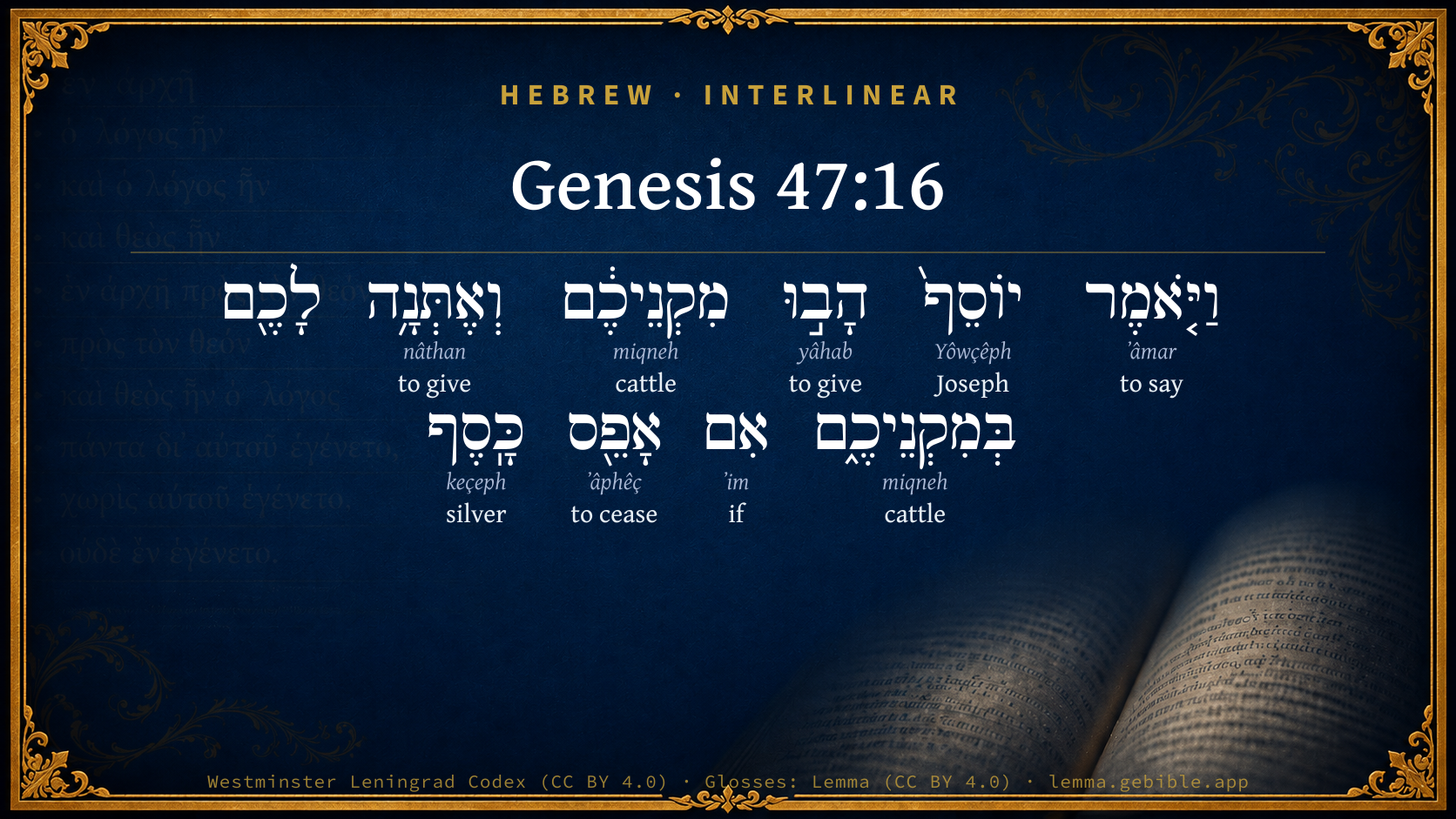
Hebrew (Westminster Leningrad Codex) Genesis 47:16 appears in the Hebrew Old Testament. The text above is from the Westminster Leningrad Codex. Each word links to its Strong’s number, a concise gloss, and parsing drawn from the Open Scriptures Hebrew Bible morphology. Click any word for its full Brown-Driver-Briggs (BDB) entry.
Download image
Cite this verse

Genesis 47:16 (World English Bible). Public Domain. Lemma interlinear Bible study tool, https://lemma.gebible.app/v/genesis/47/16.

Show BibTeX & RIS
BibTeX
RIS
English Translation
Joseph said, "Give your cattle; and I will give you food for your cattle, if money fails."
World English Bible · Public Domain
Download a study sheet

One document with this verse’s original text, its word-by-word gloss line, the meaning frame, cross-references with their text, attributed commentary, and full source and license credits — printable, and it pastes into notes with its structure intact.

This verse Autodidact and up

Study sheet (.html) Plain text (.txt)

A passage Seminary Student

Up to 50 verses in one chapter. A passage sheet keeps up to 6 commentary sources and 12 cross-references per verse, in the order this page ranks them, and says so on the sheet whenever that leaves anything out. Ask for a single verse and you get the Autodidact verse sheet above.

Everything on this page stays free to read, with no account — the sheet is a download of what is already on screen, not access to it.

Want to remove ads? Support Godless Engineer
Compare translations 3

The same verse in 3 English versions, stacked beneath the original-language interlinear above. Click any original word for its lexicon entry.

Each is an independent rendering of the whole verse — the interlinear is not word-aligned to these translations.

Highlighted words mark where these versions differ — a whole-verse word diff, not a word-by-word alignment.

  • World English Bible Public Domain
    Joseph said, "Give your cattle; and I will give you food for your cattle, if money fails."
  • King James Version Public Domain
    And Joseph said, Give your cattle; and I will give you for your cattle, if money fail.
  • unfoldingWord Literal Text CC BY-SA 4.0
    And Joseph said, “Bring your livestock and I will give to you for your livestock, since the silver is gone.”

unfoldingWord Literal Text — © unfoldingWord, licensed CC BY-SA 4.0. Word-aligned USFM3 via Door43 (git.door43.org/unfoldingWord/en_ult).

Versions to compare (up to 4)

3 of 4 selected

Show all 18 translations

Every available English version of this verse, each an independent rendering of the whole verse.

  • World English Bible Public Domain
    Joseph said, "Give your cattle; and I will give you food for your cattle, if money fails."
  • Berean Standard Bible Public Domain
    “Then bring me your livestock,” said Joseph. “Since the money is gone, I will sell you food in exchange for your livestock.”
  • Majority Standard Bible Public Domain
    “Then bring me your livestock,” said Joseph. “Since the money is gone, I will sell you food in exchange for your livestock.”
  • King James Version Public Domain
    And Joseph said, Give your cattle; and I will give you for your cattle, if money fail.
  • American Standard Version (1901) Public Domain
    And Joseph said, Give your cattle; and I will give you for your cattle, if money fail.
  • Revised Version (1885) Public Domain
    And Joseph said, Give your cattle; and I will give you for your cattle, if money fail.
  • Geneva Bible (1599) Public Domain
    Then saide Ioseph, Bring your cattell, and I will giue you for your cattell, if your money be spent.
  • Douay-Rheims (1899) Public Domain
    And he answered them: Bring your cattle, and for them I will give you food, if you have no money.
  • Young's Literal Translation Public Domain
    and Joseph saith, `Give your cattle; and I give to you for your cattle, if the money hath ceased.'
  • Literal Standard Version CC BY-SA 4.0
    And Joseph says, “Give your livestock; and I give to you for your livestock, if the money has ceased.”
  • Unlocked Literal Bible CC BY-SA 4.0
    Joseph said, “If your money is gone, bring your livestock and I will give you food in exchange for your livestock.”
  • unfoldingWord Literal Text CC BY-SA 4.0
    And Joseph said, “Bring your livestock and I will give to you for your livestock, since the silver is gone.”
  • Darby Bible Public Domain
    And Joseph said, Give your cattle, and I will give you for your cattle, if [your] money be all gone.
  • World Messianic Bible Public Domain
    Joseph said, “Give me your livestock; and I will give you food for your livestock, if your money is gone.”
  • Webster's Bible Public Domain
    And Joseph said, Give your cattle; and I will give you for your cattle, if money hath failed.
  • Free Bible Version CC BY-SA 4.0
    “Bring me your livestock,” Joseph told them. “I'll give you grain in exchange for your livestock if you've run out of money.”
  • Bible in Basic English Public Domain
    And Joseph said, Give me your cattle; I will give you grain in exchange for your cattle if your money is all gone.
  • JPS Tanakh (1917) Public Domain
    And Joseph said: 'Give your cattle, and I will give you bread for your cattle, if money fail.'

Literal Standard Version (2020), Covenant Press — licensed CC BY-SA 4.0. Text via the HelloAO Bible API (eBible.org). Unlocked Literal Bible (unfoldingWord) — licensed CC BY-SA 4.0. Text via the HelloAO Bible API (eBible.org). unfoldingWord Literal Text — © unfoldingWord, licensed CC BY-SA 4.0. Word-aligned USFM3 via Door43 (git.door43.org/unfoldingWord/en_ult). Free Bible Version, Dr. Jonathan Gallagher — licensed CC BY-SA 4.0. Text via the HelloAO Bible API (eBible.org).

Word by word

More ways to search: Search by grammar → Find every occurrence → Compare this word →

Practice this passage: Drill this verse → Learn its vocabulary →

אָפֵ֖ס
ʼâphêç
H656
“to cease”
Verb, Qal, Perfect, 3rd Person, Masculine, Singular
Part of Speech
Verb
Stem
Qal
Form
Perfect
Person
3rd Person
Gender
Masculine
Number
Singular
Full BDB Definition

Origin: a primitive root

TWOT: 147

(Qal) to cease, break, come to an end
  1. וַיֹּ֤אמֶר ʼâmar H559 “and · to say” Conjunction + Verb, Qal, Sequential Imperfect, 3rd Person, Masculine, Singular
  2. יוֹסֵף֙ Yôwçêph H3130 “Joseph” Noun, Proper
  3. הָב֣וּ yâhab H3051 “give” Verb, Qal, Imperative, 2nd Person, Masculine, Plural
  4. מִקְנֵיכֶ֔ם miqneh H4735 “cattle · your” Noun, Common, Masculine, Plural, Construct + Suffix, Personal, 2nd Person, Masculine, Plural
  5. וְאֶתְּנָ֥ה nâthan H5414 “and · to give” Conjunction + Verb, Qal, Cohortative, 1st Person, Common, Singular
  6. בְּמִקְנֵיכֶ֑ם miqneh H4735 “in/at · cattle · your” Preposition + Noun, Common, Masculine, Plural, Construct + Suffix, Personal, 2nd Person, Masculine, Singular
  7. אִם ʼim H518 “if” Conjunction
  8. כָּֽסֶף keçeph H3701 “silver” Noun, Common, Masculine, Singular, Absolute

About this verse

These counts appear in no published source. They are computed here, from the morphology-tagged text and Lemma’s own curated glosses. What Lemma adds →

10
words
8
distinct lemmas
Pentateuch
section

Notable vocabulary

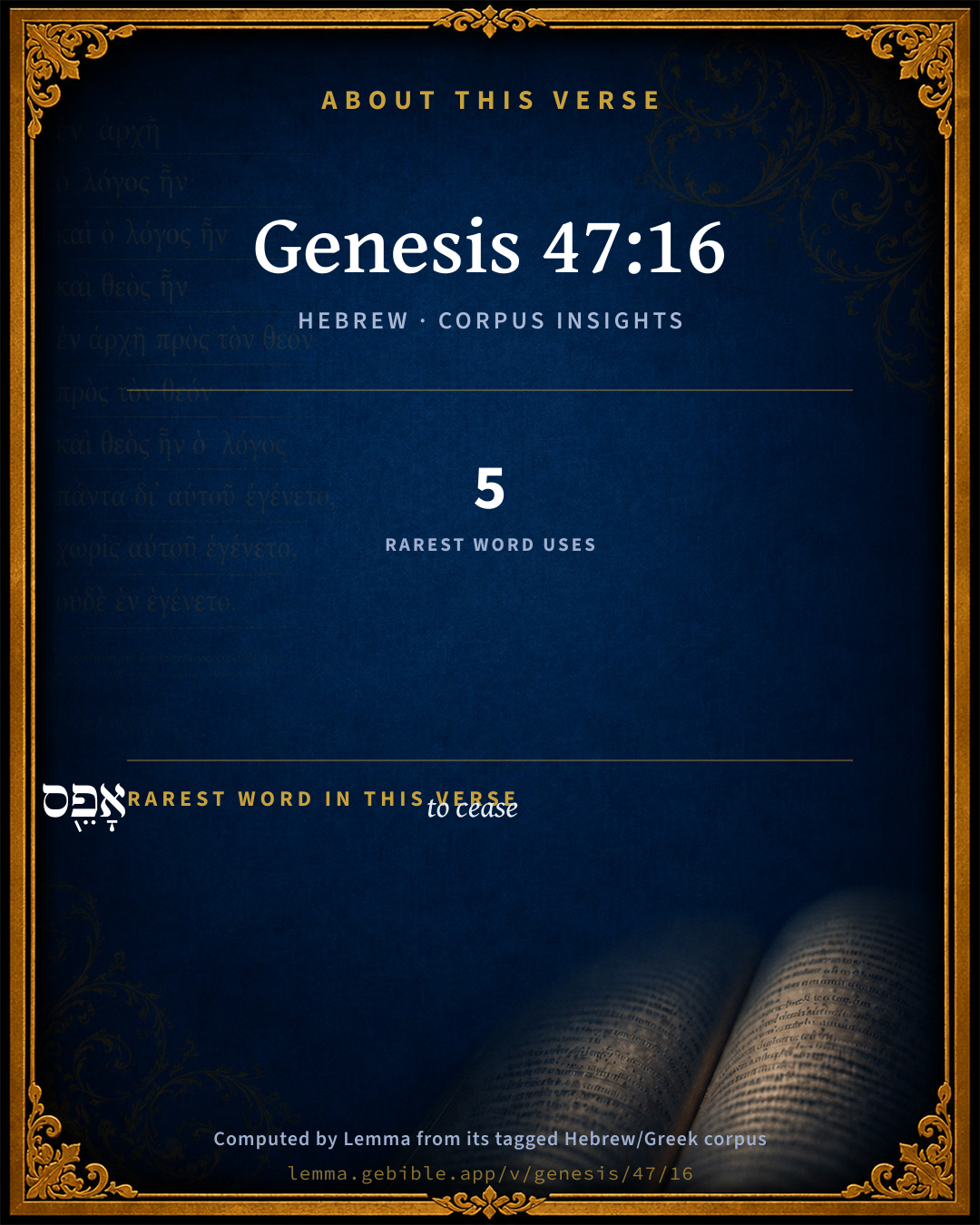
The rarest word here is אָפֵ֖ס to cease H656 — appearing just 5 times in the whole Hebrew Bible.

Shared distinctive vocabulary

אָפֵ֖ס to cease H656 occurs in 5 verses of the Hebrew Bible. Also found in:

Grammatical profile

  • 4 verbs
  • 4 nouns
  • 1 preposition
  • 1 conjunction

Verb forms

  • וַיֹּ֤אמֶר Qal · Sequential Imperfect
  • הָב֣וּ Qal · Imperative
  • וְאֶתְּנָ֥ה Qal · Cohortative
  • אָפֵ֖ס Qal · Perfect

Repetition

A word recurs within this verse — often emphatic in Hebrew:

  • מִקְנֵיכֶ֔ם cattle H4735 ×2

Hebrew & Septuagint length

In English translation the verse runs 17 words from the Hebrew and 22 from the Septuagint (LXX English) — closely comparable.

A rough comparison of the two English renderings, which tokenize alike — not a word-level alignment.

Word counts can differ between the Hebrew and the Greek without any difference in meaning — e.g. the Hebrew direct-object marker אֵת has no separate Greek word, and Greek often adds the article ὁ.

Cross-references

5

Topical passages linked to Genesis 47:16 in the Treasury of Scripture Knowledge — connected by theme and wording, ordered by reader-vote popularity; previews shown in the World English Bible.

  • Proverbs 12:17 He who is truthful testifies honestly, But a false witness lies.
  • Daniel 6:5–7 Then said these men, We shall not find any occasion against this Daniel, except we find it against him concerning the law of his God.
  • 1 Corinthians 10:32 Give no occasions for stumbling, either to Jews, or to Greeks, or to the assembly of God;
  • Philippians 4:8 Finally, brothers, whatever things are true, whatever things are honorable, whatever things are just, whatever things are pure, whatever things are lovely, whatever things are of good report; if there is any virtue, and if there is any praise, think about these things.
  • Colossians 4:5 Walk in wisdom toward those who are outside, redeeming the time.

Cross-references courtesy of OpenBible.info (CC BY 4.0).

Hebrew and Greek witnesses Masoretic Hebrew ↔ Greek Septuagint

The same verse in the two great witnesses to the Old Testament, shown verse-for-verse.

These are two independent witnesses, not word-aligned to each other, and the Septuagint is shown in lemma (dictionary) form.

Hebrew Genesis 47:16 Masoretic · Westminster Leningrad Codex

וַיֹּ֤אמֶר יוֹסֵף֙ הָב֣וּ מִקְנֵיכֶ֔ם וְאֶתְּנָ֥ה לָכֶ֖ם בְּמִקְנֵיכֶ֑ם אִם אָפֵ֖ס כָּֽסֶף

Joseph said, "Give your cattle; and I will give you food for your cattle, if money fails."

World English Bible · Public Domain

Greek LXX Genesis 47:16 Septuagint · lemma form

εἶπον δέ αὐτός ιωσηφ φέρω ὁ κτῆνος σύ καί δίδωμι σύ ἄρτος ἀντί ὁ κτῆνος σύ εἰ ἐκλείπω ὁ ἀργύριον

And Joseph said to them, Bring your cattle, and I will give you bread for your cattle, if your money is spent.

LXX2012 (modern English Septuagint) · Public Domain

On this verse, The Cambridge Bible for Schools and Colleges discusses the Septuagint’s reading. Read the note in Commentary ↓

Hebrew: Westminster Leningrad Codex (CC BY 4.0). Greek: Septuagint (public domain); English from LXX2012 (modern English Septuagint) (Public Domain). How the Septuagint differs from the Hebrew →

Targum (Aramaic paraphrase)

2

The Targum is the ancient Jewish Aramaic paraphrase of the Hebrew Scriptures — an interpretive translation, not the Hebrew text itself. Onkelos (literal) and Pseudo-Jonathan (expansive) render the Torah, and Jonathan the Prophets. Coverage is partial: where no permissively-licensed English translation exists for a verse, only the Aramaic is shown. This is verse-level text, not a word-by-word alignment to the Hebrew.

  1. Targum Onkelos Torah (Genesis–Deuteronomy)
    וַאֲמַר יוֹסֵף הָבוּ גֵּיתֵיכוֹן וְאֶתֵּן לְכוֹן בְּגֵּיתֵיכוֹן אִם שְׁלִים כַּסְפָּא

    (no public-domain English translation for this verse)

    Targum Onkelos — Aramaic: “Onkelos Genesis” (public domain); “Onkelos Exodus” (public domain); “Onkelos Leviticus” (public domain); “Onkelos Numbers” (public domain); “Onkelos Deuteronomy” (public domain). English: “Sefaria Community Translation” (CC0 1.0 (public-domain dedication)); “J.W. Etheridge. The Targums of Onkelos and Jonathan Ben Uzziel on the Pentateuch. London: Longmans, Green, 1862” (public domain). Text via Sefaria.

  2. Targum Pseudo-Jonathan Torah (Genesis–Deuteronomy)
    וַאֲמַר יוֹסֵף הָבוּ גֵיתֵיכוֹן וְאֶתֵּן לְכוֹן מָזוֹן בְּגֵיתֵיכוֹן אִין פְּסַד כַּסְפָּא

    And Joseph said, Give your flocks, and for your flocks I will give you provisions, if the money be consumed.

    Targum Pseudo-Jonathan — Aramaic: “Targum Jonathan on Genesis” (public domain); “Targum Jonathan on Exodus” (public domain); “Targum Jonathan on Leviticus” (public domain); “Targum Jonathan on Numbers” (public domain); “Targum Jonathan on Deuteronomy” (public domain). English: “The Targum of Jonathan ben Uzziel, trans. J. W. Etheridge, London, 1862” (public domain). Text via Sefaria.

Commentary

Notes on Genesis 47:16 from classic Christian and Jewish commentators (each source and its license shown beneath its notes). The classic Christian expositions comment on the surrounding passage and are grouped to its opening verse, so a note may address several verses; the Jewish commentaries on the Tanakh (Rashi and others) are per-verse, so they appear only where the commentator wrote on this verse.

Lemma curates 59 commentaries, every one of them public domain or Creative Commons licensed, each selected and text-cleaned for this edition rather than reprinted as found. About our sources →

Trapp's Complete Commentary

John Trapp

Gen 47:16 And Joseph said, Give your cattle; and I will give you for your cattle, if money fail.

Ver. 16. Give your cattle.] {See Trapp on "Gen 47:17"}

John Trapp, A Commentary or Exposition upon All the Books of the Old and New Testament (1647–1656) — public domain. Text from a community e-Sword module.

Jamieson, Fausset & Brown

Robert Jamieson, A. R. Fausset & David Brown

And Joseph said, Give your cattle--"This was the wisest course that could be adopted for the preservation both of the people and the cattle, which, being bought by Joseph, was supported at the royal expense, and very likely returned to the people at the end of the famine, to enable them to resume their agricultural labors."

Jamieson, Fausset & Brown — Commentary Critical and Explanatory on the Whole Bible (1871) — public domain (CC PDM 1.0). Text via the HelloAO Bible API.

Adam Clarke's Commentary

Verse 16. Give your cattle] This was the wisest measure that could be adopted, both for the preservation of the people and of the cattle also. As the people had not grain for their own sustenance, consequently they could have none for their cattle; hence the cattle were in the most imminent danger of starving; and the people also were in equal danger, as they must have divided a portion of that bought for themselves with the cattle, which for the sake of tillage, c., they wished of course to preserve till the seven years of famine should end. The cattle being bought by Joseph were supported at the royal expense, and very likely returned to the people at the end of the famine for how else could they cultivate their ground, transport their merchandise, &c., &c.? For this part of Joseph's conduct he certainly deserves high praise and no censure.

Adam Clarke's Commentary on the Bible (1810–1826) — public domain. Text from a community e-Sword/MySword module.

John Calvin's Commentaries

16. Give your cattle. It was a miserable spectacle, and one which might have softened hearts of iron, to see rich farmers, who previously had kept provision stored in their granaries for others, now begging food. Therefore, Joseph might be deemed cruel, because he does not give bread gratuitously to those who are poor and exhausted, but robs them of all their cattle, sheep, and asses. Seeing, however, that Joseph is transacting the business of another, I dare not charge his strictness with cruelty. If, during the seven fruitful years, he had extorted corn by force from an unwilling people, he would now have acted tyrannically in seizing their flocks and herds. But seeing that they had been at liberty to lay up, in their private stores, what they had sold to the king, they now pay the just penalty of their negligence. Joseph also perceived that they were deprived of their possessions by a divine interposition, in order that the king alone might be enriched by the spoils of all. Besides, since it was lawful for him to offer corn for sale, it was also lawful for him to exchange it for cattle. Truly, the corn belonged to the king; why then should he not demand a price from the purchasers? But they were poor, and therefore it was but just to succor them in their want. Were this rule to prevail, the greater part of sales would be unlawful. For no one freely parts with what he possesses. Wherefore, if his valuation of the cattle was fair, I do not see what was deserving of reprehension in the conduct of Joseph; especially as he was not dealing with his own property, but had been appointed prefect over the corn, with this condition, that he should acquire gain, not for himself, but for the king. If any one should object that he ought at least to have exhorted the lying to content himself with the abundant pecuniary wealth which he had obtained; I answer, that Moses relates, by the way, but a few things out of many. Any one, therefore, may easily conjecture, that a business of such great consequence, was not transacted by Joseph, without the cognizance and judgment of the king. But what, if it appeared to the king’s counselors, an equitable arrangement, that the farmers should receive, in return for their cattle, food for the whole year? Lastly, seeing that we stand or fall by the judgment of God alone, it is not for us to condemn what his law has left undecided.

John Calvin's Commentaries (1540-1563) — public domain. Text from the Calvin Translation Society English edition (1840s-50s) via the Christian Classics Ethereal Library (ccel.org). Calvin's coverage is partial (roughly two-thirds of the Bible); uncommented books and verses are honest gaps, never fabricated. The 19th-century editor's footnotes and remarks are omitted so the notes are faithfully Calvin's own voice.

Ellicott's Commentary for English Readers

JOSEPH’S POLICY IN EGYPT.

(16) Give your cattle.—As the people were in want of food, and their land incapable of cultivation as long as the Nile ceased to overflow, this was a merciful arrangement, by which the owners were delivered from a burden, and also a portion of the cattle saved for the time when they would be needed again for agricultural purposes. As the charge of so many cattle in time of dearth would be a very serious matter (1Ki_18:5-6), we now see the reason why Pharaoh wished the ablest of Joseph’s brethren to be employed in the task; and probably while there was no food for them in the Nile Valley, there would still be grass in the alluvial soil of the delta, which men used to move about with cattle would be able to find.

A Bible Commentary for English Readers, edited by Charles John Ellicott (1878–1897) — public domain. Text from a community e-Sword module.

The Cambridge Bible for Schools and Colleges

gen. ed. J. J. S. Perowne

16. I will give you] The word “bread” is evidently understood; and is found supplied in the Sam., LXX and Vulg. versions.

The Cambridge Bible for Schools and Colleges (gen. ed. J. J. S. Perowne; Cambridge University Press, 1878–1918) — public domain. Text from a community e-Sword module.

John Gill's Exposition

And they brought their cattle unto Joseph,.... Which they might the more readily do, since there was scarce any grass to feed them with; and though some of them were creatures used for food, yet might be so lean and poor for want of grass, as not to be fit to eat; and besides, they could do better without flesh than without bread:

and Joseph gave them bread in exchange for horses; with which Egypt abounded, to which many places of Scripture have respect, Deu 17:16,

and for the flocks, and for the cattle of the herds; the sheep and the oxen; which shows that these creatures were bred and fed by them, and were, no doubt, slain, and used for food:

and for the asses; which were used for carrying burdens:

and he fed them with bread for all their cattle, for that year; which seems to be the sixth year of the famine: one would wonder what Joseph should do with all their cattle, where put them, and feed them, in such a time of drought; though it is probable the number was not exceeding large, since they only fetched one year's provision of bread.

John Gill's Exposition of the Whole Bible (1746–1763) — public domain (CC PDM 1.0). Text via the HelloAO Bible API.

The Pulpit Commentary

Vers. 16, 17. And Joseph said, Give (literally, bring) your cattle; and I will give you (sc. bread) for your cattle, if money fail. And they brought their cattle unto Joseph: and Joseph gave them bread in exchange for horses, and for the flocks (literally, and for cattle of the flocks), and for the cattle of the herds, and for the asses (the severity of these terms of sale and purchase was not so great as at first sight appears, since to a famishing people under-fed cattle and starving horses must have been comparatively worthless): and he fed them literally, led, in the sense of cared for and maintained, them (cf. Psa_23:2; Isa_40:11) for all their cattle for that year this was the sixth year of the famine (vide ver. 23).

The Pulpit Commentary (1880–1919), ed. H.D.M. Spence-Jones & Joseph S. Exell — public domain. Text from a community e-Sword module.

Lesson kit

Teaching starters — assembled from the data on this page, not authored interpretation. Every prompt links to the verse data it draws on. Edit before teaching.

Genesis, in the Pentateuch, opens this verse with 10 words (8 distinct Hebrew lemmas). Its most distinctive word is ʼâphêç (“to cease”). A historical commentator’s framing appears above. Read the whole chapter for the surrounding context.

Discussion questions

  1. How does “to cease” (ʼâphêç) shape what this verse is saying?
  2. Genesis 47:15 shares the word «to cease» with this verse. How do the two illuminate each other?
  3. “cattle” occurs 2× in this one verse. What is the effect of the repetition?
  4. These translations render this verse differently; the difference is in the English rendering, not the original. What questions does that raise?
  5. The verb «וַיֹּ֤אמֶר» is Qal Sequential Imperfect. How does its form color the action?
  6. Reading how Trapp's Complete Commentary and Jamieson, Fausset & Brown read this verse, where do the two commentators agree and where do they part?

Things to notice

Reading settings

Reading text

Shown beneath each verse's original-language words.

Old Testament
Old Testament edition

Read the OT as the Masoretic Hebrew (MT) or the Greek Septuagint (LXX).

English shown for the Greek Septuagint (in the Hebrew ↔ Greek comparison).

Comparing translations? Open the Compare panel on any verse page to stack up to four side by side.