Genesis 39:4

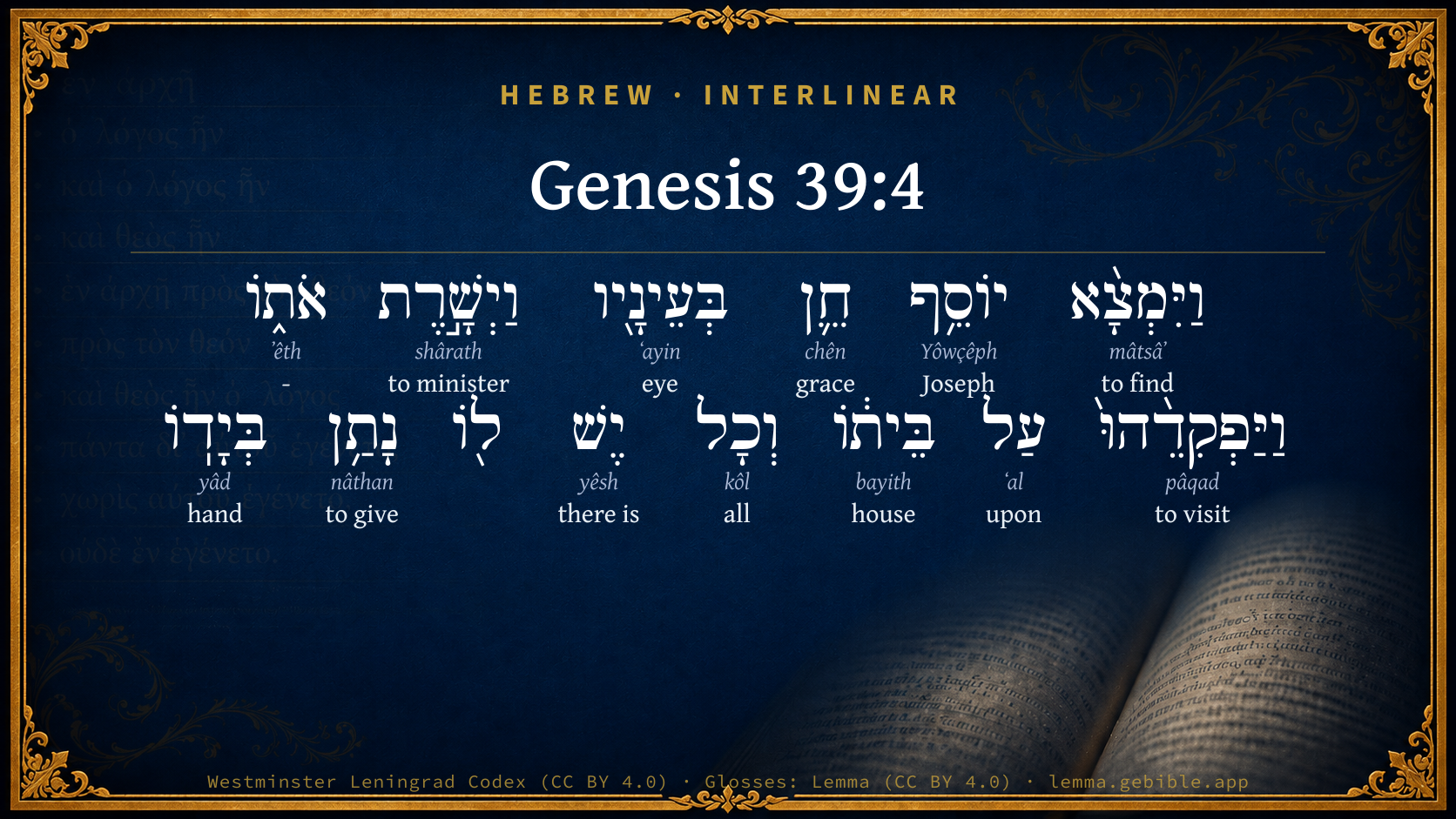
Hebrew (Westminster Leningrad Codex) Genesis 39:4 appears in the Hebrew Old Testament. The text above is from the Westminster Leningrad Codex. Each word links to its Strong’s number, a concise gloss, and parsing drawn from the Open Scriptures Hebrew Bible morphology. Click any word for its full Brown-Driver-Briggs (BDB) entry.
Download image
Cite this verse

Genesis 39:4 (World English Bible). Public Domain. Lemma interlinear Bible study tool, https://lemma.gebible.app/v/genesis/39/4.

Show BibTeX & RIS
BibTeX
RIS
English Translation
Joseph found favor in his sight. He ministered to him, and he made him overseer over his house, and all that he had he put into his hand.
World English Bible · Public Domain
Highlights
  • 1 first appearance in the Hebrew Bible
Full analysis ↓
Download a study sheet

One document with this verse’s original text, its word-by-word gloss line, the meaning frame, cross-references with their text, attributed commentary, and full source and license credits — printable, and it pastes into notes with its structure intact.

This verse Autodidact and up

Study sheet (.html) Plain text (.txt)

A passage Seminary Student

Up to 50 verses in one chapter. A passage sheet keeps up to 6 commentary sources and 12 cross-references per verse, in the order this page ranks them, and says so on the sheet whenever that leaves anything out. Ask for a single verse and you get the Autodidact verse sheet above.

Everything on this page stays free to read, with no account — the sheet is a download of what is already on screen, not access to it.

Want to remove ads? Support Godless Engineer
Compare translations 3

The same verse in 3 English versions, stacked beneath the original-language interlinear above. Click any original word for its lexicon entry.

Each is an independent rendering of the whole verse — the interlinear is not word-aligned to these translations.

Highlighted words mark where these versions differ — a whole-verse word diff, not a word-by-word alignment.

  • World English Bible Public Domain
    Joseph found favor in his sight. He ministered to him, and he made him overseer over his house, and all that he had he put into his hand.
  • King James Version Public Domain
    And Joseph found grace in his sight, and he served him: and he made him overseer over his house, and all that he had he put into his hand.
  • unfoldingWord Literal Text CC BY-SA 4.0
    So Joseph found favor in his eyes, and he served him. And he put him in charge over his house and gave into his hand all was his.

unfoldingWord Literal Text — © unfoldingWord, licensed CC BY-SA 4.0. Word-aligned USFM3 via Door43 (git.door43.org/unfoldingWord/en_ult).

Versions to compare (up to 4)

3 of 4 selected

Show all 18 translations

Every available English version of this verse, each an independent rendering of the whole verse.

  • World English Bible Public Domain
    Joseph found favor in his sight. He ministered to him, and he made him overseer over his house, and all that he had he put into his hand.
  • Berean Standard Bible Public Domain
    Joseph found favor in his sight and became his personal attendant. Potiphar put him in charge of his household and entrusted him with everything he owned.
  • Majority Standard Bible Public Domain
    Joseph found favor in his sight and became his personal attendant. Potiphar put him in charge of his household and entrusted him with everything he owned.
  • King James Version Public Domain
    And Joseph found grace in his sight, and he served him: and he made him overseer over his house, and all that he had he put into his hand.
  • American Standard Version (1901) Public Domain
    And Joseph found favor in his sight, and he ministered unto him: and he made him overseer over his house, and all that he had he put into his hand.
  • Revised Version (1885) Public Domain
    And Joseph found grace in his sight, and he ministered unto him: and he made him overseer over his house, and all that he had he put into his hand.
  • Geneva Bible (1599) Public Domain
    So Ioseph founde fauour in his sight, and serued him: and he made him ruler of his house, and put all that he had in his hand.
  • Douay-Rheims (1899) Public Domain
    And Joseph found favour in the sight of his master, and ministered to him: and being set over all by him, he governed the house committed to him, and all things that were delivered to him:
  • Young's Literal Translation Public Domain
    and Joseph findeth grace in his eyes and serveth him, and he appointeth him over his house, and all that he hath he hath given into his hand.
  • Literal Standard Version CC BY-SA 4.0
    and Joseph finds grace in his eyes and serves him, and he appoints him over his house, and all that he has he has given into his hand.
  • Unlocked Literal Bible CC BY-SA 4.0
    Joseph found favor in his sight. He served Potiphar. Potiphar made Joseph manager over his house, and everything that he possessed, he put under his care.
  • unfoldingWord Literal Text CC BY-SA 4.0
    So Joseph found favor in his eyes, and he served him. And he put him in charge over his house and gave into his hand all was his.
  • Darby Bible Public Domain
    And Joseph found favour in his eyes, and attended on him; and he set him over his house, and all that he had he gave into his hand.
  • World Messianic Bible Public Domain
    Joseph found favor in his sight. He ministered to him, and Potiphar made him overseer over his house, and all that he had he put into his hand.
  • Webster's Bible Public Domain
    And Joseph found grace in his sight, and he served him: and he made him overseer over his house, and all that he had he put into his hand.
  • Free Bible Version CC BY-SA 4.0
    Potiphar appreciated Joseph and his service, and put him in charge of his household and made him responsible for everything he owned.
  • Bible in Basic English Public Domain
    And having a high opinion of Joseph as his servant, he made him the overseer of his house and gave him control over all he had.
  • JPS Tanakh (1917) Public Domain
    And Joseph found favour in his sight, and he ministered unto him. And he appointed him overseer over his house, and all that he had he put into his hand.

Literal Standard Version (2020), Covenant Press — licensed CC BY-SA 4.0. Text via the HelloAO Bible API (eBible.org). Unlocked Literal Bible (unfoldingWord) — licensed CC BY-SA 4.0. Text via the HelloAO Bible API (eBible.org). unfoldingWord Literal Text — © unfoldingWord, licensed CC BY-SA 4.0. Word-aligned USFM3 via Door43 (git.door43.org/unfoldingWord/en_ult). Free Bible Version, Dr. Jonathan Gallagher — licensed CC BY-SA 4.0. Text via the HelloAO Bible API (eBible.org).

Word by word

More ways to search: Search by grammar → Find every occurrence → Compare this word →

Practice this passage: Drill this verse → Learn its vocabulary →

חֵ֛ן
chên
H2580
“grace”
Noun, Common, Masculine, Singular, Absolute
Part of Speech
Noun
Type
Common
Gender
Masculine
Number
Singular
State
Absolute
Full BDB Definition

Origin: from H2603

TWOT: TWOT- 694a

favour, grace, charm - favour, grace, elegance - favour, acceptance
  1. וַיִּמְצָ֨א mâtsâʼ H4672 “and · to find” Conjunction + Verb, Qal, Sequential Imperfect, 3rd Person, Masculine, Singular
  2. יוֹסֵ֥ף Yôwçêph H3130 “Joseph” Noun, Proper
  3. בְּעֵינָ֖יו ʻayin H5869 “in/at · eyes · his” Preposition + Noun, Common, Both, Dual, Construct + Suffix, Personal, 3rd Person, Masculine, Singular
  4. וַיְשָׁ֣רֶת shârath H8334 “and · to minister” Conjunction + Verb, Piel, Sequential Imperfect, 3rd Person, Masculine, Singular
  5. אֹת֑וֹ ʼêth H853 “- · him” Particle, Direct Object + Suffix, Personal, 3rd Person, Masculine, Singular
  6. וַיַּפְקִדֵ֨הוּ֙ pâqad H6485 “and · to visit · him” Conjunction + Verb, Hiphil, Sequential Imperfect, 3rd Person, Masculine, Singular + Suffix, Personal, 3rd Person, Masculine, Singular
  7. עַל ʻal H5921 “upon” Preposition
  8. בֵּית֔וֹ bayith H1004 “house · his” Noun, Common, Masculine, Singular, Construct + Suffix, Personal, 3rd Person, Masculine, Singular
  9. וְכָל kôl H3605 “and · all of” Conjunction + Noun, Common, Masculine, Singular, Construct
  10. יֶשׁ yêsh H3426 “there is” Particle, Demonstrative
  11. נָתַ֥ן nâthan H5414 “to give” Verb, Qal, Perfect, 3rd Person, Masculine, Singular
  12. בְּיָדֽוֹ yâd H3027 “in/at · hand · his” Preposition + Noun, Common, Both, Singular, Construct + Suffix, Personal, 3rd Person, Masculine, Singular

About this verse

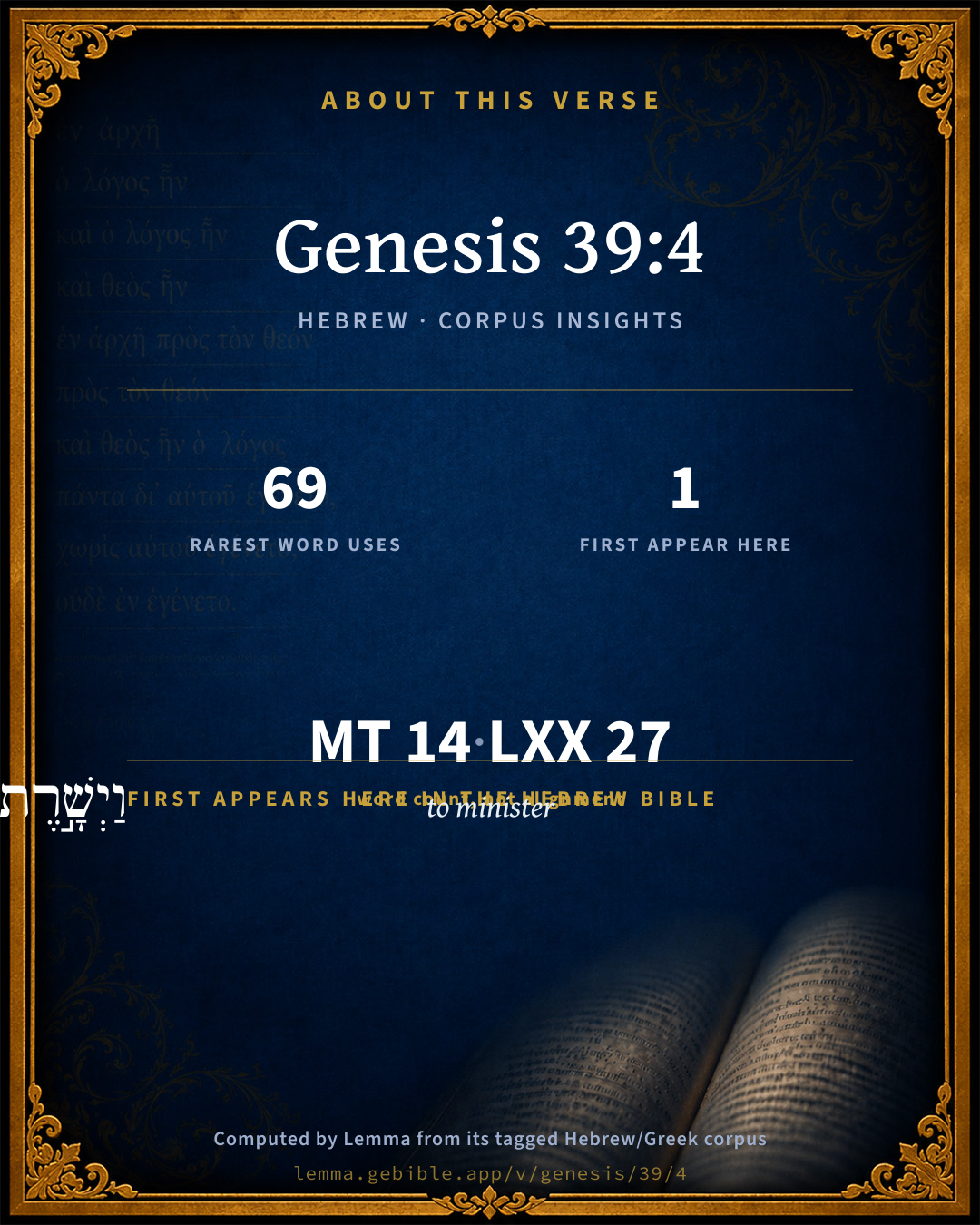
These counts appear in no published source. They are computed here, from the morphology-tagged text and Lemma’s own curated glosses. What Lemma adds →

14
words
13
distinct lemmas
Pentateuch
section

First appearance in Scripture

This word makes its first canonical appearance in the Hebrew Bible here:

  • וַיְשָׁ֣רֶת to minister H8334

Grammatical profile

  • 4 verbs
  • 6 nouns
  • 2 prepositions
  • 2 particles

Verb forms

  • וַיִּמְצָ֨א Qal · Sequential Imperfect
  • וַיְשָׁ֣רֶת Piel · Sequential Imperfect
  • וַיַּפְקִדֵ֨הוּ֙ Hiphil · Sequential Imperfect
  • נָתַ֥ן Qal · Perfect

Hebrew & Septuagint length

In English translation the verse runs 28 words from the Hebrew and 34 from the Septuagint (LXX English) — closely comparable.

A rough comparison of the two English renderings, which tokenize alike — not a word-level alignment.

Word counts can differ between the Hebrew and the Greek without any difference in meaning — e.g. the Hebrew direct-object marker אֵת has no separate Greek word, and Greek often adds the article ὁ.

In the original languages it is 14 Hebrew tokens and 27 Greek tokens — but the two are counted differently (Hebrew bundles its prefixes and suffixes into one token; the Greek is in lemma form), so that isn’t a like-for-like length.

Cross-references

18

Topical passages linked to Genesis 39:4 in the Treasury of Scripture Knowledge — connected by theme and wording, ordered by reader-vote popularity; previews shown in the World English Bible.

  • Genesis 39:21–22 But Yahweh was with Joseph, and showed kindness to him, and gave him favor in the sight of the keeper of the prison.
  • Genesis 19:19 See now, your servant has found favor in your sight, and you have magnified your loving kindness, which you have shown to me in saving my life. I can't escape to the mountain, lest evil overtake me, and I die.
  • Genesis 24:2 Abraham said to his servant, the elder of his house, who ruled over all that he had, "Please put your hand under my thigh.
  • Genesis 39:8 But he refused, and said to his master's wife, "Behold, my master doesn't know what is with me in the house, and he has put all that he has into my hand.
  • Proverbs 27:18 Whoever tends the fig tree shall eat its fruit. He who looks after his master shall be honored.
  • Acts 20:28 Take heed, therefore, to yourselves, and to all the flock, in which the Holy Spirit has made you overseers, to shepherd the assembly of the Lord and God which he purchased with his own blood.
  • Genesis 18:3 and said, "My lord, if now I have found favor in your sight, please don't go away from your servant.
  • Genesis 33:10 Jacob said, "Please, no, if I have now found favor in your sight, then receive my present at my hand, because I have seen your face, as one sees the face of God, and you were pleased with me.
  • Proverbs 16:7 When a man's ways please Yahweh, He makes even his enemies to be at peace with him.
  • Proverbs 17:2 A servant who deals wisely will rule over a son who causes shame, And shall have a part in the inheritance among the brothers.
  • Proverbs 22:29 Do you see a man skilled in his work? He will serve kings; He won't serve obscure men.
  • Genesis 15:2 Abram said, "Lord Yahweh, what will you give me, seeing I go childless, and he who will inherit my estate is Eliezer of Damascus?"
  • Genesis 32:5 I have oxen, donkeys, flocks, men-servants, and maid-servants. I have sent to tell my lord, that I may find favor in your sight.'"
  • Genesis 33:8 Esau said, "What do you mean by all this company which I met?" Jacob said, "To find favor in the sight of my lord."
  • Genesis 41:40–41 You shall be over my house, and according to your word will all my people be ruled. Only in the throne I will be greater than you."
  • 1 Samuel 16:22 Saul sent to Jesse, saying, Please let David stand before me; for he has found favor in my sight.
  • Nehemiah 2:4–5 Then the king said to me, For what do you make request? So I prayed to the God of heaven.
  • Proverbs 14:35 The king's favor is toward a servant who deals wisely, But his wrath is toward one who causes shame.

Cross-references courtesy of OpenBible.info (CC BY 4.0).

Hebrew and Greek witnesses Masoretic Hebrew ↔ Greek Septuagint

The same verse in the two great witnesses to the Old Testament, shown verse-for-verse.

These are two independent witnesses, not word-aligned to each other, and the Septuagint is shown in lemma (dictionary) form.

Hebrew Genesis 39:4 Masoretic · Westminster Leningrad Codex

וַיִּמְצָ֨א יוֹסֵ֥ף חֵ֛ן בְּעֵינָ֖יו וַיְשָׁ֣רֶת אֹת֑וֹ וַיַּפְקִדֵ֨הוּ֙ עַל בֵּית֔וֹ וְכָל יֶשׁ ל֖וֹ נָתַ֥ן בְּיָדֽוֹ

Joseph found favor in his sight. He ministered to him, and he made him overseer over his house, and all that he had he put into his hand.

World English Bible · Public Domain

Greek LXX Genesis 39:4 Septuagint · lemma form

καί εὑρίσκω ιωσηφ χάρις ἐναντίον ὁ κύριος αὐτός εὐαρεστέω δέ αὐτός καί καταἵστημι αὐτός ἐπί ὁ οἶκος αὐτός καί πᾶς ὅσος εἰμί αὐτός δίδωμι διά χείρ ιωσηφ

And Joseph found grace in the presence of his lord, and was well-pleasing to him; and he set him over his house, and all that he had he gave into the hand of Joseph.

LXX2012 (modern English Septuagint) · Public Domain

On this verse, Adam Clarke's Commentary discusses the Septuagint’s reading. Read the note in Commentary ↓

Hebrew: Westminster Leningrad Codex (CC BY 4.0). Greek: Septuagint (public domain); English from LXX2012 (modern English Septuagint) (Public Domain). How the Septuagint differs from the Hebrew →

Targum (Aramaic paraphrase)

2

The Targum is the ancient Jewish Aramaic paraphrase of the Hebrew Scriptures — an interpretive translation, not the Hebrew text itself. Onkelos (literal) and Pseudo-Jonathan (expansive) render the Torah, and Jonathan the Prophets. Coverage is partial: where no permissively-licensed English translation exists for a verse, only the Aramaic is shown. This is verse-level text, not a word-by-word alignment to the Hebrew.

  1. Targum Onkelos Torah (Genesis–Deuteronomy)
    וְאַשְׁכַּח יוֹסֵף רַחֲמִין בְּעֵינוֹהִי וְשַׁמֵּשׁ יָתֵהּ וּמַנְיֵהּ עַל בֵּיתֵהּ וְכָל דִּי אִית לֵהּ מְסַר בִּידֵהּ

    (no public-domain English translation for this verse)

    Targum Onkelos — Aramaic: “Onkelos Genesis” (public domain); “Onkelos Exodus” (public domain); “Onkelos Leviticus” (public domain); “Onkelos Numbers” (public domain); “Onkelos Deuteronomy” (public domain). English: “Sefaria Community Translation” (CC0 1.0 (public-domain dedication)); “J.W. Etheridge. The Targums of Onkelos and Jonathan Ben Uzziel on the Pentateuch. London: Longmans, Green, 1862” (public domain). Text via Sefaria.

  2. Targum Pseudo-Jonathan Torah (Genesis–Deuteronomy)
    וְאַשְׁכַּח יוֹסֵף רַחֲמִין בְּעֵינוֹי וְשַׁמֵשׁ יָתֵיהּ וּמַנְיֵיהּ אַפַּטְרוֹפּוֹס עַל בַּיְיתֵיהּ וְכָל דְאִית לֵיהּ מָסַר בִּידֵיהּ

    and Joseph found favour in his eyes, and he served him, and he appointed him superintendent over his house, and all that he had he delivered in his hands.

    Targum Pseudo-Jonathan — Aramaic: “Targum Jonathan on Genesis” (public domain); “Targum Jonathan on Exodus” (public domain); “Targum Jonathan on Leviticus” (public domain); “Targum Jonathan on Numbers” (public domain); “Targum Jonathan on Deuteronomy” (public domain). English: “The Targum of Jonathan ben Uzziel, trans. J. W. Etheridge, London, 1862” (public domain). Text via Sefaria.

Commentary

Notes on Genesis 39:4 from classic Christian and Jewish commentators (each source and its license shown beneath its notes). The classic Christian expositions comment on the surrounding passage and are grouped to its opening verse, so a note may address several verses; the Jewish commentaries on the Tanakh (Rashi and others) are per-verse, so they appear only where the commentator wrote on this verse.

Lemma curates 59 commentaries, every one of them public domain or Creative Commons licensed, each selected and text-cleaned for this edition rather than reprinted as found. About our sources →

Trapp's Complete Commentary

John Trapp

Gen 39:4 And Joseph found grace in his sight, and he served him: and he made him overseer over his house, and all [that] he had he put into his hand.

Ver. 4. And Joseph found grace in his sight.] This also was of God, who fashioneth men’s opinions, and therefore Paul, though he went to carry alms (and such are commonly welcome), yet prays that his "service might be accepted of the saints." {Rom 15:31}

And he served him.] As his page or chamberlain; afterwards he became his steward. He that is faithful in a little shall be master of more.

John Trapp, A Commentary or Exposition upon All the Books of the Old and New Testament (1647–1656) — public domain. Text from a community e-Sword module.

Joseph Benson's Commentary

Gen 39:4. He made him overseer over all that he had — Committed all to his care and management. But it may be asked how this could be, since Joseph understood not the Egyptian language? In answer to which it may be observed, that, undoubtedly, as soon as he came thither he would do his utmost to obtain the knowledge of that language, and being a person of good parts, would soon obtain it, especially as there was a great affinity between that language and his own. Besides, it is not to be supposed that Joseph was highly advanced at once, but step by step, and after some considerable time. For, considering Potiphar’s office and station, it is not likely that he would thus prefer Joseph till he had had full evidence of his fidelity, as well as of his ability to manage so great a trust.

Joseph Benson's Commentary on the Old and New Testaments (1811–1818) — public domain. Text from a community e-Sword module.

Geneva Bible (1599)

Geneva Bible translators

Because God prospered him: and so he made religion to serve his profit.

Geneva Bible (1599) marginal notes — public domain. Text via Bolls.life.

Adam Clarke's Commentary

Verse 4. He made him overseer] הפקיד hiphkid, from פקד pakad, to visit, take care of, superintend; the same as επισκοπος, overseer or bishop, among the Greeks. This is the term by which the Septuagint often express the meaning of the original.

Adam Clarke's Commentary on the Bible (1810–1826) — public domain. Text from a community e-Sword/MySword module.

The Cambridge Bible for Schools and Colleges

gen. ed. J. J. S. Perowne

4. ministered unto him] Joseph’s character and capacities were first tested by personal service, and afterwards by the responsibility of general supervision.

overseer] Joseph was made steward of the whole household, a position of which we find mention in early Egyptian records. Cf. Gen_43:16, Gen_44:1.

The Cambridge Bible for Schools and Colleges (gen. ed. J. J. S. Perowne; Cambridge University Press, 1878–1918) — public domain. Text from a community e-Sword module.

John Gill's Exposition

And Joseph found grace in his sight,.... In the sight of his master, as he did in the sight of God, he had favour both with God and man; his master had a high esteem of him, and a great value for him, and showed him much kindness and respect:

and he served him; readily, willingly, cheerfully, and faithfully; or he served him personally; his master took such a liking to him, that he selected him from the rest of his servants to wait on his person, and to be what we now call a "valet de chambre", whose business was to dress and undress him, to wait upon him at table, &c.

and he made him overseer over his house, and all that he had he put into his hand; that is, after he had served him some time, in the capacity of a valet, he advanced him, and made him the head servant, or steward of his house, and committed all his business, cash, and accounts to his care, and put all his servants under him.

John Gill's Exposition of the Whole Bible (1746–1763) — public domain (CC PDM 1.0). Text via the HelloAO Bible API.

Matthew Poole's English Annotations

He served him, not now as a slave, but in a higher degree.

All that he had he put into his hand, i.e. committed to his care and management, as Gen 16:6.

Object. How could this be, when Joseph understood not the Egyptian tongue?

Answ. Joseph doubtless when he came thither did as much as possibly he could endeavour to get the knowledge of that language, and being a person of excellent parts, would soon obtain it, especially because of the great affinity between that language and his own. Nor must we think that Joseph was thus highly advanced in an instant, but by degrees, step by step, and after some considerable time.

Matthew Poole's English Annotations on the Holy Bible (1683–1685) — public domain. Text from a community e-Sword/MySword module.

The Pulpit Commentary

And Joseph found grace in his sight, vide Gen_6:8 Gen_18:3 Gen_19:19 Gen_39:21. Most men are pleased with a good servant. Even Laban bad no objections to Jacob so long as he divided that Jehovah was multiplying his flocks for Jacob"s sake. (Gen_30:27) and he served him (i.e. he waited on Potiphar, or acted as his personal attendant and comptroller of his household): and he (i.e. Potiphar) made him overseer over his house, a position corresponding to that occupied by Eliezer in the household of Abraham. (Gen_24:2) Egyptian monuments attest the existence of such an officer in wealthy houses at an early period; a tomb at Kum-el-Ahmar exhibiting the account books, writing materials, and clerks that pertain to the office of s steward, and another at Beni-hassan, besides displaying his accustomed implements, styling him the Overseer (Wilkinson"s "Ancient Egyptians, vol. 1. p. 372, ed. 1878; Hengstenberg s "Egypt and the Books of Moses," p. 24). A sepulchral inscription belonging to the period of the eleventh dynasty also mentions among the officers comprising the household of Ameni the chancellor Athorsi, the barber Khentikhrati, the slave Gefahapi, the lady"s maid Khui, the steward Ameni, the steward Santit (vide "Records of the Past," vol. 6. p. 3). Joseph had also, after his exaltation, a ruler or steward of his house (cf. Gen_43:16, 19 44:1) and all that he had he put into his hand = literally, and all which was to him he gave into his hand, i.e. he entrusted to Joseph"s cam).

The Pulpit Commentary (1880–1919), ed. H.D.M. Spence-Jones & Joseph S. Exell — public domain. Text from a community e-Sword module.

Rashi

Rabbi Shlomo Yitzchaki (Rashi)

וכל יש לו AND ALL THAT HE HAD — This is an elliptical phrase — the word אשר is omitted after.

Rashi on the Tanakh — English translations: “The Judaica Press complete Tanach with Rashi, translated by A. J. Rosenberg” (CC BY 4.0); “Pentateuch with Rashi's commentary by M. Rosenbaum and A.M. Silbermann, 1929-1934” (public domain); “The Metsudah Tanach series, Lakewood, N.J” (CC BY 4.0); and “The Book of Joshua, Metsudah Publications, 1997” (CC BY 4.0). Text via Sefaria.

Ramban (Nachmanides)

Rabbi Moshe ben Nachman (Ramban / Nachmanides)

AND ALL THAT HE HAD HE GAVE INTO HIS HAND. I.e., to be overseer and officer in charge of all that he had in the house and in the field. Our Rabbis have a Midrash on this verse. Thus they say: “He would whisper, Commentaries.) whenever he entered and whenever he left. If his master said to him, ‘Mix a hot drink,’ it was hot immediately in Joseph’s hands and if he said, ‘Mix it lukewarm,’ it was lukewarm. [Because he suspected Joseph of witchcraft, his master said to him,] ‘What is this, Joseph? Bringing witchcraft to Egypt is like importing straw to Ofraim!’ How long did his master suspect him of practicing witchcraft? It was until he saw the Divine Presence standing over him. This is the meaning of the words, And his lord saw that the Eternal was with him.” The point of this Midrash is that because his lord was an Egyptian who did not know the Eternal, the Sages in the Midrash said that when he saw Joseph’s great success he suspected that it was done by witchcraft, as was the case with his countrymen, until he saw in a vision which was shown to him in a dream, or, when awake, in the form of a cloud of glory or the like, that his success came from the Supreme One. This was done in honor of the righteous Joseph.

Ramban (Nachmanides) on the Tanakh — English translation: “Commentary on the Torah by Ramban (Nachmanides). Translated and annotated by Charles B. Chavel. New York, Shilo Pub. House, 1971-1976” (CC BY 4.0). Text via Sefaria.

Radak

Rabbi David Kimhi (Radak)

וימצא.יוסף חן...וישרת אותו, because Joseph had found so much favour in his eyes he appointed him as his exclusive personal valet. At the same time he appointed him in charge so that without Joseph’s approval nothing could be done within this household.

וכל יש לו, all that he owned.

Radak on the Tanakh — English translations: “Sefaria Community Translation” (CC0 1.0 (public-domain dedication)); “Eliyahu Munk, HaChut Hameshulash” (CC BY 4.0); “Rabbi Mike Feuer, Jerusalem Anthology” (CC BY 4.0); and “R. David Kimhi on the first book of Psalms, Translated by R.G. Finch, London, 1919” (public domain). Text via Sefaria.

Lesson kit

Teaching starters — assembled from the data on this page, not authored interpretation. Every prompt links to the verse data it draws on. Edit before teaching.

Genesis, in the Pentateuch, opens this verse with 14 words (13 distinct Hebrew lemmas). Its most distinctive word is chên (“grace”). A historical commentator’s framing appears above. Read the whole chapter for the surrounding context.

Discussion questions

  1. What does “grace” (chên) contribute to the verse as a whole?
  2. The word “to minister” first appears here in Scripture. What is being introduced at this debut?
  3. Genesis 39:21–22 shares this passage’s theme. How do the two illuminate each other?
  4. The translations on this page render this verse differently — a whole-verse word diff, not a word-by-word alignment. What might account for the different wordings?
  5. The verb «וַיִּמְצָ֨א» is Qal Sequential Imperfect. How does its form color the action?
  6. Reading how Trapp's Complete Commentary and Joseph Benson's Commentary read this verse, where do the two commentators agree and where do they part?

Things to notice

Reading settings

Reading text

Shown beneath each verse's original-language words.

Old Testament
Old Testament edition

Read the OT as the Masoretic Hebrew (MT) or the Greek Septuagint (LXX).

English shown for the Greek Septuagint (in the Hebrew ↔ Greek comparison).

Comparing translations? Open the Compare panel on any verse page to stack up to four side by side.