Genesis 31:7

Hebrew (Westminster Leningrad Codex) Genesis 31:7 appears in the Hebrew Old Testament. The text above is from the Westminster Leningrad Codex. Each word links to its Strong’s number, a concise gloss, and parsing drawn from the Open Scriptures Hebrew Bible morphology. Click any word for its full Brown-Driver-Briggs (BDB) entry.
Download image
Cite this verse

Genesis 31:7 (World English Bible). Public Domain. Lemma interlinear Bible study tool, https://lemma.gebible.app/v/genesis/31/7.

Show BibTeX & RIS
BibTeX
RIS
English Translation
Your father has deceived me, and changed my wages ten times, but God didn't allow him to hurt me.
World English Bible · Public Domain
Highlights
  • 3 first appearances in the Hebrew Bible
Full analysis ↓
Download a study sheet

One document with this verse’s original text, its word-by-word gloss line, the meaning frame, cross-references with their text, attributed commentary, and full source and license credits — printable, and it pastes into notes with its structure intact.

This verse Autodidact and up

Study sheet (.html) Plain text (.txt)

A passage Seminary Student

Up to 50 verses in one chapter. A passage sheet keeps up to 6 commentary sources and 12 cross-references per verse, in the order this page ranks them, and says so on the sheet whenever that leaves anything out. Ask for a single verse and you get the Autodidact verse sheet above.

Everything on this page stays free to read, with no account — the sheet is a download of what is already on screen, not access to it.

Want to remove ads? Support Godless Engineer
Compare translations 3

The same verse in 3 English versions, stacked beneath the original-language interlinear above. Click any original word for its lexicon entry.

Each is an independent rendering of the whole verse — the interlinear is not word-aligned to these translations.

Highlighted words mark where these versions differ — a whole-verse word diff, not a word-by-word alignment.

  • World English Bible Public Domain
    Your father has deceived me, and changed my wages ten times, but God didn't allow him to hurt me.
  • King James Version Public Domain
    And your father hath deceived me, and changed my wages ten times; but God suffered him not to hurt me.
  • unfoldingWord Literal Text CC BY-SA 4.0
    but your father has deceived me and changed my wages ten times. However, God has not allowed him to harm me.

unfoldingWord Literal Text — © unfoldingWord, licensed CC BY-SA 4.0. Word-aligned USFM3 via Door43 (git.door43.org/unfoldingWord/en_ult).

Versions to compare (up to 4)

3 of 4 selected

Show all 18 translations

Every available English version of this verse, each an independent rendering of the whole verse.

  • World English Bible Public Domain
    Your father has deceived me, and changed my wages ten times, but God didn't allow him to hurt me.
  • Berean Standard Bible Public Domain
    And although he has cheated me and changed my wages ten times, God has not allowed him to harm me.
  • Majority Standard Bible Public Domain
    And although he has cheated me and changed my wages ten times, God has not allowed him to harm me.
  • King James Version Public Domain
    And your father hath deceived me, and changed my wages ten times; but God suffered him not to hurt me.
  • American Standard Version (1901) Public Domain
    And your father hath deceived me, and changed my wages ten times; but God suffered him not to hurt me.
  • Revised Version (1885) Public Domain
    And your father hath deceived me, and changed my wages ten times; but God suffered him not to hurt me.
  • Geneva Bible (1599) Public Domain
    But your father hath deceiued me, and changed my wages tenne times: but God suffred him not to hurt me.
  • Douay-Rheims (1899) Public Domain
    Yea, your father also hath overreached me, and hath changes my wages ten times: and yet God hath not suffered him to hurt me.
  • Young's Literal Translation Public Domain
    and your father hath played upon me, and hath changed my hire ten times; and God hath not suffered him to do evil with me.
  • Literal Standard Version CC BY-SA 4.0
    and your father has played on me, and has changed my hire ten times; and God has not permitted him to do evil with me.
  • Unlocked Literal Bible CC BY-SA 4.0
    Your father has deceived me and changed my wages ten times, but God has not permitted him to hurt me.
  • unfoldingWord Literal Text CC BY-SA 4.0
    but your father has deceived me and changed my wages ten times. However, God has not allowed him to harm me.
  • Darby Bible Public Domain
    And your father has mocked me, and has changed my wages ten times; but God suffered him not to hurt me.
  • World Messianic Bible Public Domain
    Your father has deceived me, and changed my wages ten times, but God didn’t allow him to hurt me.
  • Webster's Bible Public Domain
    And your father hath deceived me, and changed my wages ten times: but God suffered him not to hurt me.
  • Free Bible Version CC BY-SA 4.0
    But he's been cheating me—he's reduced my wages ten times! However, God hasn't let him hurt me.
  • Bible in Basic English Public Domain
    But your father has not kept faith with me, and ten times he has made changes in my payment; but God has kept him from doing me damage.
  • JPS Tanakh (1917) Public Domain
    And your father hath mocked me, and changed my wages ten times; but God suffered him not to hurt me.

Literal Standard Version (2020), Covenant Press — licensed CC BY-SA 4.0. Text via the HelloAO Bible API (eBible.org). Unlocked Literal Bible (unfoldingWord) — licensed CC BY-SA 4.0. Text via the HelloAO Bible API (eBible.org). unfoldingWord Literal Text — © unfoldingWord, licensed CC BY-SA 4.0. Word-aligned USFM3 via Door43 (git.door43.org/unfoldingWord/en_ult). Free Bible Version, Dr. Jonathan Gallagher — licensed CC BY-SA 4.0. Text via the HelloAO Bible API (eBible.org).

Word by word

More ways to search: Search by grammar → Find every occurrence → Compare this word →

Practice this passage: Drill this verse → Learn its vocabulary →

מֹנִ֑ים
môneh
H4489
“times”
Noun, Common, Masculine, Plural, Absolute
Part of Speech
Noun
Type
Common
Gender
Masculine
Number
Plural
State
Absolute
Full BDB Definition

Origin: from H4487

TWOT: 1213c

something weighed out, counted number, time
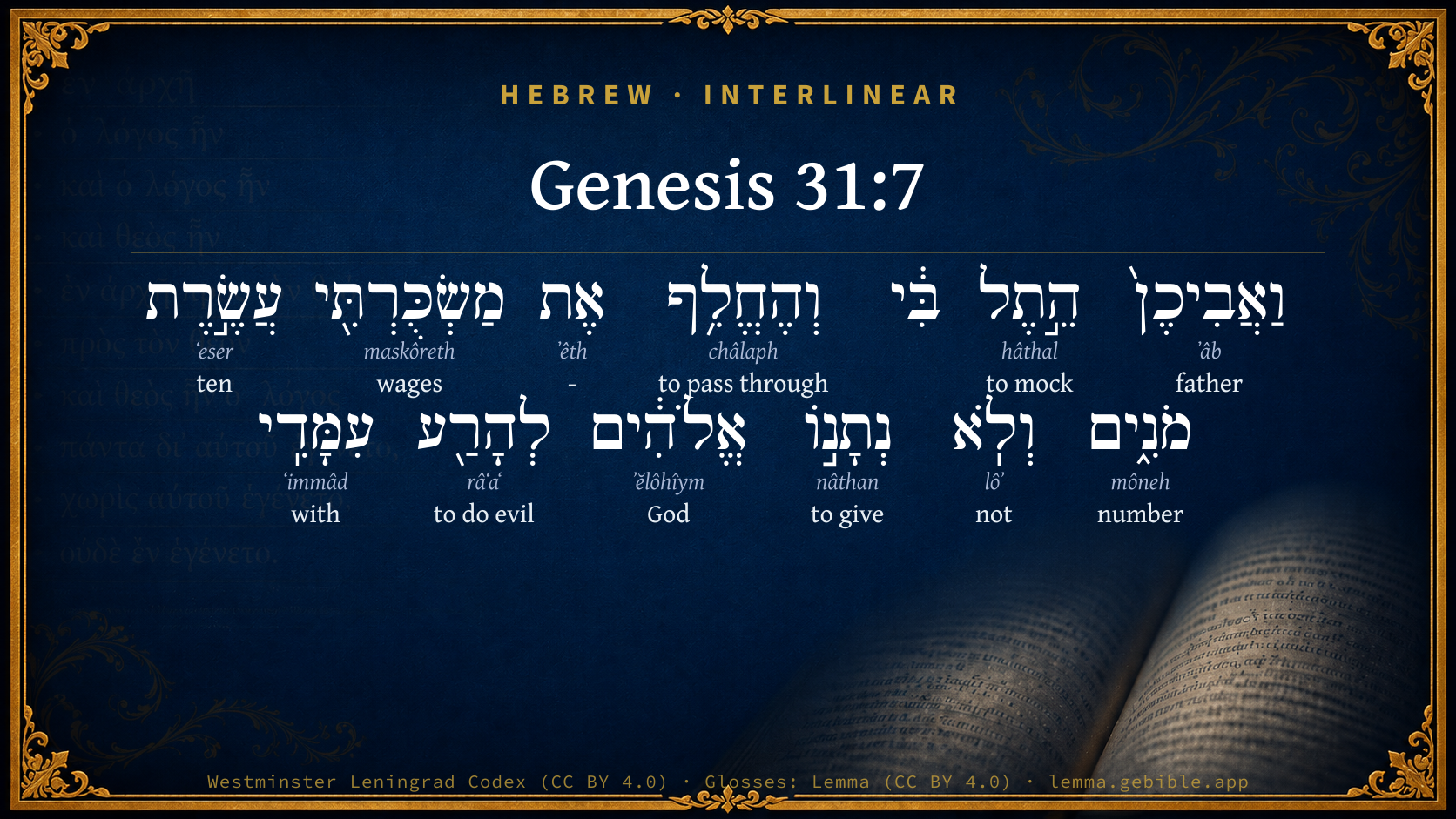
  1. וַאֲבִיכֶן֙ ʼâb H1 “and · father · your” Conjunction + Noun, Common, Masculine, Singular, Construct + Suffix, Personal, 2nd Person, Feminine, Plural
  2. הֵ֣תֶל hâthal H2048 “to mock” Verb, Hiphil, Perfect, 3rd Person, Masculine, Singular
  3. וְהֶחֱלִ֥ף châlaph H2498 “and · to pass through” Conjunction + Verb, Hiphil, Perfect, 3rd Person, Masculine, Singular
  4. אֶת ʼêth H853 “-” Particle, Direct Object
  5. מַשְׂכֻּרְתִּ֖י maskôreth H4909 “wages · my” Noun, Common, Feminine, Singular, Construct + Suffix, Personal, 1st Person, Common, Singular
  6. עֲשֶׂ֣רֶת ʻeser H6235 “ten” Adjective, Cardinal number, Masculine, Singular, Construct
  7. וְלֹֽא lôʼ H3808 “and · not” Conjunction + Particle, Negative
  8. נְתָנ֣וֹ nâthan H5414 “to give · him” Verb, Qal, Perfect, 3rd Person, Masculine, Singular + Suffix, Personal, 3rd Person, Masculine, Singular
  9. אֱלֹהִ֔ים ʼĕlôhîym H430 “God(s)” Noun, Common, Masculine, Plural, Absolute
  10. לְהָרַ֖ע râʻaʻ H7489 “to do evil” Preposition + Verb, Hiphil, Infinitive Construct
  11. עִמָּדִֽי ʻimmâd H5978 “with · me” Preposition + Suffix, Personal, 1st Person, Common, Singular

About this verse

These counts appear in no published source. They are computed here, from the morphology-tagged text and Lemma’s own curated glosses. What Lemma adds →

13
words
12
distinct lemmas
Pentateuch
section

Notable vocabulary

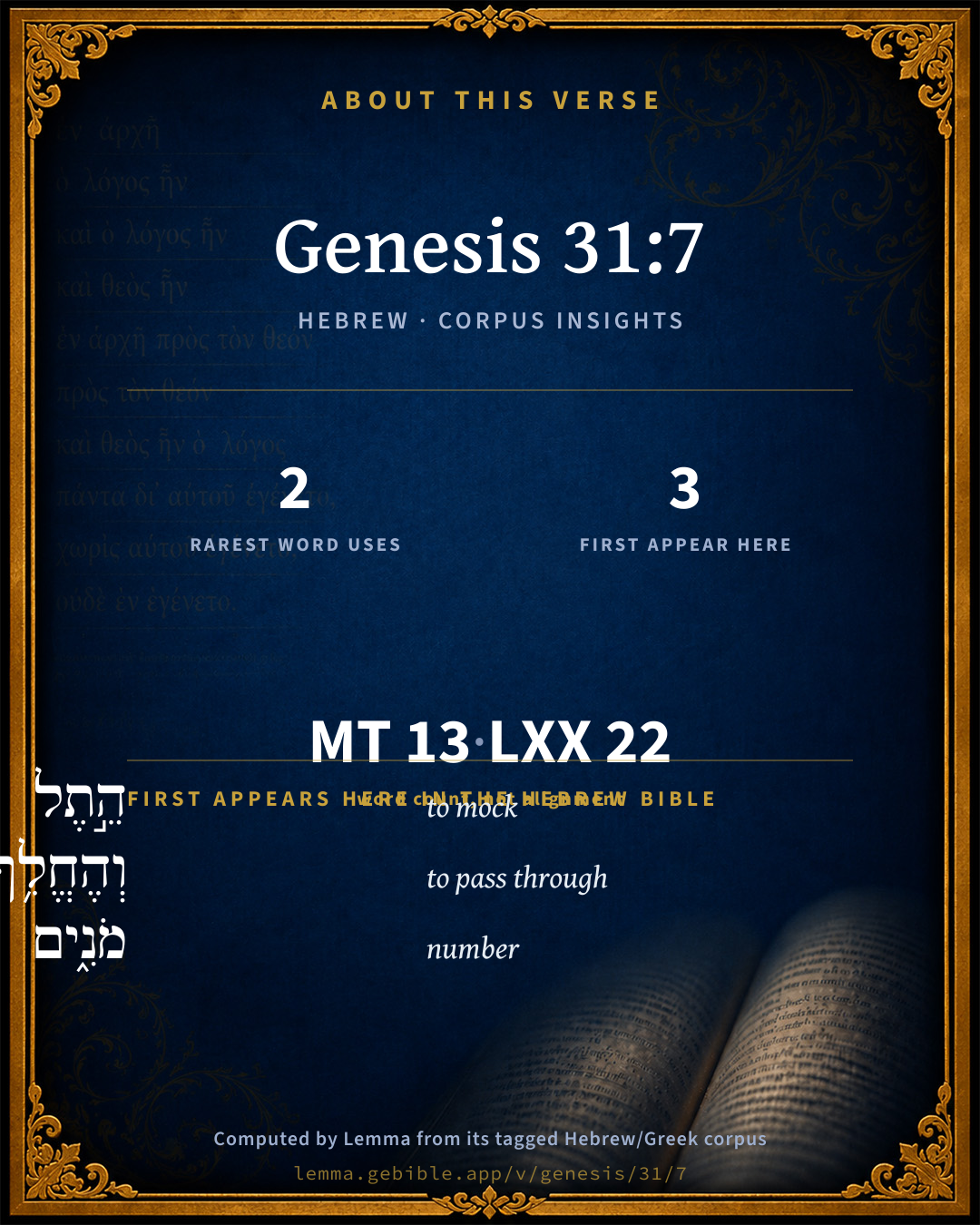
The rarest word here is מֹנִ֑ים number H4489 — appearing just 2 times in the whole Hebrew Bible.

First appearance in Scripture

These words make their first canonical appearance in the Hebrew Bible here:

  • הֵ֣תֶל to mock H2048
  • וְהֶחֱלִ֥ף to pass through H2498
  • מֹנִ֑ים number H4489

Shared distinctive vocabulary

מֹנִ֑ים number H4489 occurs in 2 verses of the Hebrew Bible. Also found in:

Grammatical profile

  • 4 verbs
  • 4 nouns
  • 1 adjective
  • 2 prepositions
  • 2 particles

Verb forms

  • הֵ֣תֶל Hiphil · Perfect
  • וְהֶחֱלִ֥ף Hiphil · Perfect
  • נְתָנ֣וֹ Qal · Perfect
  • לְהָרַ֖ע Hiphil · Infinitive Construct

Hebrew & Septuagint length

In English translation the verse runs 19 words from the Hebrew and 22 from the Septuagint (LXX English) — closely comparable.

A rough comparison of the two English renderings, which tokenize alike — not a word-level alignment.

Word counts can differ between the Hebrew and the Greek without any difference in meaning — e.g. the Hebrew direct-object marker אֵת has no separate Greek word, and Greek often adds the article ὁ.

In the original languages it is 13 Hebrew tokens and 22 Greek tokens — but the two are counted differently (Hebrew bundles its prefixes and suffixes into one token; the Greek is in lemma form), so that isn’t a like-for-like length.

Cross-references

14

Topical passages linked to Genesis 31:7 in the Treasury of Scripture Knowledge — connected by theme and wording, ordered by reader-vote popularity; previews shown in the World English Bible.

  • Genesis 31:29 It is in the power of my hand to hurt you, but the God of your father spoke to me last night, saying, 'Take heed to yourself that you don't speak to Jacob either good or bad.'
  • Genesis 31:41 These twenty years have I been in your house. I served you fourteen years for your two daughters, and six years for your flock, and you have changed my wages ten times.
  • Numbers 14:22 because all those men who have seen my glory, and my signs, which I worked in Egypt and in the wilderness, yet have tempted me these ten times, and have not listened to my voice;
  • Nehemiah 4:12 It happened that when the Jews who lived by them came, they said to us ten times from all places, You must return to us.
  • Psalms 37:28 For Yahweh loves justice, And doesn't forsake his saints. They are preserved forever, But the children of the wicked shall be cut off.
  • Zechariah 8:23 Thus says Yahweh of Hosts: "In those days, ten men will take hold, out of all the languages of the nations, they will take hold of the skirt of him who is a Jew, saying, 'We will go with you, for we have heard that God is with you.'"
  • Genesis 20:6 God said to him in the dream, "Yes, I know that in the integrity of your heart you have done this, and I also withheld you from sinning against me. Therefore I didn't allow you to touch her.
  • Leviticus 26:26 When I break your staff of bread, ten women shall bake your bread in one oven, and they shall deliver your bread again by weight: and you shall eat, and not be satisfied.
  • Job 1:10 Haven't you made a hedge around him, and around his house, and around all that he has, on every side? You have blessed the work of his hands, and his substance is increased in the land.
  • Job 19:3 You have reproached me ten times. You aren't ashamed that you attack me.
  • Isaiah 4:1 Seven women shall take hold of one man in that day, saying, "We will eat our own bread, and wear our own clothing: only let us be called by your name. Take away our reproach."
  • Isaiah 54:17 No weapon that is formed against you shall prosper; and every tongue that shall rise against you in judgment you shall condemn. This is the heritage of the servants of Yahweh, and their righteousness which is of me, says Yahweh.
  • Job 19:8 He has walled up my way so that I can't pass, And has set darkness in my paths.
  • Psalms 105:14–15 He allowed no one to do them wrong. Yes, he reproved kings for their sakes,

Cross-references courtesy of OpenBible.info (CC BY 4.0).

Hebrew and Greek witnesses Masoretic Hebrew ↔ Greek Septuagint

The same verse in the two great witnesses to the Old Testament, shown verse-for-verse.

These are two independent witnesses, not word-aligned to each other, and the Septuagint is shown in lemma (dictionary) form.

Hebrew Genesis 31:7 Masoretic · Westminster Leningrad Codex

וַאֲבִיכֶן֙ הֵ֣תֶל בִּ֔י וְהֶחֱלִ֥ף אֶת מַשְׂכֻּרְתִּ֖י עֲשֶׂ֣רֶת מֹנִ֑ים וְלֹֽא נְתָנ֣וֹ אֱלֹהִ֔ים לְהָרַ֖ע עִמָּדִֽי

Your father has deceived me, and changed my wages ten times, but God didn't allow him to hurt me.

World English Bible · Public Domain

Greek LXX Genesis 31:7 Septuagint · lemma form

ὁ δέ πατήρ σύ παρακρούω ἐγώ καί ἀλλάσσω ὁ μισθός ἐγώ ὁ δέκα ἀμνός καί οὐ δίδωμι αὐτός ὁ θεός κακοποιέω ἐγώ

But your father deceived me, and changed my wages for the ten lambs, yet God gave him not power to hurt me.

LXX2012 (modern English Septuagint) · Public Domain

On this verse, Adam Clarke's Commentary discusses the Septuagint’s reading. Read the note in Commentary ↓

Hebrew: Westminster Leningrad Codex (CC BY 4.0). Greek: Septuagint (public domain); English from LXX2012 (modern English Septuagint) (Public Domain). How the Septuagint differs from the Hebrew →

Targum (Aramaic paraphrase)

2

The Targum is the ancient Jewish Aramaic paraphrase of the Hebrew Scriptures — an interpretive translation, not the Hebrew text itself. Onkelos (literal) and Pseudo-Jonathan (expansive) render the Torah, and Jonathan the Prophets. Coverage is partial: where no permissively-licensed English translation exists for a verse, only the Aramaic is shown. This is verse-level text, not a word-by-word alignment to the Hebrew.

  1. Targum Onkelos Torah (Genesis–Deuteronomy)
    וַאֲבוּכֶן שְׁקַּר בִּי וְאַשְׁנִי יָת אַגְרִי עֲשַׂר זִמְנִין וְלָא שָׁבְקֵהּ יְיָ לְאַבְאָשָׁא עִמִּי

    (no public-domain English translation for this verse)

    Targum Onkelos — Aramaic: “Onkelos Genesis” (public domain); “Onkelos Exodus” (public domain); “Onkelos Leviticus” (public domain); “Onkelos Numbers” (public domain); “Onkelos Deuteronomy” (public domain). English: “Sefaria Community Translation” (CC0 1.0 (public-domain dedication)); “J.W. Etheridge. The Targums of Onkelos and Jonathan Ben Uzziel on the Pentateuch. London: Longmans, Green, 1862” (public domain). Text via Sefaria.

  2. Targum Pseudo-Jonathan Torah (Genesis–Deuteronomy)
    וַאֲבוּכוֹן שְׁקַר בִּי (ירוּשׁלמי וּפְרַג) וְשַׁלְחִיף יַת אַגְרִי עֲשַר חוּלְקִין וְלָא יְהַב לֵיהּ יְיָ רְשׁוּ לְאַבְאָשָׁא עִמִי

    but your father hath deceived me, and hath changed my wages ten portions; yet the Lord hath not given him power to do me evil.

    Targum Pseudo-Jonathan — Aramaic: “Targum Jonathan on Genesis” (public domain); “Targum Jonathan on Exodus” (public domain); “Targum Jonathan on Leviticus” (public domain); “Targum Jonathan on Numbers” (public domain); “Targum Jonathan on Deuteronomy” (public domain). English: “The Targum of Jonathan ben Uzziel, trans. J. W. Etheridge, London, 1862” (public domain). Text via Sefaria.

Commentary

Notes on Genesis 31:7 from classic Christian and Jewish commentators (each source and its license shown beneath its notes). The classic Christian expositions comment on the surrounding passage and are grouped to its opening verse, so a note may address several verses; the Jewish commentaries on the Tanakh (Rashi and others) are per-verse, so they appear only where the commentator wrote on this verse.

Lemma curates 59 commentaries, every one of them public domain or Creative Commons licensed, each selected and text-cleaned for this edition rather than reprinted as found. About our sources →

Trapp's Complete Commentary

John Trapp

Gen 31:7 And your father hath deceived me, and changed my wages ten times; but God suffered him not to hurt me.

Ver. 7. Changed my wages ten times.] And ever for the worse. The matter mended, with poor Jacob, as sour ale doth in summer. Laban, the churl, the richer he grew by him, the harder he was to him: like children with mouthfuls and handfuls, who will yet rather spoil all, then part with any. It is the love, not the lack of money, that makes men churls.

John Trapp, A Commentary or Exposition upon All the Books of the Old and New Testament (1647–1656) — public domain. Text from a community e-Sword module.

Joseph Benson's Commentary

Gen 31:7-8. Hath changed my wages ten times — That is, oft-times, as is often the signification of the number ten. It appears that Laban, through envy and covetousness, often broke his agreement made with Jacob, and altered it as he thought fit, and that Jacob patiently yielded to all such changes Then all the cattle bare speckled — This seems to put it out of doubt, that, as Jacob says in the following verse, it was indeed God who ordered this matter; for it can scarcely be supposed that any natural causes whatever, without his peculiar providence, could produce so many different changes in a thing of this nature, without once failing.

Joseph Benson's Commentary on the Old and New Testaments (1811–1818) — public domain. Text from a community e-Sword module.

Geneva Bible (1599)

Geneva Bible translators

Or, many times.

Geneva Bible (1599) marginal notes — public domain. Text via Bolls.life.

Adam Clarke's Commentary

Verse 7. Changed my wages ten times] There is a strange diversity among the ancient versions, and ancient and modern interpreters, on the meaning of these words. The Hebrew is עשרת מנים asereth monim, which Aquila translates δεκα αριθμους ten numbers; Symmachus, δεκακις αριτμω, ten times in number; the Septuagint δεκα αμνων, ten lambs, with which Origen appears to agree. St. Augustine thinks that by ten lambs five years' wages is meant: that Laban had withheld from him all the party-coloured lambs which had been brought forth for five years, and because the ewes brought forth lambs twice in the year, bis gravidae pecudes, therefore the number ten is used, Jacob having been defrauded of his part of the produce of ten births. It is supposed that the Septuagint use lambs for years, as Virgil does aristas.

En unquam patrios longo post tempore fines,

Pauperis et tuguri congestum cespite culmen,

Post aliquot mea regna videns mirabor aristas?

Virg. Ec. i., ver. 68.

Thus inadequately translated by DRYDEN:

O must the wretched exiles ever mourn;

Nor, after length of rolling years, return?

Are we condemn'd by Fate's unjust decree,

No more our harvests and our homes to see?

Or shall we mount again the rural throng,

And rule the country, kingdoms once our own?

Here aristas, which signifies ears of corn, is put for harvest, harvest for autumn, and autumn for years. After all, it is most natural to suppose that Jacob uses the word ten times for an indefinite number, which we might safely translate frequently; and that it means an indefinite number in other parts of the sacred writings, is evident from Le 26:26: TEN women shall bake your bread in one oven. Ec 7:19: Wisdom strengtheneth the wise more than TEN mighty men the city. Nu 14:22: Because all these men have tempted me now these TEN times. Job 19:3: These TEN times have ye reproached me. Zec 8:23: In those days - TEN men shall take hold of the skirt of him that is a Jew. Re 2:10: Ye shall have tribulation TEN days.

Adam Clarke's Commentary on the Bible (1810–1826) — public domain. Text from a community e-Sword/MySword module.

Ellicott's Commentary for English Readers

(7) Ten times.—That is, a good many times.

A Bible Commentary for English Readers, edited by Charles John Ellicott (1878–1897) — public domain. Text from a community e-Sword module.

The Cambridge Bible for Schools and Colleges

gen. ed. J. J. S. Perowne

7. changed my wages] The account given in the following passage differs from that in the preceding chapter, Gen_30:25-31. There Jacob specified the conditions, to which Laban acceded; and then Jacob resorted to artifice, in order to improve his position. Here it is Laban that has specified the wages, and arbitrarily changed them (cf. Gen_31:41) from time to time. But in every case, by the providence of God, not by Jacob’s cleverness, the result has worked out advantageously to Jacob. In ch. 30 we had principally, probably, the narrative of J; in this chapter, that of E is predominantly employed.

ten times] A phrase used to denote frequency, as in Gen_31:41, Num_14:22, Neh_4:12, Job_19:3, by a round number; Lat. decem vicibus. But LXX, not understanding the Hebrew word rendered “times” (mônîm), seems to have transliterated it with the rendering ἀμνῶν, “lambs” (or is this for μνῶν?), i.e. “ten lambing seasons.”

The Cambridge Bible for Schools and Colleges (gen. ed. J. J. S. Perowne; Cambridge University Press, 1878–1918) — public domain. Text from a community e-Sword module.

John Gill's Exposition

If he said thus, the speckled shall be thy wages,.... Sometimes Laban would say to Jacob, only the speckled lambs which the ewes shall bring forth shall be thine hire, and not the spotted; or the ringstraked, or the brown, which according to the bargain should have been his, the one and the other:

then all the cattle bare speckled; that season, God ordering it so in his providence, that Laban might be disappointed, and Jacob might have his full hire; that is, the greatest part of the cattle bore such, as Ben Melech observes:

and if he said thus, the ringstraked shall be thine hire; observing the cattle to bring forth only speckled, or the greatest part such, then he changed his hire, and would have it be not the speckled, nor the brown, only the ringstraked, there being none or few of that colour the last yeaning time:

then bare all the cattle ringstraked; or the greatest part of them were such; so that let Laban fix on what colour he would as Jacob's wages, there were sure to be the greatest part of that colour; which shows the hand of God in it, as is next observed by Jacob.

John Gill's Exposition of the Whole Bible (1746–1763) — public domain (CC PDM 1.0). Text via the HelloAO Bible API.

Haydock's Catholic Bible Commentary

Ten times. Very often, or perhaps this exact number of times, ver. 41.

George Leo Haydock (1774–1849), Haydock's Catholic Family Bible and Commentary, 1859 edition — public domain. Excludes Psalms (Douay-Rheims chapter numbering differs from Protestant) and Deuterocanonical books (Catholic canon only).

Matthew Poole's English Annotations

Ten times, i.e. ofttimes, as that certain number is commonly used, as Lev 26:26; Num 14:22; 1Sa 1:8; Job 19:3, &c.

Matthew Poole's English Annotations on the Holy Bible (1683–1685) — public domain. Text from a community e-Sword/MySword module.

Whedon's Commentary on the Bible

Daniel D. Whedon

7. Ten times — Probably a round number used for an indefinite number, and equivalent to very frequently, or, as often as possible. Compare Num_14:22; Job_19:3. The manner of Laban’s changing Jacob’s wages was doubtless that indicated in the next verse. “He made repeated attempts to limit the original stipulation by changing the rule as to the colours of the young, and so diminishing Jacob’s wages.” — Keil.

Daniel D. Whedon (gen. ed.), Commentary on the Old and New Testaments (1874–1909) — public domain. Text from a community e-Sword module.

The Pulpit Commentary

And your father hath deceived me, ltehe, the hiph. of llT; means to rob or plunder (Furst), or to cause to fall, as in the cognate languages, whence to deceive (Gesenius) and changed my wages ten times; i.e. many times, as in Num_14:22; Job_19:3 (Rosenm Bush, Kalisch, Lange) as often as possible, the number ten expressing the idea of completeness (Keil, Murphy)but God (Elohim, Jacob purposing to say that he had been protected, not by human stratagem, but by Divine interposition) suffered him not to hurt me literally, to do evil to me. The verb here construed with dMi = is sometimes followed by l, (1Ki_17:20) and sometimes by B. (1Ch_16:22)

The Pulpit Commentary (1880–1919), ed. H.D.M. Spence-Jones & Joseph S. Exell — public domain. Text from a community e-Sword module.

unfoldingWord translationNotes

Door43 World Missions Community

has deceived me

"has lied to me" or "has not treated me fairly"

my wages

"what he said he would pay me"

to hurt me

Possible meanings are 1) physical harm or 2) to cause Jacob to suffer in any way.

The speckled animals

"The animals with spots"

the flock bore

"the flock gave birth to"

The striped

"The animals with stripes"

In this way God has taken away the livestock of your father and given them to me

"This is how God gave your father's animals to me"

translationWords

deceive

livestock

unfoldingWord translationNotes — © Distant Shores Media and the Door43 World Missions Community, licensed CC BY-SA 4.0. Source: git.door43.org/Door43/en_tn.

Rashi

Rabbi Shlomo Yitzchaki (Rashi)

עשרת מנים TEN TIMES — The word מנים never means less than ten (Ruth 4:11).

מנים signifies sum — the total of enumeration — these are tens: we may infer, therefore, that he changed the conditions of his hire one hundred times (Genesis Rabbah 74:3).

Rashi on the Tanakh — English translations: “The Judaica Press complete Tanach with Rashi, translated by A. J. Rosenberg” (CC BY 4.0); “Pentateuch with Rashi's commentary by M. Rosenbaum and A.M. Silbermann, 1929-1934” (public domain); “The Metsudah Tanach series, Lakewood, N.J” (CC BY 4.0); and “The Book of Joshua, Metsudah Publications, 1997” (CC BY 4.0). Text via Sefaria.

Ramban (Nachmanides)

Rabbi Moshe ben Nachman (Ramban / Nachmanides)

AND YOUR FATHER HATH MOCKED ME, AND CHANGED MY WAGES TEN TIMES. This was true, even though Scripture did not previously relate it. And so too did Jacob tell Laban: And thou hast changed my wages ten times. There are many similar places in the Torah. For example, in this earlier section, Scripture did not relate that Leah gave the mandrakes to Rachel [although the event is referred to later in Verse 16: for I have hired thee with my son’s mandrakes].

Ramban (Nachmanides) on the Tanakh — English translation: “Commentary on the Torah by Ramban (Nachmanides). Translated and annotated by Charles B. Chavel. New York, Shilo Pub. House, 1971-1976” (CC BY 4.0). Text via Sefaria.

Radak

Rabbi David Kimhi (Radak)

ואביכן התל בי, this is a variation of the root with the same letters but with the dagesh in the letter ת, as we find in Kings 1 18,27 where it describes the prophet Elijah ridiculing the god of the priests of the Baal. Here the root is not used transitively but intransitively in the conjugation kal, hence there is not dagesh.

עשרת מונים, ten times. The reason the word עשרת is in the construct mode when we would have expected to read עשרה מונים, is because it is the final contact with the single digit numbers. It actually belongs to them, though in our language it is written as a 2 digit number. The fact is that the first 10 numbers are all part of one group, the number “ten” being the last one of that group. Hence it is treated here as if in the construct mode. To prove that this is correct, note that whenever the number ten appears, such as in ואפו עשר נשים, “ten women will bake” (Leviticus 26,26), where the number of women involved bears no relationship to the ninth or eighth woman preceding her, such a number is not in the construct mode. My late father of blessed memory explained the word עשרת as not being meant literally. It is not a figure of speech meaning “numerous times,” Yaakov had spent 6 years working for Lavan’ in order to amass his own flocks. The sheep give birth twice a year, i.e. 12 times in 6 years. Lavan therefore had opportunity to change Yaakov’s wages 8 times in the intermediate 6 years, and once each in the first year and last year respectively.

Radak on the Tanakh — English translations: “Sefaria Community Translation” (CC0 1.0 (public-domain dedication)); “Eliyahu Munk, HaChut Hameshulash” (CC BY 4.0); “Rabbi Mike Feuer, Jerusalem Anthology” (CC BY 4.0); and “R. David Kimhi on the first book of Psalms, Translated by R.G. Finch, London, 1919” (public domain). Text via Sefaria.

Lesson kit

Teaching starters — assembled from the data on this page, not authored interpretation. Every prompt links to the verse data it draws on. Edit before teaching.

Genesis, in the Pentateuch, opens this verse with 13 words (12 distinct Hebrew lemmas). Its most distinctive word is môneh (“number”). A historical commentator’s framing appears above. Read the whole chapter for the surrounding context.

Discussion questions

  1. How does “number” (môneh) shape what this verse is saying?
  2. 3 words make their first appearance in Scripture here. What does this debut establish?
  3. How does Genesis 31:41, which shares the word «number», read alongside this verse?
  4. These translations render this verse differently. What is at stake in choosing one wording over another?
  5. «הֵ֣תֶל» is a Hiphil Perfect verb. How does that grammatical form shape the action described?
  6. Compare how Trapp's Complete Commentary and Joseph Benson's Commentary read this verse. Where do they agree or differ?

Things to notice

Reading settings

Reading text

Shown beneath each verse's original-language words.

Old Testament
Old Testament edition

Read the OT as the Masoretic Hebrew (MT) or the Greek Septuagint (LXX).

English shown for the Greek Septuagint (in the Hebrew ↔ Greek comparison).

Comparing translations? Open the Compare panel on any verse page to stack up to four side by side.