
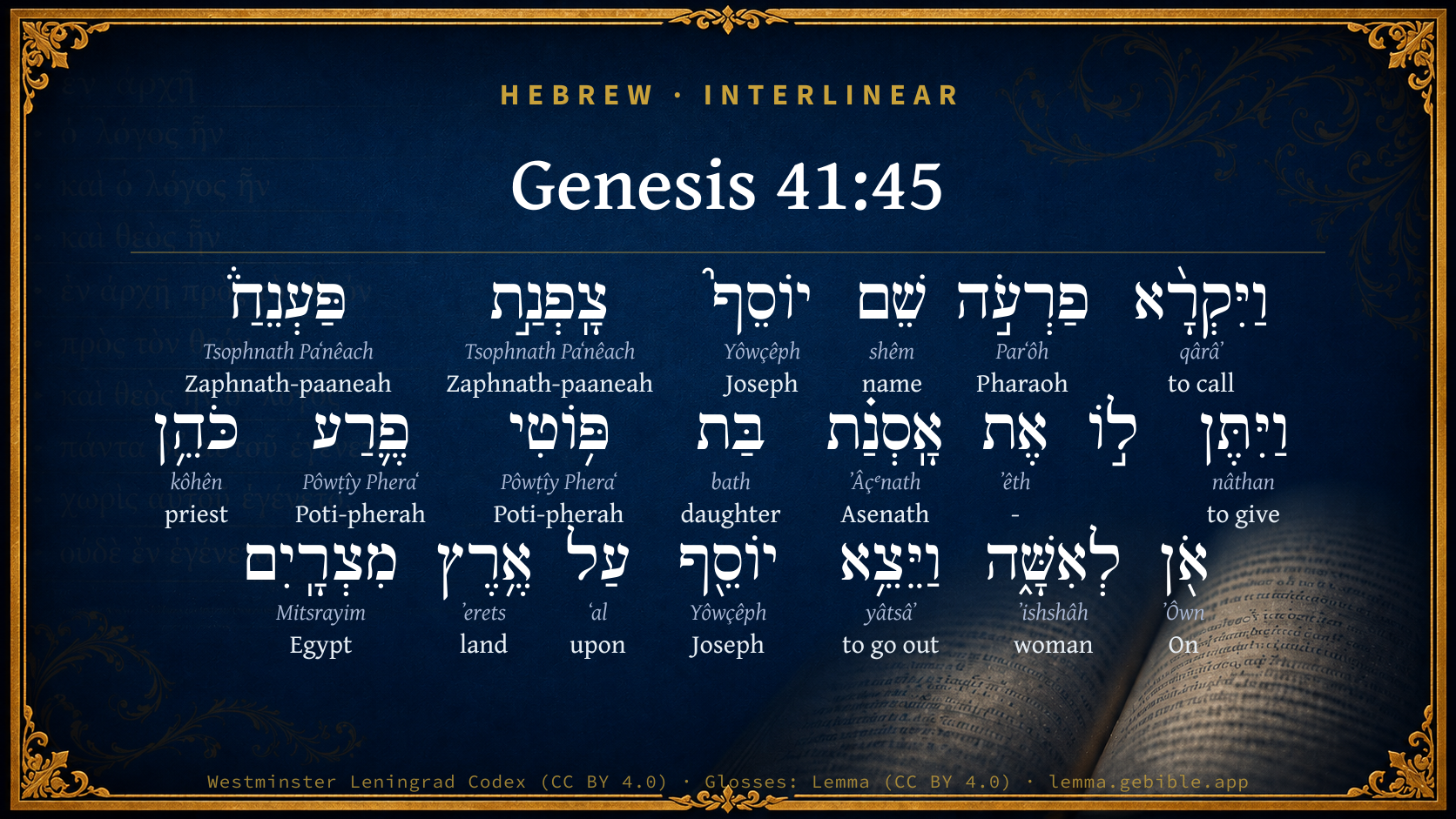
Genesis 41:45

Hebrew (Westminster Leningrad Codex) Genesis 41:45 appears in the Hebrew Old Testament. The text above is from the Westminster Leningrad Codex. Each word links to its Strong’s number, a concise gloss, and parsing drawn from the Open Scriptures Hebrew Bible morphology. Click any word for its full Brown-Driver-Briggs (BDB) entry.
Download image
Cite this verse

Genesis 41:45 (World English Bible). Public Domain. Lemma interlinear Bible study tool, https://lemma.gebible.app/v/genesis/41/45.

Show BibTeX & RIS
BibTeX
RIS
English Translation
Pharaoh called Joseph's name Zaphenath-paneah; and he gave him Asenath, the daughter of Potiphera priest of On as a wife. Joseph went out over the land of Egypt.
World English Bible · Public Domain
Highlights
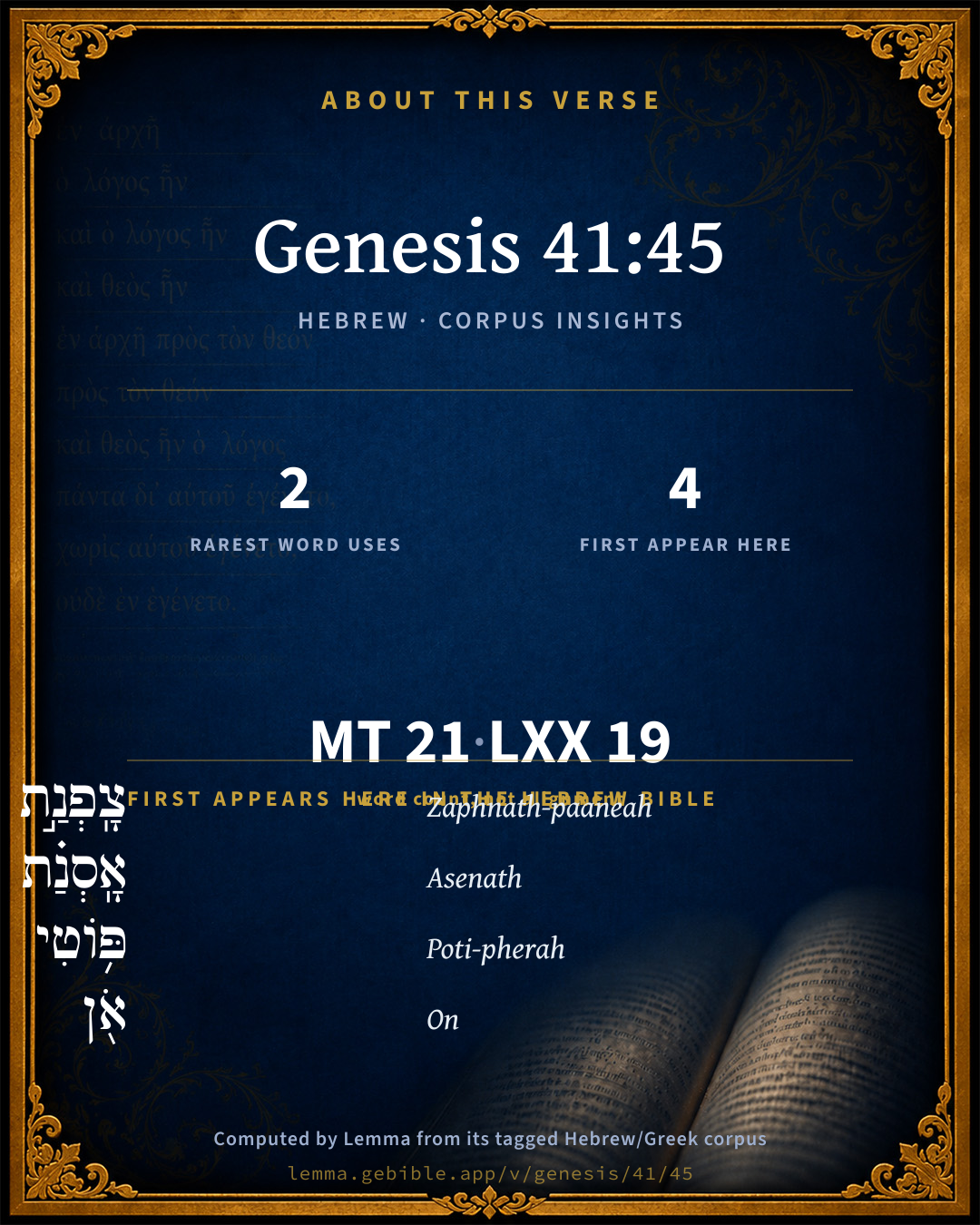
  • 4 first appearances in the Hebrew Bible
Full analysis ↓
Download a study sheet

One document with this verse’s original text, its word-by-word gloss line, the meaning frame, cross-references with their text, attributed commentary, and full source and license credits — printable, and it pastes into notes with its structure intact.

This verse Autodidact and up

Study sheet (.html) Plain text (.txt)

A passage Seminary Student

Up to 50 verses in one chapter. A passage sheet keeps up to 6 commentary sources and 12 cross-references per verse, in the order this page ranks them, and says so on the sheet whenever that leaves anything out. Ask for a single verse and you get the Autodidact verse sheet above.

Everything on this page stays free to read, with no account — the sheet is a download of what is already on screen, not access to it.

Want to remove ads? Support Godless Engineer
Compare translations 3

The same verse in 3 English versions, stacked beneath the original-language interlinear above. Click any original word for its lexicon entry.

Each is an independent rendering of the whole verse — the interlinear is not word-aligned to these translations.

Highlighted words mark where these versions differ — a whole-verse word diff, not a word-by-word alignment.

  • World English Bible Public Domain
    Pharaoh called Joseph's name Zaphenath-paneah; and he gave him Asenath, the daughter of Potiphera priest of On as a wife. Joseph went out over the land of Egypt.
  • King James Version Public Domain
    And Pharaoh called Joseph's name Zaphnathpaaneah; and he gave him to wife Asenath the daughter of Potipherah priest of On. And Joseph went out over all the land of Egypt.
  • unfoldingWord Literal Text CC BY-SA 4.0
    Then Pharaoh called Joseph’s name Zaphenath-Paneah, and he gave to him Asenath, the daughter of Potiphera the priest of On, as a wife. Then Joseph went out over the land of Egypt.

unfoldingWord Literal Text — © unfoldingWord, licensed CC BY-SA 4.0. Word-aligned USFM3 via Door43 (git.door43.org/unfoldingWord/en_ult).

Versions to compare (up to 4)

3 of 4 selected

Show all 18 translations

Every available English version of this verse, each an independent rendering of the whole verse.

  • World English Bible Public Domain
    Pharaoh called Joseph's name Zaphenath-paneah; and he gave him Asenath, the daughter of Potiphera priest of On as a wife. Joseph went out over the land of Egypt.
  • Berean Standard Bible Public Domain
    Pharaoh gave Joseph the name Zaphenath-paneah, and he gave him Asenath daughter of Potiphera, priest of On, to be his wife. And Joseph took charge of all the land of Egypt.
  • Majority Standard Bible Public Domain
    Pharaoh gave Joseph the name Zaphenath-paneah, and he gave him Asenath daughter of Potiphera, priest of On, to be his wife. And Joseph took charge of all the land of Egypt.
  • King James Version Public Domain
    And Pharaoh called Joseph's name Zaphnathpaaneah; and he gave him to wife Asenath the daughter of Potipherah priest of On. And Joseph went out over all the land of Egypt.
  • American Standard Version (1901) Public Domain
    And Pharaoh called Joseph's name Zaphenath-paneah; and he gave him to wife Asenath, the daughter of Poti-phera priest of On. And Joseph went out over the land of Egypt.
  • Revised Version (1885) Public Domain
    And Pharaoh called Joseph’s name Zaphenath-paneah; and he gave him to wife Asenath the daughter of Poti-phera priest of On. And Joseph went out over the land of Egypt.
  • Geneva Bible (1599) Public Domain
    And Pharaoh called Iosephs name Zaphnath-paaneah: and he gaue him to wife Asenath the daughter of Poti-pherah prince of On. then went Ioseph abrode in the land of Egypt.
  • Douay-Rheims (1899) Public Domain
    And he made him go up into his second chariot, the crier proclaiming that all should bow their knee before him, and that they should know he was made govenor over the whole land of Egypt.
  • Young's Literal Translation Public Domain
    and Pharaoh calleth Joseph's name Zaphnath-Paaneah, and he giveth to him Asenath daughter of Poti-Pherah, priest of On, for a wife, and Joseph goeth out over the land of Egypt.
  • Literal Standard Version CC BY-SA 4.0
    and Pharaoh calls Joseph’s name Zaphnath-Paaneah, and he gives to him Asenath daughter of Poti-Pherah, priest of On, for a wife, and Joseph goes out over the land of Egypt.
  • Unlocked Literal Bible CC BY-SA 4.0
    Pharaoh called Joseph's name “Zaphenath-Paneah.” He gave him Asenath, the daughter of Potiphera priest of On, as a wife. Joseph went out over the land of Egypt.
  • unfoldingWord Literal Text CC BY-SA 4.0
    Then Pharaoh called Joseph’s name Zaphenath-Paneah, and he gave to him Asenath, the daughter of Potiphera the priest of On, as a wife. Then Joseph went out over the land of Egypt.
  • Darby Bible Public Domain
    And Pharaoh called Joseph's name Zaphnath-paaneah, and gave him as wife Asnath the daughter of Potipherah the priest in On. And Joseph went out over the land of Egypt.
  • World Messianic Bible Public Domain
    Pharaoh called Joseph’s name Zaphenath-Paneah. He gave him Asenath, the daughter of Potiphera priest of On as a wife. Joseph went out over the land of Egypt.
  • Webster's Bible Public Domain
    And Pharaoh called Joseph's name Zaphnath-paaneah; and he gave him for a wife Asenath the daughter of Poti-pherah priest of On: and Joseph went over all the land of Egypt.
  • Free Bible Version CC BY-SA 4.0
    Pharaoh gave Joseph the name Zaphenath-paneah, and arranged for him to marry Asenath, the daughter of Potiphera, priest of On. This is how Joseph rose to power over the whole of Egypt.
  • Bible in Basic English Public Domain
    And Pharaoh gave Joseph the name of Zaphnath-paaneah; and he gave him Asenath, the daughter of Poti-phera, the priest of On, to be his wife. So Joseph went through all the land of Egypt.
  • JPS Tanakh (1917) Public Domain
    And Pharaoh called Joseph's name Zaphenath-paneah; and he gave him to wife Asenath the daughter of Poti-phera priest of On. And Joseph went out over the land of Egypt. —

Literal Standard Version (2020), Covenant Press — licensed CC BY-SA 4.0. Text via the HelloAO Bible API (eBible.org). Unlocked Literal Bible (unfoldingWord) — licensed CC BY-SA 4.0. Text via the HelloAO Bible API (eBible.org). unfoldingWord Literal Text — © unfoldingWord, licensed CC BY-SA 4.0. Word-aligned USFM3 via Door43 (git.door43.org/unfoldingWord/en_ult). Free Bible Version, Dr. Jonathan Gallagher — licensed CC BY-SA 4.0. Text via the HelloAO Bible API (eBible.org).

Word by word

More ways to search: Search by grammar → Find every occurrence → Compare this word →

Practice this passage: Drill this verse → Learn its vocabulary →

צָֽפְנַ֣ת
Tsophnath Paʻnêach
H6847
“Zaphnath-paaneah”
Noun, Proper
Part of Speech
Noun
Type
Proper
Full BDB Definition

Origin: of Egyptian derivation

TWOT: None

Zaphnath-paaneah = "treasury of the glorious rest" - a name given by Pharaoh to Joseph
  1. וַיִּקְרָ֨א qârâʼ H7121 “and · to call” Conjunction + Verb, Qal, Sequential Imperfect, 3rd Person, Masculine, Singular
  2. פַרְעֹ֣ה Parʻôh H6547 “Pharaoh” Noun, Proper
  3. שֵׁם shêm H8034 “name of” Noun, Common, Masculine, Singular, Construct
  4. יוֹסֵף֮ Yôwçêph H3130 “Joseph” Noun, Proper
  5. פַּעְנֵחַ֒ Tsophnath Paʻnêach H6847 “Zaphnath-paaneah” Noun, Proper
  6. וַיִּתֶּן nâthan H5414 “and · to give” Conjunction + Verb, Qal, Sequential Imperfect, 3rd Person, Masculine, Singular
  7. אֶת ʼêth H853 “-” Particle, Direct Object
  8. אָֽסְנַ֗ת ʼÂçᵉnath H621 “Asenath” Noun, Proper
  9. בַּת bath H1323 “daughter of” Noun, Common, Feminine, Singular, Construct
  10. פּ֥וֹטִי Pôwṭîy Pheraʻ H6319 “Poti-pherah” Noun, Proper
  11. פֶ֛רַע Pôwṭîy Pheraʻ H6319 “Poti-pherah” Noun, Proper
  12. כֹּהֵ֥ן kôhên H3548 “priest of” Noun, Common, Masculine, Singular, Construct
  13. אֹ֖ן ʼÔwn H204 “On” Noun, Proper
  14. לְאִשָּׁ֑ה ʼishshâh H802 “to/for · woman” Preposition + Noun, Common, Feminine, Singular, Absolute
  15. וַיֵּצֵ֥א yâtsâʼ H3318 “and · to go out” Conjunction + Verb, Qal, Sequential Imperfect, 3rd Person, Masculine, Singular
  16. יוֹסֵ֖ף Yôwçêph H3130 “Joseph” Noun, Proper
  17. עַל ʻal H5921 “upon” Preposition
  18. אֶ֥רֶץ ʼerets H776 “land of” Noun, Common, Both, Singular, Construct
  19. מִצְרָֽיִם Mitsrayim H4714 “Egypt” Noun, Proper

About this verse

These counts appear in no published source. They are computed here, from the morphology-tagged text and Lemma’s own curated glosses. What Lemma adds →

21
words
17
distinct lemmas
Pentateuch
section

Notable vocabulary

The rarest word here is צָֽפְנַ֣ת Zaphnath-paaneah H6847 — appearing just 2 times in the whole Hebrew Bible.

First appearance in Scripture

These words make their first canonical appearance in the Hebrew Bible here:

  • צָֽפְנַ֣ת Zaphnath-paaneah H6847
  • אָֽסְנַ֗ת Asenath H621
  • פּ֥וֹטִי Poti-pherah H6319
  • אֹ֖ן On H204

Grammatical profile

  • 3 verbs
  • 15 nouns
  • 2 prepositions
  • 1 particle

Verb forms

  • וַיִּקְרָ֨א Qal · Sequential Imperfect
  • וַיִּתֶּן Qal · Sequential Imperfect
  • וַיֵּצֵ֥א Qal · Sequential Imperfect

Repetition

Words recur within this verse — often emphatic in Hebrew:

  • יוֹסֵף֮ Joseph H3130 ×2
  • צָֽפְנַ֣ת Zaphnath-paaneah H6847 ×2
  • פּ֥וֹטִי Poti-pherah H6319 ×2

Hebrew & Septuagint length

In English translation the verse runs 28 words from the Hebrew and 22 from the Septuagint (LXX English) — closely comparable.

A rough comparison of the two English renderings, which tokenize alike — not a word-level alignment.

Word counts can differ between the Hebrew and the Greek without any difference in meaning — e.g. the Hebrew direct-object marker אֵת has no separate Greek word, and Greek often adds the article ὁ.

In the original languages it is 21 Hebrew tokens and 19 Greek tokens — but the two are counted differently (Hebrew bundles its prefixes and suffixes into one token; the Greek is in lemma form), so that isn’t a like-for-like length.

Cross-references

8

Topical passages linked to Genesis 41:45 in the Treasury of Scripture Knowledge — connected by theme and wording, ordered by reader-vote popularity; previews shown in the World English Bible.

  • Genesis 46:20 To Joseph in the land of Egypt were born Manasseh and Ephraim, whom Asenath, the daughter of Potiphera, priest of On, bore to him.
  • Exodus 2:16 Now the priest of Midian had seven daughters. They came and drew water, and filled the troughs to water their father's flock.
  • Ezekiel 30:17 The young men of Aven and of Pibeseth shall fall by the sword; and these [cities] shall go into captivity.
  • Genesis 14:18 Melchizedek king of Salem brought forth bread and wine: and he was priest of God Most High.
  • 2 Samuel 8:18 and Benaiah the son of Jehoiada [was over] the Cherethites and the Pelethites; and David's sons were chief ministers.
  • 2 Samuel 20:26 and also Ira the Jairite was chief minister to David.
  • Luke 2:1 Now it happened in those days, that a decree went out from Caesar Augustus that all the world should be enrolled.
  • Acts 11:28 One of them named Agabus stood up, and indicated by the Spirit that there should be a great famine all over the world, which also happened in the days of Claudius.

Cross-references courtesy of OpenBible.info (CC BY 4.0).

Hebrew and Greek witnesses Masoretic Hebrew ↔ Greek Septuagint

The same verse in the two great witnesses to the Old Testament, shown verse-for-verse.

These are two independent witnesses, not word-aligned to each other, and the Septuagint is shown in lemma (dictionary) form.

Hebrew Genesis 41:45 Masoretic · Westminster Leningrad Codex

וַיִּקְרָ֨א פַרְעֹ֣ה שֵׁם יוֹסֵף֮ צָֽפְנַ֣ת פַּעְנֵחַ֒ וַיִּתֶּן ל֣וֹ אֶת אָֽסְנַ֗ת בַּת פּ֥וֹטִי פֶ֛רַע כֹּהֵ֥ן אֹ֖ן לְאִשָּׁ֑ה וַיֵּצֵ֥א יוֹסֵ֖ף עַל אֶ֥רֶץ מִצְרָֽיִם

Pharaoh called Joseph's name Zaphenath-paneah; and he gave him Asenath, the daughter of Potiphera priest of On as a wife. Joseph went out over the land of Egypt.

World English Bible · Public Domain

Greek LXX Genesis 41:45 Septuagint · lemma form

καί καλέω φαραώ ὁ ὄνομα ιωσηφ ψονθομφανηχ καί δίδωμι αὐτός ὁ ασεννεθ θυγάτηρ πετεφρης ἱερεύς ἥλιος πόλις αὐτός γυνή

And Pharao called the name of Joseph, Psonthomphanech; and he gave him Aseneth, the daughter of Petephres, priest of Heliopolis, to wife.

LXX2012 (modern English Septuagint) · Public Domain

On this verse, Adam Clarke's Commentary discusses the Septuagint’s reading. Read the note in Commentary ↓

Hebrew: Westminster Leningrad Codex (CC BY 4.0). Greek: Septuagint (public domain); English from LXX2012 (modern English Septuagint) (Public Domain). How the Septuagint differs from the Hebrew →

Targum (Aramaic paraphrase)

2

The Targum is the ancient Jewish Aramaic paraphrase of the Hebrew Scriptures — an interpretive translation, not the Hebrew text itself. Onkelos (literal) and Pseudo-Jonathan (expansive) render the Torah, and Jonathan the Prophets. Coverage is partial: where no permissively-licensed English translation exists for a verse, only the Aramaic is shown. This is verse-level text, not a word-by-word alignment to the Hebrew.

  1. Targum Onkelos Torah (Genesis–Deuteronomy)
    וּקְרָא פַּרְעֹה שׁוּם יוֹסֵף גַּבְרָא דְמִטַּמְרָן גָּלְיָן לֵהּ וִיהַב לֵהּ יָת אָסְנַת בַּת פּוֹטִי פֶרַע רַבָּא דְאוֹן לְאִתְּתָא וּנְפַק יוֹסֵף (שַׁלִּיט) עַל אַרְעָא דְמִצְרָיִם

    (no public-domain English translation for this verse)

    Targum Onkelos — Aramaic: “Onkelos Genesis” (public domain); “Onkelos Exodus” (public domain); “Onkelos Leviticus” (public domain); “Onkelos Numbers” (public domain); “Onkelos Deuteronomy” (public domain). English: “Sefaria Community Translation” (CC0 1.0 (public-domain dedication)); “J.W. Etheridge. The Targums of Onkelos and Jonathan Ben Uzziel on the Pentateuch. London: Longmans, Green, 1862” (public domain). Text via Sefaria.

  2. Targum Pseudo-Jonathan Torah (Genesis–Deuteronomy)
    וּקְרָא פַרְעה שְׁמֵיהּ דְיוֹסֵף גַבְרָא דִטְמִירָן מְפַרְסֵם וִיהַב לֵיהּ יַת אָסְנַת דִילֵידַת דִינָה לִשְׁכֶם וּרְבֵיתָה אִיתַּת פּוֹטִיפֶרַע רַבָּא דְטָנִיס לְאִינְתּוּ וּנְפַק יוֹסֵף שַׁלִיט עַל אַרְעָא דְמִצְרַיִם

    And Pharoh called the name of Joseph, The man who revealeth mysteries. And he gave him Asenath, whom Dinah had borne to Shekem, and the wife of Potiphera prince (Rabba) of Tanis had brought up, to be his wife. And Joseph went forth ruler over the land of Mizraim.

    Targum Pseudo-Jonathan — Aramaic: “Targum Jonathan on Genesis” (public domain); “Targum Jonathan on Exodus” (public domain); “Targum Jonathan on Leviticus” (public domain); “Targum Jonathan on Numbers” (public domain); “Targum Jonathan on Deuteronomy” (public domain). English: “The Targum of Jonathan ben Uzziel, trans. J. W. Etheridge, London, 1862” (public domain). Text via Sefaria.

Commentary

Notes on Genesis 41:45 from classic Christian and Jewish commentators (each source and its license shown beneath its notes). The classic Christian expositions comment on the surrounding passage and are grouped to its opening verse, so a note may address several verses; the Jewish commentaries on the Tanakh (Rashi and others) are per-verse, so they appear only where the commentator wrote on this verse.

Lemma curates 59 commentaries, every one of them public domain or Creative Commons licensed, each selected and text-cleaned for this edition rather than reprinted as found. About our sources →

Trapp's Complete Commentary

John Trapp

Gen 41:45 And Pharaoh called Joseph’s name Zaphnathpaaneah; and he gave him to wife Asenath the daughter of Potipherah priest of On. And Joseph went out over [all] the land of Egypt.

Ver. 45. Zaphnath-paaneah.] That is, saith Jerome, the Saviour of the world. A high style; so the Greeks, when Flaminius, who had freed them from bondage, came among them, called him Saviour, Saviour, with such a courage, that the birds that flew over their heads, amazed at the noise, fell to the ground. Hunniades, having overthrown Mesites, the Turks’ general, at his return into the camp a wonderful number of the poor captives came, and falling at his feet and kissing them, gave God thanks for their deliverance by him. Some called him father, some the defender of his country; the soldiers, their invincible general; the captives, their saviour; the women, their protector; the young men and children, their tender father. He again, with tears standing in his eyes, courteously embraced them, rejoicing at the public good; and himself giving most hearty thanks unto God, commanded the like to be done in all the churches of that province. {a}

The daughter of Potipherah priest of On.] Called Aven, Eze 30:17, that is, "wickedhess," because there they sacrificed to the sun; whence it was called Heliopolis. The chief ruler here under Pharaoh was Priest of the Sun: belike, priests were no small men in those days among the Eygptians. Among the Ethiopians, their neighbours, the priests of Jupiter were grown to that height of insolency, and had so bewitched the people with their superstitions, that they would sometimes take upon them to depose and kill their kings. This had been often done there; till at length, when they attempted the same upon Erganes, king of that country, he slew them all, and took away their priesthood. {b} Oh that God would once put into the hearts of Christian kings to deal so by that high priest of Rome, who hath so long usurped authority to depose and abuse them at his pleasure!

{a} Turk. Hist., fol. 269.

{b} Nullo detrectante, donec ad Erganem regem perventum est, qui omnes occidit et saterdotium sustulit. - Alex. ab Alexandro.

John Trapp, A Commentary or Exposition upon All the Books of the Old and New Testament (1647–1656) — public domain. Text from a community e-Sword module.

The Biblical Illustrator

Joseph S. Exell

Gen_41:45

Pharaoh called Josephs name Zaphnath-paaneah

Josephs new name

Besides other marks of honour, Joseph received a new name from the king--analogous to those which Daniel and his friends received, in a later age, from Nebuchadnezzar, and having some special appropriateness to the work which be was to perform.

Different explanations have been given of its meaning. Some, like those who drew up the marginal readings of our Bible, understand by it a revealer of secrets, but others, viewing the term as really an Egyptian word in Hebrew letters, have put it back again into its Egyptian form, getting, according to Brugsch, the meaning, the governor of the abode of him who lives; or, according to Canon Cooke, whose dissertation in the Speakers Commentary on the Egyptian words in the Pentateuch is of very great value, the food of life, or the food of the living. I am, of course, incompetent to judge between these scholars, but I wish you to note, as a mark of the age of this history, that we have here imbedded in the Hebrew text Egyptian words in Hebrew letters, to which, in this ]ate day, our Egyptologists, who have learned the language from the inscriptions on the monuments, are able to give very definite and intelligible translations--a fact which scarcely comports with the notion now so popular with some, that this book is only a production of a very late date, composed, perhaps, eight hundred years after the events. But similar conformation of the age of this record may be found in the description of Josephs investiture with office as compared with the representation of such ceremonies found upon the monuments. (W. M. Taylor, D. D.)

Josephs adoption of Egyptian manners

A question may arise in reference to the complete adoption by Joseph of Egyptian manners. His name is changed. According to the high authority of Brugsch, his new name means governor of the district of the dwelling-place of the living one, and thus includes as one of its elements the name of an Egyptian god, Ankh, worshipped at Pithom. Other Egyptian scholars, however, render it storehouse of the house of life. But, in any case, the Egyptian name implies a complete identification with Egypt. His marriage to the daughter of a priest may not have involved adoption into the sacerdotal caste, nor participation in idolatrous worship, but is another mark, at least, of naturalization. It is difficult to recognize a son of Abraham in Pharaohs minister; and his action sounds unpleasantly like that of the unworthy Englishmen whom one hears of in the Turkish service, with pasha at their names. But we may easily exaggerate the extent of Josephs assimilation, and overrate the sharpness of the separation between that generation of the sons of the promise and the rest of the world. The Pharaoh with whom Joseph had to do was not a full-blooded Egyptian; and his predecessors, at all events, were not orthodox worshippers, according to Egyptian standards. He appears in Gen_41:38 as recognizing one God; and we know that, in the opinion of competent authorities, the religion of Egypt had a monotheistic basis beneath all the wood, hay, stubble of legend and animal worship. Possibly we may see in this Hyksos king another instance, like those of Abimeleeh of Gerar and Melchizedek of Salem, which widens our conceptions of the extent of the early faith in one supreme God, and surprises with twinkling light where we had thought darkness reigned; but, whether this be so or no, Joseph did not give up his religion because he became an Egyptian in name, and married an Egyptian wife. The old faith in the Divine promise to his fathers lived on in his heart, and flamed out at last when he gave commandment concerning his bones. So he teaches us the lesson of willing co-operation, so far as may be, in the charities and duties of life, with those who do not share our faith, and shows us that the firmer our hold of the truth and promise of God, the more safe and obligatory is it to become all things to all men, that we may by all means help and save some. No doubt that principle is often abused, and made an excuse for unhallowed mingling with the world; but it is a true principle for all that; and as long as Christian people seek to assimilate themselves to others, and to establish friendly relations for unselfish ends, and not from cowardice or a sneaking wish to be of the world, after all no harm will come of it. Ye are the salt of the earth. Salt must be rubbed into the substance which it is to preserve from putrefaction. So Christian men are to go among those whom they would save; and remember that a greater than Joseph was called a Friend of publicans and sinners. (A. Maclaren, D. D.)

The Biblical Illustrator, edited by Joseph S. Exell (c. 1880s–1900s) — public domain. Text from a community e-Sword module.

Tyndale Open Study Notes

Tyndale Open Resources

41:45 As token of Joseph’s new status, Pharaoh gave him an Egyptian name and a wife from a high-ranking family. • On was a center for sun worship that came to be known as Heliopolis (“sun city”).

Tyndale Open Study Notes — © Tyndale Open Resources, licensed CC BY-SA 4.0. Text via the HelloAO Bible API.

Geneva Bible (1599)

Geneva Bible translators

Or, priest.

Or, the expounder of secrets.

Geneva Bible (1599) marginal notes — public domain. Text via Bolls.life.

Jamieson, Fausset & Brown

Robert Jamieson, A. R. Fausset & David Brown

Zaphnath-paaneah--variously interpreted, "revealer of secrets"; "saviour of the land"; and from the hieroglyphics, "a wise man fleeing from pollution"--that is, adultery.

gave him to wife Asenath, the daughter of--His naturalization was completed by this alliance with a family of high distinction. On being founded by an Arab colony, Poti-pherah, like Jethro, priest of Midian, might be a worshipper of the true God; and thus Joseph, a pious man, will be freed from the charge of marrying an idolatress for worldly ends.

On--called Aven (Eze 30:17) and also Beth-shemesh (Jer 43:13). In looking at this profusion of honors heaped suddenly upon Joseph, it cannot be doubted that he would humbly yet thankfully acknowledge the hand of a special Providence in conducting him through all his checkered course to almost royal power; and we, who know more than Joseph did, cannot only see that his advancement was subservient to the most important purposes relative to the Church of God, but learn the great lesson that a Providence directs the minutest events of human life.

Jamieson, Fausset & Brown — Commentary Critical and Explanatory on the Whole Bible (1871) — public domain (CC PDM 1.0). Text via the HelloAO Bible API.

Adam Clarke's Commentary

Verse 45. Zaphnath-paaneah] The meaning of this title is as little known as that of abrech in the preceding verse. Some translate it, The revealer of secrets; others, The treasury of glorious comfort. St. Jerome translates the whole verse in the most arbitrary manner. Vertitque nomen ejus, et vocavit eum, lingua AEgyptiaca, Salvatorem mundi. "And he changed his name, and called him in the Egyptian language, The saviour of the world." None of the Asiatic versions acknowledge this extraordinary gloss, and it is certainly worthy of no regard. The Anglo-Saxon nearly copies the Vulgate: [Anglo-Saxon] And named him in Egyptian, The healer of the world. All the etymologies hitherto given of this word are, to say the least of them, doubtful. I believe it also to be an Egyptian epithet, designating the office to which he was now raised; and similar to our compound terms, Prime-Minister, Lord Chancellor, High-Treasurer, Chief Justice, c.

Asenath the daughter of Poti-pherah] There is no likelihood that the Poti-pherah mentioned here is the same as the Potiphar who had purchased Joseph, and, on the false accusations of his wife, cast him into prison.

1. The Scripture gives no intimation that they were one and the same person.

2. Poti-pherah had children, and Potiphar was an eunuch See Clarke on Ge 37:36; for though eunuchs often kept women, there is no proof that they had any issue by them.

Priest of On.] For the signification of the word כהן cohen or priest, See Clarke on Ge 14:18. On is rendered Heliopolis (the city of the sun, [Anglo-Saxon]) by the Septuagint and Anglo-Saxon; and it is very likely that this Poti-pherah was intendant of that nome or province, under Pharaoh.

Joseph went out over all the land] No doubt for the building of granaries, and appointing proper officers to receive the corn in every place, as Dr. Dodd has very properly conjectured.

Adam Clarke's Commentary on the Bible (1810–1826) — public domain. Text from a community e-Sword/MySword module.

Ellicott's Commentary for English Readers

(45) Zaphnath-paaneah.—This word also is Egyptian, and, fortunately, there is no Hebrew word of similar sound to suggest a false meaning. Canon Cook shows that it means “food of life,” or “food of the living.” The LXX. have Psonthom-phanek, which Jerome, on the authority of the Jews in Egypt, translates “saviour of the world.” By “the world,” would be meant the living, as in Canon Cook’s explanation, which, in the sense of “he who feeds the world,” or “the living,” is the best exposition yet given. There is no authority for the supposition that the name means “revealer of secrets.”

Asenath.—Án Egyptian word signifying the “favourite of Neith,” the Egyptian Minerva.

Potipherah.—See Note on Gen_39:1.

On.—This is also an Egyptian word, signifying the sun, whence in Hebrew the name of this city was Bethshemesh, house of the sun; in Greek, Heliopolis; and in Latin, Oppidum Solls. It was famous for its temple of Ra, the sun, destroyed at an early period by the Persians, but still remarkable for its ruins, among which is an obelisk covered with hieroglyphics of extreme antiquity. Several of the obelisks now at Rome were brought by the emperor Caligula from this spot. It is situated about six miles north-east of Cairo.

A difficulty has been felt by some in a Hebrew shepherd being thus described as marrying the daughter of a priest of the sun; and also that Joseph, a worshipper of the One God, should ally himself with an idolater. But the elevation of a slave to high rank is not an uncommon occurrence in the East, especially as he might be of as good birth and education as his owner, slaves being obtained either by kidnapping, or by war. And a slave so raised to power, would not be likely to oppose his benefactor, nor would even a high priest refuse a daughter to the king’s favourite, especially if, as appears to have been the case, he had first been raised to the priesthood. Joseph too, would rightly regard the whole matter as providential, and though he might not know for what exact purpose, as regards his race, he was thus exalted, there was noble work for him to do in saving Egypt from perishing by famine. The narrative throughout represents him as remaining true to the religion of his family (Gen_41:51-52; Gen_42:18; Gen_43:29; Gen_45:5; Gen_45:7-9; Gen_48:9; Gen_1:19-20; Gen_1:24), but probably, on public occasions he would be required to attend at the religious solemnities of the Egyptian gods. We must remember, however, that their worship had not degenerated as yet into the miserable idolatry of later times, and that the Egyptian creed contained much primæval truth, though in a corrupted form. Pharaoh himself, in Gen_41:38-39, speaks as one that acknowledged a supreme God, and Joseph throughout freely used to him the name of Elohim. As for Asenath, no doubt Joseph would teach her higher views of the Deity, and make her acquainted with the religious hopes and destinies of the Abrahamic race.

The possibility, however, of a foreigner attaining to high rank in Egypt, is demonstrated by the story of Saneha, translated in Records of the Past, vol. vi., pp. 131-150. It belongs to the reign of Amenemha I., a king of the twelfth dynasty, and represents Saneha as entering Egypt in the dress of a herbseller, but in time he marries there the eldest daughter of a local king, has a large landed estate given him, “which abounded in wines more than in water,” and, finally, is sent for by King Amenemha, and raised to such high rank, as to be clad in “garments of kingly attire,” and on his going to the royal palace “the king’s children attend him, proceeding even unto the great gates.” This curious evidence, which is even a little older than the time of Joseph, proves that there is nothing unusual or improbable in his exaltation.

A Bible Commentary for English Readers, edited by Charles John Ellicott (1878–1897) — public domain. Text from a community e-Sword module.

The Cambridge Bible for Schools and Colleges

gen. ed. J. J. S. Perowne

45. Zaphenath-paneah] An Egyptian name for which the meaning is given by some Egyptologists “God speaks, and He lives,” i.e. De-pnute-ef-ônch. A proper name of this form does not as yet however appear to have been found in the Egyptian inscriptions before the 20th Dynasty, i.e. the 13th century b.c. The LXX endeavoured to transliterate the name by Ψονθομφανήχ. The Vulg. renders salvator mundi; and Jerome records ab Egyptiis didicimus, quod in linguâ eorum resonet salvator mundi.

Josephus (Ant. ii. 91), Targum of Onkelos, and the Syriac rendered the name by “Revealer of Secrets”; and this was very generally accepted in Christian tradition, the derivation being assumed to be from the Hebrew root zâphan, “to conceal.”

Asenath] A proper name, meaning “Belonging to the goddess Neith.”

Poti-phera] As in Gen_41:50 and Gen_46:20. This is the same name, spelled fuller, as in Gen_37:36 (see note), Gen_39:1, meaning “the gift of the sun-god.” We may compare the Greek name Heliodorus.

priest of On] “On,” known in later times as Heliopolis, was situate about 7 miles N.E. of Cairo; and was the great centre of Egyptian Ra, or Sun, worship. The obelisk still standing at Heliopolis was there in Joseph’s time. By his marriage with Asenath, Joseph became connected with one of the principal Egyptian families. Potiphera, the priest of On, would have been a man of eminence; but should not be confounded with “the captain of the guard” (Gen_37:36). Late Jewish tradition identified the two names; and asserted that Asenath had reported to her father her mother’s shameless conduct, whereupon he gave Asenath to Joseph as wife, in order that Joseph might be cleared of any shadow of blame. But this is mere romance.

The Cambridge Bible for Schools and Colleges (gen. ed. J. J. S. Perowne; Cambridge University Press, 1878–1918) — public domain. Text from a community e-Sword module.

John Gill's Exposition

And Joseph gathered corn as the sand of the sea, very much,

until he left numbering,.... At first he took an account of the quantities that were bought and laid up, how much there was in each granary, until it amounted to so much, that there was no end of numbering it; it was like the sand of the sea, an hyperbolical expression, denoting the great abundance of it:

for it was without number; not only the grains of corn, but even the measures of it, whatever were used; so Artapanus, an Heathen writer, says (p), Joseph, when governor of Egypt, got together the corn of seven years, an immense quantity.

(p) Apud Euseb. Praepar. Evangel. l. 9. c. 23. p. 430.

John Gill's Exposition of the Whole Bible (1746–1763) — public domain (CC PDM 1.0). Text via the HelloAO Bible API.

Haydock's Catholic Bible Commentary

The saviour of the world. Tsaphenath pahneach. (Challoner) --- In the Coptic language, which is derived from the Egyptian, Psotemphane is said to mean the saviour of the world. St. Jerome supposed this word was not Hebrew; and therefore he added, in the Egyptian tongue, though he knew it might be interpreted in Hebrew "a revealer of secrets." (q. Heb.) --- Putiphare. Whether this person be the same with his old master, cannot easily be decided. Most people think he was not. See St. Chrysostom, 63. hom. --- Priest. None were esteemed more noble in Egypt. --- Heliopolis. Hebrew On, "the city of the sun," built on the banks of the Nile, about half a day’s journey to the north of Memphis.

George Leo Haydock (1774–1849), Haydock's Catholic Family Bible and Commentary, 1859 edition — public domain. Excludes Psalms (Douay-Rheims chapter numbering differs from Protestant) and Deuterocanonical books (Catholic canon only).

Matthew Poole's English Annotations

Zaphnath-paaneah, i.e. The revealer of secrets, as the Hebrews generally understand it, and with them most others.

Poti-pherah, not that Potiphar, Gen 39:1; both because he had another title, and dwelt in another place; and because it is not probable Joseph would have married the daughter of so unchaste a mother; but another and a greater person. It is the observation of a late ingenious and learned writer, that among the Egyptians there were three words, or endings of words, near akin, but differing in signification, and in the degree of dignity and authority, to which those names were annexed: Phar, which belonged to inferior officers; and Pherah, which was given to those of greater dignity and power; and Pharaoh, which was appropriated to the king.

Priest, or prince, as the word signifies, Exo 18:1; 2Sa 8:18; 20:26, and elsewhere. This sense is the more probable, both from Joseph’s high quality, and from his holy disposition, whereby he hated idolatry, and would never have married the daughter of an idolatrous priest.

On was a famous city of Egypt, called also Aven, Eze 30:17, and afterwards, as some think, Heliopolis, now Damiata. See Jer 43:13.

Joseph went out over all the land, upon his employment, and to execute the king’s command, and his own counsel.

Matthew Poole's English Annotations on the Holy Bible (1683–1685) — public domain. Text from a community e-Sword/MySword module.

Whedon's Commentary on the Bible

Daniel D. Whedon

45. Zaphnath-paaneah — An Egyptian name signifying bread of life, a most appropriate designation of Joseph, in his relation to the Egyptians. Others have explained the word as meaning, revealers of secrets, (Targ., Syr.,) saviour of the world, (Vulgate,) but the deciphering of the hieroglyphic inscriptions has led to the explanation first given above. See Cook’s Essay on Egyptian Words. The same writer explains Asenath to mean sacred to Neith, the Egyptian Athene, or Minerva; or perhaps a combination of Isis and Neith, names of two deities — Isis-neith, a name very likely to be given to his daughter by an Egyptian priest. So also Potipherah is explained as meaning devoted to Ra, the sun god, a suitable name for the priest of On, or Heliopolis, the great city and seat of the worship of the sun. This city stood about two hours’ ride north-east of Cairo, and its site is now “marked by low mounds inclosing a space about three quarters of a mile in length, by half a mile in breadth; which was once occupied partly by houses and partly by the celebrated temple of the Sun. The solitary obelisk which still rises in the midst, is the sole remnant of the former splendours of the place. The Seventy translate the name On by Heliopolis, city of the sun; and the Hebrew prophet calls it in the same sense, Bethshemesh. Jer_43:13. The city suffered greatly from the invasion of Cambyses; and in Strabo’s time it was a mass of splendid ruins.” — Robinson.

Daniel D. Whedon (gen. ed.), Commentary on the Old and New Testaments (1874–1909) — public domain. Text from a community e-Sword module.

The Pulpit Commentary

And Pharaoh called Joseph"s name Zaphnath-paaneah; an Egyptian word, of which the most accredited interpretations are conqomfanhc (LXX); Salva-tor Mundi (Vulgate); "the Salvation of the World," answering to the Coptic P-sote-m-ph-eneh P the article, sots salvation, m the sign of the genitive, ph the article, and eneh the world (Furst, Jablonsky, Rosellini, and others); "the Rescuer of the World" (Gesenius); "the Prince of the Life of the World" (Brugsch); "the Food of Life," or "the Food of the Living" (Canon Cook in "Speaker"s Commentary")and he gave him to wife cf. the act of Rhampsinitus, who gave his daughter in marriage to the son of an architect on account of his cleverness (Herod., 2:121)Asenath another Egyptian term, rendered JAseneq (LXX), and explained by Egyptologers to mean, "She who is of Neith, i.e. the Minerva of the Egyptians" (Gesenius, Furst), "the Worshipper of Neith" (Jablousky), "the Favorite of Neith" (Canon Cook in "Speaker"s Commentary"), though by some authorities regarded as Hebrew (Pools in Smith"s " Dictionary," art. Joseph)the daughter of Potipherah Potipherah ("devoted to the sun") Potiphar. (vide Gen_39:1) The name is very common on Egyptian monuments (Hengstenberg"s "Egypt and the Books of Moses," p. 32)priest or prince (Onkelos.), as in 2Sa_8:18, where the word heKo, as explained bypoliv 1Ch_18:17, means a principal minister of State, though the probability is that Poti-pherah belonged to the priestly caste in Egyptof On or Heliopolis, JHliou (LXX), the name on the monuments being ta-Ra or pa-Ra, house of the sun. "The site of Heliopolis is still marked by the massive walls that surround it, and by a granite obelisk bearing the name of Osirtasen I, of the twelfth dynasty, dating about 3900 years ago" (Wilkinson in Rawlinson"s "Herod.," 2. p. 8). The priests attached to the temple of the sun at Heliopolis enjoyed the reputation of being the most intelligent and cultured historians in Egypt (Herod., 2:3). That a priest"s daughter should have married with a foreign shepherd may, have been distasteful to the prejudices of an intolerant priesthood (Bohlen), but in the case of Asenath and Joseph it was recommended by sundry powerful considerations.

1. Though a foreign shepherd, Joseph was a descendant of Abraham, whom a former Pharaoh had recognized and honored as a prince, and " The Story of Saneha," a hieratic papyrus belonging to the twelfth dynasty, shows that Eastern foreigners might even become sons-in-law to the most powerful potentates under the ancient empire (vide "Records of the Past," vol. 6. pp. 135-150).

2. Though a foreign shepherd, Joseph was at this time grand vizier of the realm, with absolute control of the lives and fortunes of its people (vide ver. 44).

3. Though a foreign shepherd, he was obviously a favorite of Pharaoh, who, besides being monarch of the realm, was the recognized head of the priestly caste, over whom, therefore, he exercised more than a merely external authority.

4. Though a foreign shepherd Joseph had become a naturalized Egyptian, as may be gathered from Gen_43:32. And,

5. Though a foreign shepherd, he was circumcised, which, if this rite was already observed in Egypt, and did not originate with Joseph, would certainly not prove a bar to the contemplated alliance (vide Canon Cook in "Speaker"s Commentary," vol. 1. p. 480; Kurst, "Hist. of Old Covenant," Hengstenberg, "Egypt and the Books of Moses," pp. 32-35). As to the probability of Joseph consenting to become son-in-law to a heathen priest, it may suffice to remember that though marriage with idolaters was expressly forbidden by patriarchal commandment, (Gen_24:3 Gen_28:1) and afterwards by Mosaic statute (Gen_34:16; Deu_7:3) it was sometimes contracted for what seemed a perfectly adequate reason, viz., the furtherance of the Divine purposes concerning Israel, and apparently too with the Divine sanction (cf. the cases of Moses, Exo_2:21, and Esther,; (Gen_2:16) that Joseph may have deemed the religion of Egypt, especially in its early symbolical forms, as perfectly compatible with a pure monotheistic worship, or, if he judged it idolatrous, he may both have secured for himself complete toleration and have felt himself strong enough to resist its seductions; that Asenath may have adopted her husband"s faith, though on this, of course, nothing can be affirmed; and lastly, that the narrator of this history pronounces no judgment on the moral quality of Joseph"s conduct in consenting to this alliance, which, though overruled for good, may have been, considered in itself, a sin. And Joseph went out over all the land of Egypt in the discharge of his vice-regal duties.

The Pulpit Commentary (1880–1919), ed. H.D.M. Spence-Jones & Joseph S. Exell — public domain. Text from a community e-Sword module.

Keil & Delitzsch

C. F. Keil & F. Delitzsch

But in order that Joseph might be perfectly naturalized, the king gave him an Egyptian name, Zaphnath-Paaneah, and married him to Asenath, the daughter of Potipherah, the priest at On. The name Zaphnath-Paaneah (a form adapted to the Hebrew, for Ψονθομφανήχ lxx; according to a Greek scholium, σωτὴρ κόσμον, "salvator mundi" (Jerome), answers to the Coptic P-sote-m-ph-eneh, - P the article, sote salvation, m the sign of the genitive, ph the article, and eneh the world (lit., aetas, seculum); or perhaps more correctly, according to Rosellini and more recent Egyptologists, to the Coptic P-sont-em-ph-anh, i.e., sustentator vitae, support or sustainer of life, with reference to the call entrusted to him by God.

(Note: Luther in his version, "privy councillor," follows the rabbinical explanation, which was already to be found in Josephus (Ant. ii. 6, 1): κρυπτῶν εὑρετής, from צפנת = צפנות occulta, and פענח revelator.)

Asenath, Ἀσενέθ (lxx), possibly connected with the name Neith, the Egyptian Pallas. Poti-Phera, Πετεφρῆ (lxx), a Coptic name signifying ille qui solis est, consecrated to the sun (φρη with the aspirated article signifies the sun in Memphitic). On was the popular name for Heliopolis (Ἡλιούπολις, lxx), and according to Cyrill. Alex. and Hos 5:8 signifies the sun; whilst the name upon the monuments is ta-R or pa-R, house of the sun (Brugsch, Reisebericht, p. 50). From a very early date there was a celebrated temple of the sun here, with a learned priesthood, which held the first place among the priests' colleges of Egypt (Herod. 2, 3; Hengst. pp. 32ff.). This promotion of Joseph, from the position of a Hebrew slave pining in prison to the highest post of honour in the Egyptian kingdom, is perfectly conceivable, on the one hand, from the great importance attached in ancient times to the interpretation of dreams and to all occult science, especially among the Egyptians, and on the other hand, from the despotic form of government in the East; but the miraculous power of God is to be seen in the fact, that God endowed Joseph with the gift of infallible interpretation, and so ordered the circumstances that this gift opened the way for him to occupy that position in which he became the preserver, not of Egypt alone, but of his own family also. And the same hand of God, by which he had been so highly exalted after deep degradation, preserved him in his lofty post of honour from sinking into the heathenism of Egypt; although, by his alliance with the daughter of a priest of the sun, the most distinguished caste in the land, he had fully entered into the national associations and customs of the land.

Keil & Delitzsch — Biblical Commentary on the Old Testament (1861–1891) — public domain (CC PDM 1.0). Text via the HelloAO Bible API. (Old Testament only.)

Scofield Reference Notes

C. I. Scofield

Zaphnath-paaneah

Asenath, the Gentile bride espoused by Joseph the rejected one Joh 19:15 type of the Church, called out from the Gentiles to be the bride of Christ during the time of His rejection by His brethren, Israel.; Act 15:14; Eph 5:31; Eph 5:32. (See Scofield "Gen 37:2").

Zaphnath-paaneah Coptic, revealer of secret things.

The Scofield Reference Bible (1917 edition), notes by C. I. Scofield — public domain. Text from a community e-Sword module.

Rashi

Rabbi Shlomo Yitzchaki (Rashi)

צפנת פענח signifies "Explainer of hidden things". There is no other example in Scripture of the word.

פוטי פרע — POTIPHERAH — he is identical with Potiphar.

Rashi on the Tanakh — English translations: “The Judaica Press complete Tanach with Rashi, translated by A. J. Rosenberg” (CC BY 4.0); “Pentateuch with Rashi's commentary by M. Rosenbaum and A.M. Silbermann, 1929-1934” (public domain); “The Metsudah Tanach series, Lakewood, N.J” (CC BY 4.0); and “The Book of Joshua, Metsudah Publications, 1997” (CC BY 4.0). Text via Sefaria.

Ramban (Nachmanides)

Rabbi Moshe ben Nachman (Ramban / Nachmanides)

‘TZAPHNATH PA’NEI’ACH.’ Rabbi Abraham ibn Ezra said, “If this is an Egyptian word, we do not know its meaning, and if it is a translated one [from Yoseiph, the Hebrew name for Joseph], then we do not know the meaning of the name Yoseiph, [that is, the aspect of the name which has this translation].But according to the opinion of earlier scholars, who say that it means “explainer of secrets” and is a Hebrew expression, it is possible that Pharaoh called him by this honorable name in accordance with the language of Joseph’s country after he asked him,.” or the king may have known the language of Canaan, which was adjacent to Egypt, and its purport is that “he reveals concealed matters.” So also did Pharaoh’s daughter name Moses our teacher in the language of his people, for out of the water ‘m’shithihu’ (I pulled him). Now do not wonder why Egyptian writers called Moses, “Munyos,” for they changed the names into the language they understood or used, as the Targum Onkelos does in some cases, as for example, Between Kadesh and Shur, which he translated as “between Rekem and Chigra,” and similarly with many names. And in some places Onkelos does not change them at all, just as in the case of Sichon king of Cheshbon and Og king of Bashan, and many others like them. This is because in his times they were called thus in Aramaic.

THE DAUGHTER OF POTI-PHERAH ‘KOHEIN’ (PRIEST OF) ON. He is indentical with Potiphar. He was called Poti-phera connotes “uncover and pull down.” See Ramban above, 39:19. because he had been emasculated on account of having purchased Joseph for sodomy. Thus the language of Rashi, and it is actually a Midrash of our Rabbis. On account of this Midrash, Rashi was forced to say in explanation of kohein On is found further in his commentary on 47:22. that “the term kohein always means one who ministers to Deity with the exception of this one, i.e., kohein On, which denotes one of high rank since he was the chief of the slaughterers of the king’s animals, and similarly, kohein Midian.” But I say that according to the words of our Rabbis, [who said that Poti-phera is identical with Potiphar, and was called Poti-phera because of his emasculation, as explained above], does not mean, as Rashi explained, “one of high rank,” or “the chief of On,” but rather “the priest of On.” Potiphar was an officer of the king, and later when he became physically castrate, on account of which they called him “Poti-phera,” he was embarassed and retired from his office. He then entered a temple of idol-worship and became a priest therein, for such was the custom among the nobility, and it is possible that On was the name of his idol. Likewise, kohein Midian means “priest of Midian,” just as they said, concerning Jethro, that he used to fatten calves for the idols.Now the truth of the matter is that the term k’hunah means ministry, but not to the Deity alone, for it is stated, And David’s sons were ‘kohanim,’ and in the book of Chronicles, in the same connection it says, And the sons of David were chiefs at the side of the king. in the book of Samuel means “chief ministers.” Similarly we find in the following verses: He leadeth ‘kohanim’ barefoot, referring to ministers of the king; ‘y’chahein pe’eir,’ (he has clothed him in splendor as a ministering priest), meaning that they will make him garments unlike those of the rest of the people, for glory and for splendor. Also similar is the verse [II Kings 10:11], And his familiar friends ‘v’kohanav’, meaning his chief ministers.

Ramban (Nachmanides) on the Tanakh — English translation: “Commentary on the Torah by Ramban (Nachmanides). Translated and annotated by Charles B. Chavel. New York, Shilo Pub. House, 1971-1976” (CC BY 4.0). Text via Sefaria.

Radak

Rabbi David Kimhi (Radak)

צפנת פענח, an Egyptian expression, similar to Nevuchadnezzar giving Daniel and his companions Chaldaic names when he appointed them to high office. (Daniel 1,7) Other commentators (Rashi, Ibn Ezra, Ram’ban) explain the name צפנת פענח as being Hebrew.

ויצא יוסף, he now proceeded to take the reins of government into his hands

Radak on the Tanakh — English translations: “Sefaria Community Translation” (CC0 1.0 (public-domain dedication)); “Eliyahu Munk, HaChut Hameshulash” (CC BY 4.0); “Rabbi Mike Feuer, Jerusalem Anthology” (CC BY 4.0); and “R. David Kimhi on the first book of Psalms, Translated by R.G. Finch, London, 1919” (public domain). Text via Sefaria.

Lesson kit

Teaching starters — assembled from the data on this page, not authored interpretation. Every prompt links to the verse data it draws on. Edit before teaching.

Genesis, in the Pentateuch, opens this verse with 21 words (17 distinct Hebrew lemmas). Its most distinctive word is Tsophnath Paʻnêach (“Zaphnath-paaneah”). A historical commentator’s framing appears above. Read the whole chapter for the surrounding context.

Discussion questions

  1. The word Tsophnath Paʻnêach carries the sense “Zaphnath-paaneah.” How does it shape the verse?
  2. 4 words here appear for the first time in Scripture. What is being introduced at this debut?
  3. Genesis 46:20 shares this passage’s theme. How do the two illuminate each other?
  4. “Joseph” occurs 2× in this one verse. What is the effect of the repetition?
  5. These translations render this verse differently; the difference is in the English rendering, not the original. What questions does that raise?
  6. The verb «וַיִּקְרָ֨א» is Qal Sequential Imperfect. How does its form color the action?
  7. Reading how Trapp's Complete Commentary and The Biblical Illustrator read this verse, where do the two commentators agree and where do they part?

Things to notice

Reading settings

Reading text

Shown beneath each verse's original-language words.

Old Testament
Old Testament edition

Read the OT as the Masoretic Hebrew (MT) or the Greek Septuagint (LXX).

English shown for the Greek Septuagint (in the Hebrew ↔ Greek comparison).

Comparing translations? Open the Compare panel on any verse page to stack up to four side by side.