
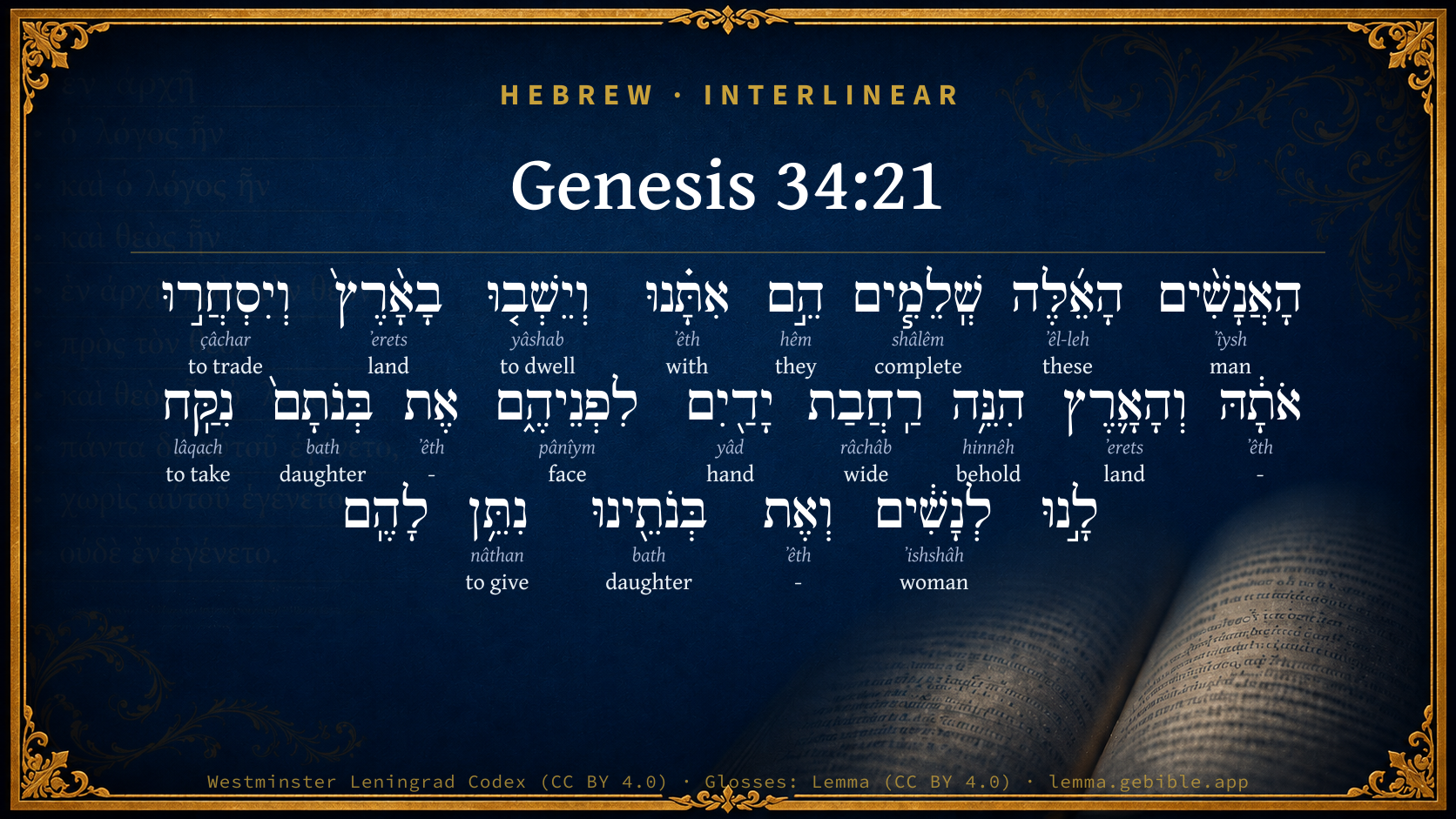
Genesis 34:21

Hebrew (Westminster Leningrad Codex) Genesis 34:21 appears in the Hebrew Old Testament. The text above is from the Westminster Leningrad Codex. Each word links to its Strong’s number, a concise gloss, and parsing drawn from the Open Scriptures Hebrew Bible morphology. Click any word for its full Brown-Driver-Briggs (BDB) entry.
Download image
Cite this verse

Genesis 34:21 (World English Bible). Public Domain. Lemma interlinear Bible study tool, https://lemma.gebible.app/v/genesis/34/21.

Show BibTeX & RIS
BibTeX
RIS
English Translation
"These men are peaceful with us. Therefore let them live in the land and trade in it. For, behold, the land is large enough for them. Let us take their daughters to us for wives, and let us give them our daughters.
World English Bible · Public Domain
Highlights
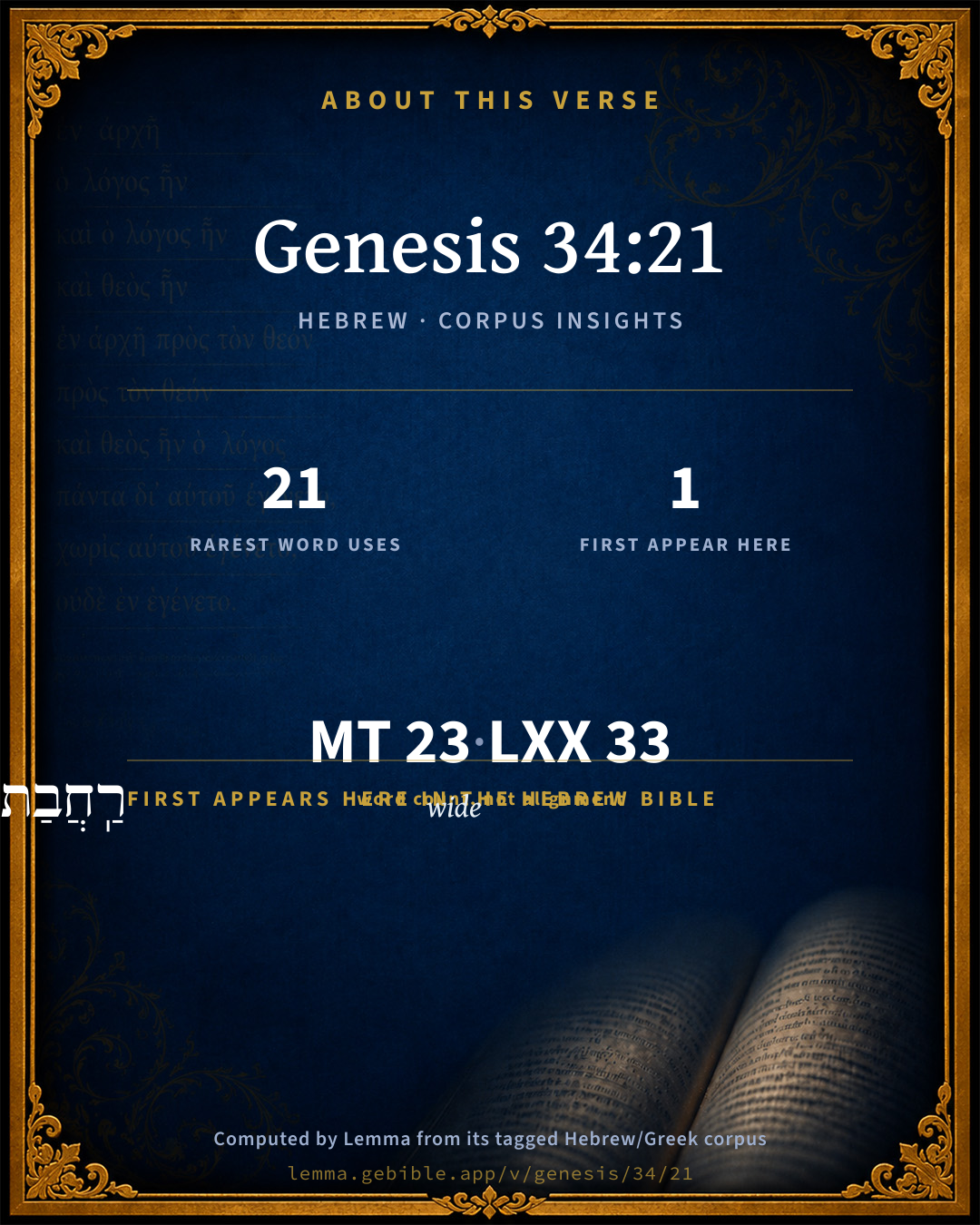
  • 1 first appearance in the Hebrew Bible
Full analysis ↓
Download a study sheet

One document with this verse’s original text, its word-by-word gloss line, the meaning frame, cross-references with their text, attributed commentary, and full source and license credits — printable, and it pastes into notes with its structure intact.

This verse Autodidact and up

Study sheet (.html) Plain text (.txt)

A passage Seminary Student

Up to 50 verses in one chapter. A passage sheet keeps up to 6 commentary sources and 12 cross-references per verse, in the order this page ranks them, and says so on the sheet whenever that leaves anything out. Ask for a single verse and you get the Autodidact verse sheet above.

Everything on this page stays free to read, with no account — the sheet is a download of what is already on screen, not access to it.

Want to remove ads? Support Godless Engineer
Compare translations 3

The same verse in 3 English versions, stacked beneath the original-language interlinear above. Click any original word for its lexicon entry.

Each is an independent rendering of the whole verse — the interlinear is not word-aligned to these translations.

Highlighted words mark where these versions differ — a whole-verse word diff, not a word-by-word alignment.

  • World English Bible Public Domain
    "These men are peaceful with us. Therefore let them live in the land and trade in it. For, behold, the land is large enough for them. Let us take their daughters to us for wives, and let us give them our daughters.
  • King James Version Public Domain
    These men are peaceable with us; therefore let them dwell in the land, and trade therein; for the land, behold, it is large enough for them; let us take their daughters to us for wives, and let us give them our daughters.
  • unfoldingWord Literal Text CC BY-SA 4.0
    “These men peaceful with us, so let them settle in the land, and let them trade in it. And behold, the land broad of hands before them. We can take their daughters for ourselves as wives, and we can give our daughters to them.

unfoldingWord Literal Text — © unfoldingWord, licensed CC BY-SA 4.0. Word-aligned USFM3 via Door43 (git.door43.org/unfoldingWord/en_ult).

Versions to compare (up to 4)

3 of 4 selected

Show all 18 translations

Every available English version of this verse, each an independent rendering of the whole verse.

  • World English Bible Public Domain
    "These men are peaceful with us. Therefore let them live in the land and trade in it. For, behold, the land is large enough for them. Let us take their daughters to us for wives, and let us give them our daughters.
  • Berean Standard Bible Public Domain
    “These men are at peace with us. Let them live and trade in our land; indeed, it is large enough for them. Let us take their daughters in marriage and give our daughters to them.
  • Majority Standard Bible Public Domain
    “These men are at peace with us. Let them live and trade in our land; indeed, it is large enough for them. Let us take their daughters in marriage and give our daughters to them.
  • King James Version Public Domain
    These men are peaceable with us; therefore let them dwell in the land, and trade therein; for the land, behold, it is large enough for them; let us take their daughters to us for wives, and let us give them our daughters.
  • American Standard Version (1901) Public Domain
    These men are peaceable with us; therefore let them dwell in the land, and trade therein; for, behold, the land is large enough for them; let us take their daughters to us for wives, and let us give them our daughters.
  • Revised Version (1885) Public Domain
    These men are peaceable with us; therefore let them dwell in the land, and trade therein; for, behold, the land is large enough for them; let us take their daughters to us for wives, and let us give them our daughters.
  • Geneva Bible (1599) Public Domain
    These men are peaceable with vs: and that they may dwell in the land, and doe their affaires therin (for behold, the land hath roume ynough for them) let vs take their daughters to wiues, and giue them our daughters.
  • Douay-Rheims (1899) Public Domain
    These men are peaceable and willing to dwell with us: let them trade in the land, and till it, which being large and wide wanteth men to till it: we shall take their daughters for wives, and we will give them ours.
  • Young's Literal Translation Public Domain
    `These men are peaceable with us; then let them dwell in the land, and trade `in' it; and the land, lo, `is' wide before them; their daughters let us take to ourselves for wives, and our daughters give to them.
  • Literal Standard Version CC BY-SA 4.0
    “These men are peaceable with us; then let them dwell in the land, and trade [in] it; and the land, behold, [is] wide before them; their daughters let us take to ourselves for wives, and our daughters give to them.
  • Unlocked Literal Bible CC BY-SA 4.0
    “These men are at peace with us, so let them live in the land and trade in it for, really, the land is large enough for them. Let us take their daughters as wives, and let us give them our daughters.
  • unfoldingWord Literal Text CC BY-SA 4.0
    “These men peaceful with us, so let them settle in the land, and let them trade in it. And behold, the land broad of hands before them. We can take their daughters for ourselves as wives, and we can give our daughters to them.
  • Darby Bible Public Domain
    These men are peaceable with us; therefore let them dwell in the land, and trade in it. And the land -- behold, it is of wide extent before them. We will take their daughters as wives, and give them our daughters.
  • World Messianic Bible Public Domain
    “These men are peaceful with us. Therefore let them live in the land and trade in it. For behold, the land is large enough for them. Let’s take their daughters to us for wives, and let’s give them our daughters.
  • Webster's Bible Public Domain
    These men are peaceable with us, therefore let them dwell in the land, and trade therein: for the land, behold, it is large enough for them: let us take their daughters to us for wives, and let us give them our daughters.
  • Free Bible Version CC BY-SA 4.0
    “These men are our friends,” they told them. “Let's have them live here in our country and allow them to go wherever they want—it's big enough for all of them too. We can take their daughters as wives, and we can give our daughters to them to marry.
  • Bible in Basic English Public Domain
    It is the desire of these men to be at peace with us; let them then go on living in this country and doing trade here, for the country is wide open before them; let us take their daughters as wives and let us give them our daughters.
  • JPS Tanakh (1917) Public Domain
    'These men are peaceable with us; therefore let them dwell in the land, and trade therein; for, behold, the land is large enough for them; let us take their daughters to us for wives, and let us give them our daughters.

Literal Standard Version (2020), Covenant Press — licensed CC BY-SA 4.0. Text via the HelloAO Bible API (eBible.org). Unlocked Literal Bible (unfoldingWord) — licensed CC BY-SA 4.0. Text via the HelloAO Bible API (eBible.org). unfoldingWord Literal Text — © unfoldingWord, licensed CC BY-SA 4.0. Word-aligned USFM3 via Door43 (git.door43.org/unfoldingWord/en_ult). Free Bible Version, Dr. Jonathan Gallagher — licensed CC BY-SA 4.0. Text via the HelloAO Bible API (eBible.org).

Word by word

More ways to search: Search by grammar → Find every occurrence → Compare this word →

Practice this passage: Drill this verse → Learn its vocabulary →

וְיִסְחֲר֣וּ
çâchar
H5503
“and · to trade”
Conjunction + Verb, Qal, Imperfect, 3rd Person, Masculine, Plural
Part of Speech
Conjunction + Verb
Stem
Qal
Form
Imperfect
Person
3rd Person
Gender
Masculine
Number
Plural
Full BDB Definition

Origin: a primitive root

TWOT: 1486

to go around, go about, travel about in, go about in trade - (Qal) - to go about to and fro (in business) - trader, trafficker (participle) - (Pilpel) to palpitate
  1. הָאֲנָשִׁ֨ים ʼîysh H376 “the · men” Particle, Definite Article + Noun, Common, Masculine, Plural, Absolute
  2. הָאֵ֜לֶּה ʼêl-leh H428 “the · these” Particle, Definite Article + Pronoun, Demonstrative, Common, Plural
  3. שְֽׁלֵמִ֧ים shâlêm H8003 “complete” Adjective, Adjective, Masculine, Plural, Absolute
  4. הֵ֣ם hêm H1992 “they” Pronoun, Personal, 3rd Person, Masculine, Plural
  5. אִתָּ֗נוּ ʼêth H854 “with · us” Preposition + Suffix, Personal, 1st Person, Common, Plural
  6. וְיֵשְׁב֤וּ yâshab H3427 “and · to dwell” Conjunction + Verb, Qal, Imperfect, 3rd Person, Masculine, Plural
  7. בָאָ֨רֶץ֙ ʼerets H776 “in/at the · land” Preposition, Determined + Noun, Common, Both, Singular, Absolute
  8. אֹתָ֔הּ ʼêth H853 “- · her” Particle, Direct Object + Suffix, Personal, 3rd Person, Feminine, Singular
  9. וְהָאָ֛רֶץ ʼerets H776 “and · the · land” Conjunction + Particle, Definite Article + Noun, Common, Both, Singular, Absolute
  10. הִנֵּ֥ה hinnêh H2009 “behold” Particle, Demonstrative
  11. רַֽחֲבַת râchâb H7342 “wide of” Adjective, Adjective, Feminine, Singular, Construct
  12. יָדַ֖יִם yâd H3027 “hands” Noun, Common, Both, Dual, Absolute
  13. לִפְנֵיהֶ֑ם pânîym H6440 “to/for · face(s) · their” Preposition + Noun, Common, Both, Plural, Construct + Suffix, Personal, 3rd Person, Masculine, Plural
  14. אֶת ʼêth H853 “-” Particle, Direct Object
  15. בְּנֹתָם֙ bath H1323 “daughters · their” Noun, Common, Feminine, Plural, Construct + Suffix, Personal, 3rd Person, Masculine, Plural
  16. נִקַּֽח lâqach H3947 “to take” Verb, Qal, Imperfect, 1st Person, Common, Plural
  17. לְנָשִׁ֔ים ʼishshâh H802 “to/for · women” Preposition + Noun, Common, Feminine, Plural, Absolute
  18. וְאֶת ʼêth H853 “and · -” Conjunction + Particle, Direct Object
  19. בְּנֹתֵ֖ינוּ bath H1323 “daughters · our” Noun, Common, Feminine, Plural, Construct + Suffix, Personal, 1st Person, Common, Plural
  20. נִתֵּ֥ן nâthan H5414 “to give” Verb, Qal, Imperfect, 1st Person, Common, Plural

About this verse

These counts appear in no published source. They are computed here, from the morphology-tagged text and Lemma’s own curated glosses. What Lemma adds →

23
words
17
distinct lemmas
Pentateuch
section

Notable vocabulary

The rarest word here is וְיִסְחֲר֣וּ to trade H5503 — appearing just 21 times in the whole Hebrew Bible.

First appearance in Scripture

This word makes its first canonical appearance in the Hebrew Bible here:

  • רַֽחֲבַת wide H7342

Shared distinctive vocabulary

וְיִסְחֲר֣וּ to trade H5503 occurs in 20 verses of the Hebrew Bible. Also found in:

Grammatical profile

  • 4 verbs
  • 8 nouns
  • 2 adjectives
  • 2 pronouns
  • 3 prepositions
  • 4 particles

Verb forms

  • וְיֵשְׁב֤וּ Qal · Imperfect
  • וְיִסְחֲר֣וּ Qal · Imperfect
  • נִקַּֽח Qal · Imperfect
  • נִתֵּ֥ן Qal · Imperfect

Repetition

Words recur within this verse — often emphatic in Hebrew:

  • בָאָ֨רֶץ֙ land H776 ×2
  • בְּנֹתָם֙ daughter H1323 ×2

Hebrew & Septuagint length

In English translation the verse runs 42 words from the Hebrew and 42 from the Septuagint (LXX English) — the same length.

A rough comparison of the two English renderings, which tokenize alike — not a word-level alignment.

Word counts can differ between the Hebrew and the Greek without any difference in meaning — e.g. the Hebrew direct-object marker אֵת has no separate Greek word, and Greek often adds the article ὁ.

In the original languages it is 23 Hebrew tokens and 33 Greek tokens — but the two are counted differently (Hebrew bundles its prefixes and suffixes into one token; the Greek is in lemma form), so that isn’t a like-for-like length.

Hebrew and Greek witnesses Masoretic Hebrew ↔ Greek Septuagint

The same verse in the two great witnesses to the Old Testament, shown verse-for-verse.

These are two independent witnesses, not word-aligned to each other, and the Septuagint is shown in lemma (dictionary) form.

Hebrew Genesis 34:21 Masoretic · Westminster Leningrad Codex

הָאֲנָשִׁ֨ים הָאֵ֜לֶּה שְֽׁלֵמִ֧ים הֵ֣ם אִתָּ֗נוּ וְיֵשְׁב֤וּ בָאָ֨רֶץ֙ וְיִסְחֲר֣וּ אֹתָ֔הּ וְהָאָ֛רֶץ הִנֵּ֥ה רַֽחֲבַת יָדַ֖יִם לִפְנֵיהֶ֑ם אֶת בְּנֹתָם֙ נִקַּֽח לָ֣נוּ לְנָשִׁ֔ים וְאֶת בְּנֹתֵ֖ינוּ נִתֵּ֥ן לָהֶֽם

"These men are peaceful with us. Therefore let them live in the land and trade in it. For, behold, the land is large enough for them. Let us take their daughters to us for wives, and let us give them our daughters.

World English Bible · Public Domain

Greek LXX Genesis 34:21 Septuagint · lemma form

ὁ ἄνθρωπος οὗτος εἰρηνικός εἰμί μετά ἐγώ οἰκέω ἐπί ὁ γῆ καί ἐνπορεύομαι αὐτός ὁ δέ γῆ ἰδού πλατύς ἐναντίον αὐτός ὁ θυγάτηρ αὐτός λαμβάνω ἐγώ γυνή καί ὁ θυγάτηρ ἐγώ δίδωμι αὐτός

These men are peaceful, let them dwell with us upon the land, and let them trade in it, and behold the land is extensive before them; we will take their daughters to us for wives, and we will give them our daughters.

LXX2012 (modern English Septuagint) · Public Domain

Hebrew: Westminster Leningrad Codex (CC BY 4.0). Greek: Septuagint (public domain); English from LXX2012 (modern English Septuagint) (Public Domain). How the Septuagint differs from the Hebrew →

Targum (Aramaic paraphrase)

2

The Targum is the ancient Jewish Aramaic paraphrase of the Hebrew Scriptures — an interpretive translation, not the Hebrew text itself. Onkelos (literal) and Pseudo-Jonathan (expansive) render the Torah, and Jonathan the Prophets. Coverage is partial: where no permissively-licensed English translation exists for a verse, only the Aramaic is shown. This is verse-level text, not a word-by-word alignment to the Hebrew.

  1. Targum Onkelos Torah (Genesis–Deuteronomy)
    גֻּבְרַיָּא הָאִלֵּין שָׁלְמִין אִנּוּן עִמָּנָא וִיתִיבוּן בְּאַרְעָא וְיַעְבְּדוּן בַּהּ סְחוֹרְתָא וְאַרְעָא הָא פְתָיוּת יְדִין קֳדָמֵיהוֹן יָת בְּנָתֵיהוֹן נִסַּב לָנָא לִנְשִׁין וְיָת בְּנָתָנָא נִתֵּן לְהוֹן

    (no public-domain English translation for this verse)

    Targum Onkelos — Aramaic: “Onkelos Genesis” (public domain); “Onkelos Exodus” (public domain); “Onkelos Leviticus” (public domain); “Onkelos Numbers” (public domain); “Onkelos Deuteronomy” (public domain). English: “Sefaria Community Translation” (CC0 1.0 (public-domain dedication)); “J.W. Etheridge. The Targums of Onkelos and Jonathan Ben Uzziel on the Pentateuch. London: Longmans, Green, 1862” (public domain). Text via Sefaria.

  2. Targum Pseudo-Jonathan Torah (Genesis–Deuteronomy)
    גוּבְרַיָא הָאִלֵין שַׁלְמִין אִינוּן עִמָנָא וְיֵתְבוּן בְּאַרְעָא וְיַעַבְדוּן בָּהּ פְּרַקְמַטְיָא וְאַרְעָא הָא פַּתְיַית תְּחוּמִין קֳדָמֵיהוֹן יַת בְּנָתֵיהוֹן נִיסַב לָנָא לִנְשִׁין וְיַת בְּנָתָנָא נִיתֵּין לְהוֹם

    These men are friendly with us; and they may dwell in the land and do business in it; and the land, behold, it is broad (in) limits before them; let us take their daughters to us for wives, and give our daughters to them.

    Targum Pseudo-Jonathan — Aramaic: “Targum Jonathan on Genesis” (public domain); “Targum Jonathan on Exodus” (public domain); “Targum Jonathan on Leviticus” (public domain); “Targum Jonathan on Numbers” (public domain); “Targum Jonathan on Deuteronomy” (public domain). English: “The Targum of Jonathan ben Uzziel, trans. J. W. Etheridge, London, 1862” (public domain). Text via Sefaria.

Commentary

Notes on Genesis 34:21 from classic Christian and Jewish commentators (each source and its license shown beneath its notes). The classic Christian expositions comment on the surrounding passage and are grouped to its opening verse, so a note may address several verses; the Jewish commentaries on the Tanakh (Rashi and others) are per-verse, so they appear only where the commentator wrote on this verse.

Lemma curates 59 commentaries, every one of them public domain or Creative Commons licensed, each selected and text-cleaned for this edition rather than reprinted as found. About our sources →

Trapp's Complete Commentary

John Trapp

Gen 34:21 These men [are] peaceable with us; therefore let them dwell in the land, and trade therein; for the land, behold, [it is] large enough for them; let us take their daughters to us for wives, and let us give them our daughters.

Ver. 21. These men are peaceable, &c.] Nothing more ordinary, with politicians, than to cover private ends and respects, with pretence of public good: as Jeroboam told the people, it was too much trouble for them to go up to Jerusalem to worship; they should take a shorter cut to Dan and Bethel. So Jehu, in all his reformations, had a hawk’s eye to a kingdom; his main end was, to settle the crown upon his own head. The Turkish Janizaries, desirous to be rid of their Sultan Osman, pretended, and persuaded the people, that he was Jaour, that is, an infidel; and that he endeavoured to betray the Turkish Empire to Christian dogs, May 18, 1622. {a}

{a} Parei, Hist. Profan. Medal., 1176.

John Trapp, A Commentary or Exposition upon All the Books of the Old and New Testament (1647–1656) — public domain. Text from a community e-Sword module.

Geneva Bible (1599)

Geneva Bible translators

Thus many pretend to speak for a public profit, when they only speak for their own private gain and commodity.

Geneva Bible (1599) marginal notes — public domain. Text via Bolls.life.

John Calvin's Commentaries

21. These men are peaceable. Moses describes the mode of acting, whereby they persuaded the Shechemites to accept the conditions which the sons of Jacob had imposed. It was difficult to induce a whole people to submit in an affair of such magnitude to a few foreigners. For we know what displeasure a change of religion produces: but Hamor and Shechem reason from utility; and this is natural rhetoric. For although honor has a more plausible appearance, it is yet for the most part cold in persuasion. But among the vulgar, utility carries almost every point; because the major part eagerly pursues what it deems expedient for itself. With this design, Hamor and Shechem extol the family of Jacob for their honesty and tranquil habits, in order that the Shechemites may deem it useful to themselves to receive such guests. They add that the land is sufficiently large, so that no loss is to be feared on the part of the original inhabitants. They then enumerate other advantages; meanwhile, they cunningly conceal the private and real cause of their request. Whence it follows that all these pretexts were fallacious. But it is a very common disease, that men of rank who have great authority, while making all things subservient to their own private ends, feign themselves to be considerate for the common good, and pretend to a desire for the public advantage. And, truly, it may be believed, that the persons here spoken of were the best among all the people, and were endowed with singular superiority; for the Shechemites had chosen Hamor for their prince, as one who was preeminent in excellent gifts. Yet we see how he and his son lie and deceive, under the appearance of rectitude. Whence also we perceive hypocrisy to be so deeply rooted in human minds, that it is a miracle to find any one entirely free from it; especially where private advantage is concerned. From this example let all who govern, learn to cultivate sincerity in public designs, without any sinister regard to their own interests. On the other hand; let the people exercise self-government, lest they too earnestly seek their own advantage; because it will often happen that they are caught by a specious appearance of good, as fishes by the hook. For as self-love is blind, we are drawn without judgment to the hope of gain. And the Lord also justly chastises this cupidity, to which he sees us to be unduly prone, when he suffers us to be deceived by it. Moses says that this discourse took place in the gate of the city, where public assemblies were then wont to be held and judgment administered.

John Calvin's Commentaries (1540-1563) — public domain. Text from the Calvin Translation Society English edition (1840s-50s) via the Christian Classics Ethereal Library (ccel.org). Calvin's coverage is partial (roughly two-thirds of the Bible); uncommented books and verses are honest gaps, never fabricated. The 19th-century editor's footnotes and remarks are omitted so the notes are faithfully Calvin's own voice.

Ellicott's Commentary for English Readers

(21) Let us take their daughters . . . —In a young community, such as this of the Hivites at Shechem appears to have been, the addition of a large number of women was a valuable increase of their strength, and one that brought the promise also of future extension. Jacob’s men were also chiefly of the Semitic stock, and therefore possessed of high physical and mental endowments; and as they were rich in cattle and other wealth, their incorporation with the people of Shechem would raise it to a high rank among the petty states of Canaan. There was much plausibility, therefore, in Hamor’s proposal and arguments.

A Bible Commentary for English Readers, edited by Charles John Ellicott (1878–1897) — public domain. Text from a community e-Sword module.

John Gill's Exposition

Only herein will the men consent unto us,.... The only term or condition insisted upon, to come into an alliance and affinity with us, and

for to dwell with us, to be one people, to become one body politic, is the following one:

if every male among us be circumcised, as they are circumcised; submitting to this rite, they agree to take up their residence with us, and be incorporated among us, and become one people.

John Gill's Exposition of the Whole Bible (1746–1763) — public domain (CC PDM 1.0). Text via the HelloAO Bible API.

Rashi

Rabbi Shlomo Yitzchaki (Rashi)

שלמים means peaceable and whole hearted.

והארץ הנה רחבת ידים FOR THE LAND, BEHOLD, IT IS LARGE ENOUGH (literally, wide-handed) — the metaphor is that of a man whose hand is large and generous, and the idea is: “You will lose nothing if they dwell and trade in the land, for much merchandise is brought here and there are no buyers for it”.

Rashi on the Tanakh — English translations: “The Judaica Press complete Tanach with Rashi, translated by A. J. Rosenberg” (CC BY 4.0); “Pentateuch with Rashi's commentary by M. Rosenbaum and A.M. Silbermann, 1929-1934” (public domain); “The Metsudah Tanach series, Lakewood, N.J” (CC BY 4.0); and “The Book of Joshua, Metsudah Publications, 1997” (CC BY 4.0). Text via Sefaria.

Ramban (Nachmanides)

Rabbi Moshe ben Nachman (Ramban / Nachmanides)

THESE MEN ARE PEACEABLE WITH US. The men of the city thought that they hated them as they saw them dejected, and it angered them very much. Perhaps they guarded themselves against them and installed in their city bars and doors, for Jacob’s sons were mighty men and valiant men for the war. But now Hamor and his son Shechem told them, “Do not fear and do not keep distant from them for they are whole-hearted with us.”

Ramban (Nachmanides) on the Tanakh — English translation: “Commentary on the Torah by Ramban (Nachmanides). Translated and annotated by Charles B. Chavel. New York, Shilo Pub. House, 1971-1976” (CC BY 4.0). Text via Sefaria.

Radak

Rabbi David Kimhi (Radak)

האנשים האלה שלמים הם אתנו, they are quite peaceful towards us even though I raped their sister; the reason is that they are anxious to live side by side with us and to become one people. They are asking for a very minor concession on our part, that all out males must circumcise themselves as they are all circumcised themselves. He argued that acceptance of such a demand would not deprive his townsfolk of anything of value. In return for complying with their demand his countrymen would become co-owners of the extensive property of Yaakov’s family רחבת ידים לפניהם. Even though they do possess extensive herds and flocks, the land is more than adequate to support these animals without our having to limit the grazing land allocated to our livestock.

Radak on the Tanakh — English translations: “Sefaria Community Translation” (CC0 1.0 (public-domain dedication)); “Eliyahu Munk, HaChut Hameshulash” (CC BY 4.0); “Rabbi Mike Feuer, Jerusalem Anthology” (CC BY 4.0); and “R. David Kimhi on the first book of Psalms, Translated by R.G. Finch, London, 1919” (public domain). Text via Sefaria.

Lesson kit

Teaching starters — assembled from the data on this page, not authored interpretation. Every prompt links to the verse data it draws on. Edit before teaching.

Genesis, in the Pentateuch, opens this verse with 23 words (17 distinct Hebrew lemmas). Its most distinctive word is çâchar (“to trade”). A historical commentator’s framing appears above. Read the whole chapter for the surrounding context.

Discussion questions

  1. How does “to trade” (çâchar) shape what this verse is saying?
  2. The word “wide” first appears here in Scripture. What is being introduced at this debut?
  3. Genesis 23:16 shares the word «to trade» with this verse. How do the two illuminate each other?
  4. “land” occurs 2× in this one verse. What is the effect of the repetition?
  5. These translations render this verse differently. What is at stake in choosing one wording over another?
  6. The verb «וְיֵשְׁב֤וּ» is Qal Imperfect. How does its form color the action?
  7. Reading how Trapp's Complete Commentary and Geneva Bible (1599) read this verse, where do the two commentators agree and where do they part?

Things to notice

Reading settings

Reading text

Shown beneath each verse's original-language words.

Old Testament
Old Testament edition

Read the OT as the Masoretic Hebrew (MT) or the Greek Septuagint (LXX).

English shown for the Greek Septuagint (in the Hebrew ↔ Greek comparison).

Comparing translations? Open the Compare panel on any verse page to stack up to four side by side.