1 Samuel 12:13

Hebrew (Westminster Leningrad Codex) 1 Samuel 12:13 appears in the Hebrew Old Testament. The text above is from the Westminster Leningrad Codex. Each word links to its Strong’s number, a concise gloss, and parsing drawn from the Open Scriptures Hebrew Bible morphology. Click any word for its full Brown-Driver-Briggs (BDB) entry.
Download image
Cite this verse

1 Samuel 12:13 (World English Bible). Public Domain. Lemma interlinear Bible study tool, https://lemma.gebible.app/v/1-samuel/12/13.

Show BibTeX & RIS
BibTeX
RIS
English Translation
Now therefore see the king whom you have chosen, and whom you have asked for: and, behold, Yahweh has set a king over you.
World English Bible · Public Domain
Download a study sheet

One document with this verse’s original text, its word-by-word gloss line, the meaning frame, cross-references with their text, attributed commentary, and full source and license credits — printable, and it pastes into notes with its structure intact.

This verse Autodidact and up

Study sheet (.html) Plain text (.txt)

A passage Seminary Student

Up to 50 verses in one chapter. A passage sheet keeps up to 6 commentary sources and 12 cross-references per verse, in the order this page ranks them, and says so on the sheet whenever that leaves anything out. Ask for a single verse and you get the Autodidact verse sheet above.

Everything on this page stays free to read, with no account — the sheet is a download of what is already on screen, not access to it.

Want to remove ads? Support Godless Engineer
Compare translations 3

The same verse in 3 English versions, stacked beneath the original-language interlinear above. Click any original word for its lexicon entry.

Each is an independent rendering of the whole verse — the interlinear is not word-aligned to these translations.

Highlighted words mark where these versions differ — a whole-verse word diff, not a word-by-word alignment.

  • World English Bible Public Domain
    Now therefore see the king whom you have chosen, and whom you have asked for: and, behold, Yahweh has set a king over you.
  • King James Version Public Domain
    Now therefore behold the king whom ye have chosen, and whom ye have desired! and, behold, the LORD hath set a king over you.
  • unfoldingWord Literal Text CC BY-SA 4.0
    But now, behold the king whom you have chosen, whom you have requested. And behold, Yahweh has given a king over you.

unfoldingWord Literal Text — © unfoldingWord, licensed CC BY-SA 4.0. Word-aligned USFM3 via Door43 (git.door43.org/unfoldingWord/en_ult).

Versions to compare (up to 4)

3 of 4 selected

Show all 18 translations

Every available English version of this verse, each an independent rendering of the whole verse.

  • World English Bible Public Domain
    Now therefore see the king whom you have chosen, and whom you have asked for: and, behold, Yahweh has set a king over you.
  • Berean Standard Bible Public Domain
    Now here is the king you have chosen, the one you requested. Behold, the LORD has placed a king over you.
  • Majority Standard Bible Public Domain
    Now here is the king you have chosen, the one you requested. Behold, the LORD has placed a king over you.
  • King James Version Public Domain
    Now therefore behold the king whom ye have chosen, and whom ye have desired! and, behold, the LORD hath set a king over you.
  • American Standard Version (1901) Public Domain
    Now therefore behold the king whom ye have chosen, and whom ye have asked for: and, behold, Jehovah hath set a king over you.
  • Revised Version (1885) Public Domain
    Now therefore behold the king whom ye have chosen, and whom ye have asked for: and, behold, the LORD hath set a king over you.
  • Geneva Bible (1599) Public Domain
    Nowe therefore beholde the King whome yee haue chosen, and whome yee haue desired: loe therefore, the Lord hath set a King ouer you.
  • Douay-Rheims (1899) Public Domain
    Now therefore your king is here, whom you have chosen and desired: Behold the Lord hath given you a king.
  • Young's Literal Translation Public Domain
    And, now, lo, the king whom ye have chosen -- whom ye have asked! and lo, Jehovah hath placed over you a king.
  • Literal Standard Version CC BY-SA 4.0
    And now, behold the king whom you have chosen—whom you have asked for! And behold, YHWH has placed a king over you.
  • Unlocked Literal Bible CC BY-SA 4.0
    Now here is the king whom you have chosen, whom you have asked for and whom Yahweh has now appointed as king over you.
  • unfoldingWord Literal Text CC BY-SA 4.0
    But now, behold the king whom you have chosen, whom you have requested. And behold, Yahweh has given a king over you.
  • Darby Bible Public Domain
    And now behold, the king whom ye have chosen, whom ye have asked for! and behold, Jehovah has set a king over you.
  • World Messianic Bible Public Domain
    Now therefore see the king whom you have chosen and whom you have asked for. Behold, the LORD has set a king over you.
  • Webster's Bible Public Domain
    Now therefore, behold the king whom ye have chosen, and whom ye have desired! and behold, the LORD hath set a king over you.
  • Free Bible Version CC BY-SA 4.0
    So here's the king you have chosen, the one you asked for. Look—the Lord now gives him to you as your king!
  • Bible in Basic English Public Domain
    Here, then, is the king marked out by you: the Lord has put a king over you.
  • JPS Tanakh (1917) Public Domain
    Now therefore behold the king whom ye have chosen, and whom ye have asked for; and, behold, the LORD hath set a king over you.

Literal Standard Version (2020), Covenant Press — licensed CC BY-SA 4.0. Text via the HelloAO Bible API (eBible.org). Unlocked Literal Bible (unfoldingWord) — licensed CC BY-SA 4.0. Text via the HelloAO Bible API (eBible.org). unfoldingWord Literal Text — © unfoldingWord, licensed CC BY-SA 4.0. Word-aligned USFM3 via Door43 (git.door43.org/unfoldingWord/en_ult). Free Bible Version, Dr. Jonathan Gallagher — licensed CC BY-SA 4.0. Text via the HelloAO Bible API (eBible.org).

Word by word

More ways to search: Search by grammar → Find every occurrence → Compare this word →

Practice this passage: Drill this verse → Learn its vocabulary →

בְּחַרְתֶּ֖ם
bâchar
H977
“to choose”
Verb, Qal, Perfect, 2nd Person, Masculine, Plural
Part of Speech
Verb
Stem
Qal
Form
Perfect
Person
2nd Person
Gender
Masculine
Number
Plural
Full BDB Definition

Origin: a primitive root

TWOT: 231

to choose, elect, decide for - (Qal) to choose - (Niphal) to be chosen - (Pual) to be chosen, selected
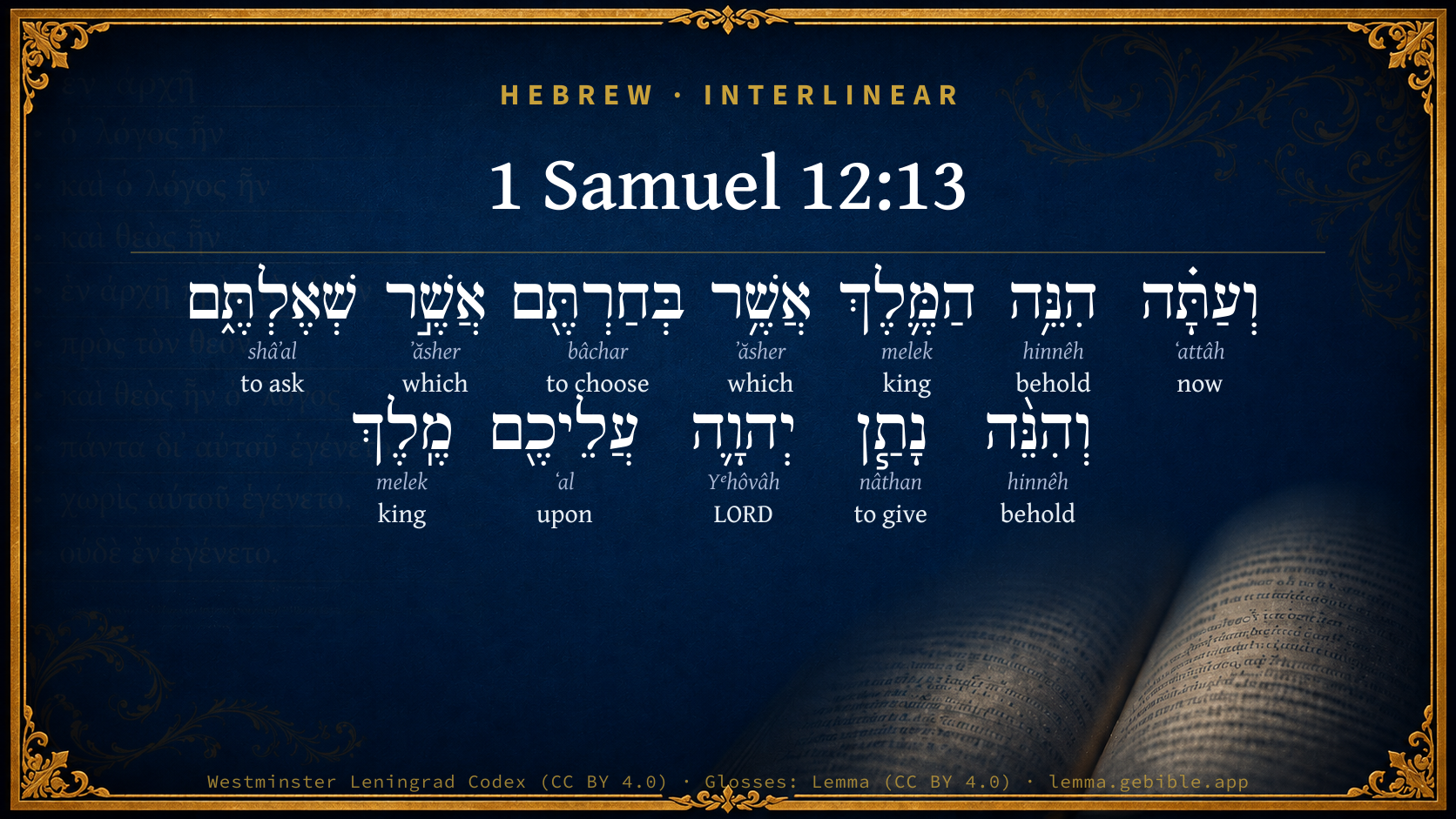
  1. וְעַתָּ֗ה ʻattâh H6258 “and · now” Conjunction + Adverb
  2. הִנֵּ֥ה hinnêh H2009 “behold” Particle, Demonstrative
  3. הַמֶּ֛לֶךְ melek H4428 “the · king” Particle, Definite Article + Noun, Common, Masculine, Singular, Absolute
  4. אֲשֶׁ֥ר ʼăsher H834 “which” Particle, Relative
  5. אֲשֶׁ֣ר ʼăsher H834 “which” Particle, Relative
  6. שְׁאֶלְתֶּ֑ם shâʼal H7592 “to ask” Verb, Qal, Perfect, 2nd Person, Masculine, Plural
  7. וְהִנֵּ֨ה hinnêh H2009 “and · behold” Conjunction + Particle, Demonstrative
  8. נָתַ֧ן nâthan H5414 “to give” Verb, Qal, Perfect, 3rd Person, Masculine, Singular
  9. יְהוָ֛ה Yᵉhôvâh H3068 “LORD” Noun, Proper
  10. עֲלֵיכֶ֖ם ʻal H5921 “upon · you” Preposition + Suffix, Personal, 2nd Person, Masculine, Plural
  11. מֶֽלֶךְ melek H4428 “king” Noun, Common, Masculine, Singular, Absolute

About this verse

These counts appear in no published source. They are computed here, from the morphology-tagged text and Lemma’s own curated glosses. What Lemma adds →

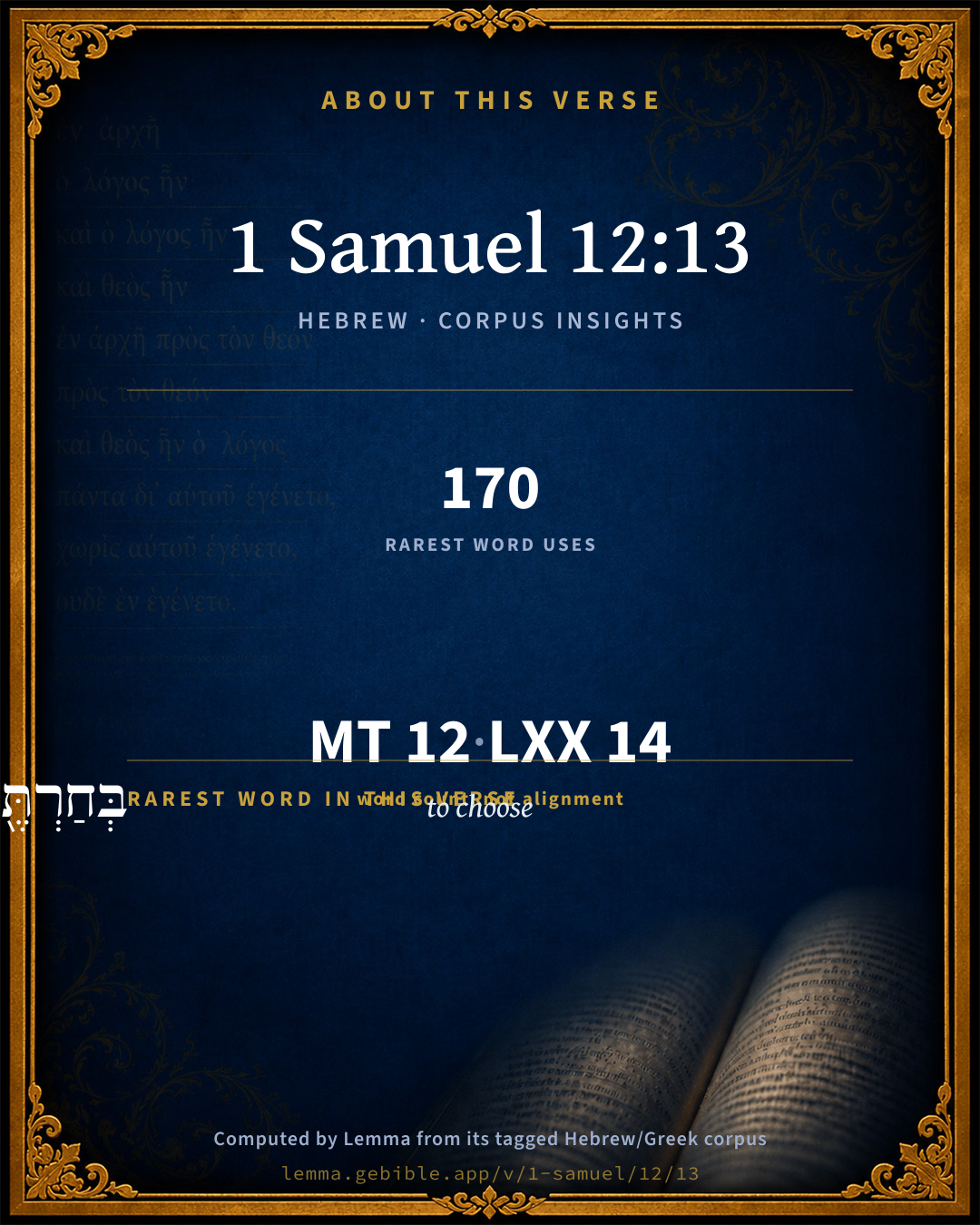
12
words
9
distinct lemmas
Historical
section

Grammatical profile

  • 3 verbs
  • 3 nouns
  • 1 preposition
  • 1 adverb
  • 4 particles

Verb forms

  • בְּחַרְתֶּ֖ם Qal · Perfect
  • שְׁאֶלְתֶּ֑ם Qal · Perfect
  • נָתַ֧ן Qal · Perfect

Repetition

Words recur within this verse — often emphatic in Hebrew:

  • הִנֵּ֥ה behold H2009 ×2
  • הַמֶּ֛לֶךְ king H4428 ×2
  • אֲשֶׁ֥ר which H834 ×2

Hebrew & Septuagint length

In English translation the verse runs 24 words from the Hebrew and 19 from the Septuagint (LXX English) — closely comparable.

A rough comparison of the two English renderings, which tokenize alike — not a word-level alignment.

Word counts can differ between the Hebrew and the Greek without any difference in meaning — e.g. the Hebrew direct-object marker אֵת has no separate Greek word, and Greek often adds the article ὁ.

In the original languages it is 12 Hebrew tokens and 14 Greek tokens — but the two are counted differently (Hebrew bundles its prefixes and suffixes into one token; the Greek is in lemma form), so that isn’t a like-for-like length.

Cross-references

7

Topical passages linked to 1 Samuel 12:13 in the Treasury of Scripture Knowledge — connected by theme and wording, ordered by reader-vote popularity; previews shown in the World English Bible.

  • 1 Samuel 10:24 Samuel said to all the people, "You see him whom Yahweh has chosen, that there is none like him among all the people?" All the people shouted, and said, [Long] live the king.
  • Hosea 13:11 I have given you a king in my anger, And have taken him away in my wrath.
  • 1 Samuel 8:5 and they said to him, Behold, you are old, and your sons don't walk in your ways: now make us a king to judge us like all the nations.
  • 1 Samuel 9:20 As for your donkeys who were lost three days ago, don't set your mind on them; for they are found. For whom is all that is desirable in Israel? Is it not for you, and for all your father's house?
  • 1 Samuel 11:15 All the people went to Gilgal; and there they made Saul king before Yahweh in Gilgal; and there they offered sacrifices of peace-offerings before Yahweh; and there Saul and all the men of Israel rejoiced greatly.
  • Psalms 78:29–31 So they ate, and were well filled. He gave them their own desire.
  • Acts 13:21 Afterward they asked for a king, and God gave to them Saul the son of Kish, a man of the tribe of Benjamin, for forty years.

Cross-references courtesy of OpenBible.info (CC BY 4.0).

Hebrew and Greek witnesses Masoretic Hebrew ↔ Greek Septuagint

The same verse in the two great witnesses to the Old Testament, shown verse-for-verse.

These are two independent witnesses, not word-aligned to each other, and the Septuagint is shown in lemma (dictionary) form.

Hebrew 1 Samuel 12:13 Masoretic · Westminster Leningrad Codex

וְעַתָּ֗ה הִנֵּ֥ה הַמֶּ֛לֶךְ אֲשֶׁ֥ר בְּחַרְתֶּ֖ם אֲשֶׁ֣ר שְׁאֶלְתֶּ֑ם וְהִנֵּ֨ה נָתַ֧ן יְהוָ֛ה עֲלֵיכֶ֖ם מֶֽלֶךְ

Now therefore see the king whom you have chosen, and whom you have asked for: and, behold, Yahweh has set a king over you.

World English Bible · Public Domain

Greek LXX 1 Samuel 12:13 Septuagint · lemma form

καί νῦν ἰδού ὁ βασιλεύς ὅς ἐκλέγω καί ἰδού δίδωμι κύριος ἐπί σύ βασιλεύς

And now behold the king whom you⌃ have chosen; and behold, the Lord has set a king over you.

LXX2012 (modern English Septuagint) · Public Domain

On this verse, Keil & Delitzsch discusses the Septuagint’s reading. Read the note in Commentary ↓

Hebrew: Westminster Leningrad Codex (CC BY 4.0). Greek: Septuagint (public domain); English from LXX2012 (modern English Septuagint) (Public Domain). How the Septuagint differs from the Hebrew →

Targum (Aramaic paraphrase)

1

The Targum is the ancient Jewish Aramaic paraphrase of the Hebrew Scriptures — an interpretive translation, not the Hebrew text itself. Onkelos (literal) and Pseudo-Jonathan (expansive) render the Torah, and Jonathan the Prophets. Coverage is partial: where no permissively-licensed English translation exists for a verse, only the Aramaic is shown. This is verse-level text, not a word-by-word alignment to the Hebrew.

  1. Targum Jonathan Prophets (Joshua–Malachi)
    וּכְעַן הָא מַלְכָּא דְאִתְרְעִיתוּן דִי שְׁאֶלְתּוּן וְהָא מַנֵי יְיָ עֲלֵיכוֹן מַלְכָּא:

    (no public-domain English translation for this verse)

    Targum Jonathan — Aramaic: “Mikraot Gedolot” (public domain). English: “Sefaria Community Translation” (CC0 1.0 (public-domain dedication)); “London "Chaldee Paraphrase," 1871” (public domain). Text via Sefaria.

Commentary

Notes on 1 Samuel 12:13 from classic Christian and Jewish commentators (each source and its license shown beneath its notes). The classic Christian expositions comment on the surrounding passage and are grouped to its opening verse, so a note may address several verses; the Jewish commentaries on the Tanakh (Rashi and others) are per-verse, so they appear only where the commentator wrote on this verse.

Lemma curates 59 commentaries, every one of them public domain or Creative Commons licensed, each selected and text-cleaned for this edition rather than reprinted as found. About our sources →

Trapp's Complete Commentary

John Trapp

1Sa 12:13 Now therefore behold the king whom ye have chosen, [and] whom ye have desired! and, behold, the LORD hath set a king over you.

Ver. 13. Behold, the Lord hath set a king over you.] But "in his wrath." {Hos 13:11} {See Trapp on "Hos 13:11"}

John Trapp, A Commentary or Exposition upon All the Books of the Old and New Testament (1647–1656) — public domain. Text from a community e-Sword module.

The Biblical Illustrator

Joseph S. Exell

1Sa_12:13-25

Now, therefore, behold the king whom ye have chosen.

Samuels farewell address

I. One could hardly fail to note what is here taught respecting the condition of true prosperity. Samuel plainly tells people that, in gaining their desire, they had not made sure of blessing. It still remained that they must fear and serve the Lord. Refusing to do this, His hand would be against them. In early times, when man was in his childhood, it was needful that God should make Himself and His will known chiefly through temporal blessings. To fidelity He promised present benefit; against transgression he denounced present ills. Now, it is clear that God does not deal with us in just this way. From the first He sought to lead a sinning race out; into the knowledge and enjoyment of a larger life. He would lead them on to see that there is a better than merely outward and earthly good. Less and less, therefore, did be connect temporal prosperity with obedience. Here, then, is the true good; in the smile of God, communion with Him, His present keeping and guidance, and heirship to an inheritance spiritual and eternal. This, with just such admixture of earthly honour and treasure as seems to God best, is true prosperity. When God would greatly bless, it is in ways like these. Does it need, now, to be greatly insisted that this is conditioned, still and forever, on the fear of God and faithful keeping of His commands? There are those who seem not to see it. Many, apparently, imagine that the present and future smile and favour of God come alike to all; not in gracious offer only, but in actual possession. They rather resent the suggestion that it can make any essential difference. But this is practical atheism--call it by whatever pleasing name we will. Then there is a class who seem to fancy that the requirement of obedience as a condition of present and future good is done away, for us at least, by the gospel promise of gratuitous pardon and free grace. This, too, is a fatal mistake. The seemingly two ways, of Samuel and of Christ, are not two, but one. Never was an Old Testament saint saved by the merit of his works. He, too, came into Gods spiritual household by undeserving favour. But he did not come bringing disobedience and self-will along with him. He came to love, trust, serve, and obey. So does the returning soul now come. And, coming with any other spirit, God cannot give him approving welcome. Now and forever, here and hereafter, true blessing is conditioned upon our walking in Gods way.

II. It will repay us to note the light which this Scripture sheds upon the use of wonders and signs. To confirm the words he had spoken, Samuel makes his appeal to God. He asks a sign from heaven, and his request is granted: The Lord sent thunder and rain that day. Robinson, in his Palestine, says: In ordinary seasons, from the cessation of the showers in spring until their commencement in October and November, rain never falls and the sky is usually serene. Jerome, whose home was in that land, tells us, I have never seen rain in Judea in the end of June or in July. The fulfilment of Samuels prediction was thus a wonder and a sign. Now, supposing there is sufficient need of them, nothing is more natural than expectation of such signs from heaven. But that wonders and signs may be at any particular time probable there must be an adequate occasion for them. The end to be accomplished must be worthy, and other and ordinary means inadequate to it. It must be clear that the signs will do what the ordinary means can not. There was such adequate occasion when the book of Revelation was incomplete. It is not certain that there is now, at any time with us, a similar need; and our Saviour, whose wonders were so many and so stupendous, declared that, in response to idle curiosity or unbelieving demand, no sign shall be given. Of such, They have Moses and the prophets, the written gospel and the Divine spirit; if they hear not them, neither would they be persuaded though One rose from the dead.

III. It is worth our while to note briefly the hint we here have of the real estimate is which the worldly man holds the ungodly. Upon the latter the former sometimes turns his back with not a little seeming scorn. So, in a measure, Israel had done with Samuel. They wanted a more stately rule. But now, no sooner is the sense of their sin and of Gods ready resources of judgment brought home to them than they are glad to get, as we say, under His wing.

IV. In this scripture there are impressive reminders of the great and multiplied incentives which wanderers have to return to God. Why does Samuel remind the people that right relations with God are the condition of true prosperity, save that he may persuade them to return to Him? And why does he make use of the startling sign from heaven but to the same end? What an array of incentives! Surely, if we fail to find God and the blessing He would bestow, the fault cannot be that of Him who sets before us motives so numerous and so great.

V. There is an important intimation running all through these words as to what it is which makes one truly and savingly religious. Upon this point there would seem to be among men a great and strange variety of opinions. Some seem to suppose that religion mainly consists in knowing and holding the truth, or in soundness of intellectual belief; others have thought that he is a sufficiently religious person who reads his Bible, and says his prayers, and goes to his church, and pays his share for its support; there are those who make chief account of warm and ardent religious emotions, and think it enough to delight in psalms and hymns and spiritual songs; just now there is a considerable class who would have us understand that religion is summed up in what is termed a good life--in practical reverence for honesty, charity, truth, neighbourly kindness, and kindred virtues. But now the thought which underlies all of Samuels words is different from anything here named, What he implies is that true, acceptable, saving religion consists in a right personal relation to a personal God. This does not mean that any one of the things enumerated is worthless, unimportant. Each is an important help to it, or expression or fruit of it. But never are they anywhere in the Scripture set forth as the very thing itself; as that central reality whence all its deep blessedness flows, and in which its reasonableness consists. He is a truly religious man who is in a right personal relation to a personal God.

VI. This address, as a whole, gives us a pleasing glimpse of the beauty and power of unselfish piety. His own were the hands that anointed his successor. To those who have cast him off he pledges his unceasing prayers and gives his cheerful help. In all this there was rare magnanimity. Some good men have fallen greatly below it. Have we not heard of Gospel ministers who, when rightly or wrongly dismissed from their charge, have spoken harsh words and gone out with a resentful spirit? and of Sunday school superintendents, chief singers, and other helpers, who, because another has been put in their place or because disparaging words have been spoken concerning them, have altogether withdrawn from Christian work? This is simply because to step down and out from a place of influence and honour, to see the crown of favour transferred to the head of another, is never easy. To do it patiently takes great grace. Yet it is not impossible. We have witnessed it in ministers and church officials, who have proved just as constant and ardent in the ranks as at the head; in following as when they led. The beauty of such a spirit never fails of recognition. Such men are everywhere beloved. (Monday Club Sermon.)

The Biblical Illustrator, edited by Joseph S. Exell (c. 1880s–1900s) — public domain. Text from a community e-Sword module.

Joseph Benson's Commentary

1Sa 12:13. Behold the king whom ye have chosen — Though God chose him by lot, yet the people are said to choose him; either generally, because they chose that form of government; or particularly, because they approved of God’s choice, and confirmed it. The Lord hath set a king ever you — He hath yielded to your inordinate desire.

Joseph Benson's Commentary on the Old and New Testaments (1811–1818) — public domain. Text from a community e-Sword module.

Keil & Delitzsch

C. F. Keil & F. Delitzsch

After the prophet had thus held up before the people their sin against the Lord, he bade them still further consider, that the king would only procure for them the anticipated deliverance if they would fear the Lord, and give up their rebellion against God.

Sa1 12:13

"But now behold the king whom ye have chosen, whom ye have asked for! behold, Jehovah hath set a king over you." By the second והנּה, the thought is brought out still more strongly, that Jehovah had fulfilled the desire of the people. Although the request of the people had been an act of hostility to God, yet Jehovah had fulfilled it. The word בּהרתּם, relating to the choice by lot (Sa1 10:17.), is placed before שׁאלתּם אשׁר, to show that the demand was the strongest act that the people could perform. They had not only chosen the king with the consent or by the direction of Samuel; they had even demanded a king of their own self-will.

Sa1 12:14

Still, since the Lord had given them a king, the further welfare of the nation would depend upon whether they would follow the Lord from that time forward, or whether they would rebel against Him again. "If ye will only fear the Lord, and serve Him, ... and ye as well as the king who rules over you will be after Jehovah your God." אם, in the sense of modo, if only, does not require any apodosis, as it is virtually equivalent to the wish, "O that ye would only!" for which אם with the imperfect is commonly used (vid., Kg2 20:19; Pro 24:11, etc.; and Ewald, 329, b.). There is also nothing to be supplied to יהוה אחר ... והיתם, since אחר היה, to be after or behind a person, is good Hebrew, and is frequently met with, particularly in the sense of attaching one's self to the king, or holding to him (vid., Sa2 2:10; Kg1 12:20; Kg1 16:21-22). This meaning is also at the foundation of the present passage, as Jehovah was the God-king of Israel.

Sa1 12:15

"But if ye do not hearken to the voice of Jehovah, and strive against His commandment, the hand of Jehovah will be heavy upon you, as upon your fathers." ו in the sense of as, i.e., used in a comparative sense, is most frequently placed before whole sentences (see Ewald, 340, b.); and the use of it here may be explained, on the ground that בּאבתיכם contains the force of an entire sentence: "as it was upon your fathers." The allusion to the fathers is very suitable here, because the people were looking to the king for the removal of all the calamities, which had fallen upon them from time immemorial. The paraphrase of this word, which is adopted in the Septuagint, ἐπὶ τὸν βασιλέα ὑμῶν, is a very unhappy conjecture, although Thenius proposes to alter the text to suit it.

Sa1 12:16-17

In order to give still greater emphasis to his words, and to secure their lasting, salutary effect upon the people, Samuel added still further: Even now ye may see that ye have acted very wickedly in the sight of Jehovah, in demanding a king. This chain of thought is very clearly indicated by the words גּם־עתּה, "yea, even now." "Even now come hither, and see this great thing which Jehovah does before your eyes." The words גּם־עתּה, which are placed first, belong, so far as the sense is concerned, to את־הד ראוּ; and התיצּבוּ ("place yourselves," i.e., make yourselves ready) is merely inserted between, to fix the attention of the people more closely upon the following miracle, as an event of great importance, and one which they ought to lay to heart. "Is it not now wheat harvest? I will call to Jehovah, that He may give thunder (קלוה, as in Exo 9:23, etc.) and rain. Then perceive and see, that the evil is great which ye have done in the eyes of Jehovah, to demand a king." The wheat harvest occurs in Palestine between the middle of May and the middle of June (see by Bibl. Arch. i. 118). And during this time it scarcely ever rains. Thus Jerome affirms (ad Am. c. 4): "Nunquam in fine mensis Junii aut in Julio in his provinciis maximeque in Judaea pluvias vidimus." And Robinson also says in his Palestine (ii. p. 98): "In ordinary seasons, from the cessation of the showers in spring until their commencement in October and November, rain never falls, and the sky is usually serene" (see my Arch. i. 10). So that when God sent thunder and rain on that day in answer to Samuel's appeal to him, this was a miracle of divine omnipotence, intended to show to the people that the judgments of God might fall upon the sinners at any time. Thunderings, as "the voice of God" (Exo 9:28), are harbingers of judgment.

Keil & Delitzsch — Biblical Commentary on the Old Testament (1861–1891) — public domain (CC PDM 1.0). Text via the HelloAO Bible API. (Old Testament only.)

MacLaren's Expositions of Holy Scripture

Alexander MacLaren

1 Samuel

SAMUEL’S CHALLENGE AND CHARGE

OLD TRUTH FOR A NEW EPOCH

1Sa 12:13 - 1Sa 12:25.

Samuel’s office as judge necessarily ended when Saul was made king, but his office of prophet continued. This chapter deals with both the cessation and the continuance, giving at first his dignified, and somewhat pained, vindication of his integrity, and then passing on to show him exercising his prophetic function in exhortation, miracle, and authoritative declaration of Jehovah’s will.

I. The first point is the sign which Samuel gave. Usually there is no rain in Palestine from about the end of April till October. Samuel was speaking during the wheat harvest, which falls about the beginning of June. We note that he volunteered the sign, and, what is still more remarkable, that he is sure that God will send it in answer to his prayer. Why was he thus certain? Because he recognised that the impulse to proffer the sign came from God. We know little of the mental processes by which a prophet could discriminate between his own thinkings and God’s speech, but such discrimination was possible, or there could have been no ring of confidence in the prophet’s ‘Thus saith the Lord.’ Not even a ‘Samuel among them that call upon His name’ had a right to assume that every asking would certainly have an answer. It is when we ask ‘anything according to His will’ that we know that ‘He heareth us,’ and are entitled to predict to others the sure answer.

It seems a long leap logically from hearing the thunder and seeing the rain rushing down on the harvest field, to recognising the sin of asking for a king. But the connecting steps are plain. Samuel announced the storm, he asked God to send it, it came at his word; therefore he was approved of God and was His messenger; therefore his words about the desire for a king were God’s words. Again, God sent the tempest; therefore God ruled the elemental powers, and wielded them so as to affect Israel, and therefore it had been folly and sin to wish for another defender. So the result of the thunder-burst was twofold-they ‘feared Jehovah and Samuel,’ and they confessed their sin in desiring a king. They were but rude and sense-bound men, like children in many respects; their religion was little more than outward worship and a vague awe; they needed ‘signs’ as children need picture-books. The very slightness and superficiality of their religion made their confession easy and swift, and neither the one nor the other went deep enough to be lasting. The faith that is built on ‘signs and wonders’ is easily battered down; the repentance that is due to a thunderstorm is over as soon as the sun comes out again. The shallowness of the contrition in this case is shown by two things,-the request to Samuel to pray for them, and the boon which they begged him to ask, ‘that we die not.’ They had better have prayed for themselves, and they had better have asked for strength to cleave to Jehovah. They were like Simon Magus cowering before Peter, and beseeching him, ‘Pray ye for me to the Lord, that none of the things which ye have spoken may come upon me.’ That is not the voice of true repentance, the ‘godly sorrow’ which works healing and life, but that of the ‘sorrow of the world which worketh death.’ The real penitent will press the closer to the forgiving Father, and his cry will be for purity even more than for pardon.

II. Samuel’s closing words are tender, wise, and full of great truths. He begins with encouragement blended with reiteration of the people’s sin. It is not safe for a forgiven man to forget his sin quickly. The more sure he is that God has forgotten, the more careful he should be to remember it, for gratitude, humility and watchfulness. But it should never loom so large before him as to shut out the sunshine of God’s love, for no fruits of goodness will ripen in character without that light. It is a great piece of practical wisdom always to keep one’s forgiven sin in mind, and yet not to let it paralyse hopefulness and effort. ‘Ye have indeed done all this evil, . . . yet turn not aside from following Jehovah.’ That is a truly evangelical exhortation. The memory of past failures is never to set the tune for future service. Again, Samuel based the exhortation to whole-hearted service of Jehovah on Jehovah’s faithfulness and great benefits {1Sa 12:22 - 1Sa 12:24}, It is suicidal folly to turn away from Him who never turns away from us; it is black ingratitude, as well as suicidal folly, to refuse to serve Him whose mercies encompass us. That divine good pleasure, which has no source but in Himself, flows out like an artesian well, unceasing. His ‘nature and property’ is to love. His past is the prophecy of His future. He will always be what He has been, and always do what He has done. Therefore we need not fear, though we change and are faithless. ‘He cannot deny Himself.’ His revealed character would be dimmed if He abandoned a soul that clung to Him. So our faith should, in some measure, match His faithfulness, and we should build firmly on the firm foundation.

III. Samuel answers the people’s request for his prayers with a wise word, full of affection, and also full of dignity and warning, all the more impressive because veiled. He promises his continued intercession, but he puts it as a duty which he owes to God rather than to them only, and he thus sufficiently asserts his God-appointed office. He promises to do more than pray for them; namely, to continue as their ethical and religious guide, which they had not asked him to be. That at once makes his future position in the monarchy clear. He is still the prophet, though no longer the judge, and, as the future was to show, he has to direct monarch as well as people. But it also hints to the people that his prayers for them will be of little avail unless they listen to his teaching. Whether a Samuel prays for us or not, if we do not listen to the voices that bid us serve God, we ‘shall be consumed.’

Alexander MacLaren, Expositions of Holy Scripture (1904–1910) — public domain. Text from a community e-Sword module.

Tyndale Open Study Notes

Tyndale Open Resources

12:13 Even though the Israelites’ request amounted to a rejection of God as king, the Lord . . . granted it (see study notes on 8:7 and 8:8).

Tyndale Open Study Notes — © Tyndale Open Resources, licensed CC BY-SA 4.0. Text via the HelloAO Bible API.

Ellicott's Commentary for English Readers

(13) Now therefore, behold the king whom ye have chosen.—The seer now turns from the story of the past and its sad lessons to the present. “You now have your wish—behold your king. The Eternal has seen fit to grant your petition. His—again pointing to Saul—election rests on the will of the invisible King, whom virtually you have rejected.”

A Bible Commentary for English Readers, edited by Charles John Ellicott (1878–1897) — public domain. Text from a community e-Sword module.

The Cambridge Bible for Schools and Colleges

gen. ed. J. J. S. Perowne

13. whom ye have desired] Asked, as in 1Sa_12:17; 1Sa_12:19. The word however is omitted by the Sept., and may possibly be an addition to the original text.

The Cambridge Bible for Schools and Colleges (gen. ed. J. J. S. Perowne; Cambridge University Press, 1878–1918) — public domain. Text from a community e-Sword module.

John Gill's Exposition

Now therefore behold the king whom ye have chosen, and whom ye have desired,.... For though God chose their king for them, it was at their request; they chose to have a king, and desired one, and they approved of and consented to, and confirmed the choice he had made, and so it was in effect their own:

and, behold, the Lord hath set a king over you; he gratified them in their desires; though he did not suffer them to make themselves a king, he suffered them to have one, and he gave them one; this power he reserved to himself of setting up and pulling down kings at his pleasure.

John Gill's Exposition of the Whole Bible (1746–1763) — public domain (CC PDM 1.0). Text via the HelloAO Bible API.

Haydock's Catholic Bible Commentary

Desired. St. Augustine (in Psalm li.) considers this as a kind of sarcasm. (Calmet) --- You will see what advantages you will derive from your choice. (Menochius)

George Leo Haydock (1774–1849), Haydock's Catholic Family Bible and Commentary, 1859 edition — public domain. Excludes Psalms (Douay-Rheims chapter numbering differs from Protestant) and Deuterocanonical books (Catholic canon only).

Matthew Poole's English Annotations

Whom ye have chosen: though God chose him by lot, yet the people are said to choose him; either generally, because they chose that form of government, or particularly, because they approved of God’s choice, 1Sa 10:24, and confirmed it, 1Sa 11:15.

The Lord hath set a king over you; he hath yielded to your inordinate desire.

Matthew Poole's English Annotations on the Holy Bible (1683–1685) — public domain. Text from a community e-Sword/MySword module.

The Pulpit Commentary

Behold the king whom ye have chosen!... behold, Jehovah hath set a king over you. We have here the two sides of the transaction. The people had desired a king, chosen and appointed by themselves, to represent the nation in temporal matters; Jehovah gave them a king to represent himself, with authority coming from God, and limited by God. Most, too, of the kings of Judah were as truly representatives of Jehovah as any of the judges had been, and David even more so. Desired is rather "demanded," "required." They had done much more than desire a king.

The Pulpit Commentary (1880–1919), ed. H.D.M. Spence-Jones & Joseph S. Exell — public domain. Text from a community e-Sword module.

John Wesley's Explanatory Notes

Ye have chosen - Though God chose him by lot, yet the people are said to chuse him; either generally, because they chose that form of government; or particularly, because they approved of God's choice, and confirmed it. The Lord - He hath yielded to your inordinate desire.

John Wesley, Explanatory Notes Upon the Whole Bible (1754–1765) — public domain. Text via the GEBible commentary corpus.

Lesson kit

Teaching starters — assembled from the data on this page, not authored interpretation. Every prompt links to the verse data it draws on. Edit before teaching.

1 Samuel, in the Historical, opens this verse with 12 words (9 distinct Hebrew lemmas). Its most distinctive word is bâchar (“to choose”). A historical commentator’s framing appears above. Read the whole chapter for the surrounding context.

Discussion questions

  1. How does “to choose” (bâchar) shape what this verse is saying?
  2. How does 1 Samuel 10:24, which shares this passage’s theme, read alongside this verse?
  3. What does the repetition of “behold” (2× in this one verse) do in this verse?
  4. These translations render this verse differently. What is at stake in choosing one wording over another?
  5. «בְּחַרְתֶּ֖ם» is a Qal Perfect verb. How does that grammatical form shape the action described?
  6. Compare how Trapp's Complete Commentary and The Biblical Illustrator read this verse. Where do they agree or differ?

Things to notice

Reading settings

Reading text

Shown beneath each verse's original-language words.

Old Testament
Old Testament edition

Read the OT as the Masoretic Hebrew (MT) or the Greek Septuagint (LXX).

English shown for the Greek Septuagint (in the Hebrew ↔ Greek comparison).

Comparing translations? Open the Compare panel on any verse page to stack up to four side by side.