
Exodus 13:5

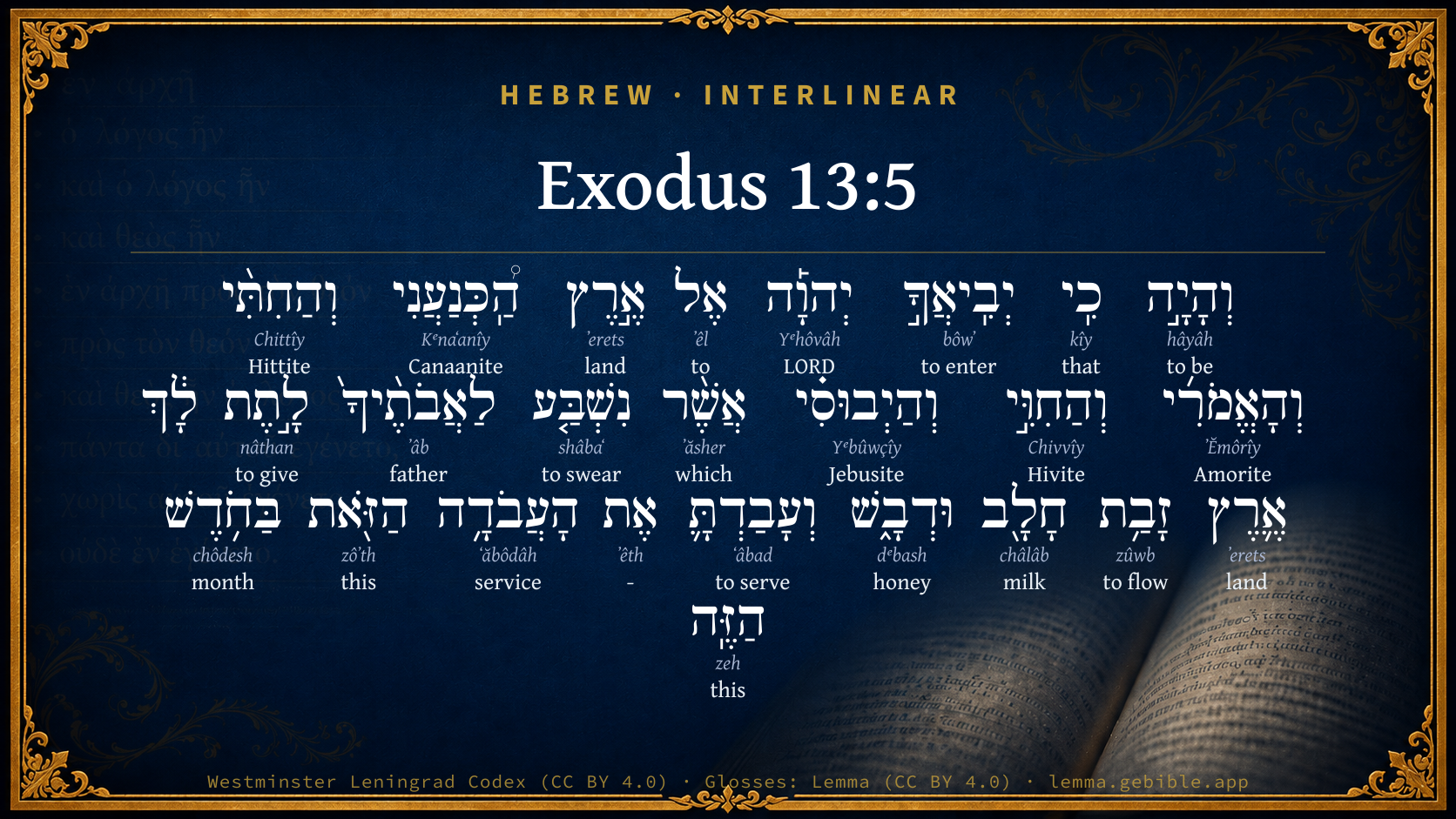
Hebrew (Westminster Leningrad Codex) Exodus 13:5 appears in the Hebrew Old Testament. The text above is from the Westminster Leningrad Codex. Each word links to its Strong’s number, a concise gloss, and parsing drawn from the Open Scriptures Hebrew Bible morphology. Click any word for its full Brown-Driver-Briggs (BDB) entry.
Download image
Cite this verse

Exodus 13:5 (World English Bible). Public Domain. Lemma interlinear Bible study tool, https://lemma.gebible.app/v/exodus/13/5.

Show BibTeX & RIS
BibTeX
RIS
English Translation
It shall be, when Yahweh shall bring you into the land of the Canaanite, and the Hittite, and the Amorite, and the Hivite, and the Jebusite, which he swore to your fathers to give you, a land flowing with milk and honey, that you shall keep this service in this month.
World English Bible · Public Domain
Download a study sheet

One document with this verse’s original text, its word-by-word gloss line, the meaning frame, cross-references with their text, attributed commentary, and full source and license credits — printable, and it pastes into notes with its structure intact.

This verse Autodidact and up

Study sheet (.html) Plain text (.txt)

A passage Seminary Student

Up to 50 verses in one chapter. A passage sheet keeps up to 6 commentary sources and 12 cross-references per verse, in the order this page ranks them, and says so on the sheet whenever that leaves anything out. Ask for a single verse and you get the Autodidact verse sheet above.

Everything on this page stays free to read, with no account — the sheet is a download of what is already on screen, not access to it.

Want to remove ads? Support Godless Engineer
Compare translations 3

The same verse in 3 English versions, stacked beneath the original-language interlinear above. Click any original word for its lexicon entry.

Each is an independent rendering of the whole verse — the interlinear is not word-aligned to these translations.

Highlighted words mark where these versions differ — a whole-verse word diff, not a word-by-word alignment.

  • World English Bible Public Domain
    It shall be, when Yahweh shall bring you into the land of the Canaanite, and the Hittite, and the Amorite, and the Hivite, and the Jebusite, which he swore to your fathers to give you, a land flowing with milk and honey, that you shall keep this service in this month.
  • King James Version Public Domain
    And it shall be when the LORD shall bring thee into the land of the Canaanites, and the Hittites, and the Amorites, and the Hivites, and the Jebusites, which he sware unto thy fathers to give thee, a land flowing with milk and honey, that thou shalt keep this service in this month.
  • unfoldingWord Literal Text CC BY-SA 4.0
    And it will be that Yahweh will bring you to the land of the Canaanite and the Hittite and the Amorite and the Hivite and the Jebusite, which he swore to your fathers to give to you, a land flowing with milk and honey—and you shall serve this service in this month.

unfoldingWord Literal Text — © unfoldingWord, licensed CC BY-SA 4.0. Word-aligned USFM3 via Door43 (git.door43.org/unfoldingWord/en_ult).

Versions to compare (up to 4)

3 of 4 selected

Show all 18 translations

Every available English version of this verse, each an independent rendering of the whole verse.

  • World English Bible Public Domain
    It shall be, when Yahweh shall bring you into the land of the Canaanite, and the Hittite, and the Amorite, and the Hivite, and the Jebusite, which he swore to your fathers to give you, a land flowing with milk and honey, that you shall keep this service in this month.
  • Berean Standard Bible Public Domain
    And when the LORD brings you into the land of the Canaanites, Hittites, Amorites, Hivites, and Jebusites—the land He swore to your fathers that He would give you, a land flowing with milk and honey—you shall keep this service in this month.
  • Majority Standard Bible Public Domain
    And when the LORD brings you into the land of the Canaanites, Hittites, Amorites, Hivites, and Jebusites—the land He swore to your fathers that He would give you, a land flowing with milk and honey—you shall keep this service in this month.
  • King James Version Public Domain
    And it shall be when the LORD shall bring thee into the land of the Canaanites, and the Hittites, and the Amorites, and the Hivites, and the Jebusites, which he sware unto thy fathers to give thee, a land flowing with milk and honey, that thou shalt keep this service in this month.
  • American Standard Version (1901) Public Domain
    And it shall be, when Jehovah shall bring thee into the land of the Canaanite, and the Hittite, and the Amorite, and the Hivite, and the Jebusite, which he sware unto thy fathers to give thee, a land flowing with milk and honey, that thou shalt keep this service in this month.
  • Revised Version (1885) Public Domain
    And it shall be when the LORD shall bring thee into the land of the Canaanite, and the Hittite, and the Amorite, and the Hivite, and the Jebusite, which he sware unto thy fathers to give thee, a land flowing with milk and honey, that thou shalt keep this service in this month.
  • Geneva Bible (1599) Public Domain
    Now when the Lord hath brought thee into the land of the Canaanites, and Hittites, and Amorites, and Hiuites, and Iebusites (which he sware vnto thy fathers, that he woulde giue thee, a land flowing with milke and honie) then thou shalt keepe this seruice in this moneth.
  • Douay-Rheims (1899) Public Domain
    And when the Lord shall have brought thee into the land of the Chanaanite, and the Hethite, and the Amorrhite, and the Hevite, and the Jebusite, which he swore to thy fathers that he would give thee, a land that floweth with milk and honey, thou shalt celebrate this manner of sacred rites in this month.
  • Young's Literal Translation Public Domain
    `And it hath been, when Jehovah bringeth thee in unto the land of the Canaanite, and of the Hittite, and of the Amorite, and of the Hivite, and of the Jebusite, which He hath sworn to thy fathers to give to thee, a land flowing with milk and honey, that thou hast done this service in this month.
  • Literal Standard Version CC BY-SA 4.0
    And it has been, when YHWH brings you to the land of the Canaanite, and of the Hittite, and of the Amorite, and of the Hivite, and of the Jebusite, which He has sworn to your fathers to give to you, a land flowing with milk and honey, that you have done this service in this month.
  • Unlocked Literal Bible CC BY-SA 4.0
    When Yahweh brings you into the land of the Canaanites, Hittites, Amorites, Hivites, and the Jebusites, the land that he swore to your ancestors to give you, a land flowing with milk and honey—then you must observe this act of worship in this month.
  • unfoldingWord Literal Text CC BY-SA 4.0
    And it will be that Yahweh will bring you to the land of the Canaanite and the Hittite and the Amorite and the Hivite and the Jebusite, which he swore to your fathers to give to you, a land flowing with milk and honey—and you shall serve this service in this month.
  • Darby Bible Public Domain
    And it shall be when Jehovah hath brought thee into the land of the Canaanite and the Hittite and the Amorite and the Hivite and the Jebusite, which he swore to thy fathers to give thee, a land flowing with milk and honey, that thou shalt keep this service in this month.
  • World Messianic Bible Public Domain
    It shall be, when the LORD brings you into the land of the Canaanite, and the Hittite, and the Amorite, and the Hivite, and the Jebusite, which he swore to your fathers to give you, a land flowing with milk and honey, that you shall keep this service in this month.
  • Webster's Bible Public Domain
    And it shall be when the LORD shall bring thee into the land of the Canaanites, and the Hittites, and the Amorites, and the Hivites, and the Jebusites, which he swore to thy fathers to give thee, a land flowing with milk and honey; that thou shalt keep this service in this month.
  • Free Bible Version CC BY-SA 4.0
    The Lord is going to take you into the land of the Canaanites, Hittites, Amorites, Hivites, and Jebusites, the land he promised your forefathers he would give you, a land flowing with milk and honey. So you are to observe this ceremony in this month.
  • Bible in Basic English Public Domain
    And it will be that, when the Lord takes you into the land of the Canaanite and the Hittite and the Amorite and the Hivite and the Jebusite, the land which he made an oath to your fathers that he would give you, a land flowing with milk and honey, you will do this act of worship in this month.
  • JPS Tanakh (1917) Public Domain
    And it shall be when the LORD shall bring thee into the land of the Canaanite, and the Hittite, and the Amorite, and the Hivite, and the Jebusite, which He swore unto thy fathers to give thee, a land flowing with milk and honey, that thou shalt keep this service in this month.

Literal Standard Version (2020), Covenant Press — licensed CC BY-SA 4.0. Text via the HelloAO Bible API (eBible.org). Unlocked Literal Bible (unfoldingWord) — licensed CC BY-SA 4.0. Text via the HelloAO Bible API (eBible.org). unfoldingWord Literal Text — © unfoldingWord, licensed CC BY-SA 4.0. Word-aligned USFM3 via Door43 (git.door43.org/unfoldingWord/en_ult). Free Bible Version, Dr. Jonathan Gallagher — licensed CC BY-SA 4.0. Text via the HelloAO Bible API (eBible.org).

Word by word

More ways to search: Search by grammar → Find every occurrence → Compare this word →

Practice this passage: Drill this verse → Learn its vocabulary →

וְהַחִוִּ֣י
Chivvîy
H2340
“and · the · Hivite”
Conjunction + Particle, Definite Article + Noun, Gentilic, Masculine, Singular, Absolute
Part of Speech
Conjunction + Particle + Noun
Type
Gentilic
Gender
Masculine
Number
Singular
State
Absolute
Full BDB Definition

Origin: perhaps from H2333

TWOT: None

Hivite = "villagers" - 6th generation of descendants of Canaan, the son of Ham, who were living in northern Canaan near Mount Hermon at the time of the conquest
  1. וְהָיָ֣ה hâyâh H1961 “and · to be” Conjunction + Verb, Qal, Sequential Perfect, 3rd Person, Masculine, Singular
  2. כִֽי kîy H3588 “that” Conjunction
  3. יְבִֽיאֲךָ֣ bôwʼ H935 “to enter · you” Verb, Hiphil, Imperfect, 3rd Person, Masculine, Singular + Suffix, Personal, 2nd Person, Masculine, Singular
  4. יְהוָ֡ה Yᵉhôvâh H3068 “LORD” Noun, Proper
  5. אֶל ʼêl H413 “to” Preposition
  6. אֶ֣רֶץ ʼerets H776 “land of” Noun, Common, Both, Singular, Construct
  7. הַֽ֠כְּנַעֲנִי Kᵉnaʻanîy H3669 “the · Canaanite” Particle, Definite Article + Noun, Gentilic, Masculine, Singular, Absolute
  8. וְהַחִתִּ֨י Chittîy H2850 “and · the · Hittite” Conjunction + Particle, Definite Article + Noun, Gentilic, Masculine, Singular, Absolute
  9. וְהָאֱמֹרִ֜י ʼĔmôrîy H567 “and · the · Amorite” Conjunction + Particle, Definite Article + Noun, Gentilic, Masculine, Singular, Absolute
  10. וְהַיְבוּסִ֗י Yᵉbûwçîy H2983 “and · the · Jebusite” Conjunction + Particle, Definite Article + Noun, Gentilic, Masculine, Singular, Absolute
  11. אֲשֶׁ֨ר ʼăsher H834 “which” Particle, Relative
  12. נִשְׁבַּ֤ע shâbaʻ H7650 “to swear” Verb, Niphal, Perfect, 3rd Person, Masculine, Singular
  13. לַאֲבֹתֶ֨יךָ֙ ʼâb H1 “to/for · fathers · your” Preposition + Noun, Common, Masculine, Plural, Construct + Suffix, Personal, 2nd Person, Masculine, Singular
  14. לָ֣תֶת nâthan H5414 “to give” Preposition + Verb, Qal, Infinitive Construct
  15. אֶ֛רֶץ ʼerets H776 “land” Noun, Common, Both, Singular, Absolute
  16. זָבַ֥ת zûwb H2100 “flowing” Verb, Qal, Participle Active, Feminine, Singular, Construct
  17. חָלָ֖ב châlâb H2461 “milk” Noun, Common, Masculine, Singular, Absolute
  18. וּדְבָ֑שׁ dᵉbash H1706 “and · honey” Conjunction + Noun, Common, Masculine, Singular, Absolute
  19. וְעָבַדְתָּ֛ ʻâbad H5647 “and · to serve” Conjunction + Verb, Qal, Sequential Perfect, 2nd Person, Masculine, Singular
  20. אֶת ʼêth H853 “-” Particle, Direct Object
  21. הָעֲבֹדָ֥ה ʻăbôdâh H5656 “the · service” Particle, Definite Article + Noun, Common, Feminine, Singular, Absolute
  22. הַזֹּ֖את zôʼth H2063 “the · this” Particle, Definite Article + Pronoun, Demonstrative, Feminine, Singular
  23. בַּחֹ֥דֶשׁ chôdesh H2320 “in/at the · month” Preposition, Determined + Noun, Common, Masculine, Singular, Absolute
  24. הַזֶּֽה zeh H2088 “the · this” Particle, Definite Article + Pronoun, Demonstrative, Masculine, Singular

About this verse

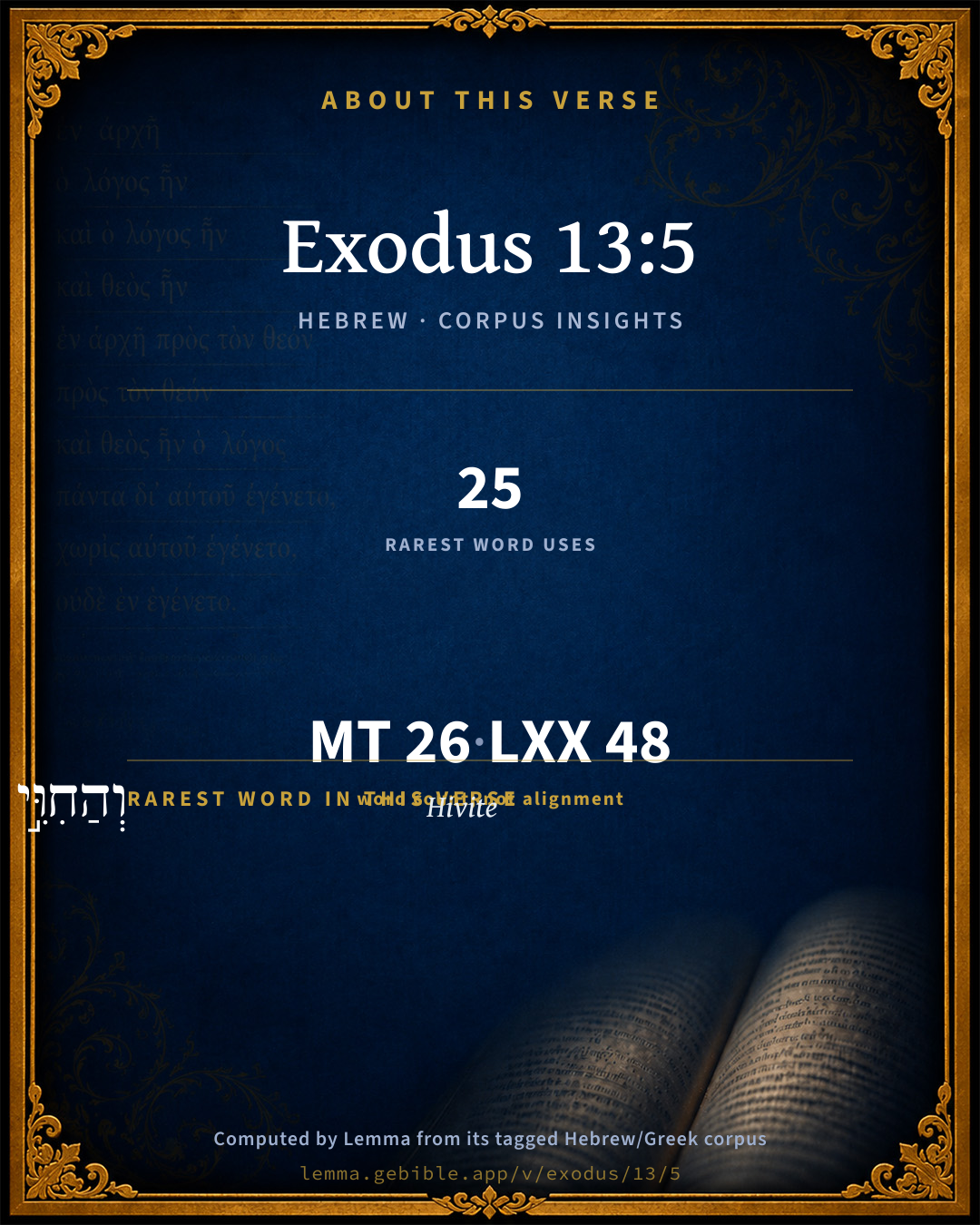
These counts appear in no published source. They are computed here, from the morphology-tagged text and Lemma’s own curated glosses. What Lemma adds →

26
words
24
distinct lemmas
Pentateuch
section

Notable vocabulary

The rarest word here is וְהַחִוִּ֣י Hivite H2340 — appearing just 25 times in the whole Hebrew Bible.

Shared distinctive vocabulary

וְהַחִוִּ֣י Hivite H2340 occurs in 25 verses of the Hebrew Bible. Also found in:

Grammatical profile

  • 6 verbs
  • 13 nouns
  • 2 pronouns
  • 2 prepositions
  • 1 conjunction
  • 2 particles

Verb forms

  • וְהָיָ֣ה Qal · Sequential Perfect
  • יְבִֽיאֲךָ֣ Hiphil · Imperfect
  • נִשְׁבַּ֤ע Niphal · Perfect
  • לָ֣תֶת Qal · Infinitive Construct
  • זָבַ֥ת Qal · Participle Active
  • וְעָבַדְתָּ֛ Qal · Sequential Perfect

Repetition

A word recurs within this verse — often emphatic in Hebrew:

  • אֶ֣רֶץ land H776 ×2

Hebrew & Septuagint length

In English translation the verse runs 51 words from the Hebrew and 59 from the Septuagint (LXX English) — closely comparable.

A rough comparison of the two English renderings, which tokenize alike — not a word-level alignment.

Word counts can differ between the Hebrew and the Greek without any difference in meaning — e.g. the Hebrew direct-object marker אֵת has no separate Greek word, and Greek often adds the article ὁ.

In the original languages it is 26 Hebrew tokens and 48 Greek tokens — but the two are counted differently (Hebrew bundles its prefixes and suffixes into one token; the Greek is in lemma form), so that isn’t a like-for-like length.

Cross-references

19

Topical passages linked to Exodus 13:5 in the Treasury of Scripture Knowledge — connected by theme and wording, ordered by reader-vote popularity; previews shown in the World English Bible.

  • Exodus 3:8 I have come down to deliver them out of the hand of the Egyptians, and to bring them up out of that land to a good and large land, to a land flowing with milk and honey; to the place of the Canaanite, the Hittite, the Amorite, the Perizzite, the Hivite, and the Jebusite.
  • Joshua 24:11 You went over the Jordan, and came to Jericho: and the men of Jericho fought against you, the Amorite, and the Perizzite, and the Canaanite, and the Hittite, and the Girgashite, the Hivite, and the Jebusite; and I delivered them into your hand.
  • Exodus 6:8 I will bring you into the land which I swore to give to Abraham, to Isaac, and to Jacob; and I will give it to you for a heritage: I am Yahweh.'"
  • Exodus 12:25–26 It shall happen when you have come to the land which Yahweh will give you, according as he has promised, that you shall keep this service.
  • Exodus 3:17 and I have said, I will bring you up out of the affliction of Egypt to the land of the Canaanite, the Hittite, the Amorite, the Perizzite, the Hivite, and the Jebusite, to a land flowing with milk and honey."'
  • Exodus 34:11 Observe that which I command you this day. Behold, I drive out before you the Amorite, the Canaanite, the Hittite, the Perizzite, the Hivite, and the Jebusite.
  • Genesis 15:18–21 In that day Yahweh made a covenant with Abram, saying, "To your seed have I given this land, from the river of Egypt to the great river, the river Euphrates:
  • Deuteronomy 26:1 It shall be, when you are come in to the land which Yahweh your God gives you for an inheritance, and possess it, and dwell therein,
  • Genesis 17:7–8 I will establish my covenant between me and you and your seed after you throughout their generations for an everlasting covenant, to be a God to you and to your seed after you.
  • Genesis 22:16–18 and said, "I have sworn by myself, says Yahweh, because you have done this thing, and have not withheld your son, your only son,
  • Genesis 26:3 Sojourn in this land, and I will be with you, and will bless you. For to you, and to your seed, I will give all these lands, and I will establish the oath which I swore to Abraham your father.
  • Genesis 50:24 Joseph said to his brothers, "I am dying, but God will surely visit you, and bring you up out of this land to the land which he swore to Abraham, to Isaac, and to Jacob."
  • Exodus 33:1 Yahweh spoke to Moses, "Depart, go up from here, you and the people that you have brought up out of the land of Egypt, to the land of which I swore to Abraham, to Isaac, and to Jacob, saying, 'I will give it to your seed.'
  • Numbers 14:16 Because Yahweh was not able to bring this people into the land which he swore to them, therefore he has slain them in the wilderness.
  • Numbers 14:30 surely you shall not come into the land, concerning which I swore that I would make you dwell therein, save Caleb the son of Jephunneh, and Joshua the son of Nun.
  • Numbers 32:11 Surely none of the men who came up out of Egypt, from twenty years old and upward, shall see the land which I swore to Abraham, to Isaac, and to Jacob; because they have not wholly followed me:
  • Deuteronomy 7:1 When Yahweh your God shall bring you into the land where you go to possess it, and shall cast out many nations before you, the Hittite, and the Girgashite, and the Amorite, and the Canaanite, and the Perizzite, and the Hivite, and the Jebusite, seven nations greater and mightier than you;
  • Deuteronomy 12:29 When Yahweh your God shall cut off the nations from before you, where you go in to dispossess them, and you dispossess them, and dwell in their land;
  • Deuteronomy 19:1 When Yahweh your God shall cut off the nations, whose land Yahweh your God gives you, and you succeed them, and dwell in their cities, and in their houses;

Cross-references courtesy of OpenBible.info (CC BY 4.0).

Hebrew and Greek witnesses Masoretic Hebrew ↔ Greek Septuagint

The same verse in the two great witnesses to the Old Testament, shown verse-for-verse.

These are two independent witnesses, not word-aligned to each other, and the Septuagint is shown in lemma (dictionary) form.

Hebrew Exodus 13:5 Masoretic · Westminster Leningrad Codex

וְהָיָ֣ה כִֽי יְבִֽיאֲךָ֣ יְהוָ֡ה אֶל אֶ֣רֶץ הַֽ֠כְּנַעֲנִי וְהַחִתִּ֨י וְהָאֱמֹרִ֜י וְהַחִוִּ֣י וְהַיְבוּסִ֗י אֲשֶׁ֨ר נִשְׁבַּ֤ע לַאֲבֹתֶ֨יךָ֙ לָ֣תֶת לָ֔ךְ אֶ֛רֶץ זָבַ֥ת חָלָ֖ב וּדְבָ֑שׁ וְעָבַדְתָּ֛ אֶת הָעֲבֹדָ֥ה הַזֹּ֖את בַּחֹ֥דֶשׁ הַזֶּֽה

It shall be, when Yahweh shall bring you into the land of the Canaanite, and the Hittite, and the Amorite, and the Hivite, and the Jebusite, which he swore to your fathers to give you, a land flowing with milk and honey, that you shall keep this service in this month.

World English Bible · Public Domain

Greek LXX Exodus 13:5 Septuagint · lemma form

καί εἰμί ἡνίκα ἐάν εἰςἄγω σύ κύριος ὁ θεός σύ εἰς ὁ γῆ ὁ χαναναῖος καί χετταῖος καί ευαῖος καί γεργεσαῖος καί ἀμορραῖος καί φερεζαῖος καί ιεβουσαῖος ὅς ὄμνυμι ὁ πατήρ σύ δίδωμι σύ γῆ ῥέω γάλα καί μέλι καί ποιέω ὁ λατρεία οὗτος ἐν ὁ μήν οὗτος

And it shall come to pass when the Lord your God shall have brought you into the land of the Chananites, and the Chettites, and Amorites, and Evites, and Jebusites, and Gergesites, and Pherezites, which he swore to your fathers to give you, a land flowing with milk and honey, that you shall perform this service in this month.

LXX2012 (modern English Septuagint) · Public Domain

On this verse, John Gill's Exposition discusses the Septuagint’s reading. Read the note in Commentary ↓

Hebrew: Westminster Leningrad Codex (CC BY 4.0). Greek: Septuagint (public domain); English from LXX2012 (modern English Septuagint) (Public Domain). How the Septuagint differs from the Hebrew →

Targum (Aramaic paraphrase)

2

The Targum is the ancient Jewish Aramaic paraphrase of the Hebrew Scriptures — an interpretive translation, not the Hebrew text itself. Onkelos (literal) and Pseudo-Jonathan (expansive) render the Torah, and Jonathan the Prophets. Coverage is partial: where no permissively-licensed English translation exists for a verse, only the Aramaic is shown. This is verse-level text, not a word-by-word alignment to the Hebrew.

  1. Targum Onkelos Torah (Genesis–Deuteronomy)
    וִיהֵי אֲרֵי יָעֵלִנָךְ יְיָ לְאַרְעָא דִכְנַעֲנָאֵי וְחִתָּאֵי וֶאֱמוֹרָאֵי וְחִוָאֵי וִיבוּסָאֵי דִי קַיִים לַאֲבָהָתָךְ לְמִתַּן לָךְ אַרְעָא עַבְדָא חֲלָב וּדְבָשׁ וְתִפְלַח יָת פָּלְחָנָא הָדָא בְּיַרְחָא הָדֵין:

    (no public-domain English translation for this verse)

    Targum Onkelos — Aramaic: “Onkelos Genesis” (public domain); “Onkelos Exodus” (public domain); “Onkelos Leviticus” (public domain); “Onkelos Numbers” (public domain); “Onkelos Deuteronomy” (public domain). English: “Sefaria Community Translation” (CC0 1.0 (public-domain dedication)); “J.W. Etheridge. The Targums of Onkelos and Jonathan Ben Uzziel on the Pentateuch. London: Longmans, Green, 1862” (public domain). Text via Sefaria.

  2. Targum Pseudo-Jonathan Torah (Genesis–Deuteronomy)
    וִיהֵי אֲרוּם יֵיעָלִינָךְ יְיָ אֱלָהָךְ לְאַרַע כְּנַעֲנָאֵי חִיתָּאֵי וְאֵימוֹרָאֵי וְחִיוָאֵי וִיבוּסָאֵי דְּקַיֵּים בְּמֵימְרֵיהּ וּלְאַבְהָתָךְ לְמִיתַּן לָךְ אַרְעָא עַבְדָא חֲלָב וּדְבָשׁ וְתִפְלַח יַת פּוּלְחָנָא הָדָא בְּיַרְחָא הָדֵין

    And it shall be, when the Lord your God shall have brought you into the land of the Kenaanaee, and Hittaee, and Amoraee, and Hivaee, and Jebusaee, which He sware by His Word unto Abraham to give thee, a land producing milk and honey, that thou shalt keep this service in this month.

    Targum Pseudo-Jonathan — Aramaic: “Targum Jonathan on Genesis” (public domain); “Targum Jonathan on Exodus” (public domain); “Targum Jonathan on Leviticus” (public domain); “Targum Jonathan on Numbers” (public domain); “Targum Jonathan on Deuteronomy” (public domain). English: “The Targum of Jonathan ben Uzziel, trans. J. W. Etheridge, London, 1862” (public domain). Text via Sefaria.

Commentary

Notes on Exodus 13:5 from classic Christian and Jewish commentators (each source and its license shown beneath its notes). The classic Christian expositions comment on the surrounding passage and are grouped to its opening verse, so a note may address several verses; the Jewish commentaries on the Tanakh (Rashi and others) are per-verse, so they appear only where the commentator wrote on this verse.

Lemma curates 59 commentaries, every one of them public domain or Creative Commons licensed, each selected and text-cleaned for this edition rather than reprinted as found. About our sources →

Trapp's Complete Commentary

John Trapp

Exo 13:5 And it shall be when the LORD shall bring thee into the land of the Canaanites, and the Hittites, and the Amorites, and the Hivites, and the Jebusites, which he sware unto thy fathers to give thee, a land flowing with milk and honey, that thou shalt keep this service in this month.

Ver. 5. A land flowing with milk and honey.] Where fulness may breed forgetfulness, saturity, security.

John Trapp, A Commentary or Exposition upon All the Books of the Old and New Testament (1647–1656) — public domain. Text from a community e-Sword module.

The Biblical Illustrator

Joseph S. Exell

Exo_13:5-7

Keep this service.

The ordinances of the Lord

I. That the ordinances of the Lord must be observed in the times of prosperity (Exo_13:5).

II. That the ordinances of the Lord must be observed with true intelligence (Exo_13:8-9).

III. That the ordinances of the Lord must be observed with parental solicitude. God has appointed the family the moral nursery of the young. Lessons:

1. To attend to all the ordinances of the Lord.

2. To attend to them at the most appropriate time.

3. To attend to them in right spirit and temper. (J. S. Exell, M. A.)

The Biblical Illustrator, edited by Joseph S. Exell (c. 1880s–1900s) — public domain. Text from a community e-Sword module.

Joseph Benson's Commentary

Exo 13:5. When the Lord shall bring you into the land, thou shalt keep this service — Until then they were not obliged to keep the passover, without a particular command from God. There shall no leavened bread be seen in all thy quarters — Accordingly the Jews’ usage was, before the feast of the passover, to cast all the leavened bread out of their houses; either they burned it, or buried it, or broke it small, and threw it into the wind; they searched diligently with lighted candles in all the corners of their houses, lest any leaven should remain. The strictness enjoined in this matter was designed, 1st, To make the feast the more solemn, and consequently the more taken notice of by the children, who would ask, Why is so much ado made? 2d, To teach us how solicitous we should be to put away from us all sin.

Joseph Benson's Commentary on the Old and New Testaments (1811–1818) — public domain. Text from a community e-Sword module.

Tyndale Open Study Notes

Tyndale Open Resources

13:5 A land flowing with milk and honey refers to a land that was agriculturally rich, where there was pasturage for cattle and crops with blooms from which bees could make honey.

Tyndale Open Study Notes — © Tyndale Open Resources, licensed CC BY-SA 4.0. Text via the HelloAO Bible API.

Jamieson, Fausset & Brown

Robert Jamieson, A. R. Fausset & David Brown

when the Lord shall bring thee--The passover is here instituted as a permanent festival of the Israelites. It was, however, only a prospective observance; we read of only one celebration of the passover during the protracted sojourn in the wilderness [Num 9:5]; but on their settlement in the promised land, the season was hallowed as a sacred anniversary [Jos 5:10], in conformity with the directions here given.

Jamieson, Fausset & Brown — Commentary Critical and Explanatory on the Whole Bible (1871) — public domain (CC PDM 1.0). Text via the HelloAO Bible API.

Adam Clarke's Commentary

Verse 5. When the Lord shall bring thee into the land] Hence it is pretty evident that the Israelites were not obliged to celebrate the Passover, or keep the feast of unleavened bread, till they were brought into the promised land.

Adam Clarke's Commentary on the Bible (1810–1826) — public domain. Text from a community e-Sword/MySword module.

Ellicott's Commentary for English Readers

(5) The Canaanites, and the Hittites . . . —The full number of the Canaanitish nations was seven, five of which are here enumerated. The other two were the Perizzites and the Girgashites, which seem to have been the least important. The most important were the Canaanites, Hittites, and Amorites; and these are consequently almost always placed first. At the time of the Exodus, and for many centuries afterwards, the actually most powerful nation would seem to have been that of the Hittites. (See Jos_1:4; 1Ki_10:29; 2Ki_7:6; and compare the Egyptian and Assyrian remains passim.)

A land flowing with milk and honey.—See Note on Exo_3:8.

Thou shalt keep this service.—Kalisch concludes from this verse, and from Exo_12:25, that there was no obligation upon the Israelites to keep the Passover until they obtained possession of Canaan. He holds that two Passovers only were celebrated before that event—one by Moses in the wilderness of Sinai (Num_9:1-5), and the other by Joshua at Gilgal, in the plain of Jericho (Jos_5:10-11).

A Bible Commentary for English Readers, edited by Charles John Ellicott (1878–1897) — public domain. Text from a community e-Sword module.

The Cambridge Bible for Schools and Colleges

gen. ed. J. J. S. Perowne

5. And it shall be, &c.] so v. 11; cf. Deu_6:10; Deu_7:1; Deu_11:29.

the Canaanite, &c., … flowing with milk and honey] See on Exo_3:8.

which he sware, &c.] See Gen_24:7 (cf. Exo_15:18); and comp. the references in Gen_50:24, Exo_13:11; Exo_32:13; Exo_33:1, and constantly a Dt., as Exo_1:8, Exo_6:10; Exo_6:18, &c.

this service] as prescribed in vv. 6, 7.

5–7. How Maẓẓoth is to be kept, after the Israelites have entered Canaan.

The Cambridge Bible for Schools and Colleges (gen. ed. J. J. S. Perowne; Cambridge University Press, 1878–1918) — public domain. Text from a community e-Sword module.

John Gill's Exposition

And it shall be when the Lord shall bring thee into the land of the Canaanites,.... Though the whole land was called the land of Canaan, yet there was one tribe or nation of them particularly so called as here, distinct from those that follow:

and the Hittites, and the Amorites, and the Hivites, and the Jebusites; there were seven nations in all, but two are here omitted, the Girgashites and Perizzites, but they are added in the Septuagint version, see Deu 7:1.

which he swore unto thy fathers to give thee; to Abraham, Isaac, and Jacob; so that they might be assured they would be brought into it, since they had both the word and oath of God for it; and which is the rather mentioned now for their encouragement, since they were at this time set forward in their journey thitherwards:

a land flowing with milk and honey; See Gill on Exo 3:8,

that thou shalt keep this service in this month; the month of Abib; that is, the following service concerning unleavened bread; it is concluded from hence by some, that those laws concerning the passover, and eating unleavened bread, and sanctifying the firstborn, did not oblige the Israelites, while in the wilderness, only when they came into the land of Canaan; and it seems pretty clear that this was the case with respect to the two latter, but not the former, since it is certain they did keep the passover in the wilderness, and were obliged to it, Num 9:1 but then it may be observed, that there is no mention there of their keeping the feast of unleavened bread, only of the passover, as here no mention is made of the feast of the passover, which, though they followed one another, were, two distinct feasts.

John Gill's Exposition of the Whole Bible (1746–1763) — public domain (CC PDM 1.0). Text via the HelloAO Bible API.

Albert Barnes' Notes on the Bible

The Canaanites - Five nations only are named in this passage, whereas six are named in Exo 3:8, and ten in the original promise to Abraham, Gen 15:19-21. The first word “Canaanite” is generic, and includes all the Hamite races of Palestine.

Albert Barnes' Notes on the Bible (1834–1885) — public domain. Text from a community e-Sword/MySword module.

Haydock's Catholic Bible Commentary

When. These regulations did not therefore take place in the desert. (Menochius)

George Leo Haydock (1774–1849), Haydock's Catholic Family Bible and Commentary, 1859 edition — public domain. Excludes Psalms (Douay-Rheims chapter numbering differs from Protestant) and Deuterocanonical books (Catholic canon only).

Matthew Poole's English Annotations

This service; which is spoken of before, and in the following verses. From this place it is evident the Israelites were not obliged to this service in the wilderness without a particular command from God. See Deu 12:1,9.

Matthew Poole's English Annotations on the Holy Bible (1683–1685) — public domain. Text from a community e-Sword/MySword module.

The Pulpit Commentary

The land of the Canaanites, etc. Compare Exo_3:8, Exo_3:17. The six nations of these passages are reduced here to five by the omission of the Perizzites, one of the less important tribes. Which he sware unto thy fathers to give thee . See Gen_15:18 Gen_24:7; and compare the comment on Exo_6:8. That thou shalt keep this service. This injunction had been already given (Exo_12:25) almost in the same words; but on the former occasion it was delivered to the elders only; now it is laid upon the whole people.

The Pulpit Commentary (1880–1919), ed. H.D.M. Spence-Jones & Joseph S. Exell — public domain. Text from a community e-Sword module.

John Wesley's Explanatory Notes

When the Lord shall bring you into the land, thou shalt keep this service - 'Till then they were not obliged to keep the passover, without a particular command from God.

John Wesley, Explanatory Notes Upon the Whole Bible (1754–1765) — public domain. Text via the GEBible commentary corpus.

Rashi

Rabbi Shlomo Yitzchaki (Rashi)

אל ארץ הכנעני וגו׳ TO THE LAND OF THE CANAANITE — And although it enumerates here only the five peoples, all the seven nations are implied (Mekhilta) for all are included in the generic term Canaanite, although there was one of the races of Canaan which had no other name than that of Canaanite (whilst the other races had, beside the generic name Canaanite, some special designation as Hittite etc.: hence under the term Canaanite one may understand either the one race bearing this name or any of the other races. Here, therefore, the introductory word הכנעני alludes to the particular tribe so called and to the two others included in this generic term, or it may allude to three tribes included in the generic term. In either case we get the “seven peoples of Canaan”).

נשבע לאבתיך WHICH HE SWORE UNTO THY FATHERS — In the case of Abraham it says, (Genesis 15:18) “On that day the Lord made a covenant with Abram [saying, To thy seed I will give this land]”; in the case of Isaac it says, (Genesis 26:3) “Sojourn in this land … [for to thee and to thy seed I will give all these countries]”; and in the case of Jacob it says, (Genesis 28:13) “the land wheron thou liest [to thee will I give it and to thy seed]” (Mekhilta).

זבת חלב ודבש FLOWING WITH MILK AND HONEY — milk flows from the goats and honey flows from the dates and from the figs.

את העבודה הזאת THIS SERVICE — that of the Paschal offering. But has it not already been said above, (Exodus 12:25) “And it shall come to pass when ye be come into the land … [that ye shall keep this service]”? Why then does it repeat it again? On account of a new matter that is introduced here; viz., in the former chapter it says, (v. 26) “And it shall come to pass when your children shall say unto you, What mean ye by this service?” and there Scripture is speaking about a wicked son who excludes himself from the Israelite community (by saying ye, as though he does not wish to participate in the service), whilst here it states, (v. 8) “And thou shalt tell thy son”, referring to a son who does not know how to enquire, and Scripture teaches you that you yourself must open up the conversation with Agadic explanations which attract the heart (cf. Mekhilta; Shabbat 87a).

Rashi on the Tanakh — English translations: “The Judaica Press complete Tanach with Rashi, translated by A. J. Rosenberg” (CC BY 4.0); “Pentateuch with Rashi's commentary by M. Rosenbaum and A.M. Silbermann, 1929-1934” (public domain); “The Metsudah Tanach series, Lakewood, N.J” (CC BY 4.0); and “The Book of Joshua, Metsudah Publications, 1997” (CC BY 4.0). Text via Sefaria.

Ramban (Nachmanides)

Rabbi Moshe ben Nachman (Ramban / Nachmanides)

AND IT SHALL BE WHEN THE ETERNAL SHALL BRING THEE INTO THE LAND OF THE CANAANITE, AND THE HITTITE, AND THE AMORITE, AND THE HIVITE, AND THE JEBUSITE. “Although it enumerates here only five peoples, all of the seven nations are implied. They are all included in [the generic term] Canaanite although there was one of the races which had no name other than that of Canaanite.” thus refers to the particular nation and to the two other nations, i.e., the Perizzite and the Girgashite, which are not specifically mentioned here, since they are included in the generic name Canaanite. Thus the language of Rashi.It is true that they are all included in [the generic term] Canaanite, for they were all his sons. Therefore when Scripture says, And it shall be when the Eternal shall bring thee into the land of the Canaanite, it alludes to all of the seven nations, and thus everywhere does Scripture make use of the term, “the land of Canaan.” But here, [according to Rashi’s interpretation], there is no reason why Scripture should mention most of them and yet leave some of them included in the term Canaanite!In the opinion of our Rabbis, the land of these five nations mentioned here was a land flowing with milk and honey, but not so the land of the remaining two nations [omitted here]. Therefore He gladdened them only with this land [of the five nations]. Thus the Rabbis taught in the Sifre with respect to first-fruits:, 300. “And He hath given us this land, a land flowing with milk and honey. Just as the land flowing with milk and honey mentioned elsewhere, [i.e., in the verse before us], refers to the land of the five nations, so also the land flowing with milk and honey mentioned here [in the case of the first-fruits] means the land of the five nations. Rabbi Yosei says that first-fruits are not brought from beyond the Jordan since it is not a land flowing with milk and honey.” Thus the land of the two nations, [the Perizzite and the Girgashite], were excluded from the law of first-fruits because theirs is not a land flowing with milk and honey, and for the same reason, Rabbi Yosei also excluded the land beyond the Jordan, which belonged to the Amorite. And the Amorite mentioned here [among the five nations whose land was flowing with milk and honey], is the Amorite who lived in the Land of Israel proper. A text similar [to the one in the Sifre] is found in the Mechilta on this chapter.It is further taught in the Sifre:, 164. “And they, [i.e., all the tribe of Levi], shall have no inheritance — this refers to the inheritance of the five nations; Among their brethren — this refers to the inheritance of the two nations.” The Rabbis [of the Sifre] thus separated these five nations as different, because theirs was the main land which He promised them, for that was the land flowing with milk and honey. And Rashi, in the section of Shoftim V’shotrim, experienced difficulty in explaining this Beraitha. Now according to this opinion [that only the land of the five nations mentioned here was flowing with milk and honey], Scripture stated above, [And I am come down to deliver them… and to bring them up] unto a good and large Land, unto a Land flowing with milk and honey, [and then proceeds to mention the five nations listed here as well as the Perizzite]. However, it does not add the Perizzite there on account of its land flowing with milk and honey, but because it was part of the good and large Land.These are the six nations mentioned everywhere, for the Girgashite, [the seventh nation], emigrated of his own accord, and is not mentioned in the Torah except in the verse: And He shall cast out many nations before thee, the Hittite, and the Girgashite, and the Amorite, and the Canaanite, and the Perizzite, and the Hivite, and the Jebusite, seven nations. This is why He said many nations, [i.e., because all seven are mentioned]. And it is also written: But thou shalt surely destroy them: the Hittite, and the Amorite, the Canaanite, and the Perizzite, the Hivite, and the Jebusite, 20:17. but He did not mention the Girgashite, thus alluding to the fact that he would not war against the Israelites but instead would emigrate of his own accord.

Ramban (Nachmanides) on the Tanakh — English translation: “Commentary on the Torah by Ramban (Nachmanides). Translated and annotated by Charles B. Chavel. New York, Shilo Pub. House, 1971-1976” (CC BY 4.0). Text via Sefaria.

Lesson kit

Teaching starters — assembled from the data on this page, not authored interpretation. Every prompt links to the verse data it draws on. Edit before teaching.

Exodus, in the Pentateuch, opens this verse with 26 words (24 distinct Hebrew lemmas). Its most distinctive word is Chivvîy (“Hivite”). A historical commentator’s framing appears above. Read the whole chapter for the surrounding context.

Discussion questions

  1. The word Chivvîy carries the sense “Hivite.” How does it shape the verse?
  2. How does Genesis 10:17, which shares the word «Hivite», read alongside this verse?
  3. What does the repetition of “land” (2× in this one verse) do in this verse?
  4. These translations render this verse differently; the difference is in the English rendering, not the original. What questions does that raise?
  5. «וְהָיָ֣ה» is a Qal Sequential Perfect verb. How does that grammatical form shape the action described?
  6. Compare how Trapp's Complete Commentary and The Biblical Illustrator read this verse. Where do they agree or differ?

Things to notice

Reading settings

Reading text

Shown beneath each verse's original-language words.

Old Testament
Old Testament edition

Read the OT as the Masoretic Hebrew (MT) or the Greek Septuagint (LXX).

English shown for the Greek Septuagint (in the Hebrew ↔ Greek comparison).

Comparing translations? Open the Compare panel on any verse page to stack up to four side by side.