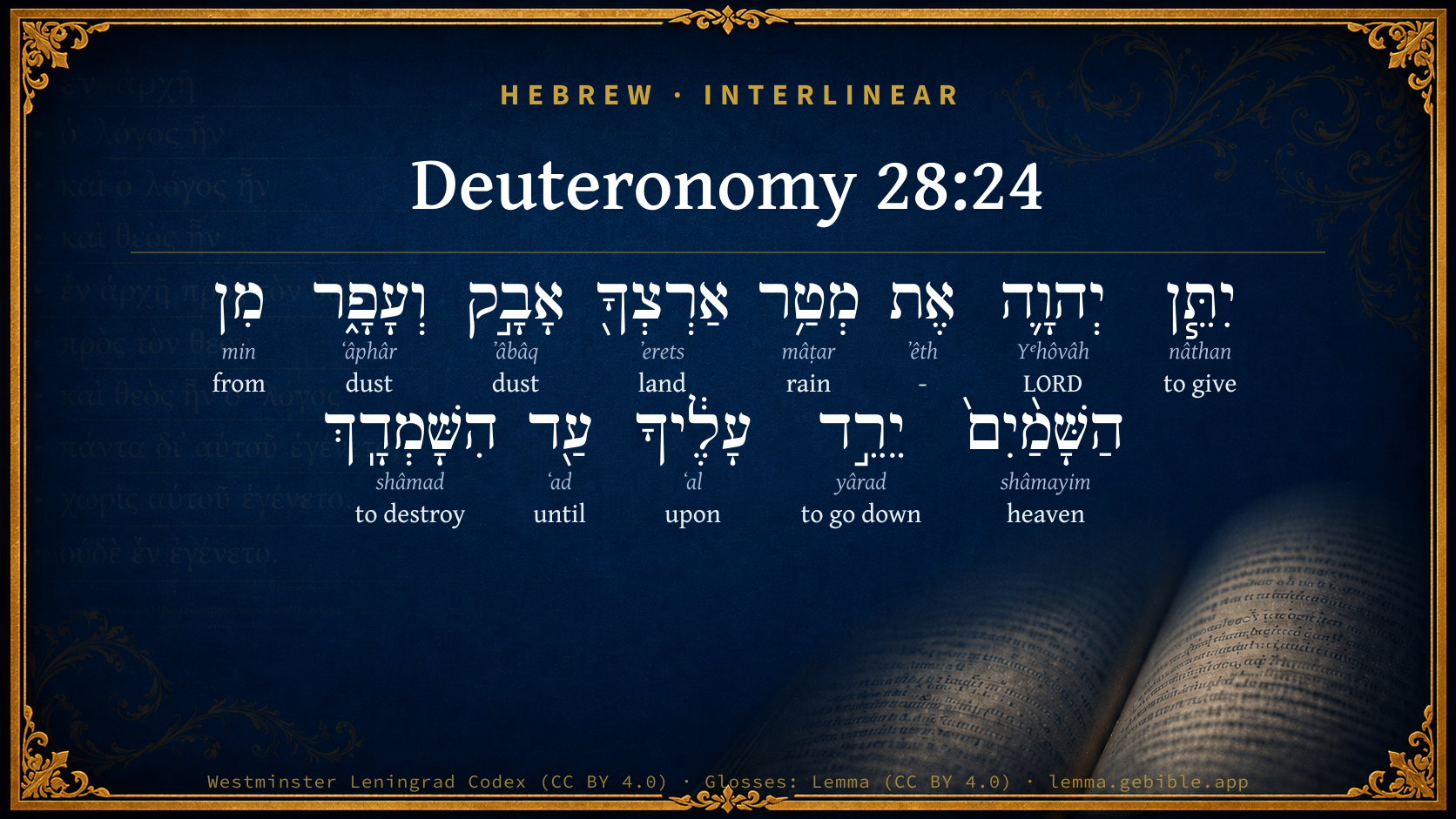
Deuteronomy 28:24

Hebrew (Westminster Leningrad Codex) Deuteronomy 28:24 appears in the Hebrew Old Testament. The text above is from the Westminster Leningrad Codex. Each word links to its Strong’s number, a concise gloss, and parsing drawn from the Open Scriptures Hebrew Bible morphology. Click any word for its full Brown-Driver-Briggs (BDB) entry.
Download image
Cite this verse

Deuteronomy 28:24 (World English Bible). Public Domain. Lemma interlinear Bible study tool, https://lemma.gebible.app/v/deuteronomy/28/24.

Show BibTeX & RIS
BibTeX
RIS
English Translation
Yahweh will make the rain of your land powder and dust: from the sky shall it come down on you, until you are destroyed.
World English Bible · Public Domain
Download a study sheet

One document with this verse’s original text, its word-by-word gloss line, the meaning frame, cross-references with their text, attributed commentary, and full source and license credits — printable, and it pastes into notes with its structure intact.

This verse Autodidact and up

Study sheet (.html) Plain text (.txt)

A passage Seminary Student

Up to 50 verses in one chapter. A passage sheet keeps up to 6 commentary sources and 12 cross-references per verse, in the order this page ranks them, and says so on the sheet whenever that leaves anything out. Ask for a single verse and you get the Autodidact verse sheet above.

Everything on this page stays free to read, with no account — the sheet is a download of what is already on screen, not access to it.

Want to remove ads? Support Godless Engineer
Compare translations 3

The same verse in 3 English versions, stacked beneath the original-language interlinear above. Click any original word for its lexicon entry.

Each is an independent rendering of the whole verse — the interlinear is not word-aligned to these translations.

Highlighted words mark where these versions differ — a whole-verse word diff, not a word-by-word alignment.

  • World English Bible Public Domain
    Yahweh will make the rain of your land powder and dust: from the sky shall it come down on you, until you are destroyed.
  • King James Version Public Domain
    The LORD shall make the rain of thy land powder and dust: from heaven shall it come down upon thee, until thou be destroyed.
  • unfoldingWord Literal Text CC BY-SA 4.0
    Yahweh will allow the rain of your land powder and dust; from the heavens it will come down on you until you are destroyed.

unfoldingWord Literal Text — © unfoldingWord, licensed CC BY-SA 4.0. Word-aligned USFM3 via Door43 (git.door43.org/unfoldingWord/en_ult).

Versions to compare (up to 4)

3 of 4 selected

Show all 18 translations

Every available English version of this verse, each an independent rendering of the whole verse.

  • World English Bible Public Domain
    Yahweh will make the rain of your land powder and dust: from the sky shall it come down on you, until you are destroyed.
  • Berean Standard Bible Public Domain
    The LORD will turn the rain of your land into dust and powder; it will descend on you from the sky until you are destroyed.
  • Majority Standard Bible Public Domain
    The LORD will turn the rain of your land into dust and powder; it will descend on you from the sky until you are destroyed.
  • King James Version Public Domain
    The LORD shall make the rain of thy land powder and dust: from heaven shall it come down upon thee, until thou be destroyed.
  • American Standard Version (1901) Public Domain
    Jehovah will make the rain of thy land powder and dust: from heaven shall it come down upon thee, until thou be destroyed.
  • Revised Version (1885) Public Domain
    The LORD shall make the rain of thy land powder and dust: from heaven shall it come down upon thee, until thou be destroyed.
  • Geneva Bible (1599) Public Domain
    The Lord shall giue thee for the rayne of thy land, dust and ashes: euen from heauen shall it come downe vpon thee, vntil thou be destroyed.
  • Douay-Rheims (1899) Public Domain
    The Lord give thee dust for rain upon thy land, and let ashes come down from heaven upon thee, till thou be consumed.
  • Young's Literal Translation Public Domain
    Jehovah giveth the rain of thy land -- dust and ashes; from the heavens it cometh down on thee till thou art destroyed.
  • Literal Standard Version CC BY-SA 4.0
    YHWH gives dust and ashes [for] the rain of your land; it comes down on you from the heavens until you are destroyed.
  • Unlocked Literal Bible CC BY-SA 4.0
    Yahweh will make the rain of your land into powder and dust; from the heavens will it come down on you, until you are destroyed.
  • unfoldingWord Literal Text CC BY-SA 4.0
    Yahweh will allow the rain of your land powder and dust; from the heavens it will come down on you until you are destroyed.
  • Darby Bible Public Domain
    Jehovah will give as the rain of thy land powder and dust; from the heavens shall it come down upon thee until thou be destroyed.
  • World Messianic Bible Public Domain
    The LORD will make the rain of your land powder and dust. It will come down on you from the sky, until you are destroyed.
  • Webster's Bible Public Domain
    The LORD shall make the rain of thy land powder and dust: from heaven shall it come down upon thee, until thou art destroyed.
  • Free Bible Version CC BY-SA 4.0
    The Lord will change the rain of your land into dust and sand; it will fall from the sky on you until you're destroyed.
  • Bible in Basic English Public Domain
    The Lord will make the rain of your land powder and dust, sending it down on you from heaven till your destruction is complete.
  • JPS Tanakh (1917) Public Domain
    The LORD will make the rain of thy land powder and dust; from heaven shall it come down upon thee, until thou be destroyed.

Literal Standard Version (2020), Covenant Press — licensed CC BY-SA 4.0. Text via the HelloAO Bible API (eBible.org). Unlocked Literal Bible (unfoldingWord) — licensed CC BY-SA 4.0. Text via the HelloAO Bible API (eBible.org). unfoldingWord Literal Text — © unfoldingWord, licensed CC BY-SA 4.0. Word-aligned USFM3 via Door43 (git.door43.org/unfoldingWord/en_ult). Free Bible Version, Dr. Jonathan Gallagher — licensed CC BY-SA 4.0. Text via the HelloAO Bible API (eBible.org).

Word by word

More ways to search: Search by grammar → Find every occurrence → Compare this word →

Practice this passage: Drill this verse → Learn its vocabulary →

אָבָ֣ק
ʼâbâq
H80
“dust”
Noun, Common, Masculine, Singular, Absolute
Part of Speech
Noun
Type
Common
Gender
Masculine
Number
Singular
State
Absolute
Full BDB Definition

Origin: from root of H79

TWOT: 11a

dust - on ground - clouds (figuratively)
  1. יִתֵּ֧ן nâthan H5414 “to give” Verb, Qal, Imperfect, 3rd Person, Masculine, Singular
  2. יְהוָ֛ה Yᵉhôvâh H3068 “LORD” Noun, Proper
  3. אֶת ʼêth H853 “-” Particle, Direct Object
  4. מְטַ֥ר mâṭar H4306 “rain of” Noun, Common, Masculine, Singular, Construct
  5. אַרְצְךָ֖ ʼerets H776 “land · your” Noun, Common, Both, Singular, Construct + Suffix, Personal, 2nd Person, Masculine, Singular
  6. וְעָפָ֑ר ʻâphâr H6083 “and · dust” Conjunction + Noun, Common, Masculine, Singular, Absolute
  7. מִן min H4480 “from” Preposition
  8. הַשָּׁמַ֨יִם֙ shâmayim H8064 “the · heaven(s)” Particle, Definite Article + Noun, Common, Masculine, Plural, Absolute
  9. יֵרֵ֣ד yârad H3381 “to go down” Verb, Qal, Imperfect, 3rd Person, Masculine, Singular
  10. עָלֶ֔יךָ ʻal H5921 “upon · you” Preposition + Suffix, Personal, 2nd Person, Masculine, Singular
  11. עַ֖ד ʻad H5704 “until” Preposition
  12. הִשָּׁמְדָֽךְ shâmad H8045 “to destroy · you” Verb, Niphal, Infinitive Construct + Suffix, Personal, 2nd Person, Feminine, Singular

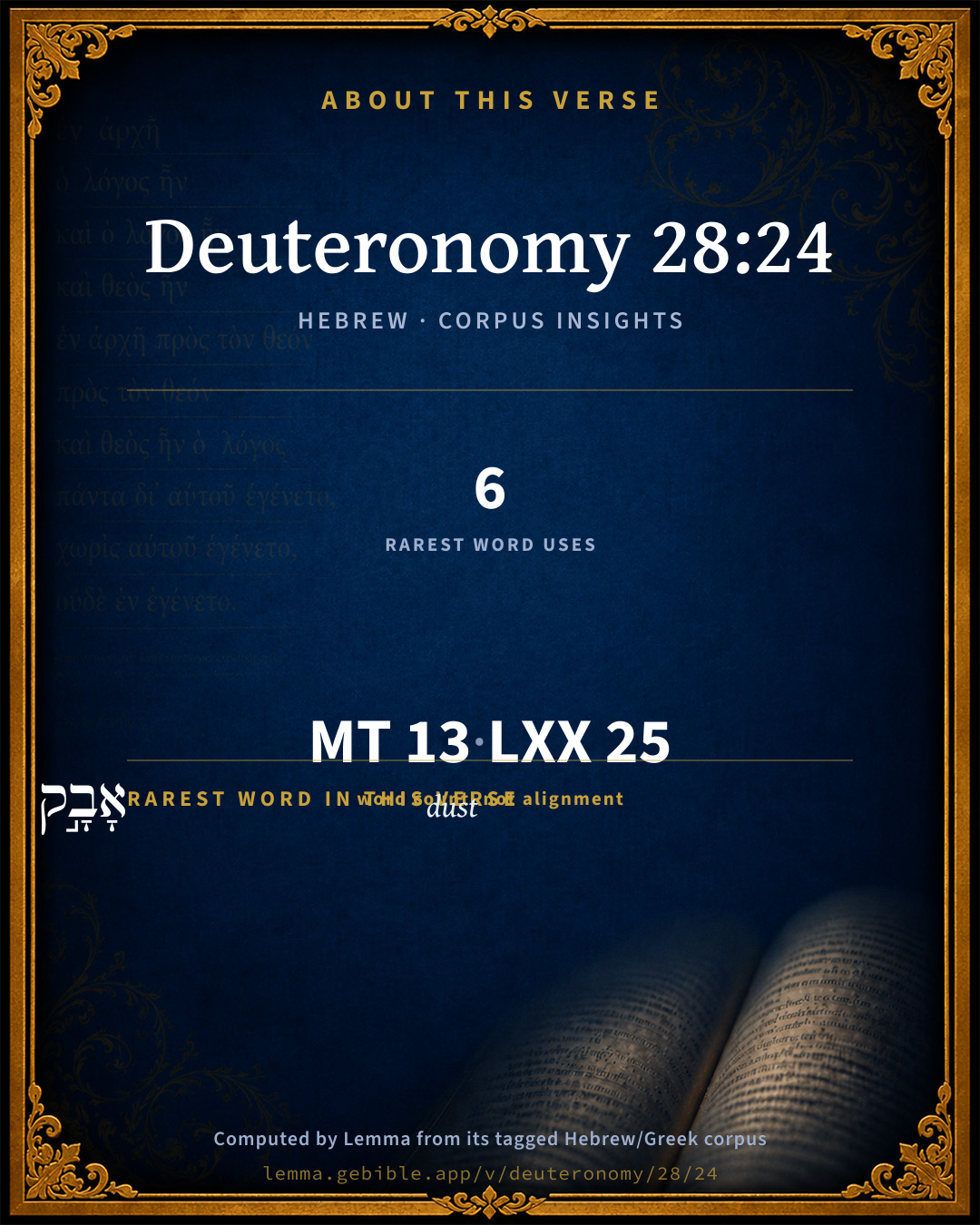
About this verse

These counts appear in no published source. They are computed here, from the morphology-tagged text and Lemma’s own curated glosses. What Lemma adds →

13
words
13
distinct lemmas
Pentateuch
section

Notable vocabulary

The rarest word here is אָבָ֣ק dust H80 — appearing just 6 times in the whole Hebrew Bible.

Shared distinctive vocabulary

אָבָ֣ק dust H80 occurs in 6 verses of the Hebrew Bible. Also found in:

Grammatical profile

  • 3 verbs
  • 6 nouns
  • 3 prepositions
  • 1 particle

Verb forms

  • יִתֵּ֧ן Qal · Imperfect
  • יֵרֵ֣ד Qal · Imperfect
  • הִשָּׁמְדָֽךְ Niphal · Infinitive Construct

Hebrew & Septuagint length

In English translation the verse runs 24 words from the Hebrew and 32 from the Septuagint (LXX English) — closely comparable.

A rough comparison of the two English renderings, which tokenize alike — not a word-level alignment.

Word counts can differ between the Hebrew and the Greek without any difference in meaning — e.g. the Hebrew direct-object marker אֵת has no separate Greek word, and Greek often adds the article ὁ.

In the original languages it is 13 Hebrew tokens and 25 Greek tokens — but the two are counted differently (Hebrew bundles its prefixes and suffixes into one token; the Greek is in lemma form), so that isn’t a like-for-like length.

Cross-references

5

Topical passages linked to Deuteronomy 28:24 in the Treasury of Scripture Knowledge — connected by theme and wording, ordered by reader-vote popularity; previews shown in the World English Bible.

  • Deuteronomy 28:12 Yahweh will open to you his good treasure in the sky, to give the rain of your land in its season, and to bless all the work of your hand: and you shall lend to many nations, and you shall not borrow.
  • Isaiah 5:24 Therefore as the tongue of fire devours the stubble, And as the dry grass sinks down in the flame, So their root shall be as rottenness, And their blossom shall go up as dust; Because they have rejected the law of Yahweh of Hosts, And despised the word of the Holy One of Israel.
  • Amos 4:11 "I have overthrown some of you, As when God overthrew Sodom and Gomorrah, And you were like a burning stick plucked out of the fire; Yet you haven't returned to me," says Yahweh.
  • Job 18:15–21 There shall dwell in his tent that which is none of his. Sulfur shall be scattered on his habitation.
  • Genesis 19:24 Then Yahweh rained on Sodom and on Gomorrah sulfur and fire from Yahweh out of the sky.

Cross-references courtesy of OpenBible.info (CC BY 4.0).

Hebrew and Greek witnesses Masoretic Hebrew ↔ Greek Septuagint

The same verse in the two great witnesses to the Old Testament, shown verse-for-verse.

These are two independent witnesses, not word-aligned to each other, and the Septuagint is shown in lemma (dictionary) form.

Hebrew Deuteronomy 28:24 Masoretic · Westminster Leningrad Codex

יִתֵּ֧ן יְהוָ֛ה אֶת מְטַ֥ר אַרְצְךָ֖ אָבָ֣ק וְעָפָ֑ר מִן הַשָּׁמַ֨יִם֙ יֵרֵ֣ד עָלֶ֔יךָ עַ֖ד הִשָּׁמְדָֽךְ

Yahweh will make the rain of your land powder and dust: from the sky shall it come down on you, until you are destroyed.

World English Bible · Public Domain

Greek LXX Deuteronomy 28:24 Septuagint · lemma form

δίδωμι κύριος ὁ ὑετός ὁ γῆ σύ κονιορτός καί χοῦς ἐκ ὁ οὐρανός καταβαίνω ἐπί σύ ἕως ἄν ἐκτρίβω σύ καί ἕως ἄν ἀποὀλλύω σύ

The Lord your God make the rain of your land dust; and dust shall come down from heaven, until it shall have destroyed you, and until it shall have quickly consumed you.

LXX2012 (modern English Septuagint) · Public Domain

Hebrew: Westminster Leningrad Codex (CC BY 4.0). Greek: Septuagint (public domain); English from LXX2012 (modern English Septuagint) (Public Domain). How the Septuagint differs from the Hebrew →

Targum (Aramaic paraphrase)

2

The Targum is the ancient Jewish Aramaic paraphrase of the Hebrew Scriptures — an interpretive translation, not the Hebrew text itself. Onkelos (literal) and Pseudo-Jonathan (expansive) render the Torah, and Jonathan the Prophets. Coverage is partial: where no permissively-licensed English translation exists for a verse, only the Aramaic is shown. This is verse-level text, not a word-by-word alignment to the Hebrew.

  1. Targum Onkelos Torah (Genesis–Deuteronomy)
    יִתֵּן יְיָ יָת מְטַר אַרְעָךְ אַבְקָא וְעַפְרָא מִן שְׁמַיָא יֵחוּת עֲלָךְ עַד דְתִשְׁתֵּצֵי

    (no public-domain English translation for this verse)

    Targum Onkelos — Aramaic: “Onkelos Genesis” (public domain); “Onkelos Exodus” (public domain); “Onkelos Leviticus” (public domain); “Onkelos Numbers” (public domain); “Onkelos Deuteronomy” (public domain). English: “Sefaria Community Translation” (CC0 1.0 (public-domain dedication)); “J.W. Etheridge. The Targums of Onkelos and Jonathan Ben Uzziel on the Pentateuch. London: Longmans, Green, 1862” (public domain). Text via Sefaria.

  2. Targum Pseudo-Jonathan Torah (Genesis–Deuteronomy)
    יְגָרֵי יְיָ בָּתַר מִטְרִין דְנַחְתִין עַל אַרְעֲכוֹן רוּחָא דְמַסְקָא אַבְקָא וְעַפְרָא עִילַוֵי עִשְבֵּי חַקְלֵיכוֹן מִן שְׁמַיָא יֵחוֹת פּוּרְעָנוּ עֲלֵיכוֹן עַד דְתִשְׁתֵּיצוּן

    After the rain which cometh down on the earth, the Lord will send a wind that shall drive dust and ashes upon the herbage of your fields; and calamity will fall upon you from the heavens, until you are consumed.

    Targum Pseudo-Jonathan — Aramaic: “Targum Jonathan on Genesis” (public domain); “Targum Jonathan on Exodus” (public domain); “Targum Jonathan on Leviticus” (public domain); “Targum Jonathan on Numbers” (public domain); “Targum Jonathan on Deuteronomy” (public domain). English: “The Targum of Jonathan ben Uzziel, trans. J. W. Etheridge, London, 1862” (public domain). Text via Sefaria.

Commentary

Notes on Deuteronomy 28:24 from classic Christian and Jewish commentators (each source and its license shown beneath its notes). The classic Christian expositions comment on the surrounding passage and are grouped to its opening verse, so a note may address several verses; the Jewish commentaries on the Tanakh (Rashi and others) are per-verse, so they appear only where the commentator wrote on this verse.

Lemma curates 59 commentaries, every one of them public domain or Creative Commons licensed, each selected and text-cleaned for this edition rather than reprinted as found. About our sources →

Trapp's Complete Commentary

John Trapp

Deu 28:24 The LORD shall make the rain of thy land powder and dust: from heaven shall it come down upon thee, until thou be destroyed.

Ver. 24. Powder and dust.] Which the wind and other things raise in times of drought.

John Trapp, A Commentary or Exposition upon All the Books of the Old and New Testament (1647–1656) — public domain. Text from a community e-Sword module.

Tyndale Open Study Notes

Tyndale Open Resources

28:24 The only thing even resembling rain would be the swirling dust that coats everything to suffocation.

Tyndale Open Study Notes — © Tyndale Open Resources, licensed CC BY-SA 4.0. Text via the HelloAO Bible API.

Geneva Bible (1599)

Geneva Bible translators

Or, out of the air as dust raised with wind.

Geneva Bible (1599) marginal notes — public domain. Text via Bolls.life.

Jamieson, Fausset & Brown

Robert Jamieson, A. R. Fausset & David Brown

the rain of thy land powder and dust--an allusion probably to the dreadful effects of tornadoes in the East, which, raising the sands in immense twisted pillars, drive them along with the fury of a tempest. These shifting sands are most destructive to cultivated lands; and in consequence of their encroachments, many once fertile regions of the East are now barren deserts.

Jamieson, Fausset & Brown — Commentary Critical and Explanatory on the Whole Bible (1871) — public domain (CC PDM 1.0). Text via the HelloAO Bible API.

Adam Clarke's Commentary

Verse 24. The rain of thy land powder and dust] As their heavens - atmosphere, clouds, c., were to be as brass-yielding no rain so the surface of the earth must be reduced to powder; and this, being frequently taken up by the strong winds, would fall down in showers instead of rain. Whole caravans have been buried under showers of sand; and Thevenot, a French traveller, who had observed these showers of dust, &c., says, "They grievously annoy all they fall on, filling their eyes, ears, nostrils, &c." - Travels in the East, part 1, book ii., chap. 80. The ophthalmia in Egypt appears to be chiefly owing to a very fine sand, the particles of which are like broken glass, which are carried about by the wind, and, entering into the ciliary glands, produce grievous and continual inflammations.

Adam Clarke's Commentary on the Bible (1810–1826) — public domain. Text from a community e-Sword/MySword module.

Ellicott's Commentary for English Readers

(24) Powder and dust.—The great desert, which lies on the eastern frontier of Palestine, makes this only too possible.

A Bible Commentary for English Readers, edited by Charles John Ellicott (1878–1897) — public domain. Text from a community e-Sword module.

The Cambridge Bible for Schools and Colleges

gen. ed. J. J. S. Perowne

24. The Sirocco (Sherḳiyeh), as the present writer has more than once encountered it in Judaea, brings up a fog of dust as dense and fine as a sea-mist, but very destructive. Until thou be destroyed, see Deu_28:20.

The Cambridge Bible for Schools and Colleges (gen. ed. J. J. S. Perowne; Cambridge University Press, 1878–1918) — public domain. Text from a community e-Sword module.

John Gill's Exposition

The Lord will smite thee with the botch of Egypt,.... Which some understand of the leprosy, Of that sort of it called "elephantiasis", frequent among the Egyptians; See Gill on Lev 13:2. Thevenot (i) relates, that when the time of the increase of the Nile expires, the Egyptians are attended with sharp prickings in their skin like needles. So Vansleb says (k),"the waters of the Nile cause an itch in the skin, which troubles such as drink of them when the river increases. This itch is very small, and appears first about the arms, next upon the stomach, and spreads all about the body, which causes a grievous pain; and not only the river water, but that out of the cisterns drank of, brings it, and it lasts about six weeks.''Though some take this botch to be the botch and blain which the Egyptians were plagued with for refusing to let Israel go, Exo 9:9,

and with the emerods; or haemorrhoids, the piles, a disease of the fundament, attended sometimes with ulcers there; see Sa1 5:9,

and with the scab and with the itch: the one moist, the other dry, and both very distressing:

whereof thou canst not be healed; by any art of men; which shows these to be uncommon ones, and from the immediate hand of God.

(i) Apud Scheuchzer. Physic. Sacr. vol. 3. p. 426, 427. (k) Relation of a Voyage to Egypt, p. 35, 36.

John Gill's Exposition of the Whole Bible (1746–1763) — public domain (CC PDM 1.0). Text via the HelloAO Bible API.

Haydock's Catholic Bible Commentary

Consumed. Protestants, "The Lord shall make the rain of thy land powder and dust: from heaven it shall come down upon thee, till thou be destroyed." (Haydock) --- The dust coming instead of rain shall render the land more barren. (Calmet) In those dreary regions, where clouds of sand and dust overwhelm the poor traveller, the Israelites would have a good idea what inconveniences would attend such a state of the atmosphere, if it were only for a short continuance. But when it was intended for destruction, how could they possibly support life!

George Leo Haydock (1774–1849), Haydock's Catholic Family Bible and Commentary, 1859 edition — public domain. Excludes Psalms (Douay-Rheims chapter numbering differs from Protestant) and Deuterocanonical books (Catholic canon only).

Matthew Poole's English Annotations

Either,

1. Thy rain shall be as unprofitable to thy ground and seed as if it were only so much dust. Or,

2. Instead of rain shall come nothing but dust from heaven, which being raised and carried up by the wind in great abundance, doth return and fall upon the earth as it were in clouds or showers.

Until thou be destroyed, to wit, by famine, following these great droughts.

Matthew Poole's English Annotations on the Holy Bible (1683–1685) — public domain. Text from a community e-Sword/MySword module.

John Wesley's Explanatory Notes

Dust - Either thy rain shall be as unprofitable to thy ground and seed as if it were only so much dust. Or instead of rain shall come nothing but dust from heaven, which being raised and carried up by the wind in great abundance, returns, and falls upon the earth as it were in clouds or showers.

John Wesley, Explanatory Notes Upon the Whole Bible (1754–1765) — public domain. Text via the GEBible commentary corpus.

Rashi

Rabbi Shlomo Yitzchaki (Rashi)

מטר ארצך אבק ועפר [GOD SHALL MAKE] THE RAIN OF THY LAND POWDER AND DUST, through “a wind that comes after the rain” as the Talmud says (Taanit 3b); rain will fall but not as much as is needed, so that there will not be sufficient of it to lay the dust; the wind will come and blow the dust about and cover the leaves of the vegetation which are still wet from the water and it will adhere to them and so become mud which will afterwards become dry, and they will rot (Taanit 3b).

Rashi on the Tanakh — English translations: “The Judaica Press complete Tanach with Rashi, translated by A. J. Rosenberg” (CC BY 4.0); “Pentateuch with Rashi's commentary by M. Rosenbaum and A.M. Silbermann, 1929-1934” (public domain); “The Metsudah Tanach series, Lakewood, N.J” (CC BY 4.0); and “The Book of Joshua, Metsudah Publications, 1997” (CC BY 4.0). Text via Sefaria.

Lesson kit

Teaching starters — assembled from the data on this page, not authored interpretation. Every prompt links to the verse data it draws on. Edit before teaching.

Deuteronomy, in the Pentateuch, opens this verse with 13 words (13 distinct Hebrew lemmas). Its most distinctive word is ʼâbâq (“dust”). A historical commentator’s framing appears above. Read the whole chapter for the surrounding context.

Discussion questions

  1. What does “dust” (ʼâbâq) contribute to the verse as a whole?
  2. How does Exodus 9:9, which shares the word «dust», read alongside this verse?
  3. The translations on this page render this verse differently — a whole-verse word diff, not a word-by-word alignment. What might account for the different wordings?
  4. «יִתֵּ֧ן» is a Qal Imperfect verb. How does that grammatical form shape the action described?
  5. Compare how Trapp's Complete Commentary and Tyndale Open Study Notes read this verse. Where do they agree or differ?

Things to notice

Reading settings

Reading text

Shown beneath each verse's original-language words.

Old Testament
Old Testament edition

Read the OT as the Masoretic Hebrew (MT) or the Greek Septuagint (LXX).

English shown for the Greek Septuagint (in the Hebrew ↔ Greek comparison).

Comparing translations? Open the Compare panel on any verse page to stack up to four side by side.