
Deuteronomy 3:16

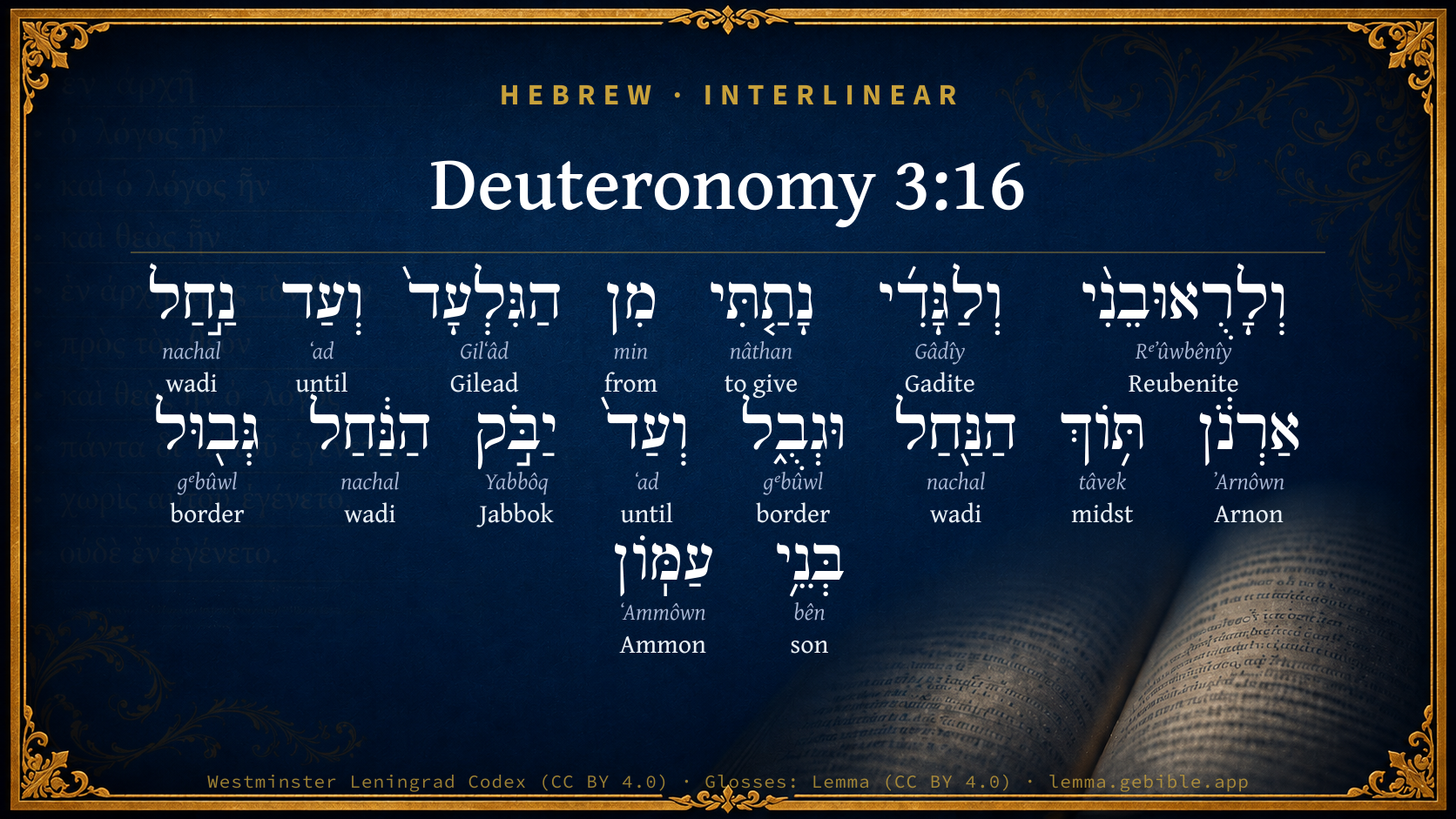
Hebrew (Westminster Leningrad Codex) Deuteronomy 3:16 appears in the Hebrew Old Testament. The text above is from the Westminster Leningrad Codex. Each word links to its Strong’s number, a concise gloss, and parsing drawn from the Open Scriptures Hebrew Bible morphology. Click any word for its full Brown-Driver-Briggs (BDB) entry.
Download image
Cite this verse

Deuteronomy 3:16 (World English Bible). Public Domain. Lemma interlinear Bible study tool, https://lemma.gebible.app/v/deuteronomy/3/16.

Show BibTeX & RIS
BibTeX
RIS
English Translation
To the Reubenites and to the Gadites I gave from Gilead even to the valley of the Arnon, the middle of the valley, and the border [of it], even to the river Jabbok, which is the border of the children of Ammon;
World English Bible · Public Domain
Download a study sheet

One document with this verse’s original text, its word-by-word gloss line, the meaning frame, cross-references with their text, attributed commentary, and full source and license credits — printable, and it pastes into notes with its structure intact.

This verse Autodidact and up

Study sheet (.html) Plain text (.txt)

A passage Seminary Student

Up to 50 verses in one chapter. A passage sheet keeps up to 6 commentary sources and 12 cross-references per verse, in the order this page ranks them, and says so on the sheet whenever that leaves anything out. Ask for a single verse and you get the Autodidact verse sheet above.

Everything on this page stays free to read, with no account — the sheet is a download of what is already on screen, not access to it.

Want to remove ads? Support Godless Engineer
Compare translations 3

The same verse in 3 English versions, stacked beneath the original-language interlinear above. Click any original word for its lexicon entry.

Each is an independent rendering of the whole verse — the interlinear is not word-aligned to these translations.

Highlighted words mark where these versions differ — a whole-verse word diff, not a word-by-word alignment.

  • World English Bible Public Domain
    To the Reubenites and to the Gadites I gave from Gilead even to the valley of the Arnon, the middle of the valley, and the border [of it], even to the river Jabbok, which is the border of the children of Ammon;
  • King James Version Public Domain
    And unto the Reubenites and unto the Gadites I gave from Gilead even unto the river Arnon half the valley, and the border even unto the river Jabbok, which is the border of the children of Ammon;
  • unfoldingWord Literal Text CC BY-SA 4.0
    And to the Reubenites and to the Gadites I gave from Gilead and as far as the wadi of Arnon, the middle of the wadi a border, and as far as the wadi of Jabbok, the border of the sons of Ammon,

unfoldingWord Literal Text — © unfoldingWord, licensed CC BY-SA 4.0. Word-aligned USFM3 via Door43 (git.door43.org/unfoldingWord/en_ult).

Versions to compare (up to 4)

3 of 4 selected

Show all 18 translations

Every available English version of this verse, each an independent rendering of the whole verse.

  • World English Bible Public Domain
    To the Reubenites and to the Gadites I gave from Gilead even to the valley of the Arnon, the middle of the valley, and the border [of it], even to the river Jabbok, which is the border of the children of Ammon;
  • Berean Standard Bible Public Domain
    and to the Reubenites and Gadites I gave the territory from Gilead to the Arnon Valley (the middle of the valley was the border) and up to the Jabbok River, the border of the Ammonites.
  • Majority Standard Bible Public Domain
    and to the Reubenites and Gadites I gave the territory from Gilead to the Arnon Valley (the middle of the valley was the border) and up to the Jabbok River, the border of the Ammonites.
  • King James Version Public Domain
    And unto the Reubenites and unto the Gadites I gave from Gilead even unto the river Arnon half the valley, and the border even unto the river Jabbok, which is the border of the children of Ammon;
  • American Standard Version (1901) Public Domain
    And unto the Reubenites and unto the Gadites I gave from Gilead even unto the valley of the Arnon, the middle of the valley, and the border `thereof', even unto the river Jabbok, which is the border of the children of Ammon;
  • Revised Version (1885) Public Domain
    And unto the Reubenites and unto the Gadites I gave from Gilead even unto the valley of Arnon, the middle of the valley, and the border thereof; even unto the river Jabbok, which is the border of the children of Ammon;
  • Geneva Bible (1599) Public Domain
    And vnto the Reubenites and Gadites I gaue the rest of Gilead, and vnto the riuer of Arnon, halfe the riuer and the borders, euen vnto the riuer Iabbok, which is the border of the children of Ammon:
  • Douay-Rheims (1899) Public Domain
    And to the tribes of Ruben and Cad I gave of the land of Galaad as far as the torrent Amen, half the torrent, and the confines even unto the torrent Jeboc, which is the border of the children of Ammon:
  • Young's Literal Translation Public Domain
    `And to the Reubenite and to the Gadite I have given from Gilead even unto the brook Arnon, the middle of the valley and the border, even unto Jabbok the brook, the border of the sons of Ammon,
  • Literal Standard Version CC BY-SA 4.0
    And to the Reubenite and to the Gadite I have given from Gilead even to the Brook of Arnon, the middle of the valley and the border, even to the Brook of Jabbok, the border of the sons of Ammon,
  • Unlocked Literal Bible CC BY-SA 4.0
    To the Reubenites and to the Gadites I gave territory from Gilead to the Valley of the Arnon—the middle of the valley is the territory's border—and to the Jabbok River, which is the border with the descendants of Ammon.
  • unfoldingWord Literal Text CC BY-SA 4.0
    And to the Reubenites and to the Gadites I gave from Gilead and as far as the wadi of Arnon, the middle of the wadi a border, and as far as the wadi of Jabbok, the border of the sons of Ammon,
  • Darby Bible Public Domain
    And to the Reubenites and to the Gadites I gave from Gilead even to the river Arnon, the middle of the ravine and its border, as far as the river Jabbok, the border of the children of Ammon;
  • World Messianic Bible Public Domain
    To the Reubenites and to the Gadites I gave from Gilead even to the valley of the Arnon, the middle of the valley, and its border, even to the river Jabbok, which is the border of the children of Ammon;
  • Webster's Bible Public Domain
    And to the Reubenites and to the Gadites I gave from Gilead even to the river Arnon half the valley, and the border even to the river Jabbok, which is the border of the children of Ammon:
  • Free Bible Version CC BY-SA 4.0
    while I assigned to the tribes of Reuben and Gad the area from Gilead to the Arnon Valley, the boundary line being the middle of the valley, all the way to the Jabbok River on the Ammonite border.
  • Bible in Basic English Public Domain
    And the land from Gilead to the valley of the Arnon, with the middle of the valley as a limit, as far as the river Jabbok which is the limit of the country of the children of Ammon, I gave to the Reubenites and the Gadites;
  • JPS Tanakh (1917) Public Domain
    And unto the Reubenites and unto the Gadites I gave from Gilead even unto the valley of Arnon, the middle of the valley for a border; even unto the river Jabbok, which is the border of the children of Ammon;

Literal Standard Version (2020), Covenant Press — licensed CC BY-SA 4.0. Text via the HelloAO Bible API (eBible.org). Unlocked Literal Bible (unfoldingWord) — licensed CC BY-SA 4.0. Text via the HelloAO Bible API (eBible.org). unfoldingWord Literal Text — © unfoldingWord, licensed CC BY-SA 4.0. Word-aligned USFM3 via Door43 (git.door43.org/unfoldingWord/en_ult). Free Bible Version, Dr. Jonathan Gallagher — licensed CC BY-SA 4.0. Text via the HelloAO Bible API (eBible.org).

Word by word

More ways to search: Search by grammar → Find every occurrence → Compare this word →

Practice this passage: Drill this verse → Learn its vocabulary →

יַבֹּ֣ק
Yabbôq
H2999
“Jabbok”
Noun, Proper
Part of Speech
Noun
Type
Proper
Full BDB Definition

Origin: probably from H1238

TWOT: None

Jabbok = "emptying" - a stream which intersects the mountain range of Gilead, and falls into the Jordan on the east about midway between the Sea of Galilee and the Dead Sea
  1. וְלָרֻאוּבֵנִ֨י Rᵉʼûwbênîy H7206 “and · to/for the · Reubenite” Conjunction + Preposition, Determined + Noun, Gentilic, Masculine, Singular, Absolute
  2. וְלַגָּדִ֜י Gâdîy H1425 “and · to/for the · Gadite” Conjunction + Preposition, Determined + Noun, Gentilic, Masculine, Singular, Absolute
  3. נָתַ֤תִּי nâthan H5414 “to give” Verb, Qal, Perfect, 1st Person, Common, Singular
  4. מִן min H4480 “from” Preposition
  5. הַגִּלְעָד֙ Gilʻâd H1568 “the · Gilead” Particle, Definite Article + Noun, Proper
  6. וְעַד ʻad H5704 “and · until” Conjunction + Preposition
  7. נַ֣חַל nachal H5158 “wadi of” Noun, Common, Masculine, Singular, Construct
  8. אַרְנֹ֔ן ʼArnôwn H769 “Arnon” Noun, Proper
  9. תּ֥וֹךְ tâvek H8432 “midst of” Noun, Common, Masculine, Singular, Construct
  10. הַנַּ֖חַל nachal H5158 “the · wadi” Particle, Definite Article + Noun, Common, Masculine, Singular, Absolute
  11. וּגְבֻ֑ל gᵉbûwl H1366 “and · border” Conjunction + Noun, Common, Masculine, Singular, Absolute
  12. וְעַד֙ ʻad H5704 “and · until” Conjunction + Preposition
  13. הַנַּ֔חַל nachal H5158 “the · wadi” Particle, Definite Article + Noun, Common, Masculine, Singular, Absolute
  14. גְּב֖וּל gᵉbûwl H1366 “border of” Noun, Common, Masculine, Singular, Construct
  15. בְּנֵ֥י bên H1121 “sons of” Noun, Common, Masculine, Plural, Construct
  16. עַמּֽוֹן ʻAmmôwn H5983 “Ammon” Noun, Proper

About this verse

These counts appear in no published source. They are computed here, from the morphology-tagged text and Lemma’s own curated glosses. What Lemma adds →

17
words
13
distinct lemmas
Pentateuch
section

Notable vocabulary

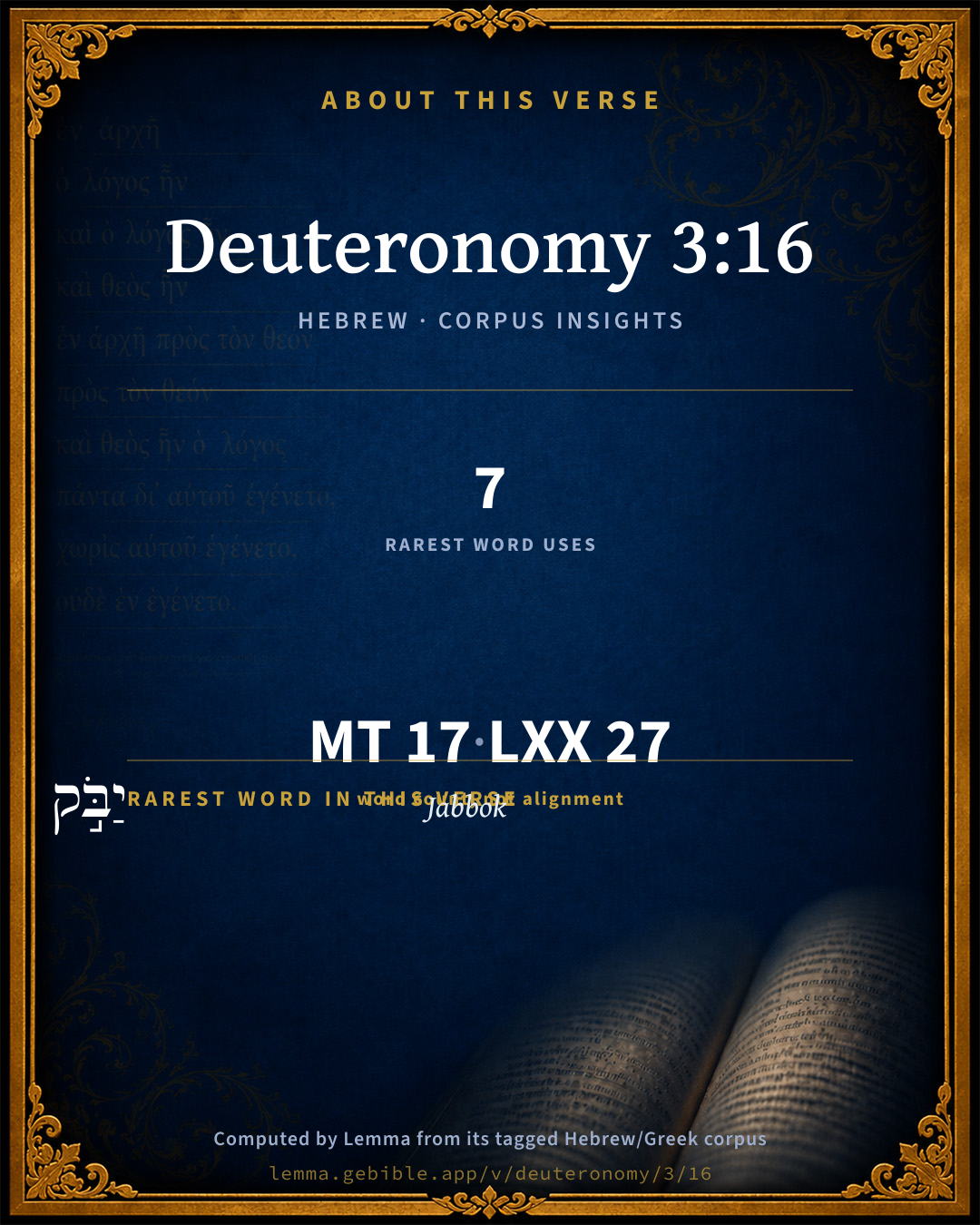
The rarest word here is יַבֹּ֣ק Jabbok H2999 — appearing just 7 times in the whole Hebrew Bible.

Shared distinctive vocabulary

יַבֹּ֣ק Jabbok H2999 occurs in 7 verses of the Hebrew Bible. Also found in:

Grammatical profile

  • 1 verb
  • 13 nouns
  • 3 prepositions

Verb forms

  • נָתַ֤תִּי Qal · Perfect

Repetition

Words recur within this verse — often emphatic in Hebrew:

  • נַ֣חַל wadi H5158 ×3
  • וְעַד until H5704 ×2
  • וּגְבֻ֑ל border H1366 ×2

Hebrew & Septuagint length

In English translation the verse runs 42 words from the Hebrew and 38 from the Septuagint (LXX English) — closely comparable.

A rough comparison of the two English renderings, which tokenize alike — not a word-level alignment.

Word counts can differ between the Hebrew and the Greek without any difference in meaning — e.g. the Hebrew direct-object marker אֵת has no separate Greek word, and Greek often adds the article ὁ.

In the original languages it is 17 Hebrew tokens and 27 Greek tokens — but the two are counted differently (Hebrew bundles its prefixes and suffixes into one token; the Greek is in lemma form), so that isn’t a like-for-like length.

Cross-references

6

Topical passages linked to Deuteronomy 3:16 in the Treasury of Scripture Knowledge — connected by theme and wording, ordered by reader-vote popularity; previews shown in the World English Bible.

  • Numbers 21:24 Israel struck him with the edge of the sword, and possessed his land from the Arnon to the Jabbok, even to the children of Ammon; for the border of the children of Ammon was strong.
  • Deuteronomy 2:37 only to the land of the children of Ammon you didn't come near; all the side of the river Jabbok, and the cities of the hill-country, and wherever Yahweh our God forbade us.
  • 2 Samuel 24:5 They passed over the Jordan, and encamped in Aroer, on the right side of the city that is in the middle of the valley of Gad, and to Jazer:
  • Genesis 32:22 He rose up that night, and took his two wives, and his two handmaids, and his eleven sons, and passed over the ford of the Jabbok.
  • Numbers 32:33–38 Moses gave to them, even to the children of Gad, and to the children of Reuben, and to the half-tribe of Manasseh the son of Joseph, the kingdom of Sihon king of the Amorites, and the kingdom of Og king of Bashan, the land, according to the cities of it with [their] borders, even the cities of the land round about.
  • Joshua 12:2–3 Sihon king of the Amorites, who lived in Heshbon, and ruled from Aroer, which is on the edge of the valley of the Arnon, and [the city that is in] the middle of the valley, and half Gilead, even to the river Jabbok, the border of the children of Ammon;

Cross-references courtesy of OpenBible.info (CC BY 4.0).

Hebrew and Greek witnesses Masoretic Hebrew ↔ Greek Septuagint

The same verse in the two great witnesses to the Old Testament, shown verse-for-verse.

These are two independent witnesses, not word-aligned to each other, and the Septuagint is shown in lemma (dictionary) form.

Hebrew Deuteronomy 3:16 Masoretic · Westminster Leningrad Codex

וְלָרֻאוּבֵנִ֨י וְלַגָּדִ֜י נָתַ֤תִּי מִן הַגִּלְעָד֙ וְעַד נַ֣חַל אַרְנֹ֔ן תּ֥וֹךְ הַנַּ֖חַל וּגְבֻ֑ל וְעַד֙ יַבֹּ֣ק הַנַּ֔חַל גְּב֖וּל בְּנֵ֥י עַמּֽוֹן

To the Reubenites and to the Gadites I gave from Gilead even to the valley of the Arnon, the middle of the valley, and the border [of it], even to the river Jabbok, which is the border of the children of Ammon;

World English Bible · Public Domain

Greek LXX Deuteronomy 3:16 Septuagint · lemma form

καί ὁ ρουβην καί ὁ γαδ δίδωμι ἀπό ὁ γαλαάδ ἕως χειμάρρους αρνων μέσος ὁ χειμάρρους ὅριον καί ἕως ὁ ιαβοκ ὁ χειμάρρους ὅριον ὁ υἱός αμμαν

And to Ruben and to Gad I gave the land under Galaad as far as the brook of Arnon, the border between the brook and as far as Jaboc; the brook is the border to the children Amman.

LXX2012 (modern English Septuagint) · Public Domain

Hebrew: Westminster Leningrad Codex (CC BY 4.0). Greek: Septuagint (public domain); English from LXX2012 (modern English Septuagint) (Public Domain). How the Septuagint differs from the Hebrew →

Targum (Aramaic paraphrase)

2

The Targum is the ancient Jewish Aramaic paraphrase of the Hebrew Scriptures — an interpretive translation, not the Hebrew text itself. Onkelos (literal) and Pseudo-Jonathan (expansive) render the Torah, and Jonathan the Prophets. Coverage is partial: where no permissively-licensed English translation exists for a verse, only the Aramaic is shown. This is verse-level text, not a word-by-word alignment to the Hebrew.

  1. Targum Onkelos Torah (Genesis–Deuteronomy)
    וּלְשִׁבְטָא דִרְאוּבֵן וּלְשִׁבְטָּא דְגָד יְהָּבִית מִן גִלְעָד וְעַד נַחֲלָא דְאַרְנֹן גוֹ נַחֲלָא וּתְחוּם וְעַד יוּבְקָא דְנַחֲלָא תְּחוּם בְּנֵי עַמוֹן

    (no public-domain English translation for this verse)

    Targum Onkelos — Aramaic: “Onkelos Genesis” (public domain); “Onkelos Exodus” (public domain); “Onkelos Leviticus” (public domain); “Onkelos Numbers” (public domain); “Onkelos Deuteronomy” (public domain). English: “Sefaria Community Translation” (CC0 1.0 (public-domain dedication)); “J.W. Etheridge. The Targums of Onkelos and Jonathan Ben Uzziel on the Pentateuch. London: Longmans, Green, 1862” (public domain). Text via Sefaria.

  2. Targum Pseudo-Jonathan Torah (Genesis–Deuteronomy)
    וּלְשֵׁבֶט רְאוּבֵן וּלְשֵׁבֶט גָּד יְהָבִית מִן גִּלְעָד וְעַד נַחֲלָאאַרְנוֹנָא מְצִיעוּת נַחֲלָא וּתְחוּמֵיהּ וְעַד יוּבְקָא דְנַחֲלֵי תְּחוּמָא דִבְנֵי עַמּוֹן

    To the tribe Reuben and the tribe Gad have I given from Gilead to the river Arnona, half of the valley and its limit, unto the stream of Jubeka on the limit of the children of Ammon,

    Targum Pseudo-Jonathan — Aramaic: “Targum Jonathan on Genesis” (public domain); “Targum Jonathan on Exodus” (public domain); “Targum Jonathan on Leviticus” (public domain); “Targum Jonathan on Numbers” (public domain); “Targum Jonathan on Deuteronomy” (public domain). English: “The Targum of Jonathan ben Uzziel, trans. J. W. Etheridge, London, 1862” (public domain). Text via Sefaria.

Commentary

Notes on Deuteronomy 3:16 from classic Christian and Jewish commentators (each source and its license shown beneath its notes). The classic Christian expositions comment on the surrounding passage and are grouped to its opening verse, so a note may address several verses; the Jewish commentaries on the Tanakh (Rashi and others) are per-verse, so they appear only where the commentator wrote on this verse.

Lemma curates 59 commentaries, every one of them public domain or Creative Commons licensed, each selected and text-cleaned for this edition rather than reprinted as found. About our sources →

Trapp's Complete Commentary

John Trapp

Deu 3:16 And unto the Reubenites and unto the Gadites I gave from Gilead even unto the river Arnon half the valley, and the border even unto the river Jabbok, [which is] the border of the children of Ammon;

Ver. 16. Unto the river Jabbok.] Famous for Jacob’s wrestling with God near unto it. {Gen 32:22}

John Trapp, A Commentary or Exposition upon All the Books of the Old and New Testament (1647–1656) — public domain. Text from a community e-Sword module.

Geneva Bible (1599)

Geneva Bible translators

Which separateth the Ammonites from the Amorites.

Geneva Bible (1599) marginal notes — public domain. Text via Bolls.life.

Jamieson, Fausset & Brown

Robert Jamieson, A. R. Fausset & David Brown

from Gilead--that is, not the mountainous region, but the town Ramoth-gilead,

even unto the river Arnon half the valley--The word "valley" signifies a wady, either filled with water or dry, as the Arnon is in summer, and thus the proper rendering of the passage will be--"even to the half or middle of the river Arnon" (compare Jos 12:2). This prudent arrangement of the boundaries was evidently made to prevent all disputes between the adjacent tribes about the exclusive right to the water.

Jamieson, Fausset & Brown — Commentary Critical and Explanatory on the Whole Bible (1871) — public domain (CC PDM 1.0). Text via the HelloAO Bible API.

Ellicott's Commentary for English Readers

(16, 17) And unto the Reubenites and unto the Gadites I gave.—The circumstances are detailed in Numbers 32. They desired the land for their cattle.

A Bible Commentary for English Readers, edited by Charles John Ellicott (1878–1897) — public domain. Text from a community e-Sword module.

The Cambridge Bible for Schools and Colleges

gen. ed. J. J. S. Perowne

16. And unto the Reubenites, etc.] Since this verse repeats what is already stated, it also is regarded as secondary. ‘The language of 16, however, is harmonious with that of Deu_2:36, and it is possible that this sequence represents the older form of the narrative, before the incorporation of the account of Og, for there seems no reason why an editorial expounder should thus imperfectly reproduce statements already made.’ (Oxf. Hex., ii. 252.)

the middle of the valley for a border] That is, the exact border was not the edge, but the stream-bed of the wâdy.

The Cambridge Bible for Schools and Colleges (gen. ed. J. J. S. Perowne; Cambridge University Press, 1878–1918) — public domain. Text from a community e-Sword module.

John Gill's Exposition

The plain also, and Jordan,.... The plain by Jordan, the plains of Moab on the side of it, together with the river:

and the coast thereof; the country adjoining to it:

from Chinnereth even unto the sea of the plain, even the salt sea; that is, from Gennesaret, as the Targums of Onkelos and Jonathan, called the land of Gennesaret, Mat 14:34, from thence to the sea of Sodom, the sea of the plain, where the cities of the plain stood, Sodom, Gomorrah, &c. and the salt sea, so called from the salt and nitrous waters of it, the lake Asphaltites:

under Ashdothpisgah eastward; mentioned among the cities given to the tribe of Reuben, Jos 13:20 rendered "the springs of Pisgah", Deu 4:49, the word having the signification of effusions, pourings out; so the Targums.

John Gill's Exposition of the Whole Bible (1746–1763) — public domain (CC PDM 1.0). Text via the HelloAO Bible API.

Albert Barnes' Notes on the Bible

The sense is that the Reubenites and Gadites were to possess the district from the Jabbok on the north to the Arnon on the south, including the middle part of the valley of the Arnon, and the territory (“coast” or “border”) thereto pertaining.

Albert Barnes' Notes on the Bible (1834–1885) — public domain. Text from a community e-Sword/MySword module.

Haydock's Catholic Bible Commentary

Torrent. The other part belonged to the Moabites, (Calmet) on the south and east. --- Ammon. See chap. ii. 37. The two tribes of Gad and Ruben occupied the territory lying between the Jeboc and the Arnon, hemmed in by the mountains of Galaad, on the east, and by the Jordan and the most salt sea, and that of Cenereth, on the west. Gad occupied the northern division of this country. (Haydock)

George Leo Haydock (1774–1849), Haydock's Catholic Family Bible and Commentary, 1859 edition — public domain. Excludes Psalms (Douay-Rheims chapter numbering differs from Protestant) and Deuterocanonical books (Catholic canon only).

Matthew Poole's English Annotations

Half the valley, or rather to the middle of the river; for the word rendered half signifies commonly middle; and the same Hebrew word signifying both a valley and a brook or river, it seems more reasonable to understand it of a river, as the same word is here rendered in the next foregoing clause of this verse, than of a valley, which was not mentioned before, especially seeing there is here an article added which seems to be emphatical, and to note that river, to wit, now mentioned. Add to this, that there was no such valley, much less any half valley, belonging both unto the Reubenites and Gadites. But according to the other translation the sense is plain and agreeable to the truth, that their land extended from Gilead unto Aroer, and, to speak exactly, to the middle of that river; for as that river was the border between them and others, so one half of it belonged to them, as the other half did to others. And that this is no subtle device, as some may think it, but the truth of the thing, and the real meaning of the place, will appear by comparing this place with two others:

1. With Jos 12:2, where the same thing is expressed in the same words in the Hebrew which are here, though our translators render the selfsame words there from the middle of the river, which here they render half of the valley; and where the bounds of Sihon’s kingdom, which was the same portion there mentioned as given to Reuben and Gad, are thus described, from Aroer, which is upon the bank of the river of Arnon, and from the middle of the river, and from half Gilead, even unto the river Jabbok, which is the border of the children of Ammon.

2. With Deu 2:36, From Aroer, which is by the brink of the river of Arnon, and from the city that is by the river, or rather, as the Hebrew hath it, in the river, i.e. from Ar, which was the chief city of the Moabites, and therefore denied to the Israelites, as is here implied, and more fitly expressed, Deu 2:9, which city was seated in an island in the middle of the river. So that here we have a just and full reason why the border of this land given to Reuben and Gad is so nicely and critically described there, even to the middle of a river, which although in truth and strictness it be the bound of those lands which are divided by a river, yet is not usually expressed in the description of borders, either in Scripture or other authors, because here was an eminent city of the Moabites in the middle of this river, which by this curious and exact description is excepted from their possession, as God would have it to be. And the border even unto the river Jabbok: the meaning seems to be this, and the border, to wit, of their land, was, which verb substantive is commonly understood, or went forth, (as the phrase is, Jos 15:6,7, &c.,) from thence, to wit, from the river Arnon, even unto the river Jabbok, for so indeed their border did proceed. Which is the border of the children of Ammon. Object. This was the border between them and the Manassites, as is evident, and therefore not the border of the Ammonites.

Answ. It bordered upon the Manassites in one part, and upon the Ammonites in another part, to wit, in that part which is remoter from Jordan, and so both are true.

Matthew Poole's English Annotations on the Holy Bible (1683–1685) — public domain. Text from a community e-Sword/MySword module.

Whedon's Commentary on the Bible

Daniel D. Whedon

16, 17. Reubenites… Gadites — The territory allotted to the tribes of Reuben and Gad is more fully described. They were to have Gilead to the south of the Jabbok as far as the Arnon — to the middle of the valley. (The gorge or valley of the Arnon is eighty miles long and about two miles wide.) On the western side they were to have the Arabah or plain, and the bank of the Jordan from the Sea of Galilee to the Dead Sea.

Ashdoth-pisgah probably means the slopes of Pisgah.

Daniel D. Whedon (gen. ed.), Commentary on the Old and New Testaments (1874–1909) — public domain. Text from a community e-Sword module.

The Pulpit Commentary

Vers. 16, 17. The possession of the tribes of Reuben and Gad is here more exactly defined. Its southern boundary was the middle of the valley (the wady) of the Arnon; half the valley, and the border, i.e. the middle of the ravine (or wady) and its edge; a more precise definition of the river Arnon; the brook which flowed through the middle of the ravine was to be their boundary line to the south. On the northeast the Upper Jabbok (Nahr Amman ) was to be their boundary; this separated them from Ammonitis, the region of the children of Ammon. (Num_21:24) On the west the "Arabah (Ghor), and the Jordan and its border (its east bank), from Chinnereth (Kinnereth), a fenced city by the sea of Galilee, thence called "the sea of Chinnereth" (Num_34:11; Jos_12:3 Jos_19:35) to the sea of the "Arabah, the salt sea, under Ashdoth-pisgah the slopes (literally, the outpourings, the place where the mountain torrents flow out, hence the base of the hill) of Pisgah (Num_21:15 Num_27:12) eastward; i.e. simply the east side of the "Arabah and the Jordan.

The Pulpit Commentary (1880–1919), ed. H.D.M. Spence-Jones & Joseph S. Exell — public domain. Text from a community e-Sword module.

John Wesley's Explanatory Notes

Half the valley - Or rather to the middle of the river: for the word rendered half signifies commonly middle, and the same Hebrew word means both a valley and a brook or river. And this sense is agreeable to the truth, that their land extended from Gilead unto Arnon, and, to speak exactly, to the middle of that river; for as that river was the border between them and others, so one half of it belonged to them, as the other half did to others, Josh. xii, 2. The same thing is expressed in the same words in the Hebrew which are here, though our translators render the self- same words there, from the middle of the river, which here they render, half of the valley. There the bounds of Sihon's kingdom, which was the same portion here mentioned as given to Reuben and Gad, are thus described, from Aroer, which is upon the bank of the river of Arnon, and from the middle of the river, and from half Gilead, even unto the river Jabbok, which is the border of the children of Ammon.

John Wesley, Explanatory Notes Upon the Whole Bible (1754–1765) — public domain. Text via the GEBible commentary corpus.

Rashi

Rabbi Shlomo Yitzchaki (Rashi)

תוך הנחל וגבול THE MIDST OF THE BROOK AND THE TERRITORY, i.e., all the brook and in addition, land on its opposite bank. The words therefore are as much as to say, עד "unto” the Brook of Arnon, ועד "and” that which is mentioned as being "unto” (i.e. the Brook itself) is included (by the words תוך הנחל), and even more than this (namely, the גבול, land on the other side of the brook).

Rashi on the Tanakh — English translations: “The Judaica Press complete Tanach with Rashi, translated by A. J. Rosenberg” (CC BY 4.0); “Pentateuch with Rashi's commentary by M. Rosenbaum and A.M. Silbermann, 1929-1934” (public domain); “The Metsudah Tanach series, Lakewood, N.J” (CC BY 4.0); and “The Book of Joshua, Metsudah Publications, 1997” (CC BY 4.0). Text via Sefaria.

Lesson kit

Teaching starters — assembled from the data on this page, not authored interpretation. Every prompt links to the verse data it draws on. Edit before teaching.

Deuteronomy, in the Pentateuch, opens this verse with 17 words (13 distinct Hebrew lemmas). Its most distinctive word is Yabbôq (“Jabbok”). A historical commentator’s framing appears above. Read the whole chapter for the surrounding context.

Discussion questions

  1. How does “Jabbok” (Yabbôq) shape what this verse is saying?
  2. How does Genesis 32:22, which shares the word «Jabbok», read alongside this verse?
  3. What does the repetition of “wadi” (3× in this one verse) do in this verse?
  4. The translations on this page render this verse differently — a whole-verse word diff, not a word-by-word alignment. What might account for the different wordings?
  5. «נָתַ֤תִּי» is a Qal Perfect verb. How does that grammatical form shape the action described?
  6. Compare how Trapp's Complete Commentary and Geneva Bible (1599) read this verse. Where do they agree or differ?

Things to notice

Reading settings

Reading text

Shown beneath each verse's original-language words.

Old Testament
Old Testament edition

Read the OT as the Masoretic Hebrew (MT) or the Greek Septuagint (LXX).

English shown for the Greek Septuagint (in the Hebrew ↔ Greek comparison).

Comparing translations? Open the Compare panel on any verse page to stack up to four side by side.