Genesis 30:9

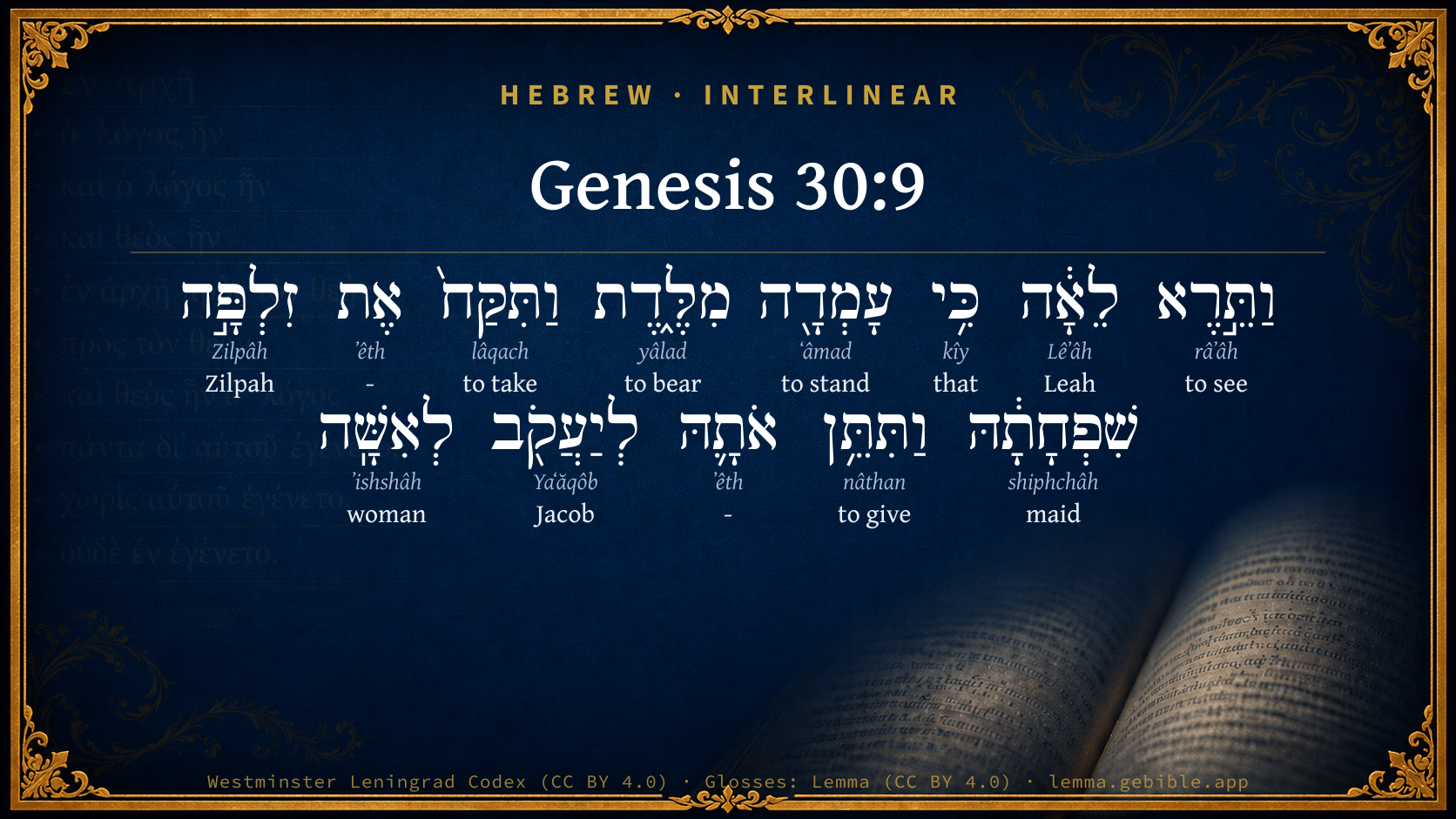
Hebrew (Westminster Leningrad Codex) Genesis 30:9 appears in the Hebrew Old Testament. The text above is from the Westminster Leningrad Codex. Each word links to its Strong’s number, a concise gloss, and parsing drawn from the Open Scriptures Hebrew Bible morphology. Click any word for its full Brown-Driver-Briggs (BDB) entry.
Download image
Cite this verse

Genesis 30:9 (World English Bible). Public Domain. Lemma interlinear Bible study tool, https://lemma.gebible.app/v/genesis/30/9.

Show BibTeX & RIS
BibTeX
RIS
English Translation
When Leah saw that she had finished bearing, she took Zilpah, her handmaid, and gave her to Jacob as a wife.
World English Bible · Public Domain
Download a study sheet

One document with this verse’s original text, its word-by-word gloss line, the meaning frame, cross-references with their text, attributed commentary, and full source and license credits — printable, and it pastes into notes with its structure intact.

This verse Autodidact and up

Study sheet (.html) Plain text (.txt)

A passage Seminary Student

Up to 50 verses in one chapter. A passage sheet keeps up to 6 commentary sources and 12 cross-references per verse, in the order this page ranks them, and says so on the sheet whenever that leaves anything out. Ask for a single verse and you get the Autodidact verse sheet above.

Everything on this page stays free to read, with no account — the sheet is a download of what is already on screen, not access to it.

Want to remove ads? Support Godless Engineer
Compare translations 3

The same verse in 3 English versions, stacked beneath the original-language interlinear above. Click any original word for its lexicon entry.

Each is an independent rendering of the whole verse — the interlinear is not word-aligned to these translations.

Highlighted words mark where these versions differ — a whole-verse word diff, not a word-by-word alignment.

  • World English Bible Public Domain
    When Leah saw that she had finished bearing, she took Zilpah, her handmaid, and gave her to Jacob as a wife.
  • King James Version Public Domain
    When Leah saw that she had left bearing, she took Zilpah her maid, and gave her Jacob to wife.
  • unfoldingWord Literal Text CC BY-SA 4.0
    Now Leah saw that she had ceased from bearing, so she took Zilpah her maidservant and gave her to Jacob as a wife.

unfoldingWord Literal Text — © unfoldingWord, licensed CC BY-SA 4.0. Word-aligned USFM3 via Door43 (git.door43.org/unfoldingWord/en_ult).

Versions to compare (up to 4)

3 of 4 selected

Show all 18 translations

Every available English version of this verse, each an independent rendering of the whole verse.

  • World English Bible Public Domain
    When Leah saw that she had finished bearing, she took Zilpah, her handmaid, and gave her to Jacob as a wife.
  • Berean Standard Bible Public Domain
    When Leah saw that she had stopped having children, she gave her servant Zilpah to Jacob as a wife.
  • Majority Standard Bible Public Domain
    When Leah saw that she had stopped having children, she gave her servant Zilpah to Jacob as a wife.
  • King James Version Public Domain
    When Leah saw that she had left bearing, she took Zilpah her maid, and gave her Jacob to wife.
  • American Standard Version (1901) Public Domain
    When Leah saw that she had left off bearing, she took Zilpah her handmaid, and gave her to Jacob to wife.
  • Revised Version (1885) Public Domain
    When Leah saw that she had left bearing, she took Zilpah her handmaid, and gave her to Jacob to wife.
  • Geneva Bible (1599) Public Domain
    And when Leah saw that she had left bearing, shee tooke Zilpah her mayde, and gaue her Iaakob to wife.
  • Douay-Rheims (1899) Public Domain
    Lia, perceiving that she had left off bearing, gave Zelpha her handmaid to her husband.
  • Young's Literal Translation Public Domain
    And Leah seeth that she hath ceased from bearing, and she taketh Zilpah her maid-servant, and giveth her to Jacob for a wife;
  • Literal Standard Version CC BY-SA 4.0
    And Leah sees that she has ceased from bearing, and she takes Zilpah her maidservant, and gives her to Jacob for a wife;
  • Unlocked Literal Bible CC BY-SA 4.0
    When Leah saw that she had stopped having children, she took Zilpah, her servant, and gave her to Jacob as a wife.
  • unfoldingWord Literal Text CC BY-SA 4.0
    Now Leah saw that she had ceased from bearing, so she took Zilpah her maidservant and gave her to Jacob as a wife.
  • Darby Bible Public Domain
    And when Leah saw that she had ceased to bear, she took Zilpah her maidservant and gave her to Jacob as wife.
  • World Messianic Bible Public Domain
    When Leah saw that she had finished bearing, she took Zilpah, her servant, and gave her to Jacob as a wife.
  • Webster's Bible Public Domain
    When Leah saw that she had left bearing, she took Zilpah, her maid, and gave her Jacob for a wife.
  • Free Bible Version CC BY-SA 4.0
    Leah realized she wasn't having any more children, so she gave her personal maid Zilpah to Jacob as a wife.
  • Bible in Basic English Public Domain
    When it was clear to Leah that she would have no more children for a time, she gave Zilpah, her servant, to Jacob as a wife.
  • JPS Tanakh (1917) Public Domain
    When Leah saw that she had left off bearing, she took Zilpah her handmaid, and gave her to Jacob to wife.

Literal Standard Version (2020), Covenant Press — licensed CC BY-SA 4.0. Text via the HelloAO Bible API (eBible.org). Unlocked Literal Bible (unfoldingWord) — licensed CC BY-SA 4.0. Text via the HelloAO Bible API (eBible.org). unfoldingWord Literal Text — © unfoldingWord, licensed CC BY-SA 4.0. Word-aligned USFM3 via Door43 (git.door43.org/unfoldingWord/en_ult). Free Bible Version, Dr. Jonathan Gallagher — licensed CC BY-SA 4.0. Text via the HelloAO Bible API (eBible.org).

Word by word

More ways to search: Search by grammar → Find every occurrence → Compare this word →

Practice this passage: Drill this verse → Learn its vocabulary →

זִלְפָּ֣ה
Zilpâh
H2153
“Zilpah”
Noun, Proper
Part of Speech
Noun
Type
Proper
Full BDB Definition

Origin: from an unused root apparently mean to trickle, as myrrh

TWOT: None

Zilpah = "a trickling" - the Syrian given by Laban to Leah as a handmaid, a concubine of Jacob, mother of Asher and Gad
  1. וַתֵּ֣רֶא râʼâh H7200 “and · to see” Conjunction + Verb, Qal, Sequential Imperfect, 3rd Person, Feminine, Singular
  2. לֵאָ֔ה Lêʼâh H3812 “Leah” Noun, Proper
  3. כִּ֥י kîy H3588 “that” Conjunction
  4. עָמְדָ֖ה ʻâmad H5975 “to stand” Verb, Qal, Perfect, 3rd Person, Feminine, Singular
  5. מִלֶּ֑דֶת yâlad H3205 “from · to bear” Preposition + Verb, Qal, Infinitive Construct
  6. וַתִּקַּח֙ lâqach H3947 “and · to take” Conjunction + Verb, Qal, Sequential Imperfect, 3rd Person, Feminine, Singular
  7. אֶת ʼêth H853 “-” Particle, Direct Object
  8. שִׁפְחָתָ֔הּ shiphchâh H8198 “maid · her” Noun, Common, Feminine, Singular, Construct + Suffix, Personal, 3rd Person, Feminine, Singular
  9. וַתִּתֵּ֥ן nâthan H5414 “and · to give” Conjunction + Verb, Qal, Sequential Imperfect, 3rd Person, Feminine, Singular
  10. אֹתָ֛הּ ʼêth H853 “- · her” Particle, Direct Object + Suffix, Personal, 3rd Person, Feminine, Singular
  11. לְיַעֲקֹ֖ב Yaʻăqôb H3290 “to/for · Jacob” Preposition + Noun, Proper
  12. לְאִשָּֽׁה ʼishshâh H802 “to/for · woman” Preposition + Noun, Common, Feminine, Singular, Absolute

About this verse

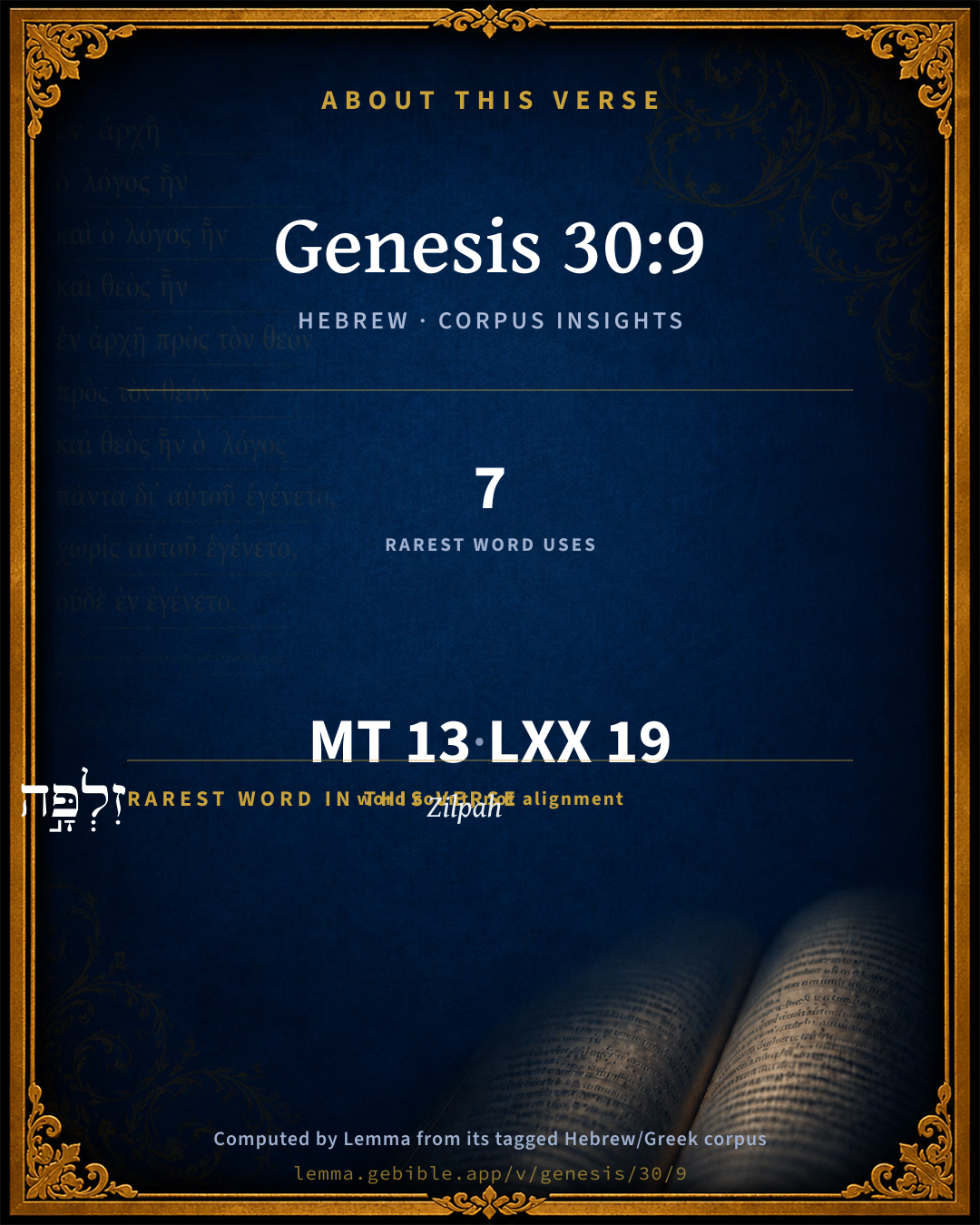
These counts appear in no published source. They are computed here, from the morphology-tagged text and Lemma’s own curated glosses. What Lemma adds →

13
words
12
distinct lemmas
Pentateuch
section

Notable vocabulary

The rarest word here is זִלְפָּ֣ה Zilpah H2153 — appearing just 7 times in the whole Hebrew Bible.

Shared distinctive vocabulary

זִלְפָּ֣ה Zilpah H2153 occurs in 7 verses of the Hebrew Bible. Also found in:

Grammatical profile

  • 5 verbs
  • 5 nouns
  • 1 conjunction
  • 2 particles

Verb forms

  • וַתֵּ֣רֶא Qal · Sequential Imperfect
  • עָמְדָ֖ה Qal · Perfect
  • מִלֶּ֑דֶת Qal · Infinitive Construct
  • וַתִּקַּח֙ Qal · Sequential Imperfect
  • וַתִּתֵּ֥ן Qal · Sequential Imperfect

Hebrew & Septuagint length

In English translation the verse runs 21 words from the Hebrew and 28 from the Septuagint (LXX English) — closely comparable.

A rough comparison of the two English renderings, which tokenize alike — not a word-level alignment.

Word counts can differ between the Hebrew and the Greek without any difference in meaning — e.g. the Hebrew direct-object marker אֵת has no separate Greek word, and Greek often adds the article ὁ.

In the original languages it is 13 Hebrew tokens and 19 Greek tokens — but the two are counted differently (Hebrew bundles its prefixes and suffixes into one token; the Greek is in lemma form), so that isn’t a like-for-like length.

Cross-references

4

Topical passages linked to Genesis 30:9 in the Treasury of Scripture Knowledge — connected by theme and wording, ordered by reader-vote popularity; previews shown in the World English Bible.

  • Genesis 30:4 She gave him Bilhah her handmaid as wife, and Jacob went in to her.
  • Genesis 16:3 Sarai, Abram's wife, took Hagar the Egyptian, her handmaid, after Abram had lived ten years in the land of Canaan, and gave her to Abram her husband to be his wife.
  • Genesis 29:35 She conceived again, and bare a son. She said, "This time will I praise Yahweh." Therefore she named him Judah. Then she stopped bearing.
  • Genesis 30:17 God listened to Leah, and she conceived, and bore Jacob a fifth son.

Cross-references courtesy of OpenBible.info (CC BY 4.0).

Hebrew and Greek witnesses Masoretic Hebrew ↔ Greek Septuagint

The same verse in the two great witnesses to the Old Testament, shown verse-for-verse.

These are two independent witnesses, not word-aligned to each other, and the Septuagint is shown in lemma (dictionary) form.

Hebrew Genesis 30:9 Masoretic · Westminster Leningrad Codex

וַתֵּ֣רֶא לֵאָ֔ה כִּ֥י עָמְדָ֖ה מִלֶּ֑דֶת וַתִּקַּח֙ אֶת זִלְפָּ֣ה שִׁפְחָתָ֔הּ וַתִּתֵּ֥ן אֹתָ֛הּ לְיַעֲקֹ֖ב לְאִשָּֽׁה

When Leah saw that she had finished bearing, she took Zilpah, her handmaid, and gave her to Jacob as a wife.

World English Bible · Public Domain

Greek LXX Genesis 30:9 Septuagint · lemma form

ὁράω δέ λεια ὅτι ἵστημι ὁ τίκτω καί λαμβάνω ζελφα ὁ παιδίσκη αὐτός καί δίδωμι αὐτός ὁ ἰακώβ γυνή

And Lea saw that she ceased from bearing, and she took Zelpha her maid, and gave her to Jacob for a wife; and he went in to her.

LXX2012 (modern English Septuagint) · Public Domain

Hebrew: Westminster Leningrad Codex (CC BY 4.0). Greek: Septuagint (public domain); English from LXX2012 (modern English Septuagint) (Public Domain). How the Septuagint differs from the Hebrew →

Targum (Aramaic paraphrase)

2

The Targum is the ancient Jewish Aramaic paraphrase of the Hebrew Scriptures — an interpretive translation, not the Hebrew text itself. Onkelos (literal) and Pseudo-Jonathan (expansive) render the Torah, and Jonathan the Prophets. Coverage is partial: where no permissively-licensed English translation exists for a verse, only the Aramaic is shown. This is verse-level text, not a word-by-word alignment to the Hebrew.

  1. Targum Onkelos Torah (Genesis–Deuteronomy)
    וַחֲזַת לֵּאָה אֲרֵי קָמַת מִלְּמֵילַד וּדְבָרַת יָת זִלְפָּה אַמְתַהּ וִיהָבַת יָתַהּ לְיַעֲקֹב לְאִנְתּוּ

    (no public-domain English translation for this verse)

    Targum Onkelos — Aramaic: “Onkelos Genesis” (public domain); “Onkelos Exodus” (public domain); “Onkelos Leviticus” (public domain); “Onkelos Numbers” (public domain); “Onkelos Deuteronomy” (public domain). English: “Sefaria Community Translation” (CC0 1.0 (public-domain dedication)); “J.W. Etheridge. The Targums of Onkelos and Jonathan Ben Uzziel on the Pentateuch. London: Longmans, Green, 1862” (public domain). Text via Sefaria.

  2. Targum Pseudo-Jonathan Torah (Genesis–Deuteronomy)
    וַחֲמַת לֵאָה אֲרוּם קָמַת מִלְמֵילָד וְשַׁחֲרָרַת יַת זִלְפָּה אַמְתָהּ וִיהָבַת יָתָהּ לְיַעֲקב לְאִנְתּוּ

    And Leah saw that she had ceased from bearing, and she made Zilpha her handmaid free, and gave her unto Jakob to wife.

    Targum Pseudo-Jonathan — Aramaic: “Targum Jonathan on Genesis” (public domain); “Targum Jonathan on Exodus” (public domain); “Targum Jonathan on Leviticus” (public domain); “Targum Jonathan on Numbers” (public domain); “Targum Jonathan on Deuteronomy” (public domain). English: “The Targum of Jonathan ben Uzziel, trans. J. W. Etheridge, London, 1862” (public domain). Text via Sefaria.

Commentary

Notes on Genesis 30:9 from classic Christian and Jewish commentators (each source and its license shown beneath its notes). The classic Christian expositions comment on the surrounding passage and are grouped to its opening verse, so a note may address several verses; the Jewish commentaries on the Tanakh (Rashi and others) are per-verse, so they appear only where the commentator wrote on this verse.

Lemma curates 59 commentaries, every one of them public domain or Creative Commons licensed, each selected and text-cleaned for this edition rather than reprinted as found. About our sources →

Trapp's Complete Commentary

John Trapp

Gen 30:9 When Leah saw that she had left bearing, she took Zilpah her maid, and gave her Jacob to wife.

Ver. 9. Left bearing,] viz., Till she began again, Gen 30:17.

John Trapp, A Commentary or Exposition upon All the Books of the Old and New Testament (1647–1656) — public domain. Text from a community e-Sword module.

Joseph Benson's Commentary

Gen 30:9. Rachel had absurdly and preposterously put her maid into her husband’s bed; and now Leah, because she missed one year in bearing children, doth the same, to be even with her. See the power of rivalship, and admire the wisdom of the divine appointment, which joins together one man and one woman only. Two sons Zilpah bare to Jacob, whom Leah looked upon herself as entitled to, in token of which, she called one Gad, promising herself a little troop of children. The other she called Asher, happy, thinking herself happy in him, and promising herself that her neighbours would think so too.

Joseph Benson's Commentary on the Old and New Testaments (1811–1818) — public domain. Text from a community e-Sword module.

Tyndale Open Study Notes

Tyndale Open Resources

30:9 When Leah saw that she had stopped bearing children, she countered Rachel’s effort by giving her servant . . . to Jacob as a wife even though she already had four sons.

Tyndale Open Study Notes — © Tyndale Open Resources, licensed CC BY-SA 4.0. Text via the HelloAO Bible API.

John Calvin's Commentaries

9. When Leah saw that she had left bearing. Moses returns to Leah, who, not content with four sons, devised a method whereby she might always retain her superior rank: and therefore she also, in turn, substitutes her maid in her place. And truly Rachel deserved such a reward of her perverse design; since she, desiring to snatch the palm from her sister, does not consider that the same contrivance to which she had resorted, might speedily be employed against herself. Yet Leah sins still more grievously, by using wicked and unjust arts in the contest. Within a short period, she had experienced the wonderful blessing of God; and now, because she ceased from bearing, for a little while, she despairs concerning the future, as if she had never participated in the Divine favor. What, if her desire was strong; why did she not resort to the fountain of blessing? In obtruding, therefore, her maid, she gave proof not only of impatience, but also of distrust; because with the remembrance of Divine mercy, faith also is extinguished in her heart. And we know that all who rely upon the Lord are so tranquil and sedate in their mind, that they patiently wait for what he is about to give. And it is the just punishment of unbelief when any one stumbles through excessive haste. So much the more ought we to beware of the assaults of the flesh, if we desire to maintain a right course.

As to the name Gad, this passage is variously expounded by commentators. In this point they agree, that בגד (bagad) means the same as if Leah had said “the time of bearing is come.” But some suppose גד (Gad,) to be the prosperous star of Jupiter; others, Mercury; others, good fortune. They adduce Isaiah 65:11, where it is written, “they offer a libation to Gad.” But the context of the Prophet shows that this ought rather to be understood of the host of heaven, or of the number of false gods; because it immediately follows that they offer sacrifices to the stars, and furnish tables for a multitude of gods: the punishment is then added, that as they had fabricated an immense number of deities, so God will “number” them “to the sword.” As it respects the present passage, nothing is less probable than that Leah should extol the planet Jupiter instead of God, seeing that she, at least, maintained the principle that the propagation of the human race flows from God alone. I wonder also that interpreters understand this of prosperous fortune, when Moses afterwards, Genesis 49:19, leads us to an opposite meaning. For the allusion he there makes would be inappropriate, “Gad, a troop shall overcome him,” etc., unless it had been the design of Leah to congratulate herself on the troop of her children. For since she had so far surpassed her sister, she declares that she has children in great abundance. When she proclaims herself happy in her sixth son, it again appears in what great esteem fecundity was then held. And certainly it is a great honor, when God confers on mortals the sacred title of parents, and through them propagates the human race formed after his own image.

John Calvin's Commentaries (1540-1563) — public domain. Text from the Calvin Translation Society English edition (1840s-50s) via the Christian Classics Ethereal Library (ccel.org). Calvin's coverage is partial (roughly two-thirds of the Bible); uncommented books and verses are honest gaps, never fabricated. The 19th-century editor's footnotes and remarks are omitted so the notes are faithfully Calvin's own voice.

Ellicott's Commentary for English Readers

(9-13) Leah . . . took Zilpah . . . —By ceasing to bear, Leah had lost her one hold upon her husband’s affection, and to regain it she follows Rachel’s example. The struggle of these two women for the husband gives us a strange picture of manners and morals, but must not be judged by our standard. Leah herself regards the bestowal of her handmaid upon Jacob as a deserving act of self-sacrifice (Gen_30:18). The names, moreover, which she gives to Zilpah’s children show that the happier frame of mind to which she had attained when she called her fourth son “Judah,” praise, remained unbroken. On the birth of the first, she says, “With good luck!” and calls his name “Gad,” that is, luck. The Jews read, in their synagogue, Luck cometh, whence the rendering of the Authorised Version, “A troop cometh;” but there is no justification for the change. With regard to the meaning of the word “Gad,” all the Versions render it prosperity, good fortune. Nor is the Samaritan, as has been alleged, an exception; for though the worthless Latin translation of it has “a troop cometh,” the Samaritan itself has with good luck. In Isa_65:11 we find Gad used as the name of an idol. Zilpah’s other son is called Asher, that is, happy, in Latin Felix, and Leah says, “With my happiness,” using just the same turn of speech as before. The first child came bringing her good luck; the second brought her happiness.

A Bible Commentary for English Readers, edited by Charles John Ellicott (1878–1897) — public domain. Text from a community e-Sword module.

John Gill's Exposition

And Zilpah, Leah's maid, bore Jacob a son. For it seems he consented to take her to wife at the motion of Leah, as he had took Bilhah at the instance of Rachel; and having gratified the one, he could not well deny the other; and went in to her, and she conceived, though neither of these things are mentioned, but are all necessarily supposed.

And Zilpah, Leah's maid, bore Jacob a son. For it seems he consented to take her to wife at the motion of Leah, as he had took Bilhah at the instance of Rachel; and having gratified the one, he could not well deny the other; and went in to her, and she conceived, though neither of these things are mentioned, but are all necessarily supposed.

Genesis 30:11

gen 30:11

gen 30:11

gen 30:11And Leah said, a troop cometh,.... A troop of children, having bore four herself, and now her maid another, and more she expected; or the commander of a troop cometh, one that shall head an army and overcome his enemies; which agrees with the prophecy of Jacob, Gen 49:19,

and she called his name Gad: which signifies a "troop", glorying in the multitude of her children, that she had or hoped to have.

John Gill's Exposition of the Whole Bible (1746–1763) — public domain (CC PDM 1.0). Text via the HelloAO Bible API.

Whedon's Commentary on the Bible

Daniel D. Whedon

9. Leah… took Zilpah — The passion and rivalry of Rachel provoke Leah to adopt the same expedient, and thus silence any boasting in that line.

Daniel D. Whedon (gen. ed.), Commentary on the Old and New Testaments (1874–1909) — public domain. Text from a community e-Sword module.

The Pulpit Commentary

When Leah saw that she had left bearing (literally, stood from bearing, as in Gen_29:35) she took Zilpah her maid, and gave her to Jacob to wife being in this led astray by Rachel"s sinful example, both as to the spirit of unholy rivalry she cherished, and the questionable means she employed for its gratification.

The Pulpit Commentary (1880–1919), ed. H.D.M. Spence-Jones & Joseph S. Exell — public domain. Text from a community e-Sword module.

John Wesley's Explanatory Notes

Rachel had done that absurd and preposterous thing of putting her maid into her husband's bed, and now Leah (because she missed one year in bearing children) doth the same, to be even with her. See the power of rivalship, and admire the wisdom of the divine appointment, which joins together one man and one woman only. Two sons Zilpah bare to Jacob, whom Leah looked upon herself as intitled to, in token of which she called one Gad, promising herself a little troop of children. The other she called Asher, Happy, thinking herself happy in him, and promising herself that her neighbours would think so too.

John Wesley, Explanatory Notes Upon the Whole Bible (1754–1765) — public domain. Text via the GEBible commentary corpus.

Keil & Delitzsch

C. F. Keil & F. Delitzsch

Zilpah's Sons. - But Leah also was not content with the divine blessing bestowed upon her by Jehovah. The means employed by Rachel to retain the favour of her husband made her jealous; and jealousy drove her to the employment of the same means. Jacob begat two sons by Zilpah her maid. The one Leah named Gad, i.e., "good fortune," saying, בּגד, "with good fortune," according to the Chethib, for which the Masoretic reading is גּד בּא, "good fortune has come," - not, however, from any ancient tradition, for the Sept. reads ἐν τύχῃ, but simply from a subjective and really unnecessary conjecture, since בּגד = "to my good fortune," sc., a son is born, gives a very suitable meaning. The second she named Asher, i.e., the happy one, or bringer of happiness; for she said, בּאשׁרי, "to my happiness, for daughters call me happy," i.e., as a mother with children. The perfect אשּׁרני relates to "what she had now certainly reached" (Del.). Leah did not think of God in connection with these two births. They were nothing more than the successful and welcome result of the means she had employed.

Keil & Delitzsch — Biblical Commentary on the Old Testament (1861–1891) — public domain (CC PDM 1.0). Text via the HelloAO Bible API. (Old Testament only.)

unfoldingWord translationNotes

Door43 World Missions Community

When Leah saw that

"When Leah became aware that"

she took Zilpah, her servant, and gave her to Jacob as a wife

"she gave Zilpah, her servant, to Jacob as a wife"

Zilpah

This is the name of Leah's female servant. See how you translated this in Genesis 29:24.

bore Jacob a son

"gave birth to a son for Jacob"

This is fortunate!

"How fortunate!" or "What good luck!"

called his name Gad

Translators may also add a footnote that says "The name Gad means 'fortunate.'"

translationWords

Leah

servant

Gad

unfoldingWord translationNotes — © Distant Shores Media and the Door43 World Missions Community, licensed CC BY-SA 4.0. Source: git.door43.org/Door43/en_tn.

Ramban (Nachmanides)

Rabbi Moshe ben Nachman (Ramban / Nachmanides)

WHEN LEAH SAW THAT SHE HAD LEFT OFF BEARING SHE TOOK ZILPAH HER HANDMAID, etc. I do not know what motivated this deed of Leah and why she gave her handmaid to her husband for she was not barren that she should hope to have children through Zilpah, and it is not natural for women to increase the number of their husbands’ wives. We must, however, say that the matriarchs were prophetesses, who knew that Jacob was destined to establish twelve tribes, and Leah desired that the majority of his sons be from her or from her handmaid, who was in her power, so that her sister Rachel would not prevail over her with respect to the number of her sons. Therefore, she said, G-d hath given me my share, because I have given my handmaid to my husband. Jacob also came unto her on account of this, i.e., that he raise many sons for he knew it to be so, as our Rabbis have said. It is possible that knowing that the Land had been given to their children, and realizing that Abraham and Isaac had not had many children, Jacob wanted to have many wives in order to increase his progeny so as to inherit the Land, for a fourth generation shall come hither again, and so Leah wanted to give him her handmaid so that he would not wed a stranger.

Ramban (Nachmanides) on the Tanakh — English translation: “Commentary on the Torah by Ramban (Nachmanides). Translated and annotated by Charles B. Chavel. New York, Shilo Pub. House, 1971-1976” (CC BY 4.0). Text via Sefaria.

Radak

Rabbi David Kimhi (Radak)

ותרא לאה, she thought that she was not going to have any more children herself, and gave her handmaid to Yaakov seeing that the matriarchs’ main concern was to increase the number of children that would be born for Yaakov.

Radak on the Tanakh — English translations: “Sefaria Community Translation” (CC0 1.0 (public-domain dedication)); “Eliyahu Munk, HaChut Hameshulash” (CC BY 4.0); “Rabbi Mike Feuer, Jerusalem Anthology” (CC BY 4.0); and “R. David Kimhi on the first book of Psalms, Translated by R.G. Finch, London, 1919” (public domain). Text via Sefaria.

Lesson kit

Teaching starters — assembled from the data on this page, not authored interpretation. Every prompt links to the verse data it draws on. Edit before teaching.

Genesis, in the Pentateuch, opens this verse with 13 words (12 distinct Hebrew lemmas). Its most distinctive word is Zilpâh (“Zilpah”). A historical commentator’s framing appears above. Read the whole chapter for the surrounding context.

Discussion questions

  1. How does “Zilpah” (Zilpâh) shape what this verse is saying?
  2. Genesis 29:24 shares the word «Zilpah» with this verse. How do the two illuminate each other?
  3. These translations render this verse differently. What is at stake in choosing one wording over another?
  4. The verb «וַתֵּ֣רֶא» is Qal Sequential Imperfect. How does its form color the action?
  5. Reading how Trapp's Complete Commentary and Joseph Benson's Commentary read this verse, where do the two commentators agree and where do they part?

Things to notice

Reading settings

Reading text

Shown beneath each verse's original-language words.

Old Testament
Old Testament edition

Read the OT as the Masoretic Hebrew (MT) or the Greek Septuagint (LXX).

English shown for the Greek Septuagint (in the Hebrew ↔ Greek comparison).

Comparing translations? Open the Compare panel on any verse page to stack up to four side by side.