Genesis 42:27

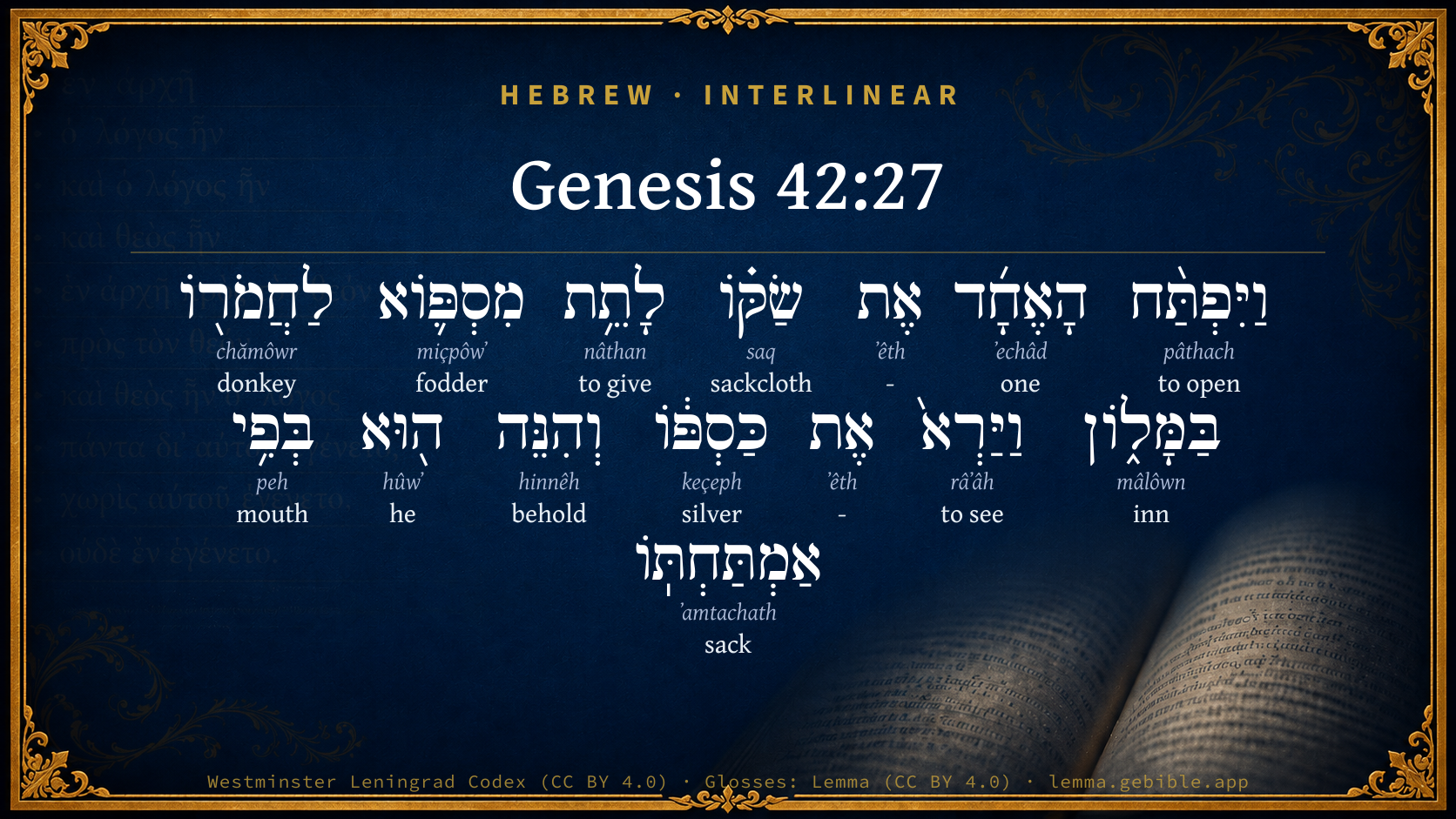
Hebrew (Westminster Leningrad Codex) Genesis 42:27 appears in the Hebrew Old Testament. The text above is from the Westminster Leningrad Codex. Each word links to its Strong’s number, a concise gloss, and parsing drawn from the Open Scriptures Hebrew Bible morphology. Click any word for its full Brown-Driver-Briggs (BDB) entry.
Download image
Cite this verse

Genesis 42:27 (World English Bible). Public Domain. Lemma interlinear Bible study tool, https://lemma.gebible.app/v/genesis/42/27.

Show BibTeX & RIS
BibTeX
RIS
English Translation
As one of them opened his sack to give his donkey food in the lodging-place, he saw his money. Behold, it was in the mouth of his sack.
World English Bible · Public Domain
Highlights
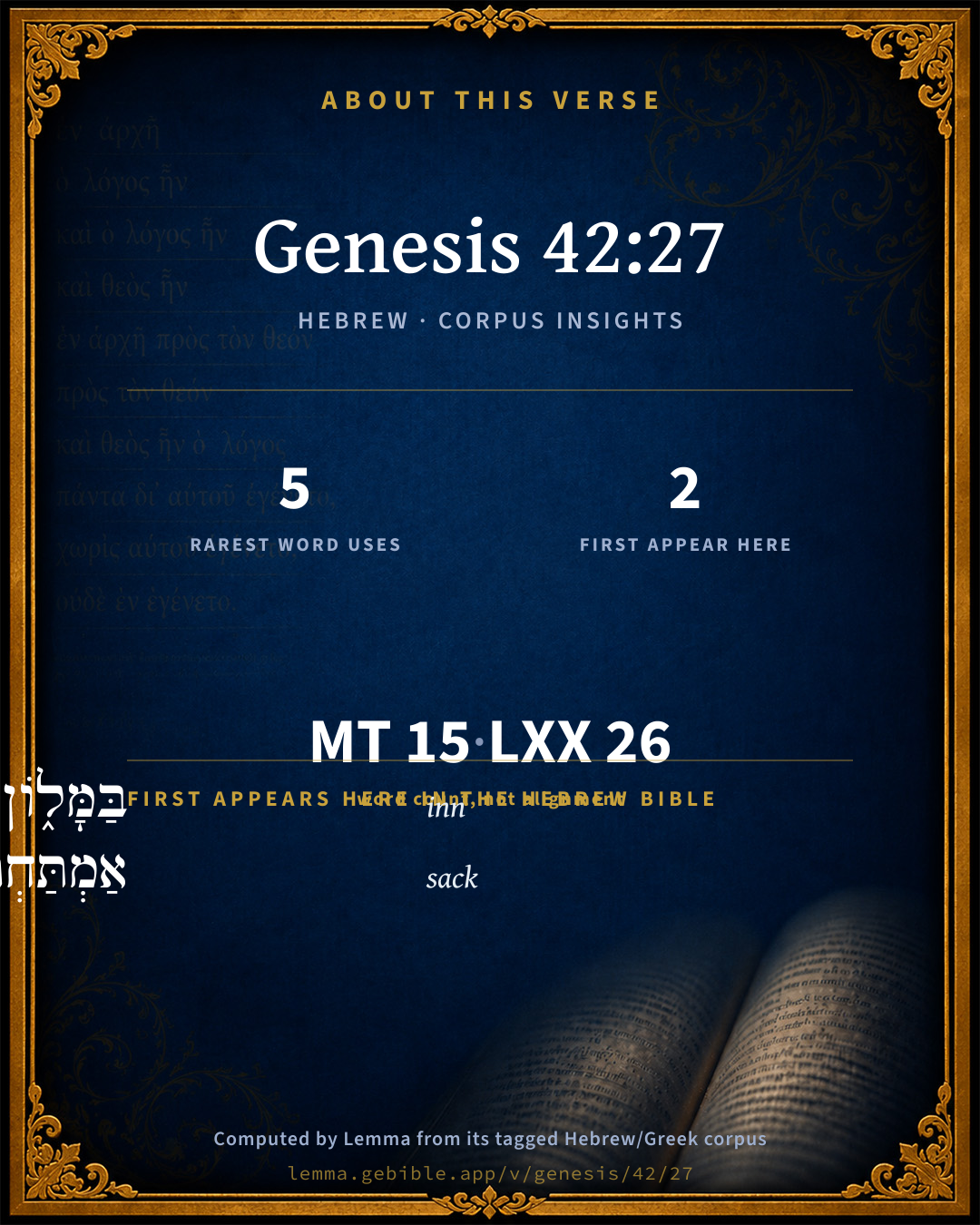
  • 2 first appearances in the Hebrew Bible
Full analysis ↓
Download a study sheet

One document with this verse’s original text, its word-by-word gloss line, the meaning frame, cross-references with their text, attributed commentary, and full source and license credits — printable, and it pastes into notes with its structure intact.

This verse Autodidact and up

Study sheet (.html) Plain text (.txt)

A passage Seminary Student

Up to 50 verses in one chapter. A passage sheet keeps up to 6 commentary sources and 12 cross-references per verse, in the order this page ranks them, and says so on the sheet whenever that leaves anything out. Ask for a single verse and you get the Autodidact verse sheet above.

Everything on this page stays free to read, with no account — the sheet is a download of what is already on screen, not access to it.

Want to remove ads? Support Godless Engineer
Compare translations 3

The same verse in 3 English versions, stacked beneath the original-language interlinear above. Click any original word for its lexicon entry.

Each is an independent rendering of the whole verse — the interlinear is not word-aligned to these translations.

Highlighted words mark where these versions differ — a whole-verse word diff, not a word-by-word alignment.

  • World English Bible Public Domain
    As one of them opened his sack to give his donkey food in the lodging-place, he saw his money. Behold, it was in the mouth of his sack.
  • King James Version Public Domain
    And as one of them opened his sack to give his ass provender in the inn, he espied his money; for, behold, it was in his sack's mouth.
  • unfoldingWord Literal Text CC BY-SA 4.0
    Then one opened his sack to give fodder to his donkey at the lodging place, and he saw his silver, and behold, it in the mouth of his sack!

unfoldingWord Literal Text — © unfoldingWord, licensed CC BY-SA 4.0. Word-aligned USFM3 via Door43 (git.door43.org/unfoldingWord/en_ult).

Versions to compare (up to 4)

3 of 4 selected

Show all 18 translations

Every available English version of this verse, each an independent rendering of the whole verse.

  • World English Bible Public Domain
    As one of them opened his sack to give his donkey food in the lodging-place, he saw his money. Behold, it was in the mouth of his sack.
  • Berean Standard Bible Public Domain
    At the place where they lodged for the night, one of them opened his sack to get feed for his donkey, and he saw his silver in the mouth of the sack.
  • Majority Standard Bible Public Domain
    At the place where they lodged for the night, one of them opened his sack to get feed for his donkey, and he saw his silver in the mouth of the sack.
  • King James Version Public Domain
    And as one of them opened his sack to give his ass provender in the inn, he espied his money; for, behold, it was in his sack's mouth.
  • American Standard Version (1901) Public Domain
    And as one of them opened his sack to give his ass provender in the lodging-place, he espied his money; and, behold, it was in the mouth of his sack.
  • Revised Version (1885) Public Domain
    And as one of them opened his sack to give his ass provender in the lodging place, he espied his money; and, behold, it was in the mouth of his sack.
  • Geneva Bible (1599) Public Domain
    And as one of them opened his sacke for to giue his asse prouender in the ynne, he espyed his money: for lo, it was in his sackes mouth.
  • Douay-Rheims (1899) Public Domain
    And one of them opening his sack, to give his beast provender in the inn, saw the money in the sack's mouth;
  • Young's Literal Translation Public Domain
    and the one openeth his sack to give provender to his ass at a lodging-place, and he seeth his money, and lo, it `is' in the mouth of his bag,
  • Literal Standard Version CC BY-SA 4.0
    and the one opens his sack to give provender to his donkey at a lodging-place, and he sees his money, and behold, it [is] in the mouth of his bag,
  • Unlocked Literal Bible CC BY-SA 4.0
    As one of them opened his sack to give his donkey feed in the lodging place, he saw his money. Behold, it was in the opening of his sack.
  • unfoldingWord Literal Text CC BY-SA 4.0
    Then one opened his sack to give fodder to his donkey at the lodging place, and he saw his silver, and behold, it in the mouth of his sack!
  • Darby Bible Public Domain
    And one of them opened his sack to give his ass food in the inn, and saw his money, and behold, it was in the mouth of his sack.
  • World Messianic Bible Public Domain
    As one of them opened his sack to give his donkey food in the lodging place, he saw his money. Behold, it was in the mouth of his sack.
  • Webster's Bible Public Domain
    And as one of them opened his sack to give his ass provender in the inn, he espied his money: for behold, it was in his sack's mouth.
  • Free Bible Version CC BY-SA 4.0
    On their way they stopped for the night, and one of them opened up his sack to give his donkey something to eat and saw his money there at the top of the sack.
  • Bible in Basic English Public Domain
    Now at their night's resting-place one of them, opening his bag to give his ass some food, saw his money in the mouth of the bag.
  • JPS Tanakh (1917) Public Domain
    And as one of them opened his sack to give his ass provender in the lodging-place, he espied his money; and, behold, it was in the mouth of his sack.

Literal Standard Version (2020), Covenant Press — licensed CC BY-SA 4.0. Text via the HelloAO Bible API (eBible.org). Unlocked Literal Bible (unfoldingWord) — licensed CC BY-SA 4.0. Text via the HelloAO Bible API (eBible.org). unfoldingWord Literal Text — © unfoldingWord, licensed CC BY-SA 4.0. Word-aligned USFM3 via Door43 (git.door43.org/unfoldingWord/en_ult). Free Bible Version, Dr. Jonathan Gallagher — licensed CC BY-SA 4.0. Text via the HelloAO Bible API (eBible.org).

Word by word

More ways to search: Search by grammar → Find every occurrence → Compare this word →

Practice this passage: Drill this verse → Learn its vocabulary →

מִסְפּ֛וֹא
miçpôwʼ
H4554
“fodder”
Noun, Common, Masculine, Singular, Absolute
Part of Speech
Noun
Type
Common
Gender
Masculine
Number
Singular
State
Absolute
Full BDB Definition

Origin: from an unused root meaning to collect

TWOT: 1529a

fodder, feed
  1. וַיִּפְתַּ֨ח pâthach H6605 “and · to open” Conjunction + Verb, Qal, Sequential Imperfect, 3rd Person, Masculine, Singular
  2. הָאֶחָ֜ד ʼechâd H259 “the · one” Particle, Definite Article + Adjective, Cardinal number, Masculine, Singular, Absolute
  3. אֶת ʼêth H853 “-” Particle, Direct Object
  4. שַׂקּ֗וֹ saq H8242 “sackcloth · his” Noun, Common, Masculine, Singular, Construct + Suffix, Personal, 3rd Person, Masculine, Singular
  5. לָתֵ֥ת nâthan H5414 “to give” Preposition + Verb, Qal, Infinitive Construct
  6. לַחֲמֹר֖וֹ chămôwr H2543 “to/for · donkey · his” Preposition + Noun, Common, Both, Singular, Construct + Suffix, Personal, 3rd Person, Masculine, Singular
  7. בַּמָּל֑וֹן mâlôwn H4411 “in/at the · inn” Preposition, Determined + Noun, Common, Masculine, Singular, Absolute
  8. וַיַּרְא֙ râʼâh H7200 “and · to see” Conjunction + Verb, Qal, Sequential Imperfect, 3rd Person, Masculine, Singular
  9. אֶת ʼêth H853 “-” Particle, Direct Object
  10. כַּסְפּ֔וֹ keçeph H3701 “silver · his” Noun, Common, Masculine, Singular, Construct + Suffix, Personal, 3rd Person, Masculine, Singular
  11. וְהִנֵּה hinnêh H2009 “and · behold” Conjunction + Particle, Demonstrative
  12. ה֖וּא hûwʼ H1931 “he” Pronoun, Personal, 3rd Person, Masculine, Singular
  13. בְּפִ֥י peh H6310 “in/at · mouth of” Preposition + Noun, Common, Masculine, Singular, Construct
  14. אַמְתַּחְתּֽוֹ ʼamtachath H572 “sack · his” Noun, Common, Feminine, Singular, Construct + Suffix, Personal, 3rd Person, Masculine, Singular

About this verse

These counts appear in no published source. They are computed here, from the morphology-tagged text and Lemma’s own curated glosses. What Lemma adds →

15
words
14
distinct lemmas
Pentateuch
section

Notable vocabulary

The rarest word here is מִסְפּ֛וֹא fodder H4554 — appearing just 5 times in the whole Hebrew Bible.

First appearance in Scripture

These words make their first canonical appearance in the Hebrew Bible here:

  • בַּמָּל֑וֹן inn H4411
  • אַמְתַּחְתּֽוֹ sack H572

Shared distinctive vocabulary

מִסְפּ֛וֹא fodder H4554 occurs in 5 verses of the Hebrew Bible. Also found in:

Grammatical profile

  • 3 verbs
  • 7 nouns
  • 1 adjective
  • 1 pronoun
  • 3 particles

Verb forms

  • וַיִּפְתַּ֨ח Qal · Sequential Imperfect
  • לָתֵ֥ת Qal · Infinitive Construct
  • וַיַּרְא֙ Qal · Sequential Imperfect

Hebrew & Septuagint length

In English translation the verse runs 28 words from the Hebrew and 32 from the Septuagint (LXX English) — closely comparable.

A rough comparison of the two English renderings, which tokenize alike — not a word-level alignment.

Word counts can differ between the Hebrew and the Greek without any difference in meaning — e.g. the Hebrew direct-object marker אֵת has no separate Greek word, and Greek often adds the article ὁ.

In the original languages it is 15 Hebrew tokens and 26 Greek tokens — but the two are counted differently (Hebrew bundles its prefixes and suffixes into one token; the Greek is in lemma form), so that isn’t a like-for-like length.

Cross-references

5

Topical passages linked to Genesis 42:27 in the Treasury of Scripture Knowledge — connected by theme and wording, ordered by reader-vote popularity; previews shown in the World English Bible.

  • Exodus 4:24 It happened on the way at a lodging place, that Yahweh met him and wanted to kill him.
  • Genesis 43:21–22 and it happened, when we came to the lodging-place, that we opened our sacks, and, behold, every man's money was in the mouth of his sack, our money in full weight. We have brought it again in our hand.
  • Genesis 44:11 Then they hurried, and took down every man his sack to the ground, and opened every man his sack.
  • Luke 2:7 She brought forth her firstborn son, and she wrapped him in bands of cloth, and laid him in a feeding trough, because there was no room for them in the inn.
  • Luke 10:34 came to him, and bound up his wounds, pouring on oil and wine. He set him on his own animal, and brought him to an inn, and took care of him.

Cross-references courtesy of OpenBible.info (CC BY 4.0).

Hebrew and Greek witnesses Masoretic Hebrew ↔ Greek Septuagint

The same verse in the two great witnesses to the Old Testament, shown verse-for-verse.

These are two independent witnesses, not word-aligned to each other, and the Septuagint is shown in lemma (dictionary) form.

Hebrew Genesis 42:27 Masoretic · Westminster Leningrad Codex

וַיִּפְתַּ֨ח הָאֶחָ֜ד אֶת שַׂקּ֗וֹ לָתֵ֥ת מִסְפּ֛וֹא לַחֲמֹר֖וֹ בַּמָּל֑וֹן וַיַּרְא֙ אֶת כַּסְפּ֔וֹ וְהִנֵּה ה֖וּא בְּפִ֥י אַמְתַּחְתּֽוֹ

As one of them opened his sack to give his donkey food in the lodging-place, he saw his money. Behold, it was in the mouth of his sack.

World English Bible · Public Domain

Greek LXX Genesis 42:27 Septuagint · lemma form

λύω δέ εἷς ὁ μάρσιππος αὐτός δίδωμι χόρτασμα ὁ ὄνος αὐτός οὗ καταλύω ὁράω ὁ δεσμός ὁ ἀργύριον αὐτός καί εἰμί ἐπάνω ὁ στόμα ὁ μάρσιππος

And one having opened his sack to give his asses fodder, at the place where they rested, saw also his bundle of money, for it was on the mouth of his sack.

LXX2012 (modern English Septuagint) · Public Domain

Hebrew: Westminster Leningrad Codex (CC BY 4.0). Greek: Septuagint (public domain); English from LXX2012 (modern English Septuagint) (Public Domain). How the Septuagint differs from the Hebrew →

Targum (Aramaic paraphrase)

2

The Targum is the ancient Jewish Aramaic paraphrase of the Hebrew Scriptures — an interpretive translation, not the Hebrew text itself. Onkelos (literal) and Pseudo-Jonathan (expansive) render the Torah, and Jonathan the Prophets. Coverage is partial: where no permissively-licensed English translation exists for a verse, only the Aramaic is shown. This is verse-level text, not a word-by-word alignment to the Hebrew.

  1. Targum Onkelos Torah (Genesis–Deuteronomy)
    וּפְתַח חַד יָת סַקֵּהּ לְמִתַּן כִּסְתָא לַחֲמָרֵהּ בְּבֵית מְבָתָא וַחֲזָא יָת כַּסְפֵּהּ וְהָא הוּא בְּפוּם טוֹעֲנֵהּ

    (no public-domain English translation for this verse)

    Targum Onkelos — Aramaic: “Onkelos Genesis” (public domain); “Onkelos Exodus” (public domain); “Onkelos Leviticus” (public domain); “Onkelos Numbers” (public domain); “Onkelos Deuteronomy” (public domain). English: “Sefaria Community Translation” (CC0 1.0 (public-domain dedication)); “J.W. Etheridge. The Targums of Onkelos and Jonathan Ben Uzziel on the Pentateuch. London: Longmans, Green, 1862” (public domain). Text via Sefaria.

  2. Targum Pseudo-Jonathan Torah (Genesis–Deuteronomy)
    וּפְתַח לֵוִי דְאִשְׁתָּאֵר בִּלְחוֹדֵיהּ מִשִׁמְעוֹן חַבְרֵיהּ יַת שַקֵיהּ לְמִתַּן אַסְפַּסְתָּא לְחַמְרֵיהּ בְּבֵי מִבְתוֹתָא וַחֲמָא יַת כַּסְפֵּיהּ וְהָא הוּא בְּפוּם טוֹנֵיהּ

    Levi, who had been left without Shimeon his companion, opened his sack to give food to his ass at the place of lodging, and saw his money: behold, it was in the mouth of his pannier.

    Targum Pseudo-Jonathan — Aramaic: “Targum Jonathan on Genesis” (public domain); “Targum Jonathan on Exodus” (public domain); “Targum Jonathan on Leviticus” (public domain); “Targum Jonathan on Numbers” (public domain); “Targum Jonathan on Deuteronomy” (public domain). English: “The Targum of Jonathan ben Uzziel, trans. J. W. Etheridge, London, 1862” (public domain). Text via Sefaria.

Commentary

Notes on Genesis 42:27 from classic Christian and Jewish commentators (each source and its license shown beneath its notes). The classic Christian expositions comment on the surrounding passage and are grouped to its opening verse, so a note may address several verses; the Jewish commentaries on the Tanakh (Rashi and others) are per-verse, so they appear only where the commentator wrote on this verse.

Lemma curates 59 commentaries, every one of them public domain or Creative Commons licensed, each selected and text-cleaned for this edition rather than reprinted as found. About our sources →

The Cambridge Bible for Schools and Colleges

gen. ed. J. J. S. Perowne

27–38. The Return to Canaan

27. one of them] Anticipating Gen_42:35. Lit. “the one,” i.e. the others followed. This verse and Gen_42:28 are from J, according to which the money is found in the sacks at their first lodging place; see Gen_43:21. According to E, the money is found in their sacks, when they reach their home (see Gen_42:35). A word for “sack,”  ’amtâhath, a very unusual one, occurs twice in Gen_42:27 (end), 28, and thirteen times in chs. 43, 44 (J), but not in Gen_42:35 or elsewhere in the O.T.

the lodging place] i.e. “the shelter,” or wayside quarters, where they could rest during the night. Cf. Exo_4:24; Jer_9:2. There is, perhaps, scarcely sufficient warrant for us to assume that this was a khan, or road-side inn. Such places hardly existed. A rough shelter, a meagre encampment of black tents, with a scanty protection of a few sticks, brushwood, and blankets, behind which the men and asses would rest, is perhaps all that is meant.

The Cambridge Bible for Schools and Colleges (gen. ed. J. J. S. Perowne; Cambridge University Press, 1878–1918) — public domain. Text from a community e-Sword module.

Trapp's Complete Commentary

John Trapp

Gen 42:27 And as one of them opened his sack to give his ass provender in the inn, he espied his money; for, behold, it [was] in his sack’s mouth.

Ver. 27. To give his ass provender in the inn.] Their inns then were not so well furnished as ours are; but they were forced to carry their provender, which was a trouble.

John Trapp, A Commentary or Exposition upon All the Books of the Old and New Testament (1647–1656) — public domain. Text from a community e-Sword module.

Jamieson, Fausset & Brown

Robert Jamieson, A. R. Fausset & David Brown

inn--a mere station for baiting beasts of burden.

he espied his money--The discovery threw them into greater perplexity than ever. If they had been congratulating themselves on escaping from the ruthless governor, they perceived that now he would have a handle against them; and it is observable that they looked upon this as a judgment of heaven. Thus one leading design of Joseph was gained in their consciences being roused to a sense of guilt.

Jamieson, Fausset & Brown — Commentary Critical and Explanatory on the Whole Bible (1871) — public domain (CC PDM 1.0). Text via the HelloAO Bible API.

Adam Clarke's Commentary

Verse 27. One of them opened his sack] From Ge 42:35 we learn that each of the ten brethren on emptying his sack when he returned found his money in it; can we suppose that this was not discovered by them all before? It seems not; and the reason was probably this: the money was put in the mouth of the sack of one only, in the sacks of the others it was placed at or near to the bottom; hence only one discovered it on the road, the rest found it when they came to empty their sacks at their father's house.

In the inn] במלון bammalon, from לן lan, to lodge, stay, remain, c. The place at which they stopped to bait or rest themselves and their asses. Our word inn gives us a false idea here there were no such places of entertainment at that time in the desert over which they had to pass, nor are there any to the present day. Travellers generally endeavour to reach a well, where they fill their girbahs, or leathern bottles, with fresh water, and having clogged their camels, asses, &c., permit them to crop any little verdure there may be in the place, keeping watch over them by turns. This is all we are to understand by the malon or inn in the text, for even caravanseries were not then in use, which are generally no more than four walls perfectly exposed, the place being open at the top.

Adam Clarke's Commentary on the Bible (1810–1826) — public domain. Text from a community e-Sword/MySword module.

John Calvin's Commentaries

27. And as one of them opened his sack. With what intention Joseph had commanded the price paid for the corn to be secretly deposited in the sacks of his brethren, may easily be conjectured; for he feared lest his father being already impoverished, would not be able again to buy provisions. The brethren, having found their money, knew not where to seek the cause; except that, being terrified, they perceived that the hand of God was against them. That they were greatly astonished appears from their not voluntarily returning to Joseph, in order to prove their own innocence: for the remedy of the evil was at hand, if they had not been utterly blinded. Wherefore we must ask God to supply us, in doubtful and troubled affairs, not only with fortitude, but also with prudence. We see also how little can be effected even by a great multitude, unless the Lord preside among them. The sons of Jacob ought mutually to have exhorted each other, and to have consulted together what was necessary to be done: but there is an end to all deliberation; no solace nor remedy is suggested. Even while each sees the rest agitated, they mutually increase each other’s trepidation. Therefore, the society and countenance of men will profit us nothing, unless the Lord strengthen us from heaven.

John Calvin's Commentaries (1540-1563) — public domain. Text from the Calvin Translation Society English edition (1840s-50s) via the Christian Classics Ethereal Library (ccel.org). Calvin's coverage is partial (roughly two-thirds of the Bible); uncommented books and verses are honest gaps, never fabricated. The 19th-century editor's footnotes and remarks are omitted so the notes are faithfully Calvin's own voice.

Ellicott's Commentary for English Readers

(27) In the inn.—Heb., lodging-place, literally, place to pass the night. It is quite possible that on a route frequented by numerous caravans there were places where a certain amount of protection for the beasts of burden and their attendants had been provided, either by the rulers, or by benevolent people. But Joseph’s brethren would find there at most only walls and water. “The one” who opened his sack is said by tradition to have been Levi. At the end of the verse this sack is called by another name, signifying a travelling-bag, or wallet for forage. The translation of these three different words, vessel, wallet, and sack, indifferently by the last of them, has led to the absurd view, common among commentators, that Joseph’s brethren went down into Egypt, each with one ass and one sack. Hence their astonishment that such an insignificant knot of men should be brought before the governor of Egypt. But the word used in Gen_42:25 signifies everything into which corn could be put; and the word at the end of this verse is the travelling-bag, which each of the patriarchs carried behind him on his riding ass. Their men would go on foot at the side of the beasts of burden laden with the corn.

It is said here that one only found his money at the lodging-place, and that the rest did not find their money until they emptied their sacks on reaching home. the sacks mentioned here (in Gen_42:35) were the same as the travelling-bags, for they are expressly so called in Gen_43:21-23. In Gen_43:21, however, they tell Joseph’s steward that they all found their money in the mouth of their sacks on opening them at the lodging-place. This was not strictly accurate, but it would have been wearisome and useless to enter into such details. Two things it was necessary to show: the first, that all had found their money; the second, that they had gone too far on their journey homewards to be able to return and give the money back. Probably what is said in Gen_43:21 was literally true only of one, and he found his money because it had been put in last, and was therefore at the mouth of the wallet. In all the other sacks it had been put in first, under the corn, and so they did not find it until “they had emptied their sacks.”

A Bible Commentary for English Readers, edited by Charles John Ellicott (1878–1897) — public domain. Text from a community e-Sword module.

John Gill's Exposition

And we said unto him, we are true men,.... Honest, upright men, not given to treacherous and treasonable practices, either in the country where they lived, or any other; they came to Egypt with no ill design upon the country, only to buy corn for the relief of their families in necessity:

we are no spies; or never were (e): they had never been guilty of such practices, and never charged with anything of that kind; they denied the charge, and detested the character.

(e) "non fuimus", Montanus; "nunquam fuimus", Junius & Tremellius, Piscator, Schmidt.

John Gill's Exposition of the Whole Bible (1746–1763) — public domain (CC PDM 1.0). Text via the HelloAO Bible API.

Matthew Poole's English Annotations

And after him the rest by his example and information did so, as is affirmed Gen 43:21, and it is not denied here.

Matthew Poole's English Annotations on the Holy Bible (1683–1685) — public domain. Text from a community e-Sword/MySword module.

Whedon's Commentary on the Bible

Daniel D. Whedon

27. The inn — מלון, a lodging place; some sheltered and suitable place for encampment over night. Possibly some sort of caravansary was, even in that early time, provided along the great highways of travel for the convenience of caravans like this.

Daniel D. Whedon (gen. ed.), Commentary on the Old and New Testaments (1874–1909) — public domain. Text from a community e-Sword module.

The Pulpit Commentary

And as one of them opened his sack literally, and the one opened his sack, i.e. they did not all open their sacks on the homeward journey, although afterwards, in reporting the circumstance to Joseph, they represent themselves as having done so; (Gen_43:21) but only one at the wayside inn, and the rest on reaching home (ver. 35; vide infra, Gen_43:21) to give his ass provender in the inn (the wOlm from Wl, an inn to pass the night, was not in the modern sense of the term, but simply a halting-place or camping station where travelers were wont to lodge, without finding for themselves or animals any other food than they carried with them), he espied his money; for, behold, it was in his sack"s mouth literally, in the opening, of his amtachath, tjTma, from jtm to spread out, an old word for a sack, (Gen_43:18, Gen_43:21, Gen_43:22) here used synonymously with qc, from which it would seem that the travelers carried two sorts of bags, one for the corn yliK (ver. 25), and another for the called asses" provender called tjTma. It was in the latter that the money had been placed.

The Pulpit Commentary (1880–1919), ed. H.D.M. Spence-Jones & Joseph S. Exell — public domain. Text from a community e-Sword module.

Rashi

Rabbi Shlomo Yitzchaki (Rashi)

ויפתח האחד literally, AND THE ONE OPENED HIS SACK — This was Levi who remained alone (one) being without Simeon his companion (cf Targum Jonathan).

במלון means the place where they stayed over night — THE INN.

אמתחתו is the sack (שק) just mentioned.

Rashi on the Tanakh — English translations: “The Judaica Press complete Tanach with Rashi, translated by A. J. Rosenberg” (CC BY 4.0); “Pentateuch with Rashi's commentary by M. Rosenbaum and A.M. Silbermann, 1929-1934” (public domain); “The Metsudah Tanach series, Lakewood, N.J” (CC BY 4.0); and “The Book of Joshua, Metsudah Publications, 1997” (CC BY 4.0). Text via Sefaria.

Ramban (Nachmanides)

Rabbi Moshe ben Nachman (Ramban / Nachmanides)

AND AS ONE OF THEM OPENED HIS SACK. One of them opened his sack in the inn to give therefrom some fodder to his ass, while the others did not open their sacks until they were with their father, just as it says, And it came to pass as they emptied their sacks, for perhaps the others took straw for their asses, lest they consume their entire loads on the way. But the one who opened the sack on the way had a weak ass, which required fodder, and he thus found the money in the mouth of his bag (‘amtachto’).Now Rashi writes that amtachath is the sack, but Onkelos translated it as “load.” It appears from Onkelos’ opinion that each one in order to equalize his load, had large sacks and small sacks, and the total load of each one is called amtachath. Thus it happened that one of them found his money at the mouth of the particular sack he opened, while it did not happen to the others until they emptied all their sacks.It seems plausible to me that amtachath is a large sack containing two sides, known in the language of the Talmud as matrata, meaning that if a person is carrying two leather sacks of equal weight on his right and left shoulders, why should he change one sack for the other? (See Rashi there.) and the money of each one was put at the mouth of one of the sides. Now it so happened that one of them opened the side where the money lay, but it did not happen to the others. This kind of sack is called amtachath because it stretches (yimtach) at the sides.

Ramban (Nachmanides) on the Tanakh — English translation: “Commentary on the Torah by Ramban (Nachmanides). Translated and annotated by Charles B. Chavel. New York, Shilo Pub. House, 1971-1976” (CC BY 4.0). Text via Sefaria.

Radak

Rabbi David Kimhi (Radak)

ויפתח האחד, one of them. According to a homiletic comment quoted by Rashi, the definitive article at the beginning of the word האחד is a hint that this was Levi, who, through his buddy Shimon having been detained by Joseph, was now “the one,” i.e. left alone without his closest companion.

בפי אמתחתו, Joseph had instructed that the money of one of them should be not just placed back in his sack, but should be placed near the top so that he would find it immediately he opened the sack. The money of the other brothers had been placed somewhere in the middle section of their respective containers, or even at the very bottom. If the money of all of them had been placed near the top of their bags they would see it as soon as they started giving fodder to their beasts, and they would turn around to Egypt pointing out that someone had made a mistake. They would be anxious to clear themselves of the danger of being accused of an additional crime, of being thieves. Joseph had therefore taken precautions that only one of them should find his money before they would get home. He had arranged matters in a way to cause them maximum worry.

Radak on the Tanakh — English translations: “Sefaria Community Translation” (CC0 1.0 (public-domain dedication)); “Eliyahu Munk, HaChut Hameshulash” (CC BY 4.0); “Rabbi Mike Feuer, Jerusalem Anthology” (CC BY 4.0); and “R. David Kimhi on the first book of Psalms, Translated by R.G. Finch, London, 1919” (public domain). Text via Sefaria.

Lesson kit

Teaching starters — assembled from the data on this page, not authored interpretation. Every prompt links to the verse data it draws on. Edit before teaching.

Genesis, in the Pentateuch, opens this verse with 15 words (14 distinct Hebrew lemmas). Its most distinctive word is miçpôwʼ (“fodder”). A historical commentator’s framing appears above. Read the whole chapter for the surrounding context.

Discussion questions

  1. What does “fodder” (miçpôwʼ) contribute to the verse as a whole?
  2. 2 words make their first appearance in Scripture here. What does this debut establish?
  3. How does Genesis 24:25, which shares the word «fodder», read alongside this verse?
  4. These translations render this verse differently. What is at stake in choosing one wording over another?
  5. «וַיִּפְתַּ֨ח» is a Qal Sequential Imperfect verb. How does that grammatical form shape the action described?
  6. Compare how The Cambridge Bible for Schools and Colleges and Trapp's Complete Commentary read this verse. Where do they agree or differ?

Things to notice

Reading settings

Reading text

Shown beneath each verse's original-language words.

Old Testament
Old Testament edition

Read the OT as the Masoretic Hebrew (MT) or the Greek Septuagint (LXX).

English shown for the Greek Septuagint (in the Hebrew ↔ Greek comparison).

Comparing translations? Open the Compare panel on any verse page to stack up to four side by side.