Genesis 17:5

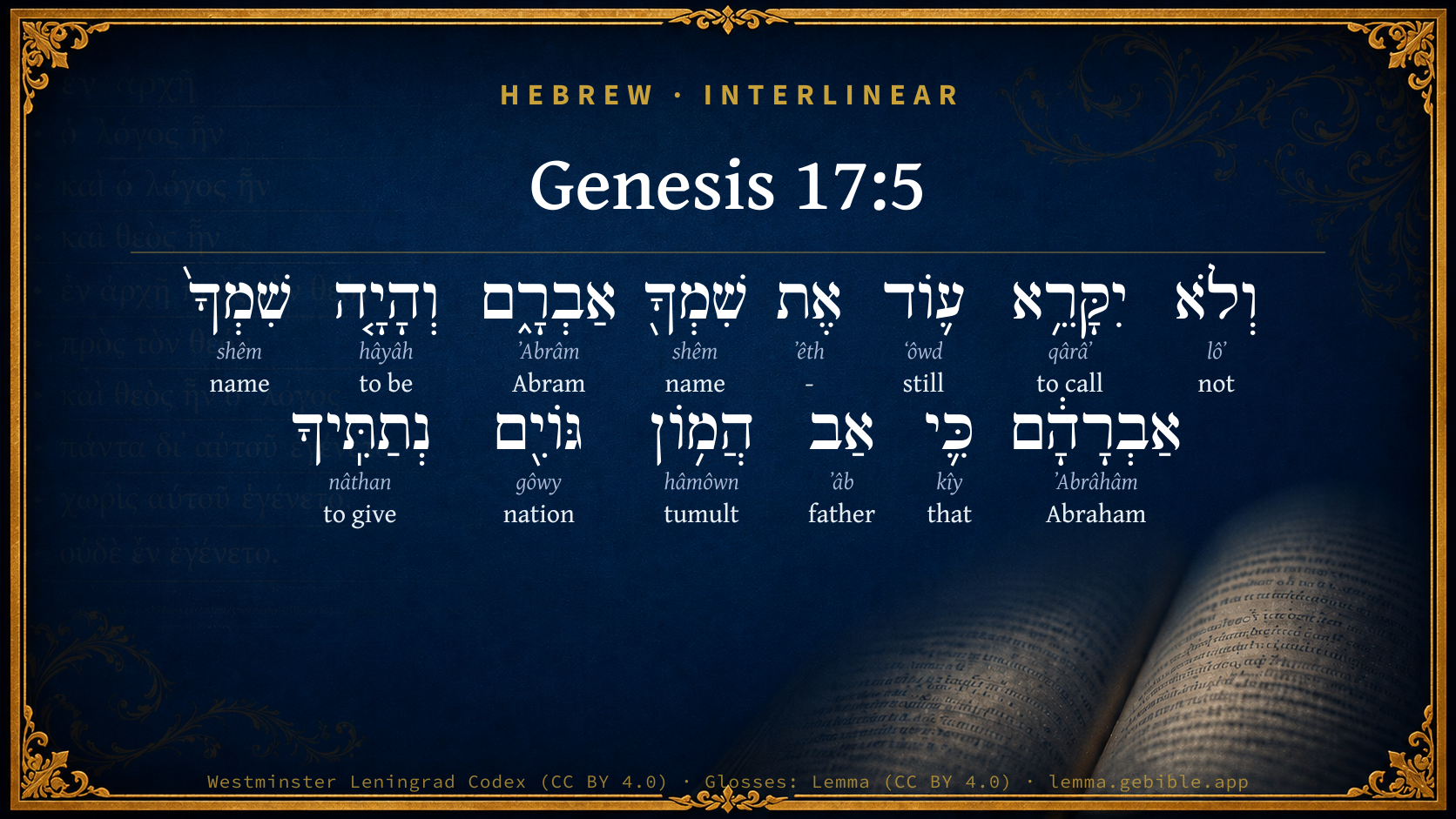
Hebrew (Westminster Leningrad Codex) Genesis 17:5 appears in the Hebrew Old Testament. The text above is from the Westminster Leningrad Codex. Each word links to its Strong’s number, a concise gloss, and parsing drawn from the Open Scriptures Hebrew Bible morphology. Click any word for its full Brown-Driver-Briggs (BDB) entry.
Download image
Cite this verse

Genesis 17:5 (World English Bible). Public Domain. Lemma interlinear Bible study tool, https://lemma.gebible.app/v/genesis/17/5.

Show BibTeX & RIS
BibTeX
RIS
English Translation
Neither will your name any more be called Abram, but your name will be Abraham; for the father of a multitude of nations have I made you.
World English Bible · Public Domain
Highlights
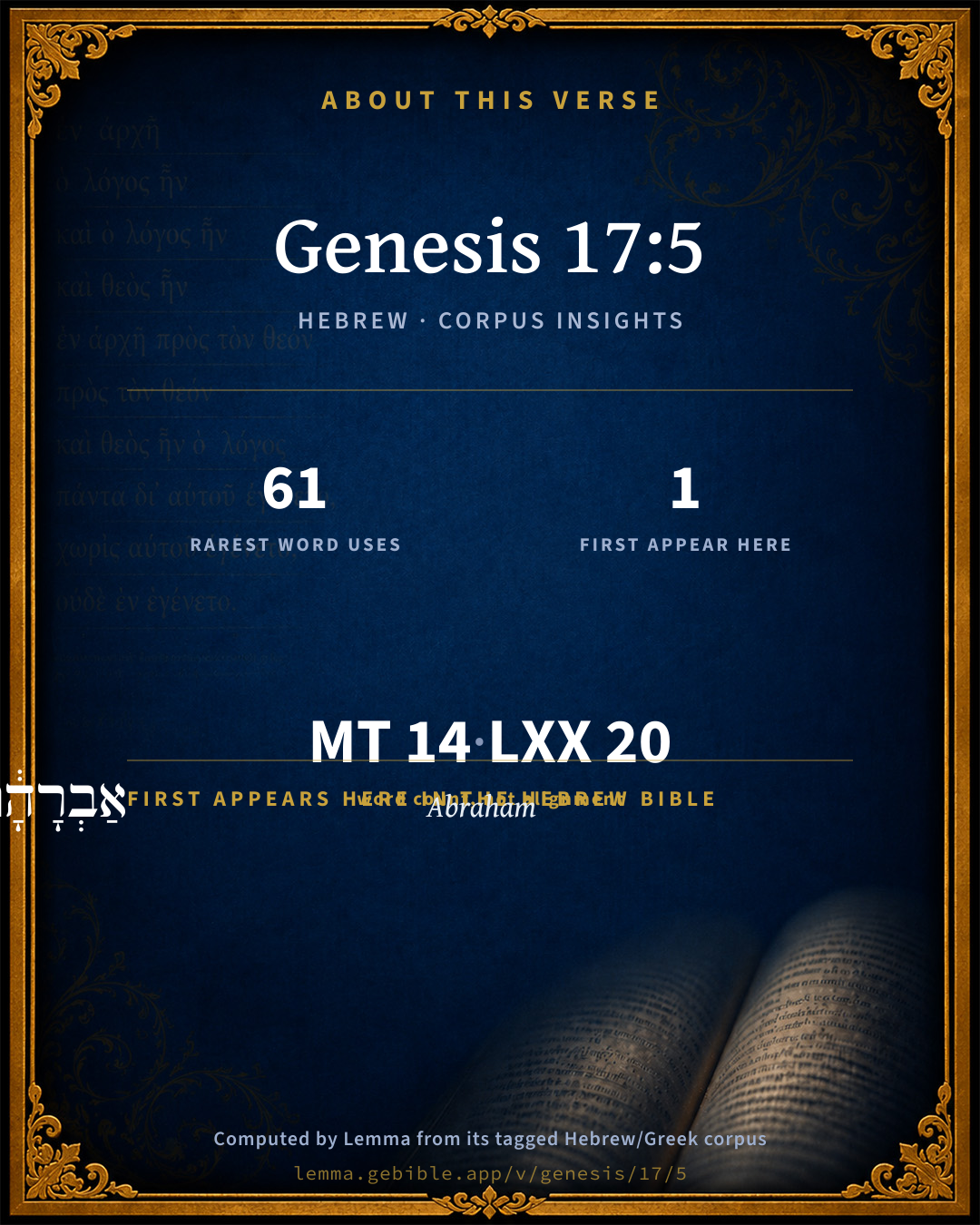
  • 1 first appearance in the Hebrew Bible
Full analysis ↓
Download a study sheet

One document with this verse’s original text, its word-by-word gloss line, the meaning frame, cross-references with their text, attributed commentary, and full source and license credits — printable, and it pastes into notes with its structure intact.

This verse Autodidact and up

Study sheet (.html) Plain text (.txt)

A passage Seminary Student

Up to 50 verses in one chapter. A passage sheet keeps up to 6 commentary sources and 12 cross-references per verse, in the order this page ranks them, and says so on the sheet whenever that leaves anything out. Ask for a single verse and you get the Autodidact verse sheet above.

Everything on this page stays free to read, with no account — the sheet is a download of what is already on screen, not access to it.

Want to remove ads? Support Godless Engineer
Compare translations 3

The same verse in 3 English versions, stacked beneath the original-language interlinear above. Click any original word for its lexicon entry.

Each is an independent rendering of the whole verse — the interlinear is not word-aligned to these translations.

Highlighted words mark where these versions differ — a whole-verse word diff, not a word-by-word alignment.

  • World English Bible Public Domain
    Neither will your name any more be called Abram, but your name will be Abraham; for the father of a multitude of nations have I made you.
  • King James Version Public Domain
    Neither shall thy name any more be called Abram, but thy name shall be Abraham; for a father of many nations have I made thee.
  • unfoldingWord Literal Text CC BY-SA 4.0
    And your name will not be called Abram anymore, but your name will be Abraham, because I have made you the father of a multitude of nations.

unfoldingWord Literal Text — © unfoldingWord, licensed CC BY-SA 4.0. Word-aligned USFM3 via Door43 (git.door43.org/unfoldingWord/en_ult).

Versions to compare (up to 4)

3 of 4 selected

Show all 18 translations

Every available English version of this verse, each an independent rendering of the whole verse.

  • World English Bible Public Domain
    Neither will your name any more be called Abram, but your name will be Abraham; for the father of a multitude of nations have I made you.
  • Berean Standard Bible Public Domain
    No longer will you be called Abram, but your name will be Abraham, for I have made you a father of many nations.
  • Majority Standard Bible Public Domain
    No longer will you be called Abram, but your name will be Abraham, for I have made you a father of many nations.
  • King James Version Public Domain
    Neither shall thy name any more be called Abram, but thy name shall be Abraham; for a father of many nations have I made thee.
  • American Standard Version (1901) Public Domain
    Neither shall thy name any more be called Abram, but thy name shall be Abraham; for the father of a multitude of nations have I made thee.
  • Revised Version (1885) Public Domain
    Neither shall thy name any more be called Abram, but thy name shall be Abraham; for the father of a multitude of nations have I made thee.
  • Geneva Bible (1599) Public Domain
    Neither shall thy name any more be called Abram, but thy name shalbe Abraham: for a father of many nations haue I made thee.
  • Douay-Rheims (1899) Public Domain
    Neither shall thy name be called any more Abram: but thou shalt be called Abraham: because I have made thee a father of many nations.
  • Young's Literal Translation Public Domain
    and thy name is no more called Abram, but thy name hath been Abraham, for father of a multitude of nations have I made thee;
  • Literal Standard Version CC BY-SA 4.0
    and your name is no longer called Abram, but your name has been Abraham, for father of a multitude of nations have I made you;
  • Unlocked Literal Bible CC BY-SA 4.0
    No longer will your name be Abram, but your name will be Abraham—for I appoint you to be the father of a multitude of nations.
  • unfoldingWord Literal Text CC BY-SA 4.0
    And your name will not be called Abram anymore, but your name will be Abraham, because I have made you the father of a multitude of nations.
  • Darby Bible Public Domain
    And thy name shall no more be called Abram, but thy name shall be Abraham; for a father of a multitude of nations have I made thee.
  • World Messianic Bible Public Domain
    Your name will no more be called Abram, but your name will be Abraham; for I have made you the father of a multitude of nations.
  • Webster's Bible Public Domain
    Neither shall thy name any more be called Abram, but thy name shall be Abraham; for a father of many nations have I made thee.
  • Free Bible Version CC BY-SA 4.0
    so your name won't be Abram any longer. Instead, your name will be Abraham because I'm going to make you the father of many nations.
  • Bible in Basic English Public Domain
    No longer will your name be Abram, but Abraham, for I have made you the father of a number of nations.
  • JPS Tanakh (1917) Public Domain
    Neither shall thy name any more be called Abram, but thy name shall be Abraham; for the father of a multitude of nations have I made thee.

Literal Standard Version (2020), Covenant Press — licensed CC BY-SA 4.0. Text via the HelloAO Bible API (eBible.org). Unlocked Literal Bible (unfoldingWord) — licensed CC BY-SA 4.0. Text via the HelloAO Bible API (eBible.org). unfoldingWord Literal Text — © unfoldingWord, licensed CC BY-SA 4.0. Word-aligned USFM3 via Door43 (git.door43.org/unfoldingWord/en_ult). Free Bible Version, Dr. Jonathan Gallagher — licensed CC BY-SA 4.0. Text via the HelloAO Bible API (eBible.org).

Word by word

More ways to search: Search by grammar → Find every occurrence → Compare this word →

Practice this passage: Drill this verse → Learn its vocabulary →

אַבְרָ֑ם
ʼAbrâm
H87
“Abram”
Noun, Proper
Part of Speech
Noun
Type
Proper
Full BDB Definition

Origin: contracted from H48

TWOT: None

Abram = "exalted father" - original name of Abraham
  1. וְלֹא lôʼ H3808 “and · not” Conjunction + Particle, Negative
  2. יִקָּרֵ֥א qârâʼ H7121 “to call” Verb, Niphal, Imperfect, 3rd Person, Masculine, Singular
  3. ע֛וֹד ʻôwd H5750 “still” Adverb
  4. אֶת ʼêth H853 “-” Particle, Direct Object
  5. שִׁמְךָ֖ shêm H8034 “name · your” Noun, Common, Masculine, Singular, Construct + Suffix, Personal, 2nd Person, Masculine, Singular
  6. וְהָיָ֤ה hâyâh H1961 “and · to be” Conjunction + Verb, Qal, Sequential Perfect, 3rd Person, Masculine, Singular
  7. שִׁמְךָ֙ shêm H8034 “name · your” Noun, Common, Masculine, Singular, Construct + Suffix, Personal, 2nd Person, Masculine, Singular
  8. אַבְרָהָ֔ם ʼAbrâhâm H85 “Abraham” Noun, Proper
  9. כִּ֛י kîy H3588 “that” Conjunction
  10. אַב ʼâb H1 “father of” Noun, Common, Masculine, Singular, Construct
  11. הֲמ֥וֹן hâmôwn H1995 “tumult of” Noun, Common, Masculine, Singular, Construct
  12. גּוֹיִ֖ם gôwy H1471 “nations” Noun, Common, Masculine, Plural, Absolute
  13. נְתַתִּֽיךָ nâthan H5414 “to give · you” Verb, Qal, Perfect, 1st Person, Common, Singular + Suffix, Personal, 2nd Person, Masculine, Singular

About this verse

These counts appear in no published source. They are computed here, from the morphology-tagged text and Lemma’s own curated glosses. What Lemma adds →

14
words
13
distinct lemmas
Pentateuch
section

First appearance in Scripture

This word makes its first canonical appearance in the Hebrew Bible here:

  • אַבְרָהָ֔ם Abraham H85

Grammatical profile

  • 3 verbs
  • 7 nouns
  • 1 conjunction
  • 1 adverb
  • 2 particles

Verb forms

  • יִקָּרֵ֥א Niphal · Imperfect
  • וְהָיָ֤ה Qal · Sequential Perfect
  • נְתַתִּֽיךָ Qal · Perfect

Repetition

A word recurs within this verse — often emphatic in Hebrew:

  • שִׁמְךָ֖ name H8034 ×2

Hebrew & Septuagint length

In English translation the verse runs 27 words from the Hebrew and 25 from the Septuagint (LXX English) — closely comparable.

A rough comparison of the two English renderings, which tokenize alike — not a word-level alignment.

Word counts can differ between the Hebrew and the Greek without any difference in meaning — e.g. the Hebrew direct-object marker אֵת has no separate Greek word, and Greek often adds the article ὁ.

In the original languages it is 14 Hebrew tokens and 20 Greek tokens — but the two are counted differently (Hebrew bundles its prefixes and suffixes into one token; the Greek is in lemma form), so that isn’t a like-for-like length.

Cross-references

13

Topical passages linked to Genesis 17:5 in the Treasury of Scripture Knowledge — connected by theme and wording, ordered by reader-vote popularity; previews shown in the World English Bible.

  • Matthew 1:21–23 She shall bring forth a son. You shall call his name Jesus, for it is he who shall save his people from their sins."
  • Nehemiah 9:7 You are Yahweh the God, who did choose Abram, and brought him forth out of Ur of the Chaldees, and gave him the name of Abraham,
  • Romans 4:17 As it is written, "I have made you a father of many nations." This is in the presence of him whom he believed: God, who gives life to the dead, and calls the things that are not, as though they were.
  • Genesis 17:15 God said to Abraham, "As for Sarai your wife, you shall not call her name Sarai, but her name will be Sarah.
  • Genesis 32:28 He said, "Your name will no longer be called 'Jacob,' but, 'Israel,' for you have fought with God and with men, and have prevailed."
  • Isaiah 62:2–4 The nations shall see your righteousness, and all kings your glory, and you shall be called by a new name, which the mouth of Yahweh shall name.
  • Jeremiah 20:3 It happened on the next day, that Pashhur brought forth Jeremiah out of the stocks. Then said Jeremiah to him, Yahweh has not called your name Pashhur, but Magormissabib.
  • Revelation 2:17 He who has an ear, let him hear what the Spirit says to the assemblies. To him who overcomes, to him I will give of the hidden manna, and I will give him a white stone, and on the stone a new name written, which no one knows but he who receives it.
  • 2 Samuel 12:25 and he sent by the hand of Nathan the prophet; and he named him Jedidiah, for Yahweh's sake.
  • Isaiah 65:15 You shall leave your name for a curse to my chosen; and the Lord Yahweh will kill you; and he will call his servants by another name:
  • Jeremiah 23:6 In his days Judah shall be saved, and Israel shall dwell safely; and this is his name by which he shall be called: Yahweh our righteousness.
  • John 1:42 He brought him to Jesus. Jesus looked at him, and said, "You are Simon the son of Jonah. You shall be called Cephas" (which is by interpretation, Peter).
  • Numbers 13:16 These are the names of the men who Moses sent to spy out the land. Moses called Hoshea the son of Nun Joshua.

Cross-references courtesy of OpenBible.info (CC BY 4.0).

Hebrew and Greek witnesses Masoretic Hebrew ↔ Greek Septuagint

The same verse in the two great witnesses to the Old Testament, shown verse-for-verse.

These are two independent witnesses, not word-aligned to each other, and the Septuagint is shown in lemma (dictionary) form.

Hebrew Genesis 17:5 Masoretic · Westminster Leningrad Codex

וְלֹא יִקָּרֵ֥א ע֛וֹד אֶת שִׁמְךָ֖ אַבְרָ֑ם וְהָיָ֤ה שִׁמְךָ֙ אַבְרָהָ֔ם כִּ֛י אַב הֲמ֥וֹן גּוֹיִ֖ם נְתַתִּֽיךָ

Neither will your name any more be called Abram, but your name will be Abraham; for the father of a multitude of nations have I made you.

World English Bible · Public Domain

Greek LXX Genesis 17:5 Septuagint · lemma form

καί οὐ καλέω ἔτι ὁ ὄνομα σύ αβραμ ἀλλά εἰμί ὁ ὄνομα σύ αβρααμ ὅτι πατήρ πολύς ἔθνος τίθημι σύ

And your name shall no more be called Abram, but your name shall be Abraam, for I have made you a father of many nations.

LXX2012 (modern English Septuagint) · Public Domain

Hebrew: Westminster Leningrad Codex (CC BY 4.0). Greek: Septuagint (public domain); English from LXX2012 (modern English Septuagint) (Public Domain). How the Septuagint differs from the Hebrew →

Targum (Aramaic paraphrase)

2

The Targum is the ancient Jewish Aramaic paraphrase of the Hebrew Scriptures — an interpretive translation, not the Hebrew text itself. Onkelos (literal) and Pseudo-Jonathan (expansive) render the Torah, and Jonathan the Prophets. Coverage is partial: where no permissively-licensed English translation exists for a verse, only the Aramaic is shown. This is verse-level text, not a word-by-word alignment to the Hebrew.

  1. Targum Onkelos Torah (Genesis–Deuteronomy)
    וְלָא יִתְקְרֵי עוֹד יָת שְׁמָּךְ אַבְרָם וִיהֵי שְׁמָךְ אַבְרָהָם אֲרֵי אַב סַגִי עַמְמִין יְהָבִתָךְ

    (no public-domain English translation for this verse)

    Targum Onkelos — Aramaic: “Onkelos Genesis” (public domain); “Onkelos Exodus” (public domain); “Onkelos Leviticus” (public domain); “Onkelos Numbers” (public domain); “Onkelos Deuteronomy” (public domain). English: “Sefaria Community Translation” (CC0 1.0 (public-domain dedication)); “J.W. Etheridge. The Targums of Onkelos and Jonathan Ben Uzziel on the Pentateuch. London: Longmans, Green, 1862” (public domain). Text via Sefaria.

  2. Targum Pseudo-Jonathan Torah (Genesis–Deuteronomy)
    וְלָא יִתְקְרֵי תּוּב יַת שְׁמָךְ אַבְרָם וִיהֵי שְׁמָךְ אַבְרָהָם אֲרוּם לְאַב סַגִי סוֹגְעֵי עַמְמִין מַנִיתָךְ

    And thy name shall be no more called Abram, but Abraham shall be thy name, because to be the father of a great multitude of peoples have I appointed thee.

    Targum Pseudo-Jonathan — Aramaic: “Targum Jonathan on Genesis” (public domain); “Targum Jonathan on Exodus” (public domain); “Targum Jonathan on Leviticus” (public domain); “Targum Jonathan on Numbers” (public domain); “Targum Jonathan on Deuteronomy” (public domain). English: “The Targum of Jonathan ben Uzziel, trans. J. W. Etheridge, London, 1862” (public domain). Text via Sefaria.

Commentary

Notes on Genesis 17:5 from classic Christian and Jewish commentators (each source and its license shown beneath its notes). The classic Christian expositions comment on the surrounding passage and are grouped to its opening verse, so a note may address several verses; the Jewish commentaries on the Tanakh (Rashi and others) are per-verse, so they appear only where the commentator wrote on this verse.

Lemma curates 59 commentaries, every one of them public domain or Creative Commons licensed, each selected and text-cleaned for this edition rather than reprinted as found. About our sources →

Trapp's Complete Commentary

John Trapp

Gen 17:5 Neither shall thy name any more be called Abram, but thy name shall be Abraham; for a father of many nations have I made thee.

Ver. 5. Neither shall thy name any more, &c.] This is reckoned for a high favour by those holy Levites. {Neh 9:7} The Jews say, that for honour’s sake, God inserted one of the letters of his own incommunicable name Jehovah into the name of Abram, now Abraham. Sure it is, that by styling himself "the God of Abraham," he doth him more honour, than if he had engraven the word Abraham upon the firmament, or in the clouds in letters of gold.

John Trapp, A Commentary or Exposition upon All the Books of the Old and New Testament (1647–1656) — public domain. Text from a community e-Sword module.

The Biblical Illustrator

Joseph S. Exell

Gen_17:5-6

Neither shall thy name any more be called Abram, but Abraham; for a father of many nations have I made thee

Spiritual parentage

I.

The change of name here made was founded on a change of character.

II. His fatherhood of Isaac was in consequence of special Divine interposition; and the fact is confirmatory and illustrative of the teaching of a spiritual sonship, so often alluded to in the New Testament.

III. For faith-character he is made the father of the faithful, or the full-of-faith. Mere natural descent counts for nothing. Conclusions:

1. Faith is an inheritance.

2. Faith is the sign of our descent.

3. Faith may be transmitted. (The Homiletic Review.)

Abraham a father of many nations

Abram the Hebrew stands at the head of many a great stream of history, like the river of Eden which parted into four. Of the leading faiths of the world, there are three which cherish his name with equal veneration; and these three are the only monotheistic faiths. To the Jew, the Moslem, and the Christian alike, the prophet Abraham forms a common ancestor. Trace these three forms of belief to their fountainhead, and they meet in the tent of that ancient confessor, exiled in the dawn of the world for his faith in the unity of God. Divided in so much else, the Englishman and the Turk, the Moor and the Arab, the Catholic and the Jew, agree in deriving their spiritual, if not also their natural, descent from that primeval friend of God. Most literally has the promise of his new name been fulfilled. He has become a father of many nations. (J. O. Dykes, D. D.)

The Biblical Illustrator, edited by Joseph S. Exell (c. 1880s–1900s) — public domain. Text from a community e-Sword module.

Joseph Benson's Commentary

Gen 17:5. In token of this, his name was changed from Abram, a high father, to Abraham, the father of a multitude. This was to confirm the faith of Abraham, while he was childless; perhaps even his own name was sometimes an occasion of grief to him: Why should he be called a high father, who was not a father at all? But now, God having promised him a numerous issue, and given him a name which signified so much, that name was his joy.

Joseph Benson's Commentary on the Old and New Testaments (1811–1818) — public domain. Text from a community e-Sword module.

Geneva Bible (1599)

Geneva Bible translators

The changing of his name is a seal to confirm God’s promise unto him.

Geneva Bible (1599) marginal notes — public domain. Text via Bolls.life.

Jamieson, Fausset & Brown

Robert Jamieson, A. R. Fausset & David Brown

but thy name shall be Abraham--In Eastern countries a change of name is an advertisement of some new circumstance in the history, rank, or religion of the individual who bears it. The change is made variously, by the old name being entirely dropped for the new, or by conjoining the new with the old; or sometimes only a few letters are inserted, so that the altered form may express the difference in the owner's state or prospects. It is surprising how soon a new name is known and its import spread through the country. In dealing with Abraham and Sarai, God was pleased to adapt His procedure to the ideas and customs of the country and age. Instead of Abram, "a high father," he was to be called Abraham, "father of a multitude of nations" (see Rev 2:17).

Jamieson, Fausset & Brown — Commentary Critical and Explanatory on the Whole Bible (1871) — public domain (CC PDM 1.0). Text via the HelloAO Bible API.

Adam Clarke's Commentary

Verse 5. Thy name shall be Abraham] Abram אברם literally signifies a high or exalted father. Ab-ra-ham אברהם differs from the preceding only in one letter; it has ה he before the last radical. Though this may appear very simple and easy, yet the true etymology and meaning of the word are very difficult to be assigned. The reason given for the change made in the patriarch's name is this: For a father of many nations have I made thee, אב המון גוים ab-hamon goyim, "a father of a multitude of nations." This has led some to suppose that אברהם Abraham, is a contraction for אב רב המון ab-rab-hamon, "the father of a great multitude."

Aben Ezra says the name is derived from אביר המון abir-hamon, "a powerful multitude."

Rabbi Solomon Jarchi defines the name cabalistically, and says that its numeral letters amount to two hundred and forty-eight, which, says he, is the exact number of the bones in the human body. But before the ה he was added, which stands for five, it was five short of this perfection.

Rabbi Lipman says the ה he being added as the fourth letter, signifies that the Messiah should come in the fourth millenary of the world.

Clarius and others think that the ה he, which is one of the letters of the Tetragrammaton, (or word of four letters, יהוה YeHoVaH,) was added for the sake of dignity, God associating the patriarch more nearly to himself, by thus imparting to him a portion of his own name.

Having enumerated so many opinions, that of William Alabaster, in his Apparatus to the Revelation, should not be passed by. He most wisely says that ab-ram or ab-rom signifies father of the Romans, and consequently the pope; therefore Abraham was pope the first! This is just as likely as some of the preceding etymologies.

From all these learned as well as puerile conjectures we may see the extreme difficulty of ascertaining the true meaning of the word, though the concordance makers, and proper name explainers find no difficulty at all in the case; and pronounce on it as readily and authoritatively as if they had been in the Divine council when it was first imposed.

Hottinger, in his Smegma Orientale, supposes the word to be derived from the Arabic root [Arabic] rahama, which signifies to be very numerous. Hence [Arabic] ab raham would signify a copious father or father of a multitude. This makes a very good sense, and agrees well with the context. Either this etymology or that which supposes the inserted ה he to be an abbreviation of the word המן hamon, multitude, is the most likely to be the true one. But this last would require the word to be written, when full, אב רם המון ab-ram-hamon.

The same difficulty occurs, Ge 17:15, on the word Sarai, שרי which signifies my prince or princess, and Sarah, שרה where the whole change is made by the substitution of a ה he for a י yod. This latter might be translated princess in general; and while the former seems to point out her government in her own family alone, the latter appears to indicate her government over the nations of which her husband is termed the father or lord; and hence the promise states that she shall be a mother of nations, and that kings of people should spring from her. See Ge 17:15-16.

Now as the only change in each name is made by the insertion of a single letter, and that letter the same in both names, I cannot help concluding that some mystery was designed by its insertion; and therefore the opinion of Clarius and some others is not to be disregarded, which supposes that God shows he had conferred a peculiar dignity on both, by adding to their names one of the letters of his own: a name by which his eternal power and Godhead are peculiarly pointed out.

From the difficulty of settling the etymology of these two names, on which so much stress seems to be laid in the text, the reader will see with what caution he should receive the lists of explanations of the proper names in the Old and New Testaments, which he so frequently meets with, and which I can pronounce to be in general false or absurd.

Adam Clarke's Commentary on the Bible (1810–1826) — public domain. Text from a community e-Sword/MySword module.

Ellicott's Commentary for English Readers

(5) Abram.—That is, high father.

Abraham = Father of a multitude, “raham” being an Arabic word, perhaps current in Hebrew in ancient times. Another interpretation of Abram is that it is equivalent to Abi-aram, Father of Aram, or Syria. This too is an Arabic form, like Abimael in Gen_10:28. By some commentators the stress is thrown upon the insertion of the letter “h,” as being the representative of the name Yahveh or Yehveh. (Compare the change of Oshea into Jehoshua, Num_13:16.)

A Bible Commentary for English Readers, edited by Charles John Ellicott (1878–1897) — public domain. Text from a community e-Sword module.

The Cambridge Bible for Schools and Colleges

gen. ed. J. J. S. Perowne

5. Abram] The shorter form is here used for the last time. Except in Genesis, it only occurs in 1Ch_1:27, Neh_9:7.

thy name shall be Abraham] The change from “Abram” to “Abraham” is associated with the covenant promise that the patriarch shall be “the father of a multitude of nations” (’ab hamôn gôyyîm). As in many other instances, we have here a resemblance through assonance, and not a real derivation of a proper name. There is no such word as raham meaning “a multitude.” “Abraham” and “Abram” have, until recently, been regarded as forms of the same name, “Abiram,” which meant “exalted father,” or “the father is Ram,” i.e. “the exalted one.” But the longer name has been found in several Babylonian monuments belonging to the reign of Ammi-zaduga, who was tenth in the dynasty founded by Hammurabi. According to the distinguished Assyriologist, Ungnad, the Babylonian pronunciation was Abaram, and the meaning “He loves the father.”

a multitude of nations] The promise of the covenant in P contemplates not only the nation of Israel (as J, Gen_12:2, Gen_18:18, and E, Gen_46:3), but also the kindred nations of Edom and Ishmael.

The Cambridge Bible for Schools and Colleges (gen. ed. J. J. S. Perowne; Cambridge University Press, 1878–1918) — public domain. Text from a community e-Sword module.

John Gill's Exposition

Neither shall thy name be any more called Abram,.... Which signifies an "high father", which name he bore for many years before he was the father of anyone:

but thy name shall be Abraham: with all addition of the letter inserted into it, and makes the last syllable two, "raham": which word in the Arabic language, as Hottinger (g) observes, signifies "numerous" (h); so that with this addition his name Abraham may be interpreted, the father of a numerous offspring; and with this agrees the reason of it, as follows:

for a father of many nations have I made thee; not that he was so already in fact, but in the purpose and promise of God, Rom 4:17; Abraham has not only been the father of many nations, in a literal sense, as before observed, but in a mystical sense, of the whole world; that is, of all in it that believe, whether Jews or Gentiles; and so the Rabbins (i) interpret it: at first, they say, he was the father of Aram, and therefore his name was called Abram, but now he is the father of the whole world, and therefore called Abraham; and so Maimonides (k) himself says, quoting this passage,"behold he is the father of the whole world, who are gathered under the wings of the Shechinah.''

(g) Smegma Oriental. p. 88. (h), "numerus", "copiosus", Golius, col. 1055, 1056. Castel. col. 3537. (i) In Massechet Biccurim, apud Galat. in Arcan. Cathol. Ver. l. 5, 13. & 9, 12. in Maimon. in Misn. ib. c. 1. sect. 4. (k) Hilchot Biccurim, c. 4. sect. 3.

John Gill's Exposition of the Whole Bible (1746–1763) — public domain (CC PDM 1.0). Text via the HelloAO Bible API.

Haydock's Catholic Bible Commentary

Abraham. Abram, in the Hebrew, signifies a high father; but Abraham, the father of the multitude: Sarai signifies my Lady, but Sara absolutely Lady. (Challoner) --- God thus receives them, as it were, into his own family. (Calmet)

George Leo Haydock (1774–1849), Haydock's Catholic Family Bible and Commentary, 1859 edition — public domain. Excludes Psalms (Douay-Rheims chapter numbering differs from Protestant) and Deuterocanonical books (Catholic canon only).

Matthew Poole's English Annotations

Abraham, i.e. the father of a multitude; Ham in the Hebrew being put for Hamon, which signifies a multitude, by a figure called apocope, which is usual in proper names.

Matthew Poole's English Annotations on the Holy Bible (1683–1685) — public domain. Text from a community e-Sword/MySword module.

Whedon's Commentary on the Bible

Daniel D. Whedon

5. Abram… Abraham — With the giving of the covenant of circumcision is given also a new name. Hence the custom of giving names at the time of circumcision. Abram signifies high father; Abraham, father of a multitude, (by the addition of הםapparently shortened form of המון, translated many, or multitude, in this same verse and in Gen_17:4. This seems a simpler derivation than to assume, as Gesenius and others, a lost root, רהם.) Compare Gen_17:15, where Sarai’s name is changed to Sarah. Thus the letter H, (ה,) which occurs twice in the memorial name Jehovah, is incorporated in the new names of both the father and mother of the chosen seed. Comp. the “new name” of Rev_2:17; Rev_3:12. By these new names Abraham and Sarah become divinely consecrated, as they had not so fully been before.

Daniel D. Whedon (gen. ed.), Commentary on the Old and New Testaments (1874–1909) — public domain. Text from a community e-Sword module.

The Pulpit Commentary

Neither shall thy name any mere be called Abram, Abram, i.e. high father (vide; Gen_11:26) but Abraham Abraham (in Arabic signifying a multitude); hence "the father of a multitude," as the next clause explainsfor a father of many (or a multitude of) nations have I made thee.

The Pulpit Commentary (1880–1919), ed. H.D.M. Spence-Jones & Joseph S. Exell — public domain. Text from a community e-Sword module.

John Wesley's Explanatory Notes

In token of this, his name was changed from Abram, a high father, to Abraham, the father of a multitude. This was to confirm the faith of Abraham, while he was childless; perhaps even his own name was sometimes an occasion of grief to him; Why should he be called a high father, who was not a father at all? But now God had promised him a numerous issue, and had given him a name which signified so much; that name was his joy.

John Wesley, Explanatory Notes Upon the Whole Bible (1754–1765) — public domain. Text via the GEBible commentary corpus.

Scofield Reference Notes

C. I. Scofield

Abram Or, high father.

Abraham Or, father of many nations.

The Scofield Reference Bible (1917 edition), notes by C. I. Scofield — public domain. Text from a community e-Sword module.

Rashi

Rabbi Shlomo Yitzchaki (Rashi)

כי אב המון גוים FOR A FATHER OF A MULTIDUDE OF NATIONS — An acrostic on his name [אב (ר) הם]. But the ר which was previously in his name — denoting that he was the father (chieftain) only of אב (א) רם] ארם] which was his native country (cf. Genesis 21:7 with verse Genesis 21:10 of the same chapter), whilst now he became father of the entire world — nevertheless was not taken out of his name. For we find also, that the 'י in Sarai’s name continued to complain to God that it had been removed from her name when this was changed to Sarah, until it was placed as an additional letter into the name יהושע, as it is said, (Numbers 13:16) “And Moses called Hoshea (הושע) the son of Nun, Joshua (יהושע)” (Genesis Rabbah 47:1).

Rashi on the Tanakh — English translations: “The Judaica Press complete Tanach with Rashi, translated by A. J. Rosenberg” (CC BY 4.0); “Pentateuch with Rashi's commentary by M. Rosenbaum and A.M. Silbermann, 1929-1934” (public domain); “The Metsudah Tanach series, Lakewood, N.J” (CC BY 4.0); and “The Book of Joshua, Metsudah Publications, 1997” (CC BY 4.0). Text via Sefaria.

Radak

Rabbi David Kimhi (Radak)

ולא יקרא עוד את שמך, the word את after the verb in the passive conjugation "yikarey" is used to make something more clear. (the author dealt with this principle in his introduction to דקדוק המלים) Other examples of such a construction are found in Numbers 26,55 וכן יחלק את הארץ, as well as in Deuteronomy 20,8 ולא ימס את אחיו. Our sages say that when a person's name is changed this results in the cancellation of evil decrees that had been issued against such a person. (Rosh Hashanah 16) They point to Avraham and Sarah as proof. Both Avraham and Sarah after having had their names changes had become able to jointly produce Yitzchok.

ולא יקרא, people of subsequent generations will never refer to the original names of Avram and Sarai when referring to them, but will refer to them only as Sarah and Avraham. You are to tell all the people you meet that G'd has changed both your names, so that these people will tell others and soon everyone will know about this. As a result, the miracle that I have worked with you both will become public knowledge when you and Sarah will have a baby-son.

Radak on the Tanakh — English translations: “Sefaria Community Translation” (CC0 1.0 (public-domain dedication)); “Eliyahu Munk, HaChut Hameshulash” (CC BY 4.0); “Rabbi Mike Feuer, Jerusalem Anthology” (CC BY 4.0); and “R. David Kimhi on the first book of Psalms, Translated by R.G. Finch, London, 1919” (public domain). Text via Sefaria.

Lesson kit

Teaching starters — assembled from the data on this page, not authored interpretation. Every prompt links to the verse data it draws on. Edit before teaching.

Genesis, in the Pentateuch, opens this verse with 14 words (13 distinct Hebrew lemmas). Its most distinctive word is ʼAbrâm (“Abram”). A historical commentator’s framing appears above. Read the whole chapter for the surrounding context.

Discussion questions

  1. The word ʼAbrâm carries the sense “Abram.” How does it shape the verse?
  2. This is the first place “Abraham” appears in Scripture (first appears here). What does its debut here establish?
  3. How does Matthew 1:21–23, which shares this passage’s theme, read alongside this verse?
  4. What does the repetition of “name” (2× in this one verse) do in this verse?
  5. These translations render this verse differently. What is at stake in choosing one wording over another?
  6. «יִקָּרֵ֥א» is a Niphal Imperfect verb. How does that grammatical form shape the action described?
  7. Compare how Trapp's Complete Commentary and The Biblical Illustrator read this verse. Where do they agree or differ?

Things to notice

Reading settings

Reading text

Shown beneath each verse's original-language words.

Old Testament
Old Testament edition

Read the OT as the Masoretic Hebrew (MT) or the Greek Septuagint (LXX).

English shown for the Greek Septuagint (in the Hebrew ↔ Greek comparison).

Comparing translations? Open the Compare panel on any verse page to stack up to four side by side.