1 Kings 10:27

Hebrew (Westminster Leningrad Codex) 1 Kings 10:27 appears in the Hebrew Old Testament. The text above is from the Westminster Leningrad Codex. Each word links to its Strong’s number, a concise gloss, and parsing drawn from the Open Scriptures Hebrew Bible morphology. Click any word for its full Brown-Driver-Briggs (BDB) entry.
Download image
Cite this verse

1 Kings 10:27 (World English Bible). Public Domain. Lemma interlinear Bible study tool, https://lemma.gebible.app/v/1-kings/10/27.

Show BibTeX & RIS
BibTeX
RIS
English Translation
The king made silver to be in Jerusalem as stones, and cedars made he to be as the sycamore trees that are in the lowland, for abundance.
World English Bible · Public Domain
Highlights
  • 1 first appearance in the Hebrew Bible
Full analysis ↓
Download a study sheet

One document with this verse’s original text, its word-by-word gloss line, the meaning frame, cross-references with their text, attributed commentary, and full source and license credits — printable, and it pastes into notes with its structure intact.

This verse Autodidact and up

Study sheet (.html) Plain text (.txt)

A passage Seminary Student

Up to 50 verses in one chapter. A passage sheet keeps up to 6 commentary sources and 12 cross-references per verse, in the order this page ranks them, and says so on the sheet whenever that leaves anything out. Ask for a single verse and you get the Autodidact verse sheet above.

Everything on this page stays free to read, with no account — the sheet is a download of what is already on screen, not access to it.

Want to remove ads? Support Godless Engineer
Compare translations 3

The same verse in 3 English versions, stacked beneath the original-language interlinear above. Click any original word for its lexicon entry.

Each is an independent rendering of the whole verse — the interlinear is not word-aligned to these translations.

Highlighted words mark where these versions differ — a whole-verse word diff, not a word-by-word alignment.

  • World English Bible Public Domain
    The king made silver to be in Jerusalem as stones, and cedars made he to be as the sycamore trees that are in the lowland, for abundance.
  • King James Version Public Domain
    And the king made silver to be in Jerusalem as stones, and cedars made he to be as the sycamore trees that are in the vale, for abundance.
  • unfoldingWord Literal Text CC BY-SA 4.0
    And the king made silver in Jerusalem like stones, and he made cedars like the sycamores that in the Shephelah for abundance.

unfoldingWord Literal Text — © unfoldingWord, licensed CC BY-SA 4.0. Word-aligned USFM3 via Door43 (git.door43.org/unfoldingWord/en_ult).

Versions to compare (up to 4)

3 of 4 selected

Show all 18 translations

Every available English version of this verse, each an independent rendering of the whole verse.

  • World English Bible Public Domain
    The king made silver to be in Jerusalem as stones, and cedars made he to be as the sycamore trees that are in the lowland, for abundance.
  • Berean Standard Bible Public Domain
    The king made silver as common in Jerusalem as stones, and cedar as abundant as sycamore in the foothills.
  • Majority Standard Bible Public Domain
    The king made silver as common in Jerusalem as stones, and cedar as abundant as sycamore in the foothills.
  • King James Version Public Domain
    And the king made silver to be in Jerusalem as stones, and cedars made he to be as the sycamore trees that are in the vale, for abundance.
  • American Standard Version (1901) Public Domain
    And the king made silver to be in Jerusalem as stones, and cedars made he to be as the sycomore-trees that are in the lowland, for abundance.
  • Revised Version (1885) Public Domain
    And the king made silver to be in Jerusalem as stones, and cedars made he to be as the sycomore trees that are in the lowland, for abundance.
  • Geneva Bible (1599) Public Domain
    And the King gaue siluer in Ierusalem as stones, and gaue cedars as the wilde figtrees that growe abundantly in the plaine.
  • Douay-Rheims (1899) Public Domain
    And he made silver to be as plentiful in Jerusalem as stones: and cedars to be as common as sycamores which grow in the plains.
  • Young's Literal Translation Public Domain
    And the king maketh the silver in Jerusalem as stones, and the cedars he hath made as the sycamores that `are' in the low country, for abundance.
  • Literal Standard Version CC BY-SA 4.0
    And the king makes the silver in Jerusalem as stones, and he has made the cedars as the sycamores that [are] in the low country, for abundance.
  • Unlocked Literal Bible CC BY-SA 4.0
    The king had silver in Jerusalem, as much as the stones on the ground. He made cedar wood to be as abundant as the sycamore fig trees that are in the lowlands.
  • unfoldingWord Literal Text CC BY-SA 4.0
    And the king made silver in Jerusalem like stones, and he made cedars like the sycamores that in the Shephelah for abundance.
  • Darby Bible Public Domain
    And the king made silver in Jerusalem as stones, and cedars made he as the sycamores that are in the lowland for abundance.
  • World Messianic Bible Public Domain
    The king made silver as common as stones in Jerusalem, and cedars as common as the sycamore trees that are in the lowland.
  • Webster's Bible Public Domain
    And the king made silver to be in Jerusalem as stones, and cedars he made to be as the sycamore trees that are in the vale, for abundance.
  • Free Bible Version CC BY-SA 4.0
    The king made silver as plentiful in Jerusalem as stones, and cedar wood as plentiful as sycamore-figs in the foothills.
  • Bible in Basic English Public Domain
    And the king made silver as common as stones in Jerusalem and cedars like the sycamore-trees of the lowlands in number.
  • JPS Tanakh (1917) Public Domain
    And the king made silver to be in Jerusalem as stones, and cedars made he to be as the sycamore-trees that are in the Lowland, for abundance.

Literal Standard Version (2020), Covenant Press — licensed CC BY-SA 4.0. Text via the HelloAO Bible API (eBible.org). Unlocked Literal Bible (unfoldingWord) — licensed CC BY-SA 4.0. Text via the HelloAO Bible API (eBible.org). unfoldingWord Literal Text — © unfoldingWord, licensed CC BY-SA 4.0. Word-aligned USFM3 via Door43 (git.door43.org/unfoldingWord/en_ult). Free Bible Version, Dr. Jonathan Gallagher — licensed CC BY-SA 4.0. Text via the HelloAO Bible API (eBible.org).

Word by word

More ways to search: Search by grammar → Find every occurrence → Compare this word →

Practice this passage: Drill this verse → Learn its vocabulary →

כַּשִּׁקְמִ֥ים
shiqmâh
H8256
“like/as the · sycamores”
Preposition, Determined + Noun, Common, Feminine, Plural, Absolute
Part of Speech
Preposition + Noun
Type
Common
Gender
Feminine
Number
Plural
State
Absolute
Full BDB Definition

Origin: of uncertain derivation

TWOT: 2455

sycamore tree (bearing figs)
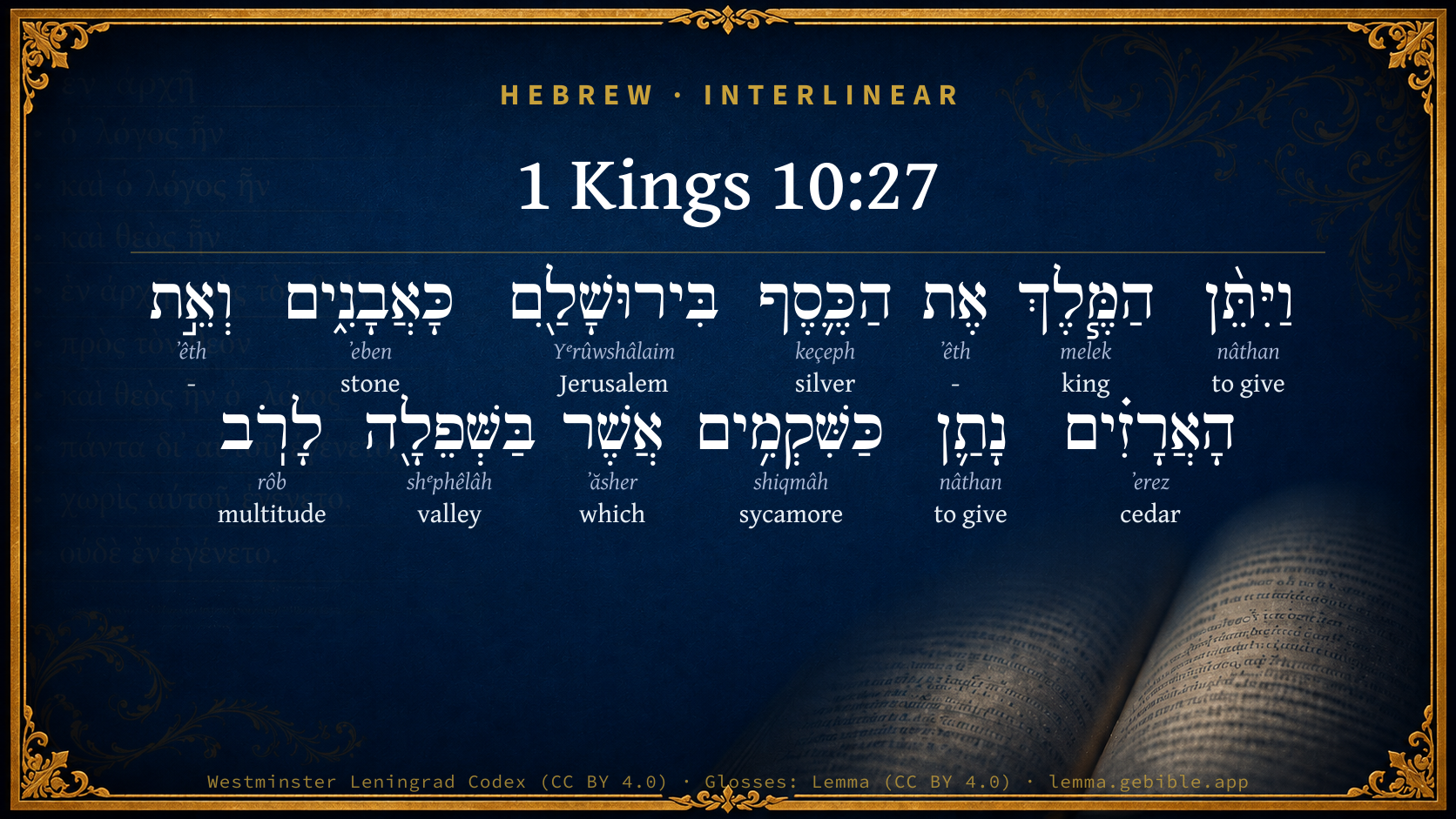
  1. וַיִּתֵּ֨ן nâthan H5414 “and · to give” Conjunction + Verb, Qal, Sequential Imperfect, 3rd Person, Masculine, Singular
  2. הַמֶּ֧לֶךְ melek H4428 “the · king” Particle, Definite Article + Noun, Common, Masculine, Singular, Absolute
  3. אֶת ʼêth H853 “-” Particle, Direct Object
  4. הַכֶּ֛סֶף keçeph H3701 “the · silver” Particle, Definite Article + Noun, Common, Masculine, Singular, Absolute
  5. בִּירוּשָׁלִַ֖ם Yᵉrûwshâlaim H3389 “in/at · Jerusalem” Preposition + Noun, Proper
  6. כָּאֲבָנִ֑ים ʼeben H68 “like/as the · stones” Preposition, Determined + Noun, Common, Feminine, Plural, Absolute
  7. וְאֵ֣ת ʼêth H853 “and · -” Conjunction + Particle, Direct Object
  8. הָאֲרָזִ֗ים ʼerez H730 “the · cedars” Particle, Definite Article + Noun, Common, Masculine, Plural, Absolute
  9. נָתַ֛ן nâthan H5414 “to give” Verb, Qal, Perfect, 3rd Person, Masculine, Singular
  10. אֲשֶׁר ʼăsher H834 “which” Particle, Relative
  11. בַּשְּׁפֵלָ֖ה shᵉphêlâh H8219 “in/at the · valley” Preposition, Determined + Noun, Common, Feminine, Singular, Absolute
  12. לָרֹֽב rôb H7230 “to/for · multitude” Preposition + Noun, Common, Both, Singular, Absolute

About this verse

These counts appear in no published source. They are computed here, from the morphology-tagged text and Lemma’s own curated glosses. What Lemma adds →

13
words
11
distinct lemmas
Historical
section

Notable vocabulary

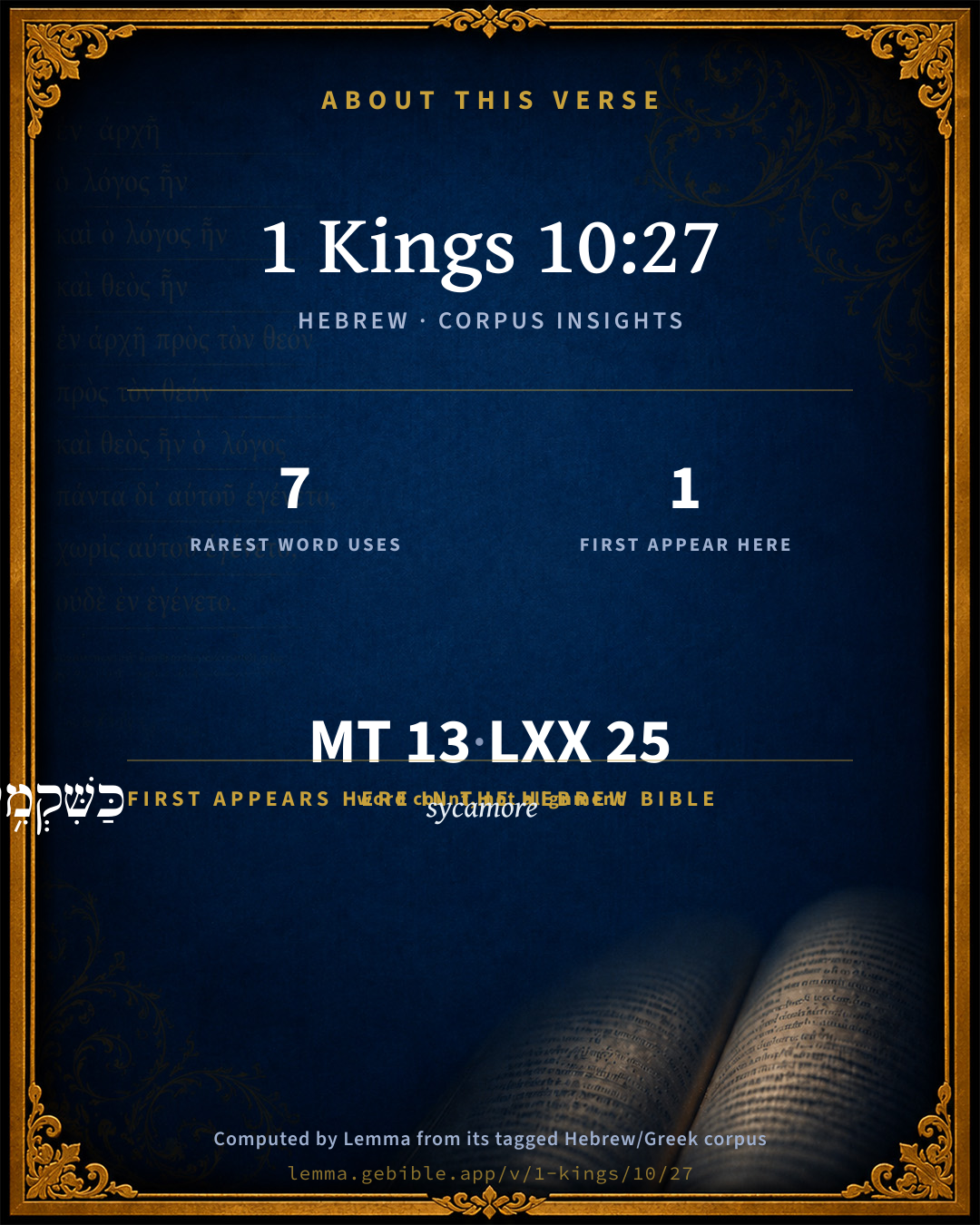
The rarest word here is כַּשִּׁקְמִ֥ים sycamore H8256 — appearing just 7 times in the whole Hebrew Bible.

First appearance in Scripture

This word makes its first canonical appearance in the Hebrew Bible here:

  • כַּשִּׁקְמִ֥ים sycamore H8256

Shared distinctive vocabulary

כַּשִּׁקְמִ֥ים sycamore H8256 occurs in 7 verses of the Hebrew Bible. Also found in:

Grammatical profile

  • 2 verbs
  • 8 nouns
  • 3 particles

Verb forms

  • וַיִּתֵּ֨ן Qal · Sequential Imperfect
  • נָתַ֛ן Qal · Perfect

Repetition

A word recurs within this verse — often emphatic in Hebrew:

  • וַיִּתֵּ֨ן to give H5414 ×2

Hebrew & Septuagint length

In English translation the verse runs 27 words from the Hebrew and 23 from the Septuagint (LXX English) — closely comparable.

A rough comparison of the two English renderings, which tokenize alike — not a word-level alignment.

Word counts can differ between the Hebrew and the Greek without any difference in meaning — e.g. the Hebrew direct-object marker אֵת has no separate Greek word, and Greek often adds the article ὁ.

In the original languages it is 13 Hebrew tokens and 25 Greek tokens — but the two are counted differently (Hebrew bundles its prefixes and suffixes into one token; the Greek is in lemma form), so that isn’t a like-for-like length.

Cross-references

4

Topical passages linked to 1 Kings 10:27 in the Treasury of Scripture Knowledge — connected by theme and wording, ordered by reader-vote popularity; previews shown in the World English Bible.

  • Deuteronomy 17:17 Neither shall he multiply wives to himself, that his heart not turn away: neither shall he greatly multiply to himself silver and gold.
  • 2 Chronicles 1:15–17 The king made silver and gold to be in Jerusalem as stones, and cedars made he to be as the sycamore trees that are in the lowland, for abundance.
  • 2 Chronicles 9:27 The king made silver to be in Jerusalem as stones, and cedars made he to be as the sycamore trees that are in the lowland, for abundance.
  • Job 22:24–25 Lay your treasure in the dust, The gold of Ophir among the stones of the brooks.

Cross-references courtesy of OpenBible.info (CC BY 4.0).

Hebrew and Greek witnesses Masoretic Hebrew ↔ Greek Septuagint

The same verse in the two great witnesses to the Old Testament, shown verse-for-verse.

These are two independent witnesses, not word-aligned to each other, and the Septuagint is shown in lemma (dictionary) form.

Hebrew 1 Kings 10:27 Masoretic · Westminster Leningrad Codex

וַיִּתֵּ֨ן הַמֶּ֧לֶךְ אֶת הַכֶּ֛סֶף בִּירוּשָׁלִַ֖ם כָּאֲבָנִ֑ים וְאֵ֣ת הָאֲרָזִ֗ים נָתַ֛ן כַּשִּׁקְמִ֥ים אֲשֶׁר בַּשְּׁפֵלָ֖ה לָרֹֽב

The king made silver to be in Jerusalem as stones, and cedars made he to be as the sycamore trees that are in the lowland, for abundance.

World English Bible · Public Domain

Greek LXX 1 Kings 10:27 Septuagint · lemma form

καί δίδωμι ὁ βασιλεύς ὁ χρυσίον καί ὁ ἀργύριον ἐν ἰερουσαλήμ ὡς λίθος καί ὁ κέδρος δίδωμι ὡς συκάμινος ὁ ἐν ὁ πεδεινός εἰς πλῆθος

And the king made gold and silver in Jerusalem as stones, and he made cedars as the sycamores in the plain for multitude.

LXX2012 (modern English Septuagint) · Public Domain

On this verse, The Cambridge Bible for Schools and Colleges discusses the Septuagint’s reading. Read the note in Commentary ↓

Hebrew: Westminster Leningrad Codex (CC BY 4.0). Greek: Septuagint (public domain); English from LXX2012 (modern English Septuagint) (Public Domain). How the Septuagint differs from the Hebrew →

Targum (Aramaic paraphrase)

1

The Targum is the ancient Jewish Aramaic paraphrase of the Hebrew Scriptures — an interpretive translation, not the Hebrew text itself. Onkelos (literal) and Pseudo-Jonathan (expansive) render the Torah, and Jonathan the Prophets. Coverage is partial: where no permissively-licensed English translation exists for a verse, only the Aramaic is shown. This is verse-level text, not a word-by-word alignment to the Hebrew.

  1. Targum Jonathan Prophets (Joshua–Malachi)
    וִיהַב מַלְכָּא יַת כַּסְפָּא בִּירוּשְׁלֵם כְּאַבְנַיָא וְיַת אַרְזַיָא יְהַב כְּשִׁקְמַיָא דְבִשְׁפֶלְתָּא לִסְגֵי:

    (no public-domain English translation for this verse)

    Targum Jonathan — Aramaic: “Mikraot Gedolot” (public domain). English: “Sefaria Community Translation” (CC0 1.0 (public-domain dedication)); “London "Chaldee Paraphrase," 1871” (public domain). Text via Sefaria.

Commentary

Notes on 1 Kings 10:27 from classic Christian and Jewish commentators (each source and its license shown beneath its notes). The classic Christian expositions comment on the surrounding passage and are grouped to its opening verse, so a note may address several verses; the Jewish commentaries on the Tanakh (Rashi and others) are per-verse, so they appear only where the commentator wrote on this verse.

Lemma curates 59 commentaries, every one of them public domain or Creative Commons licensed, each selected and text-cleaned for this edition rather than reprinted as found. About our sources →

Trapp's Complete Commentary

John Trapp

1Ki 10:27 And the king made silver [to be] in Jerusalem as stones, and cedars made he [to be] as the sycomore trees that [are] in the vale, for abundance.

Ver. 27. And the king made silver.] Heb., Gave. And herein Jerusalem became a slender representation of the Jerusalem which is above: where money, the monarch of this world, is nothing set by.

John Trapp, A Commentary or Exposition upon All the Books of the Old and New Testament (1647–1656) — public domain. Text from a community e-Sword module.

Joseph Benson's Commentary

1Ki 10:27-28. The king made silver to be in Jerusalem as stones — An hyperbolical expression, signifying a great plenty of it. Solomon had horses brought out of Egypt, and linen yarn — The two chief commodities of Egypt. The king’s merchants received the linen yarn at a price — Agreed on between Pharaoh and Solomon, who gave this privilege to his merchants for a tribute to be paid out of this commodity. Most think byssus, fine linen, is here meant, one of the principal of the Egyptian merchandises.

Joseph Benson's Commentary on the Old and New Testaments (1811–1818) — public domain. Text from a community e-Sword module.

Geneva Bible (1599)

Geneva Bible translators

Or, he made silver as plenteous as stones.

Geneva Bible (1599) marginal notes — public domain. Text via Bolls.life.

Adam Clarke's Commentary

Verse 27. Made silver - as stones] He destroyed its value by making it so exceedingly plenty.

As the sycamore trees] He planted many cedars, and doubtless had much cedar wood imported; so that it became as common as the sycamore trees, which appear to have grown there in great abundance. This is considered to be a tree that partakes of the nature of the fig tree, and of the mulberry. Of the former it has the fruit, and of the latter the leaves; that is, the fruit had a considerable resemblance to the fig, and the leaf to that of the mulberry tree: hence its name sycamore, from the Greek συκον, a fig, and μορεα, a mulberry tree.

Adam Clarke's Commentary on the Bible (1810–1826) — public domain. Text from a community e-Sword/MySword module.

Ellicott's Commentary for English Readers

(27) Made silver . . . as stones.—This influx of wealth is specially noted as enriching Jerusalem, probably without preventing the imposition of heavy burdens on the provinces. Hence the division of interest and allegiance manifested at the accession of Rehoboam. In the earlier years of the reign its prosperity is described as extending to all “Judah and Israel” (1Ki_4:20). But the wealth gathered by tribute, and by a commerce entirely in the hands of the king, would enrich only the Court and the capital; and much Oriental history, both ancient and modern, shows that such enrichment might leave the general population impoverished and oppressed

A Bible Commentary for English Readers, edited by Charles John Ellicott (1878–1897) — public domain. Text from a community e-Sword module.

The Cambridge Bible for Schools and Colleges

gen. ed. J. J. S. Perowne

27. silver] Here the LXX. has ‘gold and silver,’ and so too in the parallel passage 2Ch_9:27, and where the passage is inserted 2Ch_1:15 the LXX. reads τὸ ἀργύριον καὶ τὸ χρυσίον.

in the vale] The word (Shefelah) here rendered ‘vale’ is the name of that low-lying part of Palestine which stretches westward from the mountains of Judah to the Mediterranean (cf. Jos_9:1; Jos_12:8). The R.V. has always distinguished this as the lowland. It was a district fertile and specially well-wooded. The Hebrew word though at first only descriptive, became at last a proper name ‘Sephela.’ See 1Ma_12:38.

The Cambridge Bible for Schools and Colleges (gen. ed. J. J. S. Perowne; Cambridge University Press, 1878–1918) — public domain. Text from a community e-Sword module.

John Gill's Exposition

And Solomon had horses brought out of Egypt,.... To mount his horsemen with, and draw his chariots; which seems contrary to the command in Deu 17:16.

and linen yarn; the king's merchants received the linen yarn at a price; or rather linen itself; or linen garments, as Ben Gersom; linen being the staple commodity of Egypt, see Isa 19:9, but no mention is made of yarn in Ch2 9:28, and the word rendered "linen yarn" signifies a confluence or collection of waters and other things; and the words may be rendered, "as for the collection, the king's merchants received the collection at a price"; that is, the collection of horses, a large number of them got together for sale; these they took at a price set upon them (h), which is as follows.

(h) Vid. Braunium de Vest. Sacerdot. Heb. l. 1. c. 8. sect. 9, 10, 11.

John Gill's Exposition of the Whole Bible (1746–1763) — public domain (CC PDM 1.0). Text via the HelloAO Bible API.

Albert Barnes' Notes on the Bible

Made silver as stones - This strong hyperbole marks in the most striking way the great wealth and prosperity of the capital during Solomon’s reign. The lavish expenditure which impoverished the provinces, and produced, or helped to produce, the general discontent that led to the outbreak under Jeroboam, enriched the metropolis, which must have profited greatly by the residence of the court, the constant influx of opulent strangers, and the periodical visits of all Israelites not hindered by some urgent reason at the great festivals.

The “sycomore-trees in the vale” (Shephelah) are mentioned also in 1Ch 27:28. Like the olives and the vines, they were placed by David under a special overseer, on account of their value. The tree meant seems to be the sycomore proper, or “fig-mulberry,” which is still common in Palestine, and is highly esteemed both on account of its fruit and its timber.

Albert Barnes' Notes on the Bible (1834–1885) — public domain. Text from a community e-Sword/MySword module.

Haydock's Catholic Bible Commentary

Sycamores, (Hebrew shikmim) which were formerly very common in Palestine, as they are still about Cairo, in Egypt. The fruit resembles figs, as the leaves do the mulberry tree; whence the name is a compound of Greek: sukon, "a fig," and Greek: moria, "a mulberry;" though some would prefer Greek: moros, "a fool," to denote that the fruit is "insipid." It is however sweeter than wild figs, and proceeds from the trunk of the tree. (Calmet)

George Leo Haydock (1774–1849), Haydock's Catholic Family Bible and Commentary, 1859 edition — public domain. Excludes Psalms (Douay-Rheims chapter numbering differs from Protestant) and Deuterocanonical books (Catholic canon only).

Matthew Poole's English Annotations

Sycamore trees were vile and common. See Isa 9:10.

Matthew Poole's English Annotations on the Holy Bible (1683–1685) — public domain. Text from a community e-Sword/MySword module.

Whedon's Commentary on the Bible

Daniel D. Whedon

27. Cedars made he to be as the sycamore — That is, he imported so much of this valuable wood for building purposes that it lost its rarity in the eyes of the people, and became as common to sight as the sycamore trees that grew so abundantly in the lowlands and valleys.

Daniel D. Whedon (gen. ed.), Commentary on the Old and New Testaments (1874–1909) — public domain. Text from a community e-Sword module.

The Pulpit Commentary

And the king made silver to be in Jerusalem as stones an obviously hyperbolical expression), and cedar trees made he to be as the sycamore trees the hmqvi is the sukomwrea of the New Testament, (Luk_19:4) i.e., as the name imports, the fig mulberry the "sycamine tree" of Luk_17:6 would seem to denote the mulberry proper. Though now but comparatively rare in Palestine, it is clear that formerly it was very common, (see e.g., . Isa_9:10) whence it appears that it was used for building purposes, and where it is also contrasted with the cedars. It was esteemed both for its fruit and its wood, so much so that David appointed a steward to have the supervision both of "the olive trees and the sycamore trees in the Shefelah". (1Ch_27:28) The sycamores of Egypt, which were used for the coffins of mummies (Dict. Bib. 3. p. 1394), are referred to in Psa_78:47, in a way which bespeaks their great value. There is a good description of the tree in Thomson, "Land and Book," 1:23-25 that are in the vale Same word as in 1 Chronicles l.c. The Shefelah is a "broad swelling tract of many hundred miles in area, which sweeps gently down from the mountains of Judah "to mingle with the bounding main" of the Mediterranean" (Grove, Dict. Bib. 3. p. 1611). This "Low Country" extended from Joppa to Gaza. The translation "vale" is altogether misleading. Conder ("Tent-work," p. 5) describes it as "consisting of low hills, about five hundred feet above the sea, of white soft limestone," and adds that "the broad valleys among these hills produce fine crops of corn, and on the hills the long olive groves flourish better than in other districts an incidental and valuable confirmation of the text. "The name Sifia, or Shephelah, still exists in four or five places round Beit Jibrin" (Eleutheropolis), ib . p. 276 for abundance.

The Pulpit Commentary (1880–1919), ed. H.D.M. Spence-Jones & Joseph S. Exell — public domain. Text from a community e-Sword module.

Rashi

Rabbi Shlomo Yitzchaki (Rashi)

As stones. But above it states, “of no value.” Our Rabbis explained that one refers to the time before Shlomo married Pharaoh’s daughter, and one refers to the time after Shlomo wedded Pharaoh’s daughter.

Rashi on the Tanakh — English translations: “The Judaica Press complete Tanach with Rashi, translated by A. J. Rosenberg” (CC BY 4.0); “Pentateuch with Rashi's commentary by M. Rosenbaum and A.M. Silbermann, 1929-1934” (public domain); “The Metsudah Tanach series, Lakewood, N.J” (CC BY 4.0); and “The Book of Joshua, Metsudah Publications, 1997” (CC BY 4.0). Text via Sefaria.

Lesson kit

Teaching starters — assembled from the data on this page, not authored interpretation. Every prompt links to the verse data it draws on. Edit before teaching.

1 Kings, in the Historical, opens this verse with 13 words (11 distinct Hebrew lemmas). Its most distinctive word is shiqmâh (“sycamore”). A historical commentator’s framing appears above. Read the whole chapter for the surrounding context.

Discussion questions

  1. The word shiqmâh carries the sense “sycamore.” How does it shape the verse?
  2. This is the first place “sycamore” appears in Scripture (first appears here). What does its debut here establish?
  3. How does 1 Chronicles 27:28, which shares the word «sycamore», read alongside this verse?
  4. What does the repetition of “to give” (2× in this one verse) do in this verse?
  5. These translations render this verse differently; the difference is in the English rendering, not the original. What questions does that raise?
  6. «וַיִּתֵּ֨ן» is a Qal Sequential Imperfect verb. How does that grammatical form shape the action described?
  7. Compare how Trapp's Complete Commentary and Joseph Benson's Commentary read this verse. Where do they agree or differ?

Things to notice

Reading settings

Reading text

Shown beneath each verse's original-language words.

Old Testament
Old Testament edition

Read the OT as the Masoretic Hebrew (MT) or the Greek Septuagint (LXX).

English shown for the Greek Septuagint (in the Hebrew ↔ Greek comparison).

Comparing translations? Open the Compare panel on any verse page to stack up to four side by side.