

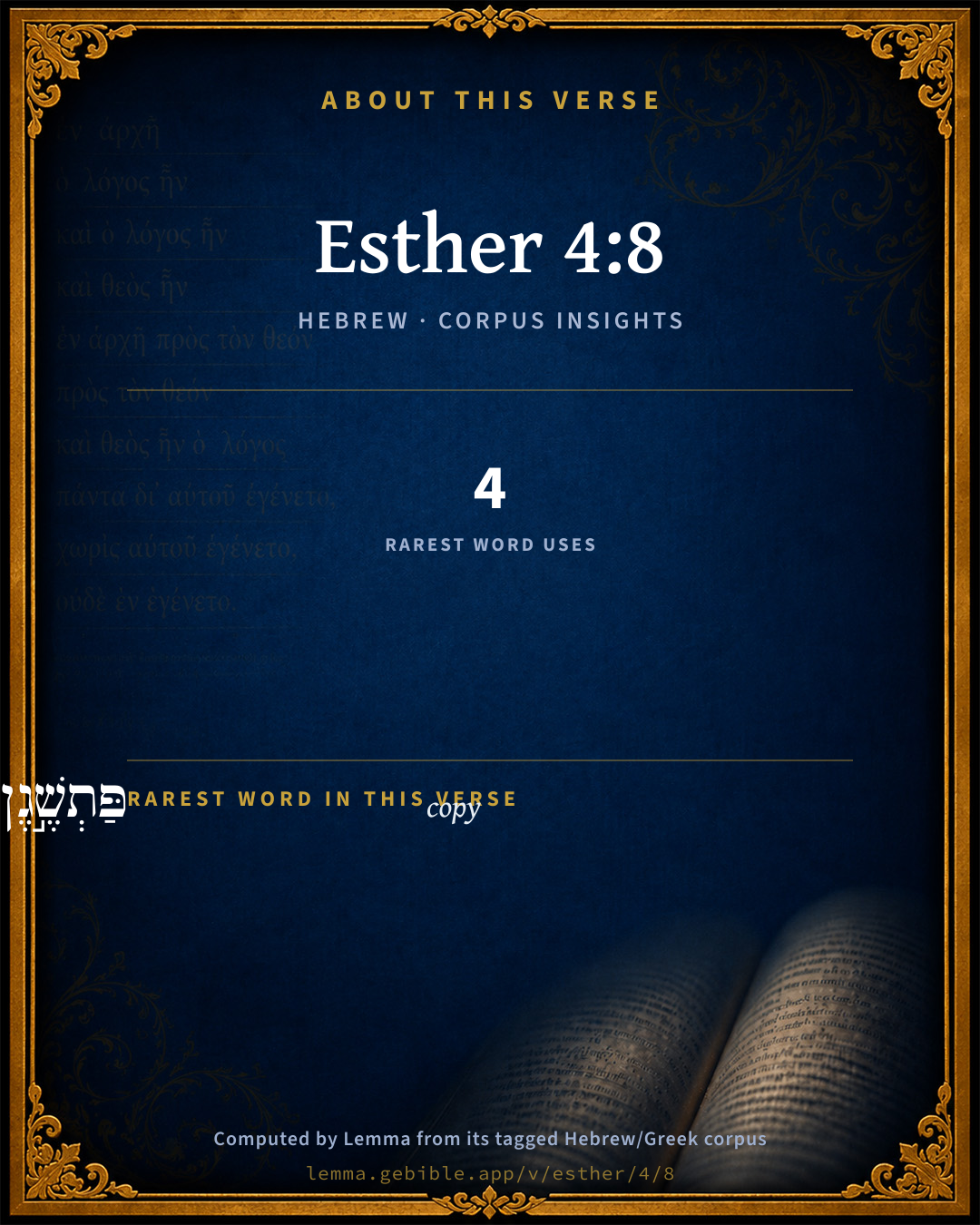
Esther 4:8

Hebrew (Westminster Leningrad Codex) Esther 4:8 appears in the Hebrew Old Testament. The text above is from the Westminster Leningrad Codex. Each word links to its Strong’s number, a concise gloss, and parsing drawn from the Open Scriptures Hebrew Bible morphology. Click any word for its full Brown-Driver-Briggs (BDB) entry.
Download image
Cite this verse

Esther 4:8 (World English Bible). Public Domain. Lemma interlinear Bible study tool, https://lemma.gebible.app/v/esther/4/8.

Show BibTeX & RIS
BibTeX
RIS
English Translation
Also he gave him the copy of the writing of the decree that was given out in Shushan to destroy them, to show it to Esther, and to declare it to her, and to charge her that she should go in to the king, to make supplication to him, and to make request before him, for her people.
World English Bible · Public Domain
Download a study sheet

One document with this verse’s original text, its word-by-word gloss line, the meaning frame, cross-references with their text, attributed commentary, and full source and license credits — printable, and it pastes into notes with its structure intact.

This verse Autodidact and up

Study sheet (.html) Plain text (.txt)

A passage Seminary Student

Up to 50 verses in one chapter. A passage sheet keeps up to 6 commentary sources and 12 cross-references per verse, in the order this page ranks them, and says so on the sheet whenever that leaves anything out. Ask for a single verse and you get the Autodidact verse sheet above.

Everything on this page stays free to read, with no account — the sheet is a download of what is already on screen, not access to it.

Want to remove ads? Support Godless Engineer
Compare translations 3

The same verse in 3 English versions, stacked beneath the original-language interlinear above. Click any original word for its lexicon entry.

Each is an independent rendering of the whole verse — the interlinear is not word-aligned to these translations.

Highlighted words mark where these versions differ — a whole-verse word diff, not a word-by-word alignment.

  • World English Bible Public Domain
    Also he gave him the copy of the writing of the decree that was given out in Shushan to destroy them, to show it to Esther, and to declare it to her, and to charge her that she should go in to the king, to make supplication to him, and to make request before him, for her people.
  • King James Version Public Domain
    Also he gave him the copy of the writing of the decree that was given at Shushan to destroy them, to shew it unto Esther, and to declare it unto her, and to charge her that she should go in unto the king, to make supplication unto him, and to make request before him for her people.
  • unfoldingWord Literal Text CC BY-SA 4.0
    Also he gave to him a copy of the writing of the law that had been given in Susa to annihilate them, in order to show Esther and to inform her and to lay a charge upon her to go to the king to implore his favor and to seek from before his face concerning her people.

unfoldingWord Literal Text — © unfoldingWord, licensed CC BY-SA 4.0. Word-aligned USFM3 via Door43 (git.door43.org/unfoldingWord/en_ult).

Versions to compare (up to 4)

3 of 4 selected

Show all 18 translations

Every available English version of this verse, each an independent rendering of the whole verse.

  • World English Bible Public Domain
    Also he gave him the copy of the writing of the decree that was given out in Shushan to destroy them, to show it to Esther, and to declare it to her, and to charge her that she should go in to the king, to make supplication to him, and to make request before him, for her people.
  • Berean Standard Bible Public Domain
    Mordecai also gave Hathach a copy of the written decree issued in Susa for the destruction of the Jews, to show and explain to Esther, urging her to approach the king, implore his favor, and plead before him for her people.
  • Majority Standard Bible Public Domain
    Mordecai also gave Hathach a copy of the written decree issued in Susa for the destruction of the Jews, to show and explain to Esther, urging her to approach the king, implore his favor, and plead before him for her people.
  • King James Version Public Domain
    Also he gave him the copy of the writing of the decree that was given at Shushan to destroy them, to shew it unto Esther, and to declare it unto her, and to charge her that she should go in unto the king, to make supplication unto him, and to make request before him for her people.
  • American Standard Version (1901) Public Domain
    Also he gave him the copy of the writing of the decree that was given out in Shushan to destroy them, to show it unto Esther, and to declare it unto her, and to charge her that she should go in unto the king, to make supplication unto him, and to make request before him, for her people.
  • Revised Version (1885) Public Domain
    Also he gave him the copy of the writing of the decree that was given out in Shushan to destroy them, to shew it unto Esther, and to declare it unto her; and to charge her that she should go in unto the king, to make supplication unto him, and to make request before him, for her people.
  • Geneva Bible (1599) Public Domain
    Also he gaue him the copy of the writing and commission that was giuen at Shushan, to destroy them, that he might shewe it vnto Ester and declare it vnto her, and to charge her that she should goe in to the King, and make petition and supplication before him for her people.
  • Douay-Rheims (1899) Public Domain
    He gave him also a copy of the edict which was hanging up in Susan, that he should shew it to the queen, and admonish her to go in to the king, and to en- treat him for her people.
  • Young's Literal Translation Public Domain
    and the copy of the writing of the law that had been given in Shushan to destroy them he hath given to him, to shew Esther, and to declare `it' to her, and to lay a charge on her to go in unto the king, to make supplication to him, and to seek from before him, for her people.
  • Literal Standard Version CC BY-SA 4.0
    and the copy of the writing of the law that had been given in Shushan to destroy them he has given to him, to show Esther, and to declare [it] to her, and to lay a charge on her to go in to the king, to make supplication to him, and to seek from before him, for her people.
  • Unlocked Literal Bible CC BY-SA 4.0
    He also gave him a copy of the decree that was issued in Susa for the Jews' destruction. He did this so that Hathak could show it to Esther, and that he should give her the responsibility of going to the king to beg for his favor, and to plead with him on behalf of her people.
  • unfoldingWord Literal Text CC BY-SA 4.0
    Also he gave to him a copy of the writing of the law that had been given in Susa to annihilate them, in order to show Esther and to inform her and to lay a charge upon her to go to the king to implore his favor and to seek from before his face concerning her people.
  • Darby Bible Public Domain
    And he gave him a copy of the writing of the decree that had been given at Shushan to destroy them, to shew [it] to Esther, and to declare [it] to her, and to charge her that she should go in unto the king, to make supplication to him, and to make request before him, for her people.
  • World Messianic Bible Public Domain
    He also gave him the copy of the writing of the decree that was given out in Susa to destroy them, to show it to Esther, and to declare it to her, and to urge her to go in to the king to make supplication to him, and to make request before him for her people.
  • Webster's Bible Public Domain
    Also he gave him the copy of the writing of the decree that was given at Shushan to destroy them, to show it to Esther, and to declare it to her, and to charge her that she should go in to the king, to make supplication to him, and to make request before him for her people.
  • Free Bible Version CC BY-SA 4.0
    Mordecai also gave him a copy of the decree that had been issued in Susa for their destruction to show Esther and explain it to her, and asked him to instruct her to go to the king and appeal for mercy and plead before him for her people.
  • Bible in Basic English Public Domain
    And he gave him the copy of the order which had been given out in Shushan for their destruction, ordering him to let Esther see it, and to make it clear to her; and to say to her that she was to go in to the king, requesting his mercy, and making prayer for her people.
  • JPS Tanakh (1917) Public Domain
    Also he gave him the copy of the writing of the decree that was given out in Shushan to destroy them, to show it unto Esther, and to declare it unto her; and to charge her that she should go in unto the king, to make supplication unto him, and to make request before him, for her people.

Literal Standard Version (2020), Covenant Press — licensed CC BY-SA 4.0. Text via the HelloAO Bible API (eBible.org). Unlocked Literal Bible (unfoldingWord) — licensed CC BY-SA 4.0. Text via the HelloAO Bible API (eBible.org). unfoldingWord Literal Text — © unfoldingWord, licensed CC BY-SA 4.0. Word-aligned USFM3 via Door43 (git.door43.org/unfoldingWord/en_ult). Free Bible Version, Dr. Jonathan Gallagher — licensed CC BY-SA 4.0. Text via the HelloAO Bible API (eBible.org).

Word by word

More ways to search: Search by grammar → Find every occurrence → Compare this word →

Practice this passage: Drill this verse → Learn its vocabulary →

פַּתְשֶׁ֣גֶן
parshegen
H6572
“copy of”
Noun, Common, Masculine, Singular, Construct
Part of Speech
Noun
Type
Common
Gender
Masculine
Number
Singular
State
Construct
Full BDB Definition

Origin: of foreign origin

TWOT: 1837

copy
  1. וְאֶת ʼêth H853 “and · -” Conjunction + Particle, Direct Object
  2. כְּתָֽב kâthâb H3791 “writing of” Noun, Common, Masculine, Singular, Construct
  3. הַ֠דָּת dâth H1881 “the · decree” Particle, Definite Article + Noun, Common, Feminine, Singular, Absolute
  4. אֲשֶׁר ʼăsher H834 “which” Particle, Relative
  5. נִתַּ֨ן nâthan H5414 “to give” Verb, Niphal, Perfect, 3rd Person, Masculine, Singular
  6. בְּשׁוּשָׁ֤ן Shûwshan H7800 “in/at · Shushan” Preposition + Noun, Proper
  7. לְהַשְׁמִידָם֙ shâmad H8045 “to destroy · them” Preposition + Verb, Hiphil, Infinitive Construct + Suffix, Personal, 3rd Person, Masculine, Plural
  8. נָ֣תַן nâthan H5414 “to give” Verb, Qal, Perfect, 3rd Person, Masculine, Singular
  9. לְהַרְא֥וֹת râʼâh H7200 “to see” Preposition + Verb, Hiphil, Infinitive Construct
  10. אֶת ʼêth H853 “-” Particle, Direct Object
  11. אֶסְתֵּ֖ר ʼEçtêr H635 “Esther” Noun, Proper
  12. וּלְהַגִּ֣יד nâgad H5046 “and · to make known” Conjunction + Preposition + Verb, Hiphil, Infinitive Construct
  13. וּלְצַוּ֣וֹת tsâvâh H6680 “and · to command” Conjunction + Preposition + Verb, Piel, Infinitive Construct
  14. עָלֶ֗יהָ ʻal H5921 “upon · her” Preposition + Suffix, Personal, 3rd Person, Feminine, Singular
  15. לָב֨וֹא bôwʼ H935 “to enter” Preposition + Verb, Qal, Infinitive Construct
  16. אֶל ʼêl H413 “to” Preposition
  17. הַמֶּ֧לֶךְ melek H4428 “the · king” Particle, Definite Article + Noun, Common, Masculine, Singular, Absolute
  18. לְהִֽתְחַנֶּן chânan H2603 “to be gracious” Preposition + Verb, Hithpael, Infinitive Construct
  19. וּלְבַקֵּ֥שׁ bâqash H1245 “and · to seek” Conjunction + Preposition + Verb, Piel, Infinitive Construct
  20. מִלְּפָנָ֖יו pânîym H6440 “from · to/for · face(s) · his” Preposition + Preposition + Noun, Common, Both, Plural, Construct + Suffix, Personal, 3rd Person, Masculine, Singular
  21. עַל ʻal H5921 “upon” Preposition
  22. עַמָּֽהּ ʻam H5971 “people · her” Noun, Common, Masculine, Singular, Construct + Suffix, Personal, 3rd Person, Feminine, Singular

About this verse

These counts appear in no published source. They are computed here, from the morphology-tagged text and Lemma’s own curated glosses. What Lemma adds →

26
words
20
distinct lemmas
Historical
section

Notable vocabulary

The rarest word here is פַּתְשֶׁ֣גֶן copy H6572 — appearing just 4 times in the whole Hebrew Bible.

Shared distinctive vocabulary

פַּתְשֶׁ֣גֶן copy H6572 occurs in 4 verses of the Hebrew Bible. Also found in:

Grammatical profile

  • 9 verbs
  • 8 nouns
  • 6 prepositions
  • 3 particles

Verb forms

  • נִתַּ֨ן Niphal · Perfect
  • לְהַשְׁמִידָם֙ Hiphil · Infinitive Construct
  • נָ֣תַן Qal · Perfect
  • לְהַרְא֥וֹת Hiphil · Infinitive Construct
  • וּלְהַגִּ֣יד Hiphil · Infinitive Construct
  • וּלְצַוּ֣וֹת Piel · Infinitive Construct
  • לָב֨וֹא Qal · Infinitive Construct
  • לְהִֽתְחַנֶּן Hithpael · Infinitive Construct
  • וּלְבַקֵּ֥שׁ Piel · Infinitive Construct

Repetition

Words recur within this verse — often emphatic in Hebrew:

  • נִתַּ֨ן to give H5414 ×2
  • עָלֶ֗יהָ upon H5921 ×2

Hebrew & Septuagint length

In English translation the verse runs 58 words from the Hebrew and 91 from the Septuagint (LXX English) — the Septuagint runs noticeably longer here. See the side-by-side →

A rough comparison of the two English renderings, which tokenize alike — not a word-level alignment.

Word counts can differ between the Hebrew and the Greek without any difference in meaning — e.g. the Hebrew direct-object marker אֵת has no separate Greek word, and Greek often adds the article ὁ.

Cross-references

12

Topical passages linked to Esther 4:8 in the Treasury of Scripture Knowledge — connected by theme and wording, ordered by reader-vote popularity; previews shown in the World English Bible.

  • Ecclesiastes 10:4 If the spirit of the ruler rises up against you, don't leave your place; for gentleness lays great offenses to rest.
  • Job 9:15 Whom, though I were righteous, yet would I not answer. I would make supplication to my judge.
  • Esther 2:20 Esther had not yet made known her relatives nor her people; as Mordecai had charged her: for Esther did the commandment of Mordecai, like as when she was brought up with him.
  • Esther 3:14–15 A copy of the writing, that the decree should be given out in every province, was published to all the peoples, that they should be ready against that day.
  • 1 Timothy 6:13 I charge you before God, who gives life to all things, and before Christ Jesus, who before Pontius Pilate testified the good confession,
  • Nehemiah 2:3–5 I said to the king, Let the king live forever: why should not my face be sad, when the city, the place of my fathers' tombs, lies waste, and the gates of it are consumed with fire?
  • Esther 7:3–4 Then Esther the queen answered, If I have found favor in your sight, O king, and if it please the king, let my life be given me at my petition, and my people at my request:
  • Esther 8:6 for how can I endure to see the evil that shall come to my people? or how can I endure to see the destruction of my relatives?
  • Proverbs 16:14–15 The king's wrath is a messenger of death, But a wise man will pacify it.
  • Proverbs 21:1 The king's heart is in Yahweh's hand like the watercourses. He turns it wherever he desires.
  • Acts 12:20 Now Herod was very angry with the people of Tyre and Sidon. They came with one accord to him, and, having made Blastus, the king's chamberlain, their friend, they asked for peace, because their country depended on the king's country for food.
  • 1 Timothy 6:17 Charge those who are rich in this present world that they not be haughty, nor have their hope set on the uncertainty of riches, but on the living God, who richly provides us with everything to enjoy;

Cross-references courtesy of OpenBible.info (CC BY 4.0).

Hebrew and Greek witnesses Masoretic Hebrew ↔ Greek Septuagint

The same verse in the two great witnesses to the Old Testament, shown verse-for-verse.

Here the Septuagint runs noticeably longer than the Hebrew — LXX2012 (modern English Septuagint) 91 words vs World English Bible 58. A rough length comparison of the two English translations, not a word-level alignment — read both below.

These are two independent witnesses, not word-aligned to each other, and the Septuagint is shown in lemma (dictionary) form.

Hebrew Esther 4:8 Masoretic · Westminster Leningrad Codex

וְאֶת פַּתְשֶׁ֣גֶן כְּתָֽב הַ֠דָּת אֲשֶׁר נִתַּ֨ן בְּשׁוּשָׁ֤ן לְהַשְׁמִידָם֙ נָ֣תַן ל֔וֹ לְהַרְא֥וֹת אֶת אֶסְתֵּ֖ר וּלְהַגִּ֣יד לָ֑הּ וּלְצַוּ֣וֹת עָלֶ֗יהָ לָב֨וֹא אֶל הַמֶּ֧לֶךְ לְהִֽתְחַנֶּן ל֛וֹ וּלְבַקֵּ֥שׁ מִלְּפָנָ֖יו עַל עַמָּֽהּ

Also he gave him the copy of the writing of the decree that was given out in Shushan to destroy them, to show it to Esther, and to declare it to her, and to charge her that she should go in to the king, to make supplication to him, and to make request before him, for her people.

World English Bible · Public Domain

Greek LXX Esther 4:8 Septuagint · lemma form

καί ὁ ἀντίγραφον ὁ ἐν σουσά ἐκτίθημι ὑπέρ ὁ ἀποὀλλύω αὐτός δίδωμι αὐτός δεικνύω ὁ εσθηρ καί εἶπον αὐτός ἐντέλλω αὐτός εἰςἔρχομαι παρααἰτέω ὁ βασιλεύς καί ἀξιόω αὐτός περί ὁ λαός μιμνήσκω ἡμέρα ταπείνωσις σύ ὡς τρέφω ἐν χείρ ἐγώ διότι αμαν ὁ δευτερεύω ὁ βασιλεύς λαλέω κατά ἐγώ εἰς θάνατος ἐπικαλέω ὁ κύριος καί λαλέω ὁ βασιλεύς περί ἐγώ καί ῥύομαι ἐγώ ἐκ θάνατος

And he gave him the copy of the writing that was published in Susa concerning their destruction, to show to Esther; and told him to charge her to go in and entreat the king, and to beg him for the people, remembering, said he, the days of your low estate, how you were nursed by my hand: because Aman who holds the next place to the king has spoken against us for death. Do you call upon the Lord, and speak to the king concerning us, to deliver us from death.

LXX2012 (modern English Septuagint) · Public Domain

On this verse, Haydock's Catholic Bible Commentary discusses the Septuagint’s reading. Read the note in Commentary ↓

Hebrew: Westminster Leningrad Codex (CC BY 4.0). Greek: Septuagint (public domain); English from LXX2012 (modern English Septuagint) (Public Domain). How the Septuagint differs from the Hebrew →

Commentary

Notes on Esther 4:8 from classic Christian and Jewish commentators (each source and its license shown beneath its notes). The classic Christian expositions comment on the surrounding passage and are grouped to its opening verse, so a note may address several verses; the Jewish commentaries on the Tanakh (Rashi and others) are per-verse, so they appear only where the commentator wrote on this verse.

Lemma curates 59 commentaries, every one of them public domain or Creative Commons licensed, each selected and text-cleaned for this edition rather than reprinted as found. About our sources →

Trapp's Complete Commentary

John Trapp

Est 4:8 Also he gave him the copy of the writing of the decree that was given at Shushan to destroy them, to shew [it] unto Esther, and to declare [it] unto her, and to charge her that she should go in unto the king, to make supplication unto him, and to make request before him for her people.

Ver. 8. Also he gave him the copy of the writing] That she might see it, and rest assured that it was even so, and no otherwise; and that therefore now or never she must bestir herself for the labouring Church.

That was given at Shushan] Which if ever it were full of judgment, and white as a lily (according to the name), is now stained with blood of innocents; if ever righteousness did lodge in it, yet now murderers, as Isa 1:21.

To show it unto Esther] That her eye might affect her heart, Lam 3:51, and her heart set all awork for her people; that is, herself, according to that, "Physician, heal thyself"; that is, thine own countrymen, Luk 4:23.

And to declare it unto her] In the cause, viz. his refusing to bow to Haman against his conscience (whereof it no whit repented him); and in the several circumstances laid forth in the liveliest colours, for her thorough information.

And to charge her that she should go in unto the king] Hoc perquam durum est, sed ita lex scripta est, This was extremely hard, but so the law was written, saith the civilian. This Mordecai knew would hardly be done; he, therefore, makes use of his ancient authority, and sets it on with greatest earnestness. So St Paul, "I charge you by the Lord," 1Th 5:27. And, again, "I charge thee before God, and the Lord Jesus Christ," &c., 2Ti 4:1. So St Austin to his hearers, Per tremendum Dei iudicium vos adiuro, I require and charge you by that dreadful day of judgment, when that doom’s day book shall be opened, &c. It is a weakness to be hot in a cold matter, but it is a wickedness to be cold in a hot matter. He that is earnest in good, though he may carry some things indiscreetly, yet is he far better than a time server, and a cold friend to the truth; like as in falling forward is nothing so much danger as in falling backward. Eli was to blame with his - Do no more so, my sons. And so was Jehoshaphat with his - Let not the king say so. And the people in Ahab’s time, who, when they were pressed to express whom they were for, God or Baal? they answered not a word, 1Ki 18:21. And yet how many such cold friends hath the truth today! lukewarm Laodiceans, neuter passive Christians! &c. When Callidus once declared against Gallus with a faint and languishing voice, Oh, saith Cicero, Tu nisi fingeres, sic ageres? Wouldest thou plead on that manner if thou wert in good earnest? Men’s faint appearing for God’s cause shows they do but feign; their coldness probably concludeth they do but counterfeit. Mordecai plays the man, and chargeth Esther to improve her interest in the king, her husband, for the Church’s deliverance. See here how he turneth every stone, tradeth every talent, leaveth no means unused, no course unattempted for the saints’ safety. And this the Spirit of God hath purposely recorded, that all may learn to lay out themselves to the utmost for the public; to be most zealous for the conservation and defence of the Church when it is afflicted and opposed by persecutors; seeing they cannot be saved unless she be in safety; neither can they have God for their Father unless they love and observe this their dear mother. Utinam, iterum autem utinam diligentius a cunctis ordinibus haec hodie considerarentur, saith one. Oh that these things were duly considered by all sorts today!

To make supplication unto him] Heb. To deprecate displeasure and mischief, as 1Ki 8:28 Zec 12:10.

And to make request before him] Ad quaerendum a facie eius; so Pagnine from the Hebrew, to seek for good from his face, an effectul smile, a gracious aspect, that they may live in his sight. For, "in the light of the king’s countenance is life; and his favour is as a cloud of the latter rain," Pro 16:15. The ancient Persian kings were most fond of their wives, doing them all the honour possible in court, as partakers of all their fortunes, and carried them and their children into their farthest wars; by the presence of so dear pledges, the more to encourage their minds in time of battle. Now, therefore, Esther (whom Herodotus also witnesseth to have been Xerxes’ best beloved) is to try what she can do with him for her people, who were haply grown too secure upon Esther’s preferment; as the French Churches also were upon the queen of Navarre’s greatness, and the promise of peace by that match. God, therefore, shortly after shook them up, not by shaking his rod only at them, as here at these Jews, but by permitting that bloody massacre.

John Trapp, A Commentary or Exposition upon All the Books of the Old and New Testament (1647–1656) — public domain. Text from a community e-Sword module.

The Biblical Illustrator

Joseph S. Exell

Est_4:8

And to charge her that she should go in unto the king, to make supplication unto him.

A resolute will

In the meantime, this lesson may be drawn from his conduct--that a resolute will, when it is exerted for the accomplishment of any purpose, is usually successful in the end. The triumphs of the Reformation, for example, in our own country and in other lands, where it did triumph, while they are really to be ascribed to the overruling providence of God, are instrumentally to be attributed to this, that God raised up and qualified for the work certain men of determined will and unflagging energy, who kept before them the great purpose which they sought to effect, and would be turned aside by no danger or difficulty from working it out. And I would remark, that in things spiritual--in things affecting the eternal salvation of man--resoluteness of will and indomitable energy are as indispensable as in the pursuit of temporal good. (A. B. Davidson, D. D.)

Human sympathy

How ardently Mordecai is coveting the sympathy of one whom his self-sacrifice elevated to a position above his own! Human sympathy, exhibited in practical ways, proves wondrous in power, multiplying joys and dividing sorrows. It is like sunshine upon rosebuds, unfolding hidden beauty and evoking new fragrance. Like May breezes upon consumptive cheeks, it brings back the glow of health where pallor of death has been, and paints cheerfulness where despondency has been brooding too long already. It is a contribution of the heart more priceless than the wealth of the Indies. It may be incapable of explaining the mysteries of providence; it may be disqualified for recommending resignation to the Divine will; possibly it may be powerless in affecting deliverance; but when genuine it possesses inestimable value, though it may not open avenues from Marah to the land of Beulah. (J. S. Van Dyke, D. D.)

The Biblical Illustrator, edited by Joseph S. Exell (c. 1880s–1900s) — public domain. Text from a community e-Sword module.

Tyndale Open Study Notes

Tyndale Open Resources

4:8 A copy of the decree with the king’s seal would prove to Esther the seriousness of the situation. • to beg for mercy: Mordecai gave Esther no reasons to present to the king, only an appeal to the king’s mercy and Esther’s influence on him on behalf of her own people.

Tyndale Open Study Notes — © Tyndale Open Resources, licensed CC BY-SA 4.0. Text via the HelloAO Bible API.

Geneva Bible (1599)

Geneva Bible translators

Or, contents.

Geneva Bible (1599) marginal notes — public domain. Text via Bolls.life.

Jamieson, Fausset & Brown

Robert Jamieson, A. R. Fausset & David Brown

charge her that she should go in unto the king--This language is exceedingly strong. As it can scarcely be supposed that Mordecai was still using authority over Esther as his adopted daughter, he must be considered as imploring rather than commanding her, in the name of her brethren and in the name of her God, to make a direct appeal to the feelings of her royal husband.

Jamieson, Fausset & Brown — Commentary Critical and Explanatory on the Whole Bible (1871) — public domain (CC PDM 1.0). Text via the HelloAO Bible API.

Adam Clarke's Commentary

Verse 8. That she should go in unto the king] The Greek adds, "Remember the time of your low estate, and in what manner you have been nourished, and carried in my arms; and that Haman, who is next to the king, has got a decree for our destruction. Pray, therefore, to the Lord, and plead with the king, that we may be delivered from death." But there is not a word of this either in the Hebrew, Syriac, or Vulgate.

Adam Clarke's Commentary on the Bible (1810–1826) — public domain. Text from a community e-Sword/MySword module.

The Cambridge Bible for Schools and Colleges

gen. ed. J. J. S. Perowne

8. to make request before him, for her people] See Est_2:10. It was now necessary for Esther to declare her nationality. It was only by identifying herself with the imperilled nation that their deliverance could be hoped for.

The Cambridge Bible for Schools and Colleges (gen. ed. J. J. S. Perowne; Cambridge University Press, 1878–1918) — public domain. Text from a community e-Sword module.

John Gill's Exposition

Also he gave him the copy of the writing of the decree that was given at Shushan to destroy them,.... Which had now been published in the city; by which means Mordecai had had a sight of it, and had transcribed it; see Est 3:14

to show it unto Esther, and to declare it unto her; what Haman intended against the people of the Jews; as the Targum adds:

and to charge her; in his name; whose charges she had always regarded, both before and since she was queen; or in the name of God:

that she should go in unto the king to make supplication unto him, and to make request before him for her people; signifying there was a necessity of doing it speedily, and of urging her request with great earnestness and importunity, since it was not the life of a single person, but the lives of a body of people, and her own, that lay at stake.

John Gill's Exposition of the Whole Bible (1746–1763) — public domain (CC PDM 1.0). Text via the HelloAO Bible API.

Haydock's Catholic Bible Commentary

Entreat. Septuagint, "to put in a counter-petition, and entreat," &c. --- People. Septuagint add, "and country, remembering the days of thy lowly state, how thou wast fed by my hand; for Aman, the second after the king, has spoken against us, to have us destroyed. Call then upon the Lord, and speak to the king for us, and rescue us from death." (Haydock) --- This servant must have been very trusty, as the secret was confided to him, respecting the nation to which the queen belonged. (Menochius)

George Leo Haydock (1774–1849), Haydock's Catholic Family Bible and Commentary, 1859 edition — public domain. Excludes Psalms (Douay-Rheims chapter numbering differs from Protestant) and Deuterocanonical books (Catholic canon only).

Matthew Poole's English Annotations

To charge her; not only in his own name, to whom she manifested a singular respect, though his relation to her was yet unknown, but also in the name of the great God.

Matthew Poole's English Annotations on the Holy Bible (1683–1685) — public domain. Text from a community e-Sword/MySword module.

Whedon's Commentary on the Bible

Daniel D. Whedon

8. Charge her… to make supplication — A perilous undertaking to urge upon her. But Mordecai’s faith already began to discern a divine reason for her elevation in the kingdom at that time. See Est_4:14.

Daniel D. Whedon (gen. ed.), Commentary on the Old and New Testaments (1874–1909) — public domain. Text from a community e-Sword module.

The Pulpit Commentary

Also he gave him the copy. In the original it is "a copy." Mordecai had had a copy made for the purpose of handing it to Esther. To make request to him for her people. If this was the phrase used by Mordecai to Hatach, Esther"s nationality must now have ceased to be a secret, at any rate so far as her immediate attendants were concerned. Probably Mordecai felt that the truth must now be declared. It was only as the compatriots of the queen that he could expect to get the Jews spared.

An intercessor.

If Haman"s influence with the king of Persia was used for harm, why should not Esther"s be used for good? It was a natural and happy thought on the part of Mordecai to use his ward"s influence with Ahasuerus for the deliverance and safety of the Jews. And the sequel shows the wisdom of Mordecai"s counsel, and the efficacy of Esther"s pleading. Christ, our High Priest, is, as such, our Advocate with the Father. He ever liveth to make intercession for us. As a figure of our Redeemer, the Intercessor, consider Esther, as possessing two qualifications for successful advocacy.

I An intercessor should have SYMPATHY WITH, AND INTEREST IN, THE CASE OF THOSE FOR WHOM HE PLEADS. Esther had this qualification; she loved her cousin, she loved her people. She could not think of the destruction of the Jews without distress. She was prepared to plead hard for her people"s life. So with Christ. He is the Son of man, bone of our bone, flesh of our flesh. He is touched with the feeling of our infirmities; for he was tried and tempted in all things as we are, yet without sin. How fitted is he then to represent our case, to plead our cause! We have in God the Father a Sovereign waiting to be gracious, and in Christ the Son a Mediator and Advocate who will do his part to secure our salvation.

II An intercessor should have INFLUENCE WITH THE PERSON WHOSE FAVOUR IS TO BE SOUGHT. Esther had this qualification. The king loved her above his other wives, and would naturally be disposed to please her, and receive her requests with favour. So with Christ. He is the Son of God, the "beloved Son," in whom the Father is "well pleased." Him, therefore, the Father "heareth alway." His relation to the Father, his obedience and devotion, all entitle him to the Father"s confidence. And, as a matter of fact, he does not, cannot plead in vain. To have the advocacy of Christ is to have the favour of God. Gratefully avail yourselves of Christ"s prevailing intercession, and through him let your requests be made known unto God.

The Pulpit Commentary (1880–1919), ed. H.D.M. Spence-Jones & Joseph S. Exell — public domain. Text from a community e-Sword module.

Lesson kit

Teaching starters — assembled from the data on this page, not authored interpretation. Every prompt links to the verse data it draws on. Edit before teaching.

Esther, in the Historical, opens this verse with 26 words (20 distinct Hebrew lemmas). Its most distinctive word is parshegen (“copy”). The Greek Septuagint runs longer here. A historical commentator’s framing appears above. Read the whole chapter for the surrounding context.

Discussion questions

  1. How does “copy” (parshegen) shape what this verse is saying?
  2. How does Ezra 7:11, which shares the word «copy», read alongside this verse?
  3. What does the repetition of “to give” (2× in this one verse) do in this verse?
  4. The Septuagint runs longer here than the Hebrew. What might account for the difference?
  5. The translations on this page render this verse differently — a whole-verse word diff, not a word-by-word alignment. What might account for the different wordings?
  6. «נִתַּ֨ן» is a Niphal Perfect verb. How does that grammatical form shape the action described?
  7. Compare how Trapp's Complete Commentary and The Biblical Illustrator read this verse. Where do they agree or differ?

Things to notice

Reading settings

Reading text

Shown beneath each verse's original-language words.

Old Testament
Old Testament edition

Read the OT as the Masoretic Hebrew (MT) or the Greek Septuagint (LXX).

English shown for the Greek Septuagint (in the Hebrew ↔ Greek comparison).

Comparing translations? Open the Compare panel on any verse page to stack up to four side by side.