
Genesis 23:11

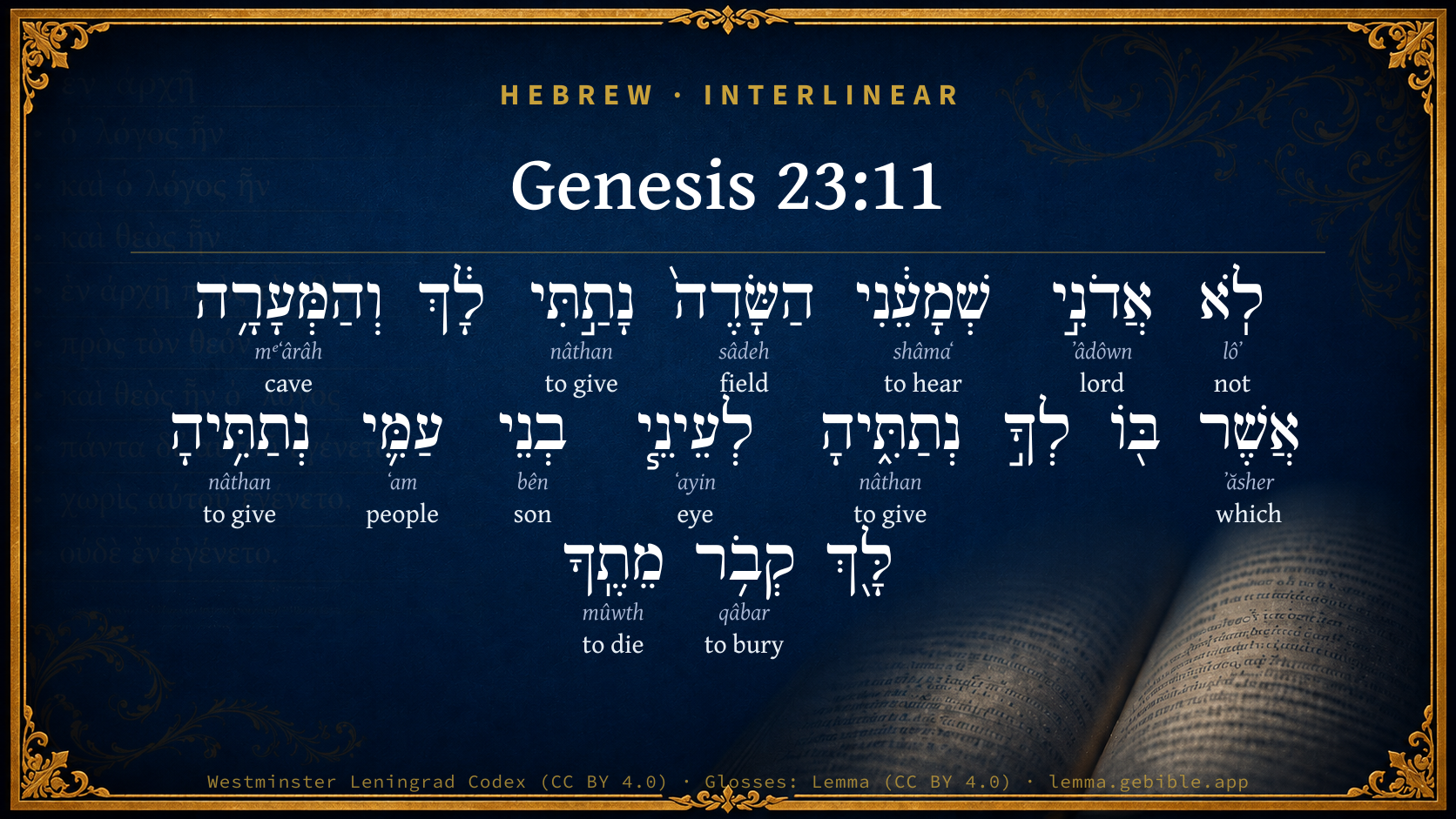
Hebrew (Westminster Leningrad Codex) Genesis 23:11 appears in the Hebrew Old Testament. The text above is from the Westminster Leningrad Codex. Each word links to its Strong’s number, a concise gloss, and parsing drawn from the Open Scriptures Hebrew Bible morphology. Click any word for its full Brown-Driver-Briggs (BDB) entry.
Download image
Cite this verse

Genesis 23:11 (World English Bible). Public Domain. Lemma interlinear Bible study tool, https://lemma.gebible.app/v/genesis/23/11.

Show BibTeX & RIS
BibTeX
RIS
English Translation
"No, my lord, hear me. I give you the field, and I give you the cave that is in it. In the presence of the children of my people I give it to you. Bury your dead."
World English Bible · Public Domain
Download a study sheet

One document with this verse’s original text, its word-by-word gloss line, the meaning frame, cross-references with their text, attributed commentary, and full source and license credits — printable, and it pastes into notes with its structure intact.

This verse Autodidact and up

Study sheet (.html) Plain text (.txt)

A passage Seminary Student

Up to 50 verses in one chapter. A passage sheet keeps up to 6 commentary sources and 12 cross-references per verse, in the order this page ranks them, and says so on the sheet whenever that leaves anything out. Ask for a single verse and you get the Autodidact verse sheet above.

Everything on this page stays free to read, with no account — the sheet is a download of what is already on screen, not access to it.

Want to remove ads? Support Godless Engineer
Compare translations 3

The same verse in 3 English versions, stacked beneath the original-language interlinear above. Click any original word for its lexicon entry.

Each is an independent rendering of the whole verse — the interlinear is not word-aligned to these translations.

Highlighted words mark where these versions differ — a whole-verse word diff, not a word-by-word alignment.

  • World English Bible Public Domain
    "No, my lord, hear me. I give you the field, and I give you the cave that is in it. In the presence of the children of my people I give it to you. Bury your dead."
  • King James Version Public Domain
    Nay, my lord, hear me: the field give I thee, and the cave that is therein, I give it thee; in the presence of the sons of my people give I it thee: bury thy dead.
  • unfoldingWord Literal Text CC BY-SA 4.0
    “No, my lord. Listen to me: I give to you the field, and I give to you the cave that in it. I give it to you before the eyes of the sons of my people. Bury your dead.”

unfoldingWord Literal Text — © unfoldingWord, licensed CC BY-SA 4.0. Word-aligned USFM3 via Door43 (git.door43.org/unfoldingWord/en_ult).

Versions to compare (up to 4)

3 of 4 selected

Show all 18 translations

Every available English version of this verse, each an independent rendering of the whole verse.

  • World English Bible Public Domain
    "No, my lord, hear me. I give you the field, and I give you the cave that is in it. In the presence of the children of my people I give it to you. Bury your dead."
  • Berean Standard Bible Public Domain
    “No, my lord. Listen to me. I give you the field, and I give you the cave that is in it. I give it to you in the presence of my people. Bury your dead.”
  • Majority Standard Bible Public Domain
    “No, my lord. Listen to me. I give you the field, and I give you the cave that is in it. I give it to you in the presence of my people. Bury your dead.”
  • King James Version Public Domain
    Nay, my lord, hear me: the field give I thee, and the cave that is therein, I give it thee; in the presence of the sons of my people give I it thee: bury thy dead.
  • American Standard Version (1901) Public Domain
    Nay, my lord, hear me. The field give I thee, and the cave that is therein, I give it thee. In the presence of the children of my people give I it thee. Bury thy dead.
  • Revised Version (1885) Public Domain
    Nay, my lord, hear me: the field give I thee, and the cave that is therein, I give it thee; in the presence of the sons of my people give I it thee: bury thy dead.
  • Geneva Bible (1599) Public Domain
    No, my Lord, heare me: the fielde giue I thee, and the caue, that therein is, I giue it thee: euen in the presence of the sonnes of my people giue I it thee, to bury thy dead.
  • Douay-Rheims (1899) Public Domain
    Let it not be so, my lord, but do thou rather hearken to what I say: The field I deliver to thee, and the cave that is therein, in the presence of the children of my people, bury thy dead.
  • Young's Literal Translation Public Domain
    `Nay, my lord, hear me: the field I have given to thee, and the cave that `is' in it, to thee I have given it; before the eyes of the sons of my people I have given it to thee -- bury thy dead.'
  • Literal Standard Version CC BY-SA 4.0
    “No, my lord, hear me: the field I have given to you, and the cave that [is] in it, to you I have given it; before the eyes of the sons of my people I have given it to you—bury your dead.”
  • Unlocked Literal Bible CC BY-SA 4.0
    “No, my master, hear me. I give you the field, and the cave that is in it. I give it to you in the presence of the sons of my people. I give it to you to bury your dead.”
  • unfoldingWord Literal Text CC BY-SA 4.0
    “No, my lord. Listen to me: I give to you the field, and I give to you the cave that in it. I give it to you before the eyes of the sons of my people. Bury your dead.”
  • Darby Bible Public Domain
    No, my lord: hear me. The field give I thee; and the cave that is in it, to thee I give it; before the eyes of the sons of my people give I it thee: bury thy dead.
  • World Messianic Bible Public Domain
    “No, my lord, hear me. I give you the field, and I give you the cave that is in it. In the presence of the children of my people I give it to you. Bury your dead.”
  • Webster's Bible Public Domain
    Nay, my lord, hear me: the field give I to thee, and the cave that is in it, I give it to thee; in the presence of the sons of my people I give it to thee: bury thy dead.
  • Free Bible Version CC BY-SA 4.0
    “No, my lord,” he said. “Please listen to me. I give you the field and the cave that is there. I give it to you and my people are my witnesses. Please go and bury your dead.”
  • Bible in Basic English Public Domain
    No, my lord, I will give you the field with the hollow in the rock; before all the children of my people will I give it to you for a resting-place for your dead.
  • JPS Tanakh (1917) Public Domain
    'Nay, my lord, hear me: the field give I thee, and the cave that is therein, I give it thee; in the presence of the sons of my people give I it thee; bury thy dead.'

Literal Standard Version (2020), Covenant Press — licensed CC BY-SA 4.0. Text via the HelloAO Bible API (eBible.org). Unlocked Literal Bible (unfoldingWord) — licensed CC BY-SA 4.0. Text via the HelloAO Bible API (eBible.org). unfoldingWord Literal Text — © unfoldingWord, licensed CC BY-SA 4.0. Word-aligned USFM3 via Door43 (git.door43.org/unfoldingWord/en_ult). Free Bible Version, Dr. Jonathan Gallagher — licensed CC BY-SA 4.0. Text via the HelloAO Bible API (eBible.org).

Word by word

More ways to search: Search by grammar → Find every occurrence → Compare this word →

Practice this passage: Drill this verse → Learn its vocabulary →

וְהַמְּעָרָ֥ה
mᵉʻârâh
H4631
“and · the · cave”
Conjunction + Particle, Definite Article + Noun, Common, Feminine, Singular, Absolute
Part of Speech
Conjunction + Particle + Noun
Type
Common
Gender
Feminine
Number
Singular
State
Absolute
Full BDB Definition

Origin: from H5783

TWOT: 1704a

cave, den, hole
  1. לֹֽא lôʼ H3808 “not” Particle, Negative
  2. אֲדֹנִ֣י ʼâdôwn H113 “lord · my” Noun, Common, Masculine, Singular, Construct + Suffix, Personal, 1st Person, Common, Singular
  3. שְׁמָעֵ֔נִי shâmaʻ H8085 “hear · me” Verb, Qal, Imperative, 2nd Person, Masculine, Singular + Suffix, Personal, 1st Person, Common, Singular
  4. הַשָּׂדֶה֙ sâdeh H7704 “the · field” Particle, Definite Article + Noun, Common, Masculine, Singular, Absolute
  5. נָתַ֣תִּי nâthan H5414 “to give” Verb, Qal, Perfect, 1st Person, Common, Singular
  6. אֲשֶׁר ʼăsher H834 “which” Particle, Relative
  7. נְתַתִּ֑יהָ nâthan H5414 “to give · her” Verb, Qal, Perfect, 1st Person, Common, Singular + Suffix, Personal, 3rd Person, Feminine, Singular
  8. לְעֵינֵ֧י ʻayin H5869 “to/for · eyes of” Preposition + Noun, Common, Both, Dual, Construct
  9. בְנֵי bên H1121 “sons of” Noun, Common, Masculine, Plural, Construct
  10. עַמִּ֛י ʻam H5971 “people · my” Noun, Common, Masculine, Singular, Construct + Suffix, Personal, 1st Person, Common, Singular
  11. נְתַתִּ֥יהָ nâthan H5414 “to give · her” Verb, Qal, Perfect, 1st Person, Common, Singular + Suffix, Personal, 3rd Person, Feminine, Singular
  12. קְבֹ֥ר qâbar H6912 “bury” Verb, Qal, Imperative, 2nd Person, Masculine, Singular
  13. מֵתֶֽךָ mûwth H4191 “dying · you” Verb, Qal, Participle Active, Masculine, Singular, Construct + Suffix, Personal, 2nd Person, Masculine, Singular

About this verse

These counts appear in no published source. They are computed here, from the morphology-tagged text and Lemma’s own curated glosses. What Lemma adds →

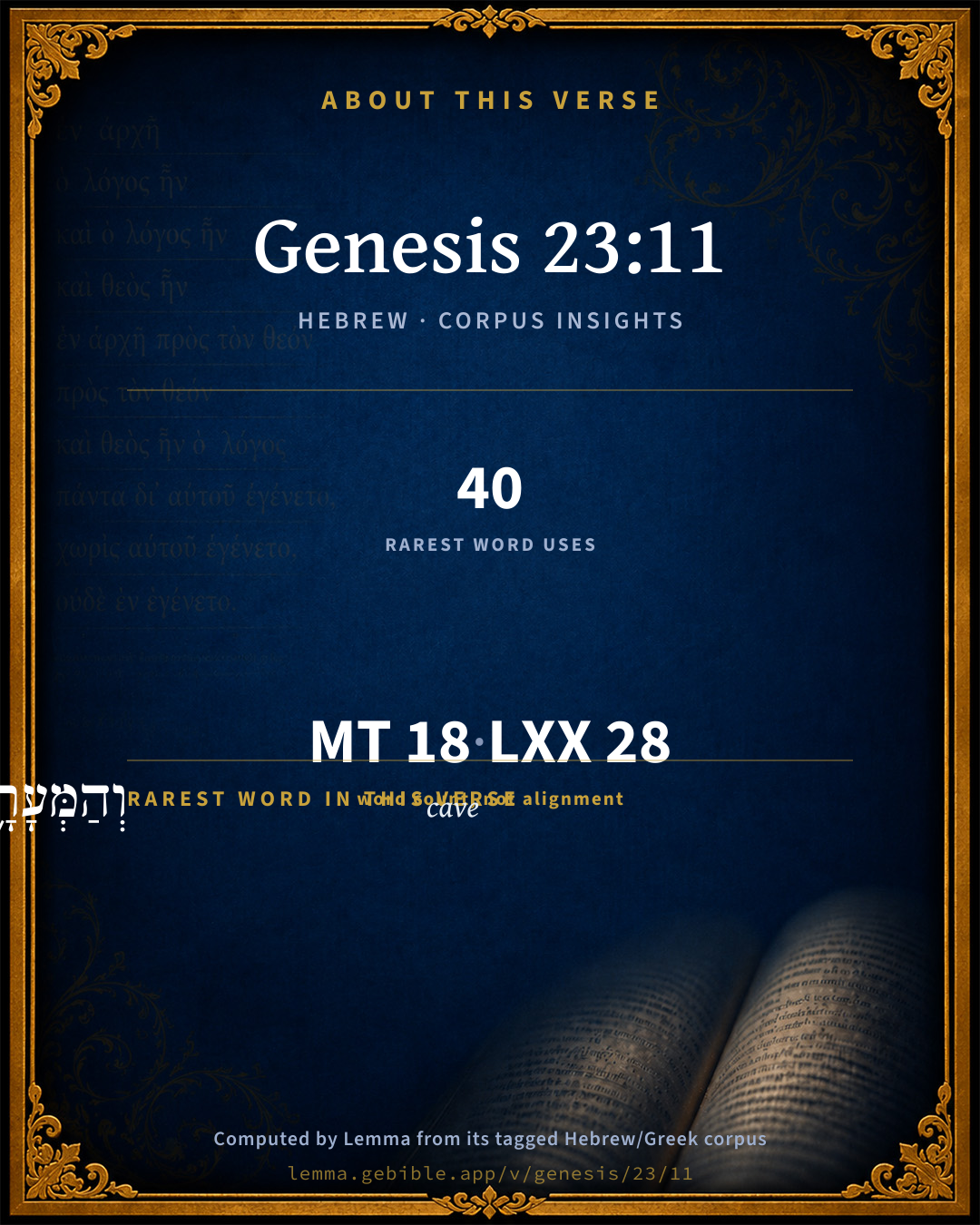
18
words
12
distinct lemmas
Pentateuch
section

Shared distinctive vocabulary

וְהַמְּעָרָ֥ה cave H4631 occurs in 36 verses of the Hebrew Bible. Also found in:

Grammatical profile

  • 6 verbs
  • 6 nouns
  • 4 prepositions
  • 2 particles

Verb forms

  • שְׁמָעֵ֔נִי Qal · Imperative
  • נָתַ֣תִּי Qal · Perfect
  • נְתַתִּ֑יהָ Qal · Perfect
  • נְתַתִּ֥יהָ Qal · Perfect
  • קְבֹ֥ר Qal · Imperative
  • מֵתֶֽךָ Qal · Participle Active

Repetition

A word recurs within this verse — often emphatic in Hebrew:

  • נָתַ֣תִּי to give H5414 ×3

Hebrew & Septuagint length

In English translation the verse runs 37 words from the Hebrew and 34 from the Septuagint (LXX English) — closely comparable.

A rough comparison of the two English renderings, which tokenize alike — not a word-level alignment.

Word counts can differ between the Hebrew and the Greek without any difference in meaning — e.g. the Hebrew direct-object marker אֵת has no separate Greek word, and Greek often adds the article ὁ.

In the original languages it is 18 Hebrew tokens and 28 Greek tokens — but the two are counted differently (Hebrew bundles its prefixes and suffixes into one token; the Greek is in lemma form), so that isn’t a like-for-like length.

Cross-references

14

Topical passages linked to Genesis 23:11 in the Treasury of Scripture Knowledge — connected by theme and wording, ordered by reader-vote popularity; previews shown in the World English Bible.

  • Luke 19:24 He said to those who stood by, 'Take the mina away from him, and give it to him who has the ten minas.'
  • Isaiah 32:8 But the noble devises noble things; and in noble things shall he continue.
  • Genesis 23:6 "Hear us, my lord. You are a prince of God among us. In the choice of our tombs bury your dead. None of us will withhold from you his tomb, but that you may bury your dead."
  • Genesis 23:18 to Abraham for a possession in the presence of the children of Heth, before all who went in at the gate of his city.
  • Numbers 35:30 Whoever kills any person, the murderer shall be slain at the mouth of witnesses: but one witness shall not testify against any person that he die.
  • Deuteronomy 17:6 At the mouth of two witnesses, or three witnesses, shall he who is to die be put to death; at the mouth of one witness he shall not be put to death.
  • Deuteronomy 19:15 One witness shall not rise up against a man for any iniquity, or for any sin, in any sin that he sins: at the mouth of two witnesses, or at the mouth of three witnesses, shall a matter be established.
  • Ruth 4:1 Now Boaz went up to the gate, and sat him down there: and, behold, the near kinsman of whom Boaz spoke came by; to whom he said, Ho, such a one! turn aside, sit down here. He turned aside, and sat down.
  • Ruth 4:4 I thought to disclose it to you, saying, Buy it before those who sit here, and before the elders of my people. If you will redeem it, redeem it: but if you will not redeem it, then tell me, that I may know; for there is none to redeem it besides you; and I am after you. He said, I will redeem it.
  • Ruth 4:9 Boaz said to the elders, and to all the people, You are witnesses this day, that I have bought all that was Elimelech's, and all that was Chilion's and Mahlon's, of the hand of Naomi.
  • Ruth 4:11 All the people who were in the gate, and the elders, said, We are witnesses. Yahweh make the woman who has come into your house like Rachel and like Leah, which two built the house of Israel: and do you worthily in Ephrathah, and be famous in Bethlehem:
  • 2 Samuel 24:20–24 Araunah looked forth, and saw the king and his servants coming on toward him: and Araunah went out, and bowed himself before the king with his face to the ground.
  • 1 Chronicles 21:22–24 Then David said to Ornan, Give me the place of this threshing floor, that I may build thereon an altar to Yahweh: for the full price shall you give it me, that the plague may be stayed from the people.
  • Jeremiah 32:7–12 Behold, Hanamel the son of Shallum your uncle shall come to you, saying, Buy you my field that is in Anathoth; for the right of redemption is yours to buy it.

Cross-references courtesy of OpenBible.info (CC BY 4.0).

Hebrew and Greek witnesses Masoretic Hebrew ↔ Greek Septuagint

The same verse in the two great witnesses to the Old Testament, shown verse-for-verse.

These are two independent witnesses, not word-aligned to each other, and the Septuagint is shown in lemma (dictionary) form.

Hebrew Genesis 23:11 Masoretic · Westminster Leningrad Codex

לֹֽא אֲדֹנִ֣י שְׁמָעֵ֔נִי הַשָּׂדֶה֙ נָתַ֣תִּי לָ֔ךְ וְהַמְּעָרָ֥ה אֲשֶׁר בּ֖וֹ לְךָ֣ נְתַתִּ֑יהָ לְעֵינֵ֧י בְנֵי עַמִּ֛י נְתַתִּ֥יהָ לָּ֖ךְ קְבֹ֥ר מֵתֶֽךָ

"No, my lord, hear me. I give you the field, and I give you the cave that is in it. In the presence of the children of my people I give it to you. Bury your dead."

World English Bible · Public Domain

Greek LXX Genesis 23:11 Septuagint · lemma form

παρά ἐγώ γίγνομαι κύριος καί ἀκούω ἐγώ ὁ ἀγρός καί ὁ σπήλαιον ὁ ἐν αὐτός σύ δίδωμι ἐναντίον πᾶς ὁ πολίτης ἐγώ δίδωμι σύ θάπτω ὁ νεκρός σύ

Attend to me, my lord, and hear me, I give to you the field and the cave which is in it; I have given it you before all my country men; bury your dead.

LXX2012 (modern English Septuagint) · Public Domain

Hebrew: Westminster Leningrad Codex (CC BY 4.0). Greek: Septuagint (public domain); English from LXX2012 (modern English Septuagint) (Public Domain). How the Septuagint differs from the Hebrew →

Targum (Aramaic paraphrase)

2

The Targum is the ancient Jewish Aramaic paraphrase of the Hebrew Scriptures — an interpretive translation, not the Hebrew text itself. Onkelos (literal) and Pseudo-Jonathan (expansive) render the Torah, and Jonathan the Prophets. Coverage is partial: where no permissively-licensed English translation exists for a verse, only the Aramaic is shown. This is verse-level text, not a word-by-word alignment to the Hebrew.

  1. Targum Onkelos Torah (Genesis–Deuteronomy)
    לָא רִבּוֹנִי קַבֵּיל מִנִּי חַקְלָא יְהָבִית לָךְ וּמְעַרְתָּא דִּי בֵהּ לָךְ יְהָבִיתַהּ לְעֵינֵי בְנֵי עַמִּי יְהָבִיתַהּ לָךְ קְבַר מִיתָךְ

    (no public-domain English translation for this verse)

    Targum Onkelos — Aramaic: “Onkelos Genesis” (public domain); “Onkelos Exodus” (public domain); “Onkelos Leviticus” (public domain); “Onkelos Numbers” (public domain); “Onkelos Deuteronomy” (public domain). English: “Sefaria Community Translation” (CC0 1.0 (public-domain dedication)); “J.W. Etheridge. The Targums of Onkelos and Jonathan Ben Uzziel on the Pentateuch. London: Longmans, Green, 1862” (public domain). Text via Sefaria.

  2. Targum Pseudo-Jonathan Torah (Genesis–Deuteronomy)
    בְּבָעוּ רִבּוֹנִי קַבֵּיל מִינִי חַקְלָא יְהָבִית לָךְ וּמְעַרְתָּא דְבֵיהּ לָךְ יְהַבְתָּהּ לְמַתְּנָא בְּאַנְפֵּי בְּנֵי עַמִי יְהַבְתָּהּ לָךְ אִיזֵל קְבַר מִיתָךְ

    My lord, listen to me: the field I give thee, and the cave which is in it, to thee I give it, as a gift before the sons of my people I give it to thee; go, bury thy dead.

    Targum Pseudo-Jonathan — Aramaic: “Targum Jonathan on Genesis” (public domain); “Targum Jonathan on Exodus” (public domain); “Targum Jonathan on Leviticus” (public domain); “Targum Jonathan on Numbers” (public domain); “Targum Jonathan on Deuteronomy” (public domain). English: “The Targum of Jonathan ben Uzziel, trans. J. W. Etheridge, London, 1862” (public domain). Text via Sefaria.

Commentary

Notes on Genesis 23:11 from classic Christian and Jewish commentators (each source and its license shown beneath its notes). The classic Christian expositions comment on the surrounding passage and are grouped to its opening verse, so a note may address several verses; the Jewish commentaries on the Tanakh (Rashi and others) are per-verse, so they appear only where the commentator wrote on this verse.

Lemma curates 59 commentaries, every one of them public domain or Creative Commons licensed, each selected and text-cleaned for this edition rather than reprinted as found. About our sources →

The Cambridge Bible for Schools and Colleges

gen. ed. J. J. S. Perowne

11. the field give I thee, &c.] As in Gen_23:6, we have here the complimentary style of bargaining. Observe the successive stages: Abraham in Gen_23:9 asks to buy the cave only; Ephron in Gen_23:11 offers to give the whole field and the cave in it for nothing; Abraham in Gen_23:13 offers to pay for the field; Ephron in Gen_23:15 mentions the price for the land; Abraham in Gen_23:16 duly pays for the field and the cave (Gen_23:17).

The Cambridge Bible for Schools and Colleges (gen. ed. J. J. S. Perowne; Cambridge University Press, 1878–1918) — public domain. Text from a community e-Sword module.

Trapp's Complete Commentary

John Trapp

Gen 23:11 Nay, my lord, hear me: the field give I thee, and the cave that [is] therein, I give it thee; in the presence of the sons of my people give I it thee: bury thy dead.

Ver. 11. The field give I thee, &c.] A brave speech of a bountiful spirit, to a stranger especially; and in that respect beyond that of Araunah the noble Jebusite to David, his liege lord; "All these things did Araunah as a king give to the king". {2Sa 24:23} Indeed, to give is a kingly employment; making men like to "the Father of lights, from whom comes every good gift and perfect giving". {Jas 1:17} Kings are styled benefactors; {a} and of the ancient kings of Egypt it is recorded, and was rehearsed among other of their praises, that they were ευμεταδοτοι, και κοινωνικοι, "willing to distribute, ready to communicate," which are the apostle’s two words in 1Ti 6:18. Cyrus took more delight in giving than possessing, as his soldiers could say of him in Xenophon. {b} It is not only better, but sweeter to do good, than to receive good, said Epicurus. {c} It is a "more blessed" thing, saith our Saviour. Titus would say, when he had done no good, he had lost a day: et molestius erat Severo Imperatori nihil peti, quam dare . Our General Norrice, like that Bishop of Lincoln, never thought he had that thing, which he did not give. Few such now-a-days.

{a} ευεργεκαι. - Diodor. Sic., lib. i. {Luk 22:25}

{b} Dιδους μαλλον η κτωμενος ηδεται

{c} του ευ παχειν το ευ ποιειν, ου καλλιον μονον αλλα κια ηδιον. - Epicur.

John Trapp, A Commentary or Exposition upon All the Books of the Old and New Testament (1647–1656) — public domain. Text from a community e-Sword module.

Joseph Benson's Commentary

Gen 23:11. The field I give thee — Thus Ephron manifests his generosity. So far was he from needing to be entreated to sell it, that, upon the first mention, he freely gives it. In the presence of my people — Grants, or contracts, were then made before all the people, or their representatives. And the gates of cities were in those days, and for many centuries after, the places of judicature and common resort, for transacting business. We may observe that Abraham finds favour in the sight of every people wherever he goes. And we need not wonder at this, considering of what a noble, candid, upright, and generous character he was. Undoubtedly, however, the peculiar favour he found among all people was chiefly owing to the providence of God: for the Scriptures always teach us to ascribe our finding favour with men to the divine blessing.

Joseph Benson's Commentary on the Old and New Testaments (1811–1818) — public domain. Text from a community e-Sword module.

Tyndale Open Study Notes

Tyndale Open Resources

23:11 Ephron did not intend to give the cave to Abraham; Abraham was expected to “give” the full price in return. Ephron wanted to sell as much as he could to avoid responsibility for caring for the cave and to receive as high a price as possible.

Tyndale Open Study Notes — © Tyndale Open Resources, licensed CC BY-SA 4.0. Text via the HelloAO Bible API.

Jamieson, Fausset & Brown

Robert Jamieson, A. R. Fausset & David Brown

Ephron answered, Nay, my lord, &c.--Here is a great show of generosity, but it was only a show; for while Abraham wanted only the cave, he joins "the field and the cave"; and though he offered them both as free gifts, he, of course, expected some costly presents in return, without which, he would not have been satisfied. The patriarch, knowing this, wished to make a purchase and asked the terms.

Jamieson, Fausset & Brown — Commentary Critical and Explanatory on the Whole Bible (1871) — public domain (CC PDM 1.0). Text via the HelloAO Bible API.

John Calvin's Commentaries

11. Hear me. Although Ephron earnestly insisted upon giving the field freely to Abraham, the holy man adheres to his purpose, and at length compels him, by his entreaties, to sell the field. Ephron, in excusing himself, says that the price was too small for Abraham to insist upon giving; yet he estimates it at four hundred shekels. Now, since Josephus says that the shekel of the sanctuary was worth four Attic drachms, if he is speaking of these, we gather from the computation of Budaeus that the price of the field was about two hundred and fifty pounds of French money; if we understand the common shekel, it will be half that amount. Abraham was not so scrupulous but that he would have received a greater gift, if there had not been a sufficient reason to prevent him. He had been presented with considerable gifts both by the king of Egypt and the king of Gerar, but he observed this rule; that he would neither receive all things, nor in all places, nor from all persons. And I have lately explained, that he bought the field, in order that he might not possess a foot of land, by the gift of any man.

John Calvin's Commentaries (1540-1563) — public domain. Text from the Calvin Translation Society English edition (1840s-50s) via the Christian Classics Ethereal Library (ccel.org). Calvin's coverage is partial (roughly two-thirds of the Bible); uncommented books and verses are honest gaps, never fabricated. The 19th-century editor's footnotes and remarks are omitted so the notes are faithfully Calvin's own voice.

Ellicott's Commentary for English Readers

(11) The field give I thee.—Only the cave had! been mentioned, but for its quiet possession the land around was necessary. In the thrice repeated “give I it thee,” there is the same courtly idea as in Gen_23:6, that they were not buying and selling, but making mutual presents.

A Bible Commentary for English Readers, edited by Charles John Ellicott (1878–1897) — public domain. Text from a community e-Sword module.

John Gill's Exposition

Nay, my lord, hear me,.... Or not so, my lord, as Aben Ezra paraphrases it; not that he denied his request entirely, or refused him the cave at any rate, but that he should not buy it of him, he would give it to him, and therefore he desires he would hear what he had to say further:

the field give I thee, and the cave that is therein I give it thee; which was more than Abraham asked to purchase; he only desired to have the cave, which lay in one corner of the field, but Ephron proposes both to give him the cave, and the field also:

in the presence of the sons of my people give I it thee; both field and cave; three times he says, "I give it thee", to show that he freely gave it, and that Abraham was welcome to it, and for the confirmation of the grant:

bury thy dead; in the cave, at once, immediately, without any more ado.

John Gill's Exposition of the Whole Bible (1746–1763) — public domain (CC PDM 1.0). Text via the HelloAO Bible API.

Whedon's Commentary on the Bible

Daniel D. Whedon

11. Give I thee — Three times over this princely son of Zohar offers to give field, cave, and all. And yet, doubtless, like the modern sheik, he would expect a splendid present in return, or, by his show of kindness and profuse liberality, prevent Abraham from objecting to his price when once named.

Daniel D. Whedon (gen. ed.), Commentary on the Old and New Testaments (1874–1909) — public domain. Text from a community e-Sword module.

The Pulpit Commentary

Nay, my lord, hear me: the field give I thee, and the cave that is therein, I give it thee an Oriental mode of expressing willingness to sell. Ephron would make a present of cave and field to the patriarch, just so have I had a hundred houses, and fields, and horses given to me" ("Land and Book," p. 578), the design being either to obtain a valuable compensation in return, or to preclude any abatement in the price (Keil), though possibly the offer to sell the entire field when he might have secured a good price for the cave alone was an indication of Ephron"s good intention (Lange). At least it seems questionable to conclude that Ephron"s generous phrases, which have now become formal and hollow courtesies indeed, meant no more in that simpler age when the ceremonies of intercourse were newer, and more truly reflected its spirit (Dykes, "Abraham, the Friend of God," p. 287). In the presence of the ions of my people give I it thee (literally, have I given, the transaction being viewed as finished): bury thy dead.

The Pulpit Commentary (1880–1919), ed. H.D.M. Spence-Jones & Joseph S. Exell — public domain. Text from a community e-Sword module.

John Wesley's Explanatory Notes

The field give I thee - Abraham thought he must be intreated to sell it, but upon the first mention, without intreaty, he freely gives it.

John Wesley, Explanatory Notes Upon the Whole Bible (1754–1765) — public domain. Text via the GEBible commentary corpus.

Rashi

Rabbi Shlomo Yitzchaki (Rashi)

לא אדני NAY, MY LORD — You are not to buy it with money.

נתתי לך I HAVE GIVEN IT TO THEE (a perfect tense) — See, it is as though I have already given it to you.

Rashi on the Tanakh — English translations: “The Judaica Press complete Tanach with Rashi, translated by A. J. Rosenberg” (CC BY 4.0); “Pentateuch with Rashi's commentary by M. Rosenbaum and A.M. Silbermann, 1929-1934” (public domain); “The Metsudah Tanach series, Lakewood, N.J” (CC BY 4.0); and “The Book of Joshua, Metsudah Publications, 1997” (CC BY 4.0). Text via Sefaria.

Ramban (Nachmanides)

Rabbi Moshe ben Nachman (Ramban / Nachmanides)

IN THE PRESENCE OF THE SONS OF MY PEOPLE. The intent thereof is to state: “Behold, all the people are present, and they are knowledgeable witnesses to the sale. Therefore do not fear denial or retraction, and so bury thy dead from now on, for it is yours and I cannot retract.” But Abraham did not do so for even after he paid its full value in silver he first took symbolic legal possession of the field and the cave. He established them as his possession in the presence of the people of the city, and all those who came in at the gate of the city, the merchants and the residents who happened to be there, and after that he buried her.

Ramban (Nachmanides) on the Tanakh — English translation: “Commentary on the Torah by Ramban (Nachmanides). Translated and annotated by Charles B. Chavel. New York, Shilo Pub. House, 1971-1976” (CC BY 4.0). Text via Sefaria.

Sforno

Rabbi Ovadia Sforno

No, my master, hear me. There is no need for the leaders of the community to intercede with me.

I have given you the field. In my mind I gave it to you the moment you spoke.

Sforno on the Tanakh — English translation: “Yalkut, Sifsei Chachomim Chumash, Metsudah Publications, 2009” (CC BY 4.0). Text via Sefaria.

Radak

Rabbi David Kimhi (Radak)

לא אדוני שמעני, not like you say that you want to pay the full value of the property. Take it for free, as a gift, and not only the cave, but I am also donating the field to you.

נתתי, I have already given it to you as a gift,

לעיני בני עמי, in front of the members of my people who are all witnesses to this transaction between me and you.

Radak on the Tanakh — English translations: “Sefaria Community Translation” (CC0 1.0 (public-domain dedication)); “Eliyahu Munk, HaChut Hameshulash” (CC BY 4.0); “Rabbi Mike Feuer, Jerusalem Anthology” (CC BY 4.0); and “R. David Kimhi on the first book of Psalms, Translated by R.G. Finch, London, 1919” (public domain). Text via Sefaria.

Lesson kit

Teaching starters — assembled from the data on this page, not authored interpretation. Every prompt links to the verse data it draws on. Edit before teaching.

Genesis, in the Pentateuch, opens this verse with 18 words (12 distinct Hebrew lemmas). Its most distinctive word is mᵉʻârâh (“cave”). A historical commentator’s framing appears above. Read the whole chapter for the surrounding context.

Discussion questions

  1. What does “cave” (mᵉʻârâh) contribute to the verse as a whole?
  2. How does Genesis 19:30, which shares the word «cave», read alongside this verse?
  3. What does the repetition of “to give” (3× in this one verse) do in this verse?
  4. The translations on this page render this verse differently — a whole-verse word diff, not a word-by-word alignment. What might account for the different wordings?
  5. «שְׁמָעֵ֔נִי» is a Qal Imperative verb. How does that grammatical form shape the action described?
  6. Compare how The Cambridge Bible for Schools and Colleges and Trapp's Complete Commentary read this verse. Where do they agree or differ?

Things to notice

Reading settings

Reading text

Shown beneath each verse's original-language words.

Old Testament
Old Testament edition

Read the OT as the Masoretic Hebrew (MT) or the Greek Septuagint (LXX).

English shown for the Greek Septuagint (in the Hebrew ↔ Greek comparison).

Comparing translations? Open the Compare panel on any verse page to stack up to four side by side.