
Genesis 30:35

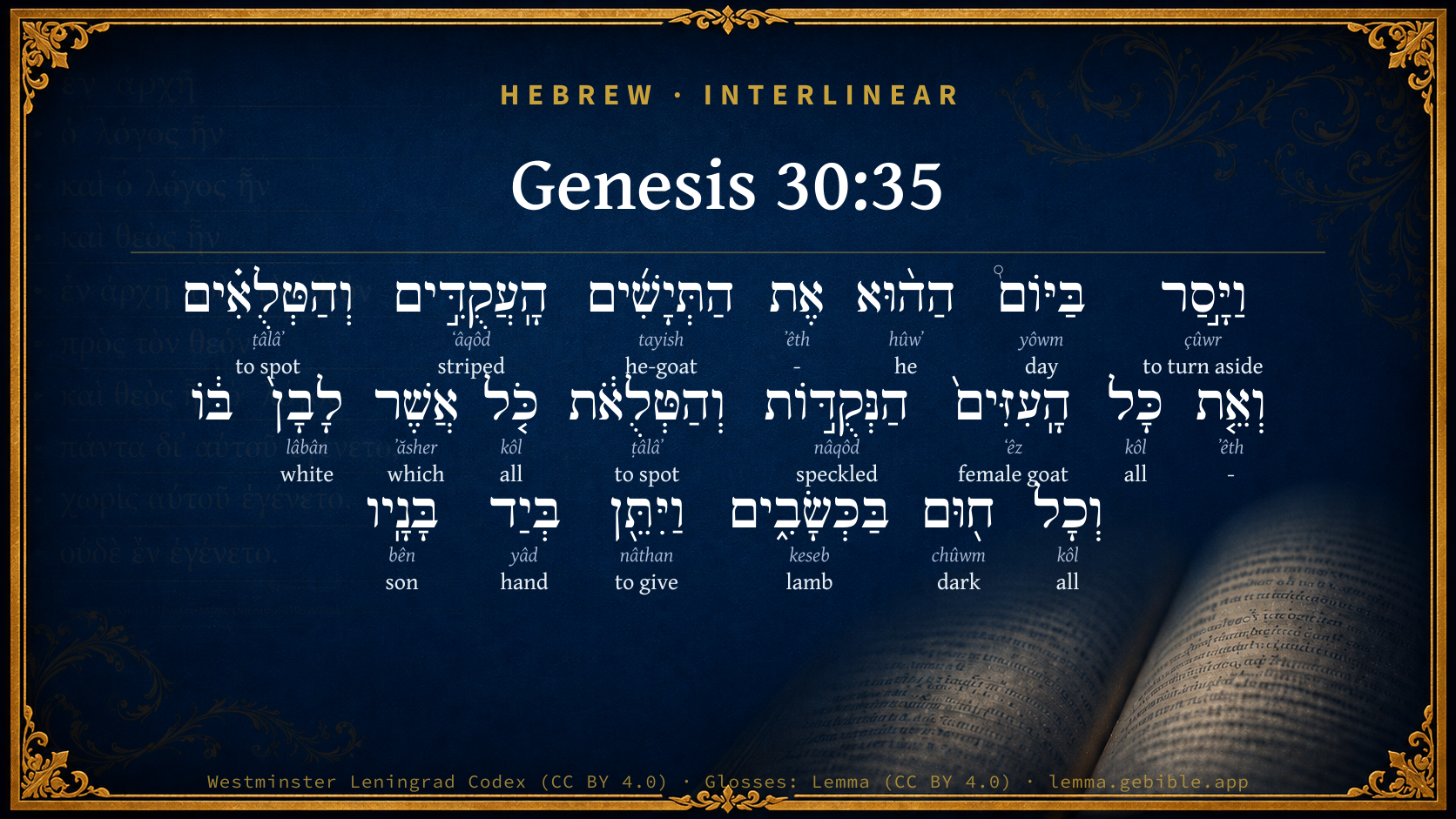
Hebrew (Westminster Leningrad Codex) Genesis 30:35 appears in the Hebrew Old Testament. The text above is from the Westminster Leningrad Codex. Each word links to its Strong’s number, a concise gloss, and parsing drawn from the Open Scriptures Hebrew Bible morphology. Click any word for its full Brown-Driver-Briggs (BDB) entry.
Download image
Cite this verse

Genesis 30:35 (World English Bible). Public Domain. Lemma interlinear Bible study tool, https://lemma.gebible.app/v/genesis/30/35.

Show BibTeX & RIS
BibTeX
RIS
English Translation
That day, he removed the male goats that were streaked and spotted, and all the female goats that were speckled and spotted, every one that had white in it, and all the black ones among the sheep, and gave them into the hand of his sons.
World English Bible · Public Domain
Highlights
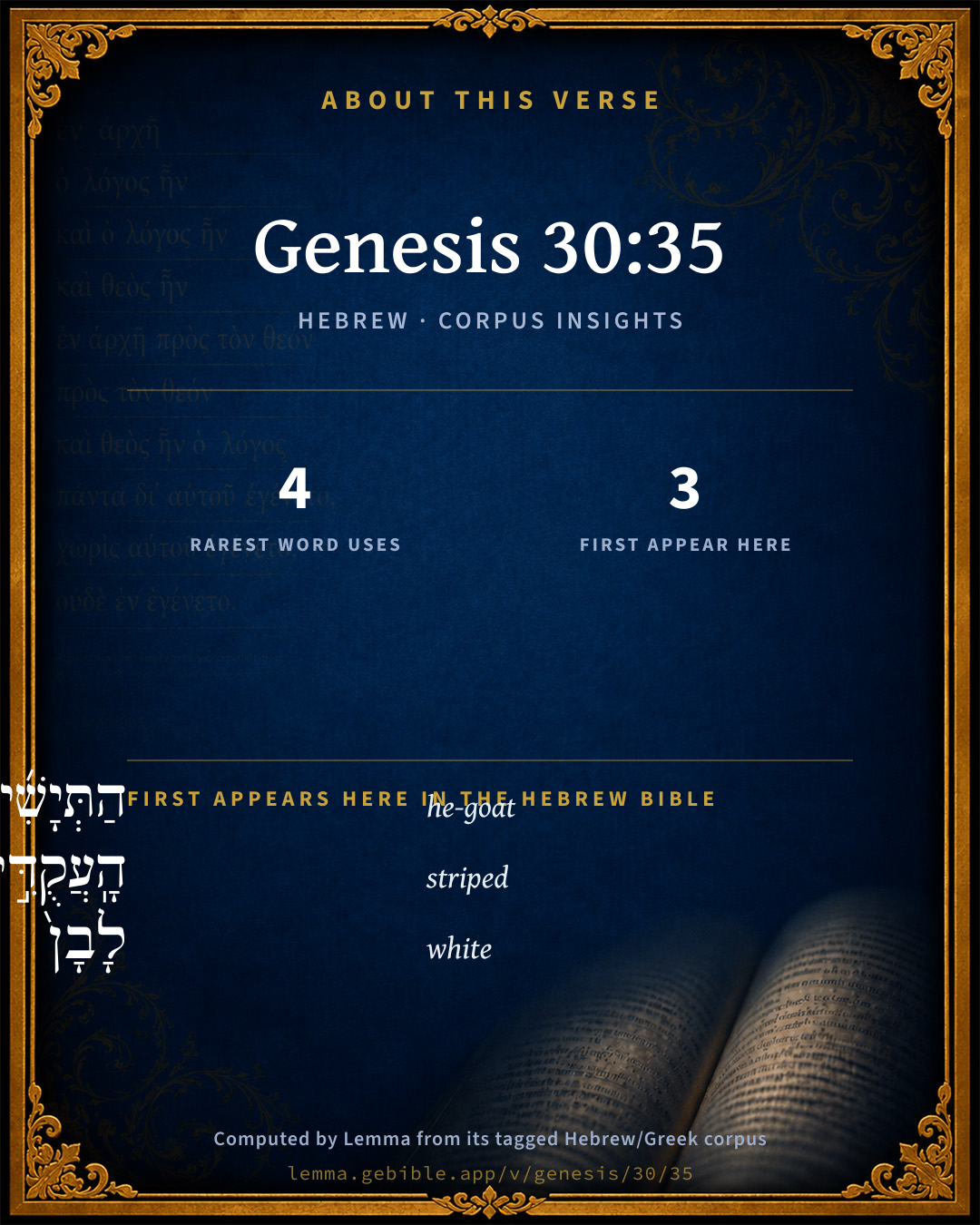
  • 3 first appearances in the Hebrew Bible
Full analysis ↓
Download a study sheet

One document with this verse’s original text, its word-by-word gloss line, the meaning frame, cross-references with their text, attributed commentary, and full source and license credits — printable, and it pastes into notes with its structure intact.

This verse Autodidact and up

Study sheet (.html) Plain text (.txt)

A passage Seminary Student

Up to 50 verses in one chapter. A passage sheet keeps up to 6 commentary sources and 12 cross-references per verse, in the order this page ranks them, and says so on the sheet whenever that leaves anything out. Ask for a single verse and you get the Autodidact verse sheet above.

Everything on this page stays free to read, with no account — the sheet is a download of what is already on screen, not access to it.

Want to remove ads? Support Godless Engineer
Compare translations 3

The same verse in 3 English versions, stacked beneath the original-language interlinear above. Click any original word for its lexicon entry.

Each is an independent rendering of the whole verse — the interlinear is not word-aligned to these translations.

Highlighted words mark where these versions differ — a whole-verse word diff, not a word-by-word alignment.

  • World English Bible Public Domain
    That day, he removed the male goats that were streaked and spotted, and all the female goats that were speckled and spotted, every one that had white in it, and all the black ones among the sheep, and gave them into the hand of his sons.
  • King James Version Public Domain
    And he removed that day the he goats that were ring-streaked and spotted, and all the she goats that were speckled and spotted, and every one that had some white in it, and all the brown among the sheep, and gave them into the hand of his sons.
  • unfoldingWord Literal Text CC BY-SA 4.0
    Then on that day he removed the male goats that were streaked and spotted, and all the female goats that were speckled and spotted, any that white on it, and all the dark-colored among the lambs. Then he gave into the hand of his sons,

unfoldingWord Literal Text — © unfoldingWord, licensed CC BY-SA 4.0. Word-aligned USFM3 via Door43 (git.door43.org/unfoldingWord/en_ult).

Versions to compare (up to 4)

3 of 4 selected

Show all 18 translations

Every available English version of this verse, each an independent rendering of the whole verse.

  • World English Bible Public Domain
    That day, he removed the male goats that were streaked and spotted, and all the female goats that were speckled and spotted, every one that had white in it, and all the black ones among the sheep, and gave them into the hand of his sons.
  • Berean Standard Bible Public Domain
    That very day Laban removed all the streaked or spotted male goats and every speckled or spotted female goat—every one that had any white on it—and every dark-colored lamb, and he placed them under the care of his sons.
  • Majority Standard Bible Public Domain
    That very day Laban removed all the streaked or spotted male goats and every speckled or spotted female goat—every one that had any white on it—and every dark-colored lamb, and he placed them under the care of his sons.
  • King James Version Public Domain
    And he removed that day the he goats that were ring-streaked and spotted, and all the she goats that were speckled and spotted, and every one that had some white in it, and all the brown among the sheep, and gave them into the hand of his sons.
  • American Standard Version (1901) Public Domain
    And he removed that day the he-goats that were ringstreaked and spotted, and all the she-goats that were speckled and spotted, every one that had white in it, and all the black ones among the sheep, and gave them into the hand of his sons;
  • Revised Version (1885) Public Domain
    And he removed that day the he-goats that were ringstraked and spotted, and all the she-goats that were speckled and spotted, every one that had white in it, and all the black ones among the sheep, and gave them into the hand of his sons;
  • Geneva Bible (1599) Public Domain
    Therefore he tooke out the same day the hee goates that were partie coloured and with great spots, and all the shee goates with litle and great spots, and all that had white in them, and all the blacke among the sheepe, and put them in the keeping of his sonnes.
  • Douay-Rheims (1899) Public Domain
    And he separated the name day the she goats, and the sheep, and the he goats, and the rams of divers colours, and spotted: and all the flock of one colour, that is, of white and black fleece, he delivered into the hands of his sons.
  • Young's Literal Translation Public Domain
    and he turneth aside during that day the ring-straked and the spotted he-goats, and all the speckled and the spotted she-goats, every one that `hath' white in it, and every brown one among the lambs, and he giveth into the hand of his sons,
  • Literal Standard Version CC BY-SA 4.0
    and he turns aside during that day the striped and the spotted male goats, and all the speckled and the spotted female goats, everyone that [has] white in it, and every brown one among the lambs, and he gives into the hand of his sons,
  • Unlocked Literal Bible CC BY-SA 4.0
    That day Laban removed the male goats that were striped and spotted, and all the female goats that were speckled and spotted, every one that had white in it, and all the black ones among the sheep, and gave them into the hand of his sons.
  • unfoldingWord Literal Text CC BY-SA 4.0
    Then on that day he removed the male goats that were streaked and spotted, and all the female goats that were speckled and spotted, any that white on it, and all the dark-colored among the lambs. Then he gave into the hand of his sons,
  • Darby Bible Public Domain
    And he removed that day the he-goats that were ringstraked and spotted, and all the she-goats that were speckled and spotted, every one that had white in it, and all the brown among the lambs, and gave [them] into the hand of his sons.
  • World Messianic Bible Public Domain
    That day, he removed the male goats that were streaked and spotted, and all the female goats that were speckled and spotted, every one that had white in it, and all the black ones among the sheep, and gave them into the hand of his sons.
  • Webster's Bible Public Domain
    And he removed that day the he-goats that were ring-streaked and spotted, and all the she-goats that were speckled and spotted; every one that had some white in it, and all the brown among the sheep, and gave them into the hands of his sons.
  • Free Bible Version CC BY-SA 4.0
    However, the same day Laban went and removed all the striped and spotted male goats, all the speckled and spotted female goats, and all the dark sheep. He had his sons look after them and sent them away—
  • Bible in Basic English Public Domain
    So that day he took all the he-goats which were banded or coloured, and all the she-goats which were marked or coloured or had white marks, and all the black sheep, and gave them into the care of his sons;
  • JPS Tanakh (1917) Public Domain
    And he removed that day the he-goats that were streaked and spotted, and all the she-goats that were speckled and spotted, every one that had white in it, and all the dark ones among the sheep, and gave them into the hand of his sons.

Literal Standard Version (2020), Covenant Press — licensed CC BY-SA 4.0. Text via the HelloAO Bible API (eBible.org). Unlocked Literal Bible (unfoldingWord) — licensed CC BY-SA 4.0. Text via the HelloAO Bible API (eBible.org). unfoldingWord Literal Text — © unfoldingWord, licensed CC BY-SA 4.0. Word-aligned USFM3 via Door43 (git.door43.org/unfoldingWord/en_ult). Free Bible Version, Dr. Jonathan Gallagher — licensed CC BY-SA 4.0. Text via the HelloAO Bible API (eBible.org).

Word by word

More ways to search: Search by grammar → Find every occurrence → Compare this word →

Practice this passage: Drill this verse → Learn its vocabulary →

הַתְּיָשִׁ֜ים
tayish
H8495
“the · he-goats”
Particle, Definite Article + Noun, Common, Masculine, Plural, Absolute
Part of Speech
Particle + Noun
Type
Common
Gender
Masculine
Number
Plural
State
Absolute
Full BDB Definition

Origin: from an unused root meaning to butt

TWOT: 2506

he-goat
  1. וַיָּ֣סַר çûwr H5493 “and · to turn aside” Conjunction + Verb, Hiphil, Sequential Imperfect, 3rd Person, Masculine, Singular
  2. בַּיּוֹם֩ yôwm H3117 “in/at the · day” Preposition, Determined + Noun, Common, Masculine, Singular, Absolute
  3. הַה֨וּא hûwʼ H1931 “the · he” Particle, Definite Article + Pronoun, Personal, 3rd Person, Masculine, Singular
  4. אֶת ʼêth H853 “-” Particle, Direct Object
  5. הָֽעֲקֻדִּ֣ים ʻâqôd H6124 “the · striped” Particle, Definite Article + Adjective, Adjective, Masculine, Plural, Absolute
  6. וְהַטְּלֻאִ֗ים ṭâlâʼ H2921 “and · the · spotted” Conjunction + Particle, Definite Article + Verb, Qal, Participle Passive, Masculine, Plural, Absolute
  7. וְאֵ֤ת ʼêth H853 “and · -” Conjunction + Particle, Direct Object
  8. כָּל kôl H3605 “all of” Noun, Common, Masculine, Singular, Construct
  9. הָֽעִזִּים֙ ʻêz H5795 “the · female goats” Particle, Definite Article + Noun, Common, Feminine, Plural, Absolute
  10. הַנְּקֻדּ֣וֹת nâqôd H5348 “the · speckled” Particle, Definite Article + Adjective, Adjective, Feminine, Plural, Absolute
  11. וְהַטְּלֻאֹ֔ת ṭâlâʼ H2921 “and · the · spotted” Conjunction + Particle, Definite Article + Verb, Qal, Participle Passive, Feminine, Plural, Absolute
  12. כֹּ֤ל kôl H3605 “all” Noun, Common, Masculine, Singular, Absolute
  13. אֲשֶׁר ʼăsher H834 “which” Particle, Relative
  14. לָבָן֙ lâbân H3836 “white” Adjective, Adjective, Masculine, Singular, Absolute
  15. וְכָל kôl H3605 “and · all of” Conjunction + Noun, Common, Masculine, Singular, Construct
  16. ח֖וּם chûwm H2345 “dark” Adjective, Adjective, Masculine, Singular, Absolute
  17. בַּכְּשָׂבִ֑ים keseb H3775 “in/at the · lambs” Preposition, Determined + Noun, Common, Masculine, Plural, Absolute
  18. וַיִּתֵּ֖ן nâthan H5414 “and · to give” Conjunction + Verb, Qal, Sequential Imperfect, 3rd Person, Masculine, Singular
  19. בְּיַד yâd H3027 “in/at · hand of” Preposition + Noun, Common, Both, Singular, Construct
  20. בָּנָֽיו bên H1121 “sons · his” Noun, Common, Masculine, Plural, Construct + Suffix, Personal, 3rd Person, Masculine, Singular

About this verse

These counts appear in no published source. They are computed here, from the morphology-tagged text and Lemma’s own curated glosses. What Lemma adds →

22
words
17
distinct lemmas
Pentateuch
section

Notable vocabulary

The rarest word here is הַתְּיָשִׁ֜ים he-goat H8495 — appearing just 4 times in the whole Hebrew Bible.

First appearance in Scripture

These words make their first canonical appearance in the Hebrew Bible here:

  • הַתְּיָשִׁ֜ים he-goat H8495
  • הָֽעֲקֻדִּ֣ים striped H6124
  • לָבָן֙ white H3836

Shared distinctive vocabulary

הַתְּיָשִׁ֜ים he-goat H8495 occurs in 4 verses of the Hebrew Bible. Also found in:

Grammatical profile

  • 4 verbs
  • 9 nouns
  • 4 adjectives
  • 1 pronoun
  • 1 preposition
  • 3 particles

Verb forms

  • וַיָּ֣סַר Hiphil · Sequential Imperfect
  • וְהַטְּלֻאִ֗ים Qal · Participle Passive
  • וְהַטְּלֻאֹ֔ת Qal · Participle Passive
  • וַיִּתֵּ֖ן Qal · Sequential Imperfect

Repetition

Words recur within this verse — often emphatic in Hebrew:

  • כָּל all H3605 ×3
  • וְהַטְּלֻאִ֗ים to spot H2921 ×2

Hebrew & Septuagint length

In English translation the verse runs 46 words from the Hebrew and 44 from the Septuagint (LXX English) — closely comparable.

A rough comparison of the two English renderings, which tokenize alike — not a word-level alignment.

Word counts can differ between the Hebrew and the Greek without any difference in meaning — e.g. the Hebrew direct-object marker אֵת has no separate Greek word, and Greek often adds the article ὁ.

Cross-references

1

Topical passages linked to Genesis 30:35 in the Treasury of Scripture Knowledge — connected by theme and wording, ordered by reader-vote popularity; previews shown in the World English Bible.

  • Genesis 31:9 Thus God has taken away the cattle of your father, and given them to me.

Cross-references courtesy of OpenBible.info (CC BY 4.0).

Hebrew and Greek witnesses Masoretic Hebrew ↔ Greek Septuagint

The same verse in the two great witnesses to the Old Testament, shown verse-for-verse.

These are two independent witnesses, not word-aligned to each other, and the Septuagint is shown in lemma (dictionary) form.

Hebrew Genesis 30:35 Masoretic · Westminster Leningrad Codex

וַיָּ֣סַר בַּיּוֹם֩ הַה֨וּא אֶת הַתְּיָשִׁ֜ים הָֽעֲקֻדִּ֣ים וְהַטְּלֻאִ֗ים וְאֵ֤ת כָּל הָֽעִזִּים֙ הַנְּקֻדּ֣וֹת וְהַטְּלֻאֹ֔ת כֹּ֤ל אֲשֶׁר לָבָן֙ בּ֔וֹ וְכָל ח֖וּם בַּכְּשָׂבִ֑ים וַיִּתֵּ֖ן בְּיַד בָּנָֽיו

That day, he removed the male goats that were streaked and spotted, and all the female goats that were speckled and spotted, every one that had white in it, and all the black ones among the sheep, and gave them into the hand of his sons.

World English Bible · Public Domain

Greek LXX Genesis 30:35 Septuagint · lemma form

καί διαστέλλω ἐν ὁ ἡμέρα ἐκεῖνος ὁ τράγος ὁ ῥαντός καί ὁ διάλευκος καί πᾶς ὁ αἴξ ὁ ῥαντός καί ὁ διάλευκος καί πᾶς ὅς εἰμί λευκός ἐν αὐτός καί πᾶς ὅς εἰμί φαιός ἐν ὁ ἀρνός καί δίδωμι διά χείρ ὁ υἱός αὐτός

And he separated in that day the spotted and speckled he-goats, and all the spotted and speckled she-goats, and all that was grey among the rams, and every one that was white among them, and he gave them into the hand of his sons.

LXX2012 (modern English Septuagint) · Public Domain

Hebrew: Westminster Leningrad Codex (CC BY 4.0). Greek: Septuagint (public domain); English from LXX2012 (modern English Septuagint) (Public Domain). How the Septuagint differs from the Hebrew →

Targum (Aramaic paraphrase)

2

The Targum is the ancient Jewish Aramaic paraphrase of the Hebrew Scriptures — an interpretive translation, not the Hebrew text itself. Onkelos (literal) and Pseudo-Jonathan (expansive) render the Torah, and Jonathan the Prophets. Coverage is partial: where no permissively-licensed English translation exists for a verse, only the Aramaic is shown. This is verse-level text, not a word-by-word alignment to the Hebrew.

  1. Targum Onkelos Torah (Genesis–Deuteronomy)
    וְאַעְדִּי בְיוֹמָא הַהוּא יָת תְּיָשַׁיָא רְגוֹלַיָא וּרְקוֹעַיָא וְיָת כָּל עִזַּיָא נְמוֹרְתָא וּרְקוֹעֲתָא כֹּל דִּי חִוָּר בֵּהּ וְכָל דִּשְׁחוּם בְּאִמְּרַיָּא וִיהַב בְּיַד בְּנוֹהִי

    (no public-domain English translation for this verse)

    Targum Onkelos — Aramaic: “Onkelos Genesis” (public domain); “Onkelos Exodus” (public domain); “Onkelos Leviticus” (public domain); “Onkelos Numbers” (public domain); “Onkelos Deuteronomy” (public domain). English: “Sefaria Community Translation” (CC0 1.0 (public-domain dedication)); “J.W. Etheridge. The Targums of Onkelos and Jonathan Ben Uzziel on the Pentateuch. London: Longmans, Green, 1862” (public domain). Text via Sefaria.

  2. Targum Pseudo-Jonathan Torah (Genesis–Deuteronomy)
    וְאַפְרֵישׁ בְּיוֹמָא הַהוּא יַת בָּרְחַיָא דְסִימָנָא בְּרִגְלֵיהוֹן וּקְרוּחַיָא וְיַת כָּל עִיזַיָא נְמוֹרְתָּא וּקְרוֹחְתָּא כָּל דִי שׁוּמָא חִיוְורָא בֵּיהּ וְכָל דִי לְחוּשׁ בְּאִימְרַיָא וִיהַב בִּידָא דִבְנוֹי

    And he separated that day the goats which were marked in their feet, and the spotted, and all the goats streaked or spotted, every one which had a white place in him, and every black one among the lambs, and gave them into the hand of his sons.

    Targum Pseudo-Jonathan — Aramaic: “Targum Jonathan on Genesis” (public domain); “Targum Jonathan on Exodus” (public domain); “Targum Jonathan on Leviticus” (public domain); “Targum Jonathan on Numbers” (public domain); “Targum Jonathan on Deuteronomy” (public domain). English: “The Targum of Jonathan ben Uzziel, trans. J. W. Etheridge, London, 1862” (public domain). Text via Sefaria.

Commentary

Notes on Genesis 30:35 from classic Christian and Jewish commentators (each source and its license shown beneath its notes). The classic Christian expositions comment on the surrounding passage and are grouped to its opening verse, so a note may address several verses; the Jewish commentaries on the Tanakh (Rashi and others) are per-verse, so they appear only where the commentator wrote on this verse.

Lemma curates 59 commentaries, every one of them public domain or Creative Commons licensed, each selected and text-cleaned for this edition rather than reprinted as found. About our sources →

Adam Clarke's Commentary

Verse 35. The he-goats that were ring-streaked] התישים העקדים hatteyashim haakuddim, the he-goats that had rings of black or other coloured hair around their feet or legs.

It is extremely difficult to find out, from Ge 30:32 and Ge 30:35, in what the bargain of Jacob with his father-in-law properly consisted. It appears from Ge 30:32, that Jacob was to have for his wages all the speckled, spotted, and brown among the sheep and the goats; and of course that all those which were not party-coloured should be considered as the property of Laban. But in Ge 30:35 it appears that Laban separated all the party-coloured cattle, delivered them into the hands of his own sons; which seems as if he had taken these for his own property, and left the others to Jacob. It has been conjectured that Laban, for the greater security, when he had separated the party-coloured, which by the agreement belonged to Jacob, see Ge 30:32, put them under the care of his own sons, while Jacob fed the flock of Laban, Ge 30:36, three days' journey being between the two flocks. If therefore the flocks under the care of Laban's sons brought forth young that were all of one colour, these were put to the flocks of Laban under the care of Jacob; and if any of the flocks under Jacob's care brought forth party-coloured young, they were put to the flocks belonging to Jacob under the care of Laban's sons. This conjecture is not satisfactory, and the true meaning appears to be this: Jacob had agreed to take all the party-coloured for his wages. As he was now only beginning to act upon this agreement, consequently none of the cattle as yet belonged to him; therefore Laban separated from the flock, Ge 30:35, all such cattle as Jacob might afterwards claim in consequence of his bargain, (for as yet he had no right;) therefore Jacob commenced his service to Laban with a flock that did not contain a single animal of the description of those to which he might be entitled; and the others were sent away under the care of Laban's sons, three days' journey from those of which Jacob had the care. The bargain, therefore, seemed to be wholly in favour of Laban; and to turn it to his own advantage, Jacob made use of the stratagems afterwards mentioned. This mode of interpretation removes all the apparent contradiction between Ge 30:32 and Ge 30:35, with which commentators in general have been grievously perplexed. From the whole account we learn that Laban acted with great prudence and caution, and Jacob with great judgment. Jacob had already served fourteen years; and had got no patrimony whatever, though he had now a family of twelve children, eleven sons and one daughter, besides his two wives, and their two maids, and several servants. See Ge 30:43. It was high time that he should get some property for these; and as his father-in-law was excessively parsimonious, and would scarcely allow him to live, he was in some sort obliged to make use of stratagem to get an equivalent for his services. But did he not push this so far as to ruin his father-in-law's flocks, leaving him nothing but the refuse? See Ge 30:42.

Adam Clarke's Commentary on the Bible (1810–1826) — public domain. Text from a community e-Sword/MySword module.

Joseph Benson's Commentary

Gen 30:35-36. He gave them into the hands of his sons — To be fed apart by themselves, lest Jacob should get any of them to mix with those of one colour. He set three days’ journey betwixt himself and Jacob — Such journeys as flocks are able to make, that they might not so much as see one another. Between this and the 37th verse, the Samaritan copy inserts a paragraph about the angel’s appearing to Jacob in a dream, which is not found in any other version; but is related by Jacob himself in the following chapter, Gen 30:11, as a thing which had happened to him, and which justifies the policy which the subsequent verses represent him as using.

Joseph Benson's Commentary on the Old and New Testaments (1811–1818) — public domain. Text from a community e-Sword module.

Geneva Bible (1599)

Geneva Bible translators

Or, red or brown.

Or, Laban.

Geneva Bible (1599) marginal notes — public domain. Text via Bolls.life.

John Calvin's Commentaries

35. And he removed that day. From this verse the form of the compact is more certainly known. Laban separates the sheep and goats marked with spots from the pure flock, that is, from the white or black, and commits these to his sons to be fed; interposing a three-days’ journey between them and the rest; lest, by promiscuous intercourse, a particoloured offspring should be produced. It follows, therefore, that, in the flock which Jacob fed, nothing remained but cattle of one color: thus but faint hope of gain remained to the holy man, while every provision was made for Laban’s advantage. It also appears, from the distance of the places, in which Laban kept his flocks apart, that he was not less suspicious than covetous; for dishonest men are wont to measure others by their own standard; whence it happens that they are always distrustful and alarmed.

John Calvin's Commentaries (1540-1563) — public domain. Text from the Calvin Translation Society English edition (1840s-50s) via the Christian Classics Ethereal Library (ccel.org). Calvin's coverage is partial (roughly two-thirds of the Bible); uncommented books and verses are honest gaps, never fabricated. The 19th-century editor's footnotes and remarks are omitted so the notes are faithfully Calvin's own voice.

Ellicott's Commentary for English Readers

(35) And he removed.—The question has been asked whether it was Jacob or Laban who made the division, and whether Jacob was to have all such sheep and goats as were parti-coloured already, or such only as should be born afterwards. The authors of the Authorised Version evidently thought that Laban himself removed all speckled sheep and goats, and kept them; but the Hebrew is by no means so much in favour of this view as their own translation. Thus, in Gen_30:32 they insert “of such” in italics; the Hebrew distinctly says, And it shall be my hire: that is, every one speckled or spotted shall be mine, the singular number being used throughout. Next, in Gen_30:33 they translate, in time to come: according to this, if the particoloured sheep and goats at any time produced white or black lambs, as they generally would, such would revert to Laban; the Hebrew says, My righteousness shall answer for me to-morrow. Jacob was to make the selection at once, but the next day Laban was to look over all those put aside, and if he found among them any white sheep, or black or brown goats, he was to regard them as stolen—that is, not merely might he take them back, but require the usual fine or compensation.

And gave them into the hand of his sons.—It has been assumed that these were Laban’s sons, on the ground that Jacob’s sons were not old enough to undertake the charge; but as Reuben was twenty-six, this was not the case. Jacob’s flocks would have fared but badly if they had been entrusted to Laban’s sons, nor could he, six years later, have escaped, had his property been in their keeping, without Laban being immediately aware of it.

A Bible Commentary for English Readers, edited by Charles John Ellicott (1878–1897) — public domain. Text from a community e-Sword module.

The Cambridge Bible for Schools and Colleges

gen. ed. J. J. S. Perowne

35. into the hand of his sons] Laban in accepting Jacob’s offer determines to make the very best of the new arrangement. Any parti-coloured goats, and any black sheep in his flock, “he removed that day,” and put into the keeping of his own sons, so that they might not afterwards be claimed by Jacob. Jacob will begin the new term of service with nothing in his favour. All the sheep that he will tend will be white, and all the goats black.

The Cambridge Bible for Schools and Colleges (gen. ed. J. J. S. Perowne; Cambridge University Press, 1878–1918) — public domain. Text from a community e-Sword module.

John Gill's Exposition

And the flocks conceived before the rods,.... At them, and in sight of them; which had such influence upon them through thee force of imagination, and a divine power and providence so directing and succeeding this device, that they

brought forth cattle ringstraked, speckled, and spotted; such as Jacob was to have for his hire; and, though there was no doubt a more than ordinary concourse of divine Providence attending this affair; yet there have been many strange things brought about in a natural way by the strength of imagination, as may be observed in those marks which women are said to mark their children with, while with child of them; as also in conceiving and bearing such like unto them they have fancied, as the woman that bore a blackamoor, through often looking at the picture of one in her chamber; and an Ethiopian queen, who by the same means bore a white child, fair and beautiful, which she exposed, lest she should be thought an adulteress (r): and what comes nearer to the case here, Jerom reports (s) the like things done in Spain among horses and mares, by placing beautiful horses before mares at the time of leaping; and the Apis, or Egyptian ox, which had peculiar spots in it, was produced in like manner, so that there was always in succession one of the same form and colour, as Austin asserts (t); and it may be observed, what is affirmed by some writers (u), that sheep will change their colours according to the different waters they drink of at the time of their being covered; and that some rivers drank of will make white sheep black, and black white, and others red and yellow. But as Jacob was directed of God to take this method, this is sufficient to justify him, and upon his blessing and providence the success depended, whatever there may be in nature to bring about such an effect; and as it was to do himself justice, who had been greatly injured by Laban, it was equally as just and righteous a thing to take this course, as it was for the Israelites by a divine direction to borrow jewels, &c. of the Egyptians, whereby they were repaid for their hard service. (This was written over one hundred years before the laws of genetics were discovered. We know that the result was from God not of Jacob's schemes. Ed.)

(r) Heliodor. Ethiopic. l. 4. c. 8. (s) Quaest. Heb. in Gen. fol. 70. L. M. (t) De Civit. Dei, l. 18. c. 5. (u) Aelian. de Animal. l. 8. c. 21. Plin. Nat. Hist. l. 2. c. 103.

John Gill's Exposition of the Whole Bible (1746–1763) — public domain (CC PDM 1.0). Text via the HelloAO Bible API.

Haydock's Catholic Bible Commentary

His sons. These continued to observe the conduct of Jacob, while Laban drove off all the flocks of divers colours to so great a distance, ver. 36, that there was no danger of the sheep under Jacob’s care getting to them. Thus Laban first began to violate the agreement; and the angel of the Lord suggested to Jacob, the plan by which he was preserved from serving a cruel and avaricious man without wages, chap. xxxi. 12. (Menochius)

George Leo Haydock (1774–1849), Haydock's Catholic Family Bible and Commentary, 1859 edition — public domain. Excludes Psalms (Douay-Rheims chapter numbering differs from Protestant) and Deuterocanonical books (Catholic canon only).

Matthew Poole's English Annotations

The he-goats that were ring-straked, which had lines or strakes like bands about them of diverse colours from the rest of their body.

Every one that had some white: this word some is oft understood in other texts of Scripture, and here it is so necessarily; as appears both from the thing itself, as it is related, and from the phrase; for he saith not that was white, but that had white in it, to wit, mixed with other colours.

Matthew Poole's English Annotations on the Holy Bible (1683–1685) — public domain. Text from a community e-Sword/MySword module.

Whedon's Commentary on the Bible

Daniel D. Whedon

35. Gave them into the hand of his sons — Here note the overreaching and imperious disposition of Laban. He does not leave Jacob to divide the flocks, but does it himself, and then removes Jacob’s part three days distant. Jacob was bound to look after Laban’s flock, (Gen_30:31,) and the latter takes every advantage of that fact.

Daniel D. Whedon (gen. ed.), Commentary on the Old and New Testaments (1874–1909) — public domain. Text from a community e-Sword module.

The Pulpit Commentary

And he Laban (Rosenm Keil, Delitzsch, Kalisch, Murphy, et alii); Jacob (Lange)removed that day (that the smallest possible chance of success might remain to his nephew) the he-goats that were ringstraked (striped or banded) and spotted, and all the she-goats that were speckled and spotted, and every one that had some white in it, and all the brown among the sheep, four sorts of animals were to be removed:

(1) the dotted,

(2) the patched,

(3) the ring-marked or striped, and

(4) the black or brown

and gave them into the hand of his (Laban"s or Jacob"s, ut supra) sons.

The Pulpit Commentary (1880–1919), ed. H.D.M. Spence-Jones & Joseph S. Exell — public domain. Text from a community e-Sword module.

unfoldingWord translationNotes

Door43 World Missions Community

that were striped and spotted

"that had stripes and spots"

that were speckled and spotted

"that had spots"

every one that had white in it

"every goat that had some white in it"

all the black ones among the sheep

"all the black sheep"

gave them into the hand

Here "hand" stands for control or care. AT: "had his sons take care of them" (See: Metonymy)

translationWords

Laban

Jacob

hand

day

unfoldingWord translationNotes — © Distant Shores Media and the Door43 World Missions Community, licensed CC BY-SA 4.0. Source: git.door43.org/Door43/en_tn.

Rashi

Rabbi Shlomo Yitzchaki (Rashi)

ויסר AND HE REMOVED i.e., Laban removed ביום ההוא ON THAT DAY

את התישים i.e. THE HE-GOATS.

כל אשר לבן בו EVERY ONE THAT HAD WHITE IN IT — all that had a white spot.

ויתן AND HE i.e. Laban, GAVE THEM ביד בניו INTO THE HAND OF HIS SONS.

Rashi on the Tanakh — English translations: “The Judaica Press complete Tanach with Rashi, translated by A. J. Rosenberg” (CC BY 4.0); “Pentateuch with Rashi's commentary by M. Rosenbaum and A.M. Silbermann, 1929-1934” (public domain); “The Metsudah Tanach series, Lakewood, N.J” (CC BY 4.0); and “The Book of Joshua, Metsudah Publications, 1997” (CC BY 4.0). Text via Sefaria.

Ramban (Nachmanides)

Rabbi Moshe ben Nachman (Ramban / Nachmanides)

AND HE REMOVED THAT DAY THE HE-GOATS. The meaning thereof is that Scripture relates that Jacob had said in a general way, removing from there … the spotted and the speckled among the goats, [which, according to Ramban’s opinion explained above, refers only to the she-goats], but Laban was afraid of the influence of the male seed, and so he removed the he-goats that were even ringstraked, having a little white on their feet at the spot where they are bound, and he removed from the sheep every one that had white in it together with all the brownish ones. Now if every one that had white in it means that he removed from among the he-goats and she-goats all that had any white color in them, whether ringstraked or grizzled, in that case, and all brownish among the sheep is in addition to the colors mentioned [for, as we have seen, Ramban is of the opinion that Jacob’s hire from the sheep was from all three colors]. The reason why they added the brownish color to the hire from the sheep is that it is not in their nature to be born with the same colors as he-goats and she-goats, and it is not in the nature of goats to be brownish.

Ramban (Nachmanides) on the Tanakh — English translation: “Commentary on the Torah by Ramban (Nachmanides). Translated and annotated by Charles B. Chavel. New York, Shilo Pub. House, 1971-1976” (CC BY 4.0). Text via Sefaria.

Lesson kit

Teaching starters — assembled from the data on this page, not authored interpretation. Every prompt links to the verse data it draws on. Edit before teaching.

Genesis, in the Pentateuch, opens this verse with 22 words (17 distinct Hebrew lemmas). Its most distinctive word is tayish (“he-goat”). A historical commentator’s framing appears above. Read the whole chapter for the surrounding context.

Discussion questions

  1. What does “he-goat” (tayish) contribute to the verse as a whole?
  2. 3 words make their first appearance in Scripture here. What does this debut establish?
  3. How does Genesis 32:14, which shares the word «he-goat», read alongside this verse?
  4. What does the repetition of “all” (3× in this one verse) do in this verse?
  5. These translations render this verse differently. What is at stake in choosing one wording over another?
  6. «וַיָּ֣סַר» is a Hiphil Sequential Imperfect verb. How does that grammatical form shape the action described?
  7. Compare how Adam Clarke's Commentary and Joseph Benson's Commentary read this verse. Where do they agree or differ?

Things to notice

  • 3 words make their first canonical appearance in Scripture here.
  • These translations choose different wording for 15 words in this verse.
  • “all” occurs 3× in this single verse.
  • 17 distinct Hebrew lemmas span 22 words in this verse.

Reading settings

Reading text

Shown beneath each verse's original-language words.

Old Testament
Old Testament edition

Read the OT as the Masoretic Hebrew (MT) or the Greek Septuagint (LXX).

English shown for the Greek Septuagint (in the Hebrew ↔ Greek comparison).

Comparing translations? Open the Compare panel on any verse page to stack up to four side by side.