
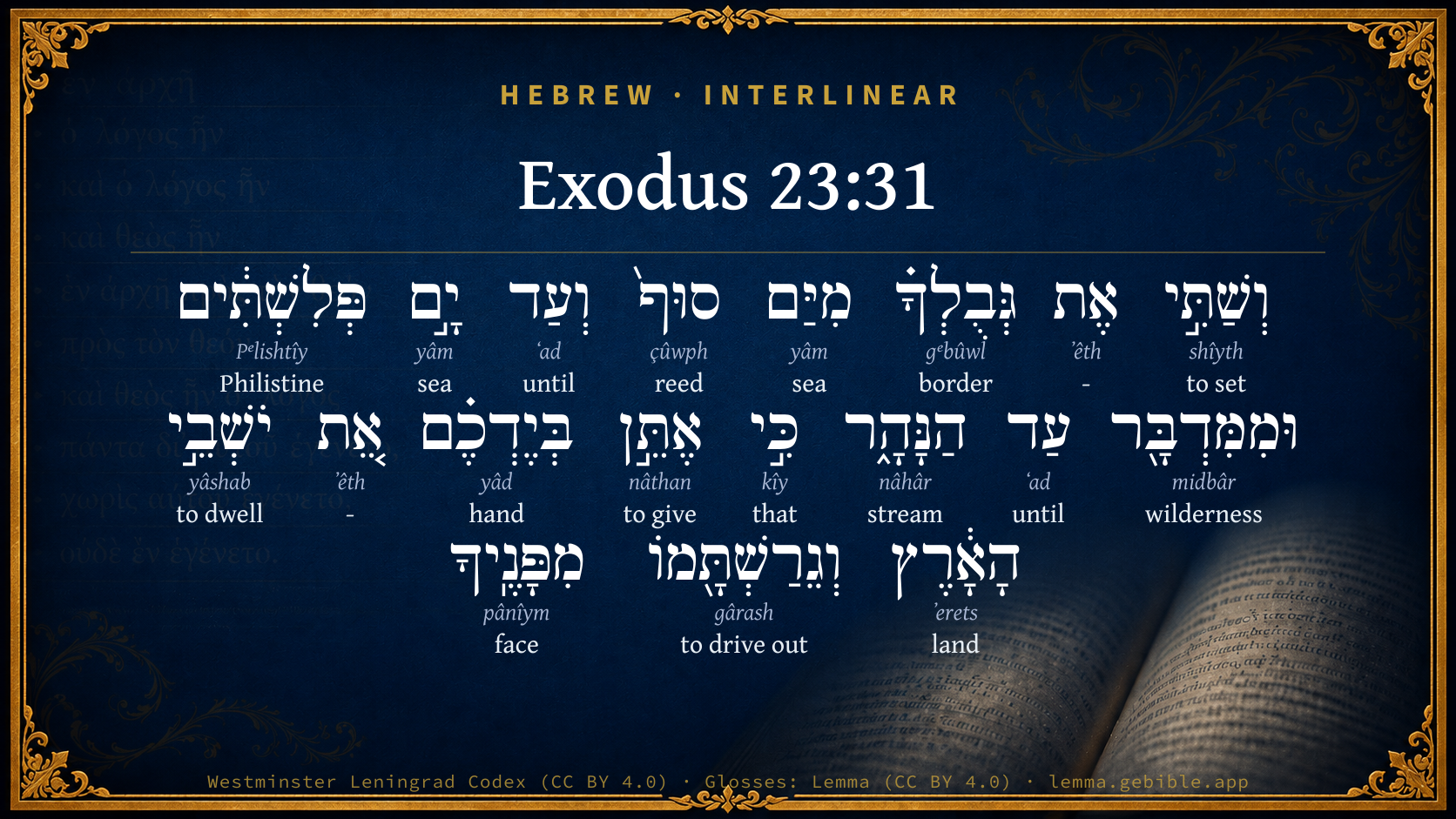
Exodus 23:31

Hebrew (Westminster Leningrad Codex) Exodus 23:31 appears in the Hebrew Old Testament. The text above is from the Westminster Leningrad Codex. Each word links to its Strong’s number, a concise gloss, and parsing drawn from the Open Scriptures Hebrew Bible morphology. Click any word for its full Brown-Driver-Briggs (BDB) entry.
Download image
Cite this verse

Exodus 23:31 (World English Bible). Public Domain. Lemma interlinear Bible study tool, https://lemma.gebible.app/v/exodus/23/31.

Show BibTeX & RIS
BibTeX
RIS
English Translation
I will set your border from the Red Sea even to the sea of the Philistines, and from the wilderness to the River; for I will deliver the inhabitants of the land into your hand, and you shall drive them out before you.
World English Bible · Public Domain
Download a study sheet

One document with this verse’s original text, its word-by-word gloss line, the meaning frame, cross-references with their text, attributed commentary, and full source and license credits — printable, and it pastes into notes with its structure intact.

This verse Autodidact and up

Study sheet (.html) Plain text (.txt)

A passage Seminary Student

Up to 50 verses in one chapter. A passage sheet keeps up to 6 commentary sources and 12 cross-references per verse, in the order this page ranks them, and says so on the sheet whenever that leaves anything out. Ask for a single verse and you get the Autodidact verse sheet above.

Everything on this page stays free to read, with no account — the sheet is a download of what is already on screen, not access to it.

Want to remove ads? Support Godless Engineer
Compare translations 3

The same verse in 3 English versions, stacked beneath the original-language interlinear above. Click any original word for its lexicon entry.

Each is an independent rendering of the whole verse — the interlinear is not word-aligned to these translations.

Highlighted words mark where these versions differ — a whole-verse word diff, not a word-by-word alignment.

  • World English Bible Public Domain
    I will set your border from the Red Sea even to the sea of the Philistines, and from the wilderness to the River; for I will deliver the inhabitants of the land into your hand, and you shall drive them out before you.
  • King James Version Public Domain
    And I will set thy bounds from the Red sea even unto the sea of the Philistines, and from the desert unto the river: for I will deliver the inhabitants of the land into your hand; and thou shalt drive them out before thee.
  • unfoldingWord Literal Text CC BY-SA 4.0
    And I will set your borders from the Sea of Reeds to the sea of the Philistines, and from the wilderness to the river. For I will give the inhabitants of the land into your hand. And you will drive them out from before your faces.

unfoldingWord Literal Text — © unfoldingWord, licensed CC BY-SA 4.0. Word-aligned USFM3 via Door43 (git.door43.org/unfoldingWord/en_ult).

Versions to compare (up to 4)

3 of 4 selected

Show all 18 translations

Every available English version of this verse, each an independent rendering of the whole verse.

  • World English Bible Public Domain
    I will set your border from the Red Sea even to the sea of the Philistines, and from the wilderness to the River; for I will deliver the inhabitants of the land into your hand, and you shall drive them out before you.
  • Berean Standard Bible Public Domain
    And I will establish your borders from the Red Sea to the Sea of the Philistines, and from the desert to the Euphrates. For I will deliver the inhabitants into your hand, and you will drive them out before you.
  • Majority Standard Bible Public Domain
    And I will establish your borders from the Red Sea to the Sea of the Philistines, and from the desert to the Euphrates. For I will deliver the inhabitants into your hand, and you will drive them out before you.
  • King James Version Public Domain
    And I will set thy bounds from the Red sea even unto the sea of the Philistines, and from the desert unto the river: for I will deliver the inhabitants of the land into your hand; and thou shalt drive them out before thee.
  • American Standard Version (1901) Public Domain
    And I will set thy border from the Red Sea even unto the sea of the Philistines, and from the wilderness unto the River: for I will deliver the inhabitants of the land into your hand: and thou shalt drive them out before thee.
  • Revised Version (1885) Public Domain
    And I will set thy border from the Red Sea even unto the sea of the Philistines, and from the wilderness unto the River: for I will deliver the inhabitants of the land into your hand; and thou shalt drive them out before thee.
  • Geneva Bible (1599) Public Domain
    And I will make thy coastes from the red sea vnto the sea of the Philistims, and from the desert vnto the Riuer: for I will deliuer the inhabitants of the lande into your hande, and thou shalt driue them out from thy face.
  • Douay-Rheims (1899) Public Domain
    And I will set thy bounds from the Red Sea to the sea of the Palestines, and from the desert to the river: I will deliver the inhabitants of the land into your hands, and will drive them out from before you.
  • Young's Literal Translation Public Domain
    `And I have set thy border from the Red Sea, even unto the sea of the Philistines, and from the wilderness unto the River: for I give into your hand the inhabitants of the land, and thou hast cast them out from before thee;
  • Literal Standard Version CC BY-SA 4.0
    And I have set your border from the Red Sea, even to the sea of the Philistines, and from the wilderness to the River; for I give the inhabitants of the land into your hand, and you have cast them out from before you.
  • Unlocked Literal Bible CC BY-SA 4.0
    I will fix your borders from the Sea of Reeds to the Sea of the Philistines, and from the wilderness to the Euphrates River. I will give you victory over the land's inhabitants. You will drive them out before yourselves.
  • unfoldingWord Literal Text CC BY-SA 4.0
    And I will set your borders from the Sea of Reeds to the sea of the Philistines, and from the wilderness to the river. For I will give the inhabitants of the land into your hand. And you will drive them out from before your faces.
  • Darby Bible Public Domain
    And I will set thy bounds from the Red Sea even unto the sea of the Philistines, and from the wilderness unto the river; for I will give the inhabitants of the land into your hand, that thou mayest dispossess them from before thee.
  • World Messianic Bible Public Domain
    I will set your border from the Sea of Suf even to the sea of the Philistines, and from the wilderness to the River; for I will deliver the inhabitants of the land into your hand, and you shall drive them out before you.
  • Webster's Bible Public Domain
    And I will set thy bounds from the Red sea even to the sea of the Philistines, and from the desert to the river: for I will deliver the inhabitants of the land into your hand; and thou shalt drive them out before thee.
  • Free Bible Version CC BY-SA 4.0
    I will fix your borders from the Red Sea to the Sea of the Philistines, and from the desert to the Euphrates River. I will hand the inhabitants of the land over to you, and you will drive them out.
  • Bible in Basic English Public Domain
    I will let the limits of your land be from the Red Sea to the sea of the Philistines, and from the waste land to the river Euphrates: for I will give the people of those lands into your power; and you will send them out before you.
  • JPS Tanakh (1917) Public Domain
    And I will set thy border from the Red Sea even unto the sea of the Philistines, and from the wilderness unto the River; for I will deliver the inhabitants of the land into your hand; and thou shalt drive them out before thee.

Literal Standard Version (2020), Covenant Press — licensed CC BY-SA 4.0. Text via the HelloAO Bible API (eBible.org). Unlocked Literal Bible (unfoldingWord) — licensed CC BY-SA 4.0. Text via the HelloAO Bible API (eBible.org). unfoldingWord Literal Text — © unfoldingWord, licensed CC BY-SA 4.0. Word-aligned USFM3 via Door43 (git.door43.org/unfoldingWord/en_ult). Free Bible Version, Dr. Jonathan Gallagher — licensed CC BY-SA 4.0. Text via the HelloAO Bible API (eBible.org).

Word by word

More ways to search: Search by grammar → Find every occurrence → Compare this word →

Practice this passage: Drill this verse → Learn its vocabulary →

סוּף֙
çûwph
H5488
“reed”
Noun, Common, Masculine, Singular, Absolute
Part of Speech
Noun
Type
Common
Gender
Masculine
Number
Singular
State
Absolute
Full BDB Definition

Origin: probably of Egyptian origin

TWOT: 1479

reed, rush, water plant - rushes - sea of rushes - of Red Sea - of arms of Red Sea - of Gulf of Suez - of sea from straits to Gulf of Akaba
  1. וְשַׁתִּ֣י shîyth H7896 “and · to set” Conjunction + Verb, Qal, Sequential Perfect, 1st Person, Common, Singular
  2. אֶת ʼêth H853 “-” Particle, Direct Object
  3. גְּבֻלְךָ֗ gᵉbûwl H1366 “border · your” Noun, Common, Masculine, Singular, Construct + Suffix, Personal, 2nd Person, Masculine, Singular
  4. מִיַּם yâm H3220 “from · sea of” Preposition + Noun, Common, Masculine, Singular, Construct
  5. וְעַד ʻad H5704 “and · until” Conjunction + Preposition
  6. יָ֣ם yâm H3220 “sea of” Noun, Common, Masculine, Singular, Construct
  7. פְּלִשְׁתִּ֔ים Pᵉlishtîy H6430 “Philistines” Noun, Gentilic, Masculine, Plural, Absolute
  8. וּמִמִּדְבָּ֖ר midbâr H4057 “and · from · wilderness” Conjunction + Preposition + Noun, Common, Masculine, Singular, Absolute
  9. עַד ʻad H5704 “until” Preposition
  10. הַנָּהָ֑ר nâhâr H5104 “the · stream” Particle, Definite Article + Noun, Common, Masculine, Singular, Absolute
  11. כִּ֣י kîy H3588 “that” Conjunction
  12. אֶתֵּ֣ן nâthan H5414 “to give” Verb, Qal, Imperfect, 1st Person, Common, Singular
  13. בְּיֶדְכֶ֗ם yâd H3027 “in/at · hand · your” Preposition + Noun, Common, Both, Singular, Construct + Suffix, Personal, 2nd Person, Masculine, Plural
  14. אֵ֚ת ʼêth H853 “-” Particle, Direct Object
  15. יֹשְׁבֵ֣י yâshab H3427 “dwelling” Verb, Qal, Participle Active, Masculine, Plural, Construct
  16. הָאָ֔רֶץ ʼerets H776 “the · land” Particle, Definite Article + Noun, Common, Both, Singular, Absolute
  17. וְגֵרַשְׁתָּ֖מוֹ gârash H1644 “and · to drive out · them” Conjunction + Verb, Piel, Sequential Perfect, 2nd Person, Masculine, Singular + Suffix, Personal, 3rd Person, Masculine, Plural
  18. מִפָּנֶֽיךָ pânîym H6440 “from · face(s) · your” Preposition + Noun, Common, Both, Plural, Construct + Suffix, Personal, 2nd Person, Masculine, Singular

About this verse

These counts appear in no published source. They are computed here, from the morphology-tagged text and Lemma’s own curated glosses. What Lemma adds →

19
words
16
distinct lemmas
Pentateuch
section

Shared distinctive vocabulary

סוּף֙ reed H5488 occurs in 28 verses of the Hebrew Bible. Also found in:

Grammatical profile

  • 4 verbs
  • 10 nouns
  • 2 prepositions
  • 1 conjunction
  • 2 particles

Verb forms

  • וְשַׁתִּ֣י Qal · Sequential Perfect
  • אֶתֵּ֣ן Qal · Imperfect
  • יֹשְׁבֵ֣י Qal · Participle Active
  • וְגֵרַשְׁתָּ֖מוֹ Piel · Sequential Perfect

Repetition

Words recur within this verse — often emphatic in Hebrew:

  • מִיַּם sea H3220 ×2
  • וְעַד until H5704 ×2

Hebrew & Septuagint length

In English translation the verse runs 43 words from the Hebrew and 45 from the Septuagint (LXX English) — closely comparable.

A rough comparison of the two English renderings, which tokenize alike — not a word-level alignment.

Word counts can differ between the Hebrew and the Greek without any difference in meaning — e.g. the Hebrew direct-object marker אֵת has no separate Greek word, and Greek often adds the article ὁ.

Cross-references

22

Topical passages linked to Exodus 23:31 in the Treasury of Scripture Knowledge — connected by theme and wording, ordered by reader-vote popularity; previews shown in the World English Bible.

  • Genesis 15:18 In that day Yahweh made a covenant with Abram, saying, "To your seed have I given this land, from the river of Egypt to the great river, the river Euphrates:
  • Deuteronomy 11:24 Every place whereon the sole of your foot shall tread shall be yours: from the wilderness, and Lebanon, from the river, the river Euphrates, even to the hinder sea shall be your border.
  • Joshua 21:44 Yahweh gave them rest round about, according to all that he swore to their fathers: and there stood not a man of all their enemies before them; Yahweh delivered all their enemies into their hand.
  • Numbers 34:3–15 then your south quarter shall be from the wilderness of Zin along by the side of Edom, and your south border shall be from the end of the Salt Sea eastward;
  • Joshua 1:4 From the wilderness, and this Lebanon, even to the great river, the river Euphrates, all the land of the Hittites, and to the great sea toward the going down of the sun, shall be your border.
  • Joshua 24:18 and Yahweh drove out from before us all the peoples, even the Amorites who lived in the land: therefore we also will serve Yahweh; for he is our God.
  • 1 Kings 4:24 For he had dominion over all [the region] on this side the River, from Tiphsah even to Gaza, over all the kings on this side the River: and he had peace on all sides round about him.
  • Judges 1:4 Judah went up; and Yahweh delivered the Canaanites and the Perizzites into their hand: and they struck of them in Bezek ten thousand men.
  • Judges 11:21 Yahweh, the God of Israel, delivered Sihon and all his people into the hand of Israel, and they struck them: so Israel possessed all the land of the Amorites, the inhabitants of that country.
  • 1 Kings 4:21 Solomon ruled over all the kingdoms from the River to the land of the Philistines, and to the border of Egypt: they brought tribute, and served Solomon all the days of his life.
  • Psalms 72:8 He shall have dominion also from sea to sea, From the River to the ends of the earth.
  • Numbers 21:34 Yahweh said to Moses, Don't fear him: for I have delivered him into your hand, and all his people, and his land; and you shall do to him as you did to Sihon king of the Amorites, who lived at Heshbon.
  • Deuteronomy 3:2 Yahweh said to me, Don't fear him; for I have delivered him, and all his people, and his land, into your hand; and you shall do to him as you did to Sihon king of the Amorites, who lived at Heshbon.
  • Joshua 8:7 and you shall rise up from the ambush, and take possession of the city: for Yahweh your God will deliver it into your hand.
  • Joshua 8:18 Yahweh said to Joshua, Stretch out the javelin that is in your hand toward Ai; for I will give it into your hand. Joshua stretched out the javelin that was in his hand toward the city.
  • Joshua 10:8 Yahweh said to Joshua, Don't fear them: for I have delivered them into your hands; there shall not a man of them stand before you.
  • Joshua 10:19 but don't stay; pursue after your enemies, and strike the hindmost of them; don't allow them to enter into their cities: for Yahweh your God has delivered them into your hand.
  • Joshua 23:14 Behold, this day I am going the way of all the earth: and you know in all your hearts and in all your souls, that not one thing has failed of all the good things which Yahweh your God spoke concerning you; all are happen to you, not one thing has failed of it.
  • Joshua 24:8 I brought you into the land of the Amorites, that lived beyond the Jordan: and they fought with you; and I gave them into your hand, and you possessed their land; and I destroyed them from before you.
  • Joshua 24:12 I sent the hornet before you, which drove them out from before you, even the two kings of the Amorites; not with your sword, nor with your bow.
  • 1 Samuel 23:4 Then David inquired of Yahweh yet again. Yahweh answered him, and said, Arise, go down to Keilah; for I will deliver the Philistines into your hand.
  • 1 Kings 20:13 Behold, a prophet came near to Ahab king of Israel, and said, Thus says Yahweh, Have you seen all this great multitude? behold, I will deliver it into your hand this day; and you shall know that I am Yahweh.

Cross-references courtesy of OpenBible.info (CC BY 4.0).

Hebrew and Greek witnesses Masoretic Hebrew ↔ Greek Septuagint

The same verse in the two great witnesses to the Old Testament, shown verse-for-verse.

These are two independent witnesses, not word-aligned to each other, and the Septuagint is shown in lemma (dictionary) form.

Hebrew Exodus 23:31 Masoretic · Westminster Leningrad Codex

וְשַׁתִּ֣י אֶת גְּבֻלְךָ֗ מִיַּם סוּף֙ וְעַד יָ֣ם פְּלִשְׁתִּ֔ים וּמִמִּדְבָּ֖ר עַד הַנָּהָ֑ר כִּ֣י אֶתֵּ֣ן בְּיֶדְכֶ֗ם אֵ֚ת יֹשְׁבֵ֣י הָאָ֔רֶץ וְגֵרַשְׁתָּ֖מוֹ מִפָּנֶֽיךָ

I will set your border from the Red Sea even to the sea of the Philistines, and from the wilderness to the River; for I will deliver the inhabitants of the land into your hand, and you shall drive them out before you.

World English Bible · Public Domain

Greek LXX Exodus 23:31 Septuagint · lemma form

καί τίθημι ὁ ὅριον σύ ἀπό ὁ ἐρυθρός θάλασσα ἕως ὁ θάλασσα ὁ φυλιστιιμ καί ἀπό ὁ ἔρημος ἕως ὁ μέγας ποταμός εὐφράτης καί παραδίδωμι εἰς ὁ χείρ σύ ὁ ἐν καταἧμαι ἐν ὁ γῆ καί ἐκβάλλω αὐτός ἀπό σύ

And I will set your borders from the Red Sea, to the sea of the Phylistines, and from the wilderness to the great river Euphrates; and I will give into your hand those that dwell in the land, and will cast them out from you.

LXX2012 (modern English Septuagint) · Public Domain

Hebrew: Westminster Leningrad Codex (CC BY 4.0). Greek: Septuagint (public domain); English from LXX2012 (modern English Septuagint) (Public Domain). How the Septuagint differs from the Hebrew →

Targum (Aramaic paraphrase)

2

The Targum is the ancient Jewish Aramaic paraphrase of the Hebrew Scriptures — an interpretive translation, not the Hebrew text itself. Onkelos (literal) and Pseudo-Jonathan (expansive) render the Torah, and Jonathan the Prophets. Coverage is partial: where no permissively-licensed English translation exists for a verse, only the Aramaic is shown. This is verse-level text, not a word-by-word alignment to the Hebrew.

  1. Targum Onkelos Torah (Genesis–Deuteronomy)
    וֶאֱשַׁוֵי יָת תְּחוּמָךְ מִיַמָא דְסוּף וְעַד יַמָא דִפְלִשְׁתָּאֵי וּמִמַדְבְּרָא עַד פְּרָת אֲרֵי אֶמְסַר בִּידֵיכוֹן יָת יָתְבֵי אַרְעָא וּתְתָרֵכִנוּן מִן קֳדָמָךְ:

    (no public-domain English translation for this verse)

    Targum Onkelos — Aramaic: “Onkelos Genesis” (public domain); “Onkelos Exodus” (public domain); “Onkelos Leviticus” (public domain); “Onkelos Numbers” (public domain); “Onkelos Deuteronomy” (public domain). English: “Sefaria Community Translation” (CC0 1.0 (public-domain dedication)); “J.W. Etheridge. The Targums of Onkelos and Jonathan Ben Uzziel on the Pentateuch. London: Longmans, Green, 1862” (public domain). Text via Sefaria.

  2. Targum Pseudo-Jonathan Torah (Genesis–Deuteronomy)
    וַאֲשַׁוֵי יַת תְּחוּמָךְ מִן יַמָא דְסוּף עַד יַמָא דִפְלִשְׁתָּאֵי וּמִן מַדְבְּרָא וְעַד פְּרָת אֲרוּם אֶמְסוֹר בְּיֶדְכוֹן יַת כָּל יַתְבֵי אַרְעָא וְאַנְתְּ תְּתָרֵיכִינוּן מִן קֳדָמָךְ

    And I will set thy boundary from the sea of Suph, to the sea of the Philistaee, and from the desert unto the Pherat; for I will deliver into your hand all the inhabitants of the land, and thou shalt drive them out from before thee.

    Targum Pseudo-Jonathan — Aramaic: “Targum Jonathan on Genesis” (public domain); “Targum Jonathan on Exodus” (public domain); “Targum Jonathan on Leviticus” (public domain); “Targum Jonathan on Numbers” (public domain); “Targum Jonathan on Deuteronomy” (public domain). English: “The Targum of Jonathan ben Uzziel, trans. J. W. Etheridge, London, 1862” (public domain). Text via Sefaria.

Commentary

Notes on Exodus 23:31 from classic Christian and Jewish commentators (each source and its license shown beneath its notes). The classic Christian expositions comment on the surrounding passage and are grouped to its opening verse, so a note may address several verses; the Jewish commentaries on the Tanakh (Rashi and others) are per-verse, so they appear only where the commentator wrote on this verse.

Lemma curates 59 commentaries, every one of them public domain or Creative Commons licensed, each selected and text-cleaned for this edition rather than reprinted as found. About our sources →

Trapp's Complete Commentary

John Trapp

Exo 23:31 And I will set thy bounds from the Red sea even unto the sea of the Philistines, and from the desert unto the river: for I will deliver the inhabitants of the land into your hand; and thou shalt drive them out before thee.

Ver. 31. The sea of the Philistines,] i.e., The Mediterranean.

John Trapp, A Commentary or Exposition upon All the Books of the Old and New Testament (1647–1656) — public domain. Text from a community e-Sword module.

The Biblical Illustrator

Joseph S. Exell

Exo_23:31-33

They shall not dwell in thy land.

Lessons

1. God is the sovereign boundmaker to all nations on the earth.

2. Among all God hath promised to set the bounds of His Church on earth.

3. Gods suppression of His adversaries is a token of His settling His Churchs habitation (Exo_23:31).

4. No covenant with idolatrous adversaries must be made by the Church against Gods will.

5. No covenant can be made with idolaters, but it will be with their idols, viz., devils (Exo_23:32).

6. Converse with idolaters is very dangerous to make men such sinners against God.

7. Such sinning with idolaters is a snare, which will keep souls to destruction.

8. All such sins must be avoided, that Gods promise of good may be obtained (Exo_23:33). (G. Hughes, B. D.)

Associating with the ungodly

Those who willingly associate with the sinful are like the river Thames, which is a sweet and pretty river enough near its source; but in the great metropolis it has kept company with drains and sewers under the belief that its current was too powerful and too pure to be injured by them. It was meant that the river should purify the sewer; but, instead of that, the sewer has corrupted the river. (Union Magazine.)

The snare of worldliness

Serious people often complain of the snares they meet with from worldly people, and yet they must mix with them to get a livelihood. I advise them, if they can, to do their business with the world as they do it in the rain. If their business calls them abroad, they will not leave it undone for fear of being a little wet; but then, when it is done, they presently seek shelter, and will not stand in the rain for pleasure. So, providential and necessary calls of duty, that lead us into the world, will not hurt us, if we find the spirit of the world unpleasant, and are glad to retire from it, and keep out of it, as much as our relative duties will permit. That which is our cross is not so likely to be our snare; but if that spirit which we should always watch and pray against, infects and assimilates our minds to itself, then we are sure to suffer loss, and act below the dignity of our profession. (Newtons Letters to a Nobleman.)

.

The Biblical Illustrator, edited by Joseph S. Exell (c. 1880s–1900s) — public domain. Text from a community e-Sword module.

Tyndale Open Study Notes

Tyndale Open Resources

23:31 from the eastern wilderness to the Euphrates River: See Gen 15:18; Num 34:2-12; Deut 11:24; 2 Chr 9:26. • I will hand over to you the people: God had promised the land to Abraham (Gen 15:16). At that time, “the sins of the Amorites” had not yet run their course. Now they had. God was not arbitrarily dispossessing the Amorites (i.e., the Canaanites) but was using his people, the Israelites, to judge their wickedness.

Tyndale Open Study Notes — © Tyndale Open Resources, licensed CC BY-SA 4.0. Text via the HelloAO Bible API.

Geneva Bible (1599)

Geneva Bible translators

To wit, Ephraim.

Called the Sea of Syria.

Of Arabia called desert.

Geneva Bible (1599) marginal notes — public domain. Text via Bolls.life.

Adam Clarke's Commentary

Verse 31. I will set thy bounds from the Red Sea] On the south-east, even unto the sea of the Philistines - the Mediterranean, on the north-west; and from the desert - of Arabia, or the wilderness of Shur, on the west, to the river - the Euphrates, on the north-east. Or in general terms, from the Euphrates on the east, to the Mediterranean Sea on the west; and from Mount Libanus on the north, to the Red Sea and the Nile on the south. This promise was not completely fulfilled till the days of David and Solomon. The general disobedience of the people before this time prevented a more speedy accomplishment; and their disobedience afterwards caused them to lose the possession. So, though all the promises of God are YEA and AMEN, yet they are fulfilled but to a few, because men are slow of heart to believe; and the blessings of providence and grace are taken away from several because of their unfaithfulness.

Adam Clarke's Commentary on the Bible (1810–1826) — public domain. Text from a community e-Sword/MySword module.

Ellicott's Commentary for English Readers

(31) Thy bounds.—Those whose highest notion of prophecy identifies it with advanced human foresight naturally object to Moses having foretold the vast extent of empire which did not take place till the days of David and Solomon. It is impossible, however, to understand this passage in any other way than as an assignment to Israel of the entire tract between the Desert, or “Wilderness of the Wanderings,” and the Euphrates on the one hand, the Mediterranean and the Red Sea on the other. “The River” (han-nahar) has no other meaning in the Pentateuch than “the Euphrates.” And this was exactly the extent to which the dominions of Israel reached under Solomon, as we see from the description in Kings and Chronicles (1Ki_4:21; 1Ki_4:24; 2Ch_9:26). It had, according to Moses (Gen_15:18), been already indicated with tolerable precision in the original promise made to Abraham.

A Bible Commentary for English Readers, edited by Charles John Ellicott (1878–1897) — public domain. Text from a community e-Sword module.

John Gill's Exposition

They shall not dwell in thy land,.... The land of Canaan, given by God for an inheritance, and now would be in the possession of the Israelites; and therefore were not to suffer the old inhabitants to dwell with them in it, at least no longer than they could help it; they were to do all they could to root them out:

lest they make thee sin against me; by their ill examples and persuasions, drawing them into idolatry, than which there is no greater sin against God, it being not only contrary to his law, his mind, and will, but directly against his nature, being, perfections, and glory:

for if thou serve their gods, or "for thou wilt serve" (t); this would be the consequence of their dwelling in the land, they would draw the Israelites into the worship of their idols, to which they were naturally prone; and should they commit idolatry:

it will surely be a snare unto thee: idolatry would be the cause of their ruin and destruction, they would be snared by it, as fishes in a net, or birds and beasts by traps and gins; or "for it will be a snare" (u), that is, the Canaanites dwelling among them would be a snare to draw them into their idolatry, and go into ruin.

(t) "quia servies", Malvenda. (u) "quia erit", Pagninus, Montanus, Drusius.

Next: Exodus Chapter 24

John Gill's Exposition of the Whole Bible (1746–1763) — public domain (CC PDM 1.0). Text via the HelloAO Bible API.

Albert Barnes' Notes on the Bible

In Exo 23:23, the limits of the Land of Canaan, strictly so called, are indicated; to this, when the Israelites were about to take possession of it, were added the regions of Gilead and Bashan on the left side of the Jordan Num 32:33-42; Jos 13:29-32. These two portions made up the holy land, of which the limits were recognized, with inconsiderable variations, until the final overthrow of the Jewish polity. But in this verse the utmost extent of Hebrew dominion, as it existed in the time of David and Solomon, is set forth. The kingdom then reached to Eloth and Ezion-geber on the AElanitic Gulf of the Red Sea 1Ki 9:26, and to Tiphsah on the “River,” that is, the River Euphrates 1Ki 4:24, having for its western boundary “the Sea of the Philistines,” that is, the Mediterranean, and for its southern boundary “the desert,” that is, the wildernesses of Shur and Paran (compare Gen 15:18; Deu 1:7; Deu 11:24; Jos 1:4).

Albert Barnes' Notes on the Bible (1834–1885) — public domain. Text from a community e-Sword/MySword module.

Haydock's Catholic Bible Commentary

CHAPTER XXIII.

George Leo Haydock (1774–1849), Haydock's Catholic Family Bible and Commentary, 1859 edition — public domain. Excludes Psalms (Douay-Rheims chapter numbering differs from Protestant) and Deuterocanonical books (Catholic canon only).

Matthew Poole's English Annotations

Compare this place with Gen 15:18; Num 34:3. The sea of the Philistines, i.e. the Mediterranean or midland sea, upon whose coast the land of the Philistines lay. The desert, of Egypt or Arabia; whereof see Gen 16:7; Exo 15:22. The river, to wit, Euphrates, as it is expressed Deu 1:7; 11:24, which is oft called the river by way of eminency. All within these bounds were given them by God, but upon conditions, which they manifestly broke, and therefore were for the most part confined to a much narrower compass.

Matthew Poole's English Annotations on the Holy Bible (1683–1685) — public domain. Text from a community e-Sword/MySword module.

Whedon's Commentary on the Bible

Daniel D. Whedon

31. Thy bounds — These boundaries indicate the entire extent of territory which any people supposed to be in complete possession of Canaan would naturally control. The Red sea they had left behind them; the sea of the Philistines, that is, the Mediterranean, which bordered on the Philistine territory, formed the western boundary, the Arabian desert lay on the south and south-east, and the river Euphrates formed the eastern limit. This extent of territory actually came under the dominion of Solomon. 1Ki_4:20-25; comp. Jos_1:4.

Thou shalt drive them out — Israel’s conquest of Canaan was a mission of judgment as well as a fulfilment of promise and prophecy. They were sent into the land to destroy peoples ripe for judgment, rather than to convert those looking and waiting for redemption. See Gen_15:16, note.

Daniel D. Whedon (gen. ed.), Commentary on the Old and New Testaments (1874–1909) — public domain. Text from a community e-Sword module.

The Pulpit Commentary

And I will set thy bounds from the Red Sea even unto the sea of the Philistines. This passage by itself would be sufficient to confute Dr. Brugsch"s notion, that the Yam Suph (or "Red Sea" of our translators) is the Lake Serbonis, which is a part of the Mediterranean or "Sea of the Philistines," and cannot stand in contrast with it. The "Sea of the Philistines" and the "Red Sea" mark the boundaries of the Holy Land East and West, as the "Desert" and the "River" (Euphrates) do its boundaries North and South. That Moses here lays down those wide limits which were only reached 400 years later, in the time of David and Solomon, and were then speedily lost, can surprise no one who believes in the prophetic gift, and regards Moses as one of the greatest of the Prophets. The tract marked out by these limits had been already promised to Abraham. (Gen_15:18) Its possession by Solomon is distinctly recorded in 1Ki_4:21, 1Ki_4:24; 2Ch_9:26. As Solomon was "a man of peace," we must ascribe the acquisition of this wide empire to David. (Compare 2Sa_8:3-14 2Sa_10:6-19) The river (han-nahar) is in the Pentateuch always the Euphrates. The Nile is ha-y" or. A powerful kingdom established in Syria is almost sure to extend its influence to the Euphrates. I will deliver the inhabitants of the land into your hand. Compare Jos_21:44, for the first fulfilment of this prophecy. Its complete fulfilment was reserved for the time of David. Thou shalt drive them out. The mass of the Canaanites were no doubt "driven out" rather than exterminated. They retired northwards, and gave strength to the great Hittite kingdom which was for many centuries a formidable antagomst of the Egyptian and Assyrian empties.

The Pulpit Commentary (1880–1919), ed. H.D.M. Spence-Jones & Joseph S. Exell — public domain. Text from a community e-Sword module.

Rashi

Rabbi Shlomo Yitzchaki (Rashi)

ושתי is of the root שית or שות. The ת is dageshed, because it comes in place of two ת’s (ושת-תי) — one is necessary because no grammatical form of שות can be without the ת of the root, and the other is a servile letter (part of the suffix).

עד הנהר UNTO THE RIVER — the Euphrates.

וגרשתמו means AND THOU SHALT DRIVE THEM OUT.

Rashi on the Tanakh — English translations: “The Judaica Press complete Tanach with Rashi, translated by A. J. Rosenberg” (CC BY 4.0); “Pentateuch with Rashi's commentary by M. Rosenbaum and A.M. Silbermann, 1929-1934” (public domain); “The Metsudah Tanach series, Lakewood, N.J” (CC BY 4.0); and “The Book of Joshua, Metsudah Publications, 1997” (CC BY 4.0). Text via Sefaria.

Lesson kit

Teaching starters — assembled from the data on this page, not authored interpretation. Every prompt links to the verse data it draws on. Edit before teaching.

Exodus, in the Pentateuch, opens this verse with 19 words (16 distinct Hebrew lemmas). Its most distinctive word is çûwph (“reed”). A historical commentator’s framing appears above. Read the whole chapter for the surrounding context.

Discussion questions

  1. How does “reed” (çûwph) shape what this verse is saying?
  2. How does Exodus 2:3, which shares the word «reed», read alongside this verse?
  3. What does the repetition of “sea” (2× in this one verse) do in this verse?
  4. These translations render this verse differently. What is at stake in choosing one wording over another?
  5. «וְשַׁתִּ֣י» is a Qal Sequential Perfect verb. How does that grammatical form shape the action described?
  6. Compare how Trapp's Complete Commentary and The Biblical Illustrator read this verse. Where do they agree or differ?

Things to notice

Reading settings

Reading text

Shown beneath each verse's original-language words.

Old Testament
Old Testament edition

Read the OT as the Masoretic Hebrew (MT) or the Greek Septuagint (LXX).

English shown for the Greek Septuagint (in the Hebrew ↔ Greek comparison).

Comparing translations? Open the Compare panel on any verse page to stack up to four side by side.